
December road trip essentials
With $2 tinsel, wool I watched get shorn, and emergency toilet roll, naturally.
December road trip essentials
With $2 tinsel, wool I watched get shorn, and emergency toilet roll, naturally.
On the backpacker trail, you meet a lot of the same sorts of people—partiers, hikers, shoppers, thrill seekers—and they’re all in the same age range of 18-30. People who don’t fit into those categories tend to stick out prominently, and the woman I met in Rainbow Beach certainly did that. She was in her mid-40s, and she kept pressing her natural anti-panic remedies on my while I was having my medical freakout, and afterward she made conversation by telling anyone who happened to be in the dorm room about her collection of crystals and the many spiritual advisors she’s consulted over the years. Also, a psychic told her that she had psychic powers she hadn’t tapped into yet. She was wacky, and although she talked too much to be charming, she was sweet. One of her favorite topics was all the groovy stuff you can find in a town called Nimbin.
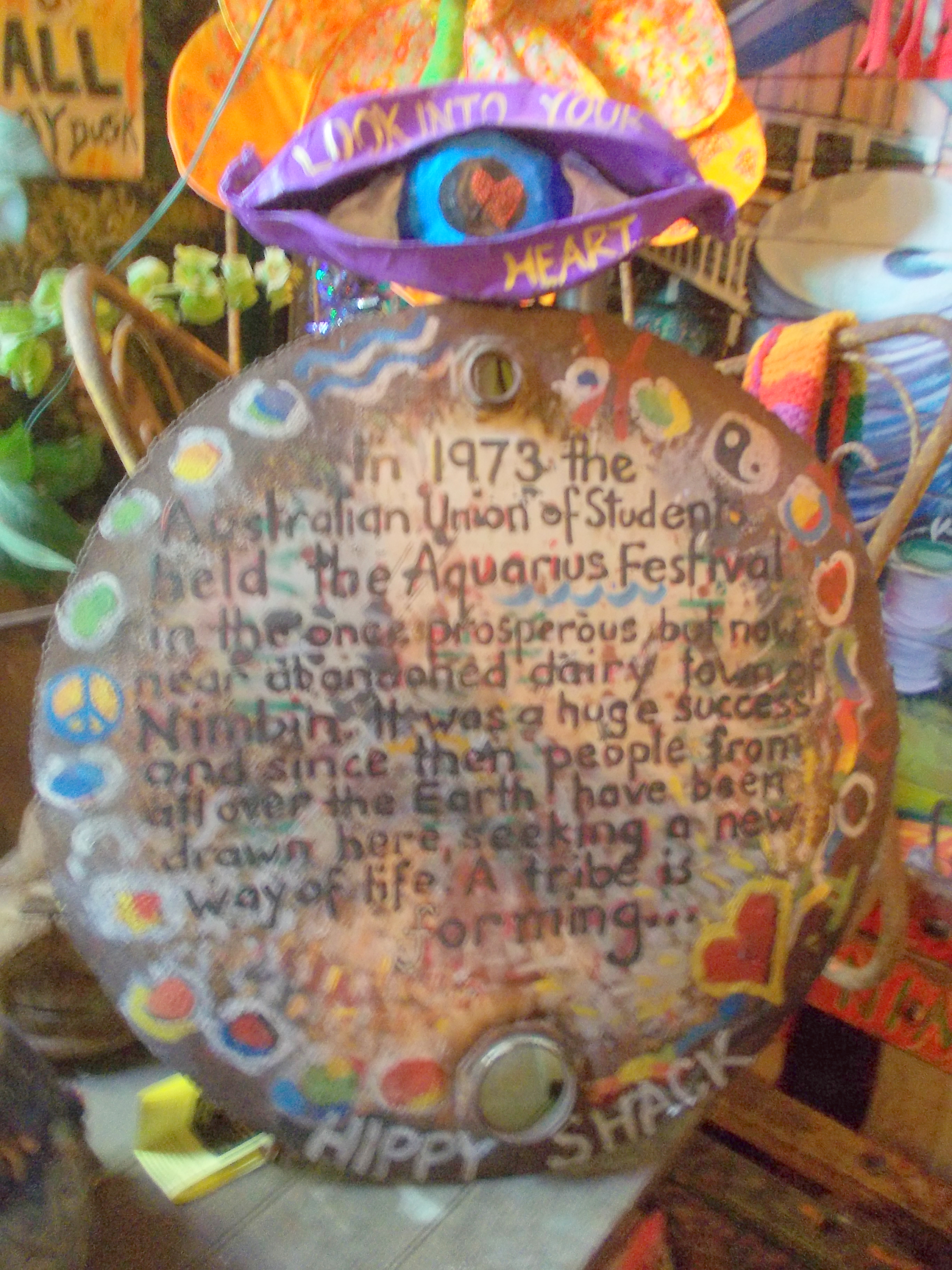
Welcome to Nimbin
Nimbin is a small town about 60 kilometers inland from Byron Bay. In 1973, antiwar activists gathered there for an “Aquarius Festival,” and some of them never left. It’s now a day trip from Byron, and busloads of young tourists come out to buy cheap pot brownies and gawk at the hippies. A day trip was included in the big bus package I’d booked, so near the end of my time in Byron I hopped on. Our first stop was a holiday park with a large swimming hole, and the driver grilled up a basic barbeque as we lazed in the sun.
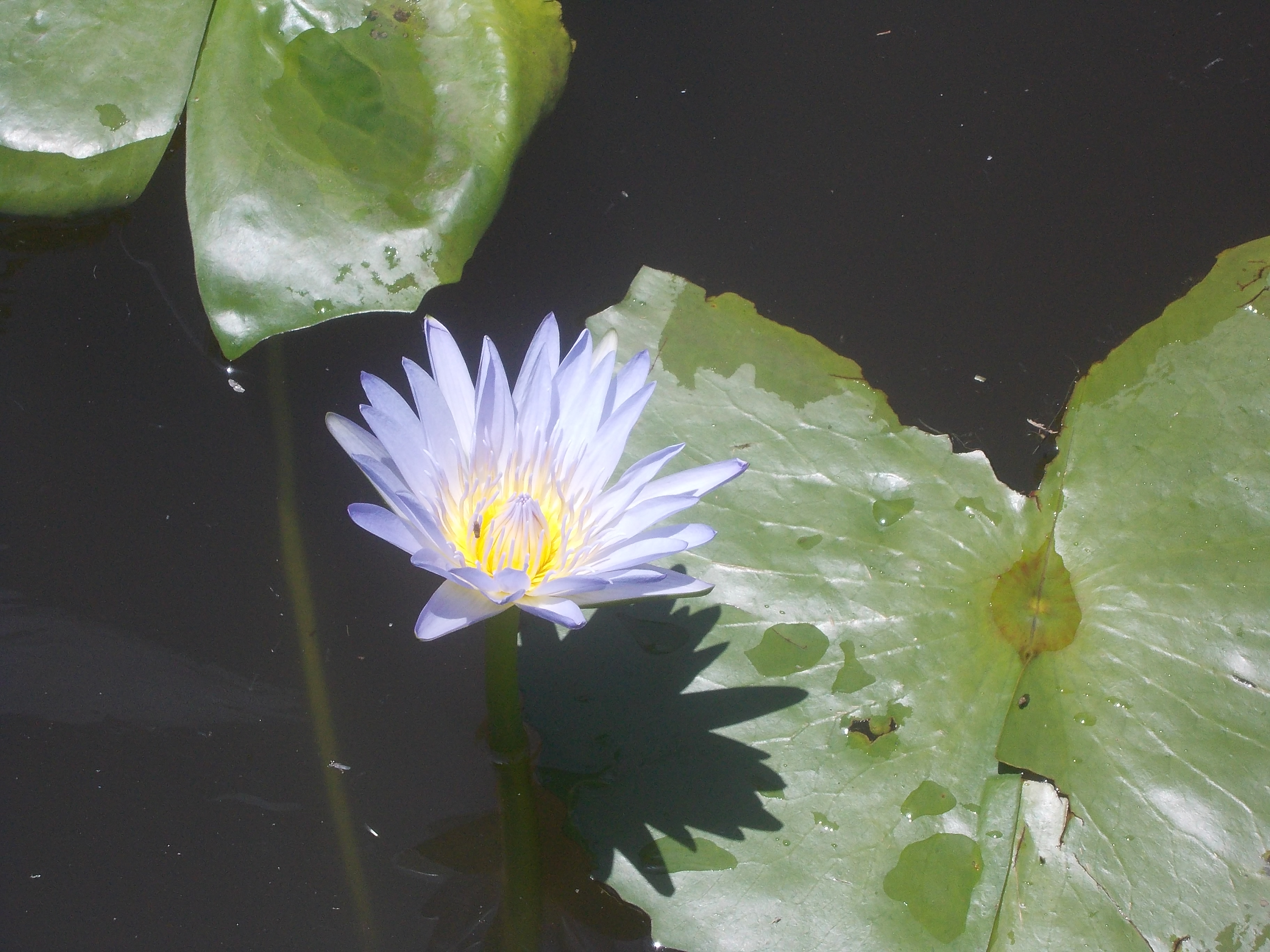
Pond of purple flowers
Then on to Nimbin, and to get us in the mood, the bus driver played “Burn One Down,” “Because I Got High,” and other theme songs. Before we entered the town, the driver gave a little speech that amounted to: marijuana is illegal in New South Wales, so if you get caught don’t come crying to us; and also, you don’t know how much of what is in the baked goods, so if you buy a cookie, eat half of it and wait for thirty minutes before taking the other half.
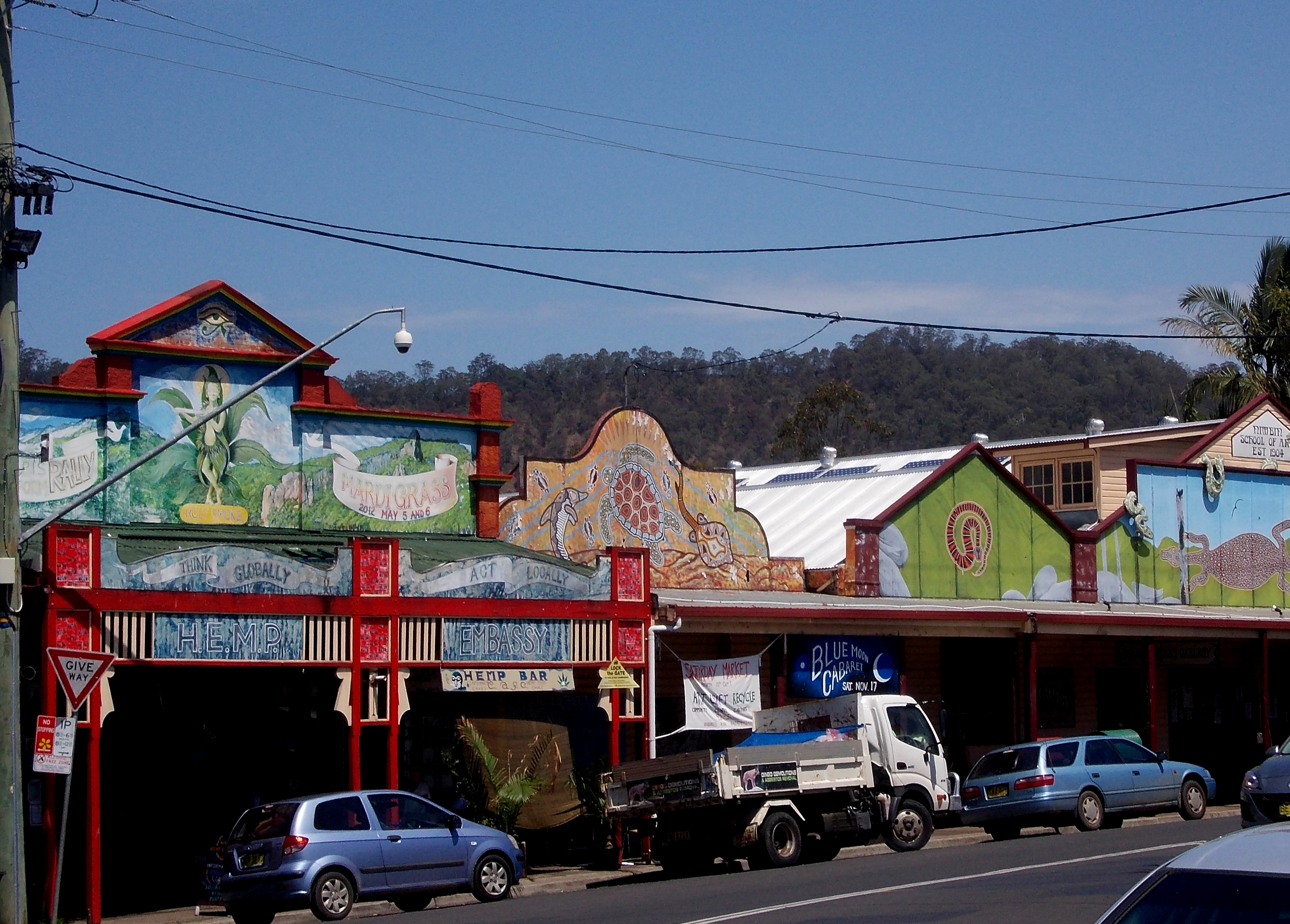
Nimbin’s main street
I spent most of my time in the fascinating Nimbin Museum. It’s been around for decades, and it’s easy to see the years piled up in the layers of papier mached newspapers, painted murals, scribbled quotes, and various paraphernalia that adorn every square inch of space in this small place. It’s a mishmash of indignation over how white people treat aboriginal people, disdain for organized religion, and more inspirational quotes than you can find in the halls of a middle school. It was a combination of important insight and ridiculous hyperbole, as a lot of hippie talk is.
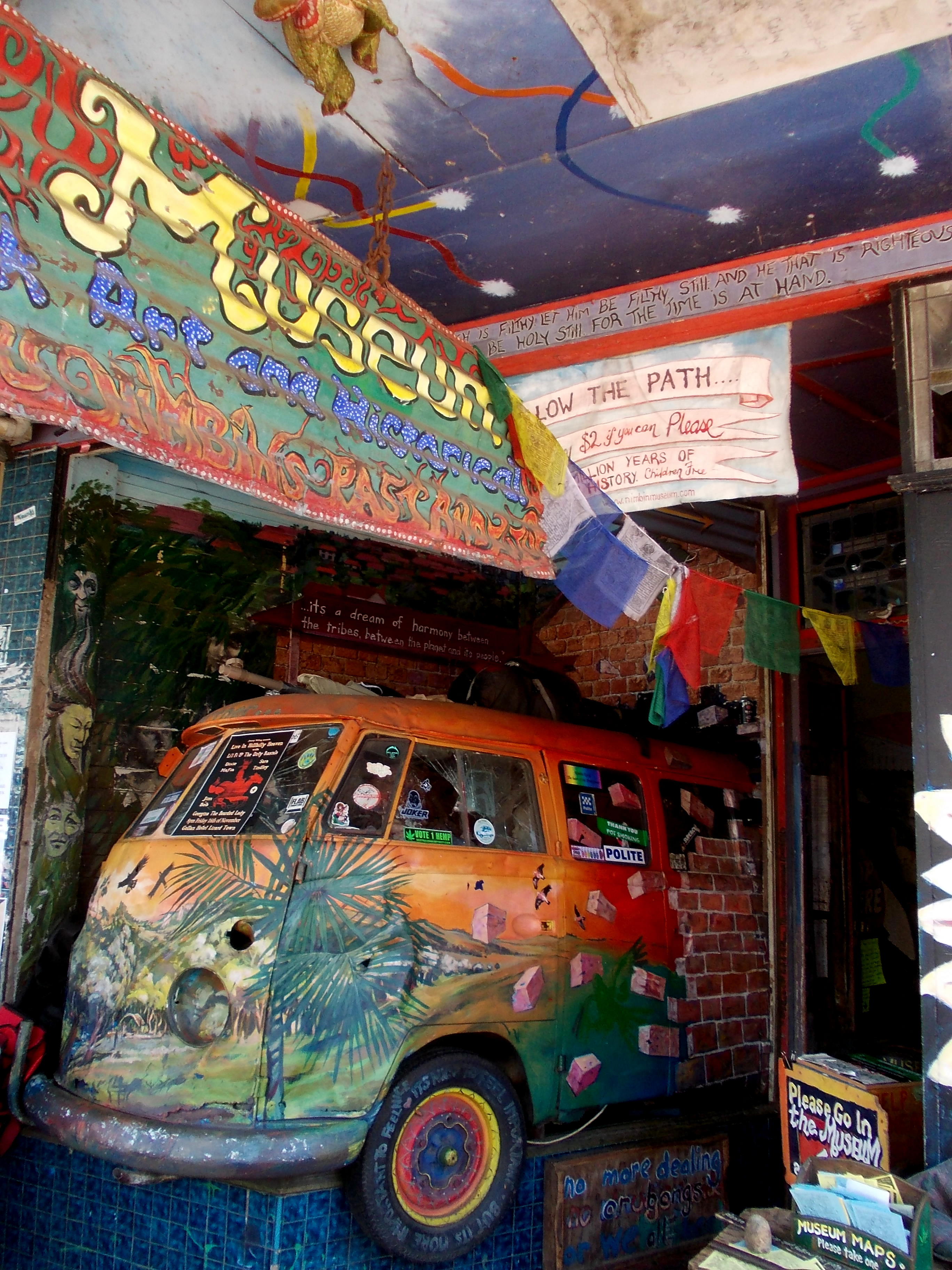
Nimbin Museum
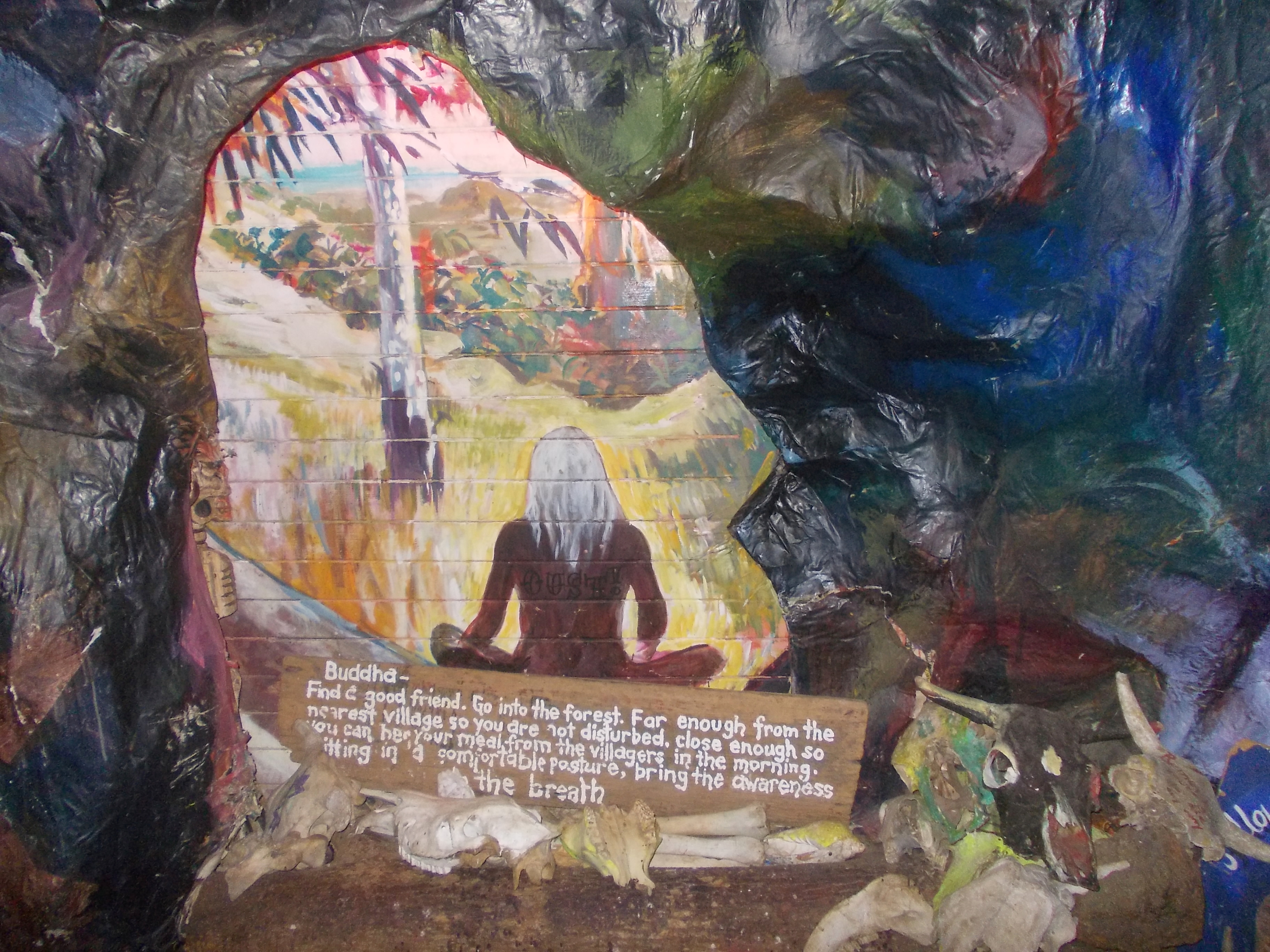 The little guide they give out at the beginning of the museum reads in part: “Nothing has made the alternative lifestyle effort of the new age pioneers more difficult than the outlawing of this herb which not long ago was the most popular plant on the planet. It nearly is again now and we believe the ‘war on drugs’ is breeding disrespect, as bad laws do.” I just cannot believe any one substance is that important to an entire movement, no matter how harmless and pleasant it is.
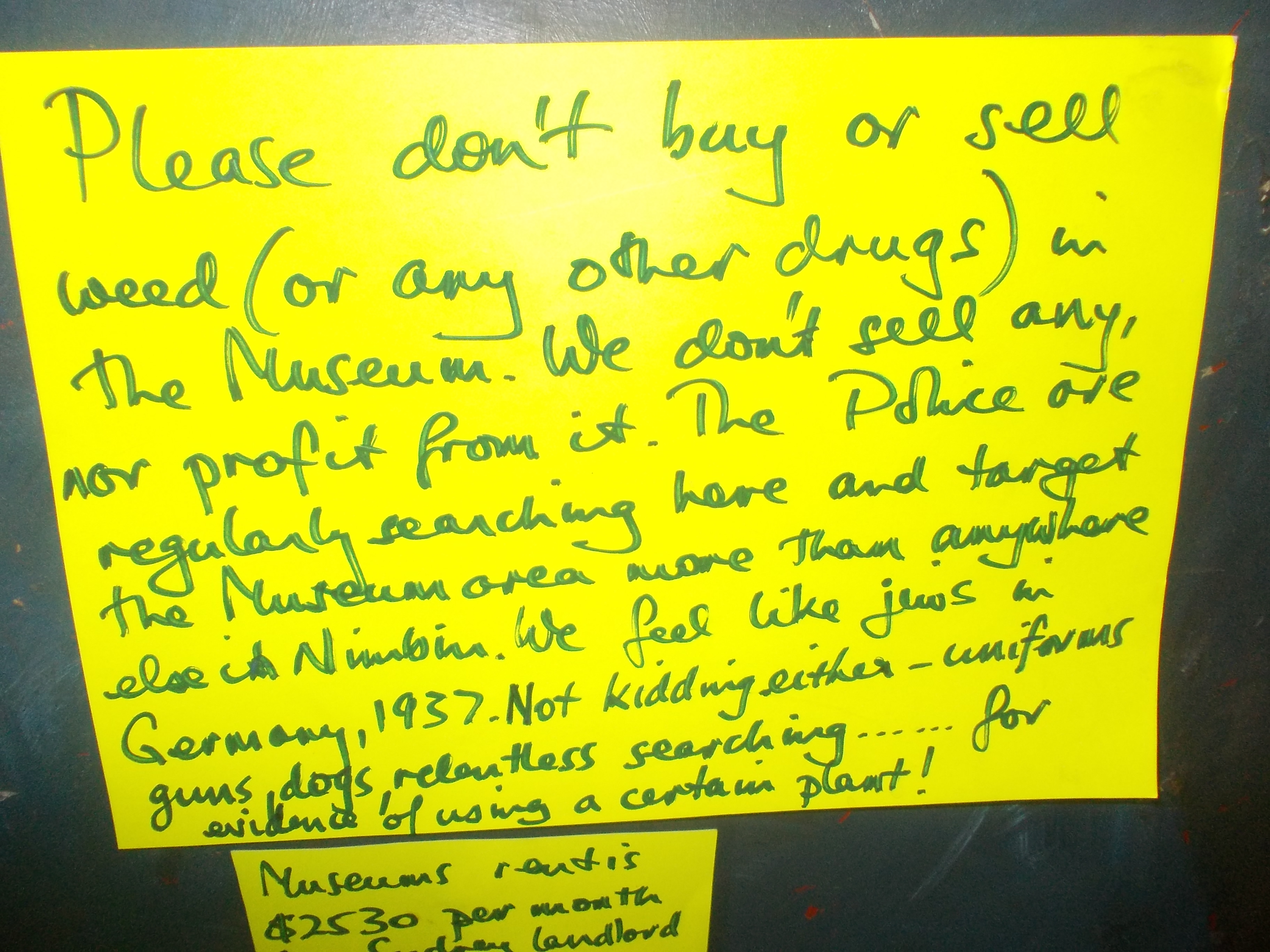
This kind of analogy makes me so angry.
In the café, I met Arie and Laura, and their wallaby Bubby. Arie shared a story about how the government robbed him of two million dollars by undervaluing the land they bought from him, although I was a little fuzzy on how he lost the two million he did receive and arrived at his current financial position of mostly broke. Bubby was adorably curled up in Arie’s lap, but Laura shared stories of how jealous Bubby is of the two humans; he’ll pee in their bed if they spend too much time with each other and not with him. Tales of a pet, and yet Arie was adamant that they don’t intend to keep him as such. He saw Bubby’s mother get hit by a car, and rescued him from the side of the road, and Bubby already runs half wild and they expect when he’s a little bigger he’ll run off one day.
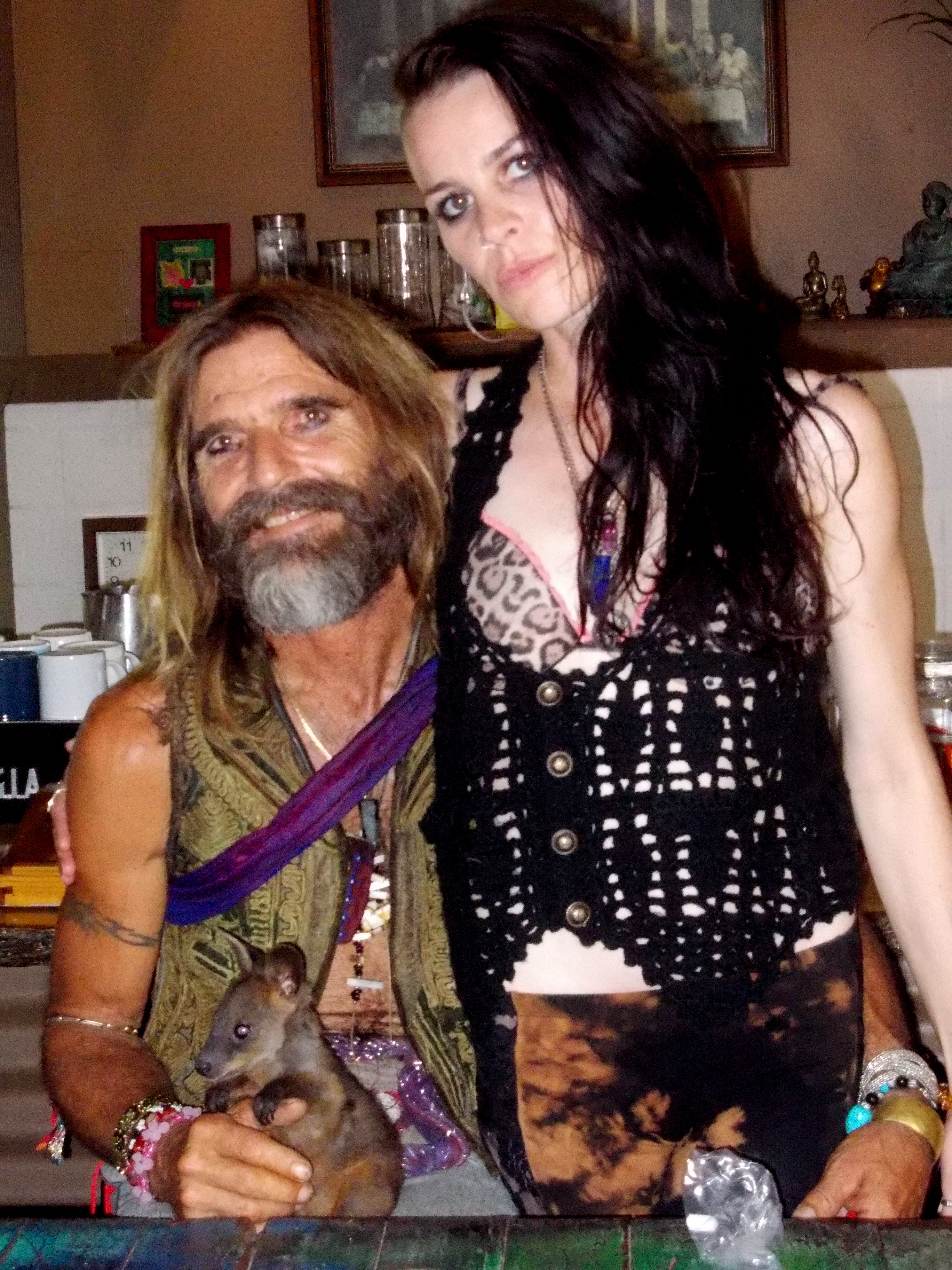
Arie, Laura, and Bubby
After everyone had had their fill of mood altering substances (no, I didn’t have anything), we got back on the bus and drove to Minyon Falls. The weather had been so dry that this usually magnificent waterfall was reduced to a trickle. Apparently, one mom decided this meant it was safe for her small children to clamber around the riverbed at the edge of the falls. Our entire tour group was looking at them from the platform wondering what she was thinking. We left before the family did, but I didn’t see anything in the paper the next day about a Dramatic and Stupid Death, so I guess they were okay.
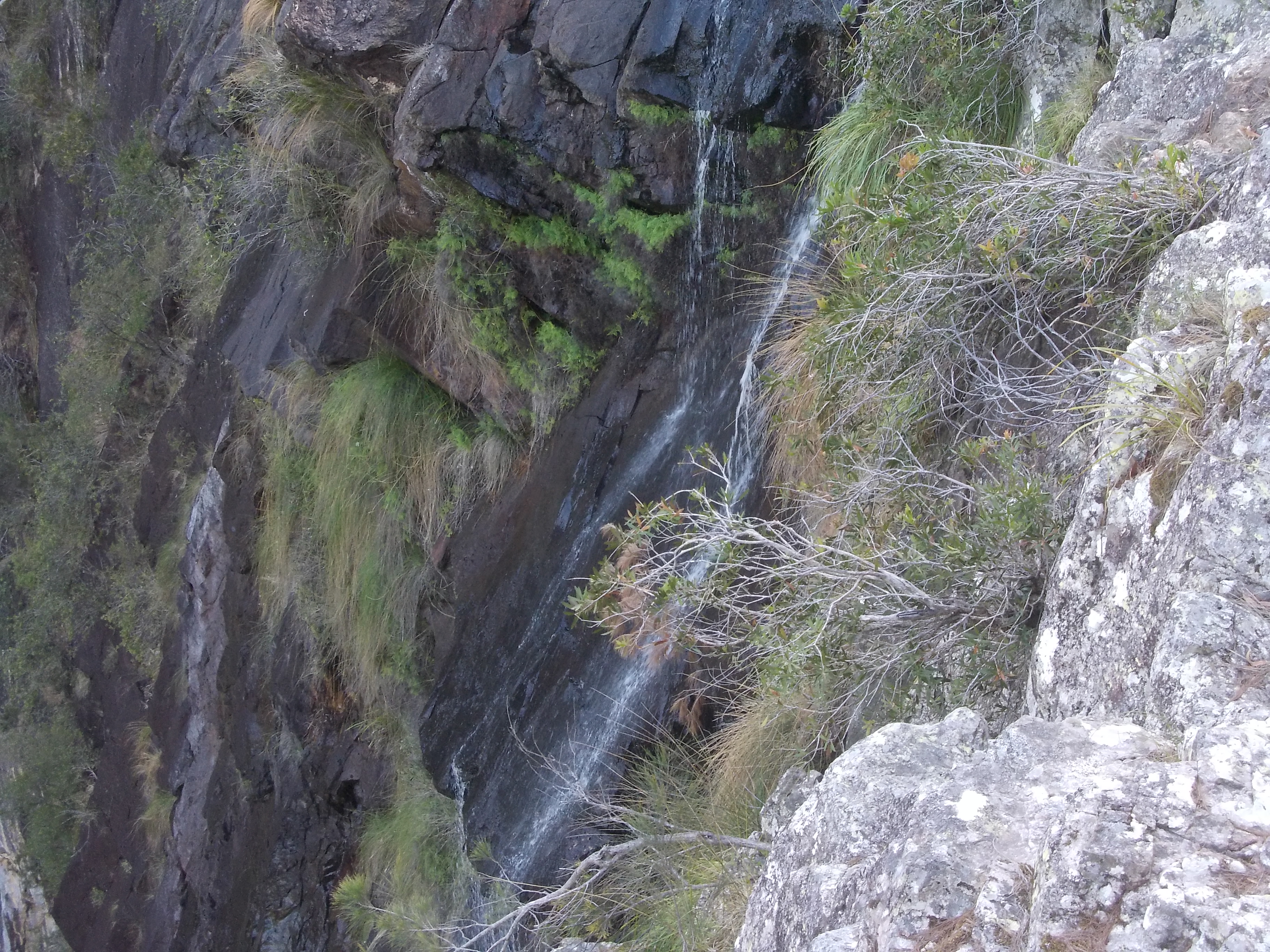
Trickle of Minyon Falls
Nimbin was basically an average small town, just a little more chilled out than most. And smelling more of incense.
I didn’t quite get bingo (I’m missing South Australia and the Australia Capital Territory). But it was fun to play! Here are license plates for almost all the states and territories in Australia. Some of them have varying taglines, so there’s more than one photo.
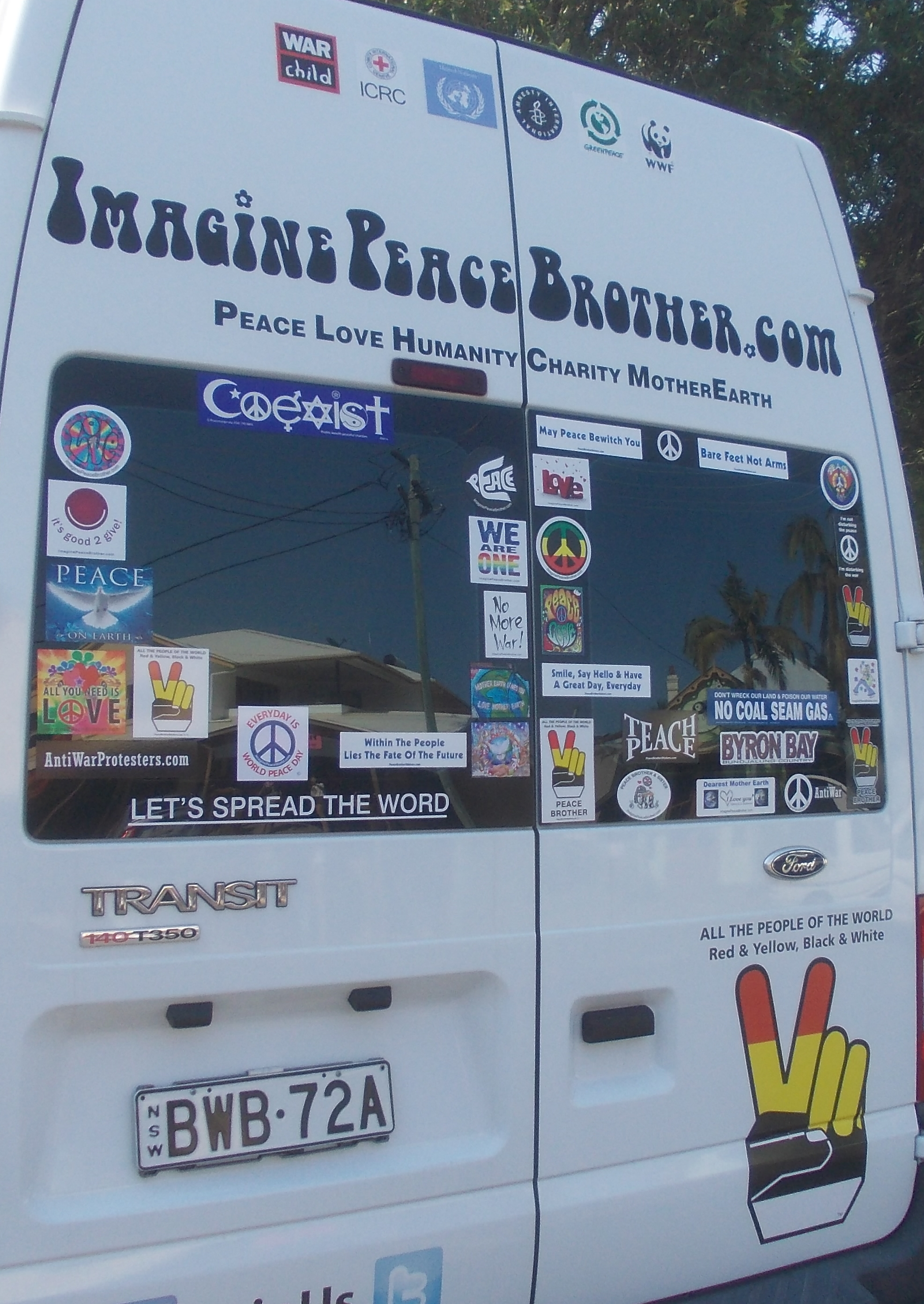
New South Wales

Tasmania

Northern Territory

Queensland
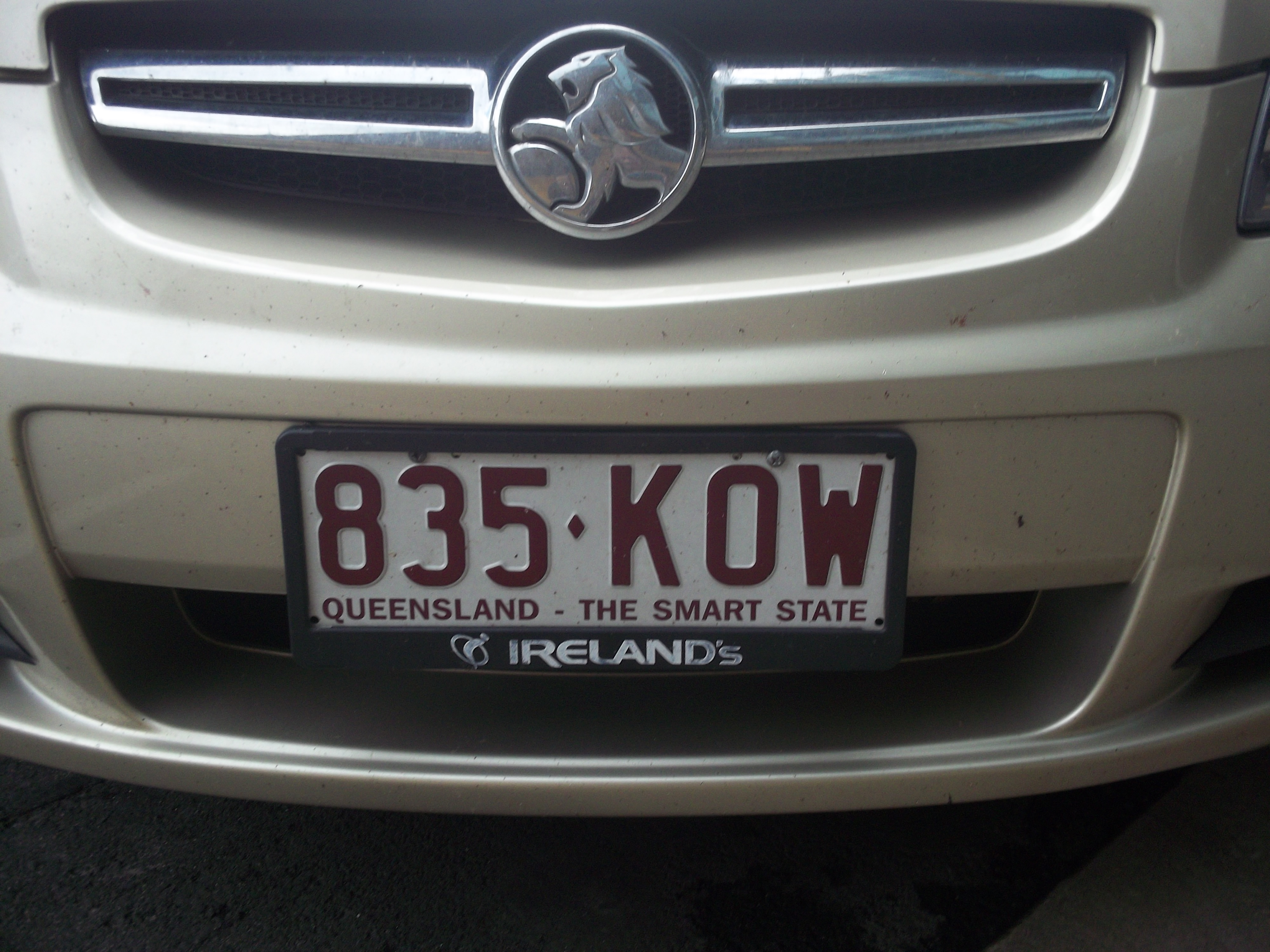
Queensland

Victoria

Victoria

Victoria

Western Australia
Victoria thinks well of itself, eh?
Byron has a way of making you stay longer than you’d planned, I’ve heard more than one person say. This can happen in various ways; some people take up surfing and never want to leave, others get into the relaxed nightlife, and some of us get stupidly ill. Oops! I spent about four weeks in Byron Bay, three weeks longer than I’d intended. Obviously, I spent a good part of that recovering from shingles on my eye, but there was plenty of time for other, much more fun activities.
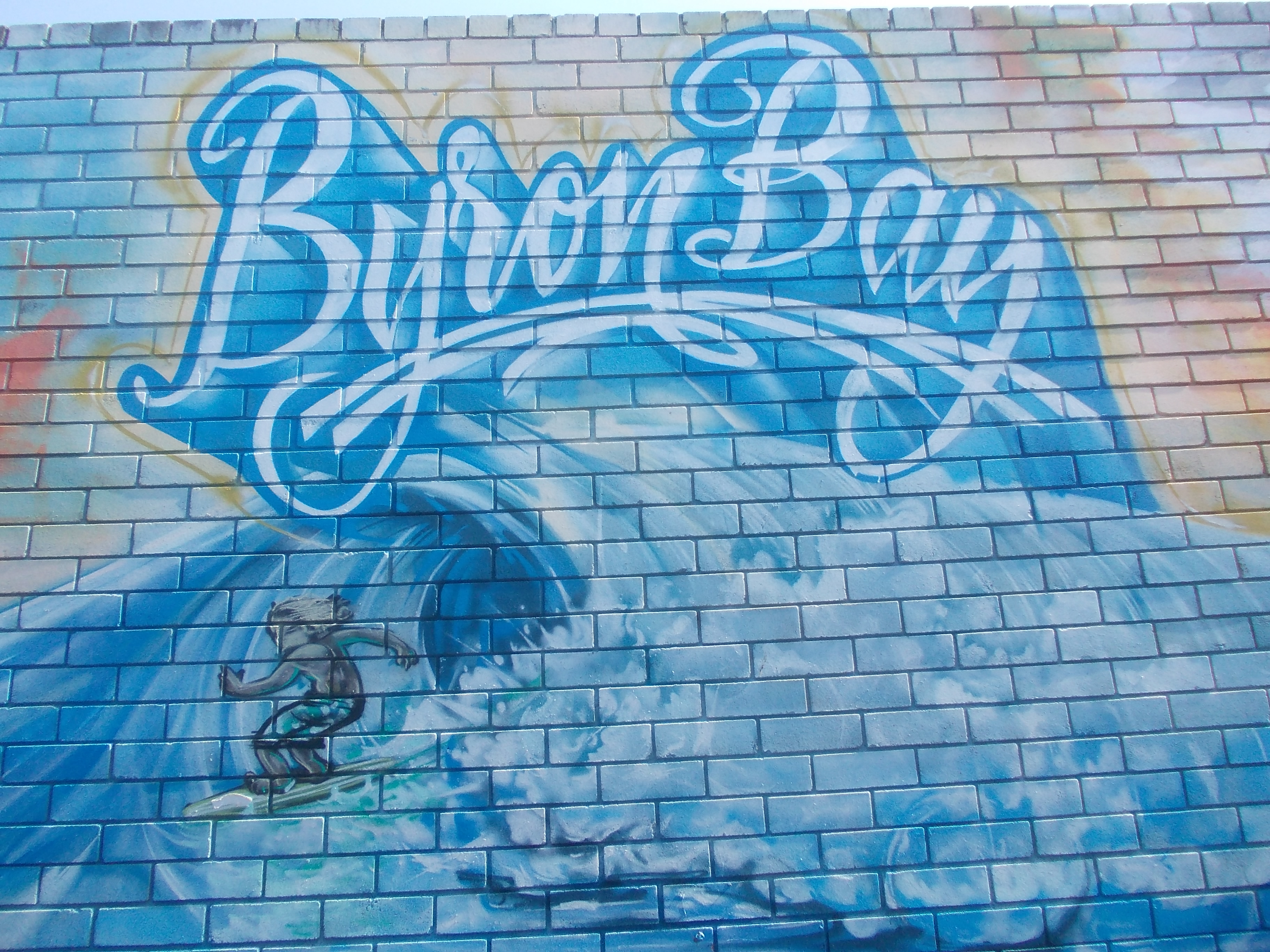
Lots of fun street art here
I stayed with Heather and her daughter Ruby-Mae, second cousins on my mother’s side, and their short-term tenant, Sophie. They live near Arakwal National Park, and a short walk up the hill behind their house takes you to a great lookout in the middle of the peninsula, so you can see water all around. On the day of the solar eclipse, I went up there to watch the sunrise, and then we stuck around for the eclipse. I was scared to look at the sun, even with the emergency blanket everyone was using as a safety measure, so I looked at a woman’s pinhole camera, and tracked the moon’s slow progress across the sun in shadow.

Sunrise over Arakwal

Waiting for the eclipse
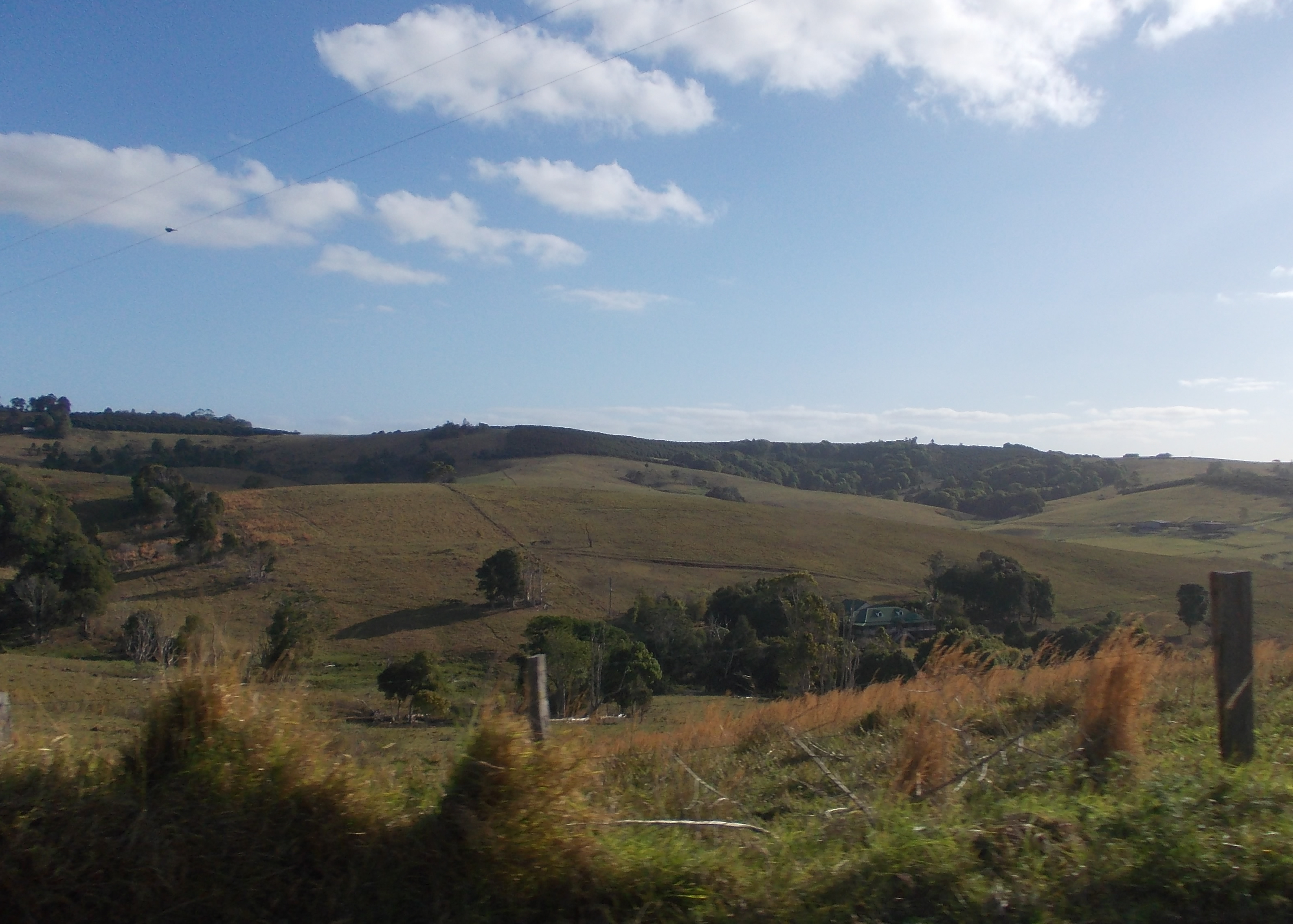
Heather owns several horses, so a few times we went up to the field they live in and I watched her feed them. We drove through the countryside, which to my mind looked like the English countryside, so I can see how settlers would want to make it look like home. It seemed to go on forever, so imagine their surprise when they went farther west and hit the Outback. Heather points out that a quick way to tell the difference between Australian and English fields (other than the different plant life, of course) is the barbed wire. They use hedges in England and barbed wire fences in Australia.

I think this one was Handsome Phil
 We went to a show in town, which was billed as a theatrical event but was basically a stand-up routine. The comedian was clearly very nervous, and the audience was very patient with him for a long time, but he never really got going, just kept asking us what it was like to live in Byron and fumbling with the mic while his video cameras recorded every misstep. Then he finally told a joke, and it was “I have a bestselling book, you may have heard of it, it’s called the Bible,” which is not only not funny but is not original. I was still willing to give him more time to redeem himself, although Heather, Ruby-Mae, and Sophie were ready to go. Then he told another joke, which was something about how women will ruthlessly tear out your heart, and I was ready to join the exodus of people streaming from the theater. I’ve never walked out on a show before—it felt weird! But definitely right.
We had an ice cream and wandered around the night market, speculating on how much of the show was done in earnest and how much of it was Andy Kaufman-esque performance art. I think he’s just a bad comedian, but if you see a movie about the greatest trick ever pulled on an audience and I’m sitting in the front row looking shell-shocked, we’ll know it was all part of a master plan.
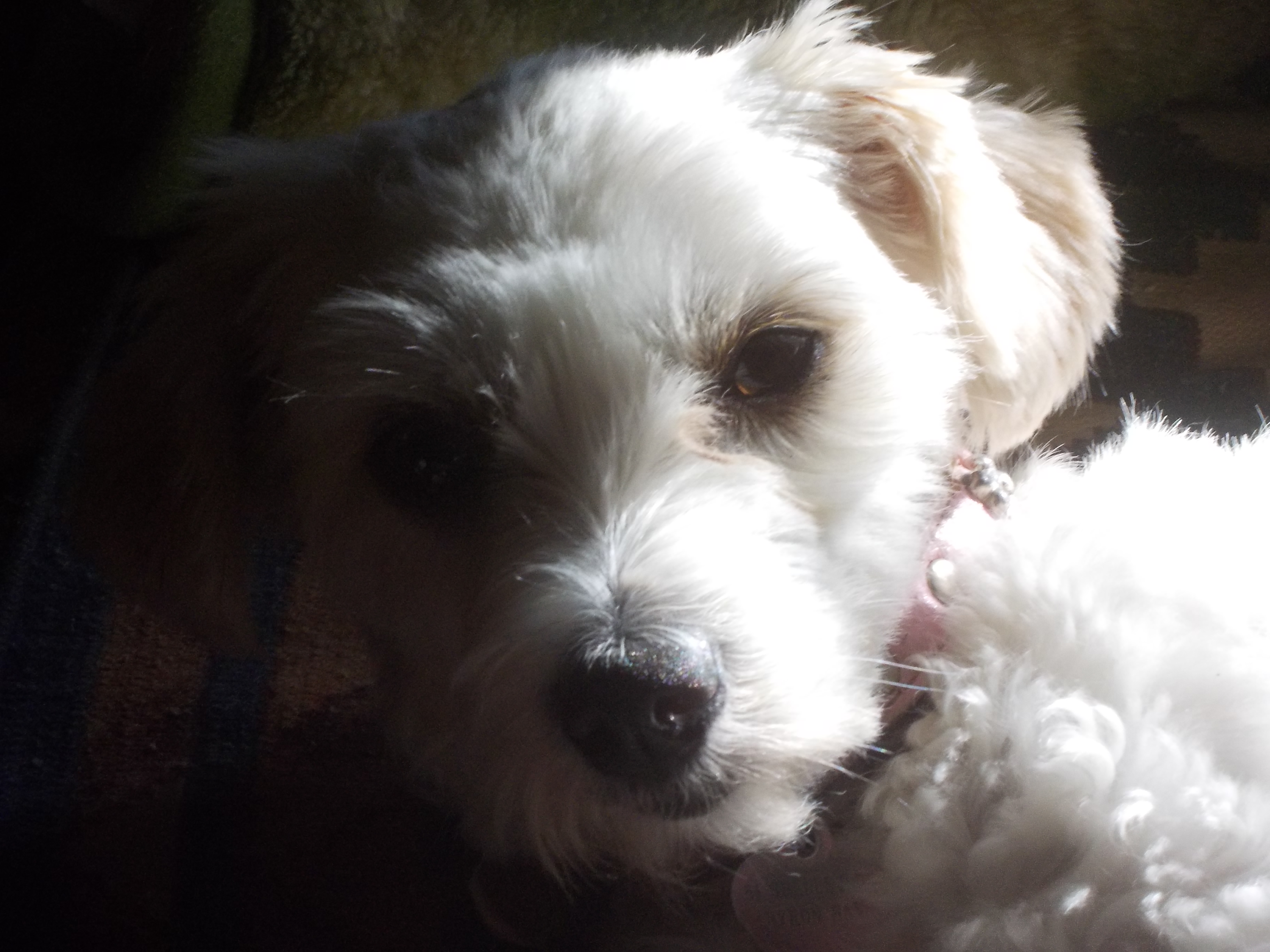
Beanie, looking contemplative, instead of getting overexcited and trying to pee on guests, which was her usual MO
Several times, we took the dogs for walks down the road, at a place they call “the lakes.” This includes a large lake surrounded by tea trees, which turn the water the color of brown tea, as well as a path over a hill to the beach. One time we walked along the beach and I saw lots of blue jellyfish up on the sand. They were just lying there, a little shiny in the sun, and as large as a dinner plate, and they looked really cool, but I didn’t have my camera with me, sorry.

The tea tree effect
We barbequed by the ocean, in sight of the most expensive hotel in Byron, where all the celebrities stay. Australia has barbeque kiosks set up all over the country, with clear instructions pasted to them. We cooked up some burgers and corn and ate it while watching the ocean and feeling the wind rise. Finally, the months-long drought ended, and we ran back to the car as the rain the town had been waiting for arrived at last.
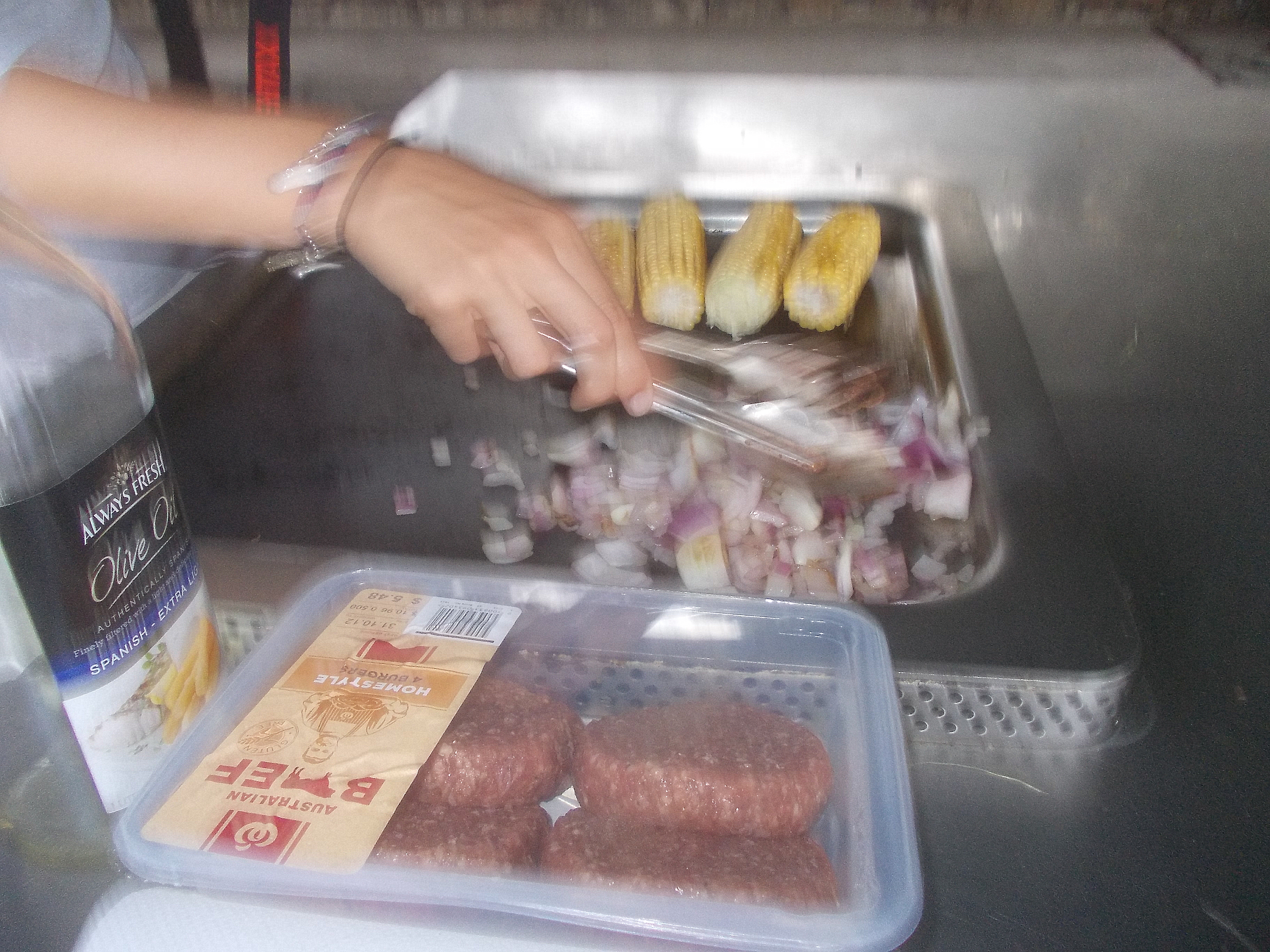
I’m not sure why this is such a blurry action shot, but anyway that’s what the grills look like here.

Dinner at the beach
We went to the farmer’s market, which is similar to all the other farmer’s markets I’ve been to; mostly white, middle- to upper-middle class people, everyone in a great mood, delicious food. The difference here is that a third of the customers were barefoot, which is much more common down under than back in the States. I thought it was a bohemian Byron thing, but then I saw people going into superstores barefoot in other towns and concluded it’s the relaxed way of life here.

To market, to market
I ate very well in Byron. Ingredients are incredibly fresh here, and I’d make myself lunches with ripe avocadoes and tasty sourdough bread that had just been made the day before. Heather is an excellent cook, and she included me in the family dinner each night, so I had curries, pasta dishes, and all sorts of tasty things while I was there. I made a feeble attempt to repay her kindness by making a dish my last week there, one they’d never heard of: chilaquiles. They went over well!
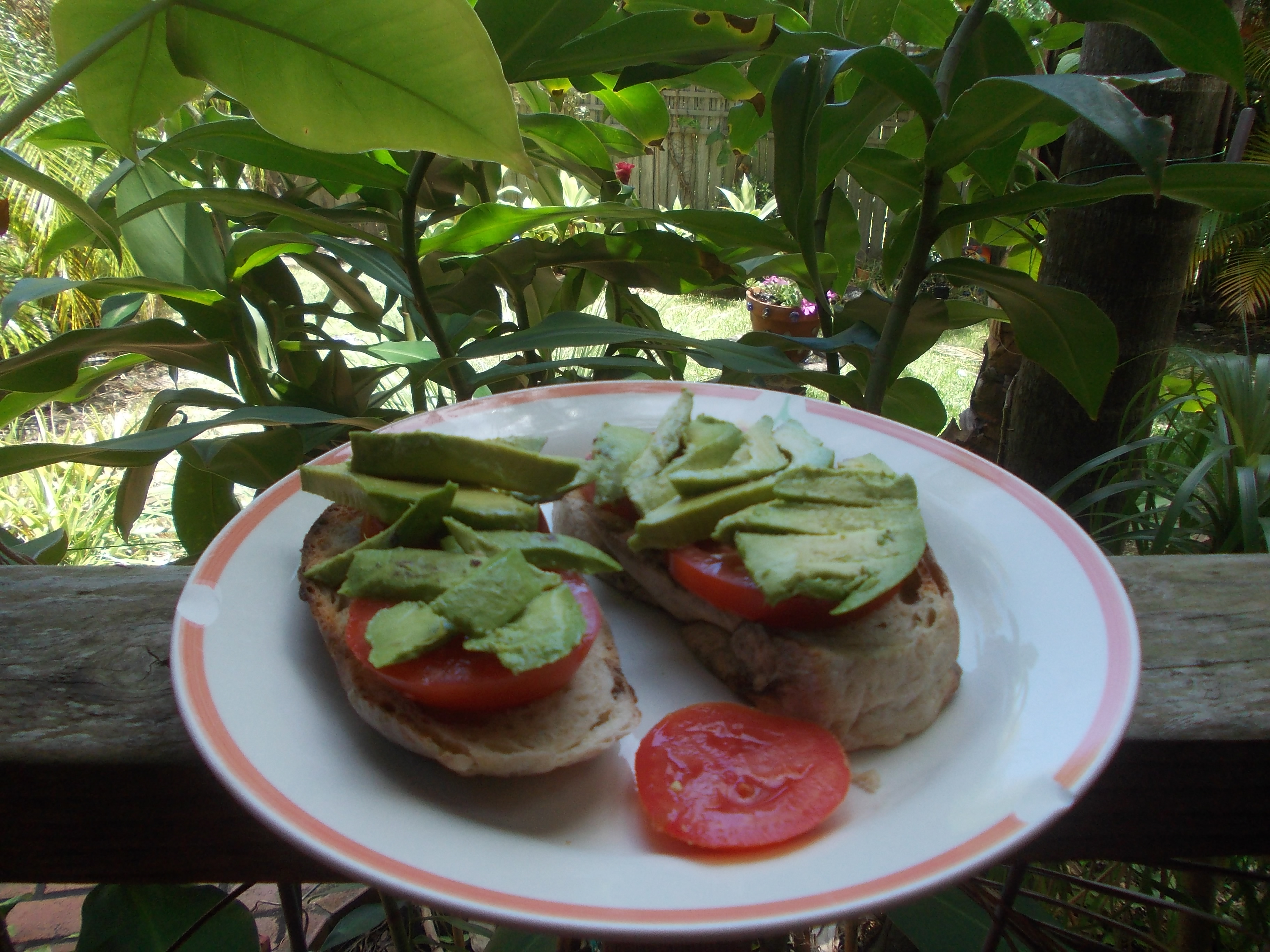
Lunch time
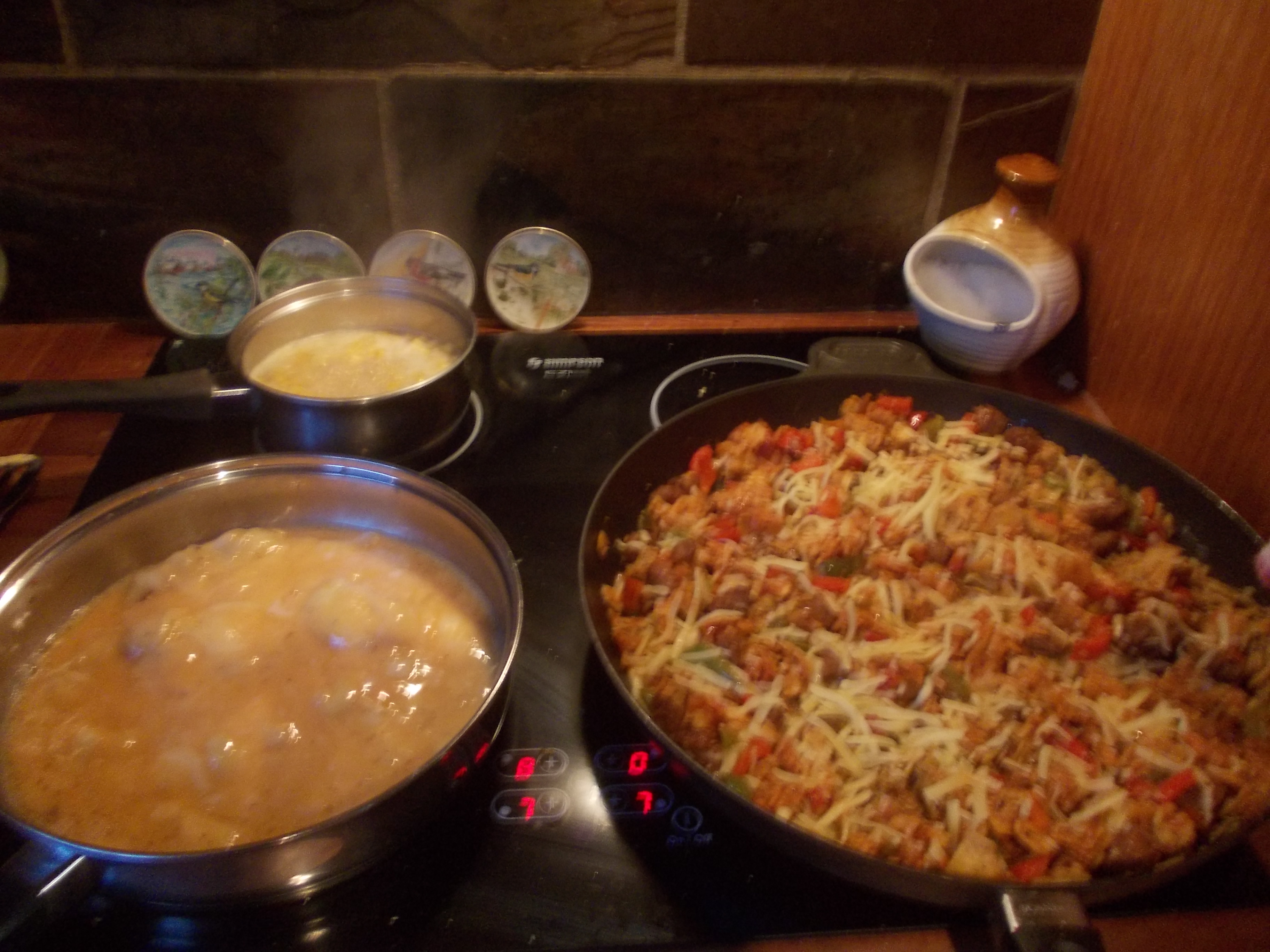
Dinner time
One Saturday, the local Buddhist community had an opening ceremony for their peace stupa, the only one of its kind in the southern hemisphere. We drove out to the Crystal Castle and joined in the ceremony. We walked around the stupa three times, turning the prayer wheels as we went. Those prayer wheels each contained rolls of prayers for peace, and the idea is that as you turn them, you increase their effectiveness. We watched the monks, who had come down from Asia for the occasion, do their own circuit of the stupa, and after one last prayer, the ceremony was over (we arrived toward the end).

Spinning the prayer wheels

Then we walked over to the main building and looked at the huge collection of crystals they have here, a lot of which come from South America. I walked in the meticulously maintained gardens, and admired the statues and crystals they’d mixed in with the plants.
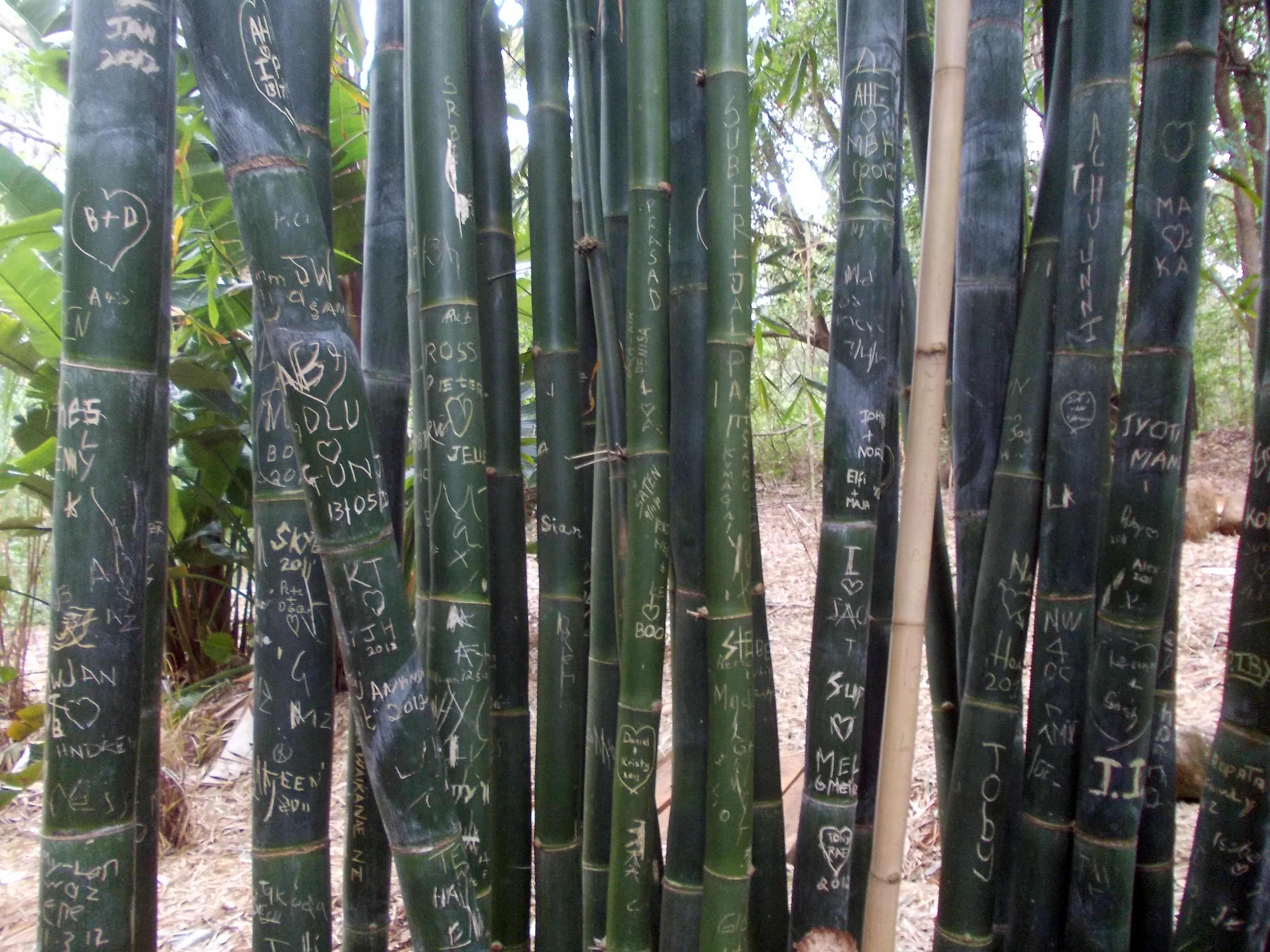
Graffiti on the bamboo
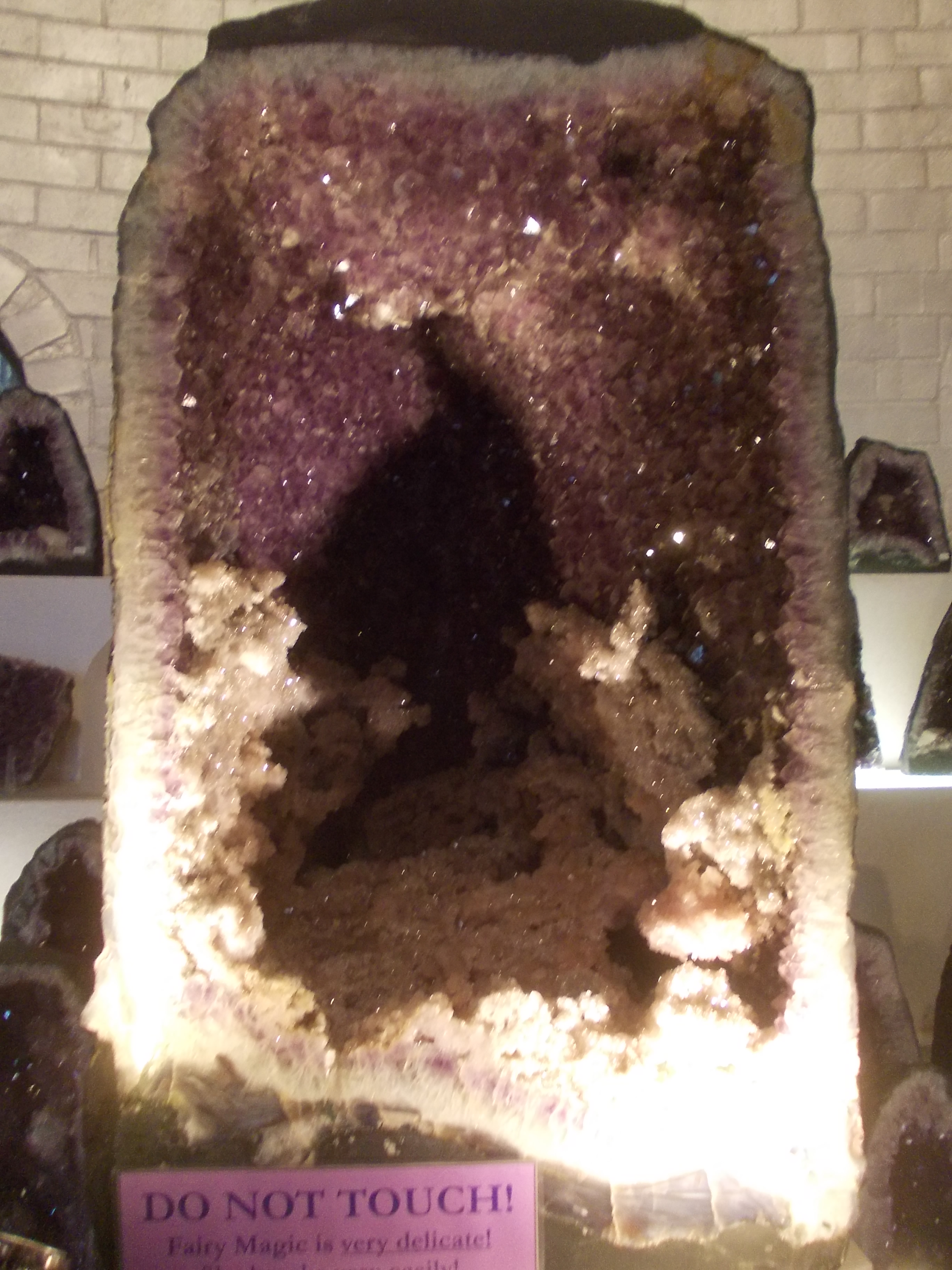
One of the many giant crystals found at the Crystal Castle
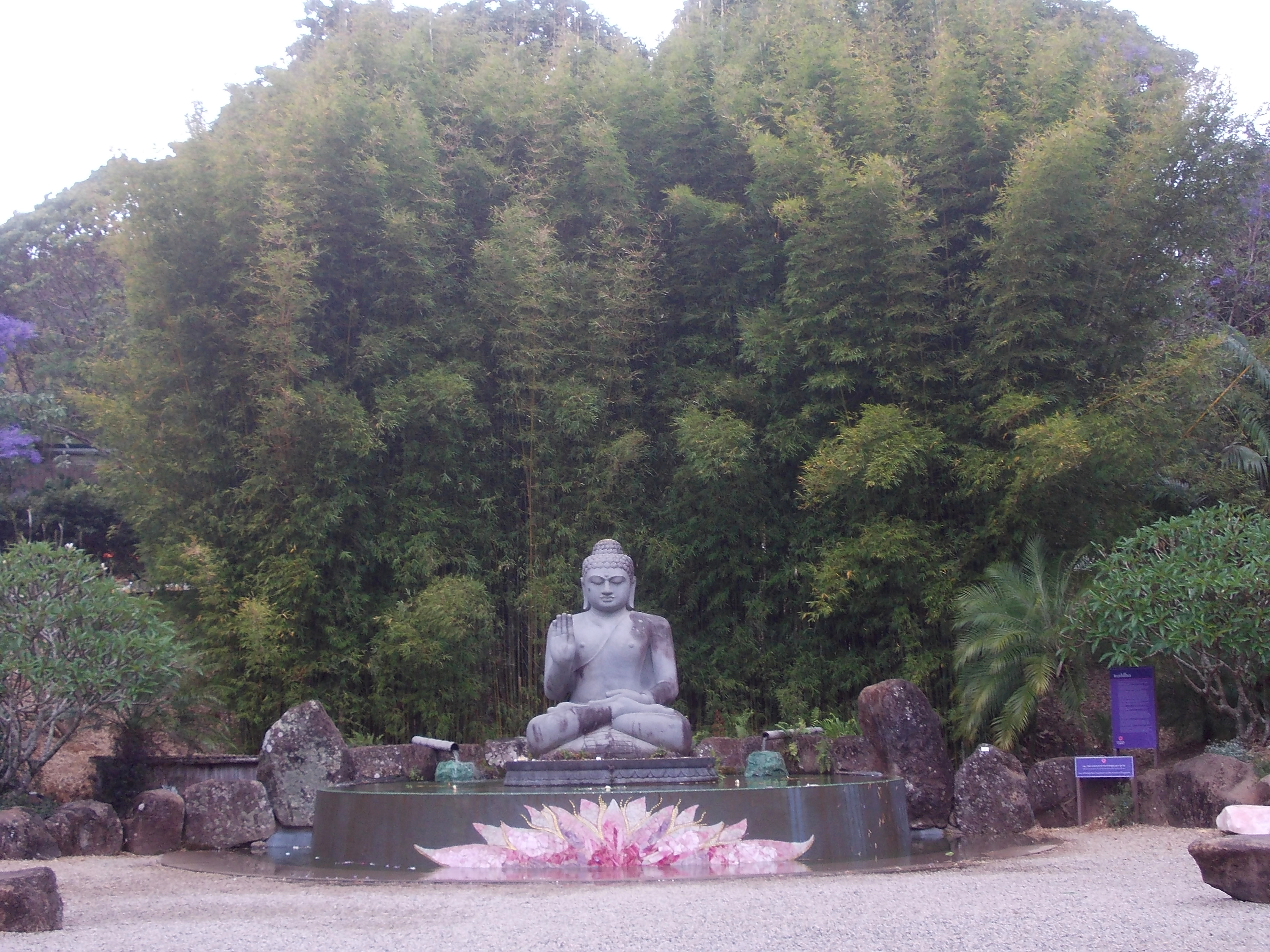
The center of the gardens
I spent some time wandering around town, picking up prescriptions, indulging in treats at cafes, walking the beach. Byron is a funny town, a mix of surf shops, head shops, and designer clothes shops. They have a great restaurant scene here, something like 90 eateries in this small town.

Boutique
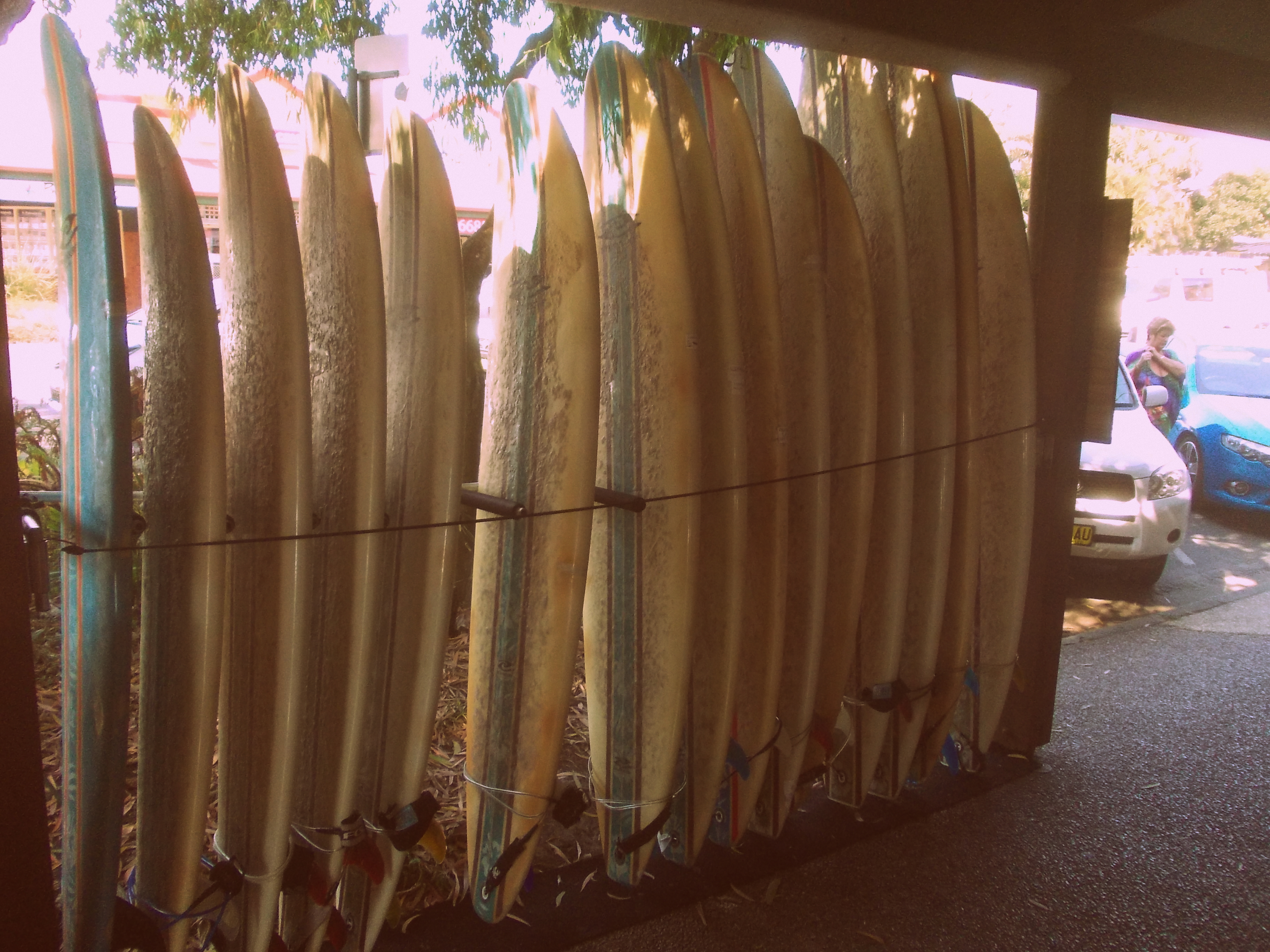
Surfer’s choice
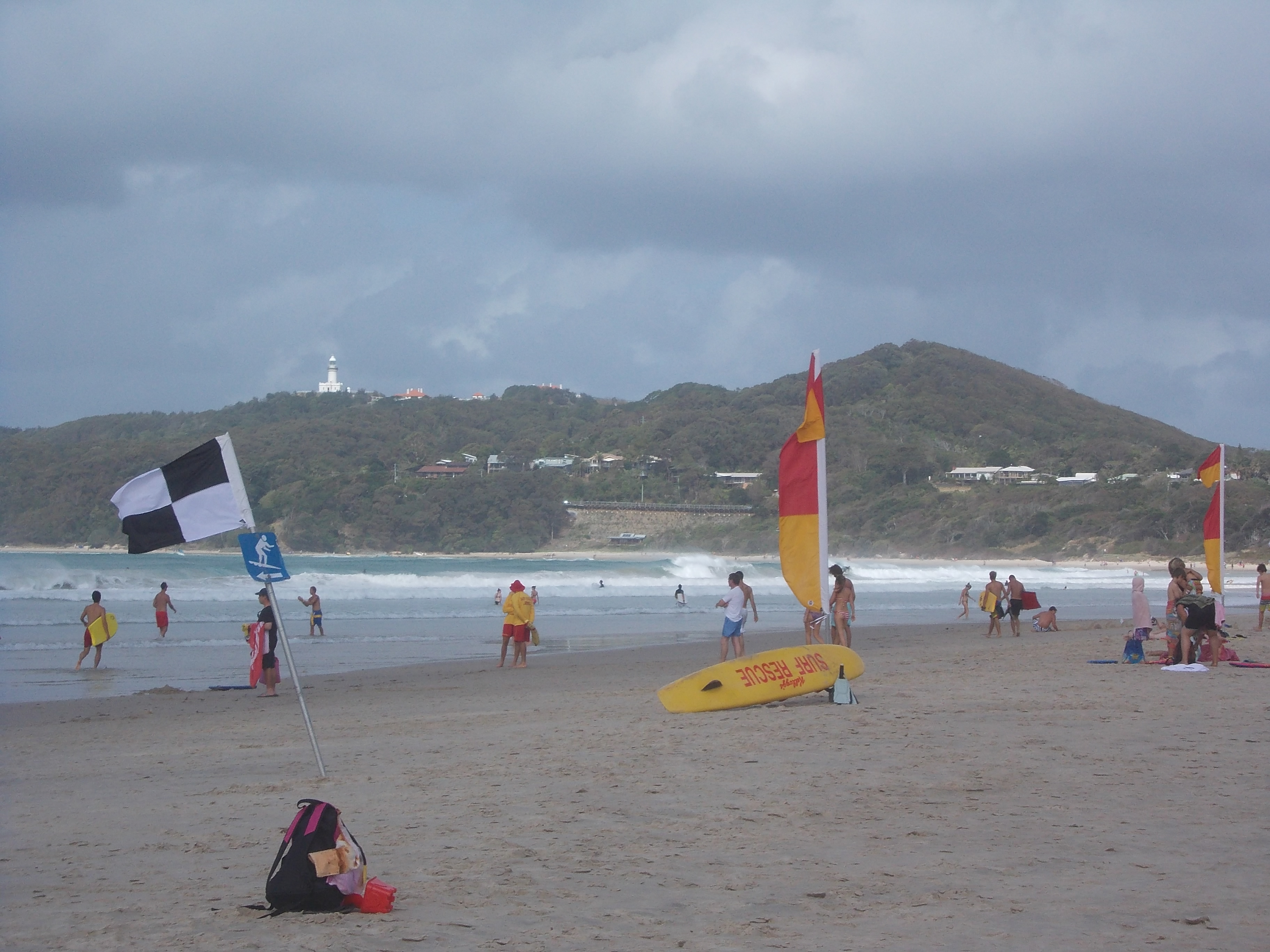
Stay in the flags!
I went to a few concerts at local bars and restaurants with Heather. It’s a big music town here, which is a draw for their family, as Rick is a musician (he was on tour while I was there). We heard some rock covers, reggae, and a few originals over the time I was there. It was great to see a town so enthusiastic about live shows.
On my last day in town, Heather drove me up to the lighthouse. There’s a little museum at the top which has the old lighthouse chair and light on display, as well as a few other items. (Heather and Rick own a lovely, detailed scrimshaw from the mid-1800s, which they’re considering donating to the museum.) We walked down the path to the lookout, which declares this to be the most eastern part of Australia. Then back up the hill, and we saw the goat, a holdout from when the government decided to reverse their earlier policy of introducing goats and instead wanted to remove this invasive species. This goat in particular is a crafty one, and has never been caught, so the Byron lighthouse still has a goat guarding its hills.

Far out
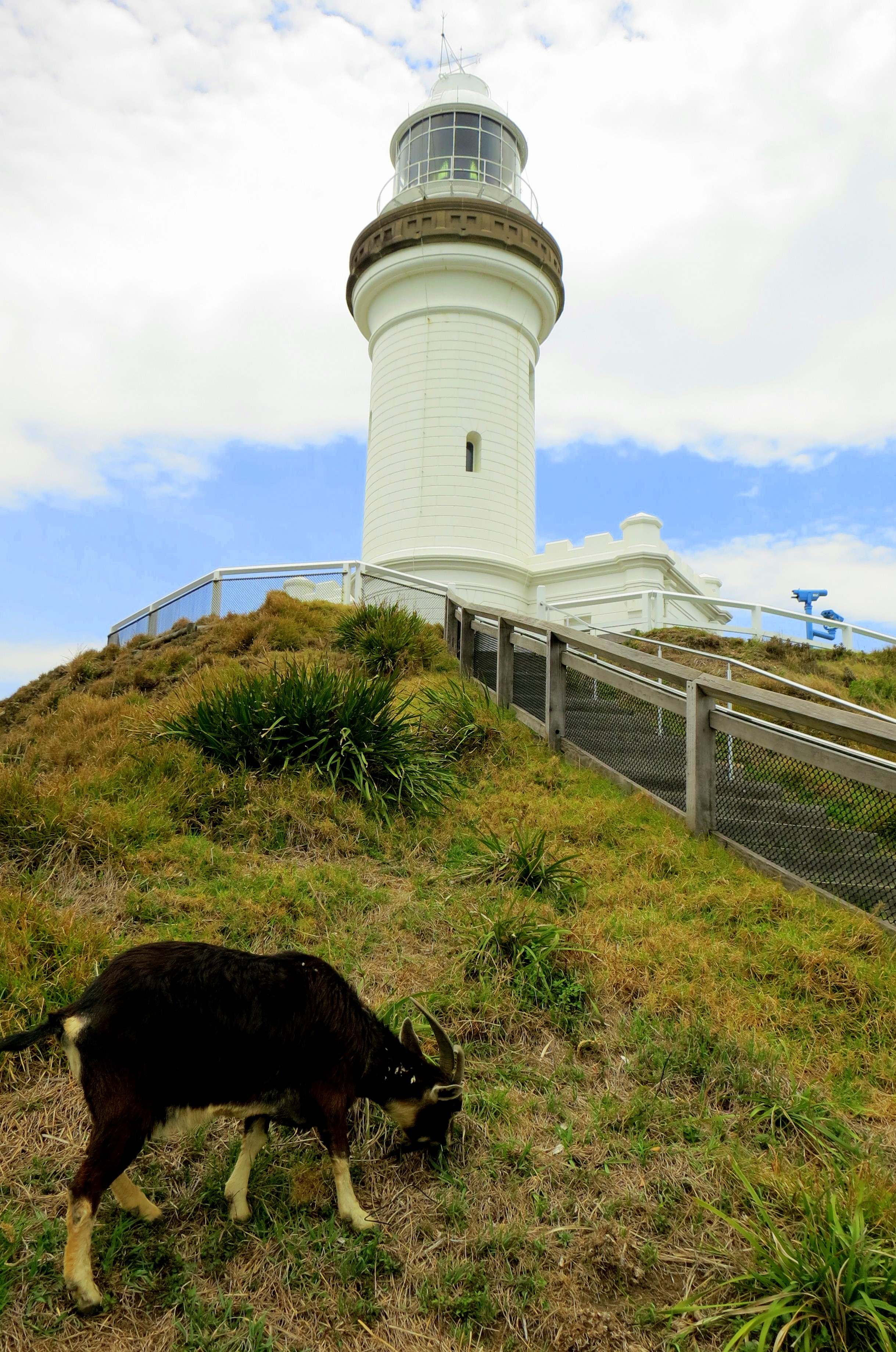
The goat and the lighthouse–sounds like a work of literary fiction
Byron Bay is a great little town, with a lot going on, and I’m glad that despite my time in sickbed, I was able to experience a lot it had to offer. Special thanks to my gracious relatives!

Peace and Justice
Fraser Island is one of Australia’s most protected places, and there’s a lot to protect: the world’s largest sand island; the purest dingo population in the country (no cross-breeding with dogs); and a popular spot for sharks, whales, and dolphins to shelter near. All these natural wonders make it a popular tourist destination, of course, which means it’s a tricky balance between conservation and promotion. It’s a big place for fishing, camping, and four-wheel driving. I went on a three-day, two-night 4WD tour, which turned out to be one of the worst, and occasionally the best, tour I’ve been on so far.

Fraser Island 4WDing
Of course, I was a little run down after my No Good, Very Bad Day, and really I should’ve just spent a week sleeping, but I was sure new sights would be the perfect cure. So I watched the safety video with the rest of my tour group, packed up a small bag with a few things, and waited outside the hostel for our 8am departure. We were split into four groups of 8 and assigned to our 4WDs. My group had a couple young German guys, a British/Scottish couple, a Swiss guy and German guy traveling together, a British woman, and me. Pretty representative of the national makeup of tourists I met in Australia, actually.
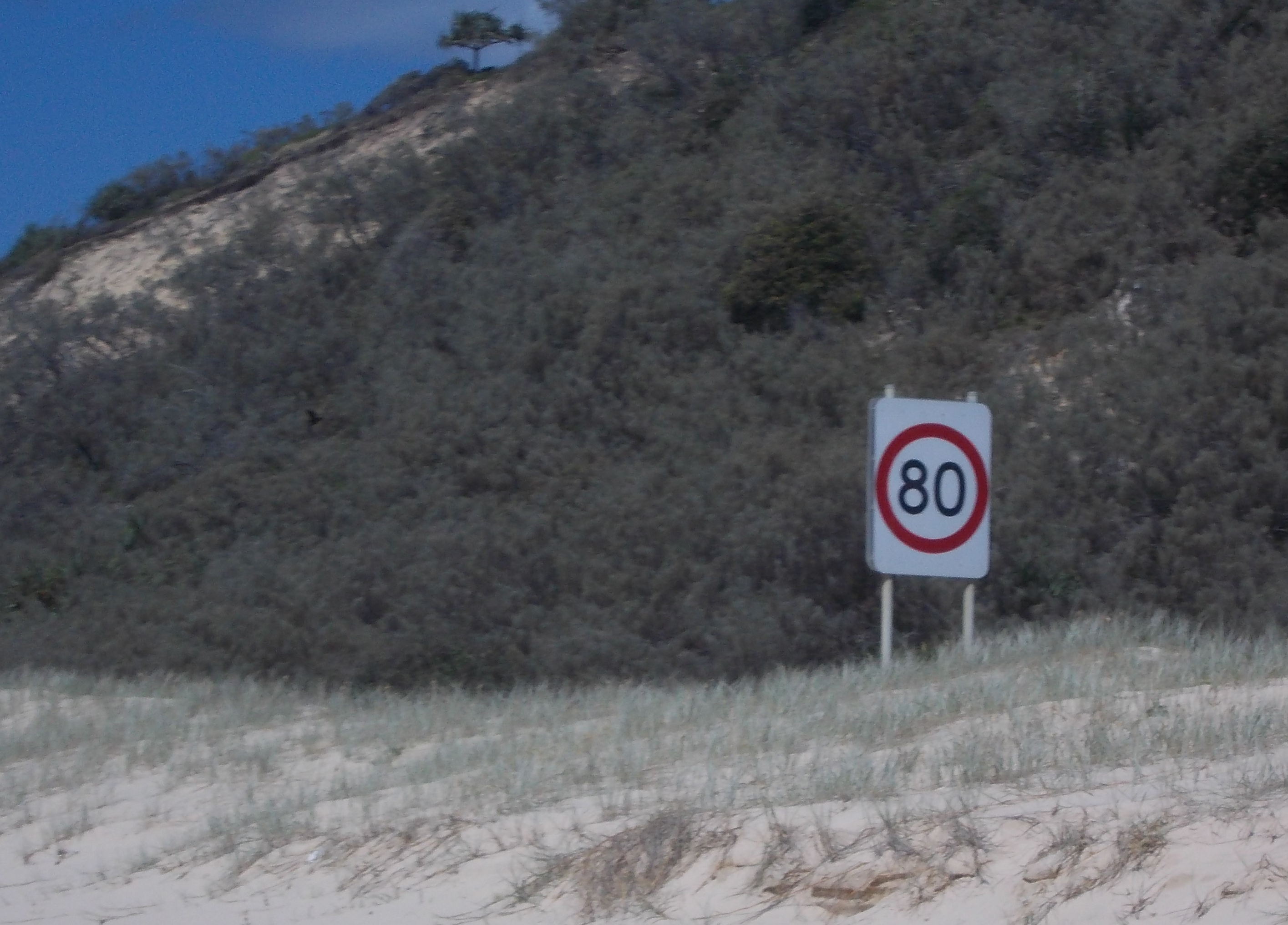
Speed limits on the beach
After a short introductory speech from our unsmiling guide, we squeezed into the cars and set off in convoy to the ferry pickup point. The thing about the 4WD tours, see, is that four vehicles drive together in a group, with a guide driving the front one, and the tourists driving the other three; it’s called a tagalong tour. Fraser has very few roads, and most of the time you’re driving directly on the sand (thus the safety video, which had a lot to say about how to drive through hard sand, soft sand, wet sand, etc.). It’s a bit mad, to pile into a car with a 19-year-old behind the wheel and let them drive you around the wilds of a sand island, but I was ready for a little non-bus touring.
It was no holds barred from the start; our driver got stuck in the sand just a couple kilometers off the boat, and the guide had to talk her through maneuvering out, and soon after that, the guide’s trailer, which had all our food, broke down, so he left it behind. We drove out to Lake Wabby, and our guide gave us some garbled instructions on how to get out to the lake and back, and then he drove away to fix the trailer.

Lake Wabby
It was quite the walk out there, and it was a very hot day, so good thing some of the walk was in the forest. We got to the sand dune that looked down into the lake, but heeding our guide’s warning about the many people who have impaled themselves on hidden branches in the water, we did not run straight down.
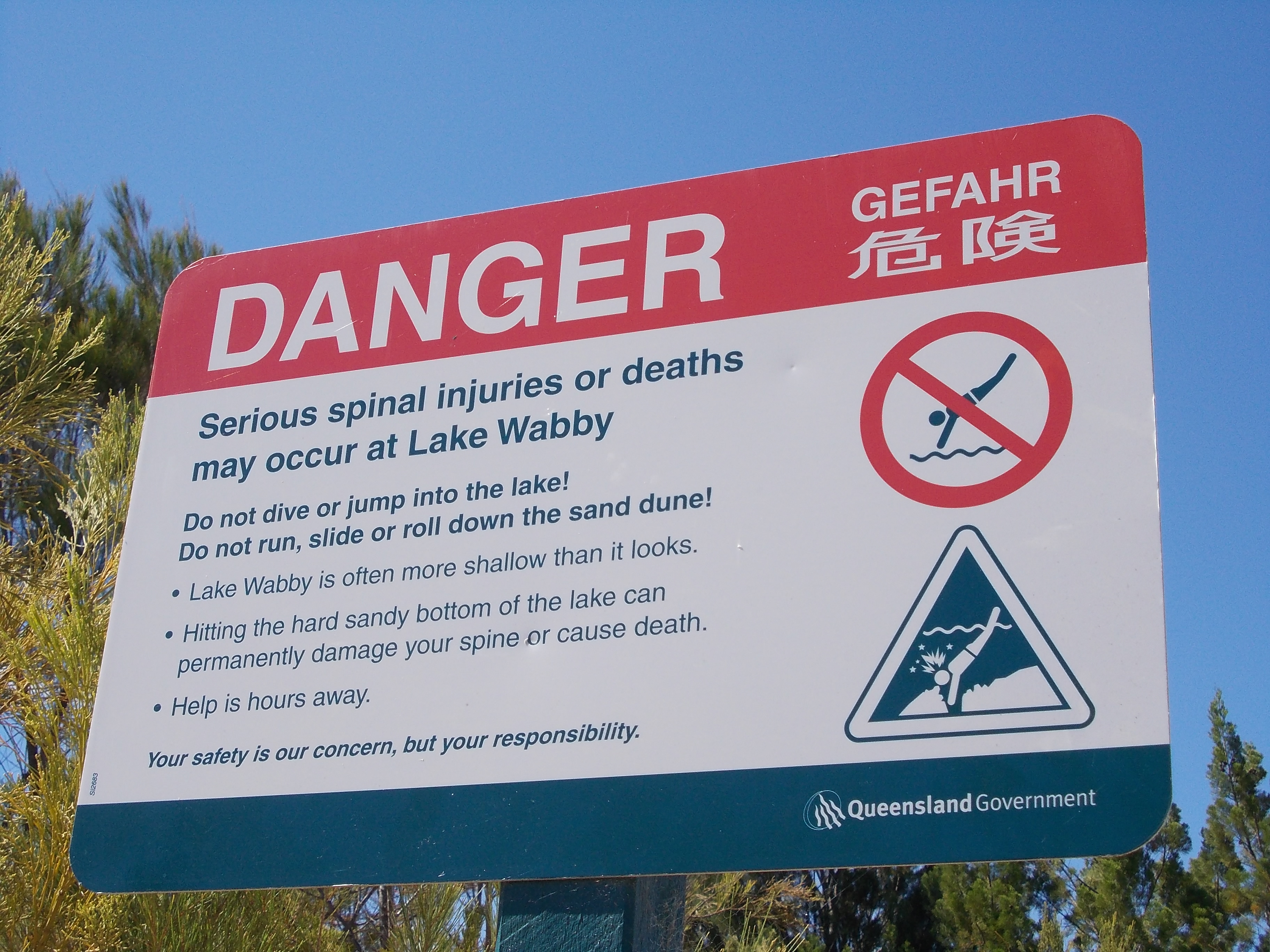
Yikes!
The water was lovely and cold, and fish cruised past me as a I swam half the length of the lake. I dried out in minutes—it really was very hot—and chatted with some of the girls in my group as we all reapplied sunscreen. The walk back was one of the hotter walks in my life. This is me at the top of the looong dune climb:
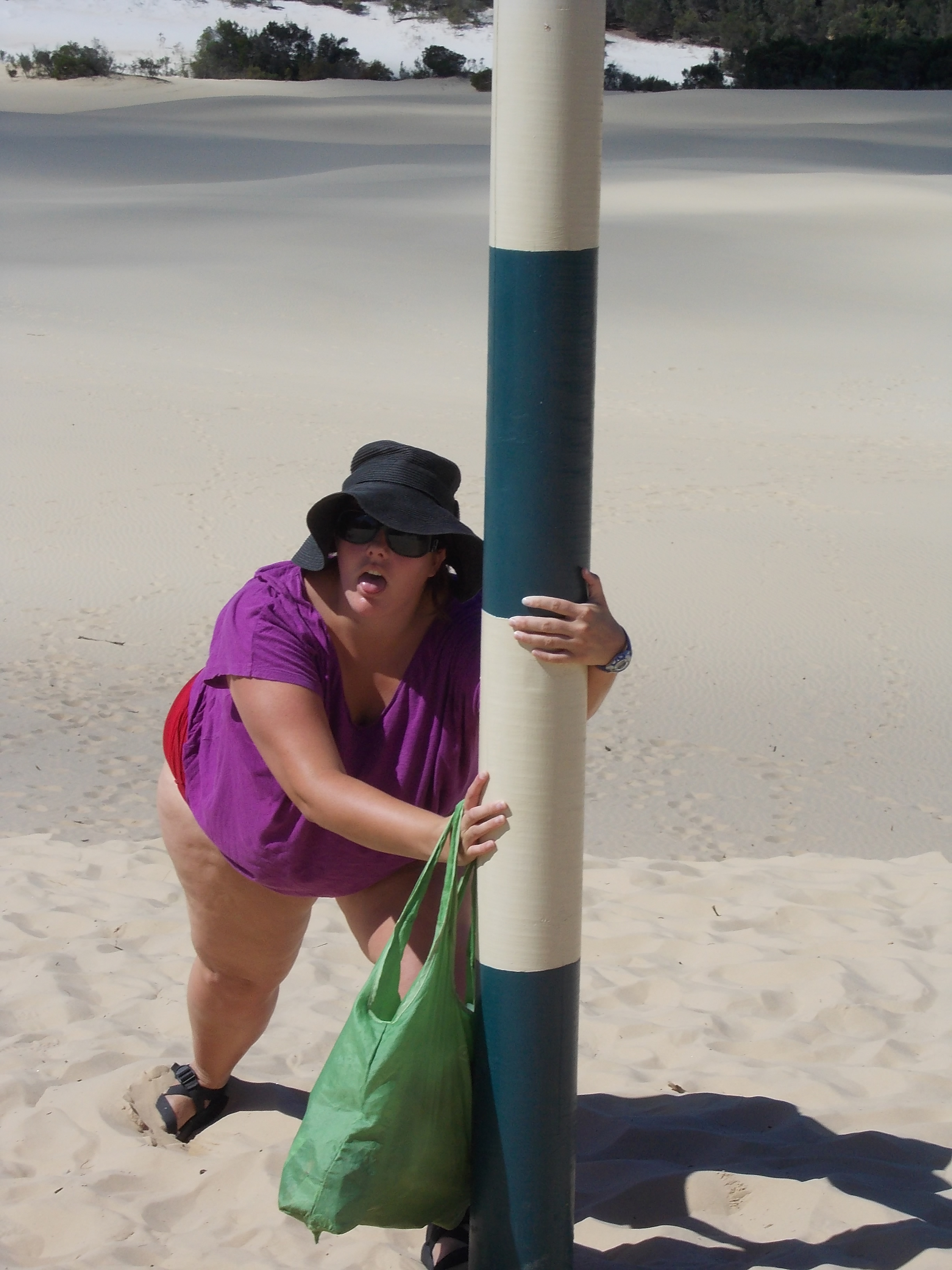
I needed another swim after that! But the safety video, the manager of the hostel, and even our grumpy guide had all impressed upon us the extreme riptides of the island, and the danger of getting in the ocean for even a few minutes. Instead, I cooled off on the ride down the beach, hanging my arm out the window and grinning out at the golden sand and blue water.

Cruisin’
We camped at K’gari Campground, which is run by the aboriginal people of the island rather than the national parks group. The rules were more lax, meaning you could have campfires here, and the tour company had set up a little shack with a sound system at one end of the camp. The food had been saved from the busted trailer, and each group set about making its own meals. The boxes of food came with hilarious instructions, which included illuminating pointers on “how to prepare toast” and “how to boil water.”
The camp had no fence around it, which meant dingoes could come and go as they pleased. We were warned never to go anywhere in camp without two other people, so that if dingoes followed us, we could all stand back to back and not be surprised by any jumping on us from behind (which has happened before). For the rest of the night, people were calling out for dingo buddies to make trips to the bathroom with them, and of course the more the guys drank, the more they decided they didn’t need any buddies. Luckily, no one got mauled, but we did see dingoes both nights, darting through the shadows and even trotting down the main camp road like they owned the place, so I never took the risk. They look like underfed house pets, but they’re wolves ready to attack if they don’t like the way you move.

No babies were harmed in the taking of this photo.
Here’s the part of the tour that contributed to it being the worst: we’d had strict warnings not to move any wood because this is a national park, but when the firewood we’d brought with us didn’t have enough kindling to satisfy the guys building the fire, they scrounged wood from around the camp. Our guide just watched them, not saying anything. Way to care, dude. Also, there had been no indication when I signed up for the tour that it would be such a party tour, and when the sound system stayed on until 3am both nights, pumping out dance hits while I tried to sleep, and we had to get up at 6:30 the next day, I was more than a little displeased.
But the worst part was the guide from another group. We were all staying in the same campsite, and he wandered over to our fire and sat next to me, and out of nowhere, told me that he had some gay guys in his group that he’d told to not try to touch him or they’d be sorry. What the hell! He was drunk and leering at me, so I didn’t tell him off as strongly as I would have liked to, but I said, “well they’re human, you didn’t need to say that,” and moved away. Way to live up to stereotypes of homophobic backcountry Australians, dude. That soured my night, and I went to bed soon after. (I did send indignant feedback to the tour company, and the owner replied, agreeing this was unacceptable and saying he would talk to the guide. I think making him pay the men he insulted the fee they paid to get on the tour, just to be so insulted, would have been the least he could do.)
You can understand that I was in a less than great mood the next morning, running on three hours’ sleep and surrounded by hungover teenagers. But we started the day at a little creek, which revived my spirits. A short walk takes you to steps down to the creek level, and you can get in and walk through it, or float (but watch out for stray tree branches) down to the beach, where it opened up big enough for the guides to pull a net across it and get a volleyball game going. Floating down the creek was so fun that I did it three times.
We stopped at the shipwreck of the Maheno, which was a swank cruise ship that got caught in a storm on its way down the Australian coast in 1935 and washed up on the shore here. It was a little eerie, this giant, rusted wreck with nothing but blue water and golden sand stretching out for miles on either side.
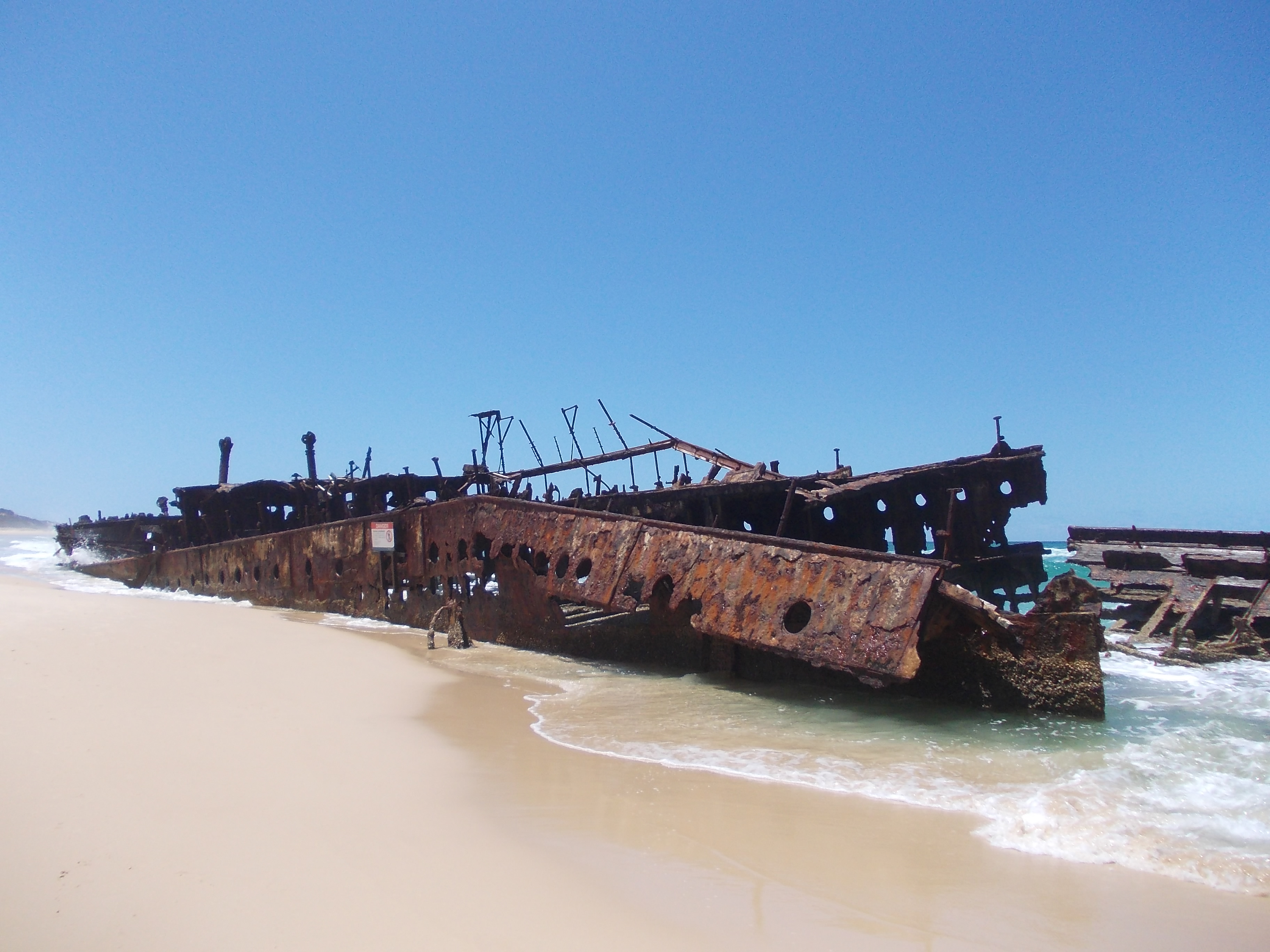
Of course I sang “The Wreck of the Edmund Fitzgerald” to myself as I walked around the Maheno.
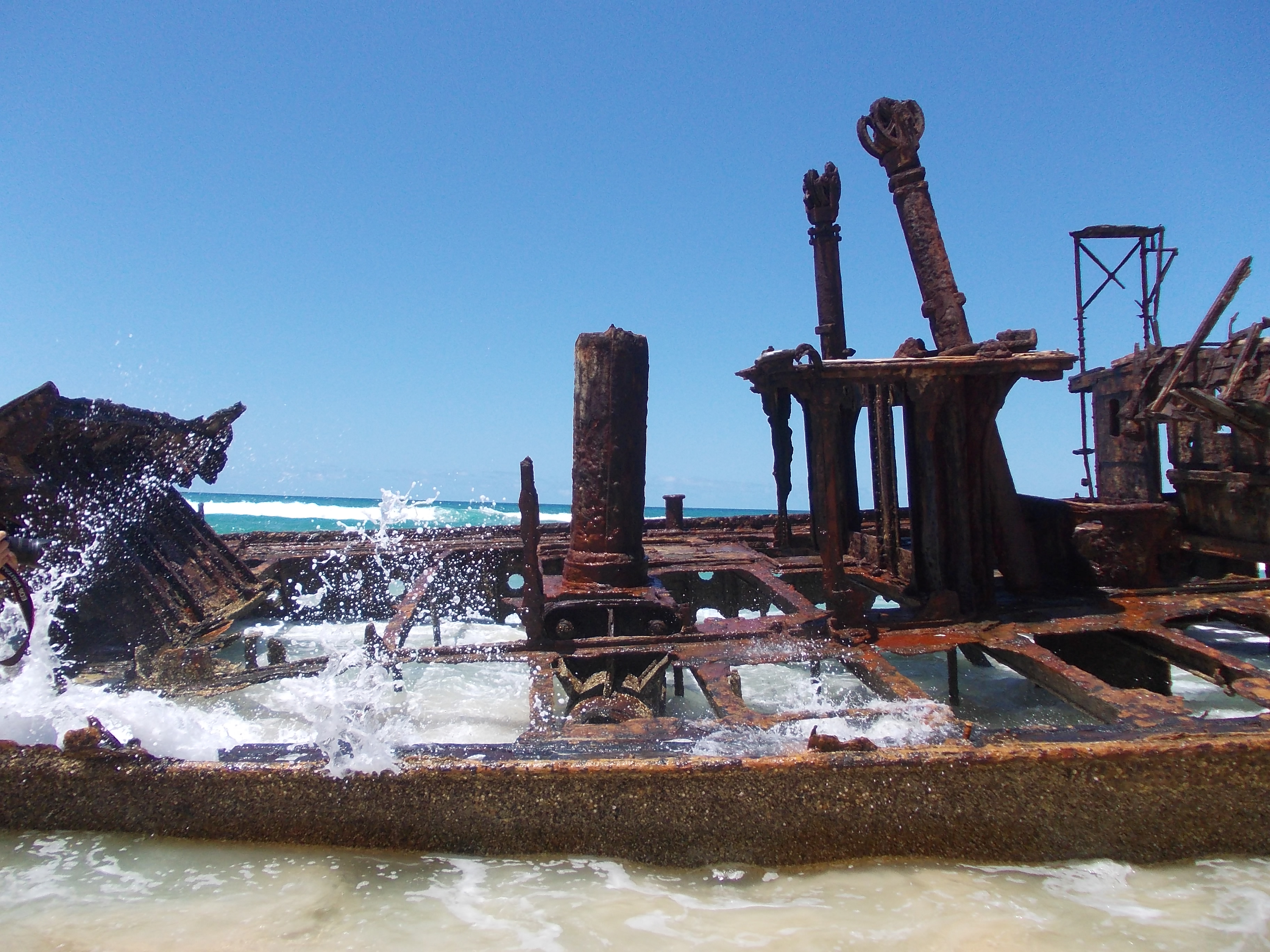
Our group had changed up a bit, with some people trading out to the guide’s car and others coming to ours so they could have a chance to drive. The car was tense, as the guys mostly wanted to go as fast as they could, and do as many donuts and tricks as they could, and the girls mostly wanted to not die. Our next stop came at the right time, before there was an actual fight, and everyone split up to explore the Champagne Pools. These are tidal pools that bubble like the beverage they’re named for, and are quite warm, so you sit in them comfortably and look for wildlife out in the ocean. Apparently there was a small shark swimming around in the pools, but I didn’t hear this until after I’d already been in them. I’m glad I didn’t find out by getting nibbled on!
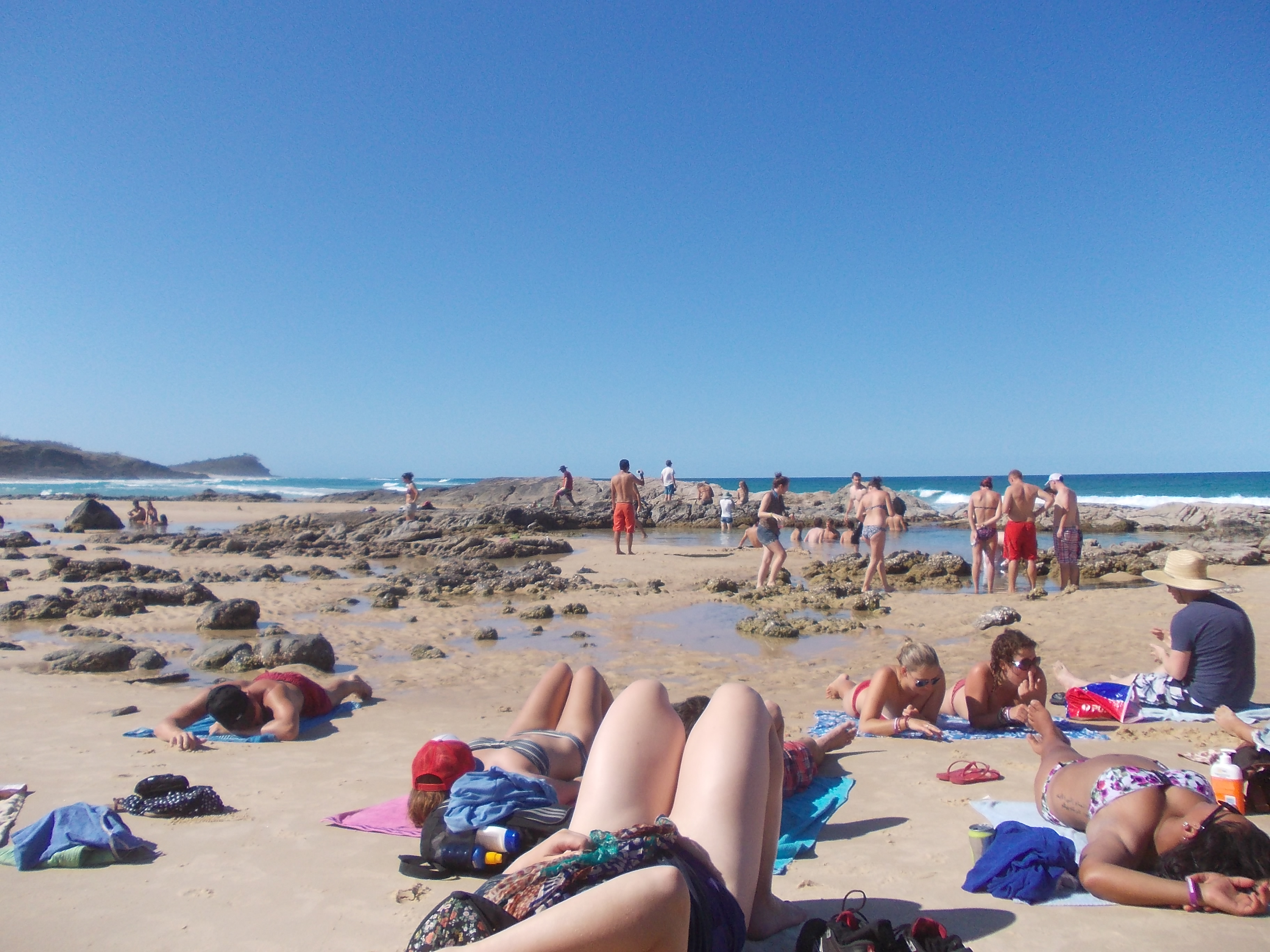
Champagne Pools
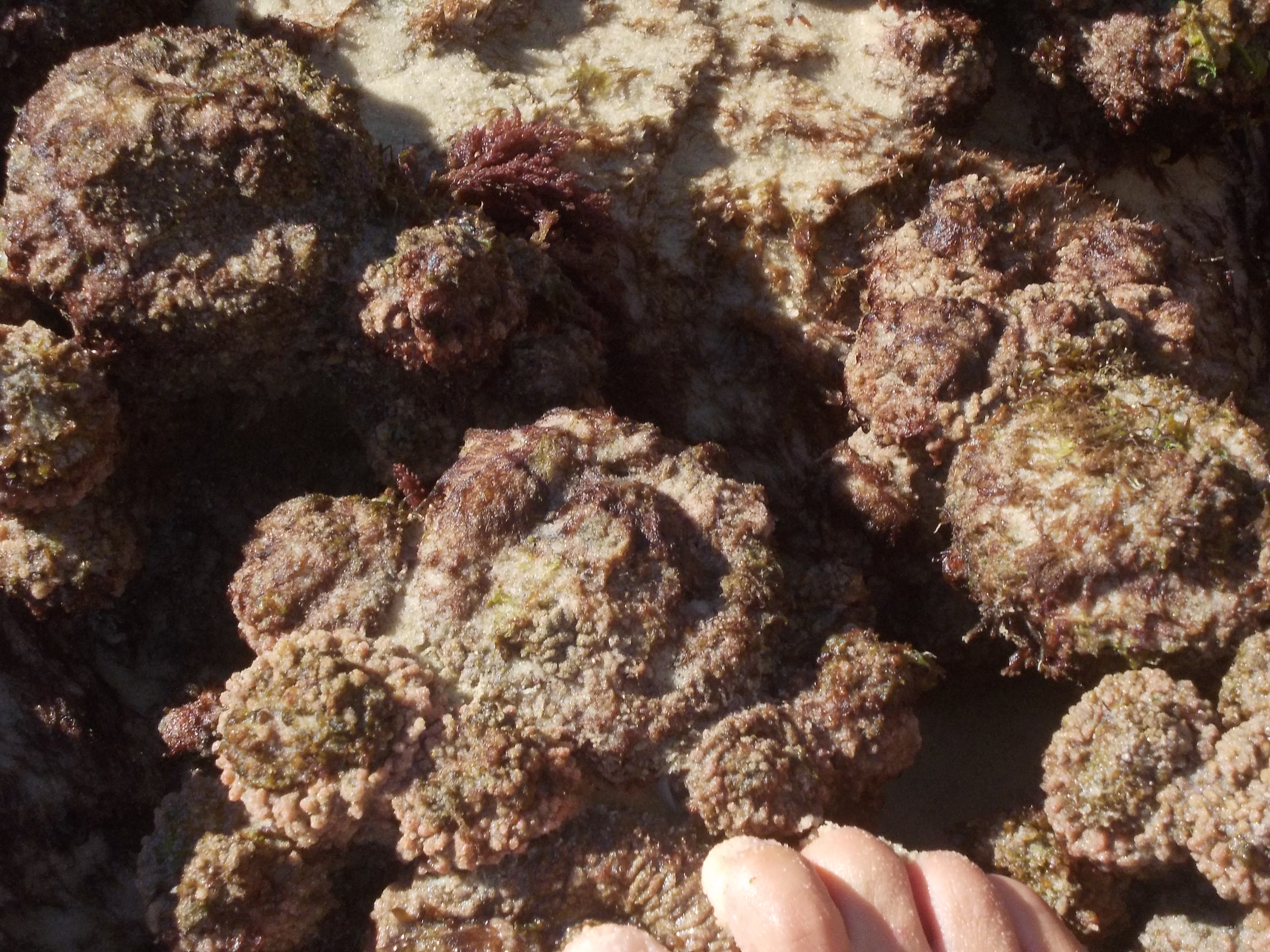
These…algae? were neat–if you pressed your toe against one, water shot out, like a fountain.
Our last stop for the day was Indian Head, which is a strange name for Australians to give a rocky peninsula. (I checked, and apparently Captain Cook called it that for the aboriginals he saw assembled there; they just called every brown person they saw “Indian” back then, I guess.) We scrambled up the hill and looked out to the sea. We saw sea turtles and dolphins, and when I saw people pointing excitedly in the far distance, I briefly saw the end of a tail and a splash from a whale. It was beautiful up there, with the coast curving away in either direction, and sea animals frolicking below, and the sun was thinking of setting so everything started to have that golden glow. We couldn’t stay past sunset because it was hard enough driving those cars in daylight, let alone in the dark, but I bet sunset up there is beautiful.

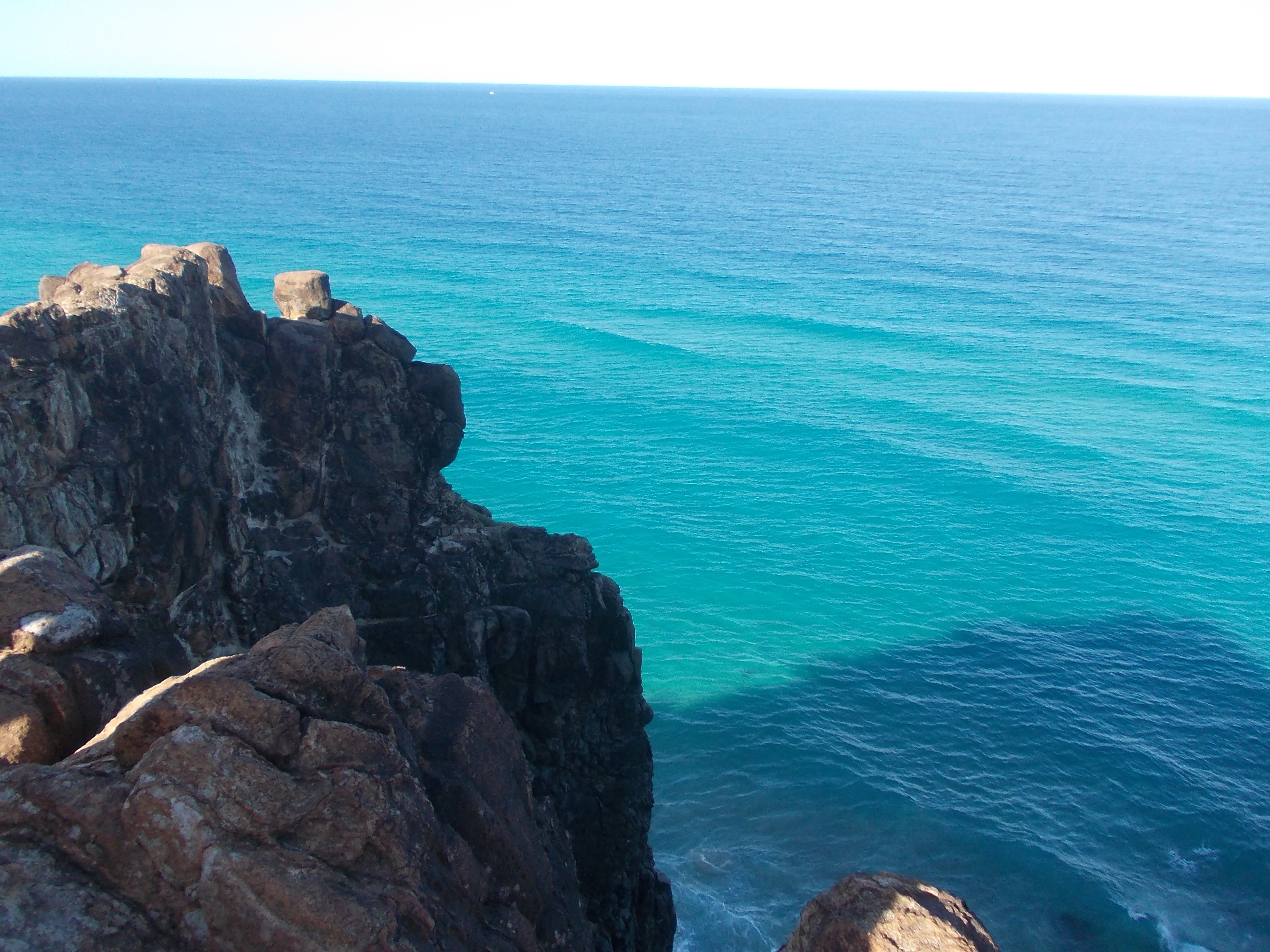
My photos don’t show all the sea turtles and dolphins we saw.
We went back to camp and set up dinner, and that night was more of the same partying. But I found a couple people who wanted to go look at the stars (which were hard to see in the trees of the campground), so we went down to the beach. The stars were amazing! We sat on the cold sand and gazed above us at the endless sky. On the walk back, we were convinced we saw dingoes in every bush and behind every tree, so we grabbed some sticks and hit them on the ground in a futile attempt to feel safer. We survived the trip back, but being that vulnerable in a wild place was wonderfully scary.
The next morning, things finally gelled. Sometimes that’s the way, isn’t it? Things aren’t quite right til the last day. We had a little more rearranging between cars, and now our group had a good mix. One of the new guys and I had talked about music for an hour the night before, so we assigned ourselves co-DJs, and traded our iPods back and forth, picking just the right tunes for the road trip. We stopped at Lake McKenzie, which is apparently a big draw for its clarity and beauty, but frankly (and I swear I don’t do this kind of comparing on my trip, for the most part), Glen Lake is much clearer and prettier. I was happy when we were back on the sand, cruising down the beach and getting the whole car singing along to Queen at full volume. This is what the tour is meant to be like, I’m sure, and I’m glad I got to experience it, and wasn’t left with the grumbling and discomfort that was the driving on the first two days.

No denying it’s pretty–and it was a good swim, too.
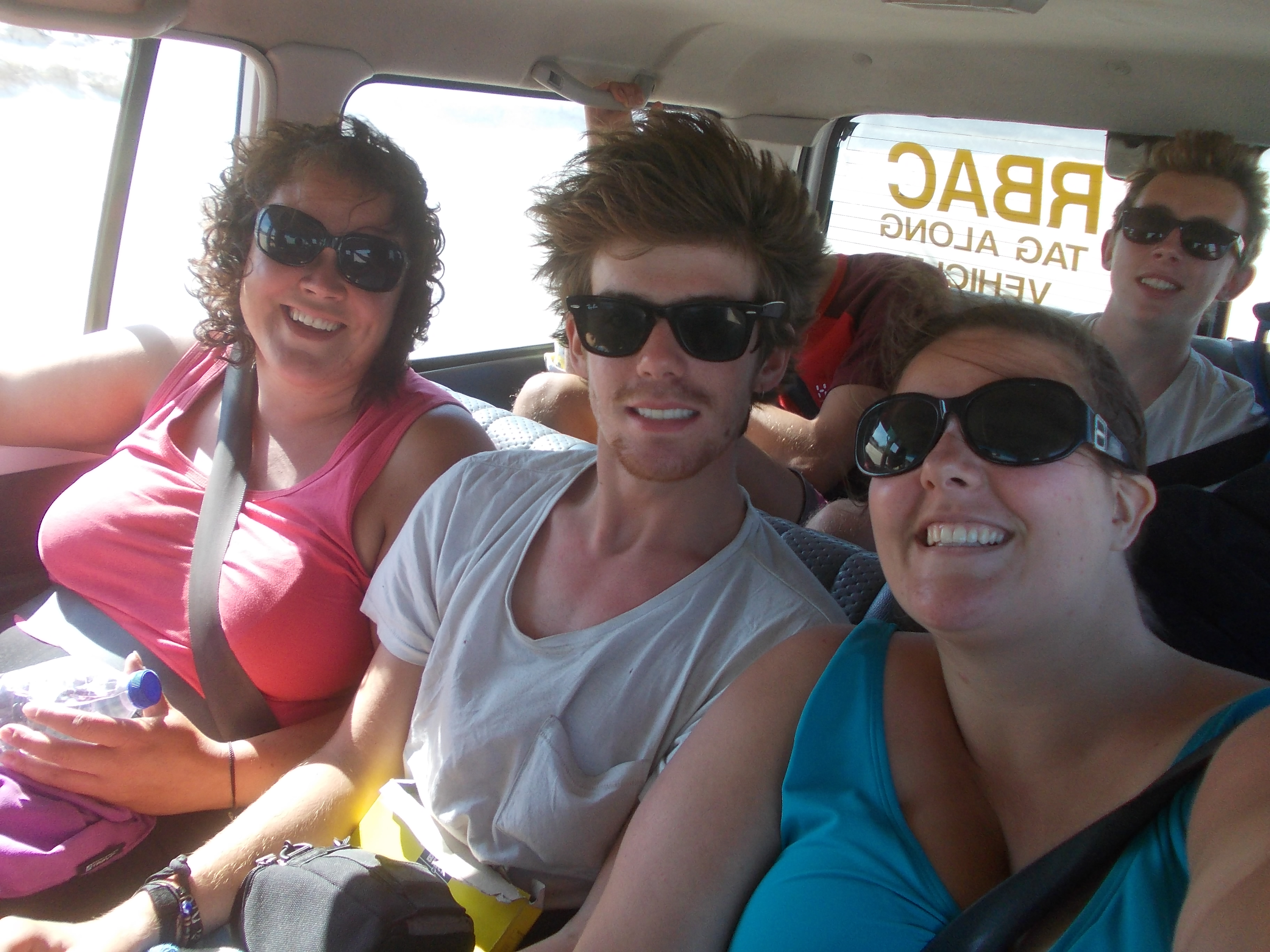
Suzanne, Jack, and me–the DJs of the trip
We missed the first ferry back to the mainland, which turned out to be a great thing. Jack and I put the music on loud and everyone got out of their cars and bopped along. Some guys made a human pyramid. And then we saw dolphins! A few of them, close to shore, jumping the waves over and over again. What a delight.
But the trip couldn’t end on that nice note, of course not. When we were literally two blocks away from the hostel, we got pulled over. The local cop was furious that we had “limbs protruding from the vehicle.” Turns out, that is illegal in Queensland! Each arm hanging out the window (including mine) would cost $120 each, and the loud music might cost the driver $200 too. He kept saying he was “sick and tired of scraping the bodies off the roads,” but I call BS on that. When was the last time someone waving their hand in the wind actually resulted in that hand getting chopped off by a stray tree branch or whatever? Still, we were very contrite, as one is with police, but he was still going to give us a ticket, until he discovered that none of us was an Australian citizen. He knew we had no incentive to pay and he’d never get his money, and clearly decided the paperwork wasn’t worth it. Phew!
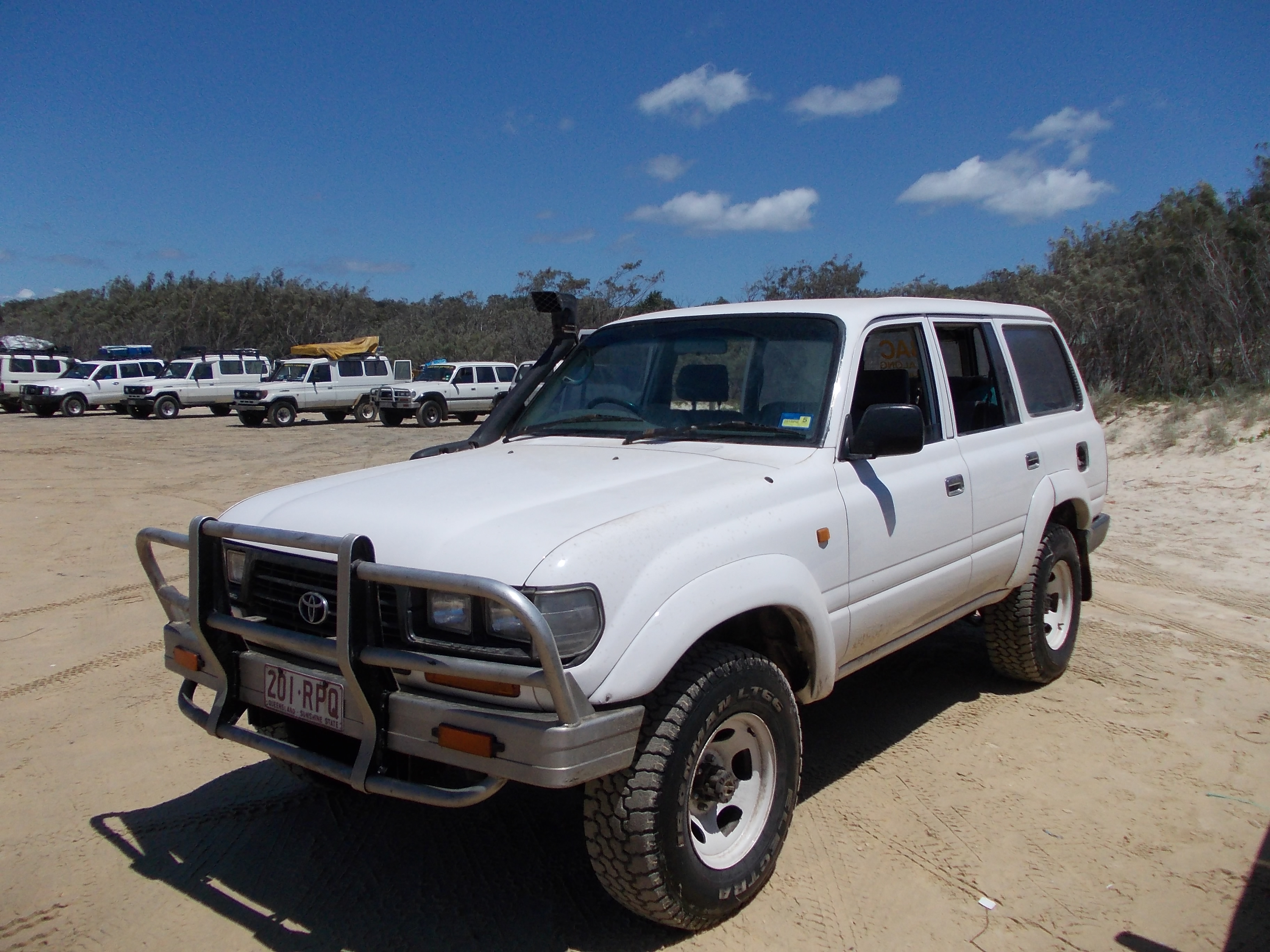
Car 4, best car
I think I would have quite liked doing a similar tour with a smaller group of people, maybe just renting a 4WD with people I knew and liked, and staying in a quiet campsite. Fraser is a beautiful place, and you’re really in the bush for most of it, so if conditions are right, I can see it being a great time—all fun, no frustration.
People often ask me about the bad side of travel—don’t I get lonely, lost, etc.? Of course! It’s not all sunshine and rainbows, and sometimes it’s downright awful. The story below is for those of you who want to hear more about the things that go wrong. It contains no fun descriptions of exciting activities, so if you’re armchair traveling with Stowaway, this one might not be for you.
“If something can go wrong, it will.” So goes Murphy’s Law, which I am assuming is named for some poor guy whose life did not go according to plan. I hope no one actually uses this as a guiding principle in their life; what a sad way to view the world. But sometimes rules prove true even when we don’t want them to, and such was the case for me in a little town called Rainbow Beach, on the east coast of Australia.
Rainbow Beach is one of the towns used as a launching pad to Fraser Island (future post!), and after my exhilarating time in the Whitsundays, I rolled into town on an overnight bus for a couple nights’ stay before going on a tour of the island. I planned to spend the day relaxing, but instead I spent it hyperventilating.
It started out okay. The bus got in at 9, and I had some breakfast, did some journaling, pondered a nap. But my right arm was really sore, and felt more so as the morning went on. Then my right leg hurt. My head was swirling from adjusting to being on land, but now it started to ache too. My chest felt tight. I started to freak out, and then I did something really stupid: I went on WebMD. I know, I know! All it ever does is convince you that your symptoms all point to either cancer or inoperable brain tumors. Self-diagnosis on the internet is a terrible thing. But too late, I’d done it, and I saw the symptoms stacked up under heart attack. I started to seriously freak out. I Googled “Australia health line” and found a number to talk to nurses for advice. (Note to women: Very often, heart attacks start with pain in the right arm in women, rather than the left, as is normal for men. Don’t ignore inexplicable right arm pain!)
Now, through all of this, I’m sitting on a bunk bed while seven other girls are wandering around the dorm room. It felt very strange to be having this private freak-out in such a public place, but there it was. I didn’t have a phone, and Skype wasn’t working, so I asked if anyone had a phone I could borrow. They were all pretty reluctant, which I like to think is because most people have text-heavy plans and not many talk minutes, and not because they were ungenerous. But one girl loaned me hers, and then I had an involved phone conversation about my health with a stranger.
I returned the phone and the girl went to the beach, and then I thought over the advice of the nurse, which was to wait a few minutes and see if I felt better or worse, and if worse, call an ambulance, because it sounded bad to her. After a few minutes, all I felt was more panicked that I hurt in strange places, and I didn’t know anyone, and I didn’t know what to do, and I wanted to abdicate adulthood if it meant someone would take over and make everything better.
I went to reception and asked to borrow their phone so I could call an ambulance. They could not have looked more indifferent when they asked why I needed an ambulance, and when I told them, they informed me that the nearest hospital was almost an hour’s drive away, and seeing as it was a Sunday, the one doctor in town wouldn’t be available. Also, they really didn’t want to loan me their phone, but eventually decided that maybe a potential heart attack was a good enough reason.
I then spent a good ten minutes discussing costs and payment options with the ambulance guys, and finally I decided that if this really was an emergency, I should just treat it as one and not worry about costs right now. So they said they’d be there in about thirty minutes, and then I wanted to call my insurance company collect to make sure it’d be covered, but the woman at reception said I couldn’t use their phone for that, but there was a phone booth up the street I could use.
I was in tears at this point. I thought I might be having a heart attack and I was an hour away from a hospital, I thought I’d have to pay at least a thousand dollars to get checked out, and the reaction of everyone around me was indifference and unwillingness to help. I was astonished at their coldness and felt utterly alone. I was going to be seriously pissed if I died from a heart attack surrounded by these assholes.
And then! A young woman approached me and asked if I was okay. She’d noticed I was crying and having trouble with something at reception, and could she help? God bless Canadians, is all I have to say. This 19-year-old girl dropped everything she was doing and offered to help however she could—come to the hospital with me, loan me her single room for a few hours to relax, whatever. Thank you, Anya, for brightening up that miserable afternoon.
The ambulance arrived, and they wanted to do some tests on site before deciding about hospital visits. By this point, with Anya’s attentions, I was feeling much calmer. I sat in the ambulance and a cute attendant hooked me up to a machine while a giant with a handlebar mustache and a nametag that read “Gorilla” asked me questions. Gorilla decided I was probably just having muscle spasms from running around on a boat and using muscles I don’t normally use, and also that I’d completely fatigued myself with my aggressive travel schedule. The cute guy said all my readings were normal, and Gorilla nodded in satisfaction that the machine agreed with him. The right arm pain, in particular, was from that weird rope-winding machine I’d worked a few times on the boat.
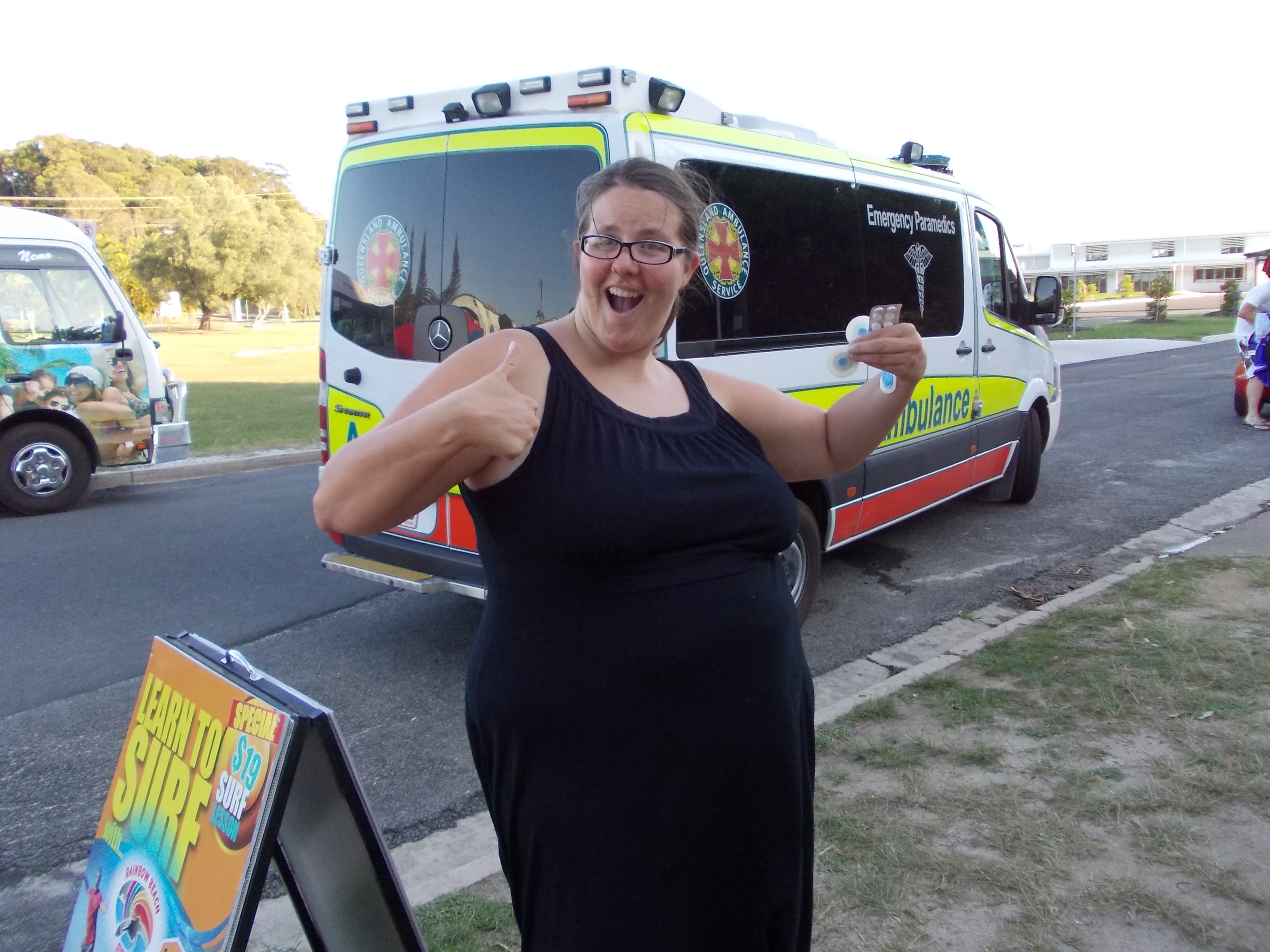
I’m alive!
Okay, so now I felt relieved and totally stupid that I’d overreacted so strongly. It’s amazing how easy it is to get discombobulated when you’re in an unfamiliar place. Sure, I’m unfit, but I exercise sometimes and I know what muscle pain feels like, and this was way different, and also the difficulty breathing was new, so that’s my rationale for freaking out. Gorilla said it was better to be safe than sorry, when it comes to this sort of thing, but now I could just take some pain relievers, drink a lot of water, and rest, and I’d be fine. He said I was okay to go to Fraser Island, which is the only thing I hold against him, because the rough world of Fraser, so soon after this panic attack/muscle spasm day, is probably what pushed my body over the edge to developing shingles. Oh well, I guess that mustache can’t be right all the time.
Hurrah, I was going to be okay! Anya and I went to the ice cream store to celebrate. We took our ice creams to a bench overlooking the ocean and chatted about our travel plans. We went back to her room so she could do some organizing, and after another thirty minutes or so we got up to go to the hostel bar for dinner. I did my usual check through my purse: keys, camera, wallet—WALLET. Where was my wallet?
Oh shit oh shit, I must have left it at the bench overlooking the ocean. I always take my purse with me places, but this time I’d just taken the wallet, and I’d put it down on the bench to eat my ice cream, and I had no memory of picking it up again. Oh shit oh shit. I ran to the bench, but nothing was there. I asked at the few stores open near the bench, but no one had turned in a wallet. If I wasn’t having a heart attack before, I might have one now.
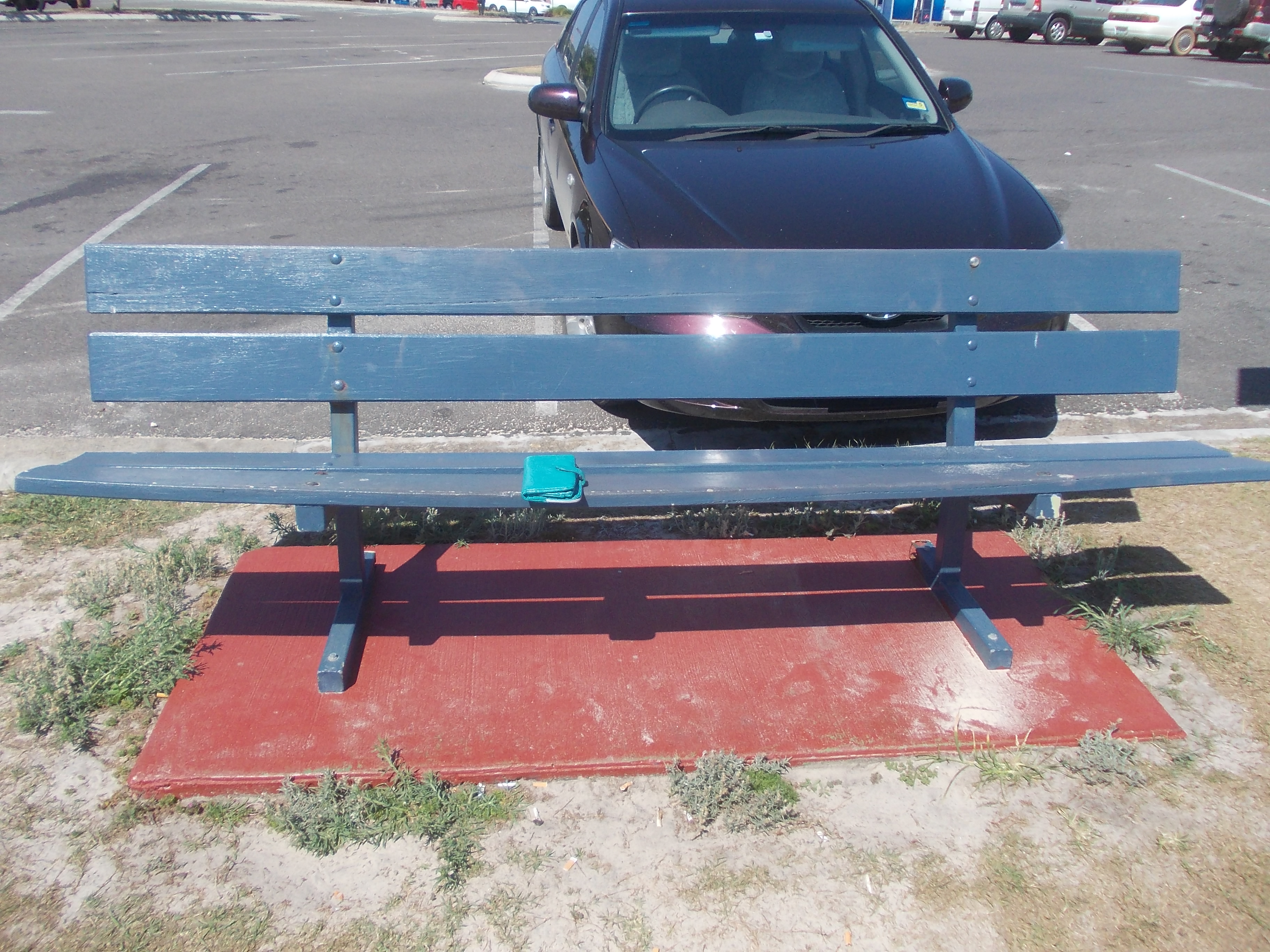
Abandoning my wallet
I went back to the hostel and told a hopeful Anya that it was gone. Happily, I knew enough of long-term travel to have separated out my back-up credit card in a different bag, so I wasn’t stranded with no means of getting money. I used the card to order dinner, and afterward I went back to reception to borrow their phone again. They love me there.
Once again, they didn’t want to loan me their phone, even when I explained I had zero money so I literally could not use the pay phone. I assured them I’d be calling a toll-free number to report a missing item. (Queensland has this thing where you can report a crime with the main number, and they tell all their stations, so if something relating to your case happens a few towns over, they’ll know to contact you, which is cool.) They tried to reassure me that when the local police find things around town, they go to the hostels and see if they belong to anyone there, so probably they’d come by in the morning with my wallet, if it was going to be found at all. I said that might be true, but it couldn’t hurt to file a report so the police had all the information they needed. Reluctantly—they wanted to go home—reception let me use their phone.
I filed my report and went to bed sore, tired, and angry. Angry at reception for being unhelpful jerks, angry at myself for misreading my body’s signals and for being so stupid as to leave my wallet on a public bench, angry at whoever stole my wallet. The day had gone from bad to worse, and that was my fault, which was even worse.
The next day dawned brighter and better. Someone had turned in my wallet, with everything still in it, down to the last dollar. They’d turned it in to a town several miles away, which meant that it was a good thing I’d ignored reception, because the police several miles away wouldn’t have thought to tour the hostels in Rainbow Beach to find the wallet’s owner. As it was, they only knew where to find me because I’d filed the report and left the hostel’s number, and they called to let me know—so I used reception’s phone again, ha!
When the cop delivered my wallet to me a few hours later, I could’ve kissed him. I wasn’t going to die of a heart attack, I wasn’t going to be destitute in Australia, and I was ready for my next adventure.
When traveling the backpackers’ circuit of the Australian east coast, one of the things one does is sail in the Whitsundays. It’s like taking the waters in Bath or catching a Broadway show in New York—you have to splash out a bit for it, but darling, you simply must. I did not know this was the case until I got to Australia, but I soon learned this was the general opinion, and I did a little research to see if it seemed worth the cost. I got a good deal by booking with the Oz Experience ticket (with the same woman who sent me to Magnetic Island), so then it was just a matter of “will the weather hold?” and “will I get seasick?”
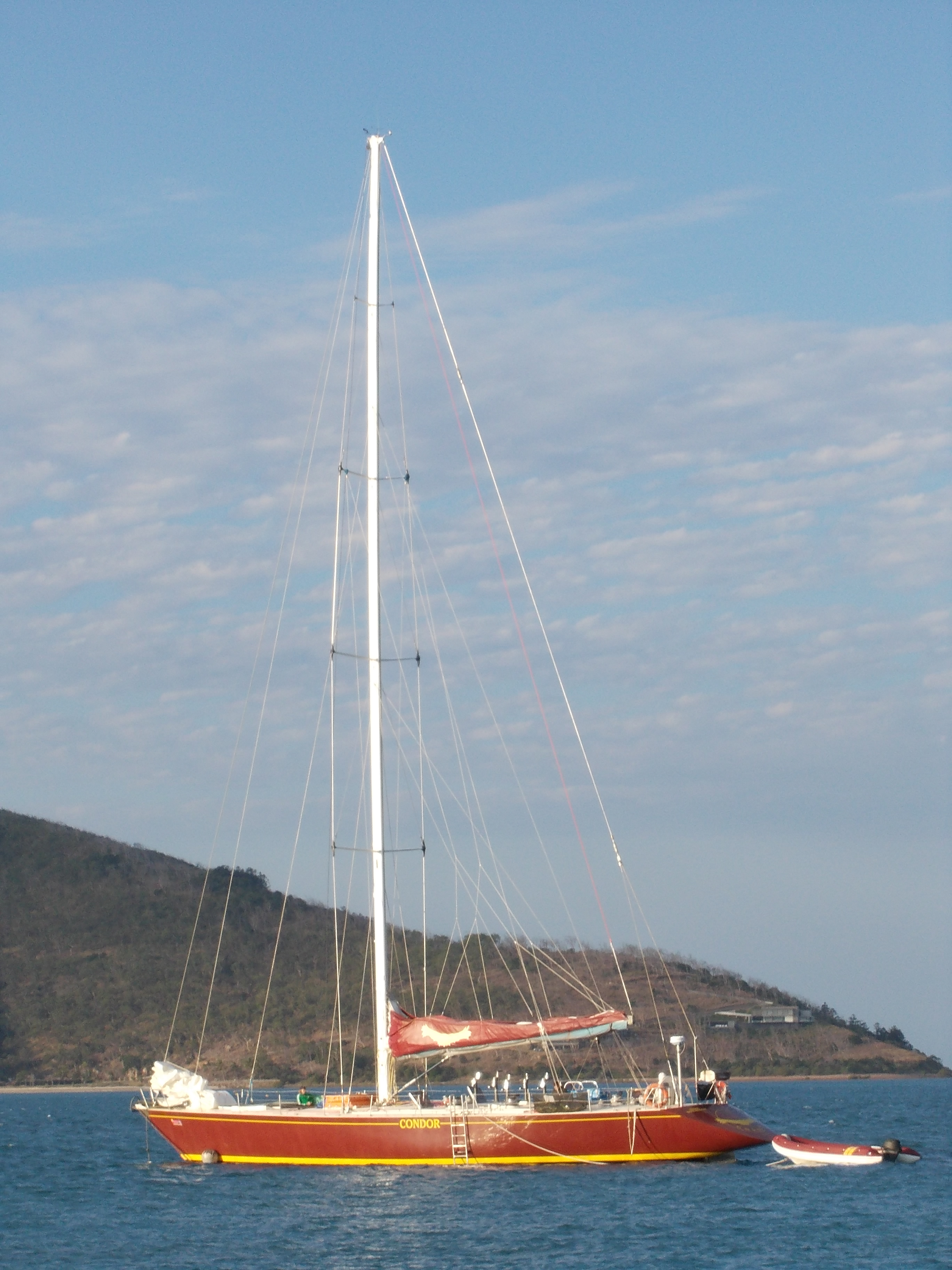
The Condor in the waters of the Whitsundays, off the east coast of Australia
I am pleased to tell you, dearest fellow travelers, that it did hold and I did not feel ill. In fact, what with the wind in my hair and the sun on my face and the water sparkling on all sides, I felt fantastic. I spent two days and two nights on board a former racing sailboat with four crew and twenty-five fellow tourists. It was one of my favorite experiences in Australia, and I see now why darling, you simply must.

Sail’s up, let’s go!
The boat, called the Condor, had won races in its prime, and the crew was fond of mentioning this fact. They had fun taking us along the established route, but it was clear that they all aspired to work on a racing vessel someday. The boat is made of a material that was new at the time—Kevlar, the bulletproof armor cops wear. It’s a heavy steel, and they used a lot of it. Basically, we were all set if we got in a chase with gun-toting pirates.
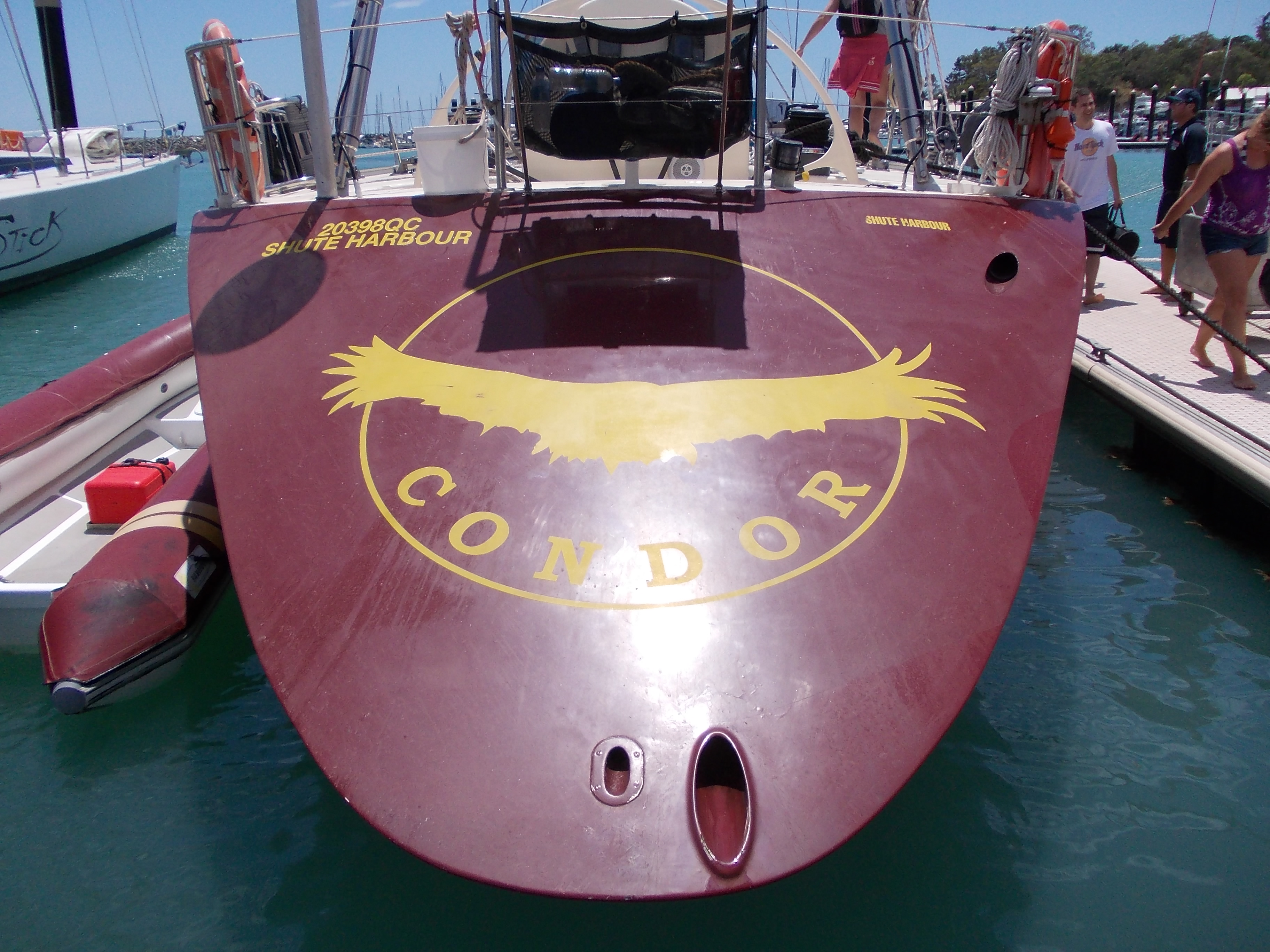 Happily, our trip was much more tranquil than that. We boarded in the early afternoon, claimed spots to sleep, and then went back up top to watch the world float by. We didn’t sail for the whole time; in fact, quite a bit of the time, we were motoring to specific destinations. But when we did sail, oh man! The crew could have done it all themselves, but they let us pitch in. Some people pulled on the mainsail and the topsail, and the rest of us furiously turned some machinery to tighten up the rigging. Then we’d be told which side of the boat was safe to be on—called the “upwind” or “windward” side because that was the side tipping up in the air rather than down in the water, based on wind and our position in the water—and we’d hang out there as we sliced through the sea.

A sailor’s life for me
The first day, we sailed to Tongue Bay and put in anchor for the night. Several other boats had the same idea, and as the sun set, the lights from all the boats glowed brightly until the stars came out, and then they were brilliantly outshone. People wandered around the boat, drinking wine, watching a dolphin play in the light off the stern, lying back and stargazing. I bundled up and chatted with a couple friendly women as we stared up at the sky. I wanted to stay there all night, but it eventually became too cold, so we all went down below, and balanced on our little bunks as the ship rocked us to sleep.
We were up bright and early the next day, and after breakfast, we got in the dinghy we’d towed, and we were ferried over to the island nearest us. We went on a short bushwalk up to a lookout point, and voila! Whitehaven Beach spread out below us. This beach has some of the whitest, loveliest sand in the world. It’s 98% silica, so for some time, people took the sand to make glass products with. Now it’s protected, which is a very good thing, because the local rocks don’t have any silica, so the sand probably blew over here years ago and it’s likely more can’t be made. What you see is what you get, here.

Looking down at Whitehaven Beach
 We walked down to the beach, dumped our things in a central pile, and spread out. Some people went to take jumping photos, the few couples with us wandered off for a romantic stroll, and I walked along the shore looking for stingrays. They float very near the shore, and although it’s hard to tell from my photos, I did see several of them. I walked almost all the way around the point (it was pretty big), and admired the brilliancy of the water, the sky, and the bright white sand. It was like a postcard of paradise had come to life, and just sparkled in the daylight.

Stingray, just floating along
Once we were back on the boat, we raised anchor and made our way toward Luncheon Bay. On the way, appropriately, we had lunch, and we watched the crew feed sea eagles. Once we got to the bay, we donned our stinger suits (because Australia is always trying to kill you) and grabbed snorkels and goggles. The dinghy took us close to the shore of this island, from which you can see the smallest lighthouse in Australia. Once we got to the reef, the crewmember cut the engine and we all fell with purpose straight into the water.
The reef here was the same Great Barrier Reef that I’d seen up in Cairns—it is 1,600 miles long, after all—but I preferred snorkeling in Cairns. The water was cloudier here, and there were way more people in the water with me. Also, importantly, the crew hadn’t briefed us on how to safely be near coral here, as they had in Cairns. I saw a man stand on coral while he adjusted his goggles. I told him he couldn’t do that, that he was causing irreparable damage to the reef, and he just looked annoyed with me. That’s why the crew needs to say these things, so they’ll get taken seriously and thus help protect the reef we’re all admiring.
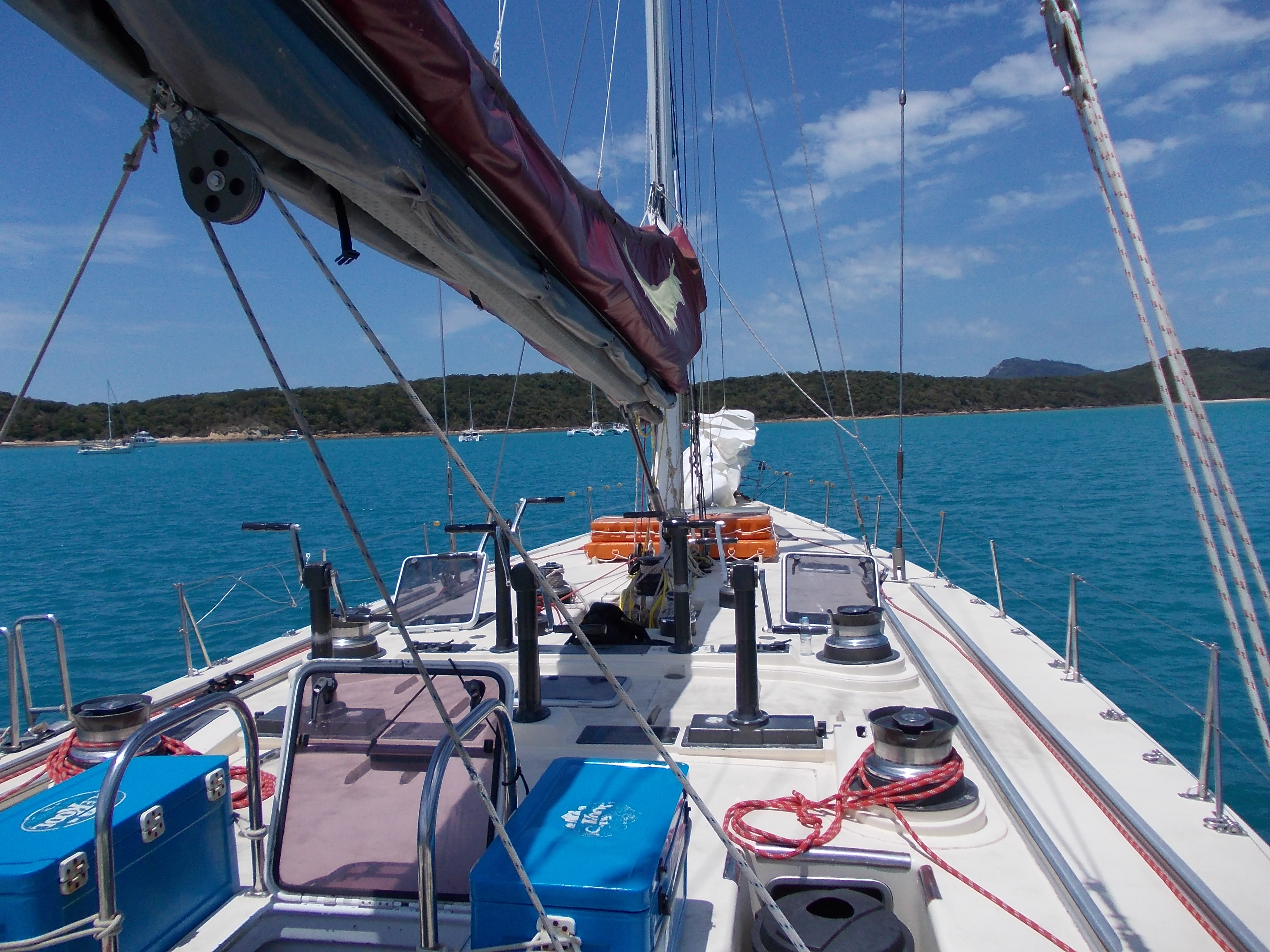
The deck of the ship
After our snorkel, we sailed around to Langford Sandbar. The dinghy took us out to the sandbar, which only had one other large group, as well as a few couples who were probably highly annoyed at the intrusion. We brought nachos that the crew had made, and snacked on those while the sun started to set. (I say nachos, but please understand that these in no way resembled nachos that you might find in the United States, other than the base of tortilla chips and the addition of some sort of cheese. Still, they were fairly tasty.) We took some group photos and raised a glass of wine as the sun set.
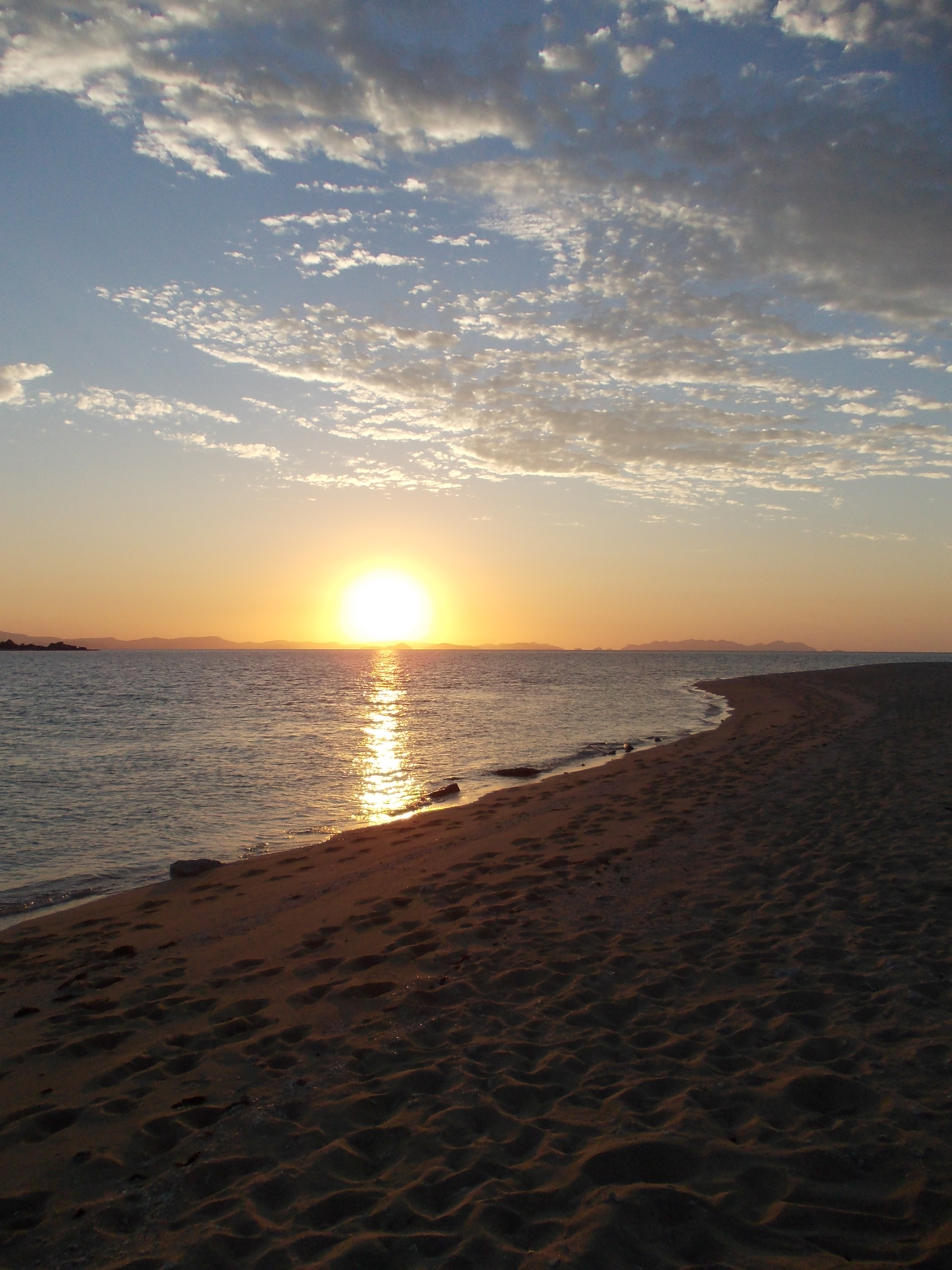 That night was a party night. It’s a strange thing to drink a bit too much wine on a boat in the ocean. You still feel expansive and invulnerable, but a little less so, since two thin wires around the edge of the boat are all that keep you from falling into the black water and the nocturnal sharks therein. So we stayed in the middle of the boat and bonded over drinking games I haven’t played since college.

I may have tried to get a dance party going.
The next day some people did a morning snorkel, but others of us read and sunbathed in the already fierce morning light. Soon it was time to raise anchor for the last time, and the crew got excited because the wind was up in just the direction they wanted it. We set the sails and all sat upwind side, and only just in time, because that wind was strong. I hadn’t actually had a chance to fling my legs over the side, so for a good portion of the sail back I was bracing myself between something holding coiled rope and a rail bracing another length of rope, which was scary because the boat must have been at least at a 45 degree angle, and if I let go of either my hand or my foothold, I’d go straight down the boat and into the water.
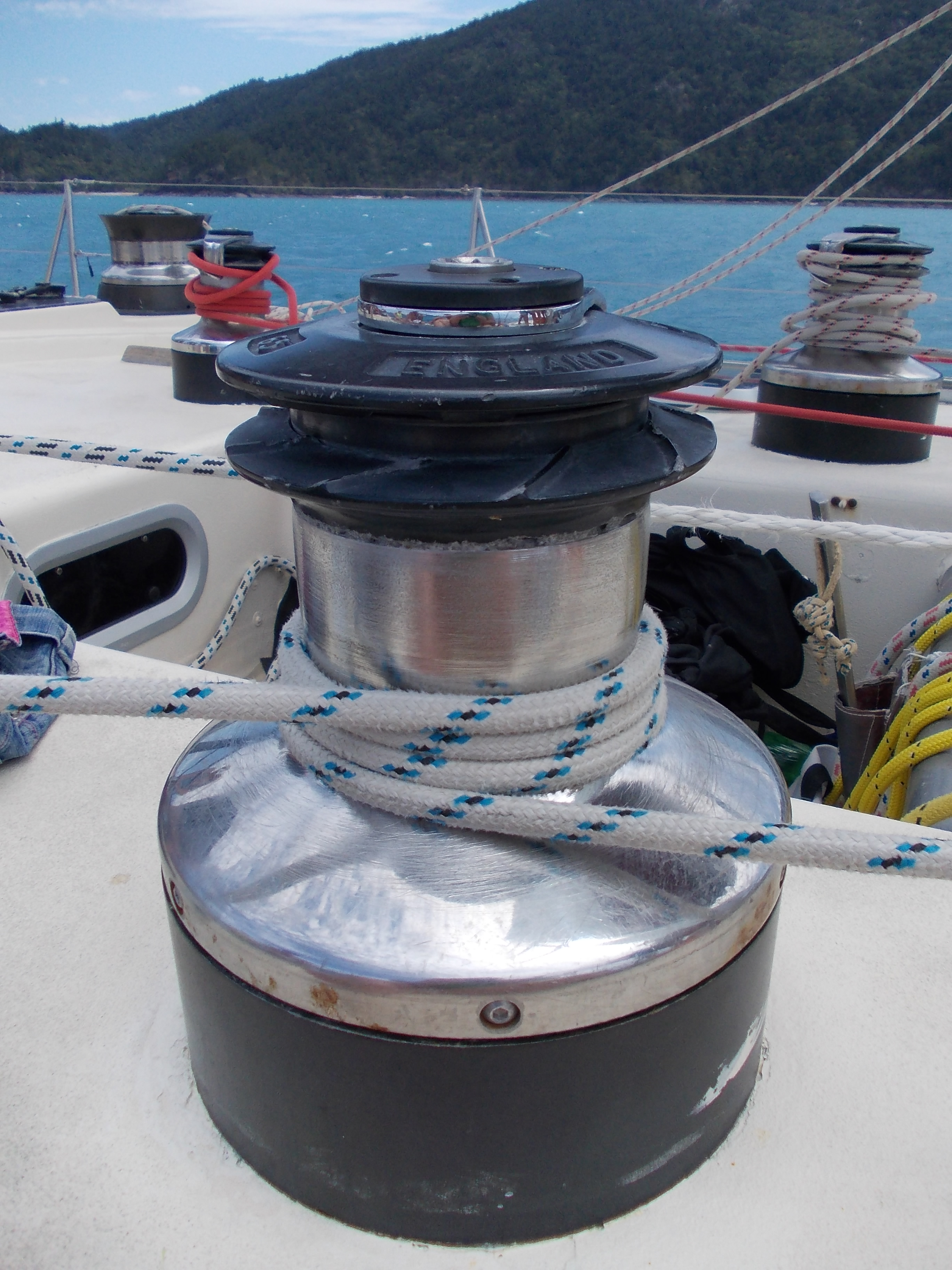
Bracing myself against this for a good 30 minutes
Once I did get more securely settled, though, it was pure bliss. All we heard was the wind whipping the sails, the waves slapping the boat, and passengers occasionally screaming as the spray flew high. I felt free and peaceful. I can see how people structure their whole lives around this feeling.
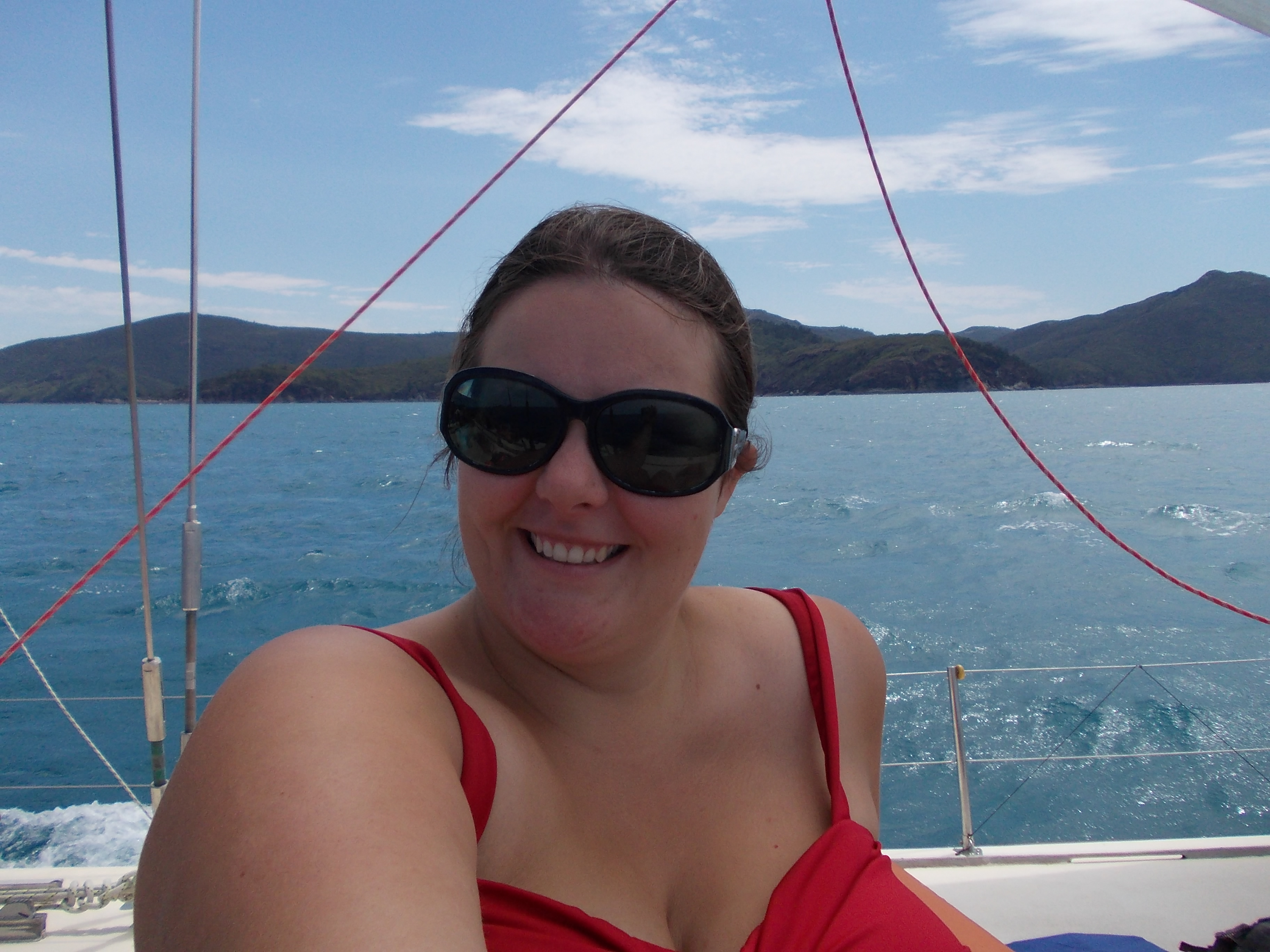
Blissful
I walked around with the sea sloshing about in my head for the next few days, and I was a bit shaky on my feet for a little bit, but I didn’t care. I even had to doze on an all-night bus ride that night rather than sleep in a proper bed, and I wasn’t bothered. I had sailed, and darling, I simply must do it again.


Trash can in Melbourne
Do you think the city workers who commissioned this trash can ever saw the movie Do the Right Thing? Because the irony of putting that phrase on the trash can (which set it all off) is killing me.
One of the most surprising sights to me in New Zealand wasn’t the fiords or the beaches or the hobbits—it was the deer farms. In Michigan, deer are wild, a bit too numerous for the health of the plant life, and hunted every year. Here, they graze in paddocks next to cows and sheep, they’re sometimes cross-bred with elk, and they’re used commercially for their meat and velvety antlers.
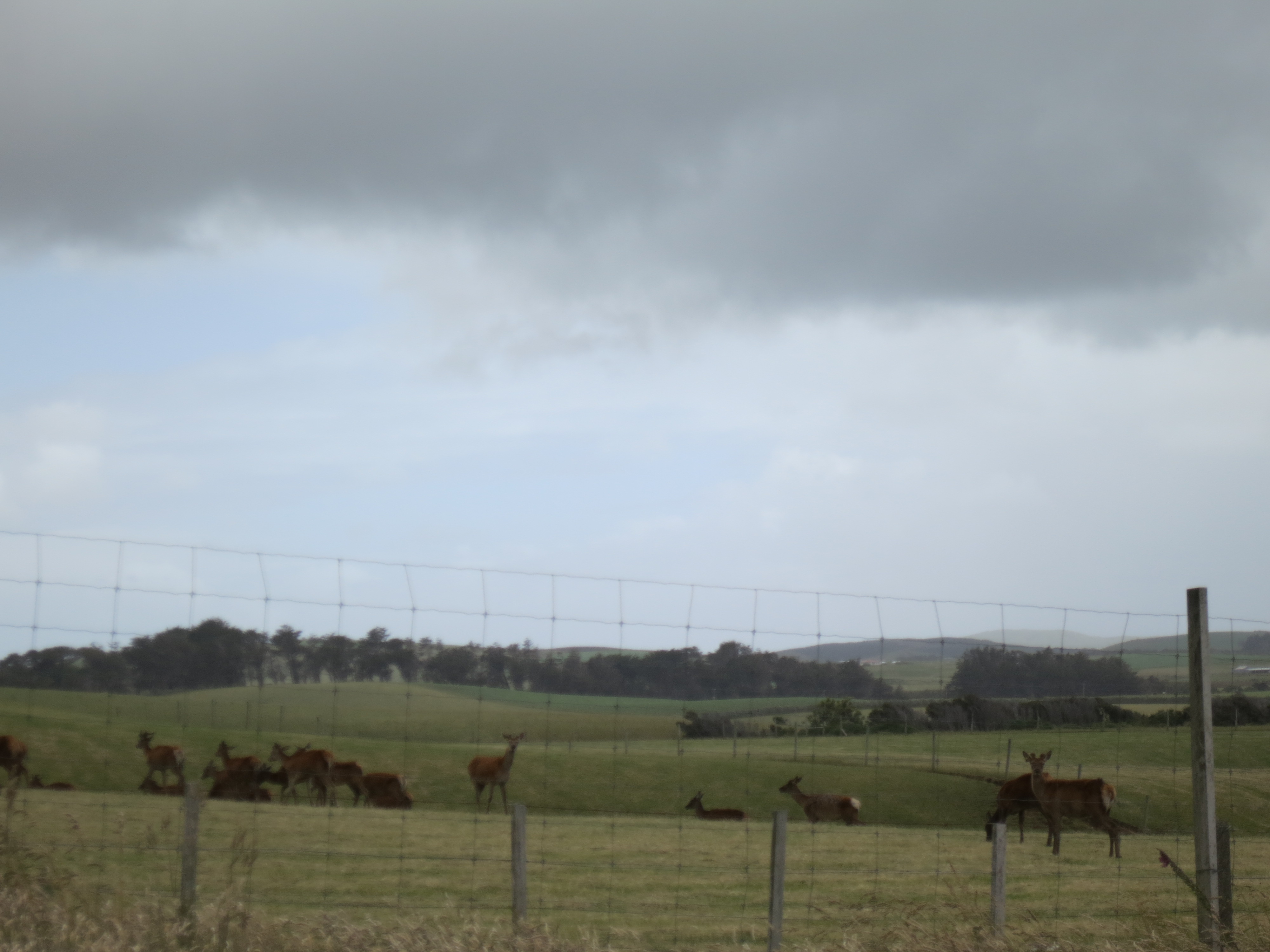
They’re not totally domesticated–they were all super aware of me, and they moved to the back of the field as I approached the fence with my camera, whereas cows and sheep just chew their cud at you.
Turns out, it wasn’t always this way. Like just about everything else in this country, some idiot Europeans introduced the species, and they got out of control (see: rabbits, stoats, ferrets, possums). Red-tailed deer were imported to the forests in the mid-1800s for pleasure hunting, but they ate and trampled all the plants. By the 1920s, the government agreed that they were a pest, and they built a series of tracks and huts throughout the country to encourage hunters to stay out for weeks at a time and kill as many deer as they could. So some of the extensive walking trails in New Zealand are the result of government trying to fix a problem they should never have allowed in the first place. Sometimes good things come from bad things.
Rainy shot of grazing deer
By the 1960s, the price of venison skyrocketed, and helicopter pilots got involved. They originally dropped people in the forests to collect the carcasses left by other hunters, but with the price of venison so high, too many people got involved, and pilots started shooting at each other. So the new goal became to capture the deer alive and establish deer farms. At first, they dropped men down from helicopters onto the backs of running deer, and their goal was to wrestle the deer to the ground and tie it up (they called this “bulldogging”). Whoa! But then they started using tranquilizer darts and net guns, and this was more effective.
There are still wild deer up in them thar hills, but for the most part, deer are now a farm animal in New Zealand. Rather than a rare sighting on the side of the road at dusk, grazing deer are part of the landscape here.
Blurry shot from the bus
My Milford Sound tour guide piqued my interest in the deer of NZ, and I used this site to get my facts straight.

Auckland, New Zealand; November 28, 2012
 Stowaway Travel Writing & Editorial Services