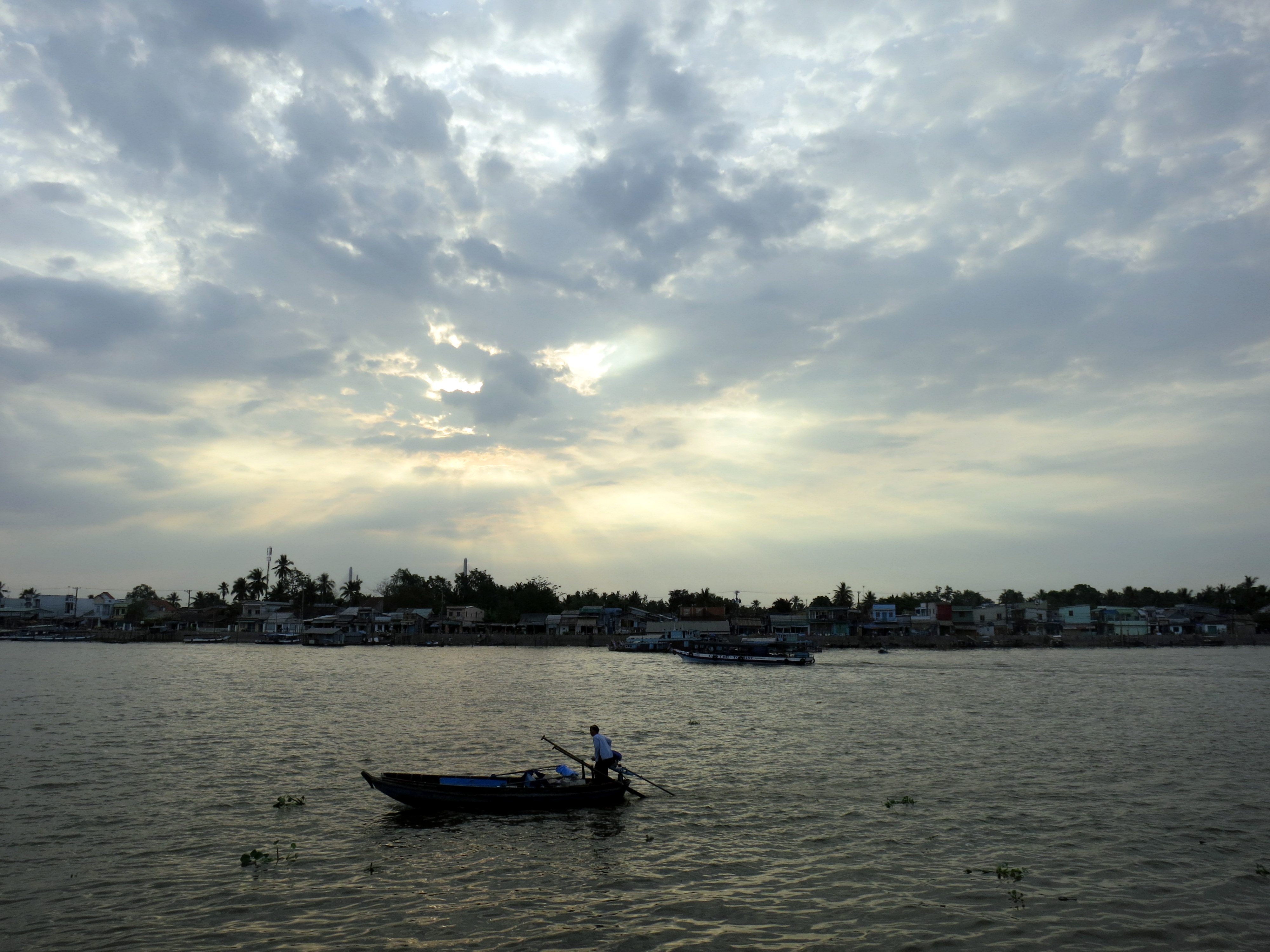
Sunrise, Can Tho, Mekong Delta, Vietnam
Sunrise, Can Tho, Mekong Delta, Vietnam
Hello dearest fellow travelers! I’m writing to you from a guesthouse in Hoi An, Vietnam, and I thought I’d update you on how the trip is going so far. (We’ll get back to in-depth posts for each place I’ve been, in chronological order, next week.) Here’s where I’ve been and where I’m going through the end of next month:
September 2012: Hawaii & Australia
October & November 2012: Australia
December 2012 & January 2013: New Zealand
January and February 2013: Thailand
February 2013: Singapore
March 2013: Laos and Cambodia
April 2013: Vietnam and Japan
May 2013: Japan and England
June and July 2013: Eastern Europe
mid-July 2013: Back in the States!
 I’ve hiked on a glacier in New Zealand, snorkeled in the Great Barrier Reef, swum with dolphins at Kaikoura, bathed elephants in Thailand, cruised on the Mekong in a slow boat, scrambled on the temples at Angkor, and crawled through the Viet Cong tunnels in Saigon.
I’ve made friends in every country I’ve been to, and I’ve visited old friends along the way. I’ve eaten food I’d never seen before. I’ve bargained for wedding presents at night markets. I’ve clung to the edge of a motorbike, stood in the back of a pickup, and jolted along in a tuk-tuk. I’ve had a few epic nights and a lot of relaxing days.
I’ve also had some not-so-great times. I got shingles in Australia and concussions in New Zealand. Last week I was hit by a car in Nha Trang, Vietnam. I was flung backwards into a pot of boiling water, which burned my thigh and some of my back, and a mystery object stabbed my calf, leaving a deep wound. I’ve had a tetanus shot, stitches, and enough antibiotics to make me fit for eating (political joke!). The healing process is very slow and I’m real shaken up. I’ve moved up to Hoi An to rest and recover, and will probably move on again in a couple days.
Tomorrow is my birthday. I’ve said for ages that I wanted to start this trip before I turned 30, and I did it. I have to say that I didn’t think I’d be spending my 30th popping anti-inflammatory pills and seeking out plain foods–I mean, 30 isn’t that old, right? But here I am, and while on the one hand I feel very alone and sad for myself, on the other hand, the magical internet means I can talk with my family on my birthday, and pretty soon I’ll feel well enough to be able to go out and enjoy the sights of this city (another World Heritage site, incidentally).
So that’s where I am and what I’ve been up to; I hope this round-up was helpful (and brief enough) for those of you playing along at home. If you’re in the States, I hope to see you this summer when I come back for my friend’s wedding. If you’re somewhere else in the world–when can I come visit?
As ever, thanks for reading, and have a great weekend.

Still searching out new horizons
You’re supposed to sing to them, and dance. Slide into the cold water in a thin rubber suit and flap your finned feet until you’re beyond the noise of the people still on the boat. Fit your mask tightly to your face and dive in to the open ocean. Watch the world around you turn a cloudy blue, deeper than you expected or can really imagine. You are over a major oceanic trench that plunges toward the earth’s core, and that kind of depth is beyond imagination, or maybe at the borders of it, where krakens lurk.

Kaikoura, New Zealand
Before the creatures of the deep can fully emerge in your mind, recall the instructions of the skipper to attract the animals you’re here to see: Make high-pitched noises, like singing, and move your body around in circles, like a dance. Be entertaining or they’ll tire of you quickly. This early-morning hour is neither feeding nor sleeping time for them; it is devoted wholly to play, so play with them. So you squeak a few times and wave your arms, and suddenly–it is so sudden you wonder how you could have not seen them before–there are six, seven, eight of them, swimming next to you.
Dusky dolphins glide past you, above you, below you. Your jaw drops and you sputter as the snorkel fills with water. You surface, drain, and dive back down, and you could easily believe that their open mouths mean they’re laughing at you, but you can’t blame them. They’re made for this world, their smooth skin the same blue-gray of the water, their sleek bodies small and flexible in the rough waves of the Pacific. You’re just visiting.
 You hum tunelessly, a high soprano song that seems to entertain. A dolphin moves to your right in a tight circle around you, and you spin with it, making two full circles before you get dizzy and the dolphin swims off, laughing again. Another one immediately swishes up and moves to the left, and you’re off again. Don’t try to get too close, don’t try to touch something this wild and free. They’ll leave if you do.
 A dolphin swims directly toward you–you’re staring straight into its eyes as it rushes forward–and leaps to the side just before your noses touch. Grin widely as dolphins wriggle below your feet and barrel-roll near your torso and jump in the air above your head. You are surrounded by dolphins, enveloped in their joyous movement.
Feel entirely calm amid the flurry of activity, as if time hasn’t stopped so much as it has slowed enough for you to appreciate each fin-flick, each shimmer of gray-black skin. You hardly feel your own body, buoyant and smooth in the water. You make no wrong moves here as you do on land. Your body floats easily among the dolphins, in the blue-green-gray water, as if it belonged there, as you have always suspected it might.

Hum “Ave Maria,” one of the loveliest songs you know and also one with a lot of high notes. You float in what you know to be saltwater, but with Schubert thrumming in your head and evolution’s best moment swimming graceful circles around your swaying body, you could easily believe yourself transported somewhere not of this world, or maybe somewhere that distills the best parts of this world into perfect beauty and peace.
Physically touch your chest to feel your heart beating, to hold to your heart this moment and all the grace it contains. Your body sustains the vibrato of the hymn, your eyes fill with your own saltwater, and it is too much, and it is just enough, and you are sharply conscious of thinking, “I am happy to be alive.”


Siem Reap, Cambodia; March 20, 2013
It’s a peculiar thing to visit a place still recovering from a natural disaster. Khao Lak was badly hit in the tsunami, but by the time I went there, it was built back up again and was a thriving tourist town. Christchurch, on the other hand, is far from reconstructed. The earthquake of February 22, 2011 hit the town center hard, and a huge part of downtown is completely shut off as workers dig up the rubble and reinforce the remaining buildings against future earthquakes.
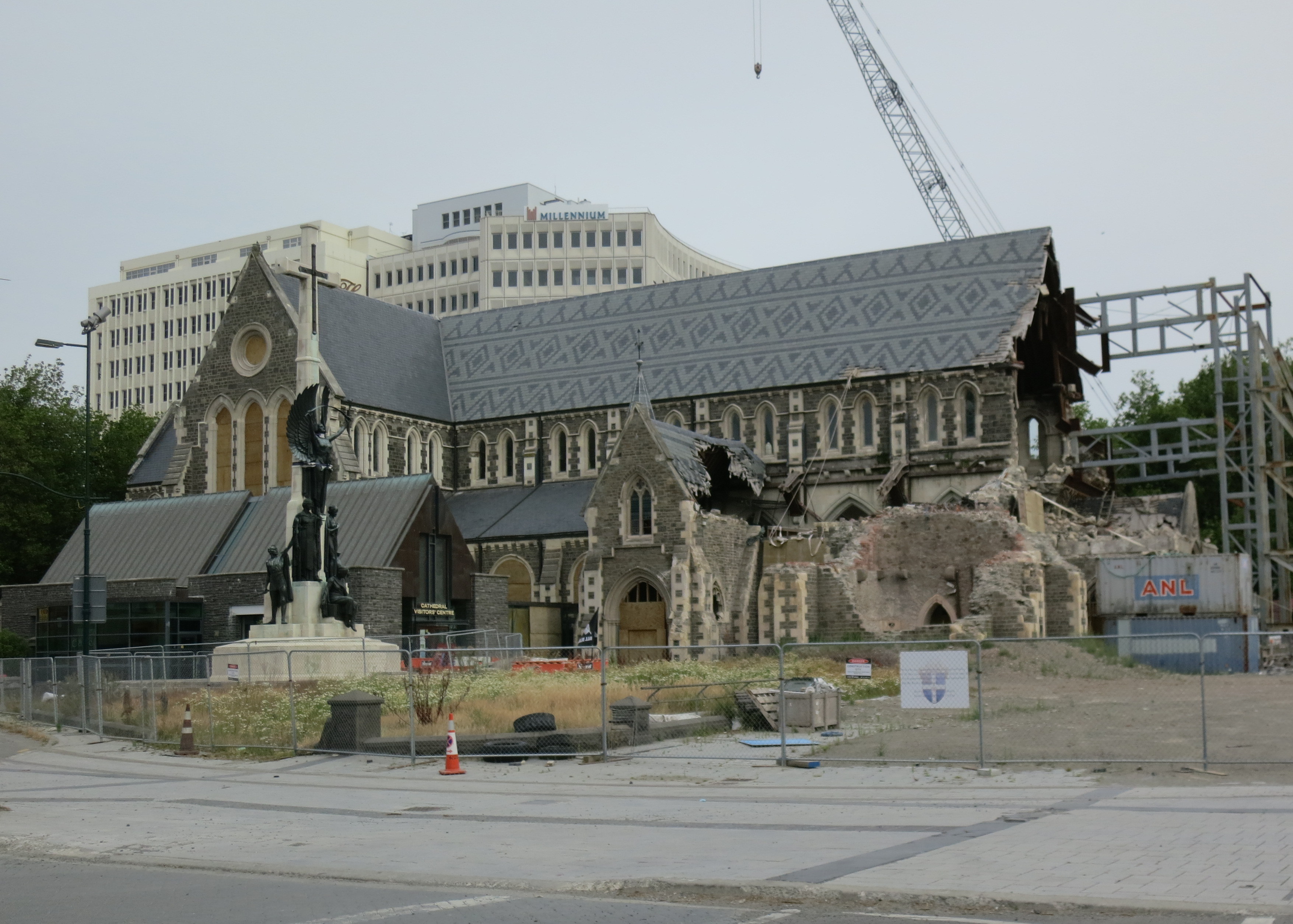
Central Christchurch
Walking past the no-go zone is eerie; shops have been left just as they were on February 22. The neon sign for an Italian restaurant lay tipped over in the overgrown grass, and weeds poked through the pavement on a walking street that no one’s walked on in two years. I looked through the smashed window of a barbershop and saw a perfectly preserved mirror and a chair facing the outside, as if someone had been in the middle of a haircut and turned to see what that rumbling sound was.
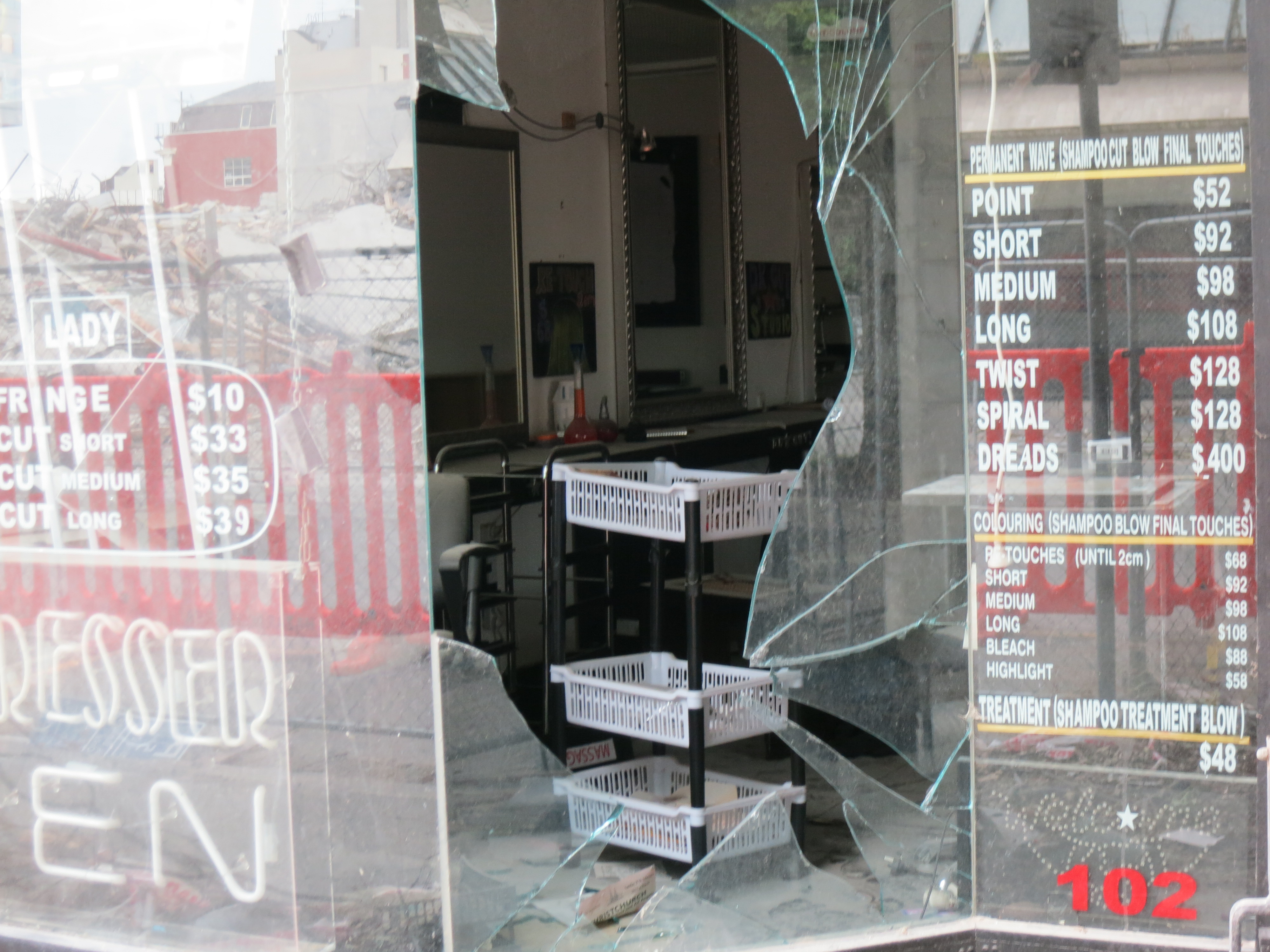
A modern-day Pompeii
There’s a lot of controversy about how to rebuild the city, in terms of how funds are allocated and which neighborhoods get priority. Condemned buildings stand alongside brand-new constructions (which actually reminded me of some neighborhoods in Chicago that are gentrifying quickly). Insurance companies were apparently unable to pay out to everyone who was affected, and anyone who wants to buy a house now can’t even get earthquake insurance. So you invest in the city’s recovery, but you can’t get protection for potential damage to that investment. Not a great situation.
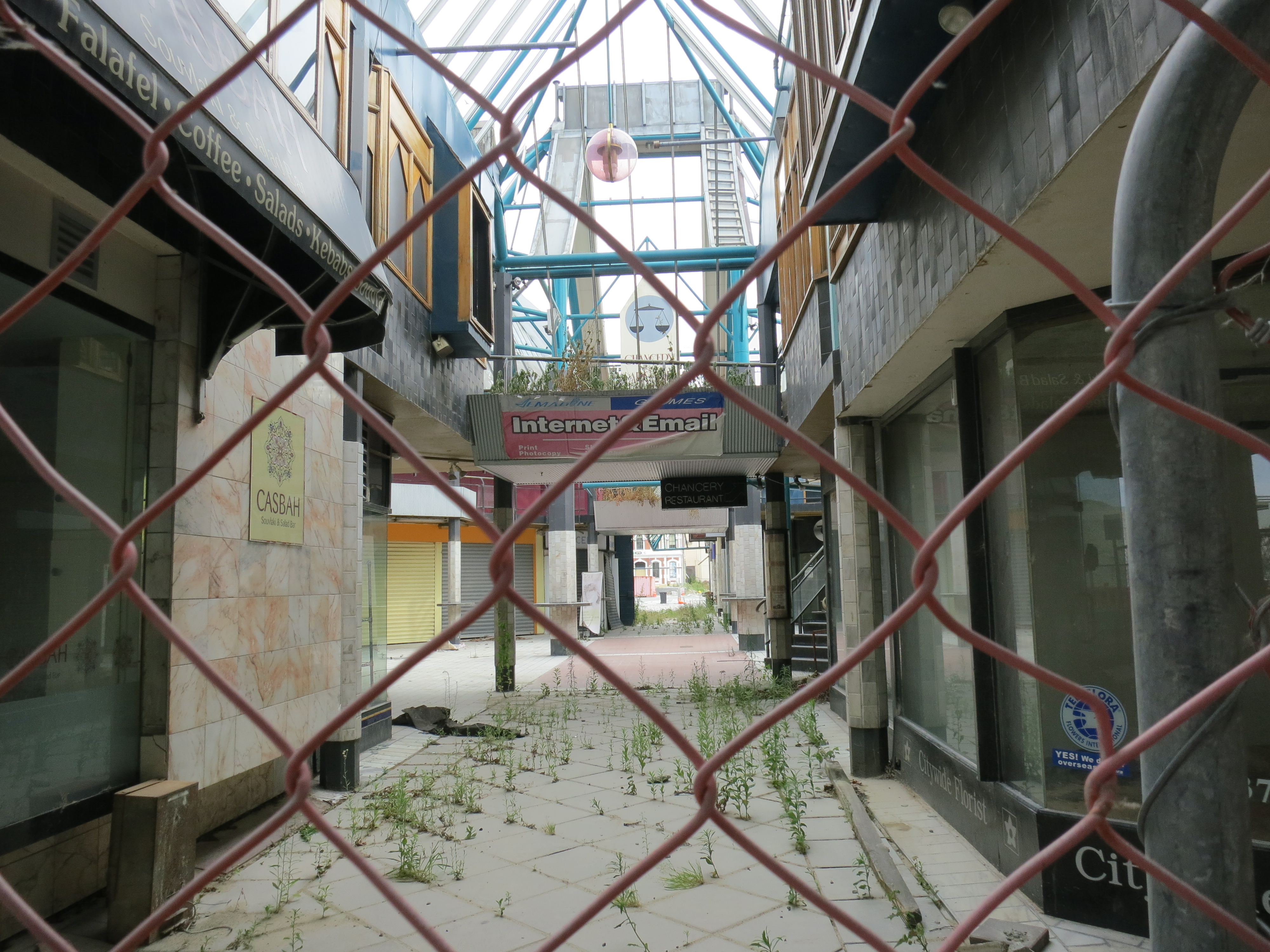 The city was bursting with art, a lot of it graffiti or pop-up displays. Some of it focused on the earthquake and the city’s resilience, and some of it was unrelated. One of the more moving pieces was a permanent-looking display on the site of St. Luke’s in the City, a church built in 1859 and destroyed beyond repair in the earthquake. The congregation have erected a small wooden bell tower, a labyrinth for reflection, and a circle of stones from the rubble of the church—one stone for each of the 185 people who died on that day.
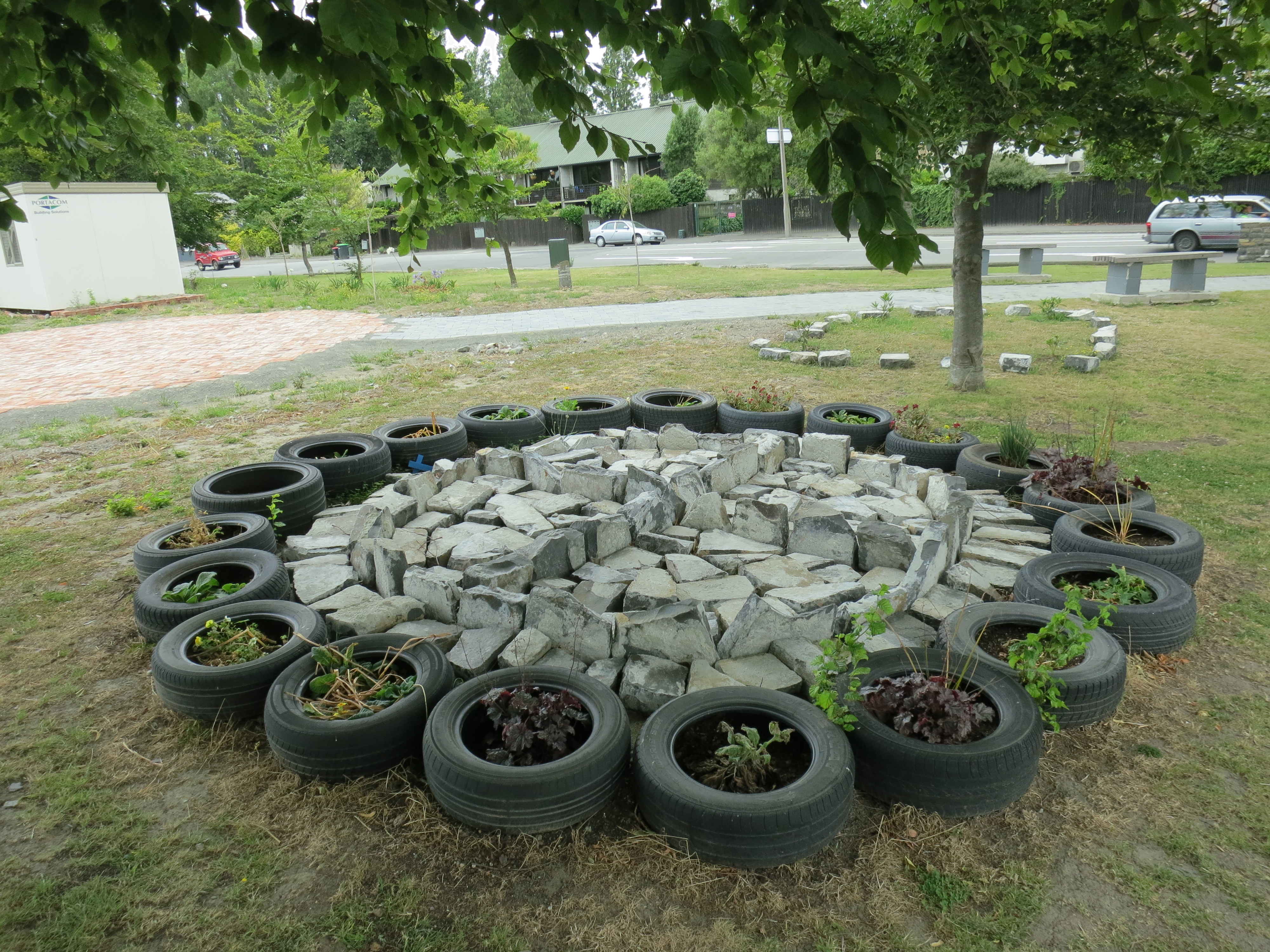
Memorial to the 185 killed in the 2011 earthquake
I stayed with Biz, a friend of a friend from back home. She put me up in her flat near the center of town and fed me veggie burritos—perfect! The next day I walked past the destruction to the botanic gardens, which are remarkably well-preserved. The visitor’s center and greenhouses are shut indefinitely, but kids were running around the playground, and a modern sculpture rose, gleaming, from one of the ponds.
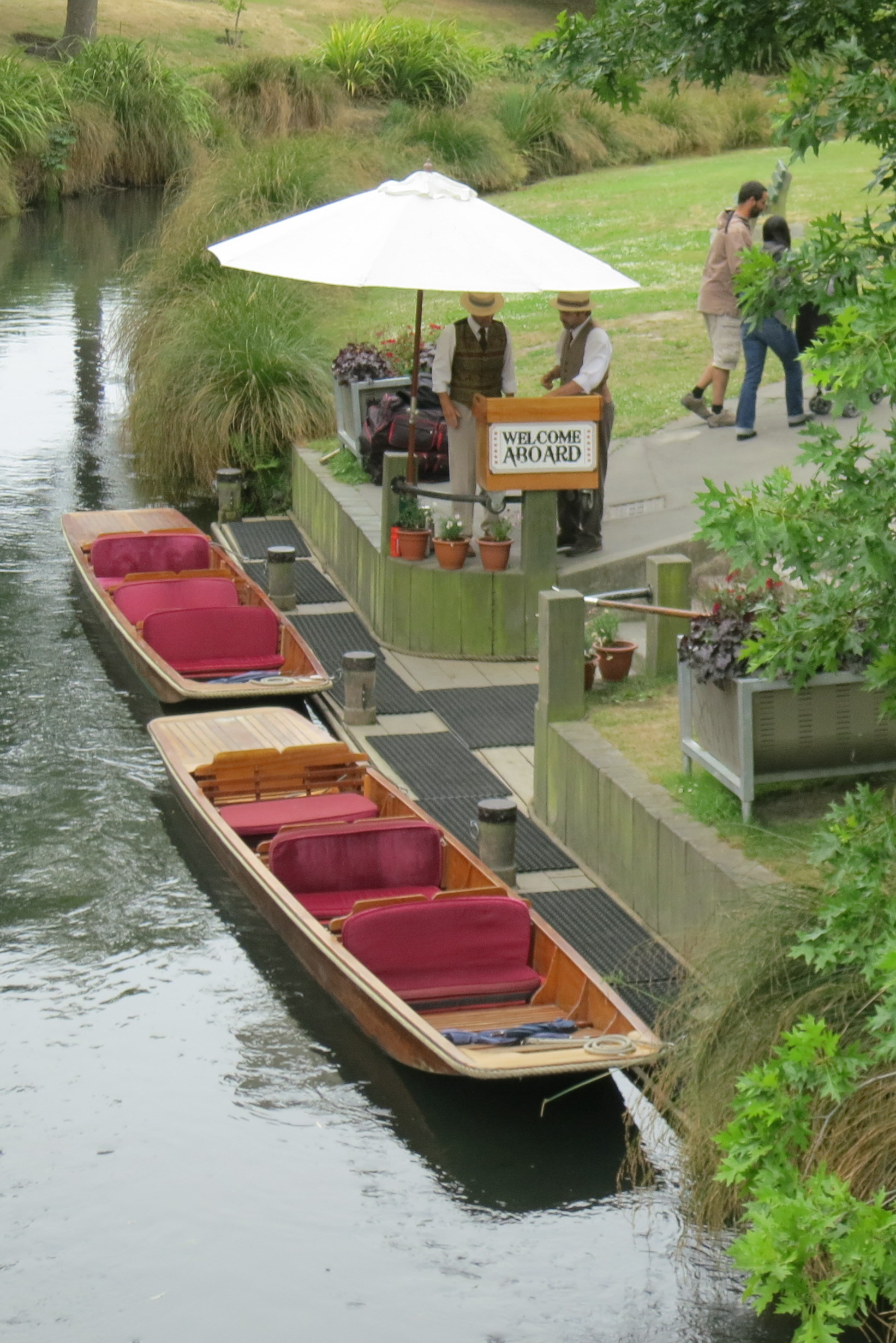
Punting along the Avon
Before the earthquake superseded whatever else anyone knew of the city, the tagline for Christchurch was that it’s more English than England. The gardens are the greatest example of this. Carefully maintained flower beds, a river named the Avon that you can punt along, and a museum built in the style of Cambridge. The park was too big to explore in one afternoon, so I focused on the famous rose garden, which is a giant circle of 250 varieties of roses, all of them wonderfully colorful and in full bloom. I had a pleasant walk around the gardens and got back to the flat just before the inevitable rain started.

Central Rose Garden
 I was going to make the last paragraph something about the resilience and spirit of the people of Christchurch, and how they’re going to make their city great again. But that’s self-evident, and there’s not much to add except I admire the folks of Christchurch and wish I could stay longer to see what that rebuilding looks like.
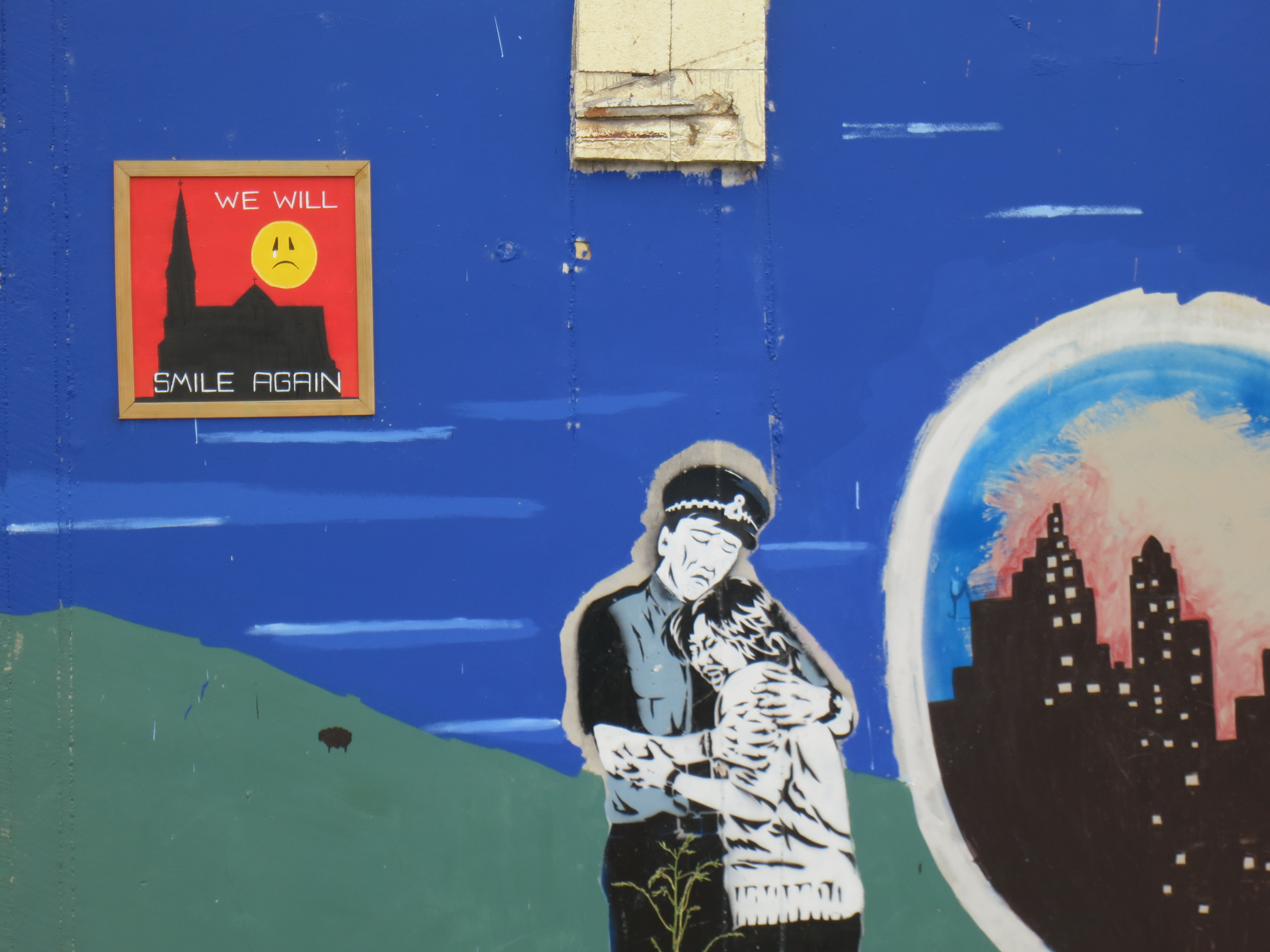
We will smile again
Water of Leith. Glenorchy. Macandrew Bay. There are a lot of Scottish names on the South Island, and that’s just the most immediate sign that the main Pakeha settlers in this part of New Zealand came from the land of lochs. Dunedin (Gaelic for Edinburgh) used to be a major industrial and commercial center for the country, but nowadays it’s mainly known as a university town. I’d intended to spend a couple days there, but as so often happens near the end of a stay in a country, there suddenly didn’t seem to be as much time as I’d thought there’d be. I liked what I saw of the town, though.

Dunedin train station, now the site of farmer’s markets
Theresa’s friend and fellow Couchsurfer Ritchie picked me up from the bus station and we decided the beautiful weather made it the perfect day for a drive along the Otago peninsula. We stopped at a shop next to a tiny beach half full of determined ocean bathers, and I bought a cheese roll, which Ritchie said is something of an Otago institution. It consists of a piece of long bread (the kind you find pre-sliced) rolled around soft cheese and chives, and then toasted. It wasn’t a delicacy, but it did the trick for lunch.

The closest I got to seeing an albatross was this stuffed one.
We drove up to the Royal Albatross Centre. The albatross is a rare bird. There’s a well-protected colony on the Otago peninsula, and you can often see them up at the center. We saw a lot of seagulls but no albatross, so we carried on down the winding coastal road to the small town Ritchie lives in. His house overlooks the ocean, and he said he often goes spearfishing for his supper. We relaxed on the balcony and I had the luxury of an afternoon nap and a few hours of reading. That night, Ritchie’s roommate mentioned how clear the skies were, so we stood on the balcony staring at the stars. I’d been searching for the Southern Cross the whole time I’d been in the southern hemisphere, but hadn’t had any luck finding it until this night, when Ritchie pointed it out to me. Just in time before I headed back to the northern hemisphere, where you can’t see it.
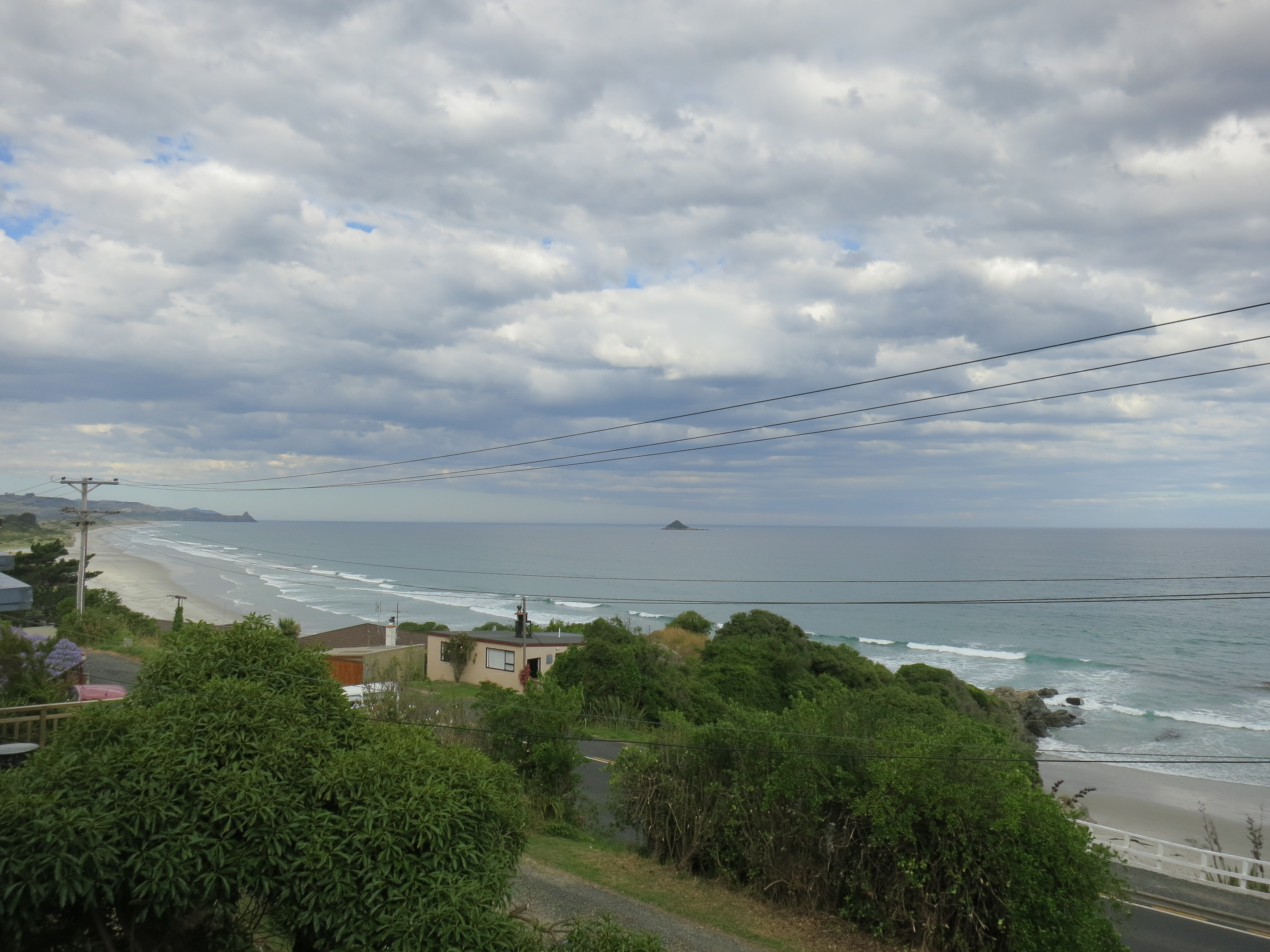
Ocean views from the balcony
The next day, I had to catch the bus up to Christchurch, so Ritchie dropped me off in the Octagon a couple of hours before it left. The Octagon is the town square, with—you guessed it—eight sides. A road rings the small park in the center, and another road bisects the park. Fancy shops and nice restaurants take up most of the storefronts, and there’s also Town Hall and the Cathedral Church of St. Paul the Apostle. Right at the top of the hill—this is New Zealand, remember, so there are hills everywhere, I hardly need mention that the Octagon was set on a hill—anyway, right at the top of the hill is a statue dedicated to Scottish poet Robert Burns. This is a city that wears its heritage with pride. (Also, Burns’ nephew was one of the founders of the Otago settlement in 1848.)

Impressive stuff at the top of the Octagon
The cathedral was putting on a free “cruise concert” for cruise ship passengers right as I was admiring the building, so I went inside. It was a lovely twenty minutes of listening to the organist play Bach, Handel, and Elgar while sitting in the spacious, sparsely decorated church. Afterward, I had lunch at a perfectly collegiate café (trendy, charming, overpriced) and admired the train station made of local stone. On the bus ride out of town, our driver told us some fun facts about Dunedin, all of which I’ve forgotten, but what stuck with me is I need to come back and spend more time here.
My last day in the Catlins was a short one, since I had to return the car that afternoon. But this being the wild and wonderful world of New Zealand, a short day is still packed with more things to do than most long days in other places. In this case, I walked on a beach of petrified forest, had a staring contest with a penguin, and glimpsed the fins of a dolphin, all before lunch.
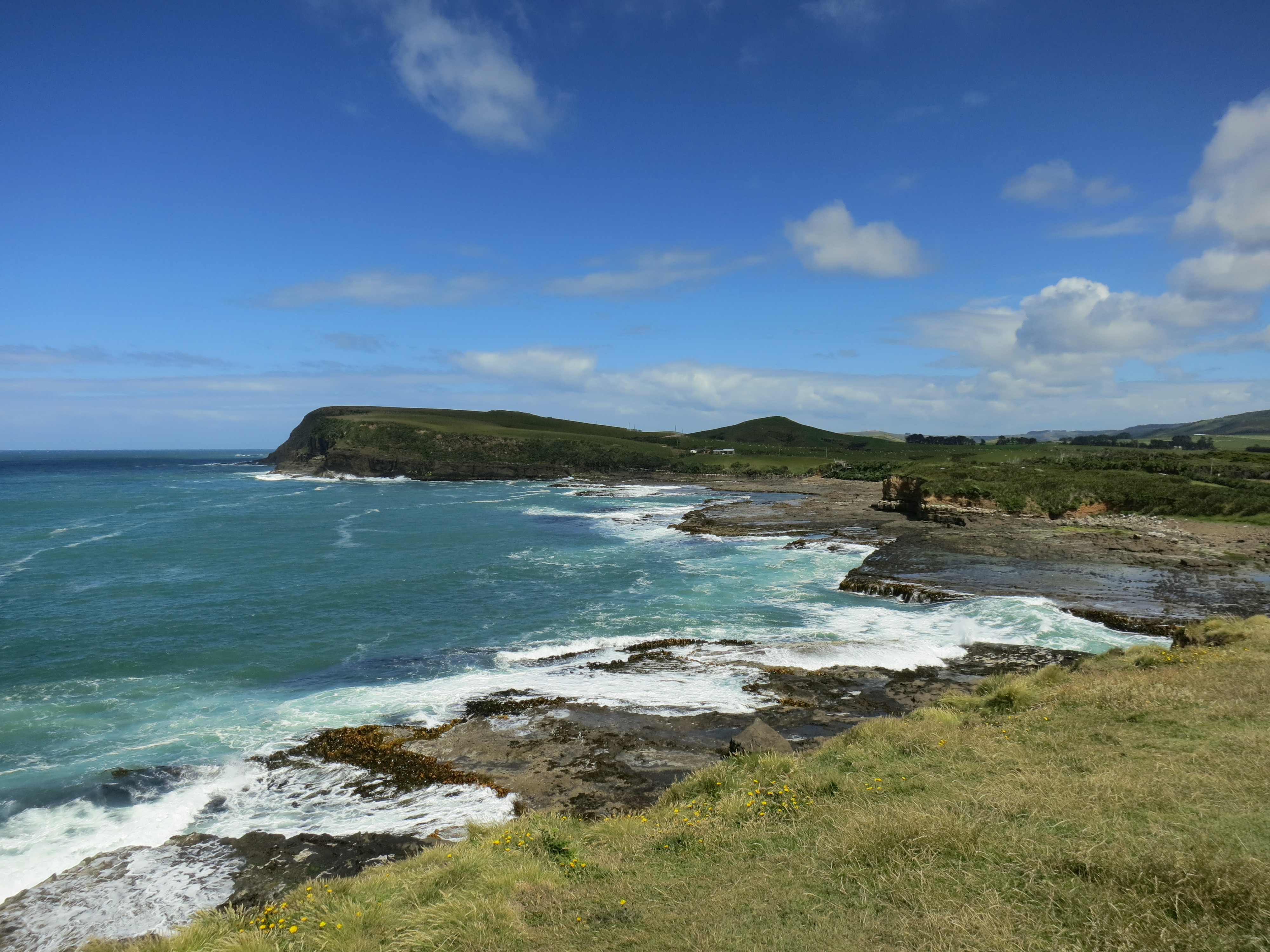
Curio Bay in the Catlins
Porpoise Bay is famous for being a refuge for a pod of Hector’s dolphins (which is the name of the species, not some dude’s pets). I met some travelers who went swimming in the bay, and dolphins just came right up next to them. If you go swimming, signs around the bay remind you to “love us from a distance or lose us forever,” and never approach a dolphin. But when I went, it was too cold to swim, and only a few brave surfers were in the water.
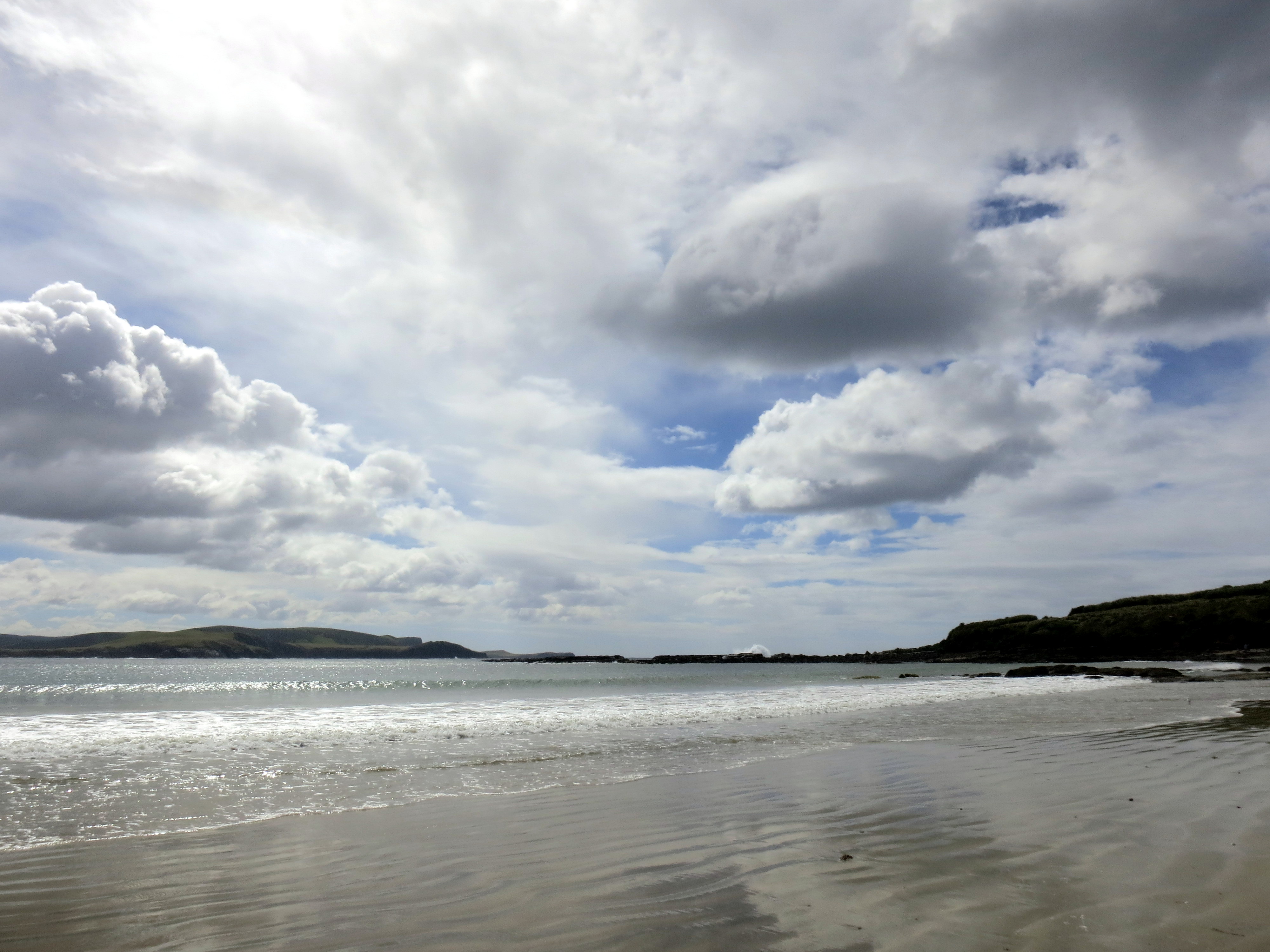
A beautiful day in Porpoise Bay
I walked along the beach and scrambled over some rocks, and saw the fins of a couple dolphins as they briefly surfaced in the distance, but they weren’t in much of a show-off mood that day. So I went back to the base of the stairs, moved aside the plank of wood spray painted “sea lion barrier/gate,” and went up to the cliffs above.
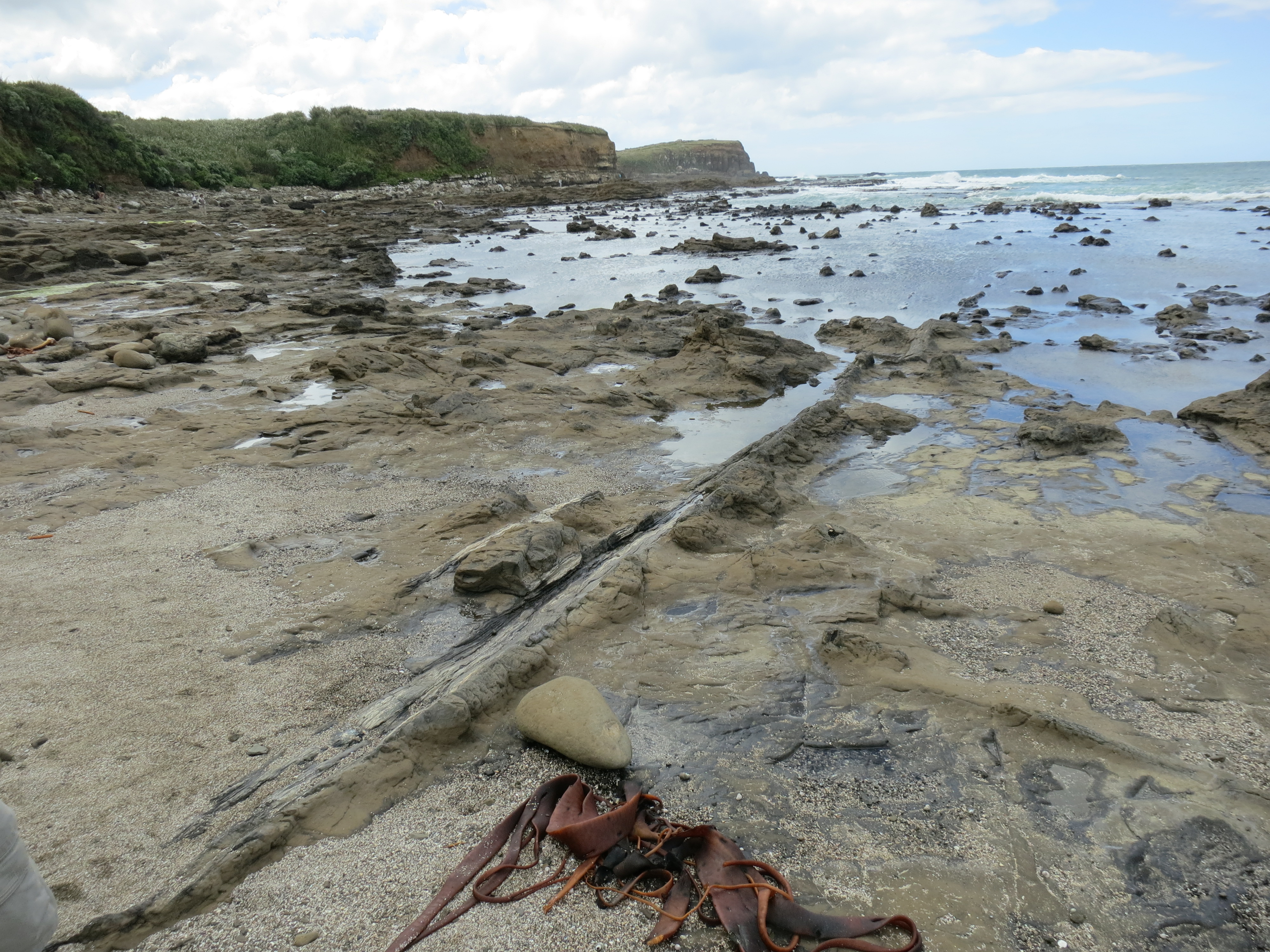
Curio Bay, just across the spit of land from Porpoise Bay, is the site of a petrified forest from the dinosaur age–it’s about 180 million years old. Long, flat logs were felled by some force in ancient times and petrified into stone, and the remains are there on the beach for anyone to walk by. I got a thrill reaching out and touching something from another age, similar to the excitement I felt touching Uluru. The tactile can be pretty powerful.


Some of those rare yellow-eyed penguins have set up a colony here too, and one little guy was out for a walk at the same time I was. A circle of paparazzi immediately surrounded him, although most people were obeying the signs asking that people keep 10 meters between themselves and penguins.
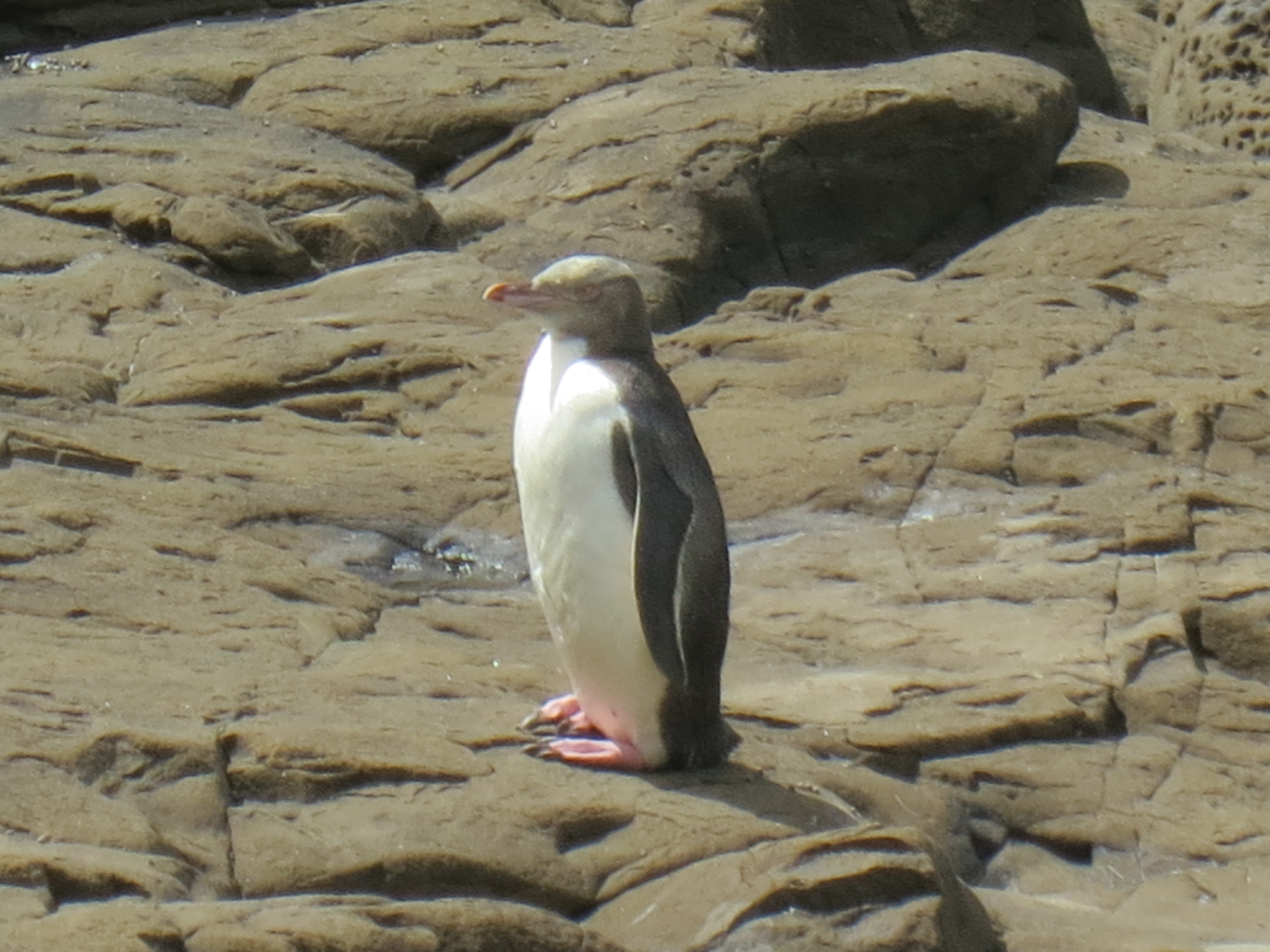
Out for a stroll
Keeping with the theme of things from the time of dinosaurs, I visited the museum in Invercargill and saw a tuatara, which looks like a lizard but is apparently unrelated. They are literally the contemporaries of dinosaurs. The most famous tuatara in the museum is Henry, a young man born sometime in the 19th century and still going strong on a diet of “if it moves, he eats it” and an exercise regimen of hardly ever moving.
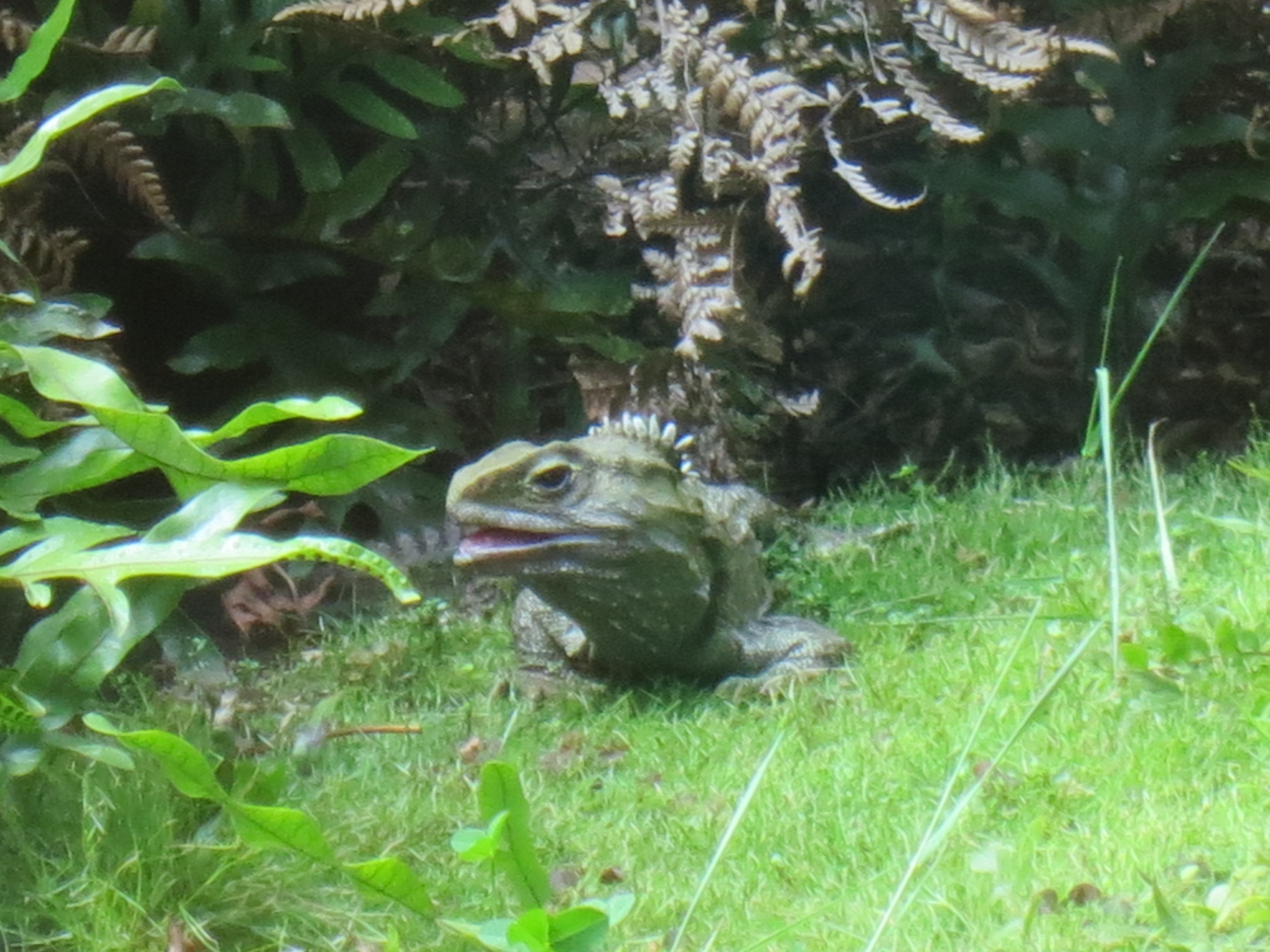
Tuatara
It was hard to leave the Catlins. There were more walks to do, and beaches to explore, and even a couple waterfalls to find, but they’ll have to keep for next time. And I do hope there’ll be a next time.
Some people count birds. Others log marathon miles. I chase waterfalls, and I saw five on my second day in the Catlins. That’s a personal record. (That’s also me plagiarizing myself from Facebook, but I liked it for a lead so here we are.)
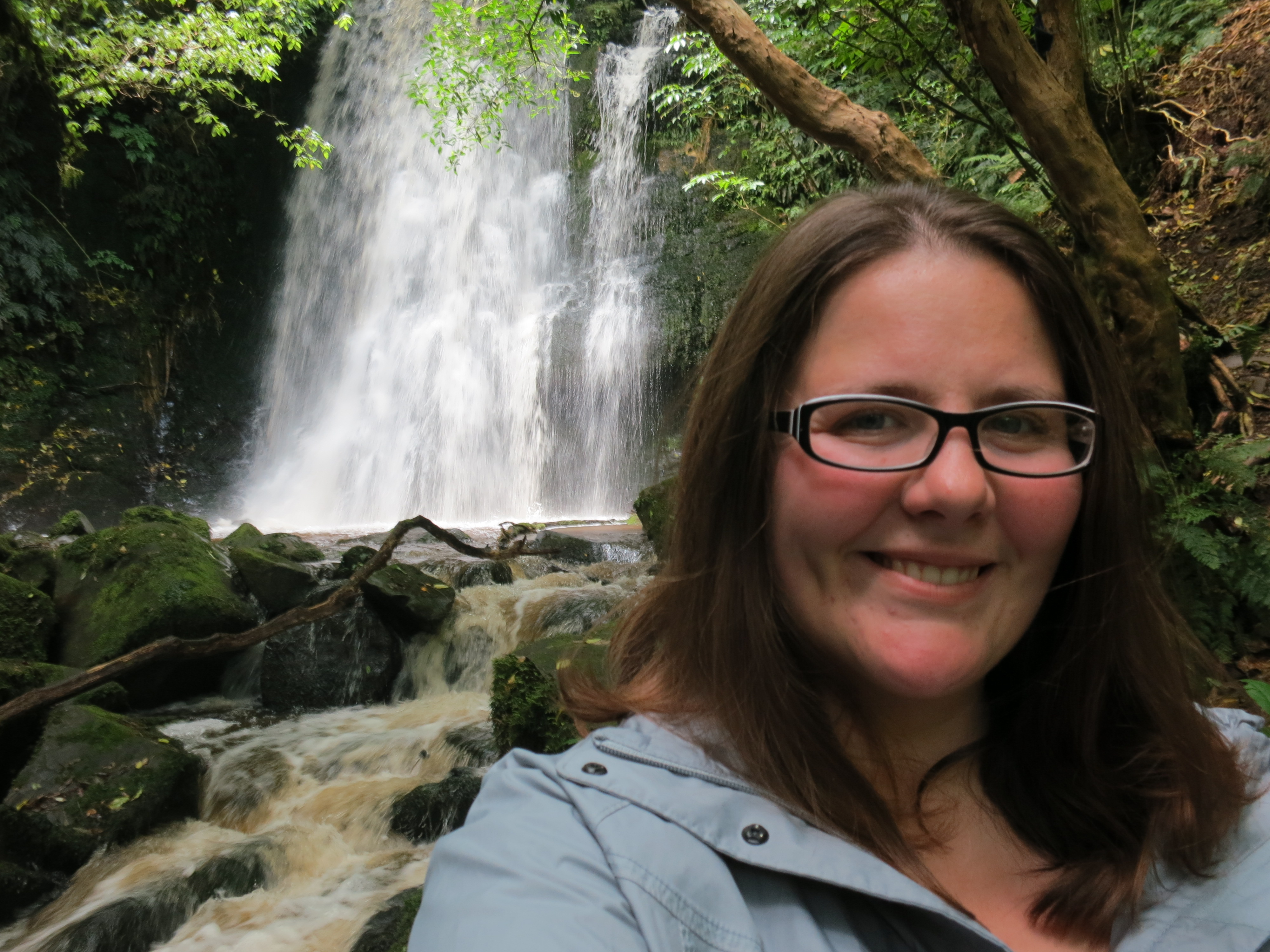
This is my “OMG waterfalls” face (at Matai Falls)
I started the day off at Jack’s Bay, where I threw a ball for an eager dog and chatted with his owner. The wind was picking up, lifting a whole layer of sand off the ground and hurrying it along to the other side of the bay. I carried on to the Owaka Teapot Gardens, which is actually the yard of someone’s home covered in teapots of all sizes and arranged in whimsical set-ups with garden gnomes and fairies. The next door neighbors know a good kitschy tourist attraction when they see one, and they set up Dollyworld, a doll and teddy bear museum. The entrepreneurial spirit is thriving in Owaka.
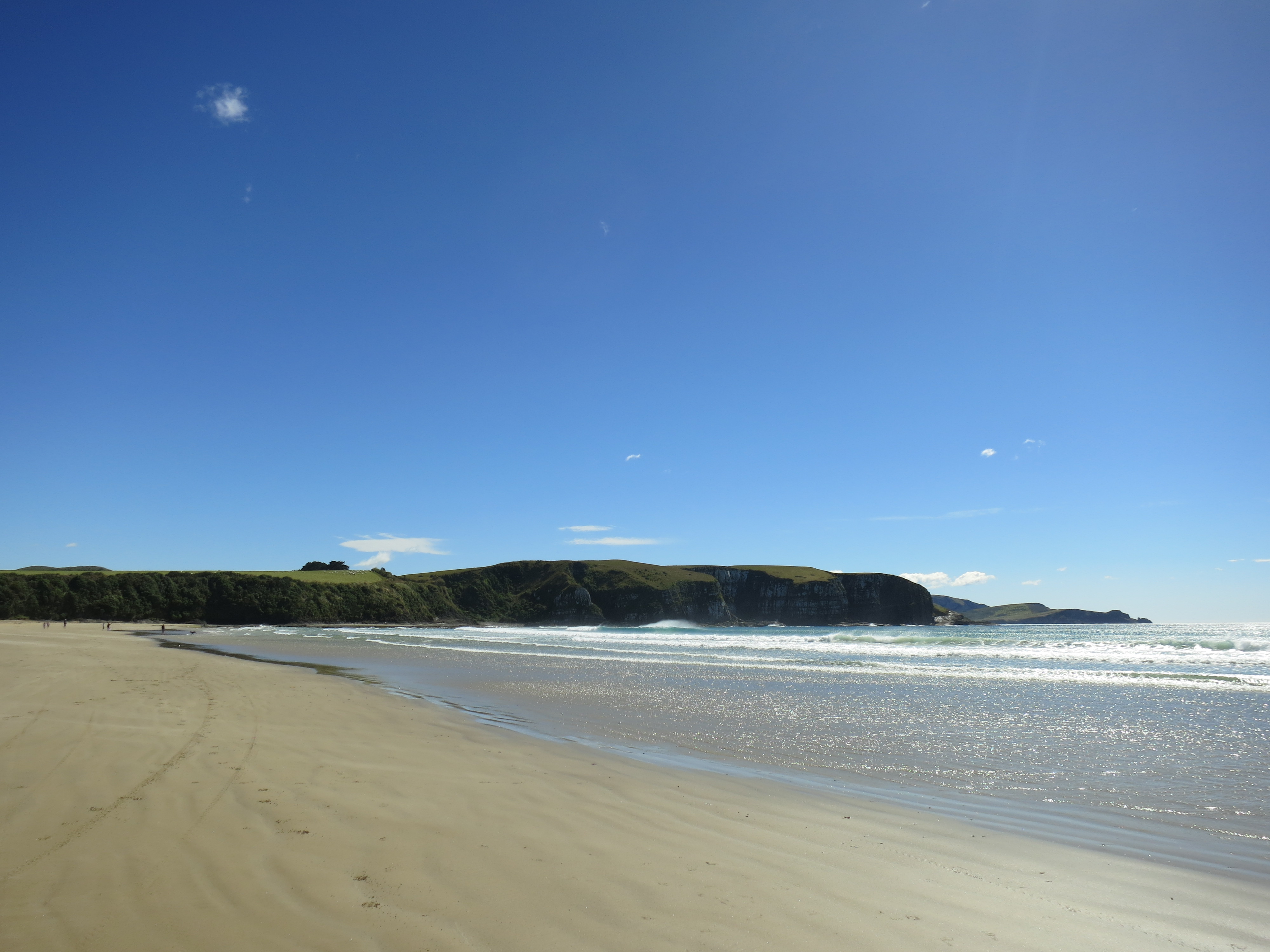
Morning at Jack’s Bay
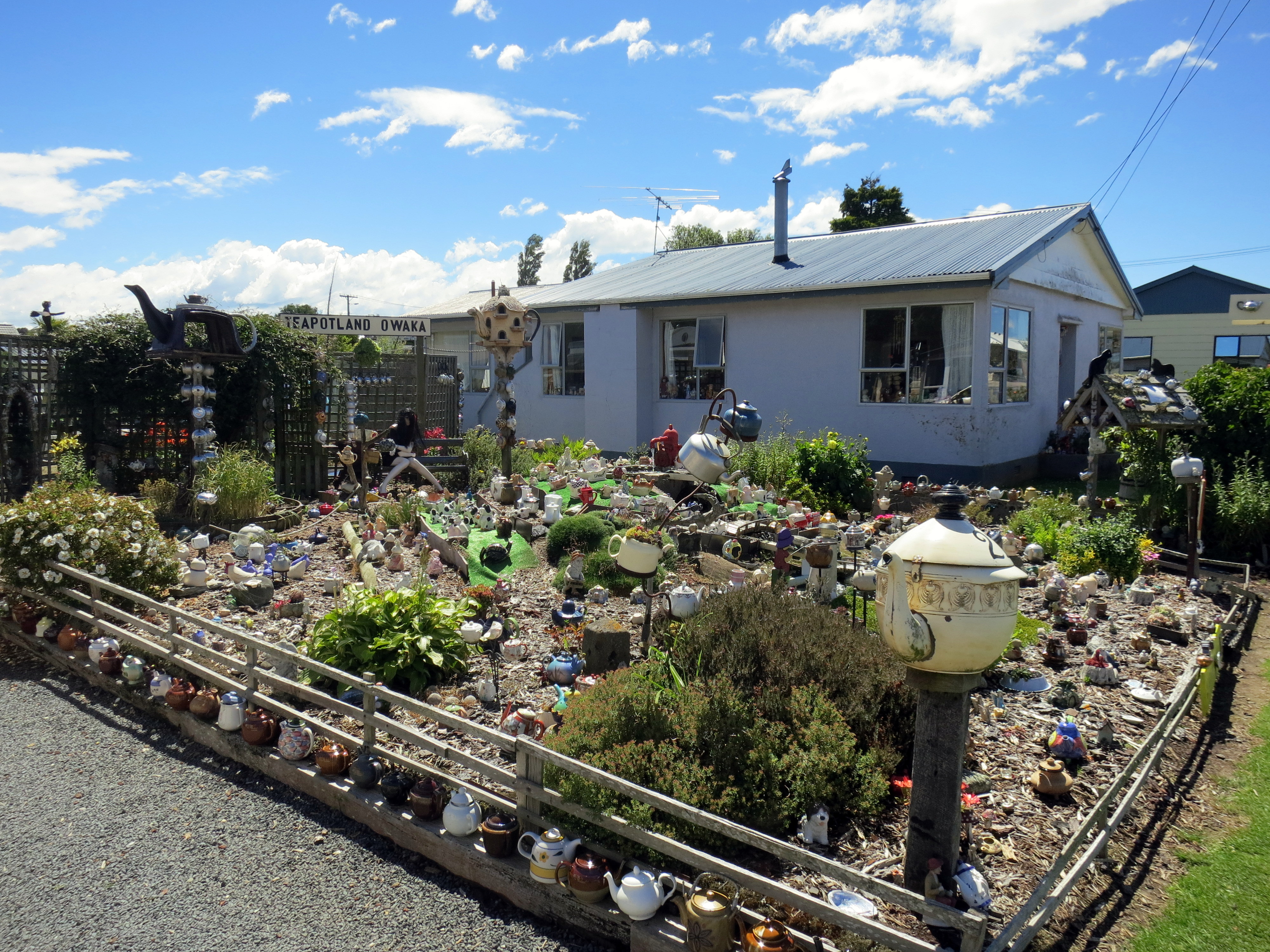
They even printed up a poem about Teapotland, which includes the lines, “In every cranny and nook/doesn’t matter where you look/Big ones, little ones, there is a teapot/Sorry, but they are all cold, not one is hot!”
I left the dolls and fairies behind for the natural world, and I spent the rest of my day falling ever more in love with this part of the world. It was a beautiful New Zealand day, which means I only had to wear my rain jacket half the time. It had rained heavily overnight, so the falls were gushing water mixed up with a bit of mud, rather than falling more prettily with clearer water. I liked it, though. Nothing like a roaring waterfall to remind you of the power of nature.
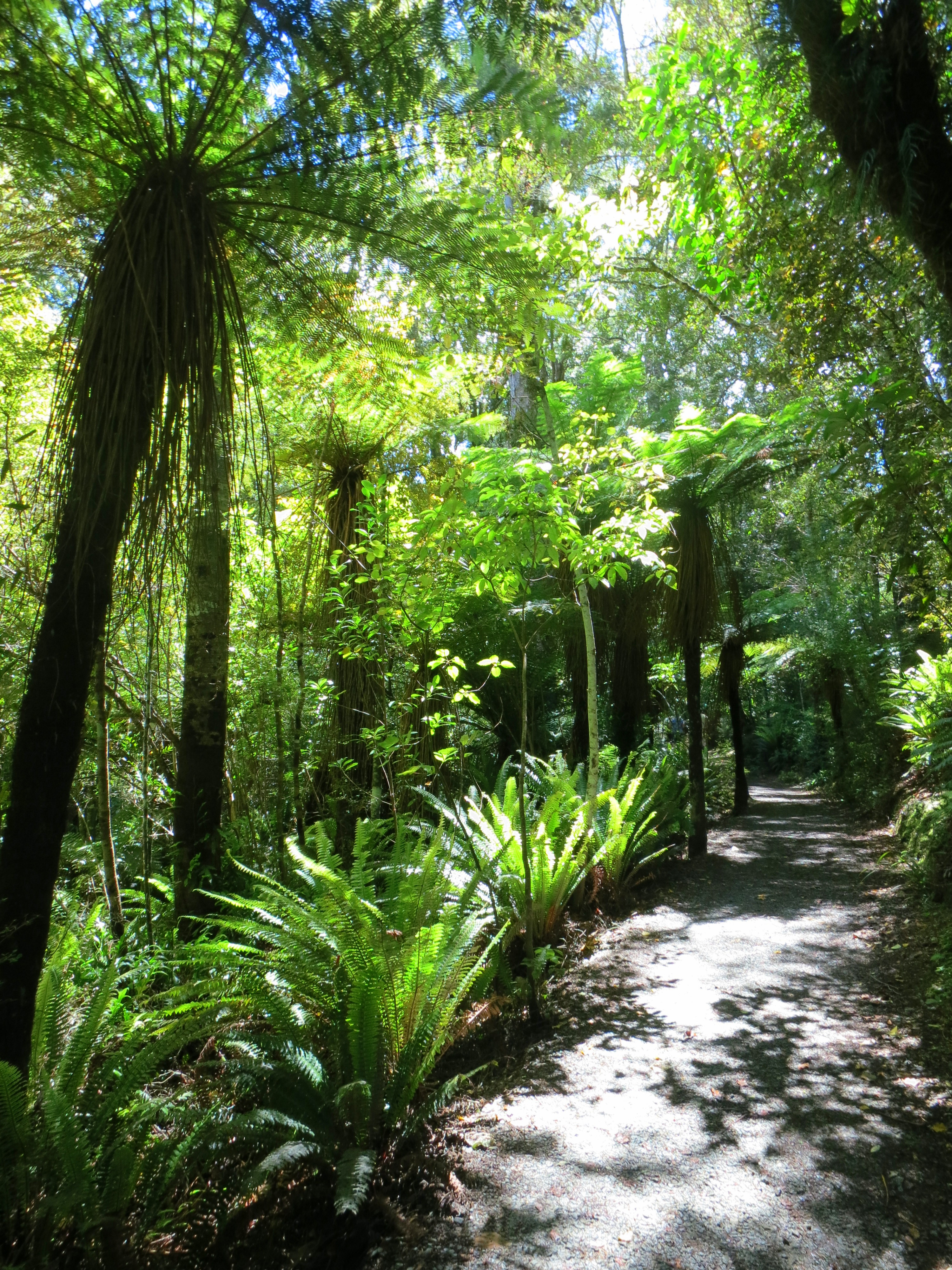
Purakaunui Falls is the most popular spot in the Catlins, and apparently the most photographed waterfalls in the country. It was an easy walk on the packed dirt path through the fern-feathered forest, across a small footbridge, and up and down a steeper track to the viewing area. I had the falls to myself for about two minutes, and then a small tour group came down, and a family with small kids, and I saw how popular the place was.

Purakaunui Falls
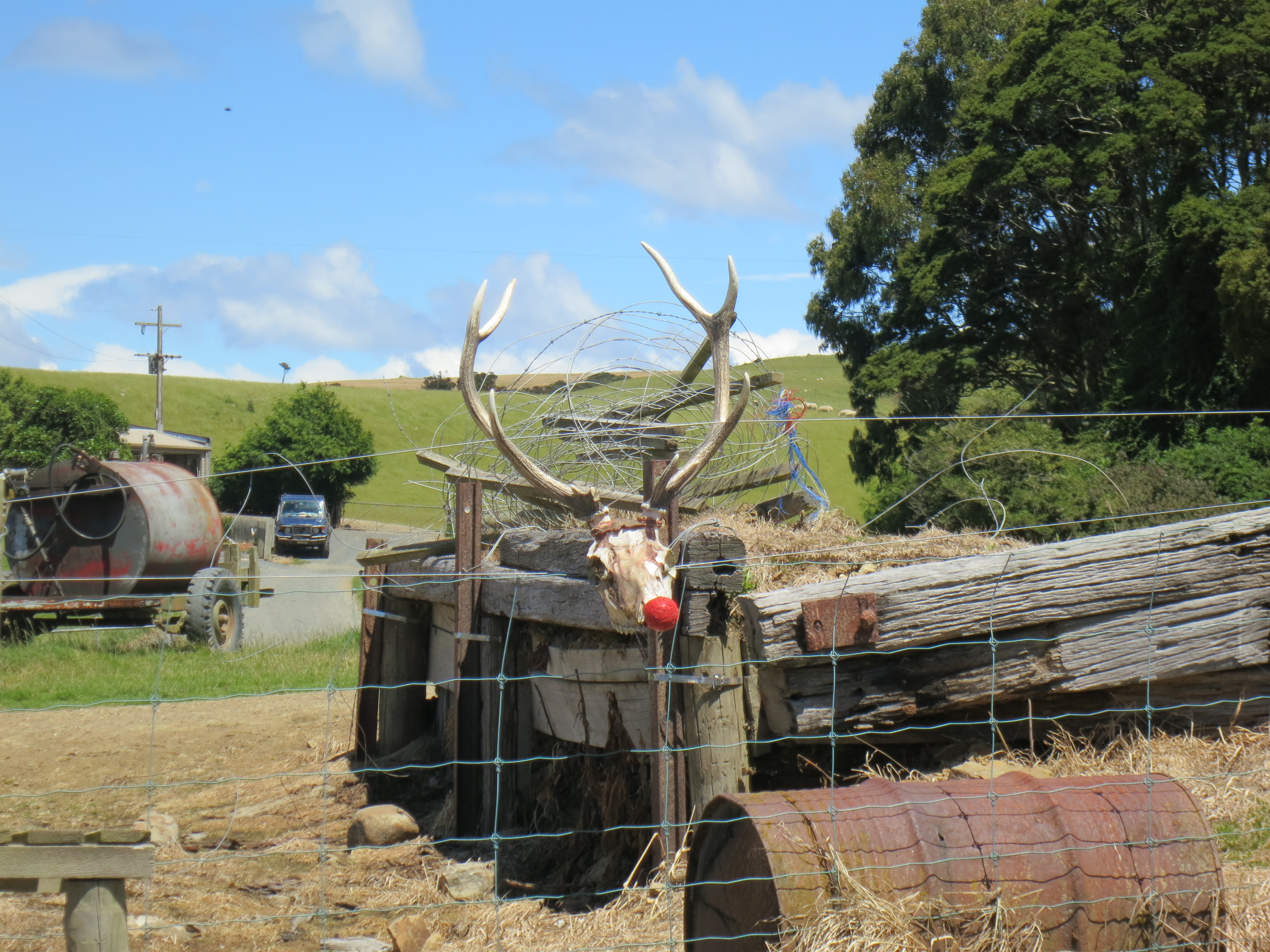
Poor Rudolph
The next stop had a one-two punch of Horseshoe Falls, and farther along that same river, Matai Falls. I only passed five other people on this trail, which suited me just fine, but the people who skipped this stop were missing out.

Horseshoe Falls
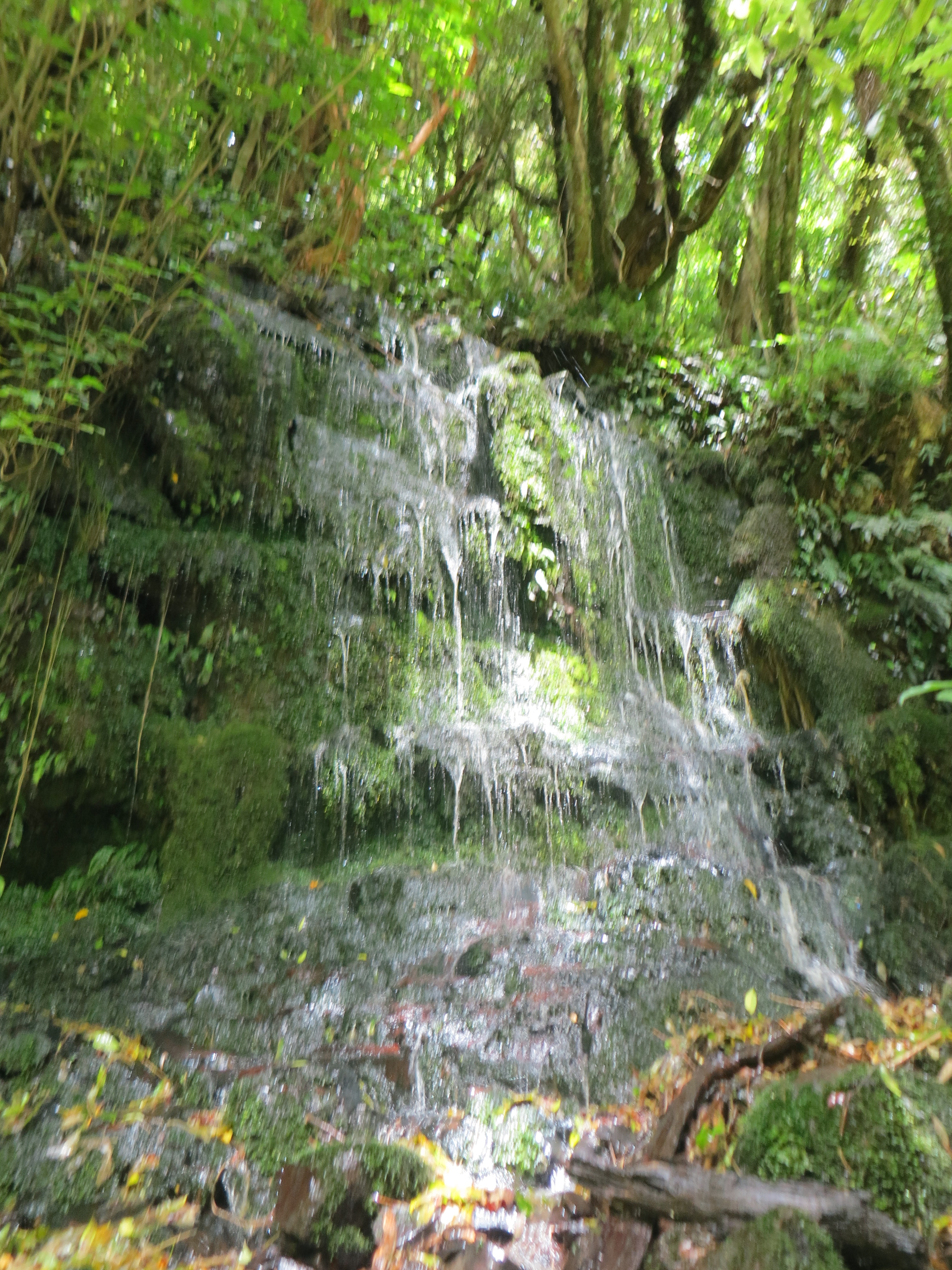
This patch of moss normally just drips, but with the heavy rains the night before, it was a mini waterfall itself.
Florence Hill Lookout was a well-signed spot, explaining the historical and ecological significance of the area. Some of the trees are over 1,000 years old, and in fact it’s the only place on the east coast of the South Island where native forest goes right down to the sea (instead of being interrupted by any of the many introduced species). This was a Maori fishing village, a Maori and Paheka whaling town, and the site of a sawmill before it became protected land.

One of the last native forests to reach the sea on the South Island
My penultimate stop for the day was McLean Falls, which involved a 30-minute walk, only 20 minutes of which could be described as leisurely. The last part of the walk was a steep climb up a switchback path, on uneven stairs made of stone and slippery packed dirt. But was it ever worth it!

Bliss
The McLean Falls were certainly the most impressive falls of the day. I sat on a rock a little to the right of the upper part of the falls and stared at them for about half an hour, mesmerized by the sights and sounds.

McLean Falls
The last falls of the day were Niagara Falls, and they barely qualify as falls at all, more like a hiccup in the river. But if my Catlins map is going to count them, then so will I. My favorite part of this stop was the sign that showed a photo of the more famous Niagara Falls, just in case you needed a comparison. Nice to see everyone has a good sense of humor about it.

Haha, good one, settlers
I spent the night at a farmstay/hostel at Slope Point. It was a working farm with a few small buildings of basic rooms for rent. I chatted with an Australian family and a French couple, and we all sat around the kitchen table listening to Van Morrison on my iPod while working on a jigsaw puzzle and eating dinner. The Aussies and French were keen hikers, so they told me about the big walks they’d been on that day, which sounded cool, but I wouldn’t have traded my day of waterfalls for anything.

Sunset at Slope Point

Phuket Town, Thailand; January 28, 2013

Sunset, Siem Reap, Cambodia
 Stowaway Travel Writing & Editorial Services