
St. Augustine Church, Tucson, AZ, March 7, 2007
St. Augustine Church, Tucson, AZ, March 7, 2007
This week’s interview is with Natalie Hurdle, co-founder of Strange Bedfellows Theatre here in Chicago, a new company just putting down roots in the city. I’m excited to see what productions come next. Thanks for sharing, Natalie!
What is your name and city of residence?
My name is Natalie Hurdle and I live in Chicago.
What medium do you work in?
I work in the theatre–I am a co-founder and ensemble member of Strange Bedfellows Theatre, and I also work at Piven Theatre Workshop.
How often do you work on your art–is it a full-time endeavor or something you work on in your spare time?
That’s an interesting question to answer as a young artist–as Strange Bedfellows continues to grow, I hope that one day it can be my one and only job. In the meantime, I work in arts management at Piven to pay my bills and learn how to run my own theatre company. Even when I’m not actively in rehearsals or meetings, I feel I’m learning and preparing and garnering new resources for my work.
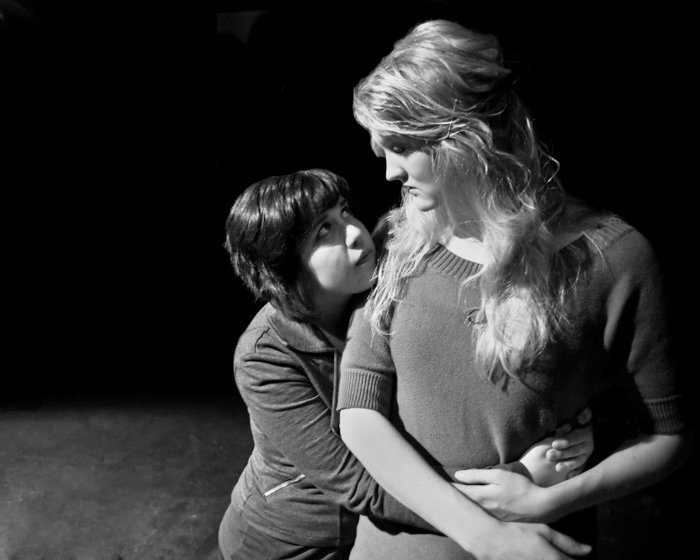
Natlie Hurdle and Jen Westervelt in Strange Bedfellows' "Fire Island"
How does art fit into your life, in general? Is it something you think about and talk about every day, or every week, or only in certain situations, etc.?
Art drives my life. It’s a constant thread in my heart and mind. Almost everything I experience ends up informing my work in one way or another. Every day, artists make the decision to keep creating–a decision that can require considerable compromises and sacrifices when it comes to personal relationships, financial security, and all the other messes in life.
On the other hand, I think to be a great artist, you need to have a life outside of art, otherwise you have nothing new to bring to what you create. Your art is richer and fuller when you step outside of your art bubble and splash around in the world and bump into other people. And there are definitely nights when I have a beer with a friend to talk about anything BUT theatre. We all need time to rejuvenate–making art can be exhausting.
When you start on a piece, what kind of end result do you have in mind? Does it get performed or published, put in a permanent form or is it more temporary?
Theatre isn’t theatre if it isn’t shared with an audience–the performers and sets and sound and lights are only half of the equation. The reaction of each different audience changes the show so incredibly. I love how I can see a performance of the same play with the same actors in the same place ten different times and the makeup of the audience alchemically alters the show. One of the things I love about theatre is how very temporary it is. That performance for that audience will never be repeated again, no matter how long the production runs. And you can’t capture the experience.
What goals do you set in relation to your art, both short- and long-term? Is it something you hope to make money doing, or is it something you want to keep uncommercialized? Does the term “sell-out” hold meaning for you or do you see the art/commerce relationship as a necessary one?
I would love to be bringing more money in as an artist so I can put more time and money back into my art. Art is valuable; I see no reason to refuse payment for making it. I don’t believe that I have a super commercial bent as a theatre artist, but finding ways to reach and engage a new audience is something I think theatre artists in particular should be thinking about–and creatively.
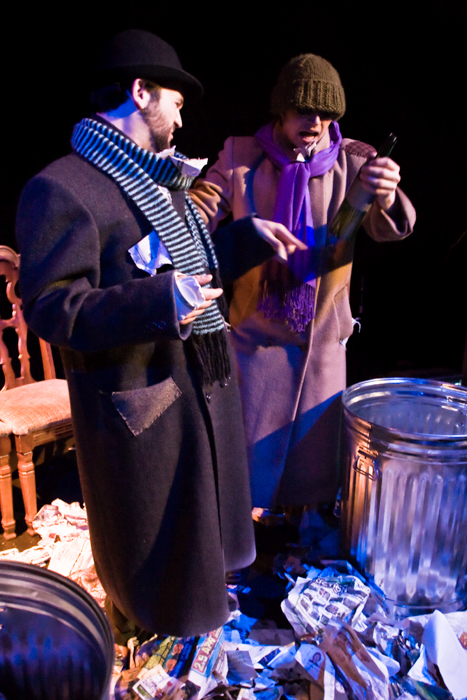
Brooks Applegate and Derrick Marshall in Strange Bedfellows' "Fire Island"
What role does collaboration with others play in your art, if any?
Strange Bedfellows is a very collaborative company. I think the work we do together is stronger and more interesting because it is made by dissimilar people with unique strengths and ideas and a common goal. Strange Bedfellows indeed.
How conscious are you of your artistic influences? Who are your artistic influences?
Very conscious. I read a lot; I see a lot of theatre; and when I feel stuck and uninspired, I go back to the artists who remind me of my passion. Anne Bogart, Paula Vogel, Sarah Ruhl, Mary Louise Parker, not to mention my great teachers–Joan Herrington, Mark Liermann, Jim Daniels, Elizabeth Terrel, and the list goes on.
Since this is a travel blog, how does travel relate to or affect your art? (Themes in what you produce, road trips to perform your music, thoughts on what happens to your painting when you ship it across the country to a customer, etc.)
When I was sixteen, I had the unreal experience of performing at the International Fringe Festival in Edinburgh, Scotland, the largest theatre festival in the world. That sealed the deal for me as an artist. I wanted to make theatre and engage with theatre and connect with other theatre artists and lovers of theatre for the rest of my life. Learning from artists of other backgrounds and cultures and examining the changing contexts in which theatre is made fascinates me. I would love to travel more to do all of that. For now, Chicago is our home base, and I imagine it will be for a long time. Who knows, though?
And finally, a right-brain question: If your art was a map, what would it be a map of?
A map of empathy. A map of magic.
If you are looking for any other information on Strange Bedfellows Theatre, check out our website.
Photos by Daniel Halden Fitzpatrick.
More weekly features! My Kind of Town Monday is a series of photos I’ve taken around Chicago. Some of them are well-known spots, others less so, and some are just places I love and don’t want to forget when I move away. It’s a year-long project of remembrance, and bonus, you get to look at pretty pictures.
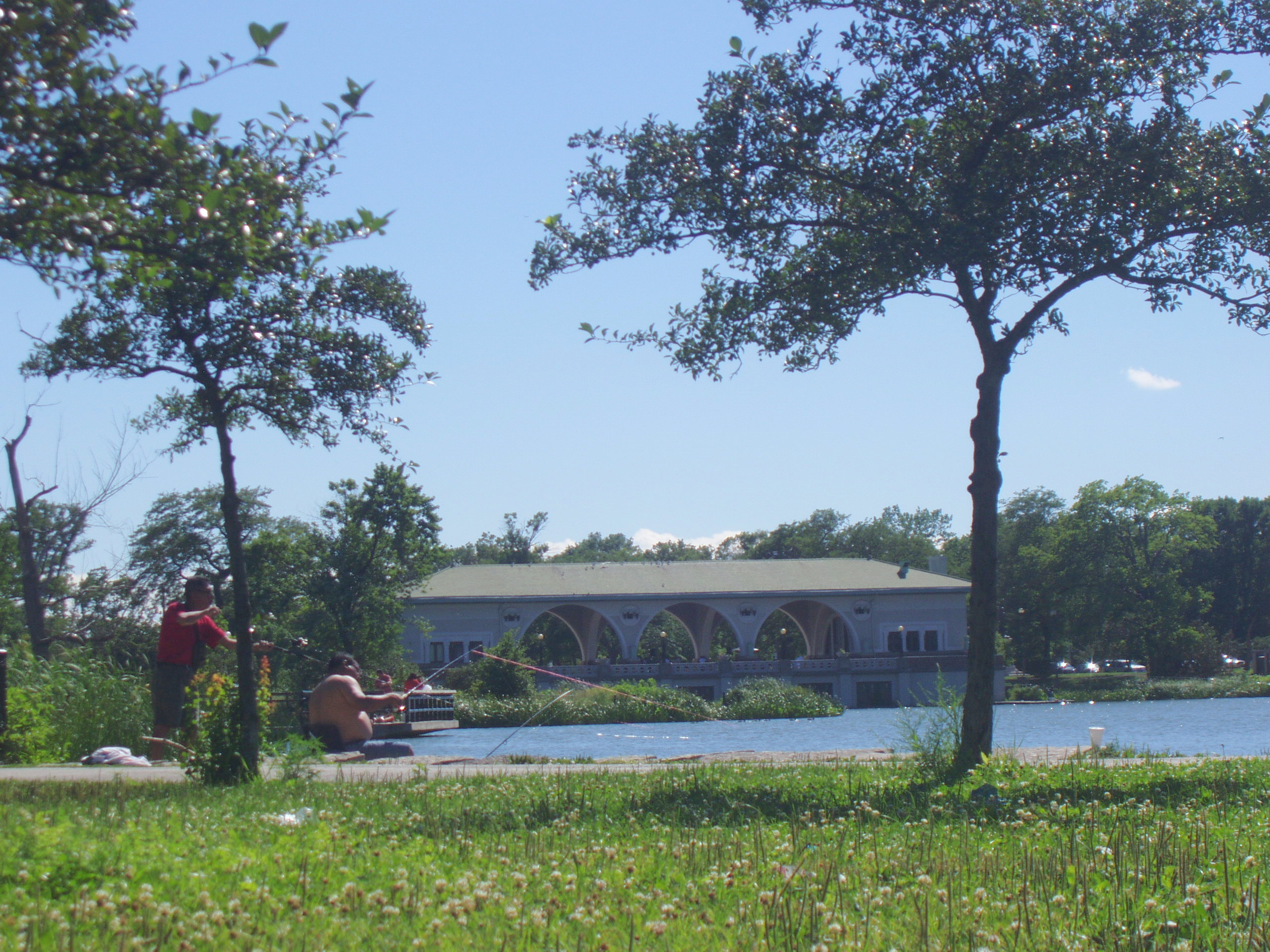
Humboldt Park boathouse, Chicago, IL
Persuasion is my favorite Jane Austen novel. That story of long-lost love being rediscovered is entirely too easy to swoon over, not to mention the supporting cast of characters is a hoot. So when I saw that my September review options for Centerstage included a musical adaptation of the book, I jumped on it. As Beth said, you can’t miss “Persuasion: The Musical!”
But oh how we should’ve missed it.
Beth drove three hours to visit me and see the play, and she said it was the worst play she’s ever seen. I felt so bad, although of course I couldn’t have known. It turned out to be a really expensively funded community theater production, with several shaky singing performances and one spectacularly bad acting and singing performance. Here’s an excerpt of the review:
Ms. Landis wrote the libretto for this adaptation, and even traveled to England to do research for it, so it is clear that this is a labor of love. Unfortunately, that love didn’t translate into a stronger performance, and enthusiasm alone can’t carry a play. This story deserves a passionate production, not a three and a half hour slog.
Three and a half hourrrrrrrrs. Nothing is that long. Maybe the Ring cycle. No one even does Shakespeare at that length anymore. Three and a half hours I will never get back.
The woman playing Anne, Barbara Landis, is the Artistic Director of the company, so she pretty clearly cast herself, but what she needed was someone to tell her no, you can write the libretto, you can pick the music, but you cannot play this part. We wondered if maybe she had an illness, because her movements and facial expressions were so odd that it seemed possible she didn’t have proper control over them. This would be terrible! To be slamming the performance of a woman who bravely overcame an illness or stroke. Except that there is no mention of that in the program, there is no indication that she is anything but well, so I have to go with the information I’m given. Based on that, it was a supremely narcissistic move to cast herself in a role she couldn’t possibly carry, and that is unfair to her cast, her crew, and her audience.
But also, she has all these accolades from past performances! (I Googled her.) She was in so many prestigious performances, as were many of her cast (several of whom were not at all up to the opera singing required). Who is casting these people? What are they seeing that I’m missing? Am I making a huge mistake in giving this a strongly negative review?
I’ve never run into this problem before. I’ve seen a couple shows that I wrote more negative than positive reviews for, but none that made me want to leave at intermission (I even texted my editor to see if I could do that, but let’s face it, that’s pretty unethical if you’re reviewing a show, to only see half of it). I was torn up about whether I should really lay into this play for being as bad as it was, and this actor in particular, or whether I should give some leeway. As you can see in the review, I devoted a whole third of my allotted words to pointing out the positives. But in the end, that’s all I could afford, because I ultimately saw it as more important to be honest, even brutally so, than to guess at motives and try and be nice. And maybe I’m out of step with the other reviewers in town, but I suppose that’s why we have so many: a reviewer for every taste.
Read the rest of the review here.
Hello, dearest fellow travelers! How are your New Year’s Celebrations coming along? Eight months of the year have come and gone, so while the magazines are already moving from guilting you for your bathing suit body to guilting you for your imminent holiday gluttony, I propose we go back and review our much more fun lists of activities we knew we’d enjoy in the year 2011. Here’s a recap of the concept:
“[With New Year’s Resolutions,] soon every decision becomes a negotiation, every moment a cost/benefit analysis. It’s mentally exhausting to live in a near-constant state of trade-offs.
“Thus, New Year’s Celebrations are totally free of cause and effect. You don’t go see that iO show as a reward for going 30 days smoke-free; you go because you have a free night and $12 and it sounds like fun. These are no-strings-attached things to do. The list is just a reminder of all the ways you love to have fun, a handy reference for whenever you might have cause to use it and celebrate the fact that you are alive.”
Here were mine. I’ve put a strikethrough the ones I’ve done this year, and I’ve added some new ones as well.
What about yours? Got any new ones? Any that you’re happy to have done?
Here’s a fun one for your weekend viewing: My Name is Mudd at the Viaduct. A non-linear production of zany antics and broad gestures, it’s about 75 minutes of laughs. Here’s an excerpt of my review:
“Mudd” succeeds by not taking itself too seriously while dealing with a serious topic, thus pushing the bounds of what historical theater can be. After all, you can go just about anywhere with a production when you start with six actors earnestly asking the newly widowed Mrs. Lincoln, “Yes, yes, but other than that, how did you like the play?”
You can read the rest of the review here. It’s a dudely play that didn’t give me a bad taste in my mouth — a rare and wondrous thing! Tickets are like $10, so enjoy.
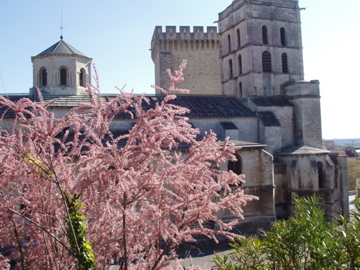
Palais des Papes, Avignon, France, April 6, 2008
This week’s artist interview was conducted with Jeannie, a writer living in mid-Michigan. Jeannie and I met at Kalamazoo College and studied abroad together in Rome junior year. Jeannie and her husband are raising a gorgeous baby daughter in Lansing, and she’s also writing a novel. I’m definitely impressed with her devotion to the craft, and her blog is a great source of writing tips and ruminations. Thanks for sharing, Jeannie!
What is your name and city of residence?
I’m Jeannie Miernik from Lansing, Michigan.
What medium do you work in?
I am writing a fantasy novel based on European folklore. The working title is Briars and Black Hellebore. On one level, it’s a retelling of fairy tales like many writers have done before, but on another level it’s a story about storytelling itself, about oral and literary traditions and the transmission of culture. It’s about the power of words and narratives to shape our realities. As I work on this novel, I am exploring what I call “metamyth,” the stories behind stories.
How often do you work on your art–is it a full-time endeavor or something you work on in your spare time?
Right now, I am a total guerilla writer. I have a six-month-old baby and two jobs, so I steal minutes here and there to write, only up to a few hours a week. It depends on how long my daughter naps!
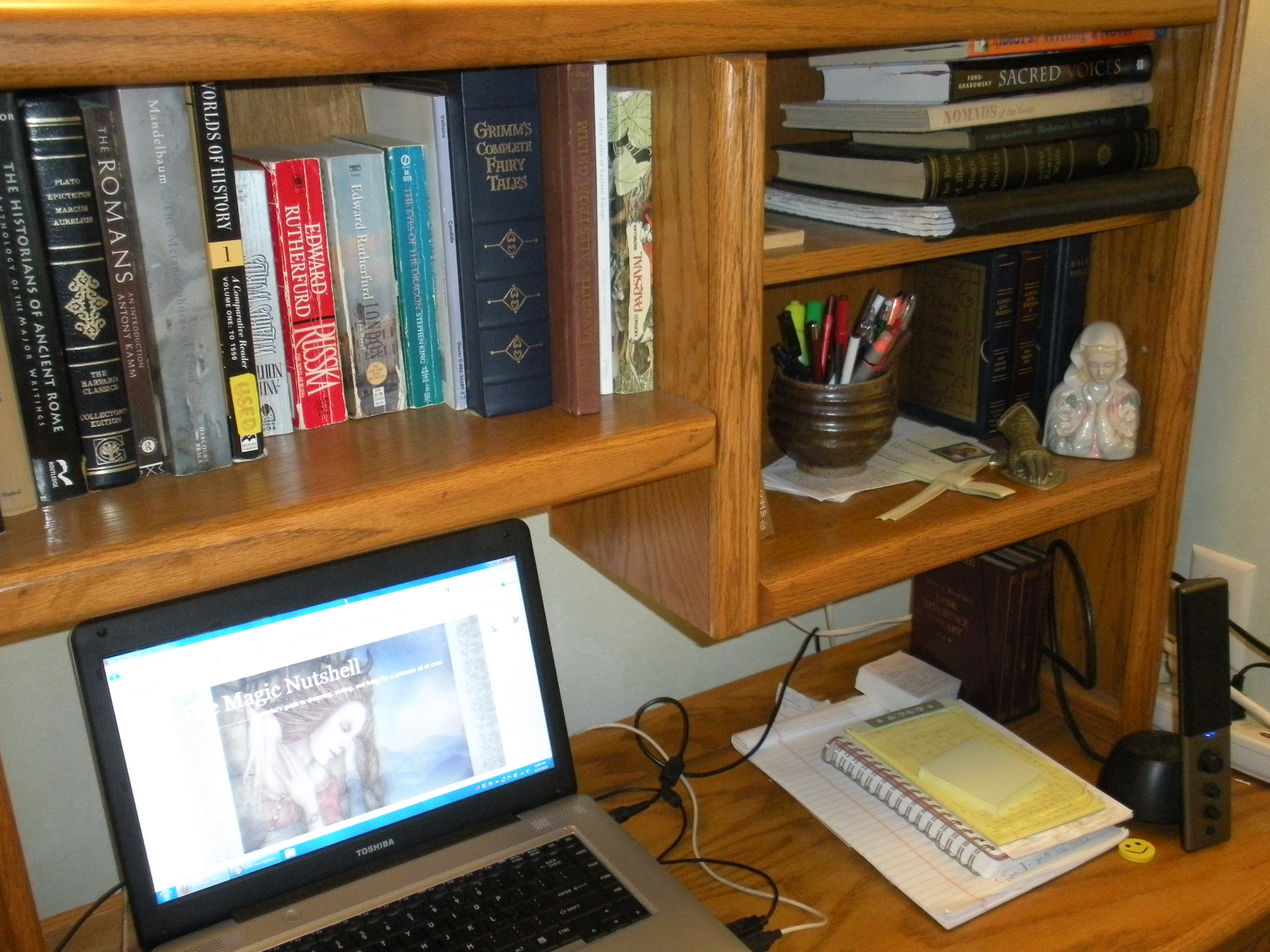
Jeannie's workspace
How does art fit into your life, in general? Is it something you think about and talk about every day, or every week, or only in certain situations, etc.?
Writing is solitary work, but I think about my plot, characters, and word choices every day—in the car, in the shower, during lulls at work, and even in dreams. Films, paintings, architecture, plays, nature, and all kinds of unlikely experiences give me ideas. Although I don’t have much time to sit down and write, I do read about European history and myth at every opportunity. I keep books and articles packed in my breast pump bag and my nightstand. I talk about concepts and interesting stories and history facts all the time with my family and friends. They will probably be bored with everything I’ve learned before I’ve finished my book!
When you start on a piece, what kind of end result do you have in mind? Does it get performed or published, put in a permanent form or is it more temporary?
I would like to see my book published one day. I hope to craft a novel of high enough quality and broad enough appeal to land a contract that could lead to an ongoing fiction writing career. I realize that such publishing deals are going the way of tenured professorships, but they still do exist, and that is my dream.
What goals do you set in relation to your art, both short- and long-term? Is it something you hope to make money doing, or is it something you want to keep uncommercialized? Does the term “sell-out” hold meaning for you or do you see the art/commerce relationship as a necessary one?
In the short term, while I’m caring for a baby, family is my top priority and takes most of my energy. So my goal for the next year or two is just to keep the writing momentum going, adding something to my manuscript every few days.
In the long term, I hope to reach many readers through publication of many novels. I hope to make enough money to support myself in continuing to write fiction—without having to maintain two “day jobs” in the meantime. It would be a great pleasure to reach a large readership who might enjoy my stories and interpret them in different ways.
Selling a work of art is not the same as selling out. I have always understood the term “selling out” to mean compromising a work’s integrity for a profit. But the difference between selling and selling out is complex and subjective. Not all changes or amendments to a work to prepare it for sale compromise its integrity. For example, an editor’s suggestions to fix errors within a manuscript to improve its quality for sale would likely improve the work from an artistic standpoint and not subvert its purpose. On the other hand, product placement within a novel that has nothing to do with the story would be a sell-out. But there is plenty of gray area between those obvious examples. I think it’s a distinction made in the gut of the artist in relation to each individual work.
The art/commerce relationship is not always necessary; many people express themselves creatively without selling their works. But the creation of any piece of art does take time and money, so if the artist cannot independently support her or his own work, it must be made possible through sales or grants or patronage, which are not entirely different arrangements. For me, selling my novel could give me the freedom to spend time writing more and better novels and improving my craft in a way that would be difficult or impossible if writing time were always forced into the periphery of my daily life.
What role does collaboration with others play in your art, if any?
The text of my novel itself I write completely on my own. But indirectly, many others have assisted me. My writing has benefited from a good critique partner who is encouraging, honest, and skilled at close reading and reviewing. Every time she says, “I don’t like this,” she points out a way to make the scene or chapter a hundred times better. Other help has been even more indirect, but no less important. My husband has been supportive in providing me some time and space to write, and I have learned a lot from networking online with authors and readers.
How conscious are you of your artistic influences? Who are your artistic influences?
I couldn’t possibly be conscious of all of them—in some way, I am influenced by every word I’ve ever heard or read—but I can name many that I intentionally draw upon.
A major influence of my current manuscript is Gregory Maguire, author of Wicked, Confessions of an Ugly Stepsister, and other creative retellings of fairy tales.
I try to read classic stories, old and new, in the hope that I can learn even a tiny bit from the literary masters. I like to read Shakespeare, the ultimate master of witty dialogue, and novelists like Vladimir Nabokov, Virginia Woolfe, Tolstoy, and Jane Austen.
I also admire J.K. Rowling for her world-building, her whimsical names and made-up words, and her fun and accessible storytelling.
My favorite modern storytellers, famous but still underrated, are American Indian authors Sherman Alexie and Louise Erdrich, who paint such vivid, inscrutable, and true faces of humanity. My own life experience is limited, and I feel that reading poignant stories of other people’s experiences, real or fictional, broadens my understanding of what it means to be human and helps me write better characters.
To keep my use of language fresh and interesting, I like to study prose and poetry in other languages as much as I can. Although I don’t read or understand Japanese, I enjoy the elegance of the haiku poetry form, and I like to read English translations of medieval Japanese love and Zen poetry. In Spanish, I have read some prose by Paolo Cuelho (translated from Portuguese) and Laura Esquivel and the poetry of Pablo Neruda. I love listening to Italian, French, and German opera and playing with different ways of translating the libretti into English to capture—or modify—meaning, tone, and lyrical rhythm in different ways. My husband and I practically worship the band Rammstein for Till Lindemann’s lyrics with their subversive and brilliant triple-entendres and wonderful turns of phrase. Some of the songs echo concepts and themes from medieval and ancient German folklore, which is perfect for my current project. Listening to Rammstein while writing has inspired a few of the scenes in my book.
With Briars and Black Hellebore in particular, I am drawing from extensive readings of Western European folklore, which is connected to the folk traditions and fairy tales of Eastern Europe and Southeast Asia and the Far East. As a child, I loved the Grimm brothers’ iterations of German fairy tales and also modern Disney movies based on fairy tales.
As an adult, I am having a great time tracing those storylines further and further back into pre-Christian epic poetry and cross-cultural traditions. I read Homer and Ovid in college, and just now I am delving into Beowulf and the Nibelungenlied, the great Germanic epic that splintered into many of the fairy tales recorded by the Grimm brothers. I am amazed at how downright entertaining and fascinating the Nibelungenlied is and how few Americans have even heard of it. I feel the same way about the story of Camaralzaman and Badoura in the Arabian Nights tales.
Old stories rooted in oral tradition have made me think deeply about the ways stories and cultural ideas evolve through time and across geo-political space, sometimes organically and sometimes intentionally by a single author. The stories within the Nibelungenlied and the Arabian Nights are influenced by true events and people, the stories of other cultures, bizarre misconceptions of other cultures, and editorial opinions and interpretations of the people who finally wrote them down. German fairy tales, often told by the lower classes and probably mostly by women, were edited, censored, and modified by the Grimm brothers in order to sell them in book form to a wealthy, male readership. (See “selling out,” above!) It is so exciting to plunge down the rabbit holes of revisionist history, cultural misappropriation, political and moral censorship, mistranslation, and divergent narratives following migrations and culture shifts.
I also have a fascination with sacred texts, Christian and otherwise. The “metamyth” of sacred texts is as interesting as the writings themselves. It is amazing how controversial and loaded the line between “myth” and “religion” is drawn in modern Western society, but the difference is impossible to define coherently or justify.
Since this is a travel blog, how does travel relate to or affect your art? (Themes in what you produce, road trips to perform your music, thoughts on what happens to your painting when you ship it across the country to a customer, etc.)
I love to create rich, purposeful settings for my stories. Traveling anywhere, to a nearby city or a distant country, to somewhere beautiful or ugly, for business or pleasure, stimulates my senses, layers and deepens my store of memories, and opens my mind and spirit to fresh insights and observations. Like a painter who builds up the “negative space” around the subject of a picture, I try to use setting to reflect and influence characters’ internal motivations, set moods, foreshadow, and become part of the action. As a novel reader, I like to be “taken away” on a journey outside myself, so I try to offer that experience in my own writing.
And finally, a right-brain question: If your art was a map, what would it be a map of?
It would be a map of Western culture. Ultimately, that is what I am exploring as I work on Briars and Black Hellebore.
If you’d like, share your website/Facebook page and any upcoming gigs/plans you’d like readers to know about.
http://magicnutshell.blogspot.com/
The House Theatre specializes in grandiose stories, generally involving a hugely ambitious main character and a lot of quick action. I’ve enjoyed The Attempters and All the Fame of Lofty Deeds, and I like the story of Cyrano de Bergerac, so I was excited to see Cyrano. Here’s an excerpt:
“Matt Hawkins’ adaption is a House Theatre production, a company infinitely familiar with the flamboyant confidence and ambitious drive associated with the word, so it will come as no surprise that ‘Cyrano’ has plenty of panache.”
You can read the rest of the review here.
Some additional thoughts:
The fighting was fantastic, like leap out of your seat and grab a sword to join in fantastic. The acting was great, too. Characters leaping on and off the grand piano in the center of the stage make for good visuals, but the actual songs played on the piano are mostly forgettable, except for the “fool in love” melody.
Mostly, I forget that the Cyrano story is not the plot of the Steve Martin movie Roxanne, no matter that the movie is loosely based on the original play. Roxanne is a comedy with a happy ending, and Cyrano is an often funny tragedy wherein most everyone dies. So manage your expectations on that front and you’ll be fine.
I have no idea why they chose Rasputin-like imagery for the poster and promotional materials. It doesn’t fit at all. Ah well.
I’ve finished John Tully’s A Short History of Cambodia: From Empire to Survival, and damn if it isn’t a discouraging read. It’s all right there in the subtitle–Cambodia was once a strong empire with the largest city in pre-Industrial times, an intricate system of canals and farmland, and an impressive collection of intricately carved temples, and now it is one of the poorest countries in the world, riddled with corruption, and desperately trying to pump up a tourism industry centered around the ruins of the greatness that once was.

A Short History of Cambodia
Of course, every country has its ups and downs, and no empire lasts forever. But the way in which Cambodia got totally screwed, over and over, from the mid-19th century through today, is both upsetting and instructive. Basically, although European colonization came late to Cambodia, it came with a vengeance. The French used an anti-missionary assault in Saigon as an excuse to send over a “protective mission” that quickly became a “permanent occupation force” (p.80). From Saigon to Cambodia, and soon they had control over Indochina (the colonialist term for much of Southeast Asia). Cambodia was officially a protectorate, but basically France treated them like a badly behaved colony, giving them strict governors and overhauling their entire system of government with no local input so it never had mass support (even measures like abolishing slavery and setting up schools for children).
By 1954, Cambodia had been caught up in the French fight with the Vietnamese, and the people wanted out. Prince Norodom Sihanouk successfully maneuvered to have the Geneva conference name Cambodia a sovereign nation, albeit with strings attached. I mentioned in another post that the intersectionality of world politics in the 20th century astonishes me, and while I’m sure that makes me sound naive, the extent to which the Cold War affected politics in literally ever corner of the globe in the latter half of the century can’t really be overstated, I don’t think. For example, the only way Sihanouk managed to get Cambodia free of French rule was by promising up and down and back and forth that Cambodia was a neutral country that would never enter into military alliances with any other country. Not to mention he had to beg to have his country back in the first place, and the US and USSR, along with some other countries, granted that. (This granting of sovereignty to nations that already existed and just need their colonizers off their backs is deeply puzzling to me. See reservations, Native American.)

Prince Sihanouk
This is not to say that either world power gave up hopes of using Cambodia in its Southeast Asian chess game, and the US presence in Vietnam went far toward stirring up discontent in Cambodia with the US and any pro-US factions. The Khmer Rouge, staunchly anti-US, started gaining followers. (“Khmer Rouge” means “Red Khmer,” the Khmer being the ethnic people of Cambodia, and the Red being a reference to their Communist affiliation–a context I never knew about or wondered about before. Funny how names can hold one meaning for you–deadly Pol Pot regime!–when they started out with quite another meaning entirely.)
Eventually, the country descended into civil war, with the war-weary Vietnamese, the jungle-hardened Khmer Rouge, the covert-bombing Americans, and the under-supplied national army all entangled in a mess of a fight. When the US and Vietnam got out, it became unwinnable for the national army, and Pol Pot and the Khmer Rouge stormed into power.

Pol Pot, looking creepily cheerful as he palms a gun and plots genocide
Pol Pot’s socialist agenda was extreme. He immediately banned all private property, currency, manufacturing, and education. He force-marched his fellow Cambodians out of the “corrupt” cities and into the countryside, and along the way murdered thousands of people the infamous killing fields outside the city. Displacing hundreds of thousands of people, killing as many, and utterly changing the basic structure of everyday life was not, surprise surprise, a successful plan. The country plunged into disrepair, and Pol Pot went back to war with Vietnam, which no one was equipped to handle. At the end of 1978, the Vietnamese invaded Cambodia and took over for the next ten years.
The sickening thing about this post-DK (Democratic Kampuchea, Pol Pot’s name for his regime) era is the international response. The bloody and drawn-out Vietnam War had done nothing to convince the US that that country wasn’t out to conquer and convert all neighboring countries to communism (the domino theory! a real winner of an idea), and China was equally upset with Vietnam’s perceived overreach into its physical and ideological domain. They were both dead-set on punishing Vietnam for its ambition, so since Vietnam had invaded/liberated Cambodia, that meant Cambodia got to suffer too. The People’s Republic of Kampuchea (PRK, the post-DK regime name) “was cut off from assistance from the UN Development Programme, the Asian Development Bank, the IMF and the World Bank, with only a trickle of humanitarian aid from UNICEF and the International Red Cross” (p. 207). In effect, the international community abandoned Cambodia.

Apparently this is how it was all gonna go down.
Not only that, but Pol Pot had fled when the Vietnamese invaded, and he ran guerrilla options for many years in the jungles, ratcheting up Cambodian civilian deaths with no one pursuing him on any serious level. The Western world was so concerned about the threat of Vietnam ruling Cambodia as a puppet state that it gave tacit (and sometimes material) support to Pol Pot and the Khmer Rouge. I repeat: we supported Pol Pot. Ask anyone with a basic knowledge of the world history of the last century who Pol Pot is, and they’ll tell you, a dictator, a genocidal madman, a brutal murderer. And yet, because it seemed politically expedient to do so, the United States and other countries supported him for a number of years, until Cambodia proved it was no Vietnamese puppet nor Communist state, and aid could be sent without troubling the conscience about the red threat (p. 213). And Pol Pot died peacefully in his sleep in 1998.
The PRK government had its fair share of gross human rights abuses, yes, but if the international community had stepped in with aid right away, and called for the swift and impartial trials of Khmer Rouge war criminals, then it would have been a very different story. Basing foreign policy a paranoid idea like the domino theory is not only foolish, it’s dangerous. It has real consequences for millions of people on the ground. The United States’ treatment of Cambodia in that twenty-year period–from Nixon’s bombings, through the support of the Khmer Rouge, to the lack of basic aid during a famine in 1979–is inhumane and unjustifiable.
So, see what I mean about Cambodia getting the wrong end of the stick for decades? The corrupt nature of its officials on every level, combined with the self-interested interference of neighboring countries and world powers, led to a war-torn nation in which the people suffered mightily. Nowadays, the country is run by a corrupt prime minister, Hun Sen, and millions of people remain in dire poverty. But aid from outside countries (especially China) does help, and the textile and tourism industries have grown the country’s economy rapidly in the last ten years. Education and health levels are rising, as well, and a healthy, educated population is much more in a position to tackle its issues and guide its own path. Cambodia’s recent history is dark, yes, but that doesn’t mean the country doesn’t have a bright future.

Cambodians moving on
Image 1 from here. Image 2 from here. Image 3 from here. Image 4 from here. Image 5 from here, credit Felix Hug.
 Stowaway Travel Writing & Editorial Services