Pretty Awesome Scoundrels

I recently watched a movie about a smart, lying, double-crossing, two-faced woman, and she was not called a bitch. This is such an incredible thing that it merits its own post.

The movie is Dirty Rotten Scoundrels, a Michael Caine/Steve Martin vehicle that plays to each of their strengths perfectly. Michael Caine gets to be a genteel know-it-all, and Steve Martin gets to be an obnoxious loudmouth. They are both con men, although Caine works only among the upper crust and does very well for himself, whereas Martin considers himself well off when he cons a woman out of twenty bucks. The entire movie consists of Caine trying to get Martin out of his small French Riviera town, so he can go back to working it by himself, conning rich women out of their jewels and pocketbooks by pretending to be a prince in need of funds to battle communists in his home country. Hilarity ensues. (No, really, it’s very funny.) The main plot unfolds when they bet that the first one to get $50,000 out of Glenne Headly, an American heiress, wins the rights to stay in Beaumont-sur-Mer, and the loser leaves town.
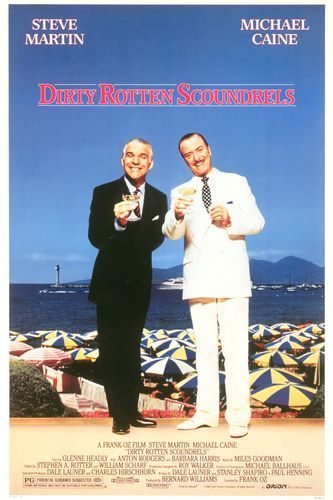
Dirty Rotten Scoundrels

Hide your valuables, ladies, the charm offensive is on

*SPOILER ALERT* The problem is, the heiress turns out not to be an heiress, but rather a woman who is touring Europe as the winner of a contest for a detergent company. She’s promised both men the $50,000, but has to bankrupt herself in order to get it. Caine turns out to have scruples and calls off the bet. Martin, unsurprisingly, has no scruples and wants to continue the bet, or at least amend it — the first man to bed her wins. Caine shows even more character when he says that he won’t try to woo her himself, but he’ll bet against Martin’s success. *NO REALLY, THIS IS THE FINAL TWIST OF THE FILM* Headly declares herself in love with Martin, and visits his bedroom. Caine hears of this and is ready to admit defeat, but then Headly shows up at his house, crying that Martin took her $50,000 and she has nothing now. Caine gives her $50,000 of his own money and takes her to the airport, where she thrusts the bag of his money back in his hands, declaring she can’t take it and running onto the plane. Only then does Martin appear, screaming that Headly took HIS money, and when Caine opens the bag, he finds instead a note from Headly that reveals she knew their con all along and played them the whole time.

Martin’s reaction: “Of all the lousy… She is disgusting! She is lying, deceitful, two-faced. She is conniving and she is dishonest!” Caine’s response: “Yes. Isn’t she wonderful?”

Now, in just about any other Hollywood film from the last fifty years, Martin’s reaction would’ve included “That bitch!” in there somewhere — we’d need to know that she is not just another player in the game, but that her gender makes her a particularly despicable one. She would not be a worthy opponent with individual skills to assess and combat, but a generic enemy in need of crushing. We would have had lingering shots of her legs and chest throughout the film. We probably would’ve seen her get naked in preparation for sleeping with Martin.

Not only that, but the other women Caine and Martin con would be bimbos, sluts, easy marks not just for being rich and stupid but for being rich and stupid in a gendered way. Instead, they are easy marks because, in Caine’s words, they’re “screened. They’re wealthy and corrupt.” His scams always involve women, yes, and they hinge on the need of these particular women for flattery, romance, and a distraction from the stultifying boredom of extreme wealth. But the scams don’t involve sexual humiliation, or dick-waving bragging afterward, or even stripping the women of all their material wealth. Caine takes a large amount of money, possibly after a mutually satisfying sexual liaison, and then slips away. And when things go badly, say, for example, when he is robbed of $50,000, he does not blame the woman who played him, or call her a bitch for outsmarting him, or plot revenge. No, he calls her wonderful, seeing her as an equal, a great challenger to his title as master con artist of the Riviera.

The movie even ends with Martin put firmly in place. Unlike Caine, he did try to degrade Headly by betting on his ability to conquer her sexually. The I-bet-I-can-screw-her-oh-wait-now-I-love-her-so-I-will-be-honorable-and-at-the-last-minute-not-continue-in-my-lie-and-take-her-clothes-off-but-it’s-cool-because-that-one-moment-of-restraint-is-enough-to-convince-her-of-my-love-so-she’ll-totally-screw-me-later-so-the-moral-of-the-story-is-I-get-laid-either-way trope is so tired, and it was refreshing to see it turned inside out here. Not only does Martin not get with Headly, and not only does she not fall in love with him, but she steals his money and leaves him naked in a hotel room. And at the end of the film, when she returns to the two men to pull them into working a con with her, she introduces Caine by name and has him talk as an integral part of the con, but then introduces Martin — “he’s a mute.” Caine was going to dupe her out of her money but not her dignity. Martin was going for whatever he could get, and what he got was shut the hell up. Fantastic.

The remarkable thing about Headly’s deception is that the movie is clear that she does this not because all women are evil, or cold-hearted, or only in it for the money, but because she is the same creature as these men, a brilliant liar who lives for the con. I don’t know how you feel about movies based on crooks swindling hard-earned money out of honest folks, but I love them. Con movies — Trouble in Paradise, The Sting, etc. — are delightful works of sparkling wit, fine-tuned plot, and great reaction shots. Morals shmorals, give me Paul Newman’s nose-scratching signal any day. This is one of the few films I know of that is so devoted to the wonder of the con that it lets women play too. And that’s pretty awesome.
Your Spring Mix 2010

Greetings, dearest fellow travelers! It’s Just- spring, the trees are in bud, the ground’s squelching into mud, and the goat man’s afoot. Time for some tunes! Here’s your Spring Mix 2010. Guaranteed to have you warbling like the robins in the trees as you bounce down the street with daffodils in your hands and a grin on your face.

If you sign into Lala, you’ll be able to play the music and see how you like it (sorry, I can’t embed the playlist here; WordPress doesn’t support it): http://www.lala.com/#playlist/5493P107114

Spring in Your Step 2010

Warmer—Beulah
Laura—Girls
I Can’t See Nobody—Nina Simone
Be My Baby—Ronettes
Never Forget You—Noisettes
Love Me Til the Sun Shines—The Kinks
Two Weeks—Grizzly Bear
Louie—Ida Maria
Wanderlust King—Gogol Bordello
Holiday—Vampire Weekend
When Water Comes to Life—Cloud Cult
Ambling Alp—Yeasayer
Blue Sky—Joan Baez
Town Called Malice—The Jam
1901—Phoenix
We Came to Dance—The Gaslight Anthem
Searching for the Ghost—Heartless Bastards
I Wish, I Wish—Cat Stevens

Bonus: A (NSFW if your work is against nonsexual nudity) video for Yeasayer’s “Ambling Alp”:

I Propose We Revamp the True Romantic Comedy: An Evisceration of “The Proposal”

Dearest fellow travelers, in the words of Gob Bluth, I’ve made a huge mistake. Not quite on par with selling out my brother or denying parentage of my son, but still scarring — I watched The Proposal. It was a slow Wednesday night, it showed up in my Netflix On Demand queue, and I like Sandra Bullock, so I thought, “Why not?” OH MY GOODNESS, SO MANY REASONS WHY NOT.

I should have turned it off within the first three minutes, when it became apparent the movie is not grounded in any version of reality I’m aware of. Sandra Bullock’s character, Margaret, is the top editor at some fancy book publishing house. In the opening scenes, we follow her as she barrels through the streets of New York on her way to the office; she spends the whole walk arguing on her cell with one of her best-selling authors. The argument? She got him a slot on Oprah to talk about his book, and he doesn’t want to do it. JUMP BACK. There is no author in the history of ever who would pass up the opportunity to appear on Oprah’s show to promote their book. Austen wanted on Oprah. Dickens owes half his popularity to his delightful Oprah appearances. Poe never got an Oprah interview, and he ended up roaming the streets of Baltimore, raving mad and hours from death. The only author to have not gone on Oprah after originally offered a slot is Jonathan Franzen, and even that was a rejection of Oprah’s Book Club and not a TV appearance (she pulled the interview after he revealed he didn’t want the book club sticker because men might find it off-putting (which, ew, men, get it together)). Every writer, published or unpublished, believes that their book is just the right one to fit between a celebrity interview and a spa package giveaway on the Queen of Talk’s show. Every  newly signed author eagerly sits down with the publicist assigned to them and says, “I’ve got a great idea for publicity. I should go on Oprah!” The publicist then groans inwardly, because the percentage of authors who make it on Oprah is minuscule, and out of that, the percentage of new authors who get to sit in Harpo Studios is infinitesimal. So you’d better believe that when an editor finagles an Oprah appearance (and by the way, I bet the publicist is a little pissed at being shoved out of their job on this one), the only response she’s going to receive is hysterical screaming, tears of joy, and possibly the offer to name their firstborn after her. When one of the plot points of your movie centers around something so deeply misguided as an author refusing to appear on Oprah, you know your movie is already in serious trouble.

But I didn’t turn it off, much to the detriment of my psyche. Apparently, when The Proposal first came out in June, critics didn’t think the movie was anything to write home about, but they didn’t think it was the worst of the breed. Oh my word are they wrong. It’s heavy-handed where it should be lighthearted, mean-spirited where it should be heartwarming, and dull where it should be lively. Not to mention, it’s a feminist’s nightmare.

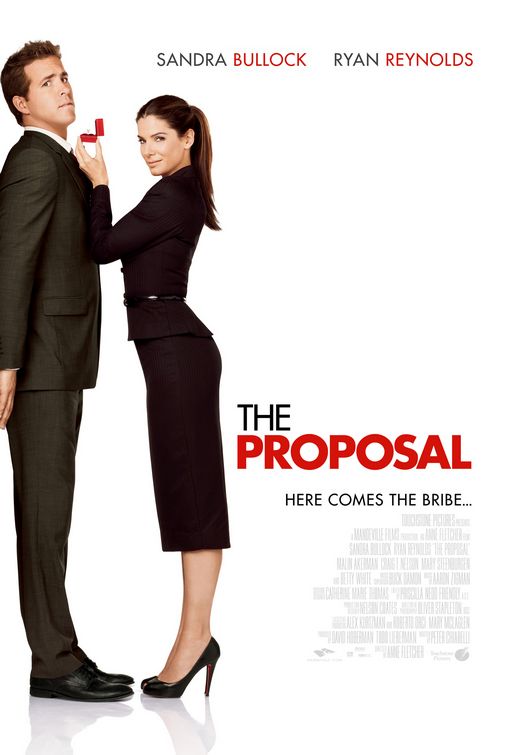
The Proposal poster

source of severe psychic damage

First, the form. I am a fan of romantic comedies; they are, at their best, vehicles for rapier wit, brilliantly timed physical humor, and genuine warmth between two likable leads gamely playing out gender politics and societal tensions on their way to the altar. It Happened One Night, The Philadelphia Story, Trouble in Paradise, Bringing Up Baby — all fantastic romantic comedies. Also all pre-WWII. Way back in 1999, Stephanie Zacharek at Salon wrote a great piece on what is wrong with the rom coms of the ’90s. Things haven’t improved since then. Think Valentine’s Day, Sex and the City, 27 Dresses, He’s Just Not That Into You — all films that seem to revel in women as catty, desperate, pathetic creatures, and men as clueless, boorish, and somehow just right for you. Many feminist sites comment regularly on the dearth of decent rom coms — Feministing even has a regular series about it, which I recommend. So I’m just joining these highly intelligent and perceptive women when I say romantic comedies ain’t what they used to be.

Generally, romantic comedies follow a predictable formula — boy and girl meet (ok, in Hollywood, heteronormative movies, it’s always boy and girl), boy and girl hate each other, boy and girl spend the rest of the movie figuring out that they love each other, usually with the help of some quirky friends. In the best ones, the obstacles are there for real character development, not just as haphazard roadblocks against the inevitable conclusion.

In The Proposal, however, the main obstacle is the slimmest of excuses — Margaret is a Canadian citizen who violated the terms of her visa and will be deported if she can’t come up with a legitimate reason she should stay in the country, so she pretends she and her assistant, Ryan Reynolds’ Andrew, are engaged. But they have to fool the evil USCIS agent who doesn’t believe their story! And they have to fly to Alaska to meet Andrew’s family and fool them into thinking it’s a real engagement, too! And Andrew has to learn how to be a man again! And Margaret needs to learn over and over and over again that what she really wants is the love of a good man!

Right. About that. Aside from the glaring publishing industry inaccuracies (throwing in a reference to the Frankfurt Book Fair does not make you up on your game, screenwriters), the movie’s main problem is its obsessive focus on taking the most extreme elements of Taming of the Shrew and applying them to the modern age. Margaret is a successful businesswoman, therefore she must be bitter, alone, and a total domineering bitch. We know this because the office underlings call her “it” (gee, that’s not unnecessarily dehumanizing), she doesn’t smile, and she fires someone when he doesn’t do his job. She must be stopped. Placing her in Alaska gives her lots of opportunities to learn the valuable lesson of humility — or rather, humiliation, which is not the same thing. Andrew grabs her ass on two different occasions, both in front of people; a stripper brings her onstage against her will to gyrate on top of her and stick his junk in her face, much to her discomfort; she takes a huge spill off a bike only to find herself in the middle of some faux-Native American spirit dance whose main purpose seems to be allowing Andrew to see her jump about and grunt so he can call her weird; she gets self-conscious around Andrew in the morning and puts on makeup in bed so he won’t notice what she actually looks like when she wakes up; he sticks his erection in her ass as they try to snuggle for the benefit of his family; she reveals secrets about herself in an attempt to bond with Andrew and show him her softer side, and he laughs at the fact that she hasn’t been laid in a year and a half; and finally, she falls out of a boat into the ocean, and flails about in panic because she can’t swim, and Andrew must save her. Literally save her. The gods of subtlety were not with these screenwriters.

In contrast, the only lesson Andrew seems to need to learn is to turn his sarcasm meter up to “high” every time he talks to Margaret and get into arguments with his father that he can stomp away from so he can do some good wood chopping (not a euphemism). We’re supposed to believe that he’s nothing but belittled by Margaret, and so not only does she have what’s coming to her, but he has to be the one to give it to her. And how is he belittled? He wakes up late (not her fault, as far as I can see) and  runs with two hot coffees and slams into the mail guy, who he then berates (not the mail guy’s fault, as far as I can see). She makes fun of him for ordering the same coffee as she does, tells him she won’t buy the manuscript he’s selected from the slush pile, and makes him accompany her to the firing of another editor. She does force him to be fake engaged to her so that she doesn’t get deported. Except, well, he could just not do that. She counter-argues that he has to because he needs this job and he won’t be able to move up in the publishing world if he doesn’t make her happy, but one of the main markers of publishing is that people change companies all the time. Even if it were another industry, I’m pretty sure he’d make it. So that’s it. Those are the many, many ways she emasculates him, and those are the moments he makes up for by continually mocking and molesting her throughout the film. I call foul.

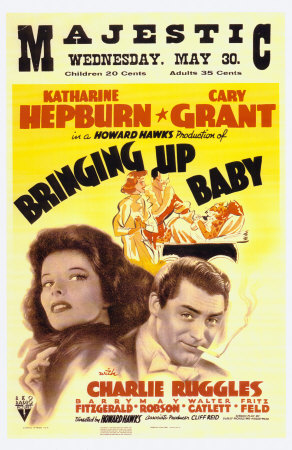
One of the great hallmarks of terrific romantic comedies is that both main characters grow and become more suited for one another. It Happened One Night is another kind of Taming of the Shrew, and there’s some ass-slapping and “shut up”s that are a little jarring, but even those instances are part of both characters letting go of stereotypes and learning how to be kinder toward one another — and that was made in 1934, not 2009. In Bringing Up Baby, Katharine Hepburn’s character is a bit MPDG, with the key difference being that she actually has her own wants and needs. But those wants and needs, while pursued to ridiculous ends, aren’t portrayed as totally unreasonable or the province of an overly demanding or pathetically desperate woman. Rather, she’s a bubbly young woman who falls for Cary Grant (who wouldn’t?) and enacts several schemes to win his heart. This proves successful, and while he becomes a little more adventurous, she isn’t knocked down a peg or two. There’s no sense that she has to give up an essential part of herself to be worthy of love.

Bringing Up Baby poster

this is how it's done

In The Proposal, there wasn’t much to define Margaret’s character to begin with, but at least we knew that she was good at her job, appeared to enjoy it, and had built herself up after the devastating loss of both her parents when she was only a teenager. That all gets broken down as she is shown to be hopeless at the Internet (really? she didn’t recognize the sound of a modem connecting?), so her very competence is brought into question; scared of Andrew’s family’s dog, which makes her even more of a weak woman because it’s a tiny dog and who’s scared of those?; and ultimately sacrificing herself for the well-being of Andrew (which wouldn’t at all be a bad thing if he’d sacrificed anything for her, or if she’d learned a lesson other than “I’m not worth a family’s love and will go cry in Canada now”). She gives up every part of herself, he gives up no part of himself, and it’s supposed to be a happy ending. I’ve rarely been more depressed when a movie ended.

There was no chemistry between the leads, we had only Betty White to carry all the comedic relief, and the dialogue was wretched. The Proposal is a failure purely from a basic cinematic point of view. But its failure as a romantic comedy — and one directed and produced by women, no less — is what really upsets me. I think the term “feminist’s nightmare” might be a bit overused, but in this case, it’s true. The lessons we learn are thus: Women shouldn’t be in charge, women should find a man and settle down, men should be jerks to women if they want their respect and love, and we should pervert love so that this is all done in love’s name. Pretty nightmarish.

At the very end of the film, as Margaret and Andrew kiss in an office full of coworkers, someone yells out, “Show her who’s boss, Andrew!” As if we were in any danger of forgetting.

Spotlight on… Emily

Dearest fellow travelers, you know I like to keep you apprised of good tunes. This here is another installment of Music You Might Very Well Enjoy, and it has the added benefit of being made by someone near and dear to me — my sister. My entire family is talented in many ways, and as I’ve mentioned before, we’re all musical. But today, let’s focus on Emily, the songwriter and performer among us. Dad taught Emily the guitar when she was in eighth grade, and only one year later, she’d written her first hit, “Whoever Said.” She’s been writing songs ever since, and performs at open mics and the like in whatever town she happens to live in, be it Ann Arbor, Avignon, or New York City.

I’m sure that writers of every kind get tired of being asked where they get their ideas, what they think about when they’re writing, and what their process is. The answers even remain mostly the same — ideas come from a small seed somewhere and get under the writer’s skin, the writer has to give over to what wants to be written when they’re sitting down with paper and pen, and they have a pretty good sense of when it’s working. But the variations on that theme are still interesting, and if you’re a writer yourself, often informative.

I asked Emily to write a bit about how she writes the wonderful songs she writes. I’ve included videos of some of my favorite tunes — “Release Me,” “For You,” and “A Story.” As she says, they’re all love songs, and they’re all ones you’ll want to listen to again and again. Enjoy!

“Songs — I like writing ’em and I like singing ’em.  I write the song that gets stuck in yer head; the one to which each person in the audience can relate.  My favorite kind of song is the one that makes your mom (or dad!) cry but it’s written right for you and your heart.  I like to write love songs — the love that grows, the love that changes, the love that ends.

“I’m no poet like Bob Dylan or Carole King but I write what I know and I write from experience.  So there isn’t a single song in my repertoire that doesn’t make me think of a person or an event or a potential or something like that.  I guess each song is its own story for my bag of memories.  Which is nice, as I have the worst memory in history so if I have something written down with a tune, I can carry that with me always.

“My songs are written in both ways — with words first or with music first, it really just depends.  Sometimes it depends on the challenge I’m setting for myself… whether I need to fit a certain chord progression in or rhythm… whether I’m trying out a new trick with finger picking or not.  Then I lace words into the music and figure out the song from there.  Other times I get a line (usually something cheesy) stuck in my head that runs in a loop until I finally get other lines to go with it.  Once that’s secured that’s when I’ll get out the guitar and see what fits with it.  Sometimes the melody I start with becomes the song’s chorus or bridge or it’s thrown out altogether for something completely different and that is so exciting.”

ETA: I can’t believe I didn’t get into this earlier, but watch the videos, because as good as Emily’s songs are (and they are good), they are transcendent when she sings them. Her voice is strong and beautiful, and although she prefers harmonizing over singing the melody in just about everything she sings, she sticks to the main tune in these videos.

Picture, Thousand Words, Etc.

Greetings from exotic Chicago! I am back on American soil and happy to be so. A report on the airplanes: about as uncomfortable as expected, but no worse so. I sat next to a man on my O’Hare-Heathrow flight who said that United is the worst of the major airlines, because they took all the inches of legroom in Economy and moved them to Economy Plus, where you pay an extra hundred bucks for the privilege. I certainly felt the difference. I was squished just sitting in the seat, of course, but trying to find a relaxing pose for my legs proved highly difficult. Especially on the eastward flight, you want to sleep, so stretching out somewhat is important. I must’ve looked like a college freshman eager to prove my comic chops on my improv troupe tryout, as I first spread my legs like a dude, one foot in the aisle and the other edging into my neighbor’s space; then pressed my legs together and sat low in my seat to shove my feet under the seat in front of me; then threw my weight to one side of the seat and wiggled my hips and legs toward the other side two inches away; then pulled my legs up and held them in mid-air; and finally settled on a rotating roster of all these options. I didn’t sleep on that flight, and it wasn’t from excitement to be traveling. I did pony up the extra cash for Economy Plus on my return flight, and if anyone has any doubt that the airlines’ anti-fat policies are anything but profit-grubbing, they only need look at that Heathrow-O’Hare flight to see the ten of us who’d paid extra spread out, while everyone else who could barely afford the basic ticket sticking it out in the back. Hell yes I paid more to make it through the eight-hour flight. Lucky for me I had that option.

But anyway. The time I spent NOT on airplanes was pretty great. I saw a lot of family and friends, and even got in some sightseeing. I can show you pictures of the pretty, pretty canals I saw in Amsterdam, the windmill I passed in Utrecht, and the queen I dined with in London (juuuuust kidding on that one), but instead, let’s take a look at some of the less-trumpted sights of these fair cities, shall we? Because I saw some damn funny things. Without further ado:

The Top 10 Unknown, Can’t-Miss Sights of My European Adventure 2010

(P.S. Formatting is way funky on this thing. I was trying for something cool and it didn’t quite work. And now I’m too tired to redo it or try again, so I’m leaving it as is and hoping you’ll find it charming. Isn’t that the American way?)

oh, art students, keep doing your thing

the happiest trash can in the world -- Marina's favorite tourist spot

there are too many amazing things about this window display for me to even put into words

snack time, anyone? (no, not me either)

rabbits at Borough Market

who ya gonna call?

a bad shot of the cricket jokes tea towel at my grandmother's house

on top of a London church -- I thought all the animals were supposed to live in harmony in Jesus' world?

animatronic T Rex! everlasting love to Liz for showing me the wonders of the Natural History Museum

heaven / bar in Utrecht

Flying the Fat Skies

Dearest fellow travelers, let’s get uncomfortable. Not oops-I-mispronounced-your-name uncomfortable or we’re-both-trying-to-go-the-same-direction-from-opposite-directions-and-keep-walking-into-each-other uncomfortable. No, I’m talking about roll-your-eyes, let-out-a-long-sigh, grumble-loudly-about-the-inconsideration-of-SOME-PEOPLE uncomfortable.

I refer, naturally, to the discomfort a thin person feels when seated next to a fat person on an airplane. The encroachment of sweaty, flabby, smelly flesh on your space, which you paid a damned good portion of your paycheck for, thankyouverymuch.

Oh wait. No, I’m not. Your discomfort sure is too bad, but it is by no means the only discomfort experienced in that situation. As the sweaty, flabby, smelly lump of flesh oozing into your seat, I can promise that you are not the only uncomfortable one here.

When I’m in an airplane seat, I am squeezed in on all sides — by the small seats that barely contain people with bikini-model bodies, let alone anyone else; by the low overhead compartment that I invariably bump into when standing up/sitting down as I try to fold up my tall 5’10” frame to fit; by the fully extended seat in front of me bruising my knees with every readjustment; and by the endless succession of passengers lurching down the aisle into my head on their way to the can and flight attendants rattling drink carts into my elbow. These are all complaints that everyone who has ever boarded an airplane has voiced (except for maybe the tall stuff — that just adds to it).

Now add to that the claustrophobia of total disapproval and condemnation. The resentful glances every time you shift in your seat, the looks of contempt every time you dare put food in your mouth, the pinched face of the flight attendant as she holds out a seatbelt extender at arm’s length. In daily life, but especially in the cramped confines of an airplane, I’m crowded in by people’s disapproval of my own body and the way I inhabit that body. Not only am I a walking moral failure, too weak to resist overeating, but other people have to see that, and that’s just offensive. On top of which, people seem to think that if they get too close, if they physically touch me, they’ll catch my fat. It sure isn’t my job to disabuse people of these totally false notions, and I’m quite content with the body I have and the way I live in it, but that isn’t a comfort when I’m hemmed in by judgment and I just want to get to my destination in peace.

Of course, not everyone is so unpleasant. A couple years ago, I sat next to a petite college-aged woman who was able to curl up in her seat and rest her head against the window. She was fine with me moving the arm rest up, and didn’t glance over with disgust when I ate the unappetizing meal of limp chicken and rice. She didn’t care what I did, so long as she could sleep for the eight-hour flight. Last year, a flight attendant held out a seatbelt extender to me with an apologetic look and said, “Oh these are old PanAm planes, and their belts are shorter.” Condescending, sure, but sweet. The remarkable thing about these women — and I shouldn’t have to remark on it at all — is that they simply treated me as another human being. I got no special treatment, just the simple courtesy you afford others when you’re all packed in like sardines and eager for a smooth journey. I don’t see why that should be so hard for people to do.

I’m going on a plane on Wednesday, and I’m not looking forward to it. I’m flying United, which last year joined Southwest as one of the major airlines that is very public about its anti-fat people policy. They received a whole 700 complaints from people who felt infringed upon by their fat neighbors (I’m guessing their fat neighbors number far more than 700). I gotta say, I feel pretty infringed upon by this policy, which states that if a flight attendant finds a passenger too large (unable to put the arm rests down “comfortably”), that passenger will be asked to buy another seat, buy a seat in first class, or if those aren’t options, get off the damn plane they’re already on and wait for another flight that has one of those options available. This policy has been covered in a lot of fat acceptance blogs, but I’ll just add to the chorus of “oh no you didn’t”; everyone is uncomfortable on a plane, nobody can afford two seats, and making the decision up to the whim of a harried flight attendant is icing on this particularly tasteless cake. Not to mention, as that Shapely Prose post details, it’s all one-sided; if those 700 people who wrote United are so upset about their comfort level, how about THEY buy the extra seat or first class ticket?

In anticipation of my impending flight, I bought a seat extender in the hopes that I could avoid the nasty looks of other passengers and the very real possibility of a humiliating encounter with a flight attendant who finds my substantial hips to be a “safety issue.” (I promise you, if the plane crashes, I will be moving off it plenty fast enough.) I spent $55 on this precaution, and then asked my friend T. to embroider my name on the extender so TSA agents and flight attendants won’t accuse me of stealing theirs. Isn’t it pretty?

my embroidered seatbelt extender -- thanks, T!

But for all that, it might not work. I might be delayed by more than a day as I wait for a flight that has two free spots, I might drain my checking account to pay for those two spots, I might miss my cousin’s confirmation (which is the main purpose of my visit to England), or any number of things could go wrong. I shelled out an extra $55 just in case my body might cause someone else to freak out, because their freak-out could very easily turn into my punishment in the form of humiliation, inconvenience, and a huge outlay of even more money. Flying is a stressful enough activity without adding these worries, and I shouldn’t have to consider them when booking a flight.

I think it’s clear to anyone reading this blog that travel means a great deal to me. It’s a freeing feeling to soar above the clouds in a giant metal bird, but lately I’ve been feeling more and more constricted by airline rules, passenger comments, and the attendant anxiety, to the point that I hesitate before booking a flight, and I find that terribly sad. I strongly encourage you to read Kate Harding’s piece in Broadsheet last week about the Kevin Smith/Southwest debacle, and bring a Kleenex, because she gets personal and very moving. She gets to the heart of why these airline policies are wrong, and why people who argue in favor of them are heartless.

For those who think the policies are reasonable and fat people need to pay for the sin of inhabiting their own bodies, just remember that however uncomfortable you may be with that mound of flesh next to you oozing into your seat, that mound of flesh is working every day to maintain a sense of dignity in a world that reduces her to just such a characterization. I am constantly re-humanizing myself in a society that doggedly works to forget how human I am, and I promise it doesn’t get much more uncomfortable than that.

Valentine’s Day 2010

For the past couple years, I’ve made my friends a Valentine’s Day mix CD. I am not attached to the “holiday” as such, so instead of anxiously hunting around town for a man to date so I have someone to buy me chocolates and flowers, I spend that time putting together a great mix of tunes instead. Past years have included a mix of all happy songs, and then a dual set of happy and sad love songs. I’ll post them another time.

But this year! Ladies and gents, I may not buy into Valentine’s Day as a special day for love and material possessions, but I am always willing to celebrate a day devoted to the S, the E, and the X. So I give you a mix that is devoted entirely to having a verrrry good time. Yes, it includes not only Barry White but also “Let’s Get It On,” and yes, it is as awesome and mood-setting as it seems. Enjoy!

BODIES: a sensual experience
Valentine’s Day 2010

Stay – Maurice & the Zendaks
Rockin’ Chair – Gwen McCrae
Can’t Take My Eyes Off of You – Lauryn Hill
Never Never Gonna Give You Up – Barry White
Feel Like Makin’ Love – Roberta Flack
Shake That Ass on the Dance Floor – Vicious Vicious
Let’s Get It On – Marvin Gaye
Your Love is King – Sade
So in Love – Curtis Mayfield
A Long Walk – Jill Scott
I’m Still in Love with You – Al Green
Your Ship – Enders Room
4 Leaf Clover – Erykah Badu
Inside My Love – Minnie Riperton
Smooth Operator – Sade
Didn’t I Blow Your Mind this Time – The Delfonics

Happy Valentine's Day! image courtesy of a Google image search

Book Report: Australia

Greetings, dearest fellow travelers! How’s your winter wanderlust? Mine usually gets extra-itchy when it’s icy and cold outside, so it’s a good thing I have a big trip planned at the end of this month. In the meantime, I can get my fix by researching future travels.

Today: thoughts on Stuart Macintyre’s A Concise History of Australia, through the first few chapters.

I’m really enjoying the Macintyre history, although his discussion of the “females” is a bit grating. Still, it’s early days yet. What I am finding interesting though, and what I hope to write more about in the future, is what the national narrative is for Australia. What stories do Australians tell about themselves? Who are their heroes, their folktales and popular myths, their national qualities and values? I’m especially interested in the ways the Australian narrative intersects with and diverges from the American narrative.

We have a really strong story of brave pioneers setting up a new country of religious freedom and self-governing independence; we gloss over some messy relations with the people who were already quite comfortable living here, thankyouverymuch, and now they get to be our friends in grade school Thanksgiving plays; and we have a big war full of homegrown heroes who thought up a new way to run a country that no one had ever tried before. In reality, of course, the Puritans who came over here were religious zealots who wanted to use this new land to make their religion the only way to live (and make money while doing it), and anyone who didn’t agree was literally cast out into the wilderness; there were many nations of Native Americans living here who responded to the invaders in various ways, including with violent resistance, treaties, assimilation, and appeasement, and the colonial settlements were by no means an inevitable or righteous undertaking; and the Founding Fathers (oof, loaded term!), who were vocal in their callbacks to Greek democracy when declaring independence from Britain, were slaveowners who needed the French to bail them out.

So that’s the American origins narrative; what’s the Australian narrative? I’m getting a sense of it from this Macintyre book, but it’s a very different thing when the invaders are convicts explicitly exiled from their homeland and ordered to work off their sentence for the good of the country they wronged. (Imagine my surprise when I found out that there was actually quite a bit of this going on in New England, and the American Revolution is what put an end to that and forced the British government to consider Australia as a dumping ground for convicts!) Here, the hardy pioneer is just as important as he (yes, always he) was in the American story, but there are two extra elements — the Australian landscape was wholly, harshly different from the English one, and the Australian pioneers were mainly made up of  subjects of the British crown who had been deemed unworthy of being full citizens of that crown. They were expected to settle this new continent for the benefit of a government and upper class citizenry that took their free labor and gave them tiny amounts of unfarmable land in return. I imagine that involves some bitterness and resentment, and I wonder how that works in the Australian story.

Which doesn’t even touch on the bitterness and resentment of Aborigines, who were of course on the continent for over 40,000 years before the British showed up and said, “This looks like a nice vacation spot.” I know there’s a lot of similarities between the British treatment of Aborigines and the British/American treatment of Native Americans — land theft, broken treaties, raped women, stolen children, forced resettlements. It’s interesting, and depressing, to see what those similarities are. Despite the fairly rapid British takeover of the Eastern part of the continent, the Aborigines didn’t just give up their land and way of life, as seen in the story of Pemulwuy, an Aboriginal man known as the Rainbow Warrior for his work uniting various Aboriginal peoples. He organized various groups of Aborigines (the term “tribe” is no longer in use, I’ve learned) to resist the British settlements, and was the first to show the British that the Aborigines weren’t going to take the invasion without a fight. He was killed in battle and his son carried on the fight. His name is left out of the definitive Australian Dictionary of Biography, since as late as the 1960s, Aborigines were considered by the dominant white class to only get in the way of the progress of the country and thus didn’t merit mention in the history books. Happily, he is now recognized as a rebel hero, and his name is getting more recognition in mainstream (yes, white) Australia.

Research update: I’m barely into the 1800s in this Macintyre book, and I have yet to read some fiction or Aborigine dreamwalking tales, but those are next. Also, the food and music, yes. I’m fairly up to date on films; I’ve seen The Piano, Muriel’s Wedding, Mad Max, The Road Warrior, Strictly Ballroom, and now Love Serenade.

My schedule for the next few weeks involves hosting a couchsurfer, hosting my sisters, and going to England for 12 days. Let’s just say Australia is a freakin’ continent and not just a country, and therefore gets two months. I’ll try to finish up what I can before my England trip, and then when I’m back in March we can talk New Zealand.