Film Club: Rabbit-Proof Fence

Damn, another movie that made me cry. Ask my family and they’ll tell you how rare that is — I’m the only one out of all five of us who is more likely, while watching sentimental schlock and genuinely moving fare alike, to roll my eyes than to have tears in them. Make no mistake, the director of Rabbit-Proof Fence fully intended to make me cry, and tugged my heartstrings all sorts of ways to make sure I did. But the story itself, plus three forlorn children onscreen, was enough to have me welling up at the end.

Rabbit-Proof Fence is an adaptation of Doris Pilkington Garimara’s book about her mother, Molly Craig. When Molly was 14, she, her sister and her cousin were forcibly removed from their home in Jigalong, in western Australia, and placed in the “re-education facility” Moore River Native Settlement. Under the White Australia plan of government, “protectors” of Aborigines were assigned to each state and territory in the country. They were supposedly meant to make sure Aborigines’ rights were looked out for, but in reality, they said who could and could not marry, where they were allowed to live, and whether they could keep their own children. It was established policy by 1931, when this movie is set, that mixed-race Aboriginal children were stolen from their families and placed in boarding schools that trained them for a life of working in white women’s houses (for the girls) or in white men’s fields (for the boys). The reasoning, like similar policies in the United States with Native Americans, was that it was best to assimilate the native population into the colonizing society, for their own benefit. Clearly it was better to be white, so whites were doing a public service by erasing Aborigines’ cultural heritage, never mind that grossly erroneous premise or the deep and lasting trauma to the parents and children.

The movie has a clear agenda, but for once I didn’t mind. The girls missed their family deeply, they couldn’t trust any whites they encountered because they would probably report the girls to the authorities and send them back to the settlement, and they walked 1500 miles to be reunited with the life and loved ones they knew. The movie didn’t have to try very hard to show that this was a really bad policy and a horrible affront to human rights — in fact, the movie tried a little too hard to show that the protector, A. O. Neville, truly believed that he was helping the Aborigines and couldn’t understand why they would possibly run away from the settlement. I mean, I guess that perspective is important, to show people that there was a majority of voting opinion that held this belief, because otherwise you’d just assume it was made-up, that it’s too obvious that you shouldn’t separate families based on racial prejudice. Because that is pretty damn obvious, but it wasn’t obvious enough to enough people until the 1970s, when the last children were ripped from their homes with official sanction before the government ended the program.

The most upsetting part about the movie was the very end. The last scene shows 2 of the 3 girls reunited with their mother and grandmother, the music swells, and we all feel relieved that they made it home. But then the voiceover comes up and says that Molly was sent back to Moore River with her own two children nine years later. She escaped with one of her two daughters and once again walked 1500 miles to get home, but that daughter was stolen from her and it was many years before she met the daughter she’d had to leave behind at Moore River. So Molly lost one of her children forever and reunited with her other child only after over 20 years of separation. This is why it’s called the Stolen Generations, plural; family after family was ripped apart in the name of racial purity and superiority.

Molly was torn from her mother, and then her children were torn from her. She was time and again denied her own family, her own choices, her own life. Despite this, she worked alongside her husband and became a mainstay in the desert community she knew and loved; in other words, she carved out her own life in spite of her country telling her she shouldn’t. I admire her immensely for that, and also her daughter for writing down her story and getting it published. Now, because of the movie, it’s a story that millions of people know, and that part of Australian history has been added back into the public consciousness. There are Stolen Generations deniers and former prime minister John Howard refused to apologize to Aborigines for the government’s actions, yes, but they know. People know. And that is the first step to action, right?

New Music Summer 2010 Mix

Well, I didn’t get any barbeque this holiday weekend, unfortunately, but I’m going to trust that you did, and therefore, as promised, here’s a bonus post for this week.

It’s your New Music Summer 2010 Mix! That’s not to say this music is all new; some of it is several years old. But it’s all new to me via one particularly music-savvy friend, Patrick (with the exception of the Michael Beauchamp track — he’s a Michigan artist and played my friend’s wedding). Patrick introduced me to a vast amount of new artists, and I’ve picked some of my favorites for a summer mix that starts out bouncy and bright in the park and meanders into sleepy and content on the porch. Enjoy!

(NB: Lala no longer exists and imeem is now owned by MySpace, so I currently have no way to play the mix for you, but I’ve included some videos to give you an idea. Please do go on out there and listen to the artists on their websites, and support with download/CD purchases.)

Oh Christine – The Cave Singers

Outside Looking In – Papercuts

Bernadette – Arrah and the Ferns

Masterplan – jj

Deadbeat Summer – Neon Indian

Orchard Fair – Wye Oak

Ruby Go Home – Thee Oh Sees

Love Is an Unfamiliar Name – The Duke Spirit

Brazen – Heartless Bastards

If We Can Land a Man on the Moon, Surely I Can Win Your Heart – Beulah

The Lucky Ones – Viva Voce

Sunday Noises – Califone

Golden Cloak – Marmoset

Buried in Teeth – Mariee Sioux

The Rest of the Day – Bedhead

Last Song of the Night – Michael Beauchamp

Light Up the Night – The Besnard Lakes

History is Not Inevitable — and That Matters for Today

History is not inevitable. Perhaps this is something they go over with history majors (although I will say I never encountered the idea in the several history courses I took in college), but for me and I think for the general populace, it’s an unusual idea. After all, events unfolded the way they did and now we are here, so how could it have been otherwise? It’s like a kind of Q.E.D. — it happened, therefore it is proven; it happened, therefore it must have been meant to happen. I know that this shows up in several religious schools of thought, like determinism in Christianity, and also in general ideas about fate. But it’s a poor approach to history.

This way of thinking sees history as static, and usually consisting of political, military, and economic events rather than a synthesis of these with social, religious, artistic, and scientific events and movements. But history is a living, breathing thing that we are creating right now. If we view ourselves as not only part of the history we know but also the part of the history future generations will learn about, it becomes easier to see past historical events as not inevitable or fated, but part of a series of individual and communal decisions made in constantly shifting circumstances. That’s not to say that I can quite wrap my linear-focused brain around the Australian Aboriginal concept of Dreamtime (in which you are here now but also in the past and the future, all at once) or the physics concept of nonlinear time. All that fluid space and time is nifty but makes me dizzy. But I can grasp the interlocking moments, motivations, and actions that make up our history, as opposed to the clear-cut line from Cause A to Effect B.

Understanding history as more complex than a straight series of inevitable events is crucial to understanding the ways we interact now — legally, socially, personally. For example, the colonization of New Zealand by the British is often seen as something that was bound to happen. The British had more efficient killing machines and more of them, they had thousands more people to populate the land, and they had the backing of an entire empire. But even if colonization were inevitable, the way it happened was drastically different from, say, the colonization of Australia. The British imported convicts to Australia and swept aside the Aborigines as if they were only a small obstacle to populating a continent, rather than the original inhabitants of that continent. In New Zealand, however, they found the Maori not only ready to fight for their land (as many Australian Aborigines were), but organized in a way the British could better understand, with recognizable leaders and specific land boundaries. So the British decided the Maori were more advanced than the Aborigines, and much more likely to respond well to being “civilized.”

Because the British saw the Maori as more civilized and basically more human than the Aborigines, they gave the Maori more consideration when taking their land, and that different historical approach has repercussions today. Unlike Australia, which was declared terra nullius (“empty land”) despite the very obvious presence of Aborigines, the British negotiated for land sales with the Maori of New Zealand. The Treaty of Waitangi was signed by the Pakeha Lieutenant-Governor and most Maori chiefs on February 6, 1840. The document was written in English and immediately translated so the Maori could know what they were signing, but the translation has some key differences from the English version. Notably, the treaty states that New Zealand is part of the British Crown, and only the Crown has the right to purchase land from Maori – or at least, one version states that. Another states that the Crown does not have this right of pre-emption. All versions were introduced with Lieutenant-Governor William Hobson stating, “We are one people.” As Philippa Mein Smith says in A Concise History of New Zealand,

Did ‘one people’ mean all the same, including one law, which in British thought meant civilising and assimilating Maori? Or did it endorse the idea of a new community of Maori and Pakeha, two ethnic groups henceforth defined in relation to each other? (p. 47)

Did the treaty mean Maori chiefs were giving up their sovereignty, or did it mean they were ruling alongside the British monarch and Pakeha governor?

These questions reverberated through the next century and a half, as first the Pakeha poured into New Zealand and bought up Maori land at ridiculously cheap prices (after the Crown bought them at even cheaper prices; an insulting way to get around that provision of the treaty) and later Maori asserted their land rights and citizenship rights. The Waitangi Tribunal in the latter half of the twentieth century resulted not only in recognition of Maori as an official language of the nation and the recognition of the importance of environmental considerations in indigenous rights, but in actual money settlements for breach of treaty (p. 231-236). Central to the arguments for money settlements and land renegotiations in the 1980s and 1990s were questions of not just what had taken place in 1840 but what kind of future both Pakeha and Maori were envisioning when they signed that treaty.

I find it fascinating that the New Zealand national government actually had a public discourse about what its intentions had been 150 years previous, and what effect those intentions and actions had on its citizens subsequently. The government recognized a breach of treaty and redressed that breach to the descendants of the wrong party. It’s all very proper Western legal action, but it’s also a bold step in acknowledging history as a living thing with no inevitable outcome and no fixed endpoint. Just because New Zealand is now a part of the British Commonwealth and overwhelmingly run by people of European descent doesn’t mean that that’s how it has to stay. Maori have regained some fishing and land rights, and they have also gained seats in parliament due to proportional representation measures, so they have more of a voice in the shaping of history going forward and not just looking back. Asians, instead of being legally shut out of the country and considered a threat to New Zealanders, are now being welcomed and encouraged to settle in New Zealand.

Certainly New Zealand has its share of bigots and racist policies, but I do find it heartening that a country that had a strong “White New Zealand” movement for decades (much like the “White Australia” movement that has unfortunately not died out as quickly it should) has made conscious efforts to not erase that history but to repudiate it and build a better one. Of course, it took the tireless efforts of thousands of ordinary citizens, activists, and politicians to bring about these changes, and I find that even more encouraging. The more people recognize history as living and evolving, the more we can build a just and peaceful history for ourselves and those who come after us.

Back in Full Force Soon

Oh my darlings, I have been busy of late. Not frantically so, but busy nevertheless. May has been a month of weddings this year, and I’ve also been hosting couchsurfers, visiting friends, and possibly (oh my) starting up a small business. (Details to follow.) But! I have also been diligently working on the A Country a Month project — I’m up to the early 20th century in the history of New Zealand, and as you may have seen a couple weeks ago, I enjoyed Whale Rider and have a few other films and books at the ready. I’m really enjoying the writing in Philippa Mein Smith’s A Concise History of New Zealand, much more so than in Macintyre’s history of Australia. I’ve already talked about it a bit in earlier posts, and trust me when I say there’s some good stuff to come. (Is that enticing enough?)

Which is all to say, no, you’re not getting a real post this week, my apologies, but next week you will have a shiny new one on Tuesday to welcome you back to work. You may even get two next week, if you’re very good and eat a lot of barbeque this holiday weekend. Enjoy!

Arizona’s Racism Hurts Little Girl in Maryland

And this is just one public moment of heartbreak that shows why 1) states shouldn’t get to make their own laws on a national issue like immigration and 2) anyone making laws on immigration had better make sure those laws are humane, just, and carefully considered.

http://thelede.blogs.nytimes.com/2010/05/19/worried-girl-asks-michelle-obama-if-her-mother-will-be-deported/

Use It or Lose It

I’m about a third of the way through Philippa Mein Smith’s A Concise History of New Zealand, and I’m starting to get the hang of some of the words she’s using. Mein Smith carefully uses Maori words for Maori objects and concepts throughout the book. She includes a glossary in the back, but once she’s explained it once in the actual text, that’s it, you have to remember what it means or constantly flip back to see what she’s talking about. This shouldn’t be hard, of course; many books introduce unfamiliar English terms and don’t re-explain them later, and I’m pretty easily able to file that new vocabulary word away in my brain and apply it to the reading at hand. But non-English phrases always stump me. My brain takes extra time to process them, even after a clear definition, so that I really am constantly flipping back to the glossary to see what she’s talking about. I find it frustrating to have to do this, but it is actually getting less frequent. I can remember now that “waka” means “large, ocean-going canoe” and “Pakeha” is the word for “white people of European descent” in the Maori language. I know that the more I think of these words themselves instead of their translations, the more I’m actually understanding the text and the culture it’s describing.

Language is hugely important in understanding anything about ourselves or others (and to some, it’s the only thing that matters at all, depending on how committed to language as sole meaning you are, but that’s a discussion for philosophers and English majors). To use the language of the people you’re learning about is to get a better sense of the nuances of words and the layers of meaning in each phrase. For example, as Mein Smith points out, the Maori weren’t Maori until the Pakeha arrived. It took the arrival of a whole new set of people to necessitate the construction of identity in opposition to (that doesn’t mean conflict with) the newcomers. So we get Maori and Pakeha, and Pakeha is different from Europeans. “Pakeha” implies intrusion, late arrival, strange new customs. “Europeans” implies Old World, civilization, explorers. “Europeans” may be the appropriate word in certain portions of histories, or in histories that don’t involve the Maori at all. But for Maori-Pakeha relations, “Pakeha” is the appropriate word to use. This repositions us, the American readers and travelers, from an outsider’s perspective so that we’re in New Zealand, with the Maori. This isn’t to say we suddenly become insiders and get to talk about the Maori as our brothers and sisters — that is just appropriation. But it does mean we get closer to understanding this point of view, this way of seeing and discussing the world, and that is a key part of travel.

I’m pretty bad at learning languages, but I’ve always wanted to be fluent in more than one. I want to be able to communicate with people in their language, to get their jokes and idioms, to see the world without translation. I don’t see myself becoming fluent in anything any time soon (although I do keep trying French), but I can learn a few words of the language everywhere I go. Saying “please” and “thank you” can seem like the lazy American’s concession to culture, but it doesn’t have to be. It can be a very real way to show respect for those you can’t understand, and a simple attempt to show appreciation for the communication you are having — be it through a translator, with gestures and pantomimes, or with their own knowledge of English.

Whether in a book or in a real life conversation, if you can use a word from the relevant language and use it with a good understanding of its many meanings and not just a word-for-word translation, chances are you’ll gain a better understanding of the culture that uses that language. Use it enough times til you’re comfortable with it, and then there’s no need to get lost in translation.

Film Club: Whale Rider

Dearest fellow travelers, come with me to the beautiful coastline of New Zealand, where we’ll cover some Film Club and some A Country a Month at the same time. Whale Rider is a 2002 film directed by Niki Caro, from a screenplay by Caro and Witi Ihimaera (who authored the book it’s based off of). Several people recommended this film to me, telling me how much I would enjoy the story of a young girl overcoming a thousand years of patriarchal rule to become the next leader of her tribe. This was an accurate prediction on your part. Whale Rider is a lovely movie.

Whale Rider movie poster

Whale Rider movie poster

Paikea is named after the legendary Maori figure who rode on the back of a whale from the homeland of Hawaiki to reach Aotearoa (the islands of New Zealand). Pai is a delightful 11-year-old who adores her crotchety old grandfather, Koro, the chief of the tribe. Yes, there is some of that well-worn gruff old man with a soft spot for a precocious young child — a tiresome cliché that flattens out both characters in many films — but it’s kept from getting too sentimental because Koro really does resent Pai for being a girl instead of a boy and thus unable to assume leadership of the tribe. Throughout the movie, he has many opportunities to relent and acknowledge her as his heir, but he refuses right up until the end. He does love Pai but says several cruel things about her and actively keeps her from learning the rites of chieftainship. She loves Koro but consistently disobeys his orders to keep her place as a girl. It’s more painful to watch a film like this, because the characters are acting more like real people than characters in other movies, and real people can be pretty awful to each other, but that’s what makes it so great, and also what makes the eventual reconciliation much more meaningful.

Another thing I liked about the movie is the film’s and Pai’s refusal to make her a saint or ideal. Koro is searching for a prophet to lead his people out of the troubled times they find themselves in (encroaching crime and drug use). Pai knows she is the next leader of the tribe, but she also knows she is no prophet. She is a gifted, sensitive girl, with a strong link to her ancestors and the natural world that her community lives in, but she is not superhuman. She doesn’t want to be a savior; she wants her whole community to come together and bring themselves out of the bad times and into a brighter future. How rarely do films, books, or even real life leaders express this wish? We are so accustomed to looking for saviors (and that’s not even counting religious figures) who will make everything right that we miss countless opportunities to fix our own problems and improve our own communities. Pai knows that the only way to be a strong group is to work as a group, and we see a beautiful illustration of that communal effort at the end of the film, when she leads a giant waka (Maori canoe) full of her neighbors into the sea as part of a celebratory ceremony. We need leaders who know how to bring out the best in us, not saviors who bring the best to us.

And yes, that happens to be my political philosophy. Heroes and saviors make great action figures and film stars, but they rarely make great history without a strong community to build on their vision. Whale Rider shows that truly humble people can also be compelling on the screen, and the numerous regular people in our lives working for a better world show how compelling they are in making history.

Arizona’s New Era of Racism: The Ethics of Traveling to Repressive Places

The state of Arizona recently passed SB 1070, which is a terrifying piece of legislation that mandates racial profiling, rewards paranoia and hate, and puts Arizona back at least 50 years. This is no exaggeration. Take a look at that NYT article — this law REQUIRES police officers to demand identification papers from anyone they suspect might be in the country illegally; it makes it a misdemeanor to not carry immigration papers; and it lets any citizen sue local law enforcement if they think this law isn’t being enforced. First we have Driving While Black; now we have Living While Brown.

This is the only law of its kind in the United States, but don’t think that doesn’t mean other states aren’t running to catch up. And don’t think for a second it isn’t racist. Check out Rachel Maddow’s short but effective rundown of the authors of the bill — longstanding members of groups whose explicit purpose is to make sure America’s majority is white. Who are most of the undocumented immigrants in Arizona? Latinos. So a law aimed at cracking down on illegal immigration is aimed at cracking down on Latinos. And how do you determine which Latinos are US citizens, legal immigrants, tourists, etc. and which are crossing the border from Mexico without official approval? No really, how do you tell? Even Governor Jan Brewer, who signed the bill into law, couldn’t answer that question. “I do not know what an illegal immigrant looks like,” she said when asked. But the police are supposed to know and make arrests based on that unknowable qualification? Is this like porn — I know it when I see it? Nope, pretty sure it’s like mandatory racial profiling — all brown people are immediately suspect.

handmade sign at the May Day rally

no child should know what a SWAT truck looks like

My dad is always concerned that I consider the other side of the matter before taking a stand, which is good advice. So okay, people who support this bill are concerned about what, exactly? Sharing increasingly scarce resources with people who weren’t born here? Talk to your representatives about spreading the wealth a little more evenly. Losing your job to someone who braved brutal conditions, rape and murder on the trip from Mexico to the States? Even fairly conservative groups will agree that many undocumented immigrants do the work you don’t want to do, and in some cases their presence even raises wages. The increasing rate of crime in your state? Take a look at those who say they’re protecting the American way and then talk to me about rising crime rates. But mostly the support for this bill comes from many white Arizonans’ discomfort at the many brown faces they encounter on a daily basis. I hate to break it to you, but you weren’t exactly here first, and you were never really the majority.

I think the reasoning that most kindhearted but ignorant Americans hold is that it’s already illegal for these people to be here, so what’s the big deal if they get caught? Well, a whole lot of people who have every legal right to be here are going to be caught up in this giant net that’s been cast, simply based on the way they look. What if they run a red light, as anyone is liable to do, and they forgot their immigration papers at home? White Arizonans would be ticketed for running the red light and sent on their way. Latino Arizonans will be ticketed, handcuffed, and brought to the police station for holding and questioning while they’re run through the system to see if they’re allowed to be here. Everyday lives will be dramatically circumscribed, as every action is weighed against the possible consequences from a hostile law enforcement body. And that’s just legal immigrants and citizens.

Undocumented immigrants (“illegal immigrants” confers illegality on a person’s very being and thus dehumanizes them, and anyway is less accurate than “undocumented immigrants,” so I won’t use it) face grave consequences for simply being out on the street when a police officer happens along and decides to take a closer look at them. The category of “undocumented immigrants” encompasses a whole host of people, including people who were brought here by their parents when they were young and know no other home than the States, people who are escaping brutal regimes and couldn’t gain refugee status but are still terrified to return to their homeland, and women who are escaping the more commonplace but equally terrifying regimes of their brutal partners. “Undocumented immigrants” does not equal “job-stealing criminals.” It equals “people.” It equals “you or me in a different situation, in a different stroke of luck or fate.” The consequences for undocumented immigrants under this law is families being ripped apart, wretched treatment in detainment facilities, forced deportation, and uncertain and dangerous futures. That’s the big deal if they get caught.

This law is not “misguided,” as President Obama has called it. It is hateful and wrong.

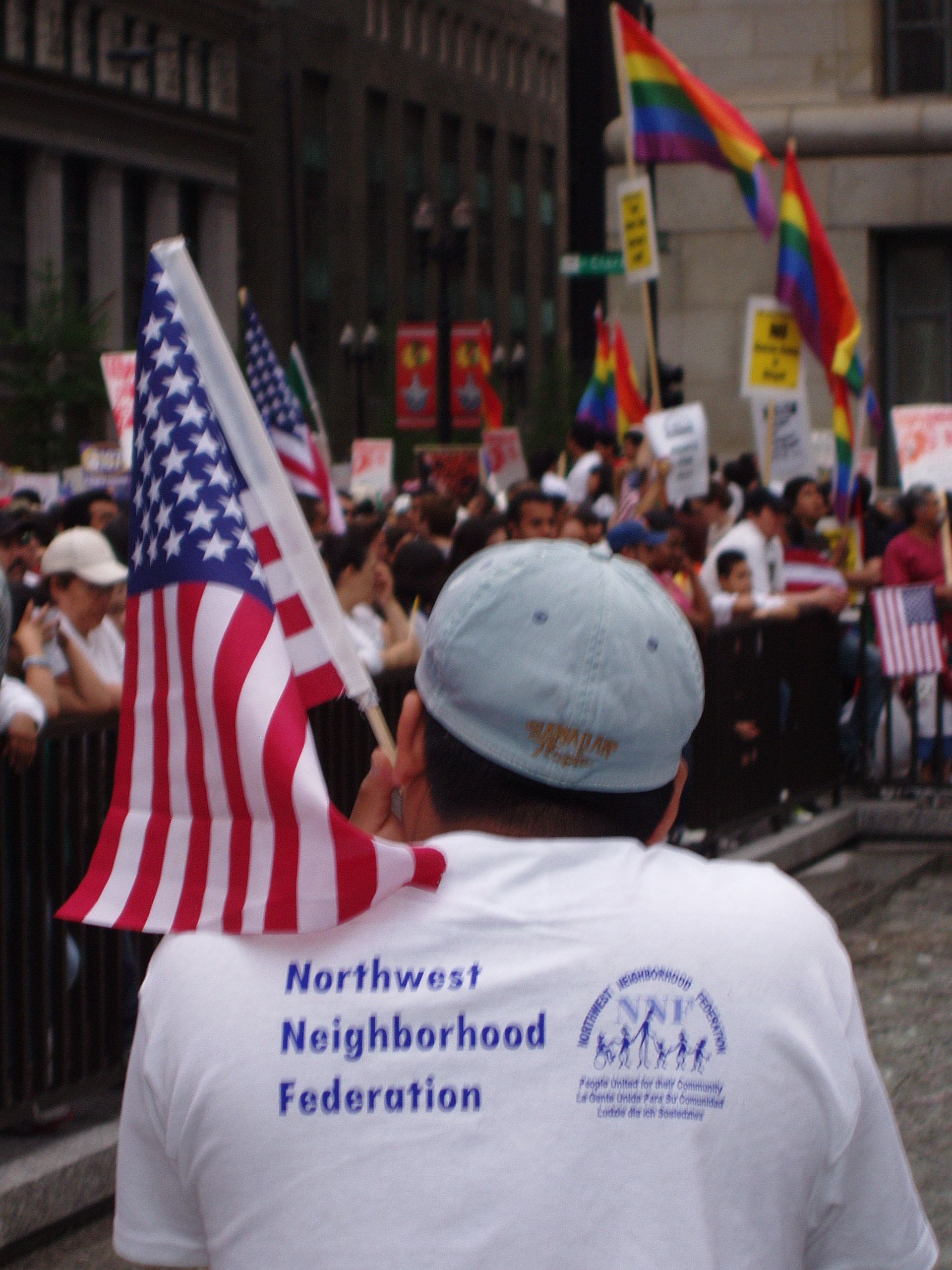
May Day Rally at Daley Plaza 2010

May Day Workers' Rights and Immigration Reform Rally at Daley Plaza 2010

So what do we do about it? This roundup at Feministe has some suggestions. The May Day rally I attended in Daley Plaza certainly united people in a loud, strong voice against it. Even some law enforcement officials are outright refusing to obey the law. Write to your Congressperson and Senators; encourage them to work on strong immigration reform legislation in this next congressional session. Write to President Obama and tell him “okay job on health care, we’ll see if Wall Street reform works, now let’s get to immigration reform.”

And since this is a travel blog, as my friend Pam suggested, let’s consider the travel implications. It might seem a small thing, but I do believe every stand we take matters. Representative Grijalva has called for a convention boycott of his own state in protest of the law, and the city of San Francisco has already voiced its support. I’m just one traveler, but I can keep my money away from Arizona and its repressive ways. This isn’t even the only racist law they’ve instated recently — ethnic studies courses are now banned as treasonous, and the state Department of Education is removing teachers who speak with too thick a Spanish accent (even though a study shows that accented teachers might be better for their students). This is a state intent on enforcing a very narrow definition of “normal” and “acceptable,” and it is a state that needs to be stopped. Whatever we can do to turn back this tide of racism, xenophobia, and hatred, we must do. Of course, there are many people in Arizona and out of state who have worked tirelessly for years for human rights in Arizona, and there was a big push from a lot of groups prior to the signing of this law to stop it before it got to the governor’s desk. Unfortunately, their calls for reason and basic decency went unanswered in this case, but that doesn’t mean that’s the only answer they’ll ever get. Americans are scared, and scared people often do stupid things. We must help people see that fear is not the right way to live, or the right way to vote.

And that’s where travel boycotts come in. Pam asked me to consider the ethics of traveling to repressive places, and what I’ve come up with is this: There are varying degrees of repression in every single human-occupied place on this planet, so of course I can’t avoid them all, nor would it be right to do so. But I can refuse to support local economies with my money and my high praise if I find their laws reprehensible. This is a work in progress kind of rule, but I think it comes down to agency and power (as so much does). The residents of Burma, for example, have agency, as every human being does, but they have very little real power, because the ruling junta has it all. The brutal laws of Burma are terrible, but I might still visit there to aid locals (if they wanted me — not all foreigners are welcome, since Americans especially can cause more trouble than they’re worth there). A boycott of Burma might hurt the residents more than the state, and the residents haven’t yet been able to oust their repressive government in favor of another.

The residents of Arizona, on the other hand, have agency AND power. They have the power to nominate and elect legislators who will pass just laws and protect the interests of ALL residents, documented and undocumented alike. Instead, an unfortunate majority of Arizonans has elected cowards, racists, and calculating fearmongers to lead them, and so we get laws like SB 1070. I will not visit a state that elects such people. I will not give money to citizens who support such legislation. This is rough for the many, many Arizonans who work so tirelessly for equality and justice, but I think it is an important statement to make against those who work for the degradation of fellow humans. Arizonans have the power to change their government, their laws, and their way of life, and so I will hold them responsible for doing just that. I have a very good friend in Tucson, but I don’t think I can visit her until her fellow residents have worked out some of their problems. People are rightfully quoting the “First they came for…” poem, but as Problem Chylde says in a brilliant and impassioned post, “We no longer wait for them to come. First we fight.”

What do you think? What is the ethical approach to visiting repressive states? What is the right response as a traveler to unjust laws and fear-filled populations?

May Day Rally 2010

Rallying for change and hope

P.S. I know I’ve used the word “racist” a lot in this post, and I know that makes a lot of people uncomfortable. Generally I agree with Jay Smooth when he says that you need to address the action rather than the sentiment behind it, but sometimes you have to call a racist a fucking racist.

The Good in People

Just a short post today. I’ve had a rotten time lately with a roommate not paying his rent, a super busy schedule at work, and some painful physical therapy to heal my sprained ankle. It was a rainy weekend and I spent it cleaning. Suffice it to say it’s not been the best of weeks.

But then. But then, dearest fellow travelers! I hosted some couch surfers tonight, and they are lovely. I’d said I could host them about a month ago, but once today actually arrived, I felt exhausted at the thought of being a sociable tour guide. Most Mondays, I write a blog post and watch a lot of TV online. I couldn’t fathom doing anything more tonight. But they got here, and we got to talking, and I made some dinner while we chatted, and we made plans to do the same tomorrow. We looked at the funny-shaped map on my wall and pointed out where we each want to travel next. We talked about our shared interest in publishing, and they told me how in France, you can major in publishing at university, like any other profession. (Neato.)

They spent all day traveling and wanted to call it an early night, so I didn’t even have to put on my party shoes and show them the town. I was able to have the relaxing evening I’d hoped for and still have good conversation and new experiences. They can’t pay the rent my ex-roommate owes or take back the insults I received from clients last week, but I immediately felt at ease with them and happier about the world in general after our dinner. There are too many good people out there to stay stuck on the bad ones, and travel is the perfect way to be reminded of this, as you’ll undoubtedly encounter many more good than bad. In fact, travel is mostly about people, and a good thing too, because all in all, people make the whole endeavor worthwhile.

Book Report: Australia, Part 2

Oh my goodness, an actual post about travel! What’s more, it’s a post about the A Country a Month challenge, which at this point should be named the Country Maybe Every Six Months, Seriously It’s Been Years Since College and I’m Out of Practice on All This Nonfiction Reading challenge.

But now — Australia! Last time, I mentioned the national narrative. Now, most of my historical information is coming from Macintyre’s Concise History, so whatever basic narrative arc he’s giving the country is going to influence how I see it. Also I’m thinking of the various ideas, stereotypes, jokes, random facts, and anecdotes about Australia I’ve heard and read over the years. And maybe I’m not reading enough or thinking critically enough, but my original understanding of the Australian story remains much the same: the white narrative is one of hardships overcome, an unforgiving land tamed, and a hardy people always down for a drink or a trek or both. To be clear, this is not how all Australians actually are, but it is the carefully cultivated national story and image.

There’s a lot to admire in that story — pursuing your dreams, making your own way, and doing it with a cheerfulness and willingness that makes the whole endeavor worthwhile. There’s also a whole lot that needs reexamining or outright condemnation. The narrative doesn’t just forget women and non-whites, it forcibly keeps them out of the history of their own country. The fragile ecosystem of this huge, dry continent has been almost entirely destroyed, and obtaining water is a real concern in an increasing number of communities. Not only did whites steal the land of the people who lived here for 40,000 years before Cook showed up, but they also stole thousands of children in an attempt to steal and destroy Aboriginal culture entirely — The Stolen Generations (for which the federal government has expressed regret, but not apologized). Those same friendly blokes willing to share a pint or five with you at the bar are also pretty likely to go home and hurt their partners — an IVAWS survey in 2003 found that 57% of women surveyed had been physically and/or sexually assaulted in their lifetimes, and 34% of those incidents were in the home (this survey also underreported the experiences of indigenous and non-English speaking women, who statistically experience a higher percentage of assaults than white women).

One of the things I was most surprised to learn about was the White Australia movement. Almost all of the early colonizers were whites, both the convicts and shortly thereafter, the gentry and entrepreneurs who bought up huge tracts of land for sheep grazing and mining (including gold). Clearly, the Aborigines were not white, and many of them did fight for their land or take a small plot to work when shut off into reservations, but from the beginning, they were not granted the rights of citizenship that Britain extended to whites. Other workers were also shut out of not just the national story, but the practical benefits of equal rights and freedom as well, especially the Chinese miners. When times got hard, as they always do, the whites blamed the non-whites, as  they always do (the world over).  Main publications like the Bulletin and eventually official government policy touted the importance of keeping Australia white and safe from foreign invaders. This was devastating on so many fronts — white women were explicitly referred to as breeders of the correct race, non-white women were forcibly sterilized to keep from reproducing, non-white men were denied jobs, and it’s not like this policy actually created more jobs for white men or made it easier to live on the Australian frontier. The White Australia policy had a huge impact on immigration, severely limiting or even outright denying the attempts of non-whites to enter the country. You can imagine how well this played with the Asian Pacific nations that surround the island country. It wasn’t until after World War II that restrictions were eased so the labor pool could be increased, and it wasn’t until freaking 1966 that the policy was mostly dismantled, and 1973 when immigration laws were changed in a meaningful way. No Statue of Liberty here; this was a country founded as a prison, and the bars keep people out as well as in.*

White Australia still holds sway in Australian politics, although of course it goes by different names — the One Nation party, mandatory detention, and an English language and “Australian values” citizenship test. As Kristin mentioned in a comment several months ago, a lot of people want to move to a rich, industrialized nation like Australia, but when they get there, they find seriously racist policies and everyday behaviors. It looks like the conservative Liberal/National parties held power for 11 damaging years, until the 2007 elections. Now the Labor party is in power, although I’m not sure what effect this has had on legislation relating to progressive issues concerning race, gender, class, etc.

White Australia policy today comic

White Australia policy today

One last thing that surprised me about Australia’s history — and pleasantly, too. The labor unions fought bitter, violent battles for years with the business owners, pastoral companies, and mining firms. According to Macintyre, the latter half of the 19th century was really rough, and the unions made some advances only to lose them a short time later. However, in 1907 the Australian Settlement was reached, which established a living wage for working men. It was specifically designed for men supporting families, which of course left out women, who weren’t guaranteed such a decent amount. I’m not sure if it left out non-white men as well, although it wouldn’t surprise me. The basic wage was guaranteed to every working man in the country, and was raised as necessary to keep up with inflation. At first, I was surprised at the long history of wage guarantees in Australia (the earliest minimum wage was introduced in 1824 in Victoria), since it’s a country so proud of hard work and individualism. But this law, combined with the efforts by the Labor Party pre-WWII to create jobs for every man in the country, fits in that picture of hard work and individualism. If you could be pretty sure of getting a job, and certain of a decent wage once you got it, you could work hard at it and really earn that wage. It wasn’t hand-outs, it was earned, was the thinking. Again, things have changed in the last 50 years, but there’s still a decent minimum wage in Australia and an expectation of available jobs. (I don’t know how this expectation squares with immigration, more women in the workplace, etc.)

There’s so much more to learn about Australia, of course, but the point of the A Country a Month challenge is to get a general idea of the country itself, both its history and its current events. I’ve tried to do that in this post, and there may be future posts on Australia. I’m especially interested in learning more about dreamwalking and how Australia’s past intersects with the current trend of Australians abroad.

Finally, please don’t think that all I want to do is find the flaws in a country. Far from it! I learned a lot about Australia that makes me even more excited to go there — the countryside, the cultural aspects, etc. But as I’ve mentioned before, I don’t believe neutralized/neutered travel writing does anyone any favors. I don’t intend this post as pointing fingers and laying blame, or an un-self-aware criticism, but please advise me if it reads like that. I’m still figuring out how to write about other cultures, places, and people without Otherizing them to oblivion or choking on my own sanctimony, but I hope this is a start.

Apologies for the imperfect coherence of this long post, but thanks for reading, and as always, please leave comments and help me keep the conversation going.

*I am perfectly aware that US immigration policies have generally been much more severely restrictive than Lady Liberty would have us remember, and of course we currently have some fucked-up approaches to the whole issue, with Arizona leading the way.