ACAM: Singapore — Where to Go, Part 2

Hello dearest fellow travelers! Last month I took a look at some of the things to do and places to go in Singapore, and got some great suggestions for further ideas both here and on Facebook. (By the way, did you know that you can now use your FB login to leave a comment in the field below, so you don’t have to go through a login process every time you want to comment? Neat!) Here I list a few more sites and attractions I’m interested in checking out when I visit Singapore.

Singapore Zoo

Several people recommended visiting the zoo in Singapore, and taking a look around their website, I can see why. The zoo has a huge range of ecosystems to explore, and it’s affiliated with other wildlife parks like the Jurong Bird Park and the Night Safari (they’re all owned by one large company). Sure, it’s corporate, but the parks are designated rescue centers for injured and at-risk wildlife, and they have breeding programs for endangered species. They also seem to have a large educational component that encourages a lot of visitor interaction, which sounds more interesting than a lot of zoos that stick to a few signs next to an animal’s cage. Also, it is in a rainforest! I’ve only ever seen rainforest animals in Midwestern climes, and I’m sure it’ll be different to see them in a place that’s naturally what they’re used to, rather than a reconstruction.

Welcome to the Jungle

Photo from http://www.asiaexplorers.com/singapore/singapore-zoo.htm

Delicious Dining Options

Everyone who has been to Singapore or knows someone who has been to Singapore has immediately mentioned the food. Oh, the food! So many dishes I’ve never heard of, like chili crab, barbequed stingray, and bak kuh teh. The blog GastroNOMmy has a wonderful list of food for first-time visitors to the city, including specific restaurants to go to when you’re there. The city is known to be a foodie’s paradise, and I can’t wait to taste just what that means.

Pulau Semakau

My friend Mindy suggested I visit this place. It’s a fascinating study in environmental care and waste management. Pulau Semakau started out as a small island and is now a gigantic garbage dump. Unlike most city dumps, however, this one serves as a multipurpose site; on top of the garbage dump rests an island of green space, mangrove plots, and trailways for walking. Since it’s essentially a pile of garbage tossed right on top of the water, engineers were careful to put screens and filters in place to keep the garbage from seeping into the water, and so far it has been successful (the island was built in 1999). However, as this article points out, most of the garbage is incinerated before being transported to the dump, and that process isn’t entirely environmentally friendly, so the cost/benefit analysis is still uncertain. I’d like to see the island and take a tour to find out more about how sustainable a model this is for other cities.

ACAM: Singapore — Where to Go, Part 1

Thanks for all the fantastic suggestions on the last couple of posts, dearest fellow travelers! It feels good to have the main outline of the trip more clearly sketched out. I believe we left off ACAM in Indonesia, which means that now we turn to the city-state of Singapore.

Every time I look at a map of the world, I see the tiny dot of Singapore on the tip of Southeast Asia and assume it’s a small city perched at the end of Malaysia. In fact, it actually consists of 63 islands, and it’s not a small city, it’s rather large. It’s true that most of it consists of city, but there’s a surprisingly large swath of public park land to explore as well. An old friend recently visited Singapore, and the pictures of his trip make me even more excited to go there and see what else about it will surprise me.

Marina Bay Sands
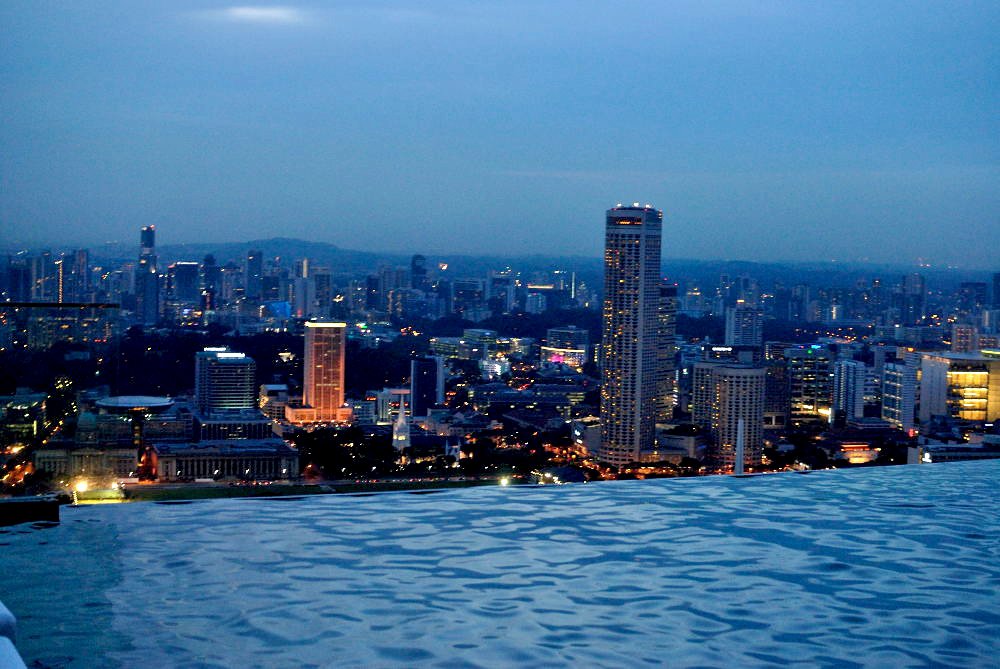
This hotel sounds sort of terrifying with its endless supply of luxury items and services. A hotel, shopping mall, casino, and even museum, it’s a monument to capitalism and aspirational living. I’m curious to see the place as a whole, but the main attraction is the infinity pool. Check out this photo!

over the edge

The infinity pool at Marina Bay Sands

Photo courtesy of Hale Cho.

It looks like you go right over the edge! The pool is totally secured there, but the water runs over it in such a way that it looks like a sheer dropoff, an edge to tumble over and a glittering city to fall into below. I am most definitely going in this pool and taking many heart-stopping photos of me “falling,” because if you can’t cause your parents heart palpitations from thousands of miles away, what kind of daughter are you?

The Southern Ridges
This is some of that unexpected parkland, and it looks delightful. There are all sorts of green spaces here, from meticulously planned gardens to a canopy walk through the tops of trees in the lush tropical forest. There’s also a famous bridge, the Henderson Waves, which gives the appearance of rolling gently through the air from one park to the next.

Look! Up in the air! It's an ocean! It's a bridge! It's... sightseeing!

Photo from http://www.nparks.gov.sg.

You can join guided tours through different parts of the park, learning about all the animals scampering about and the plants practically glowing their green at you. The canopy walk takes you right to a museum. Several different trails take you on different kinds of walks, with differing levels of difficulty. This kind of city/nature integration is a model I’d like Chicago to learn from, for sure.

So! There are a couple places I will definitely visit when I’m in Singapore. I’ve had a couple couchsurfers from Singapore, and I’m hoping I can stay with them each for a couple nights and catch up. In fact, one of my couchsurfers, the lovely Mindy, is a biology genius and a nature guide, so I might be able to snag a personal tour! Work your connections, people.

ACAM: Indonesia — Where to Go

After consulting The Rough Guide to Indonesia and the Internet, here are some places I plan to visit when I’m in Indonesia. I also updated the map (interactive! add your own ideas!).

Jakarta, Java
The capital city’s name means “City of Victory,” which probably holds bittersweet meaning after the riots of 1998 and Suharto’s resignation. I’m interested in the colonial architecture, the puppet museum, and the wooden schooners at Sunda Kelapa.

Borobudur, Java
Borobudur is the largest Buddhist temple in all of Indonesia, and a major tourist attraction. It was built to represent Meru, the ordering of the cosmos, so that you start at the base–the real world–and end at the top–nirvana. Walking that literally spiritual path will be humbling, I’m sure, and all the more so because I hope to go on one of the few sunrise tours offered.

Ubud, Bali
I’m not terribly interested in the party scene on the tourist-heavy island of Bali, but Ubud, a series of linked villages removed from the main scene, does intrigue me. The villagers are known for producing arts and various local crafts, and for preserving and maintaining the ancient culture of Bali. Apparently Elizabeth Gilbert went here in Eat, Pray, Love, although I didn’t remember that from the book (oh yeah I read it, and that is for another post), so it’s getting a lot more traffic than it used to, but maybe I’ll be there in the off season. I can’t wait to see the dancing!

Gunung Leuser National Park, Sumatra
Bukit Lawang is the starting point for trips into the jungle in this World Heritage site. The small village was wiped out in a flood caused by illegal logging in 2002, and is only just now getting back on its feet. There’s a big conservation effort going on in the park and around this village in particular, seen especially in the rehabilitating of formerly captive orangutans and releasing them back into the wild. Other rare species are also found here, and it seems like a good place to visit on an “ecotourist” kind of trip, since it supports local businesses and encourages conservation efforts as a good alternative to logging. It also seems to be on the way from Jakarta to Singapore.

ACAM: Indonesia, or How a 19th Century Dutchman Helped Me Refine My Political Manifesto

While the people of the Middle East and northern Africa are staging wonderful revolutions based on the people’s will, we in the States are fighting hard to serve the needs of the many, and I tell you what, it is a discouraging time. I don’t have the energy to argue with people anymore about why cutting Title X funding is immoral or how disbanding unions will only hurt the economy, not fix state budgets. Things seem to be getting worse and worse, with fewer and fewer victories to brighten the mood.

When I first read the selection from Max Havelaar in The Indonesian Reader, I just got even more depressed. Here’s a piece published in 1860 by a Dutch administrator in colonial Java, written anonymously because it was so damning about the colonial government, and it spells out many of the same problems of inequality, passing the buck, and exploitation that plague the modern world. The excerpt describes a system that exploited the native people of Java and surrounding islands (not united into the country of Indonesia until 1949) as a labor force for Dutch business interests. This same system employed civil servants, regional administrators, and others who were too worried about keeping their jobs to report horrific abuses and deaths, lest those reports draw unfavorable attention to their regions. Rather than look to the needs of the people they were charged with protecting, they looked only to the bottom line and worked people harder to turn a bigger profit and get more acclaim from those back in the Netherlands.

I’m not saying that the union workers in Wisconsin, Indiana, and Ohio are in the same situation as the Javanese workers in the 19th century. But the same impulse to human greed and domination runs through both stories, and the government happens to play the role of villain in both. That same story is played out over and over again throughout history, and that’s what struck me as I read this piece for the ACAM project. George Santayana’s famous “those who cannot remember the past are condemned to repeat it” has been trotted out far too many times for it to hold much meaning anymore, but it’s still true, and that’s what scares me. Are we just going to repeat the same stories of oppression and futile resistance over and over, in various horrible forms the world over? And if so, of course the question then becomes, what’s the point in fighting?

I think the answer lies in how we view history. The popular view, certainly the American view, is the linear one; we’re moving in a straight line from barbarism to civilization, and it’s just one grand march of progress and improvement. The other view sees history as a big circle, with highs and lows coming and going as the natural course of things, an inevitable turning of fortune’s wheel. The strictly linear view is clearly false; we can see people reverting to customs and laws from the bad old days all the time, so we can’t always be moving forward. The circle view is too depressing; the human experience becomes an exercise in literally spinning our wheels.

How about a Hegelian compromise? I wish I had artistic skills, because I would draw you this picture I see in my head: a series of circles, moving along a line. Those circles are various wheels of progress, regression, enlightenment, and repression, and we move through those circles as ideas are introduced, developed, and tested. We jump to new circles once those ideas have been accepted into the common understanding, and those wheels keep us spinning slowly forward through history.

It’s the development of ideas that really gets us moving into new wheels of progress and improvement. For example, right now Walker and other politicians are doing their damnedest to do away with collective bargaining in their states and eventually the country as a whole, and they very well may succeed for a period of time. But the idea of collective bargaining, which at one point in history wasn’t even a possibility, has settled firmly in the national consciousness, and what’s more, the practice of that idea has shown how easily it can be done. That’s going to make it harder to kill the idea completely, and if an idea is still alive, a movement can still survive. What’s more (and here I’m trying real hard to be positive about the current national situation), when the idea of collective bargaining survives, it should survive as a stronger idea. Right now, we see collective bargaining as a luxury afforded to certain professions, rather than a basic right of workers worldwide. As we spin about in this wheel of government bullying and corporate greed, those who fight for workers’ rights may be able to convince the general public of this difference between luxury and human right, and at that moment, we will jump into the next wheel. That will have its own ups and downs, as spinning wheels do, but it will be within this broadened national consciousness, and the discussion will grow ever more equitable.

Just as slavery was once a fact of life and is now a banned and abhorred practice, though we still fight to free trafficked persons; just as women were once the property of their husbands and now hold national office, though we still fight for their bodily autonomy; just as sodomy was once a crime and now gays and lesbians live openly, though we still fight for their right to marry and raise families — in these ways, will we continue to make strides for human rights in a world of greed and corruption.

I still feel my blood pressure rise every time I read a newspaper, and I still cry when election results are announced, but throwing up my hands in despair and deeming it all too big a problem to fix just puts me at the mercy of that spinning wheel; if I stick with it and join with others for our collective good, I can help push us over to the next one, the one with a better starting point than the one I was born into.

As Multatuli says in Max Havelaar:

After all, who would maintain that he had seen a country where no wrong was ever done? But Havelaar held that this was no reason for allowing abuses to continue where one found them, especially when one was explicitly called upon to resist them.

And we are all called. Decency calls us, history calls us, the future calls us.

A Few Quick Notes

Hello dearest fellow travelers. Some quick notes on this busy Tuesday:

  • We have one or two posts to go for ACAM: Indonesia (depending on timing — one for sure will be up this Thursday), and then it’s on to Singapore!
  • The Suggestion Box is a little bare. If you have a spare moment this week, please stop by and add your favorite restaurants, sightseeing spots, city parks, etc. to your favorite cities around the world. It’ll help with my trip so much. Thanks!
  • The Walk for Choice and Save the American Dream rallies were great! Good turnout on a chilly, snowy day, and a lot of camaraderie between the two groups. My friends and I started at the Walk for Choice, and then peeled off to strain to hear speakers at the workers’ rights rally and cheer with the crowd. I made two signs, one of which was straightforward–“Union Busting is Bad for Business”–and one of which led people to believe I was pro-life! Oh dear. It said “Why is Congress Sentencing American Women to Death?” and then in smaller letters “Stop HR 3 and HR 358.” Sessily pointed out that if you didn’t know about HR 358’s legislation of medical neglect, you might see “Death” and think I was talking about “killing babies.” Oh well! We tried to meet up with the Walk for Choice at its endpoint, but all we saw were pro-lifers releasing a hundred balloons labeled “Life” into the air; we couldn’t decide whether abandoning Life to the elements meant they are now no longer pro-life or if it just turned into a euthanasia rally. Also, someone dressed in a full Chewbacca costume was there, on the wrong side, dancing with the pro-lifers. Perhaps he was just confused without Han there to translate for him. Really, it is a metaphor for the American public. Just Wookieing around until Han comes back with some terse words of direction and a new sense of purpose.

ACAM: Indonesia

What is this? Is this a return to a project I appeared to have abandoned months ago? Why yes it is! (For newer readers, check out this post about the A Country a Month project and then hop back here.)

When I last left this project, dearest fellow travelers, I was working my way through books and articles on Indonesia, having read up a bit on Australia and New Zealand. I’ve returned to the materials on Indonesia, and I’m currently reading two books aimed at the same audience: the overseas business executive. It’s so strange to read books written for someone who is living in a foreign country because they’re arranging corporate bank accounts or building factories or whatever. I protest against the decisions these people make all the time, and I will never live the wealthy kind of life they do. But that seems to be the market for books on how to assimilate into foreign cultures, so we’ll work with what we’ve got.

The first one is Culture Smart! Indonesia by Graham Saunders. This is written by a Brit and that may be partly why it reads like an exercise in colonial noblesse oblige. Everyone has servants, try your best to put up with the strange native ways, etc. It is also much slimmer than the other guide, and only aims to convey basic information without explication or nuance. It seems to expect the reader to be staying in Indonesia for only a short time, or to ensconce herself in the expatriate community and stay there, and so there isn’t much about forming lasting relationships or gaining a deeper understanding of the country.

Culture Shock! Indonesia by Cathie Draine and Barbara Hall, on the other hand, seems to be premised on the idea that the expatriate has moved to Indonesia permanently, and thus there is much emphasis on integrating into the culture, learning the language, and understanding how things are done beyond a surface level understanding. Obviously I prefer this approach, although there are still some wincingly condescending moments, like when they talk about the “superstitions” of some of the villagers, or how “servants know their place and are happy with it.” But overall, they make an effort to introduce Westerners to Indonesian culture with respect and affection; they expect the reader to love their adopted country as much as they do. Also, they have line drawings that are straight out of my Rise Up Singing songbook, which is adorable and shows the book’s age (written in ’86, updated a decade later).

So what have I learned for my expatriating ways?

1) Don’t talk loudly or gesture wildly when speaking. This comes across as hostile and I will be avoided like the plague. If you’ve ever heard my speaking voice, you will know that this one might be a bit difficult for me.

2) Status is crucial and manners essential. Status is mostly conferred by age, so I will probably not have much with most of the adults I meet, but if I follow my host’s lead, bring gifts when I visit someone’s home, and avoid criticizing anything directly, I should be okay.

3) A few things I already knew were reinforced: don’t touch children’s heads, don’t eat or pass food with my left hand, dress modestly, and do not expect traffic to follow any of the expected rules.

I have a couple more history/literature books to browse for Indonesia, and then it’s onward to Singapore!

ACAM: Indonesia

I’ve been reading The Indonesia Reader: History, Culture, Politics; ed. Tineke Hellwig and Eric Tagliacozzo, and so far what’s really standing out is neither deep nor original, but here it is: Indonesia is a collection of islands that has been inhabited for thousands of years. And in those thousands of years, never once has Christianity been the dominant religion. Hinduism, Buddhism, and for the last several centuries, Islam, yes, but not Christianity. This is true of most of the world, of course, but that’s easy to forget here in the United States. Here, in a country founded by Christians (not the land, which was inhabited by tens of thousands of people who were doing fine without Christianity, but the country the United States), we think of a mostly Christian nation as the norm.

There’s a giant, stupid political fight going on right now because some non-Christians want to build a community center and some Christians are really upset about it. While it’s natural to center your own experiences at the expense of taking others’ experiences and needs into account, it doesn’t make for good policy. There’s a whole lot more about this fight that I’m not going to get into, but I wanted to bring it up to point out just how ridiculously narrow this point of view is. There’s so much more to the world than those people are willing to admit, or if they do, it’s only because it scares them.

Indonesia is especially interesting to me in this respect, because so much of the spread of religion there was peaceful. Considering the violence religious groups perpetrate against one another, and the force with which many people are made to convert to various religions, this is rather remarkable. Hinduism and Buddhism arrived with Indian traders early on, and Islam spread mostly through Arab traders visiting the spice islands of Java, Sumatra, etc. Sadly, in the twentieth century, religion played a major role in some terrible, deadly conflicts in the country, and tensions remain high.

Okay, I realize both posts this week seem a bit preachy, but sometimes that’s how it goes. Stay tuned tomorrow for The Good, The Bad, and The Silly, which always includes a bit of preaching but then a good dose of fun or bizarre as well — that spoonful of sugar always helps.

ACAM: Indonesia

The A Country a Month project continues apace. You may have noticed that we’ve stopped off in both Australia and New Zealand in various posts. Next up is Indonesia, a country I know nothing about. The lovely Sessily has helped me out by putting together a list of resources on Indonesia, which is below.

I’ve checked out two books from the library to get me started on my research: The Indonesia Reader: History, Culture, Politics, edited by Tineke Hellwig and Eric Tagliacozzo and A History of Modern Indonesia Since c.1200 by M.C. Ricklefs. Feel free to read along if you so desire. I’ll keep you updated on what I learn!

Indonesia

Nonfiction:

A History of Modern Indonesia, Adrian Vickers
The Indonesia Reader: History, Culture, Politics; ed. Tineke Hellwig and Eric Tagliacozzo
In the Time of Madness: Indonesia on the Edge of Chaos, Richard Lloyd Parry
The Dark Side of Paradise: Political Violence in Bali, Geoffrey Robinson
A History of Modern Indonesia Since c.1200, M.C. Ricklefs
Surviving Against the Odds: Village Industry in Indonesia, S Ann Dunham (grad thesis of Obama’s mother)
Gifts of Unknown Things, Lyall Watson (might be really new age-y)
Art in Indonesia: Continuities and Change, Claire Holt
Made in Indonesia: Indonesian Workers Since Suharto, Dan La Botz
Indonesia: Peoples and Histories, Jean Gelman Taylor
Eat Smart in Indonesia: How to Decipher the Menu, Know the Market Foods & Embark on a Tasting Adventure, Joan and David Peterson
One dollar a day: Poverty in Indonesia, Yong Ho Bang
Allah’s Torch: A Report From Behind the Scenes in Asia’s War on Terror, Tracy Dahlby

Fiction:

Pramoedya Ananta Toer:
The Girl from the Coast
Footsteps
The Fugitive
Child of all Nations
House of Glass
All That Is Gone
This Earth of Mankind
It’s Not An All Night Fair
The Mute’s Soliloquy: A Memoir
And the War is Over, Ismail Marahimin

Movies:

Eliana, Eliana (2002) (netflix)
Opera Jawa (2006) (retelling of “The Abduction of Sita” from the Ramayana, uses Javanese song, puppet theater, sacred court dance, gamelan music, and Mozart) (netflix)
Year of Living Dangerously (1982) (Australian movie about Indonesia) (not shot in Indonesia, according to wikipedia)

Music:

Indonesia (World Music Network)
Discover Indonesia: Music of Indonesia (Folkway Records)
Indonesia: Music from the Nonesuch Explorer Series (Nonesuch Records)

Storytelling as Action

I don’t have much time today to expound on this, but here’s a fascinating excerpt from the book Telling Stories: Indigenous history and memory in Australia and New Zealand, edited by Bain Attwood and Fiona Magowan (Allen & Unwin, 2001). In the entry “The saga of Captain Cook: Remembrance and morality,” Deborah Bird Rose relates the story of Captain Cook as told by Hobbles Danaiyarri, who is an Aborigine living in Yarralin in the Northern Territory of Australia. His story is told in a mix of past and present tenses, and relates the injustices his people suffered at the hands of Captain Cook and other Europeans. After reprinting Danaiyarri’s remembrance, Rose explains how history and morality are tied up in Aboriginal thinking, explaining that this remembrance is a saga as opposed to a Dreaming myth:

…the saga is set in a time frame that is conceptualised as part of the present (ordinary time), whereas Dreaming myths are set in a time frame conceptualised both as the past and as a concurrent present. The latter are source of moral principles, and moral action is judged by reference to these principles, which are deemed to be permanent rather than subject to change and negotiation. Captain Cook’s law, by contrast, is seen as immoral, and this presents Danaiyarri and others with a problem: how to account for immoral action that is reproduced through time and thus appears to endure, just as Dreaming law endures. I contend that Yarralin people’s logic requires that the Captain Cook saga be kept in ordinary time — that it not be allowed to become part of the Dreaming past. (p. 70)

Moral action is seen to endure, and actions that do not fit the moral frame of reference cannot be part of the same timeline as moral actions. So these immoral actions are framed in the present, in ordinary time, as a current problem, even if they happened hundreds of years ago. By viewing morality and history as intertwined in this way, wrongs can be addressed in the present day, even if a linear timeframe would see those wrongs as too far in the past to warrant redressing. The very act of telling these stories is a move for social justice, keeping history literally alive in the general consciousness and demanding recognition and action. As Rose concludes, “far from being the consolation of the powerless, remembrance is an active force for social change” (p. 79).

What a powerful way of viewing history, storytelling, and collective action! What do you think? What stories should we be telling in “ordinary time”?

Film Club: Rabbit-Proof Fence

Damn, another movie that made me cry. Ask my family and they’ll tell you how rare that is — I’m the only one out of all five of us who is more likely, while watching sentimental schlock and genuinely moving fare alike, to roll my eyes than to have tears in them. Make no mistake, the director of Rabbit-Proof Fence fully intended to make me cry, and tugged my heartstrings all sorts of ways to make sure I did. But the story itself, plus three forlorn children onscreen, was enough to have me welling up at the end.

Rabbit-Proof Fence is an adaptation of Doris Pilkington Garimara’s book about her mother, Molly Craig. When Molly was 14, she, her sister and her cousin were forcibly removed from their home in Jigalong, in western Australia, and placed in the “re-education facility” Moore River Native Settlement. Under the White Australia plan of government, “protectors” of Aborigines were assigned to each state and territory in the country. They were supposedly meant to make sure Aborigines’ rights were looked out for, but in reality, they said who could and could not marry, where they were allowed to live, and whether they could keep their own children. It was established policy by 1931, when this movie is set, that mixed-race Aboriginal children were stolen from their families and placed in boarding schools that trained them for a life of working in white women’s houses (for the girls) or in white men’s fields (for the boys). The reasoning, like similar policies in the United States with Native Americans, was that it was best to assimilate the native population into the colonizing society, for their own benefit. Clearly it was better to be white, so whites were doing a public service by erasing Aborigines’ cultural heritage, never mind that grossly erroneous premise or the deep and lasting trauma to the parents and children.

The movie has a clear agenda, but for once I didn’t mind. The girls missed their family deeply, they couldn’t trust any whites they encountered because they would probably report the girls to the authorities and send them back to the settlement, and they walked 1500 miles to be reunited with the life and loved ones they knew. The movie didn’t have to try very hard to show that this was a really bad policy and a horrible affront to human rights — in fact, the movie tried a little too hard to show that the protector, A. O. Neville, truly believed that he was helping the Aborigines and couldn’t understand why they would possibly run away from the settlement. I mean, I guess that perspective is important, to show people that there was a majority of voting opinion that held this belief, because otherwise you’d just assume it was made-up, that it’s too obvious that you shouldn’t separate families based on racial prejudice. Because that is pretty damn obvious, but it wasn’t obvious enough to enough people until the 1970s, when the last children were ripped from their homes with official sanction before the government ended the program.

The most upsetting part about the movie was the very end. The last scene shows 2 of the 3 girls reunited with their mother and grandmother, the music swells, and we all feel relieved that they made it home. But then the voiceover comes up and says that Molly was sent back to Moore River with her own two children nine years later. She escaped with one of her two daughters and once again walked 1500 miles to get home, but that daughter was stolen from her and it was many years before she met the daughter she’d had to leave behind at Moore River. So Molly lost one of her children forever and reunited with her other child only after over 20 years of separation. This is why it’s called the Stolen Generations, plural; family after family was ripped apart in the name of racial purity and superiority.

Molly was torn from her mother, and then her children were torn from her. She was time and again denied her own family, her own choices, her own life. Despite this, she worked alongside her husband and became a mainstay in the desert community she knew and loved; in other words, she carved out her own life in spite of her country telling her she shouldn’t. I admire her immensely for that, and also her daughter for writing down her story and getting it published. Now, because of the movie, it’s a story that millions of people know, and that part of Australian history has been added back into the public consciousness. There are Stolen Generations deniers and former prime minister John Howard refused to apologize to Aborigines for the government’s actions, yes, but they know. People know. And that is the first step to action, right?