
London, England; June 26, 2016
Where in the World Wednesday
Image
2
London, England; June 26, 2016

Paris, France; June 4, 2016
The Lady and the Unicorn tapestries, masterpieces of the form from the late 15th/early 16th centuries on display in the Museum of the Middle Ages (formerly the Cluny Museum), have appeared in novels, poems, songs, and as some sharp viewer noticed, on the walls of the Gryffindor common room in the Harry Potter movies. Ever since George Sand rediscovered them and wrote about them in the mid-19th century, these tapestries haven’t been exactly obscure. And yet, no one knows quite how to interpret them. There are several theories, the most prominent being that they are about the five senses and the soul, since at the time the tapestries were woven, the senses could be seen as doorways to the sacred but also reminders of our base humanity. The final tapestry, which bears the inscription à mon seul désir (“to my one desire/love” or “by my desire/will alone”), is usually seen as the lady putting aside material things for higher ideals. It could also be about the lady preparing to give up her virginity (unicorns are symbols of chastity but that long horn is also a bit suggestive, so unicorns are generally sexually ambiguous). But these interpretations are all wrong. Clearly, The Lady and the Unicorn series shows the lady and her maidservant falling in love.
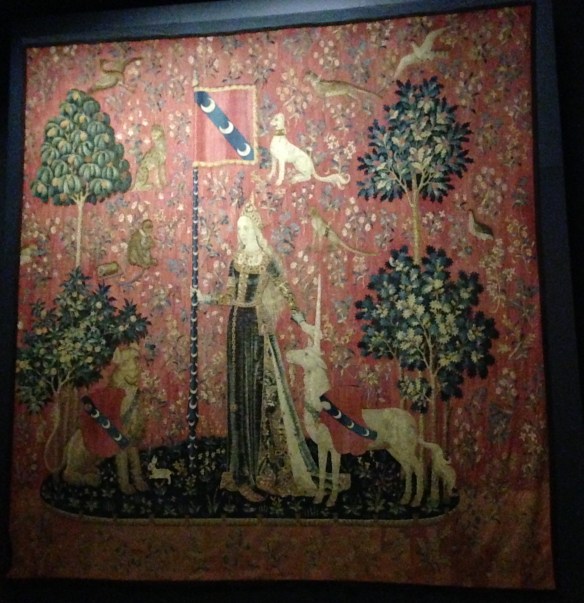
Okay, here’s our first tapestry, “Touch.” Our lady is bracing herself, holding on with one hand to the flagpole bearing her family’s crest, and with the other to the unicorn’s horn. The unicorn looks up at her calmly, secure in the knowledge that he is what she needs. She knows what’s expected of her, that she will be married off to a man, but she can’t even bear to look at him, to admit what her future will be. The lady is isolated, just her and the lion and unicorn, and one brave little bunny. Notice that many of the animals here are shackled, chained and unhappy.

Ooh, our lady and her maidservant meet here in “Taste.” Right away, the lion and unicorn are up on their hind legs, reflecting that feeling you get when you meet someone you’re immediately attracted to–you feel alert, alive, like you have to stand up and take more notice of the world. Notice that the animals are unchained and free now, and several of them have joined the women and lion and unicorn on the little island. Everyone feels like more things are possible now. The maidservant is offering up a bowl of sweets to the lady, literally offering up something sweet for the lady to taste. How does the lady feel about that? Well, she would never be so unrefined as to have her hair blown back, but her veil is waving about behind her. A little bird lands on an outstretched finger, a little symbol of freedom. Check out the look on the unicorn’s face; he knows that serious competition has just arrived.

In “Smell”, our lady and maidservant get to know each other better, as they hitch up their skirts for the work of the day, a gesture of intimacy we haven’t seen yet. Our lady, who before was so overcome with feeling that she had to glance shyly away from her maidservant, is now able to look her right in the eye. Our maidservant holds up a tray of flowers, from which our lady gathers blossoms to make into a garland. Delicate lady-flowers are definitely in play here.

Look, now they are literally making music together. In “Hearing,” our lady plays the notes on the organ while our maidservant works the bellows. This is a two-person job, and dare I say they have to be perfectly in tune with one another to do it properly? The lion is even sort of turned away to give them some privacy, although he can’t help peeking. The unicorn is coming around to the idea of this whole arrangement; the tilt of his head seems to be saying, “Go on, babe, I see what you’ve got going here.” Our wonderful maidservant looks frankly at her lady, as she has done in all the tapestries she’s been in so far. No maidenly shyness here; she knows what she wants and she’s looking right at her. I’m pretty sure we have not one but two goats on the little island as well (goats being well-known symbols of randiness).
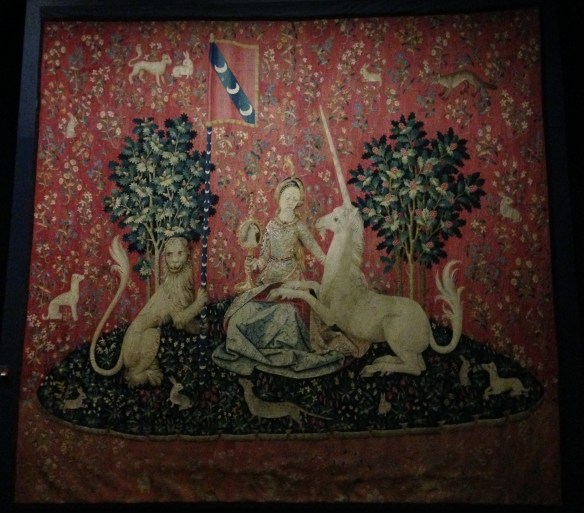
In “Sight,” our lady bids farewell to the unicorn. Our maidservant isn’t here–she has tact–so our lady looks almost sorrowfully at the unicorn as she breaks it to him that this is never going to work between them. But look at him, he’s pretty sanguine about the whole thing. He rests his hooves on her legs and gazes at her with affection. He’s not going to get in the way. She holds up a mirror so he can see himself, and what he sees isn’t a reflection of himself now but as he will be in the near future–alone, maybe, but head held high and looking out for what’s next.

Finally, here we are on the final tapestry, which shows a little tent, a bench, and our maidservant holding up a big ol’ chest of jewelry for our lady. Perhaps she’s placing the necklace back in the chest because she doesn’t need material items to be happy, just the love of this woman. Perhaps she’s taking a necklace out of the chest to give to this woman as a token of her affection. Perhaps she’s getting undressed because they’re about to go inside that tent and get busy. But whatever she’s doing with the jewelry, it’s clear what she’s doing with her future: she’s building it with this woman, her maidservant becoming her partner. A little lap dog appears for the first time, a symbol of domesticity. The lion and unicorn hold up a long veil that looks remarkably similar to what women often wear on their wedding day. And now that ambiguous phrase overhead makes sense: à mon seul désir. It both means “to my only desire/love,” as she gives her heart over to her maidservant, and also “by my desire/will alone,” as she lives her life according to her own desires and not by what was expected of her. She still displays her family’s flags proudly, she’s not trying to reject them, and look she’s even still friends with the unicorn (in a he’s-bowing-down-to-her kind of way). But she knows what she wants, and she’s looking right at her.

London, England; June 13, 2016
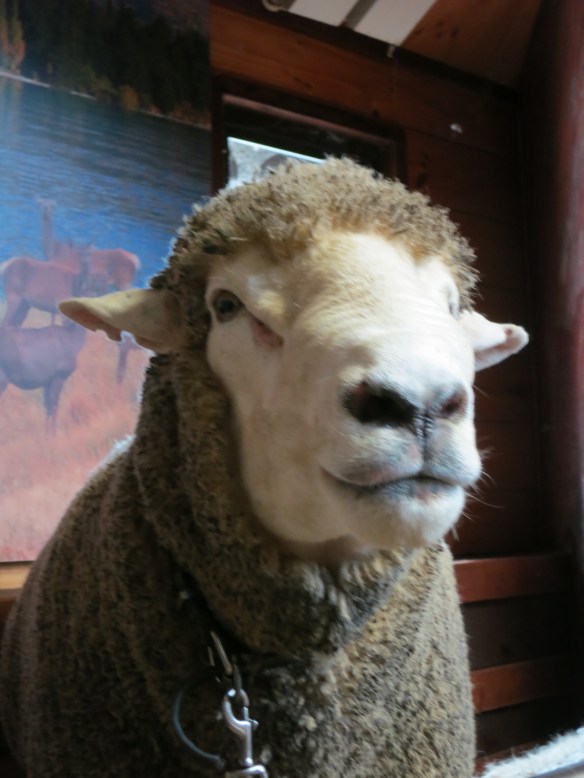
Agrodome, Rotorua, New Zealand; December 16, 2012

Quebrada de Cafayate, Argentina; June 9, 2014
Once you’ve visited the Dulwich Picture Gallery, you definitely know two things: this was the first art gallery in Britain specifically created for the public, and the building was designed by Sir John Soane. These two facts are brought up in the guided tour, the building map, the website, and probably a few other places. But they’re rather remarkable facts, so I can see why the gallery emphasizes them.
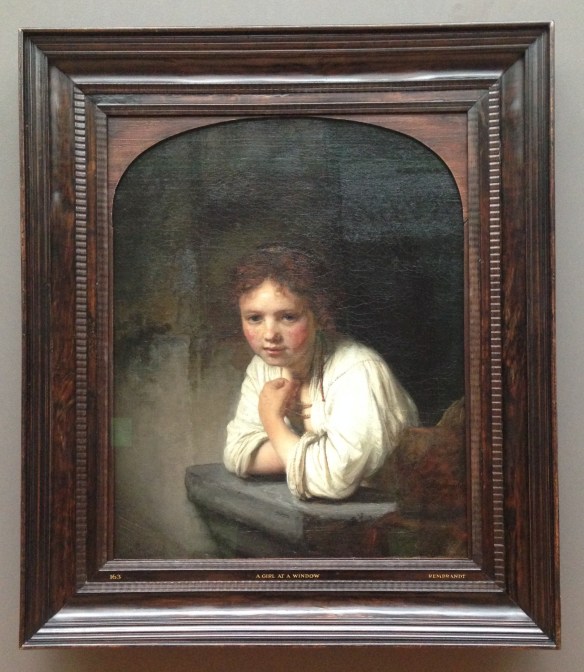
A Girl at a Window, Rembrandt
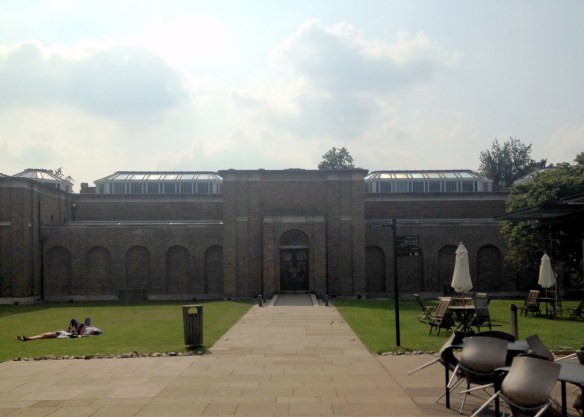
The entrance to Dulwich Picture Gallery
Soane was already Professor of Architecture at the Royal Academy when his friend’s will requested he design the gallery, so it was a big deal for him to spend his time on it (not only that, but he did it for no fee when it turned out there weren’t enough funds to cover his fee plus building costs). Soane was very interested in natural light and most of his buildings have some form of the domed canopy that we’re all familiar with from the iconic red telephone boxes (a trustee of the Sir John Soane Museum, Giles Gilbert Scott, designed the telephone boxes). He did something similar here, putting in massive skylights which light the pictures indirectly; this was a new approach and influenced future art gallery designs.
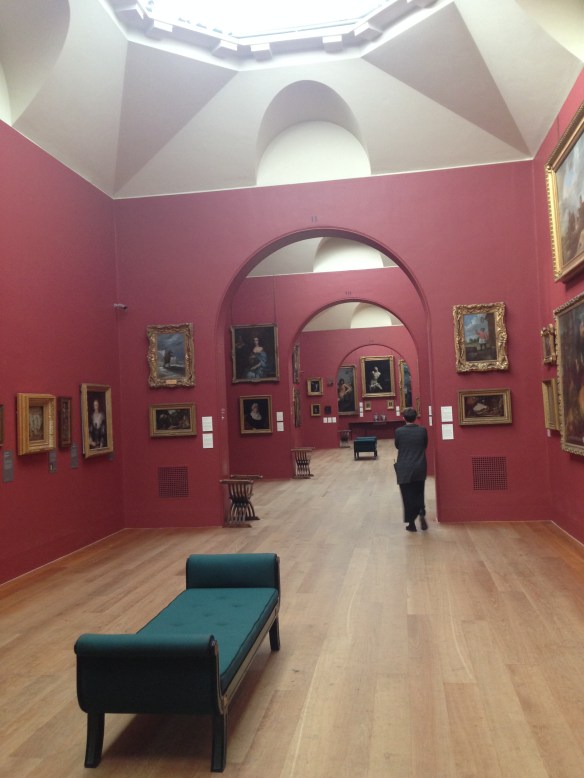
A well-lit series of interconnected rooms
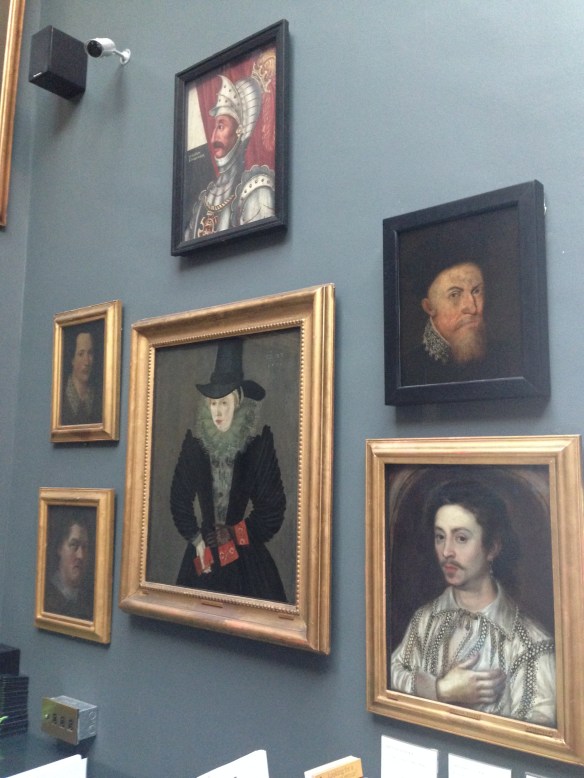
The original paintings of Dulwich College–a terrible William I, a lady, and four actors (the college was founded by actor Edward Alleyn)
The other point–that this was the first public gallery in Britain–is also remarkable. The gallery was opened in 1817, at a time when common people were only just starting to be seen as worth educating, let alone exposing to the finer things in life like art. I think the gallery’s openness must be because its founders, Noel Desenfans and Francis Bourgeois, were themselves not aristocrats. They hustled hard as art dealers (getting their start with the money Margaret Morris brought in when she married Desenfans), and they lived in comfortable nouveau riche style, inviting well-heeled friends to their home in Charlotte Street to view their personal collection. (Let’s just take a moment to appreciate how perfect that a middle-class man who worked as an art dealer was named Bourgeois–is there anything more bougie than that?) They clearly didn’t forget their roots, though, and I think it’s great that Bourgeois used his powerful connections (he was personal friends with Soane, he was wooed by Dulwich College to bequeath his collection to them) to create something for people with no connections to enjoy.

Miss Margaret Morris, later Mrs Desenfans, Reynolds

Head of an Old Man, Caracci

They’ve used period furniture to decorate the gallery
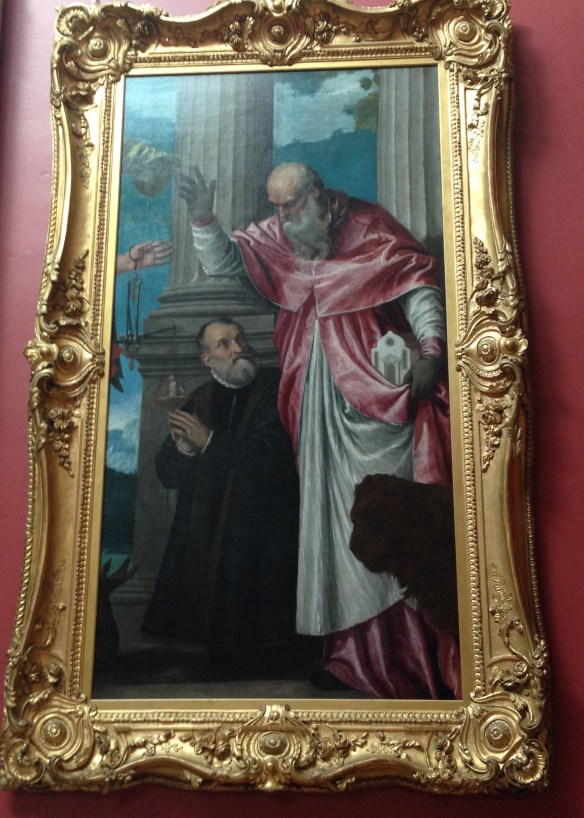
A cut-up piece of an altar piece by Veronese; other parts are in museums in California, Canada, and Scotland
Although perhaps this collection was destined for public viewing regardless. It was originally commissioned by Stanislaus Augustus, King of the Polish-Lithuanian Commonwealth, to form a national gallery of the old masters as part of his plans to encourage fine art in his country. Perhaps the public would have been invited to view that gallery? But his country kept getting partitioned by greedy nearby states, and five years after the commission, Stanislaus wasn’t ruler of anything anymore, which left Desenfans and Bourgeois with over 300 paintings to house.
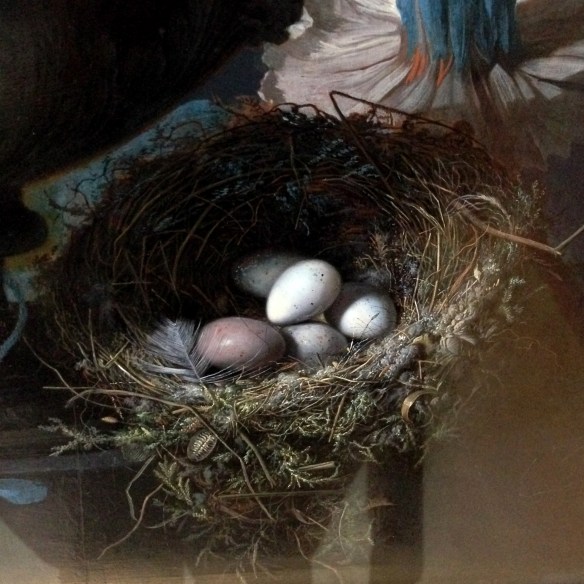
Detail of Vase with Flowers, Huysum
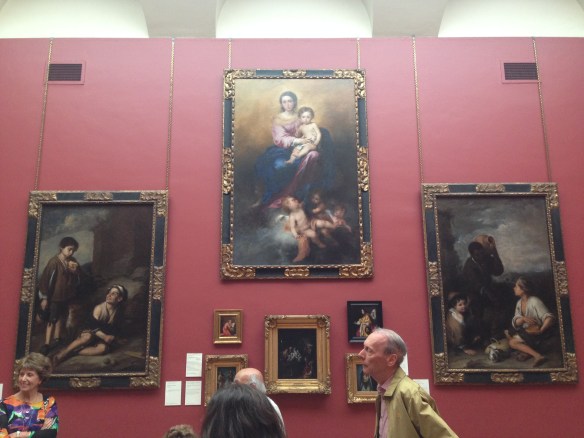
Three works by Murillo
This is one of the first times the faces of the Virgin & the baby Jesus are drawn from life studies rather than as iconic types

Saint Sebastian, Reni
Reni apparently claimed he could paint 100 different ways of people looking up, and indeed a lot of his pictures show a variation on that pose
The collection now numbers more than 600 paintings, and although the gallery doesn’t make any purchases, people try to make gifts pretty frequently. Because of limited storage space, the gallery has to be quite selective, only accepting pictures that fill a specific gap in the collection.
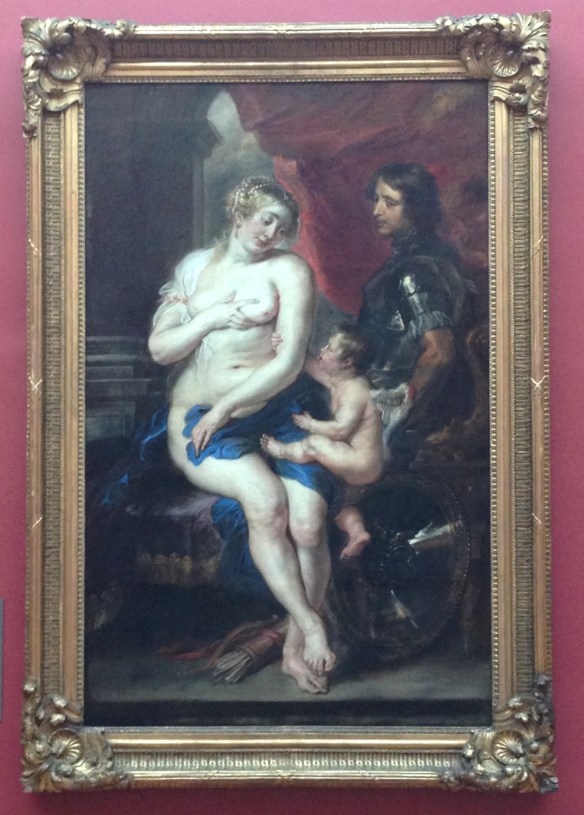
Venus, Mars and Cupid, Rubens
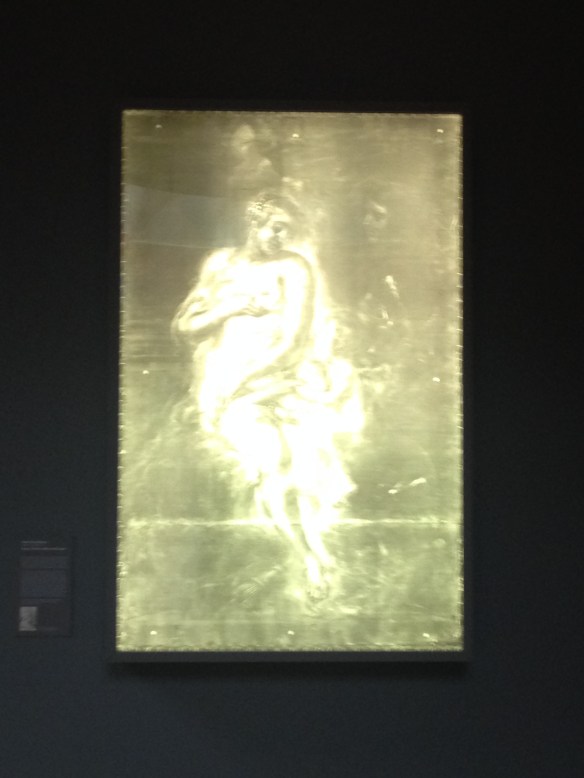
An x-ray of Rubens’ painting, which shows how he made changes like moving the left legs of both Venus and Cupid
The rooms are split up into different schools of painting, which more or less followed along national lines: British, Dutch, Flemish, French, Italian. Or as was explained to Queen Elizabeth II when she stood in the center of the gallery to re-open it after a major renovation in 2000: “To the left are the beer drinkers, ma’am, and to the right, the wine drinkers.” Meaning, of course, that the northern Europeans were to the left and the southern Europeans to the right. (Thanks to guide Hillary for this delightful anecdote.)

Paintings have been hung in a stacked style similar to the one used when the gallery first opened

Jacob III de Gheyn, Rembrandt
This painting has been stolen from the museum more than any other–four times!

Mrs Siddons as the Tragic Muse, Reynolds
This was Sarah Siddons’ favorite portrait of herself, because she felt it did the best job of highlighting her as a tragedian
After the tour was over and we started to disperse, I looked around at who was visiting on a Saturday. A lot of gray-haired folks, yes, but a few other people my age, a teenaged couple who held hands in front of a Rubens, and a couple young kids scampering about while their parents made their way around the Dutch room. Dulwich Picture Gallery might contain expensive works of art centuries years old, but it’s still filling its intended purpose of making that art available to the masses. Its founders would be proud.

Mrs Elizabeth Moody with her sons Samuel and Thomas, Gainsborough

The Nurture of Jupiter, Poussin
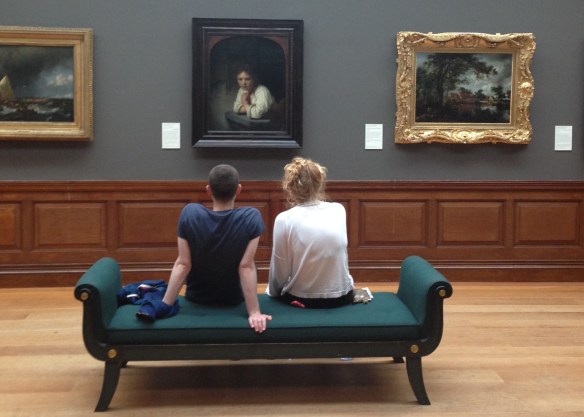
Teenagers enjoying the museum’s most famous painting
Have a great long weekend, everyone!

Llama crossing sign, Bolivia

Myatts Field, London, England; May 14, 2016
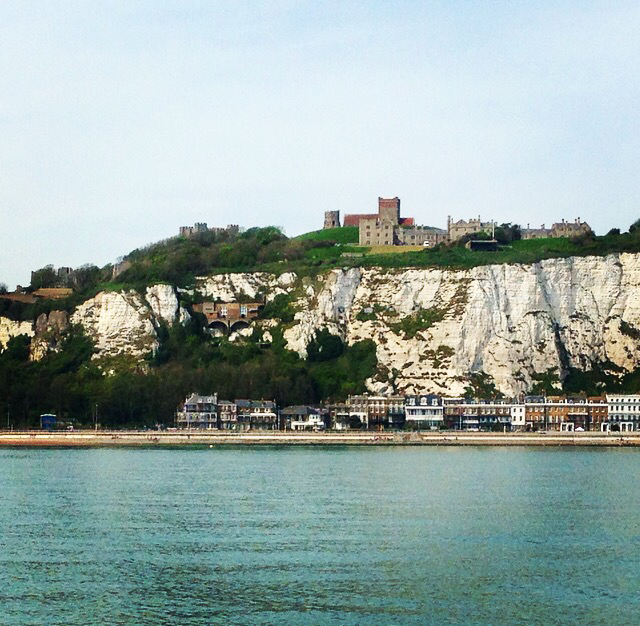
Dover Castle and those white cliffs, England; May 7, 2016
 Stowaway Travel Writing & Editorial Services