
Belgian American Club, Talman and Fullerton, Chicago, IL
Belgian American Club, Talman and Fullerton, Chicago, IL
Dearest fellow travelers, I wanted to start off the month of Vietnam research with a good book review, but instead Karin Muller’s Hitchhiking Vietnam made me more anxious. I was excited to read about her solo trip up and down the narrow Southeast Asian country in 1997. Muller envisioned traveling to remote villages on bike, making friends with the locals, and capturing it all on film for a documentary. She had a straightforward plan, a Vietnamese-English dictionary, and a lot of optimism, but instead of a thrilling adventure, she got a shitshow.
 Vietnam in the late ’90s was still recovering from the war of the ’60s and ’70s, and corruption pervaded every level of government, which made traveling outside the rigid parameters of officially sanctioned tourism difficult. Muller wasn’t allowed to go outside the city limits of Saigon on her own, so she had to travel with two guides selected for her by the Communist Party. Her guides fleeced her for at least twice as much as the agreed-upon price, took her to suburbs instead of the villages she was promised, and even hid her shoes during their naptime to keep her from exploring on her own. Later, she shook off her guides and met up with an American with a motorbike, and the two of them went north off the beaten path. But the roads were terrible, the bike broke down literally every day, and they had to dodge any military personnel who might ask for the travel papers they didn’t have. Muller and her American companion didn’t get along very well, but she stuck with him because she needed someone to train the video camera on her for the documentary. She didn’t make friends, and until the last few weeks of her trip, she didn’t see any of the remote villages she’d flown to Vietnam to see. It sounds miserable!
I don’t have quite the same agenda as Muller, or the same desire to steer clear of any and all tourist locations, but I am traveling alone and looking for some adventure. What if my trip turns out to be a series of misadventures like hers, a succession of wretched missteps and broken promises, no one to trust or enjoy spending time with, frozen out by locals and cheated out of cash by officials? She tries to spin it as the exciting journey she was looking for, but her frustration burns through every page.
That’s the danger of travel; we say we’re looking for the unexpected, but we’re expecting a positive experience. We don’t expect to have a bad time. It’s worse than just having a bad few weeks in our day-to-day lives, because we’ve planned and anticipated the travel for so long that it’s a greater disappointment when it all goes wrong.
Yet that’s a risk I’m willing to take, over and over, each time I take off on a new trip. I’m certainly hoping for a positive experience overall, dare I say even overwhelmingly, but I know that statistically that can’t be true for a year and a half trip. There are going to be some bad times, but those times can’t be predicted, so I just have to do the old “expect the best, prepare for the worst.”
And hope to high heaven that it’s nothing like poor Muller’s months in Vietnam.
Image from here.

on a hike at Lake Lansing North, Lansing, MI, October 10, 2009
This week’s interviewee is Chicago actor David Wilhelm. I’ve seen Dave kill on stage many a time, most recently as the dancing, singing, advice-giving ghost of Christopher Marlowe in “Erratica.” (It was as awesome as it sounds.) Starting TOMORROW, Wednesday the 2nd, he’s appearing in a four-week run of the American Demigods Old Tyme Variety Show at Gorilla Tango Theatre, which is sure to be a good time, so check it out. Thanks for sharing, Dave!
What is your name and city of residence?
David Wilhelm
Chicago, IL
What medium do you work in?
Theatre mostly, but I also write, and I’m working on getting into voiceover.

Dave as the ghost of Christopher Marlowe in "Erratica"
How often do you work on your art–is it a full-time endeavor or something you work on in your spare time?
You assume I consider the time I spend on acting spare. It’s not. It’s a second job (or third or fourth, depending on how you count them). It’s work I like, at least at the best of times, but it’s still work, not a hobby. This is the fundamental assumption that a lot of what I will call, for want of a better way of putting it, normal people tend to make, that art is a hobby or something you do recreationally simply because it is often done for free.
Allow me to wank philosophical for a moment.
It’s something we assume about a lot of occupations. A lot of people would say that my mother was unemployed for twenty-five years because being a full time parent is not a job. Anyone who has been a full time parent, however, would likely disagree, if they gave it any thought. I remember my mother recounting an exchange with a DA during jury selection in which he would not let go of the idea that she was unemployed. She stressed with increasing irritation that she did in fact have a job and the sooner he understood that the more teeth he’d be able to hold on to. I may be exaggerating that exchange slightly.
But ask yourself. In what way is it distinct from a job? Because it’s a position that involves no pay? That would mean an internship is not a job, or that volunteer fire fighters are technically on vacation when they’re on call at the fire house because they are not getting paid.
This is more than a job. It’s part of who I am, as cliche ridden as it may be to suggest it. It is integral to what it means to be me and were it removed I would feel that I was no longer myself.
At any rate, I don’t call myself an artist. The term is far too general. Actor at least gives an indication of what I do. I consider it a job, though it’s not how I pay the bills. To do that, I work a desk. It is boring. Mostly I sit there and pray for the death that will not come.
How does art fit into your life, in general? Is it something you think about and talk about every day, or every week, or only in certain situations, etc.?
I think I’ve covered this for the most part. My friends are, by and large, theater people, so my personal and professional circles overlap a lot. The artistic director of the theatre company I’m with presided at my wedding. The reader/groomsman was an actor, and another groomsman was the first director I ever had. And the beat goes on. When I said it was part of who I am, I didn’t mean to be glib or self-aggrandizing. The choices I’ve made and the people I’ve surrounded myself with are all part of that.
When you start on a piece, what kind of end result do you have in mind? Does it get performed or published, put in a permanent form or is it more temporary?
The idea behind theater is that it is alive. The show will change slightly from night to night. What one audience laughs at or is moved by will have no effect on another audience. The show may be recorded, but staring at a screen is hardly the same thing as being in the theater watching the play happen live, as anyone who has done both will tell you.
There is the script. That is, in some small way, permanent, but it is only one piece of the show.
What goals do you set in relation to your art, both short- and long-term? Is it something you hope to make money doing, or is it something you want to keep uncommercialized? Does the term “sell-out” hold meaning for you or do you see the art/commerce relationship as a necessary one?
The short term goal is always the same. Finish this show and gear up for the next one. Long term, it’d be brilliant to get paid to do this, enough so that it’s all I have to do. I cannot describe how much I hate riding a desk.
The commodification of art. That’s something we could spend a long time on. You can tell yourself that money doesn’t matter, but to some extent, it does, whether you’re being paid for your work or not. I would love to build glorious sets that immerse the audience in the play from the moment they enter, or costume actors in clothes specifically chosen from the whole history of fashion to communicate some intrinsic truth about them. But ultimately, I haven’t got the budget. So the actors wear what we can afford out of what we find, often some combination of their own clothes and second-hand items. It’s the same all around.
To sell out, to me, means the money is more important than the art, and ultimately you can’t know someone to be a sell-out without knowing their mind. There are plenty of big Hollywood actors who will tell you they do movies so they can come back and do theater without worrying about making ends meet. I can respect that, even if I don’t much care for some of their work. Does that mean they’re sell-outs? No. I don’t think so. And while I’d like to say I’d never make an awful movie, the pragmatist in me knows we all have our price. My wife and I have bills to pay, debts we owe. If I could wipe those away by playing some part in making “Transformers 4: Just Like Transformers 2 But Somehow Even Worse,” I just might do that. I’d keep doing theater, mind, because I need something that sates that creative impulse, and I might not watch the film once it came out. But I’d do it.
I think fifteen year-old me would have a very different answer, but he’s not here, the lazy little shit.
What role does collaboration with others play in your art, if any?
It’s integral. I can’t direct, do the lights and sound, produce, design costumes, and play all the characters. I could do a one man show, I suppose, but I’d still need someone helping with publicity, a space to perform in. Otherwise I’m just one of those crazy people on the street corner. Unless I have a hat on the ground in front of me. Then I’m an artist. Or a panhandler. It’s a fine line.
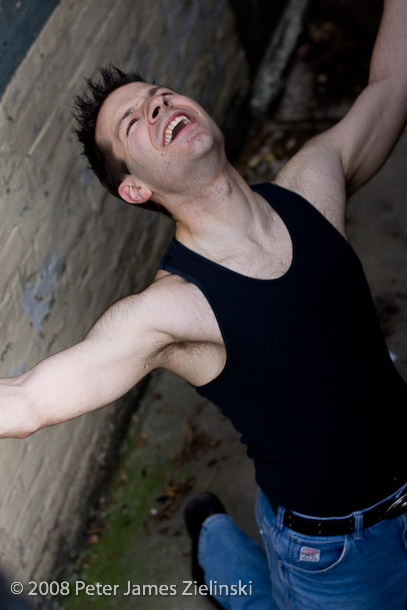
not panhandling
How conscious are you of your artistic influences? Who are your artistic influences?
To answer both questions in one go, I haven’t a fucking clue. I can tell you what writers have moved me, what performers have surprised me. In the end, everything that I am contributes in some way to the imagination that merges with the text to form the characters I play.
Since this is a travel blog, how does travel relate to or affect your art? (Themes in what you produce, road trips to perform your music, thoughts on what happens to your painting when you ship it across the country to a customer, etc.)
Money is the big issue here. Travel isn’t cheap, and most places that need entertainers can find them nearby. I’ll gladly travel anywhere to perform, so long as someone else is paying, because gods know I don’t have the coin.
I’ve traveled on my own, not as much as I’d like but more than I’ve any right to have managed. Every part of it has helped to shape me in some way into the person I am now, so in that respect, it has had some effect.
And finally, a right-brain question: If your art was a map, what would it be a map of?
Big empty space with the words: Here be dragons.
If you’d like, share your website/Facebook page and any upcoming gigs/plans you’d like readers to know about.
www.actordavidwilhelm.com
Also, I am now co-host of the new game nerd podcast Loot the Room: http://loottheroom.libsyn.com
Photo 1 credit Benjamin Haile. Photo 2 credit Peter James Zielinski.
It will surprise few readers of this blog to learn that I support the Occupy Movement (it basically comes down to Corporate Needs aren’t the same as Corporate Greed). If you’re still unsure about the focus of the protests or what people are so mad about, check out this easy-to-read, graph-heavy article that I highly recommend. And here are another couple articles with great, thoughtful responses to people who wonder why Occupy folks can’t just work harder to get a leg up. And here’s an image from the disastrous police response to the Occupy Oakland group last week that shows the scary side of simply showing up to state your discontent with the system as it stands. I encourage you to take a look at http://www.occupytogether.org/ to see what’s going on in your community and how you can get involved. And for a fun way to stick it to the banks and get rid of your junk mail at the same time, check out this video (although I don’t think adding weight to the envelope actually adds to what they pay the USPS).
In the meantime, cartoons! Here are some great images from Facebook about the Occupy Movement. Enjoy!

Oh Monopoly man, your walrus mustache used to be cute, but in this context, well, it's just sinister.

How many people do you think would LOVE to get a job?

Thanksgiving's looking pretty sad for most of the country this year, and how many more years? (Click on the image for 9 more images.)

Okay, I don't agree that the Tea Party is fascist, but I definitely agree that the Occupy Movement is democratic. Celebrate it! Support it!
Image 1 from here. Image 2 from here. Image 3 from here. Image 4 from here.
Belden and Sacramento, Chicago, IL
Profile Theatre’s A Behanding in Spokane was thrilling and discomfiting, but also empty and hopeless. Staged like a particularly well-executed playwriting exercise, we begin truly in media res, as a one-handed man shoots into a closet, calls his mother, and opens the door to let in a frantic young woman waving a dessicated human hand. What. is up. Here’s an excerpt of my play review:
Thad Hallstein’s set is so spot-on, it looks like he picked up the dingiest motel room he could find and put it down in the middle of the theater. Such a room requires a mood as bleak, and Cox sets the tone with his cruel, efficient treatment of Marilyn and Toby, and his singular focus on getting back what is rightfully his.
You can read the rest here.
I’ve never seen a Profiles show before, and while I enjoyed this show somewhat (I think the review came off more positive than I intended, oops), I’m not sure I’ll be back. They have produced just about every Neil La Bute play ever written, and I’m not super interested in supporting a theater that’s that obsessed with putting on La Bute’s misanthropic, sexist, would-be Mametism.
Greetings, dearest fellow travelers! Today I shall debut my amateur video skills. This was taken on the recent road trip I took with my sisters, and much of the footage was shot by them in a back pew while I wandered around taking photos of the elaborate pulpit. Enjoy!

Blvd Saint-Laurent and Blvd René Lévesque, Montreal, Quebec, Canada
Please welcome Paige Draper to the Aesthetically Speaking series of artist interviews. I know Paige from wayback, when she was singing in something like four choirs and dancing her way through the halls of our high school. Looks like she’s kept that joy of movement in her new home of Philly. Thanks for sharing, Paige!
What is your name and city of residence?
Paige Draper, Philadelphia
What medium do you work in?
Irish step dance
How often do you work on your art–is it a full-time endeavor or something
you work on in your spare time?
About twice a week–I teach and take lessons myself.
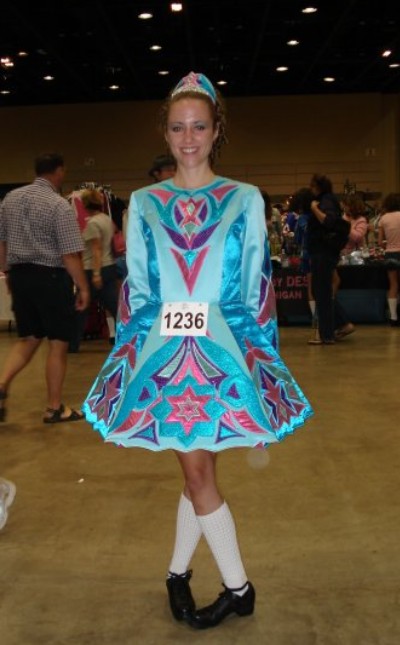
all gussied up for a competition
How does art fit into your life, in general? Is it something you think about
and talk about every day, or every week, or only in certain situations,
etc.?
Irish dance has always been a huge part of my life and I certainly think about it every day. I would like to be involved in more, but the economy makes it difficult at this point.
When you start on a piece, what kind of end result do you have in mind? Does
it get performed or published, put in a permanent form or is it more
temporary?
Usually if the dance is to be performed I’m mostly concerned about the nature and attention-span of the audience. The material needs to also accommodate the performance space and floor. Since Irish dance is performed in hard and soft shoes, whether or not we use hard shoes depends on whether it’s a hard floor or carpet. In terms of the audience, if they want traditional Irish dance we try to use traditional dances and if it’s more of a flashy show we use music and choreography from Broadway shows such as “Riverdance” and “Lord of the Dance.”
What goals do you set in relation to your art, both short- and long-term? Is
it something you hope to make money doing, or is it something you want to
keep uncommercialized? Does the term “sell-out” hold meaning for you or do
you see the art/commerce relationship as a necessary one?
Teaching Irish dance allowed me to afford graduate school and move to Philly, but now it’s more of a therapeutic part of my life. I someday will get my teaching certificate and hopefully make money as a teacher, but I’m focusing more on my role as a performer and competitor as of now. I’m not the biggest fan of the way Irish dance has been introduced in this country because it is a national symbol of Irish history and culture. “Riverdance” and especially “Lord of the Dance” represent Irish dance in a flashy, Broadway manner.
What role does collaboration with others play in your art, if any?
Concerning traditional Irish dance, we provide jobs and roles for Irish musicians, costume designers, and artists. If Irish dance were not as popular as it is in the US, these individuals may not have as many work opportunities.
How conscious are you of your artistic influences? Who are your artistic
influences?
I know that some children have expressed Irish dance as positive role in their social lives and has given them confidence as a performer and individual. I don’t have very many artistic influences, however expanding my knowledge of the history and importance of the dance has given me a powerful sense of my heritage and culture. I’d like to think that my ancestors smile upon my work to preserve and represent such a significant cultural symbol.
Since this is a travel blog, how does travel relate to or affect your art?
(Themes in what you produce, road trips to perform your music, thoughts on
what happens to your painting when you ship it across the country to a
customer, etc.)
Myself and many others travel great distances to perform and compete in Irish dance, in fact, so much to the point that it costs money and sacrifice.
And finally, a right-brain question: If your art was a map, what would it be
a map of?
I’d like to think my art is a map of Ireland and its history. The dances represent cultural traditions and historical events that have occurred in the past. It is a wonderful way to teach people about such things through movement and music.
Photo from Paige’s personal collection.
 Stowaway Travel Writing & Editorial Services