Montreal or Bust!

Well, dearest fellow travelers, we decided to ignore your advice completely. Rather than go to DC or Cape Cod or Kentucky or any of the delightful places you suggested, my sisters and I decided to make this road trip an international adventure. We really do appreciate the thoughtfulness of your suggestions, and I certainly hope to be able to check them out in the not too distant future, but we decided to go a different route (pun!).

We thought, Emily lives in New York so let’s have Lisa and Heather fly there and save one person flight expenses, and she can contribute what those would’ve been to the rental car. Ta da! Money saving.

And the destination is… Montréal!

Here’s what we’re looking at:

ITINERARY

Day 0
Lisa and Heather fly in to New York, NY, crash with Em and Lizzie

Day 1

New York, NY to Lake George, NY — 4 hours
leave in the morning, get in for lunch, spend the afternoon and evening doing light hiking, taking pictures, making a good dinner

Day 2
Lake George, NY to Montréal, QC — 3 hours
take a leisurely morning, drive a bit around looking at trees some more and singing musicals, arrive in Montreal in time for dinner/setting up wherever we’re sleeping

Day 3

Biodome! Frenchy things! Poutine! Casino! Queer times!

Day 4
Variations on above

Day 5
Montreal, QC to New York, NY — 6.5 hours
L&H fly home on evening flights

DETAILS OF WHAT TO DO, WHERE TO GO

Adirondacks / Lake George
Auto Touring
Scenic Byways Map
Example of Accommodations with efficiency kitchen (good for making dinner and save money!)

Montréal
The Village
Casino de Montréal (keno, slots, table games, etc.)
Other Things to Do
Biodome (indoor zoo that reconstructs specific ecosystems, includes penguins, supposed to be really cool)
Le Drugstore (mostly lesbian club, 3-6 floors of bars/dancing/etc.)

COSTS

Car Rental
$280 ($40/day + taxes/fees) + insurance + extra driver fees, about $330 total, except that Emily has agreed to pay the average of the flight costs for me and Heather, since she’d be buying a plane ticket if we went anywhere else. Em will pay about $200 for the car rental price, which leaves the remainder at $50 each.

Gas
approximately 700 miles total, average rental car is 30 mpg, 12 gallon tank, 350 miles per tank, need 3 full tanks (have to return it full), $50 per tank, $150 total gas, $50 each.

Food & Drink
I’m hoping we can do light breakfasts, sandwiches for lunch, then maybe go out for dinner kind of thing, to cut down on costs. So a mix of grocery stores and restaurants. Probably $150 each.

Lodging
Day 2 accommodations will probably be a place like this motel for $60/night ($20 each).

We decided that three nights in Montréal is enough time to really get comfortable, and sleep well, and feel good about where we’re staying. We’re looking at Vacation Rentals and Air BnB for more home-like places to stay in Montréal. Those look more like $70/night for 3 nights, or $70 each. Probably $100 each total.

Entertainment

Biodome=$17
Gambling=$30? 40?
Museums=$20

Probably safe to budget $100 each for this, since miscellaneous costs will come up.

TOTAL
$450 per person for the week, + L&H round-trip tickets

So whaddya think? Have you been to any of this places? Any recommendations on what to do/what not to do, etc.?

How I Nearly Blew Off a Cliff in Ireland But Lived to Tell the Tale

Today was a wet and blustery day in Chicago, and as I did a duck-and-weave through the raindrops on my way home from work, I found that I wasn’t irritated at the rain. In fact, I was feeling pretty good, thanks in no small part to the outpouring of goodwill I’ve received since I yelled to the world that the International Business Times had reprinted my post from Tuesday. But if I tried to tell you the last time I felt this giddy in a rainstorm, it’d probably be January 2004, when I was almost blown off a cliff and swept out to sea in Ireland.

a sheer, exhilarating drop from the Aran Islands into the Atlantic below

Image from http://www.travelpod.com/photos/0/Ireland/Aran%20Islands.html

I’d finished my study abroad program in Rome and was visiting friends living in other European countries easily accessible by Ryanair. It so happened that one of my good friends from high school, Miranda, was abroad at the same time, so we decided to meet up in Dublin, take a bus across the country to Galway, and return after visiting the Aran Islands. This is, in fact, what we did, only slightly derailed by the part where the winds tried to destroy us.

The Aran Islands, on the west coast of Ireland, had been described to me as the most Irish part of Ireland. I’m not sure exactly what that was supposed to mean, but I gathered it meant strikingly beautiful landscapes, quaint towns, and locals speaking the mother tongue. This is pretty much the case, although everyone speaks English as well as Irish, especially since tourism is the main industry there now.

The main tourist attractions of the islands are the ruins of stone forts such as Dún Aengus (or Aonghasa), which were probably built in the 2nd century BCE. It’s unclear whether they were entirely defensive forts, or if they also held religious or commercial value, positioned as they are with a view of a large part of the coast and therefore a good look at trading vessels coming and going. In later centuries, many structures on the islands were made over to monasteries, and farming on the shallow, rocky soil remained the main occupation until very recently, when tourism became big industry.

Miranda and I took the ferry over to Inishmore from Galway and picked up a map at a small shop we got a bit of food at. Keep in mind that this was late January, not exactly the height of tourist season, so there were very few other people around, and we considered ourselves lucky for having the island mostly to ourselves. Armed with the basic trail map and our cameras, we headed off to find one of the ruined forts, Dún Dúchatair (the Black Fort), and soon we really did have the place to ourselves, aside from a few grazing cows. We were walking on a basic kind of trail, which often seemed to devolve into just a field for a space, and the wind was picking up something fierce, but we had our destination in our sights, so we pressed on.

The Black Fort -- see how much rock was all around, too? (obvs this is a postcard; I was not blown so high off the cliff that I was able to take an aerial shot)

The rocks were everywhere, stacked to form low walls marking off small plots of land, and when they weren’t stacked in an orderly pile, they were underfoot, tripping us up. We had to tread carefully, but the sky was expansive and the island a lovely mixture of green-brown grass and slate-gray rock, and we were inordinately proud of ourselves for taking ourselves on tour rather than signing up for a guided one. We reached the fort, perched on the edge of a cliff, and it was worth the trip. The Black Fort itself was an orderly collection of rocks, small walls shaped into overlapping horseshoes, which were themselves shaped like halves of concentric circles rippling out from a stone being dropped in water. It wasn’t hard to imagine that stone being a chunk of island, either, since the center was almost at the edge of the cliff, and that cliff dropped off sharply and steeply.

We’d been scrambling over the fort for a bit, but now we needed to see the ocean, and not from far away, either. No, we needed to get real close and personal. We walked right up to the edge (there are no railings here, you litigious Americans) and leaned over, not far enough to fall in, but just far enough to feel adventurous. But whoops, the wind was still quite strong, and I found myself pulled closer to that edge than I liked. I was an arrogant 20-year-old, convinced of my travel savvy and basic immortality, but I was also a little scared of heights and a lot clumsy; the possibility of me plunging over the edge into the (beautiful, deeply blue, whitecapped) sea was now far too real. I lurched backward and stumbled over to a more stable location, like one of the handily ubiquitous gray rocks, to catch my breath.

At this point, it became clear that the fierce wind was not just a consequence of being so close to the ocean; rain was starting to fall from the sky, and it was coming down fast. Miranda and I turned around and headed back, but we found ourselves a bit lost. Our map suddenly wasn’t so helpful in the torrential downpour, and anyway the wind was doing its best to tear it from our hands. We leaned into each other, and into Miranda’s umbrella, and did what we could to follow the right set of squiggly rock walls down to the village.

Now at this point in most travel stories, I’d share with you that things were tense. After all, despite the Gulf Stream current that keeps the western Irish coast unusually warm, this was still January, and we were dressed in our winter coats and gloves, and this was a small gale bearing down on us. We weren’t sure where we were, the only living creatures we could see were cows sensibly huddling together, and I’ll wager we were both hungry and in need of a bathroom. But all I remember is enjoying every minute of it. Miranda and I both saw the absurdity of our situation and decided that rather than grumble or despair, we’d laugh. Far the better option. Talking in the storm was difficult, so we’d just walk a little, turn to each other and raise our shoulders exaggeratedly, shake our heads like “what’re you gonna do?” and laugh, then repeat.

Utterly given over to the storm and enjoying ourselves enormously

Eventually we did make it down out of the fields and rocks, and we found ourselves on the edge of the road. It didn’t take too long for a car to slow down, and a middle-aged man rolled down the window and offered us a ride into the village. We hesitated for a moment (young women, strangers, foreign country), but we quickly realized that he was just being nice, and was probably genuinely worried for us, since we looked like two barely resuscitated near-drowning victims. We got cheap, hot drinks at the same store we’d left so confidently a few hours before, shivered ourselves slightly warmer, and congratulated ourselves on being badasses. I don’t remember anything about the ferry back to Galway or the bus back to Dublin, but I clearly remember the wind whipping my hair into my face, the rain turning the gray rock a slick black, Miranda shouting with laughter, and a sense of wild freedom.

Once I was safely twenty paces back from the cliff, of course.

ACAM: Singapore — Where to Go, Part 1

Thanks for all the fantastic suggestions on the last couple of posts, dearest fellow travelers! It feels good to have the main outline of the trip more clearly sketched out. I believe we left off ACAM in Indonesia, which means that now we turn to the city-state of Singapore.

Every time I look at a map of the world, I see the tiny dot of Singapore on the tip of Southeast Asia and assume it’s a small city perched at the end of Malaysia. In fact, it actually consists of 63 islands, and it’s not a small city, it’s rather large. It’s true that most of it consists of city, but there’s a surprisingly large swath of public park land to explore as well. An old friend recently visited Singapore, and the pictures of his trip make me even more excited to go there and see what else about it will surprise me.

Marina Bay Sands
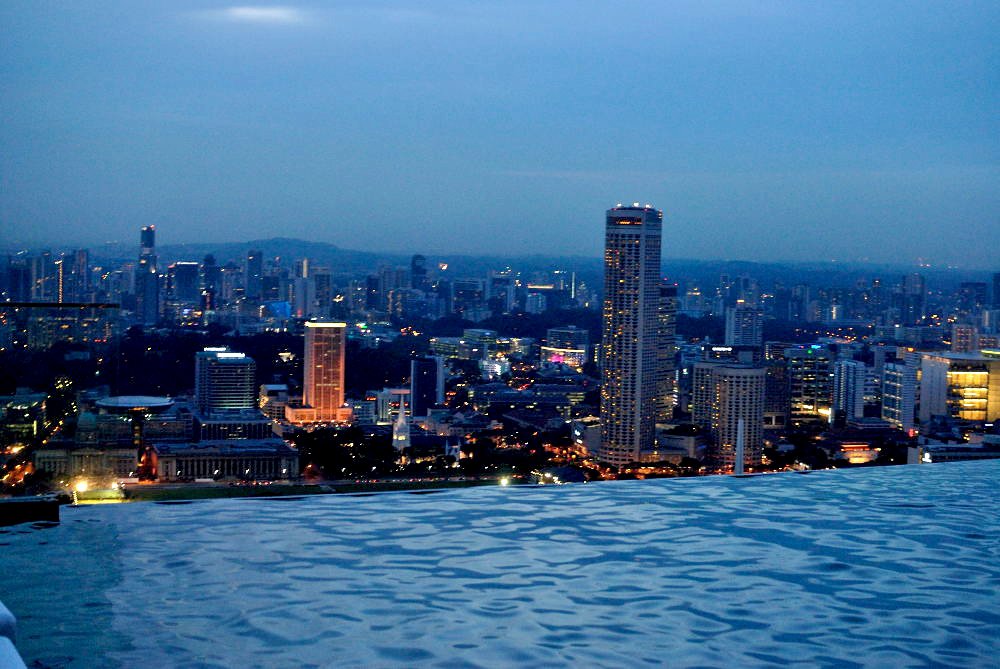
This hotel sounds sort of terrifying with its endless supply of luxury items and services. A hotel, shopping mall, casino, and even museum, it’s a monument to capitalism and aspirational living. I’m curious to see the place as a whole, but the main attraction is the infinity pool. Check out this photo!

over the edge

The infinity pool at Marina Bay Sands

Photo courtesy of Hale Cho.

It looks like you go right over the edge! The pool is totally secured there, but the water runs over it in such a way that it looks like a sheer dropoff, an edge to tumble over and a glittering city to fall into below. I am most definitely going in this pool and taking many heart-stopping photos of me “falling,” because if you can’t cause your parents heart palpitations from thousands of miles away, what kind of daughter are you?

The Southern Ridges
This is some of that unexpected parkland, and it looks delightful. There are all sorts of green spaces here, from meticulously planned gardens to a canopy walk through the tops of trees in the lush tropical forest. There’s also a famous bridge, the Henderson Waves, which gives the appearance of rolling gently through the air from one park to the next.

Look! Up in the air! It's an ocean! It's a bridge! It's... sightseeing!

Photo from http://www.nparks.gov.sg.

You can join guided tours through different parts of the park, learning about all the animals scampering about and the plants practically glowing their green at you. The canopy walk takes you right to a museum. Several different trails take you on different kinds of walks, with differing levels of difficulty. This kind of city/nature integration is a model I’d like Chicago to learn from, for sure.

So! There are a couple places I will definitely visit when I’m in Singapore. I’ve had a couple couchsurfers from Singapore, and I’m hoping I can stay with them each for a couple nights and catch up. In fact, one of my couchsurfers, the lovely Mindy, is a biology genius and a nature guide, so I might be able to snag a personal tour! Work your connections, people.

Running the Numbers: Where to Go

Hello, dearest fellow travelers! Sorry about the unannounced break; there were weddings and BBQs and many delightful things that kept me away, but now I’m back for our regular Tuesday/Thursday schedule. Today I’m introducing a new recurring feature called Running the Numbers. It’s time to get serious about budgeting for this world trip next year (NEXT YEAR JUMP BACK), so I’ll be working out what I can reasonably afford and sharing those insights with you so we can all furrow our brows in a shared nervousness about RTW budgets. Fun times, right? The budget I’m planning to work with is $30,000 over the course of a little under two years.

When I tell people I plan to travel around the world for about two years, the questions usually go: Really? By yourself? Is that safe? How can you afford it? To which I respond, yep, yep, as safe as living in a major American city, and I sure hope so! Since I plan to leave in 15 months, it’s time for me to get serious about that last part, and I’m starting to break down the budget and be judicious in which places I can realistically visit on that budget.

Every single blog written by world travelers contains at least one post on how much money the authors spent on their trip, so there’s a lot of info out there to analyze. I like the breakdowns on this blog and this one, although I do get dispirited when I see that our routes are different enough that they might not make the greatest basis for comparison. In fact, they go to many fewer countries than I had been planning to visit, so I’m starting to seriously considering pruning the itinerary. I don’t want to visit lots of places only to not have enough money to see all I want to see in each.

Currently I say I want to start in Australia and then see a lot of Asia, take the Trans-Siberian, and work my way down to some of Africa, then end in India. Looking at the phenomenal cost of visas ($80 to get into Kenya! $70 to visit India!), carefully plotting a course seems an even better idea.

So now I’m thinking my best course would look something like this:

Australia
New Zealand
Indonesia
Singapore
Thailand
Cambodia
Vietnam
China
Japan
South Korea
Russia
Poland
Hungary
Serbia
Turkey
Israel
Egypt
Morocco
Senegal
Kenya
Zimbabwe
South Africa
India

I’m sad to cut out Scandinavia, but those countries are super expensive and one of the main reasons I’d want to go, the aurora borealis, is never a certain sighting, so it’s smarter to come back another time when I can focus on patiently waiting for the lights to appear. I’m still not totally sure about each of the countries in Africa, because unlike in Asia they are much farther apart from one another and therefore they add quite a bit to transportation costs, but there are specific sights and cultures I want to experience in each of the countries listed, so I’m keeping them on for now.

Don’t forget that the plan is to return to the States after India, spend time with all the loved ones I missed, and save up a bit of money so I can go to Latin America (for those who are about to comment, “how can you not go to Peru/Argentina/Mexico?”).

Right then, dearest fellow travelers, what do you think? You’ll be reading about each of these places for the next several years, so chip in if you think I’m really missing out on a particular spot, or if you’re especially excited to hear about a place listed here.

Travel Advice — From YOU!

Dearest fellow travelers, I need your advice. Yes, instead of me imparting pearls of wisdom to you, this time I’d like some insight from your fine selves. This fall, my sisters and I are going on a weeklong trip, but we have no idea where to go.

We were meant to meet up in Portland for an event and travel around for a bit, but the event got canceled, so now we’re not tied to any specific location and we’re thinking of going somewhere less expensive to get to. When we realized we had the whole US of A to choose from, we got a little overwhelmed. I’ve traveled to at least two places outside of my state every year since college, but on each of those occasions, I was visiting someone for at least part of the time. The last time I traveled anywhere just because it looked like fun, and not because I knew someone who lived there, was in 2002, when my boyfriend and I drove to New Orleans for spring break our freshman year of college. (Side note: we were so naive and law-abiding that we didn’t even try to buy alcohol, although clearly we could have walked down the street with a giant margarita in each hand and no one would have blinked.)

If you could go anywhere in the US east of the Mississippi for a vacation with beloved family members, where would it be and why? If you’ve already been to great places and have tips on why we should go there, share that too! Drop hints, links, places NOT to go, etc. in the comments below.

Here are the requirements:

  • Must not be more than $300 round-trip from Chicago, Michigan, or New York in late September.
  • Must be gay-friendly.
  • Must be east of the Mississippi River.
  • Must have a balance of city/country life within a couple of hours’ driving distance (we’re going to rent a car). We’ll need to be able to go to a sports bar, take a hike in some mountains or stroll around a big park, visit a museum or cultural attraction, and relax in a cheap but tasty restaurant. (We have many interests.)

And… GO! Thanks in advance for your help!

Destination: Brooklyn

New York City. It’s one of the capitals of the world, a city teeming with sights to see, performances to take in, restaurants to savor. Of course, when we think of all the wonders of New York, we think of Manhattan. While there are certainly many years’ worth of things to see and do there, other boroughs have their own, less frenetic, charm. Since my sister lives in Brooklyn, I’ve spent a good portion of my two New York trips there, and I’m here to tell you it’s easy to make a whole visit out of Brooklyn alone. Here are some ideas:

This slideshow requires JavaScript.

Prospect Park

Saturday was the first nice day in a long time, and we went for a walk in Prospect Park, which stretches along over twenty city blocks, topped by a giant statue in Grand Army Plaza. The whole park was full of kids and their families playing catch, flying kites, and riding scooters all over, and we strolled along past cyclists and joggers on our way to the farmer’s market. A perfect afternoon!

Cocoa Bar

I whiled away an hour or two at this Park Slope café, drinking a tasty hot chocolate and eating a divine piece of cake called Death by Chocolate. It involved cake, pudding, AND mousse, and no, I did not perish (but I didn’t finish it either). They have a garden backed by a colorful mural, which makes it even more appealing in warmer times.

Park Slope Food Coop

(No, I’m not sure why they don’t hyphenate.) One of the most established co-ops in the country, this place is highly organized. You can’t shop there unless you’re a member, you can only visit if you sign in and wear a visitor’s badge, and if you’re a member, you have to work at least one shift a month or find yourself no longer allowed to shop there because you aren’t contributing your part. The rules make sense for a small place that has over 14,000 members, but it is a bit daunting. Pro tip: don’t go at 5pm on a Sunday. It’s a little scarring. But! The food is cheap, and so much of it is local and organic, and it sure does beat giving your money to a giant conglomerate. Plus, just this week they were raffling off a classic Schwinn, so, y’know, hipster cred is always maintained. So find a friend who’s a member and head on in.

Brooklyn Bridge and Original Brooklyn Ice Cream Factory

Back when I visited during the summer, Emily took me to Brooklyn Heights, where we had delicious ice cream at the Original Brooklyn Ice Cream Factory while strolling along the pier right under this giant bridge that I hear is being sold for a really good price. (Aw, poor NYC, maybe we shouldn’t make Brooklyn Bridge jokes when their mayor is renaming other bridges nearby.)

Coney Island

Just take the F train all the way to the end of the line and ta da! You’re at the beach, complete with an old-timey carnival and boardwalk. When my flight was delayed on my summer visit, I spent a couple hours sunning in the sand, eating a hot dog, and peeking at the Ferris wheel at Coney Island. This place was a resort destination as early as the 1830s, back when it was still an island and landfills hadn’t connected it to the mainland. Nowadays it’s a bit run-down, but you can still buy an ice cream, a useless souvenir, and an amusement park ride ticket for under $20, so what else could you ask for?

Outpost

Outpost seems to be one of those places that can be a little bit of everything for everybody–café, bar, restaurant, gallery, performance spot. When I visited during Gay Pride Weekend in ’09, a queer party group called Banned threw a delightful fête here with cupcakes, dance music, and burlesque performers who stood on tabletops and set their tassels on fire. It was pretty exciting. Also, there is a charming garden in the back with cozy seating to share a beer or three with your friends.

Park Slope shops

This neighborhood has a well-deserved reputation for being full of yuppie parents steamrolling over the sidewalks with their giant strollers, but as long as you stay nimble and avoid getting run over, there are a lot of neat shops to see. Emily and I walked along 7th Ave and poked our heads in many independent stores, places built up by locals and supported by the same. I think after a few hours I’d find it all a bit precious, but until then, the many stationery, framing, book, jewelry, and boutique pet stores are a fun way to while away an afternoon.

Re/Dress

Emily found out about Re/Dress through a friend and knew it would becomeo an immediate favorite of mine. It’s a used and vintage store for women sizes 14 and up, and unlike most thrift stores, it’s huge. (Puns!) The staff is friendly and affirmative, the décor is zany and bright, and the clothes are affordable and good quality. Emily found me the perfect LBD there, and I stocked up on summer dresses in ’09 that get me compliments every time I wear them. Highly recommended if you’re in the size range and in the neighborhood (which I think is Brooklyn Heights?).

I know there’s much, much more to see, but next time I visit Brooklyn I’m sure I’ll have even more suggestions to bring back for y’all. In the meantime, enjoy!

A Room With No View

The lake wasn’t visible yesterday. It wasn’t even a cloudy day, but when I stood at the window of the 27th floor of my office building and looked out across Adams and past the Board of Trade, I saw no horizon. There was only a soft gray sky settling down beyond Michigan Ave. It didn’t bother me, because I have this view every work day, so I get to see the lake in all its changeability. But I thought about all the tourists at the Sears Tower and wondered how many of them were disappointed that they’d made it to the tallest building in the country, only to see the city slip into a gray haze instead of a blue expanse.

Travelers want to see certain sights, take pictures of the main attraction and put those pictures up on their Facebook wall and in their Christmas cards. Even travelers who say they “don’t want to do the tourist-y thing” want to take good photos of whatever sights they do see. Despite being able to buy the main views on a postcard or in a souvenir book (with, let’s face it, a way nicer camera than most of us have), we keep snapping away to have our very own version. It matters, for some reason, that we have our own. How disappointing, then, when we can’t have it.

Helena Bonham Carter in "A Room with a View"

Lucky Lucy Honeychurch--she got the view AND the man to go with it.

I was going to turn this post into an upbeat piece on finding the beauty in every situation, and cherishing the memories of your travels more than their digitized representations, but the truth is, I really care about my photos. I’m the self-appointed photographer of most group outings with my high school friends. I have a wall in my dining room covered in snapshots of friends and family. I don’t travel through a lens, by any means; I know how to put the camera down and be in the moment. But I like to look at the picture later and think, “that was me, I took that, I was there, I remember what it felt like to be there and take that.” So when I can’t get a good shot of some view or monument on my travels, it bugs me. Especially when I’m visiting a place I’m likely to never visit again.

It’s not that the excitement of being at the Parthenon or atop Mount Kilimanjaro is any less when the view is obscured or it’s raining. It might be a bit more uncomfortable or look a little different than expected, but that basic traveler’s thrill I feel when I approach a monument or peer out over a vista is basic and deep, and utterly disconnected from peripherals like cameras or even other people. Arriving at a destination and finally viewing a sought-after view or work of art really is its own moment of joy. A photo can’t capture it.

Still, a photo can help me remember that original thrill. It can send me back to that place and time in a way a postcard or purchased photo can’t. I’m a bit of a nostalgia junkie, and although I’m trying to kick the habit so I can live in the now, etc., a little nostalgia is good for ya, and dwelling a bit on great travel moments is one of the best ways to experience it. I feel more connected to the place when I see a snapshot of it on my wall, and I feel a sense of accomplishment as I consider how I got there in the first place.

So when I’m at a scenic spot or famous destination and the view is obscured or the building covered in scaffolding, I know that the only thing to do is shrug my shoulders, take the best photo I can, and move on with my day. But I turn my head and look behind me as I go, always hoping the clouds will part and my photographic moment will return.

ACAM: Indonesia — Where to Go

After consulting The Rough Guide to Indonesia and the Internet, here are some places I plan to visit when I’m in Indonesia. I also updated the map (interactive! add your own ideas!).

Jakarta, Java
The capital city’s name means “City of Victory,” which probably holds bittersweet meaning after the riots of 1998 and Suharto’s resignation. I’m interested in the colonial architecture, the puppet museum, and the wooden schooners at Sunda Kelapa.

Borobudur, Java
Borobudur is the largest Buddhist temple in all of Indonesia, and a major tourist attraction. It was built to represent Meru, the ordering of the cosmos, so that you start at the base–the real world–and end at the top–nirvana. Walking that literally spiritual path will be humbling, I’m sure, and all the more so because I hope to go on one of the few sunrise tours offered.

Ubud, Bali
I’m not terribly interested in the party scene on the tourist-heavy island of Bali, but Ubud, a series of linked villages removed from the main scene, does intrigue me. The villagers are known for producing arts and various local crafts, and for preserving and maintaining the ancient culture of Bali. Apparently Elizabeth Gilbert went here in Eat, Pray, Love, although I didn’t remember that from the book (oh yeah I read it, and that is for another post), so it’s getting a lot more traffic than it used to, but maybe I’ll be there in the off season. I can’t wait to see the dancing!

Gunung Leuser National Park, Sumatra
Bukit Lawang is the starting point for trips into the jungle in this World Heritage site. The small village was wiped out in a flood caused by illegal logging in 2002, and is only just now getting back on its feet. There’s a big conservation effort going on in the park and around this village in particular, seen especially in the rehabilitating of formerly captive orangutans and releasing them back into the wild. Other rare species are also found here, and it seems like a good place to visit on an “ecotourist” kind of trip, since it supports local businesses and encourages conservation efforts as a good alternative to logging. It also seems to be on the way from Jakarta to Singapore.

ACAM: Indonesia, or How a 19th Century Dutchman Helped Me Refine My Political Manifesto

While the people of the Middle East and northern Africa are staging wonderful revolutions based on the people’s will, we in the States are fighting hard to serve the needs of the many, and I tell you what, it is a discouraging time. I don’t have the energy to argue with people anymore about why cutting Title X funding is immoral or how disbanding unions will only hurt the economy, not fix state budgets. Things seem to be getting worse and worse, with fewer and fewer victories to brighten the mood.

When I first read the selection from Max Havelaar in The Indonesian Reader, I just got even more depressed. Here’s a piece published in 1860 by a Dutch administrator in colonial Java, written anonymously because it was so damning about the colonial government, and it spells out many of the same problems of inequality, passing the buck, and exploitation that plague the modern world. The excerpt describes a system that exploited the native people of Java and surrounding islands (not united into the country of Indonesia until 1949) as a labor force for Dutch business interests. This same system employed civil servants, regional administrators, and others who were too worried about keeping their jobs to report horrific abuses and deaths, lest those reports draw unfavorable attention to their regions. Rather than look to the needs of the people they were charged with protecting, they looked only to the bottom line and worked people harder to turn a bigger profit and get more acclaim from those back in the Netherlands.

I’m not saying that the union workers in Wisconsin, Indiana, and Ohio are in the same situation as the Javanese workers in the 19th century. But the same impulse to human greed and domination runs through both stories, and the government happens to play the role of villain in both. That same story is played out over and over again throughout history, and that’s what struck me as I read this piece for the ACAM project. George Santayana’s famous “those who cannot remember the past are condemned to repeat it” has been trotted out far too many times for it to hold much meaning anymore, but it’s still true, and that’s what scares me. Are we just going to repeat the same stories of oppression and futile resistance over and over, in various horrible forms the world over? And if so, of course the question then becomes, what’s the point in fighting?

I think the answer lies in how we view history. The popular view, certainly the American view, is the linear one; we’re moving in a straight line from barbarism to civilization, and it’s just one grand march of progress and improvement. The other view sees history as a big circle, with highs and lows coming and going as the natural course of things, an inevitable turning of fortune’s wheel. The strictly linear view is clearly false; we can see people reverting to customs and laws from the bad old days all the time, so we can’t always be moving forward. The circle view is too depressing; the human experience becomes an exercise in literally spinning our wheels.

How about a Hegelian compromise? I wish I had artistic skills, because I would draw you this picture I see in my head: a series of circles, moving along a line. Those circles are various wheels of progress, regression, enlightenment, and repression, and we move through those circles as ideas are introduced, developed, and tested. We jump to new circles once those ideas have been accepted into the common understanding, and those wheels keep us spinning slowly forward through history.

It’s the development of ideas that really gets us moving into new wheels of progress and improvement. For example, right now Walker and other politicians are doing their damnedest to do away with collective bargaining in their states and eventually the country as a whole, and they very well may succeed for a period of time. But the idea of collective bargaining, which at one point in history wasn’t even a possibility, has settled firmly in the national consciousness, and what’s more, the practice of that idea has shown how easily it can be done. That’s going to make it harder to kill the idea completely, and if an idea is still alive, a movement can still survive. What’s more (and here I’m trying real hard to be positive about the current national situation), when the idea of collective bargaining survives, it should survive as a stronger idea. Right now, we see collective bargaining as a luxury afforded to certain professions, rather than a basic right of workers worldwide. As we spin about in this wheel of government bullying and corporate greed, those who fight for workers’ rights may be able to convince the general public of this difference between luxury and human right, and at that moment, we will jump into the next wheel. That will have its own ups and downs, as spinning wheels do, but it will be within this broadened national consciousness, and the discussion will grow ever more equitable.

Just as slavery was once a fact of life and is now a banned and abhorred practice, though we still fight to free trafficked persons; just as women were once the property of their husbands and now hold national office, though we still fight for their bodily autonomy; just as sodomy was once a crime and now gays and lesbians live openly, though we still fight for their right to marry and raise families — in these ways, will we continue to make strides for human rights in a world of greed and corruption.

I still feel my blood pressure rise every time I read a newspaper, and I still cry when election results are announced, but throwing up my hands in despair and deeming it all too big a problem to fix just puts me at the mercy of that spinning wheel; if I stick with it and join with others for our collective good, I can help push us over to the next one, the one with a better starting point than the one I was born into.

As Multatuli says in Max Havelaar:

After all, who would maintain that he had seen a country where no wrong was ever done? But Havelaar held that this was no reason for allowing abuses to continue where one found them, especially when one was explicitly called upon to resist them.

And we are all called. Decency calls us, history calls us, the future calls us.