The Lady and the Unicorn, a Lesbian Love Story

The Lady and the Unicorn tapestries, masterpieces of the form from the late 15th/early 16th centuries on display in the Museum of the Middle Ages (formerly the Cluny Museum), have appeared in novels, poems, songs, and as some sharp viewer noticed, on the walls of the Gryffindor common room in the Harry Potter movies. Ever since George Sand rediscovered them and wrote about them in the mid-19th century, these tapestries haven’t been exactly obscure. And yet, no one knows quite how to interpret them. There are several theories, the most prominent being that they are about the five senses and the soul, since at the time the tapestries were woven, the senses could be seen as doorways to the sacred but also reminders of our base humanity. The final tapestry, which bears the inscription à mon seul désir (“to my one desire/love” or “by my desire/will alone”), is usually seen as the lady putting aside material things for higher ideals. It could also be about the lady preparing to give up her virginity (unicorns are symbols of chastity but that long horn is also a bit suggestive, so unicorns are generally sexually ambiguous). But these interpretations are all wrong. Clearly, The Lady and the Unicorn series shows the lady and her maidservant falling in love.
the lady and the unicorn tapestry paris

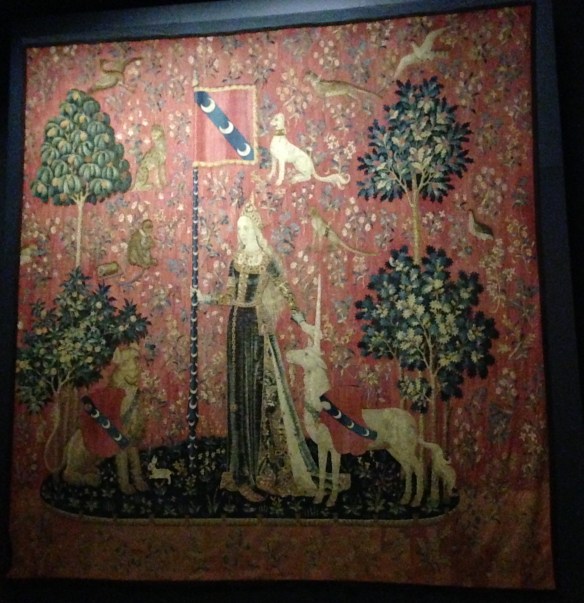
Okay, here’s our first tapestry, “Touch.” Our lady is bracing herself, holding on with one hand to the flagpole bearing her family’s crest, and with the other to the unicorn’s horn. The unicorn looks up at her calmly, secure in the knowledge that he is what she needs. She knows what’s expected of her, that she will be married off to a man, but she can’t even bear to look at him, to admit what her future will be. The lady is isolated, just her and the lion and unicorn, and one brave little bunny. Notice that many of the animals here are shackled, chained and unhappy.

the lady and the unicorn tapestry paris

Ooh, our lady and her maidservant meet here in “Taste.” Right away, the lion and unicorn are up on their hind legs, reflecting that feeling you get when you meet someone you’re immediately attracted to–you feel alert, alive, like you have to stand up and take more notice of the world. Notice that the animals are unchained and free now, and several of them have joined the women and lion and unicorn on the little island. Everyone feels like more things are possible now. The maidservant is offering up a bowl of sweets to the lady, literally offering up something sweet for the lady to taste. How does the lady feel about that? Well, she would never be so unrefined as to have her hair blown back, but her veil is waving about behind her. A little bird lands on an outstretched finger, a little symbol of freedom. Check out the look on the unicorn’s face; he knows that serious competition has just arrived.

the lady and the unicorn tapestry paris

In “Smell”, our lady and maidservant get to know each other better, as they hitch up their skirts for the work of the day, a gesture of intimacy we haven’t seen yet. Our lady, who before was so overcome with feeling that she had to glance shyly away from her maidservant, is now able to look her right in the eye. Our maidservant holds up a tray of flowers, from which our lady gathers blossoms to make into a garland. Delicate lady-flowers are definitely in play here.

the lady and the unicorn tapestry paris

Look, now they are literally making music together. In “Hearing,” our lady plays the notes on the organ while our maidservant works the bellows. This is a two-person job, and dare I say they have to be perfectly in tune with one another to do it properly? The lion is even sort of turned away to give them some privacy, although he can’t help peeking. The unicorn is coming around to the idea of this whole arrangement; the tilt of his head seems to be saying, “Go on, babe, I see what you’ve got going here.” Our wonderful maidservant looks frankly at her lady, as she has done in all the tapestries she’s been in so far. No maidenly shyness here; she knows what she wants and she’s looking right at her. I’m pretty sure we have not one but two goats on the little island as well (goats being well-known symbols of randiness).
the lady and the unicorn tapestry paris

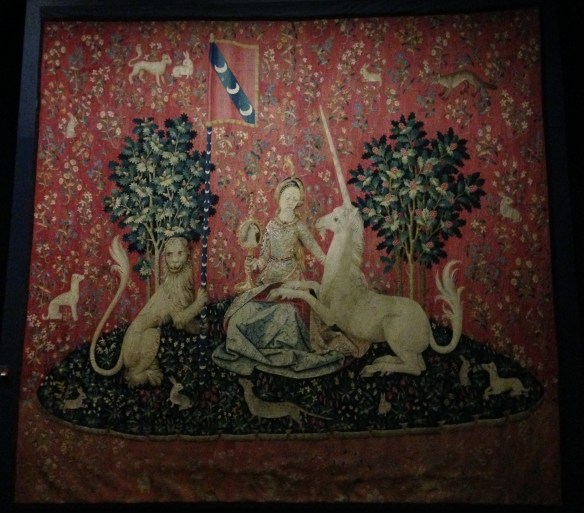
In “Sight,” our lady bids farewell to the unicorn. Our maidservant isn’t here–she has tact–so our lady looks almost sorrowfully at the unicorn as she breaks it to him that this is never going to work between them. But look at him, he’s pretty sanguine about the whole thing. He rests his hooves on her legs and gazes at her with affection. He’s not going to get in the way. She holds up a mirror so he can see himself, and what he sees isn’t a reflection of himself now but as he will be in the near future–alone, maybe, but head held high and looking out for what’s next.

the lady and the unicorn tapestry paris

Finally, here we are on the final tapestry, which shows a little tent, a bench, and our maidservant holding up a big ol’ chest of jewelry for our lady. Perhaps she’s placing the necklace back in the chest because she doesn’t need material items to be happy, just the love of this woman. Perhaps she’s taking a necklace out of the chest to give to this woman as a token of her affection. Perhaps she’s getting undressed because they’re about to go inside that tent and get busy. But whatever she’s doing with the jewelry, it’s clear what she’s doing with her future: she’s building it with this woman, her maidservant becoming her partner. A little lap dog appears for the first time, a symbol of domesticity. The lion and unicorn hold up a long veil that looks remarkably similar to what women often wear on their wedding day. And now that ambiguous phrase overhead makes sense: à mon seul désirIt both means “to my only desire/love,” as she gives her heart over to her maidservant, and also “by my desire/will alone,” as she lives her life according to her own desires and not by what was expected of her. She still displays her family’s flags proudly, she’s not trying to reject them, and look she’s even still friends with the unicorn (in a he’s-bowing-down-to-her kind of way). But she knows what she wants, and she’s looking right at her.

#BlackLivesMatter and #ICantBreathe: Resources for a Post-Ferguson America

Watching the murderers of Mike Brown and Eric Garner walk away unpunished in any way has been infuriating and heartbreaking. These two cases (and there are more cases coming to light every day, such as that of Tamir Rice) highlight the extreme racism and injustice at the root of American law and culture. Following people on Twitter and reading blog posts and articles linked from Facebook has helped me learn more and direct my energies and monies to movements that are responding on the ground (since I’m in London and can’t be there in person to march).

From blacklivesmatter.com

I’ve compiled some pieces here for Learning and Taking Action. This is mostly for my fellow white people, since a lot of this is explanatory in a way that people of color don’t need to hear because they’re living it. There are a range of pieces, from beginner to advanced stage anti-racism, so don’t be scared if you’re new to listening and talking about race in an informed way. Certainly I’m not any kind of expert, but a lot of the writers here are, so please take a look. I can especially recommend Ta-Nehisi Coates, Melissa Harris-Perry, Jay Smooth, Janet Mock, and Latoya Peterson as people to follow, read, and learn from.

Let’s not look away. Let’s look this straight in the face and tell it where to go.

Please go to the comments to share any other links you’ve found helpful.

From blacklivesmatter.tumblr.com

LEARN

If you’re only going to read one link from this post, read this one by the excellent Luvvie. It’s smart and comprehensive but succinct, and she uses funny GIFs.

White and not really understanding why people are so upset about Ferguson and Eric Garner? It’s probably because you’re mostly talking to other white people–that’s the norm in the US, as this article explains. Time to broaden what you read and who you talk to.

Here’s an even more accessible article on how acknowledging white privilege and working against racism doesn’t mean you have to hate white people, just the terrible racist system that white people put into place and now perpetuate.

The devastating new rules for being black in the United States. My friends have a baby not yet two months old, and knowing he’ll learn these rules makes me furious.

Eric Garner’s widow, Esaw, is not accepting the apology of her husband’s killer. She’s furious, she’s grieving, and she’s not letting Pantaleo make himself feel better by getting her to forgive him.

Bevin’s great collection of resources and reflections over at Queer Fat Femme highlighted this article, which reveals that #BlackLivesMatter is a specific movement founded by queer black women. It’s good to be aware of the origins of this widely-used hashtag.

Ta-Nehisi Coates continues to be one of the foremost writers on a lot of things, but especially race. Here he talks about Obama’s reaction to Ferguson, and what the system is set up to do and not do.

One piece of laminated plastic means this Vassar College professor experiences humiliating, dangerous situations rather than life-threatening situations –and he’s never allowed to forget it.

Don’t repeat the ignorant ‘but what about black-on-black crime?’ question. Coates has you covered.

The last words of some black and brown people murdered in the United States, in artwork.

We like to think that the non-indictments in the Eric Garner and Michael Brown case (and the acquittal of George Zimmerman in the murder of Trayvon Martin) are evidence of flaws in the American justice system, but this straightforward piece argues that they’re just links in the chain of a justice system doing what it’s designed to do–oppress people of color for the benefit of white people in this country.

From blacklivesmatter.blogspot.co.uk

ACT

Steps to take as a white person if the Ferguson case is just shaking you awake to the trenchant racism alive and well in the United States. Self-educate and get involved! (I especially like the intro, in which the author Janee Woods wonders why so few reactions to the case appeared on her Facebook wall–something I wondered about when looking at my wall, too.)

You want facts to convince you of the unfairness of what happened? You want convincing that protests are worthwhile? Check out this post on how to talk about Ferguson and the aftermath.

Support people taking anti-racist action in the aftermath of Ferguson by making a gift to various organizations. ‘Tis the season, right?

Do you interact with kids as a teacher, parent, guardian, relative, friend? Here’s a great resource on how to talk with them about what’s been going on.

If you already consider yourself an active ally, take a look at this piece that challenges us to be accomplices rather than allies.

Don’t contribute to #CrimingWhileWhite–keep the focus on #AliveWhileBlack.

Visit Ferguson Action and Ferguson Response for actions you can join in on.

AND SOME HOPE

Look, redirect your money for militarizing police forces to these trainings instead, and eliminate police killings of citizens in under a decade! It truly is a culture we can change, not a given we must resign ourselves to.

Don’t Shoot rally at Howard University (From http://www.cbc.ca)

Labor Day: We Still Have So Much Work to Do

Happy Labor Day, fellow Americans! I hope you’re all enjoying barbecue with loved ones. For my friends outside the US who may not know, Labor Day is the American version of May Day; it used to hold a lot more power as a holiday recognizing workers’ rights, but now it’s generally seen as the the last party of the summer. Let’s take a moment to remember why we get to have the party.

Especially this year, when we’re remembering the March on Washington 50 years ago, I think it’s important to be grateful on Labor Day for the protections and opportunities we have, while we fight for the ones we’ve lost or haven’t gained yet. The nationwide attack on teachers–especially nasty in Chicago–in the guise of helping students. The “right-to-work” laws passed in 24 states (an amazing semantic victory for the right). The gender wage gap. Crippling student loan debt–and the recent doubling of interest rates on those debts. Blocked immigration reform. An unlivable minimum wage. Minimal support for new families, especially mothers in the workforce. Legal discrimination against LGBT folks. There’s a lot about employment in the US that needs fixing. (Click on those links to see groups that are taking action; you can join them.)

Obama’s speech this past Wednesday was pretty good, but the line that adapted MLK’s famous one is great: “The arc of the moral universe may bend towards justice, but it doesn’t bend on its own.” He then urges everyone to continue fighting the good fight, a point he makes in a lot of speeches but far too frequently contradicts in his actions as president. Still, he’s not wrong. The reason we have the workers’ rights we have is because people fought for them, and not just the union leaders and lobbyists paid to fight for them. People who were tired after a long day at work then went out and rallied in the streets, wrote to members of Congress, went on strike, made changes to local laws, talked to their friends and neighbors about what was going on, elected leaders who promised to fight the fight with them. You don’t have to come home from work tired and angry with workplace injustices and your lot in life. You can come home from work tired and happy with the work you do and the conditions you work in. You can come home from work fired up to make work a place you want to return to.

So raise a toast to the unions and workers of yesterday and make a pledge to join with the ones who are fighting for a better life today. Because Labor Day means a lot more than the last day of the season to wear white.

Two Days in Bangkok

If the title of this post put that awful song in your head, I apologize. My first night in Bangkok was as grating as that song, and the first day was kind of a wash, but things picked up for the latter half of my stay there. Including infuriating political discussions on a street full of escorts.

Wat Po

Wat Po

I arrived late at night and wandered around Khaosan Road, and the next day I moved across town to a quieter hostel. On the way, I stopped at the central train station to buy a ticket out of town, and not only was the ticket I wanted not available, but I had to change transit three times just to get to the train station and then twice to carry on to the new hostel. All with a 30-pound backpack on and the tropical heat making me dizzy. My mood didn’t improve when I checked in at the hostel and learned that the Grand Palace closes at 3:30pm and there’s no way I’d make it in time, so I’d have to try to go the next day, although I’d have to go early in the morning because I needed to leave town by noon so I could get my train out of Ayutthaya in the evening. Ugh, just writing about my poor planning and the inconvenience of the sprawling city is frustrating me all over again!

Buy coupons for your every need

Buy coupons for your every need

I decided the solution to my bad mood was ice cream, so I went to the Magnum Bar downtown. I bought an electronics converter for $5 from one of those odds n ends stalls near the train station, the kind of stall probably entirely stocked with stuff that fell off a truck somewhere. But that converter is still working today, keeping my electronics from frying in the changing voltages in new countries, so I’m not asking any questions.

That night, I went out with two women I met at the hostel; H and K* are both teachers in China, in a “small” city about 2 hours west of Beijing. (“Small” in China means only a few million people, of course.) We thought we were going to a ladyboy cabaret, but K’s phone directed us to Soi Cowboy, which is a street that combines all the stereotypes about the seedier side of Thailand: neon everywhere, girls wearing next to nothing idling outside their clubs, lackluster table dancing inside the clubs, old white men at all the clubs, and a general sense that everyone is trying really hard to pretend it’s all normal and not sad.

Soi Cowboy

Soi Cowboy

We walked the length of it–the only tourist women there except for a few middle-aged women we spotted with their husbands–and ended up on the patio of Cowboy, which had a cover band inside instead of dancing girls. H had a lot of uninformed things to say about gender and sex work, which frustrated me to no end. She kept asking about ladyboys: “What are they, women or men? What parts do they have? What are they, really?” Do your homework. Even a cursory glance at a guidebook will clarify for you that ladyboys (who usually refer to themselves in other terms, actually, like “kathoey” or “a second type of woman”) are usually biologically male, but their chosen gender expression is female. Asking what gender someone is “really” is hugely insulting, no matter the culture, but especially in a place like Thailand, where information is readily available on this prominent part of the population, it’s inexcusably ignorant.

Soi Cowboy bangkokHer other favorite topic for the evening was whether the women working here had chosen this life. She’d read all sorts of stories about the “white slave trade” in Southeast Asia, which… what. But she also thinks that some Thai girls, while not kidnapped for the sex slave trade like white girls from America (WHAT), are still forced into the job. If they chose the job, though, she was okay with it. I did a little “choosing from super limited options isn’t a true choice” (my main line when encountering “feminism is about choice” defenders), but mostly I was irritated that she insisted on talking about this while we were sitting right there. If this scene bothers you, that is perfectly understandable, but there’s no reason you have to stay here. As soon as we arrived, we could see it for what it was; babbling about how worried you are for these women as you drink cocktails they bring you is useless and almost insulting.

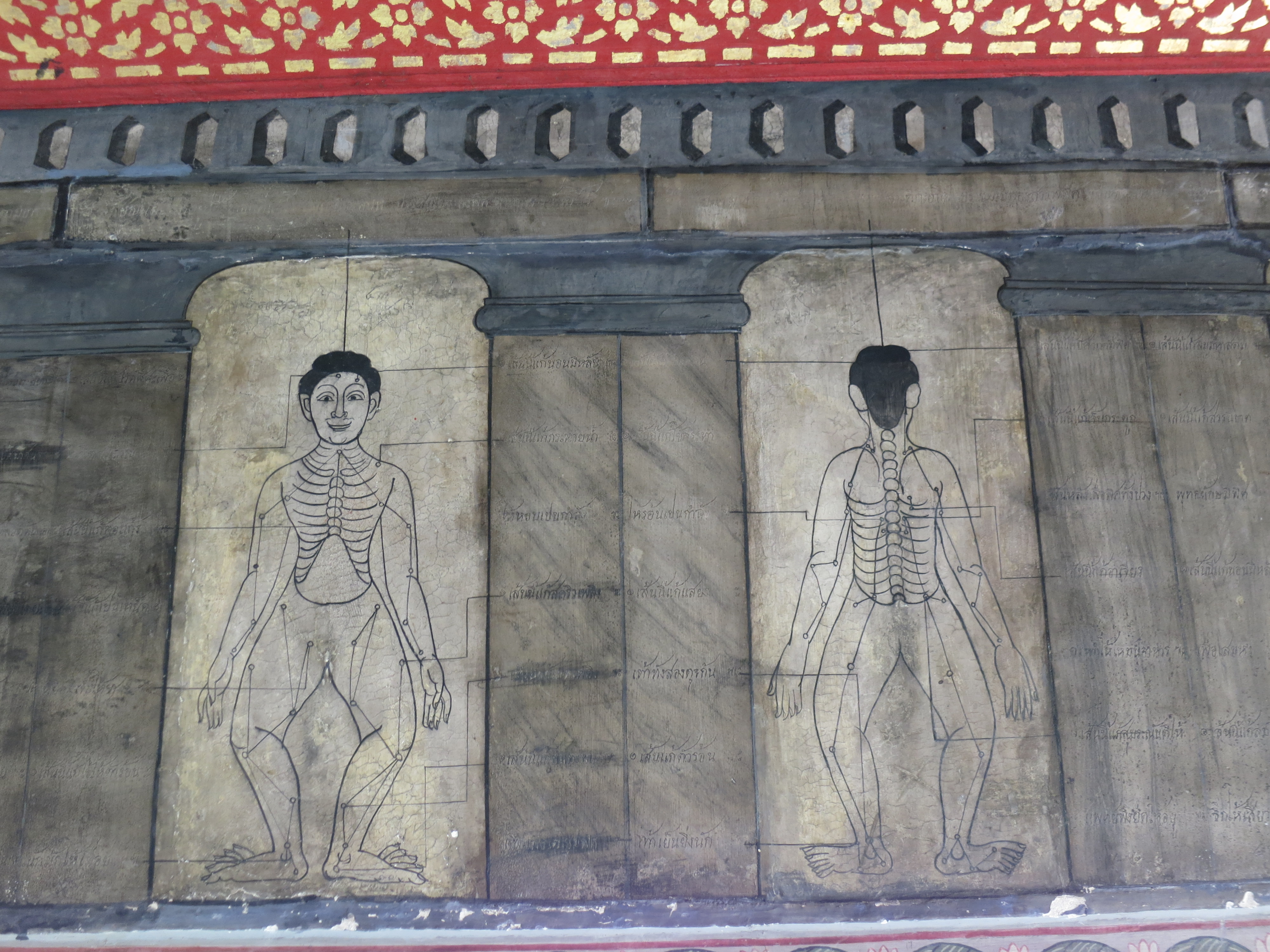
Medical diagrams at Wat Pho

Medical diagrams at Wat Pho

Anyway, when we steered clear of those conversations, we had a good time, and I was glad to have gone out for one night in Bangkok. (Oh no, I did it again.) The next day I went to the Grand Palace, but by the time I got there, every tour group in Thailand was shoving its way into the gates, and it was too overwhelming. I walked along the outer wall and crossed the street to Wat Pho instead.

Reclining Buddha in Wat Po

Reclining Buddha in Wat Po

Wat Pho (or Po) is a beautiful complex. It contains the largest reclining Buddha in Thailand, covered in gold leaf and housed in a building barely big enough for it. Pillars hold up the roof and split up the view of the buddha, which is too bad for taking in its magnificence in one look, but did give intriguing glimpses as I walked down toward the feet. The soles of the buddha’s feet are covered in intricate mother-of-pearl decorations, which were lovely. The rest of the grounds contain a massage school, a shrine to a seated buddha, and small stupas. There was also a small display on President Obama’s visit to the temple in November 2012, including the gift he brought with him–a candle from Chesapeake Bay. A candle? Really? A candle is what you get someone when you don’t know them well enough to know what to get them. Surely someone on the team could’ve tried a little harder.

The feet of the reclining buddha

The feet of the reclining buddha

After I walked around the wat, I collected my luggage, spent far too long finding a minibus, and got to Ayutthaya for a few hours of sightseeing before headed farther north. A whirlwind trip to Bangkok.

*Usually I use full names in my stories, but since I dwell on the negative parts of my time with H, I thought that imprudent.

Affordable Care Act UPHELD

Health care for everyone! I was disappointed Democrats aimed low when they passed the law and essentially gave a whole lotta money to corporations, but it is still worlds better than what we had before. People who are uninsured, poor, young; people with pre-existing conditions; people with uteri… people across the country benefit from the Affordable Care Act, and that is the victory here.

Obama’s chances vs. Romney’s come November is also a big deal, but should not be the main focus in this win for people’s health.

(But ok, for what it’s worth: Republicans will now say “I’ll repeal the law” rather than come up with a new plan, which is easier for them. They’ll say, “See, Obama DID raise taxes!” and that’s not great for Obama either. But Obama’s centerpiece legislation remains, and that’s going to do a lot for his chances, I think.)

Are You Flirting With Me Right Now?

Dearest fellow travelers, let’s talk bodies and how we talk about them. Just a bit! The subject of one’s weight and beauty is fraught with social pressures, personal histories, and private traumas. I’ve talked a little about how my own fatness affects my ability to travel, and I will probably post some more about that in the future. But for today, I wanted to share my new favorite way of stopping damaging body-shaming talk in its tracks. You can use this on yourself, your friends and lovers, even casual acquaintances. Ready for this amazing secret??

Mirror, Mirror, does this dress make my face look green?

Generally, we all feel some sort of weird in our own bodies. Maybe we think we’re too fat, too skinny, too dark, too light, too too too something–we’re always some measure off of an impossible beauty standard so deeply ingrained that we almost think it’s natural. I have a lot of thoughts about that, and a lot of websites to direct you to, but despite appearances to the contrary, I don’t like to spend all my time pontificating. I have a set amount of pontificable time. The rest is spent reading Kate Atkinson novels and imagining myself into Cary Grant movies.

But just because I’m not pontificating doesn’t mean I think it’s okay for us to go around hating on our own bodies (or those of others, but that’s a whole other conversation). How do I shut down body shaming without making the person feel yelled at, or shamed, or condescended to? How can we take a moment of body shaming and turn it into a gentle reminder to love your body, without preaching? The answer: humor! (AS ALWAYS.)

My friend told me about a roommate she had who turned her world around on this one. My friend is usually comfortable with herself, but she has her bad days, as we all do. Whenever she’d get down on herself about her thighs or her hair or her skin or whatever, her roommate would look at her lasciviously and say, “Are you flirting with me right now?” in a super exaggerated way. She’d even flutter her eyelashes a little and pucker up her lips. Every single time, my friend would laugh and carry on with her day.

It’s perfect! It’s absurd and non-confrontational, while also gently pointing up the absurdity of endlessly stressing over perceived body flaws. It doesn’t offer any of the usual reassurances — “no, that doesn’t make your butt look big,” “just eat yogurt for the next week and you’ll feel so much better,” “I have a new moisturizer you should try, it only cost $3,000” — but it is reassuring nonetheless. It reassures the stressed friend that what they see as a major flaw or even minor annoyance is actually nothing at all, a triviality, a reason to relax and have a laugh. It’s like saying, “I wasn’t focusing on your body but if we’re going to, let’s enjoy it!” It takes a moment of anguish and turns it into a moment of connection and fun.

So the next time you’re despairing your love handles, or your friend is bemoaning her chest size, make a funny face and a dramatic gesture and say, “Are you flirting with me right now?” I bet you laugh and move on with your life, in that beautiful body of yours.

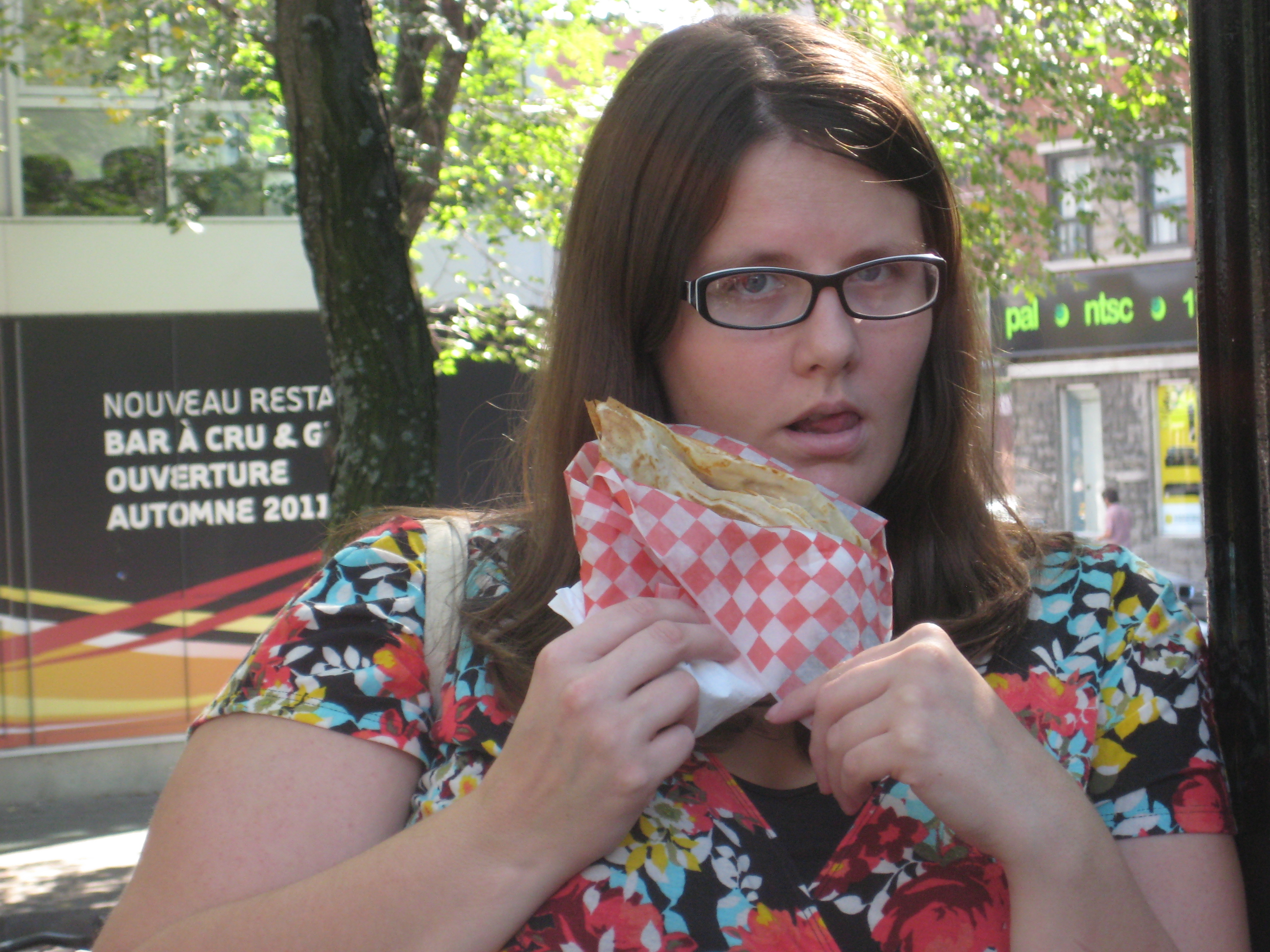
I’m definitely flirting with you right now

Image 1.

Food for Thought

Food for Thought

Not a proper GBS, but here are a couple neat things I’ve found on the Internets lately:

Two easy-to-read infographics on why health care in the US costs more than any other developed nation. I think my favorite part is the angel halos around the “Truth!” bullets in that second one, and also the fact that they say outright that lack of regulation is what allows providers and insurance to charge more here than they would be able to in countries that keep that kind of thing in check.

The ever-brilliant Rebecca Traister has been watching and commenting on the last week of Oprah’s network talk show. This article is a great reminder of why Oprah matters so much — she started out with just about nothing and now is one of the most powerful women in the country. (Funny how she’s not often held up as the example of the American Dream by politicians and media pundits. I’m sure her gender and race have nothing to do with that.) Her departure will remind Americans of just how white and male the rest of the media landscape is, and what a loss that is for all of us.

Personal Notes

Also, thanks to all who have made suggestions for where the twins and I should vacation this fall! We’ve never had a sisters-only vacation before and we’re pretty psyched. I’ll keep you updated on what we choose.

Lastly, but perhaps most importantly, who is inviting me to their Memorial Day BBQ this Monday?? It promises to be a hot and sunny day, and I promise to bring tasty beverages. Let’s do it.

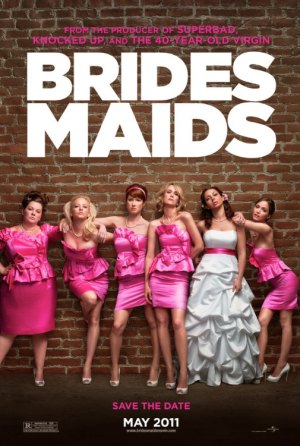
Vote with Your Dollars! Go See “Bridesmaids”

I don’t know about y’all, but we’ve been having a miraculous week of warm weather and sunshine here in Chicago. Luckily, it’s going to be rainy and cold this weekend, lest we get too confused about where we’re living and start advertising the city as a spring break destination or something. This means that it’s a good weekend to see a movie without any feelings of guilt for not enjoying the outdoors! May I recommend you go see Bridesmaids in droves.

Bitchin' but not bitchy? It could happen.

I haven’t even seen the movie yet, but I’ve read all the build-up to it. And people are putting a whole lotta pressure on this movie; it’s supposed to be the one that proves that not only are women funny, but they’re bankable. Putting aside the inherent ridiculousness of even pretending that women aren’t funny and that no one wants to spend money watching them be funny in movies, and also putting aside the fact that it took a big-name male producer (Judd Apatow) and established male director (Paul Feig) to get this female-penned screenplay (Kristen Wiig, Annie Mumolo) made, I say that since the movie has already been built up as a litmus test for what kinds of comedies studios will be greenlighting for the next decade, it is worth it to speak up.

And how do we speak up in this country? If you guessed “vote in elections,” nice try! The correct answer is “with money, baby.” So vote with your dollars for a funny, raunchy movie written by and starring women. If you can make it, go see it this weekend, since studios rely heavily on opening-weekend box office numbers when they make decisions for future projects.

Many reviewers liked the movie, including Manohla Dargis at NYT, Dustin Rowles at Pajiba, Mary Elizabeth Williams at Salon, Dana Stevens at Slate, Scott Tobias at The AV Club, etc. I doubt the movie will show me a Headly Surprise, but it just might pass the Bechdel Test, and at the very least a movie about how exhausting weddings can be for single people is welcome in this, my year of seven and counting wedding invitations. And perhaps most importantly, this movie’s going to be hilarious.

UPDATE: It was hilarious!

Three Pro Tips on Writing

#1: Author Joanna Russ died on April 29th. She wrote science fiction and literary criticism, and I have The Female Man waiting in my Goodreads queue. Another one of her books had the best book cover:

It's sad and funny 'cause it's true

#2: Zadie Smith has shared the shortest, most to to the point, list of ten rules for writers at the Guardian:

1 When still a child, make sure you read a lot of books. Spend more time doing this than anything else.

2 When an adult, try to read your own work as a stranger would read it, or even better, as an enemy would.

3 Don’t romanticise your “vocation”. You can either write good sentences or you can’t. There is no “writer’s lifestyle”. All that matters is what you leave on the page.

So far I have #1 down! Excellent. (Read the rest here.)

#3: The Rejectionist has a delightful (as usual) post on using female characters’ deaths as plot devices:

Racking up the (hot, slutty, dismembered) Lady Character body count to prove just how Depraved your serial killer is: NOT APPROPRIATE

The Lady Character randomly kills herself/is murdered solely to add Dramatic Interest to a Conflict between two Gentlemen Characters (aka the “Christopher Nolan”): NOT APPROPRIATE

I love that she named that last one. (Read the rest here.)

For Mother’s Day: Choosing Love

Most Mother’s Day pieces talk about how inspiring and brave the mother in question is, and how the daughter wanted to be just like her when she grew up. Well, my mom visited most of the national parks west of the Mississippi on her own at age 19; she moved across an ocean to marry the man she loved and start a career; she went back to school fifteen years later and now is department chair of her college’s Department of Education. Together with the man she changed continents for, she’s raised three daughters and she is still happily married. So yes, my mother is damn inspiring and quite brave, and of course I want to be just like her when I grow up. (Good thing, if the inevitability of turning into your mother is to be believed.)

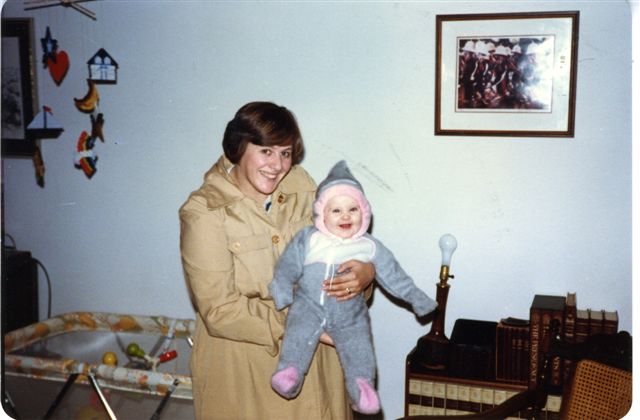
Look how delighted I was just to be held by her!

But when I was younger, rather than finding kinship in books with loving, caring mothers, three of my favorite books centered on absent, selfish, sometimes cruel mothers. I read Time Windows by Kathryn Reiss, A Solitary Blue by Cynthia Voigt, and Midnight Hour Encores by Bruce Brooks over and over. The details of each story differ, of course, but in each, the mother puts her own needs before those of her children, and the children suffer for it. In Time Windows, the mother feels trapped by domesticity and wants her own career (to be fair, it is 1904 and this was unheard of for white, middle-class women); in her anger, she locks her daughter in an attic as punishment for clumsiness. In A Solitary Blue, the mother leaves her much older husband for a bohemian lifestyle, and only returns to her son’s life when she needs money to fuel a drug scheme with her new lover. In Midnight Hour Encores, the hippie mother gives her daughter to the father within a week of the child’s birth, unable to face the huge responsibility of raising a child; years later, she gets her life together and becomes a successful businesswoman willing to set up a tentative friendship when her estranged daughter contacts her.

Why on earth would I want to read about these women? My own armchair self-analysis finds a few reasons: I wanted to see Bad Mothers punished in order to feel more secure with my Good Mother. I secretly feared my Good Mother might turn Bad and abandon me.

I think both of these are true. My mom was at home, insisting on breakfast every morning so I’d grow up strong, checking that I’d done my homework, wiping away my tears when the kids at school were mean to me. But when I was age 11 and devouring these books, she was also going to classes, doing her own homework, and writing her dissertation. In my confused adolescent mind, I saw her having a career (where before I hadn’t noticed one, since she’d taught at the school I attended so she seemingly extended her mother role to school just for me–ah, the utter narcissism of children!) and I freaked out. She’d never shown an interest in leaving home before, but what if Having a Job lured her away, as it seemed to for the mothers in these books? At age 11, I was just starting to see how taking care of my sisters and me might be a major pain in the ass, so I could easily see how she might chuck it all in to focus on her career and herself rather than on tending to our whiny needs.

But before I could get too into this strange fantasy of abandonment, the very books that led me down that path turned me right ’round again. The advantage of being an obsessive reader is that multiple meanings make themselves available on multiple readings. The protagonists of A Solitary Blue and Midnight Hour Encores start to see how their mothers had made difficult decisions when they’d left their kids. Not that this made them feel much better about how hurt they were to be left behind, but they did understand a little more how their mothers had their own interests that were separate from them, the kids, and how they’d pursued those interests instead.

Now, one of the things my mom has always said is how fortunate she feels that she was able to stay at home with us when we were little and then go back to school to continue her career, rather than having to do it all at the same time and missing out on my sisters’ and my young childhood. Unlike the mothers in these books, she didn’t have to make that hard choice. Here I was worrying about her doing something drastic, but she felt no need to do something drastic, because after those early broke years on the south side of Chicago, her husband was making a decent income that opened up possibilities.

But even if she’d had to choose, she would have chosen us. I asked her recently if she ever felt like putting us first meant putting herself last, and she said it never felt like that, because it was always about putting the family as a whole first. She didn’t see a divide between her interests and ours, because they were the same. Even when she decided to return to school and get her PhD, she saw how that had a benefit for us, too. After all, she wanted we three girls to grow into independent young women who were confident of their ability to do anything they desired, and making her own professional dreams come true was setting a good example for us.

Another good example she set, though of course it didn’t become clear to me until years later, when we’d all left the house, was that she never lost her sense of herself in us. She drove the twins to basketball practice, she listened to me practice scales on the piano, she bent over our math homework with us, she read stories aloud to us before bed, she commiserated with us on our tales of woe from school, she went to parent-teacher conferences, she joined the marching band boosters club, and so on ad infinitum. But she only came to basketball games, not practices; she didn’t sit through my piano lesson, just the recital; she only helped on homework we were stuck on, rather than checking each assignment to make sure we’d completed it. These are all things other parents do, other parents who perhaps do not have enough hobbies of their own or who don’t know what to do with the precious free time they find themselves with.

When I was growing up, this was simply the norm; from time to time, Mom had her dissertation to write, or a magazine to read, or a friend to chat with. If we were hurt or needed something or whatever, of course we could interrupt and she’d drop everything in a second. Otherwise, we could amuse ourselves, and she was not at our beck and call. Again, this was not just a good choice for her own sanity, but for our well-being and growth; we learned that everyone needs their space and that we could rely on ourselves for entertainment instead of needing someone else to feed it to us. She’s told me that she saw two dangers in losing yourself in your children: you either become resentful of the time and energy they take from you, or you expect something in return, like “I put my whole world into you, so why didn’t you turn out perfectly?” No one needs that kind of pressure, and no one ends up happy. I remember seeing Khalil Gibran’s The Prophet on her nightstand, with the “On Children” essay bookmarked. You know the one:

“Your children are not your children.
They are the sons and daughters of Life’s longing for itself.
They come through you but not from you,
And though they are with you yet they belong not to you.”

The astonishing thing to me then, that adolescent reader of books and dreamer of dire events, was that she was choosing us. The astonishing thing to me now, a single woman of 28, is that she chose us so consciously and conscientiously. She thought ever so carefully about every choice before making it, and she had good reasons for each parenting decision she made. (Note: none of this is to discount my dad, who is his own wonder but not the topic of this essay. The two of them were really big on making all parenting decisions together, and their united front was impenetrable.) She wasn’t on mothering autopilot, which is a relief to me now, since the idea of mothering is exciting but also terrifying, because how do you figure it out? By doing it, and doing it mindfully, as it turns out.

That’s the final message I got from these middle school books, too. Mothers aren’t just mothers whose only focus is their children; they’re people who have a vast array of interests, needs, and desires. That’s what was so scary to me. I was just starting to realize that mothers didn’t have to be as good as mine was, that they didn’t have to be there for us whenever we needed them, that they didn’t have to show their unconditional love on a daily basis.

I think my mom would say that she did have to do those things, that her love for us was so strong that she couldn’t imagine doing it any other way. But there were so many other ways she could have raised us, and she chose this way, the way of love, humor, strength, intelligence, curiosity, and kindness. That takes not just a good mother but a good person, and when I realized my mother was not just a good mother to me but a good person in the world, I saw more clearly why I wanted to be like her.

Happy Mother’s Day, Mom.

at Inspiration Point -- relevant, no?