Montreal or Bust!

Well, dearest fellow travelers, we decided to ignore your advice completely. Rather than go to DC or Cape Cod or Kentucky or any of the delightful places you suggested, my sisters and I decided to make this road trip an international adventure. We really do appreciate the thoughtfulness of your suggestions, and I certainly hope to be able to check them out in the not too distant future, but we decided to go a different route (pun!).

We thought, Emily lives in New York so let’s have Lisa and Heather fly there and save one person flight expenses, and she can contribute what those would’ve been to the rental car. Ta da! Money saving.

And the destination is… Montréal!

Here’s what we’re looking at:

ITINERARY

Day 0
Lisa and Heather fly in to New York, NY, crash with Em and Lizzie

Day 1

New York, NY to Lake George, NY — 4 hours
leave in the morning, get in for lunch, spend the afternoon and evening doing light hiking, taking pictures, making a good dinner

Day 2
Lake George, NY to Montréal, QC — 3 hours
take a leisurely morning, drive a bit around looking at trees some more and singing musicals, arrive in Montreal in time for dinner/setting up wherever we’re sleeping

Day 3

Biodome! Frenchy things! Poutine! Casino! Queer times!

Day 4
Variations on above

Day 5
Montreal, QC to New York, NY — 6.5 hours
L&H fly home on evening flights

DETAILS OF WHAT TO DO, WHERE TO GO

Adirondacks / Lake George
Auto Touring
Scenic Byways Map
Example of Accommodations with efficiency kitchen (good for making dinner and save money!)

Montréal
The Village
Casino de Montréal (keno, slots, table games, etc.)
Other Things to Do
Biodome (indoor zoo that reconstructs specific ecosystems, includes penguins, supposed to be really cool)
Le Drugstore (mostly lesbian club, 3-6 floors of bars/dancing/etc.)

COSTS

Car Rental
$280 ($40/day + taxes/fees) + insurance + extra driver fees, about $330 total, except that Emily has agreed to pay the average of the flight costs for me and Heather, since she’d be buying a plane ticket if we went anywhere else. Em will pay about $200 for the car rental price, which leaves the remainder at $50 each.

Gas
approximately 700 miles total, average rental car is 30 mpg, 12 gallon tank, 350 miles per tank, need 3 full tanks (have to return it full), $50 per tank, $150 total gas, $50 each.

Food & Drink
I’m hoping we can do light breakfasts, sandwiches for lunch, then maybe go out for dinner kind of thing, to cut down on costs. So a mix of grocery stores and restaurants. Probably $150 each.

Lodging
Day 2 accommodations will probably be a place like this motel for $60/night ($20 each).

We decided that three nights in Montréal is enough time to really get comfortable, and sleep well, and feel good about where we’re staying. We’re looking at Vacation Rentals and Air BnB for more home-like places to stay in Montréal. Those look more like $70/night for 3 nights, or $70 each. Probably $100 each total.

Entertainment

Biodome=$17
Gambling=$30? 40?
Museums=$20

Probably safe to budget $100 each for this, since miscellaneous costs will come up.

TOTAL
$450 per person for the week, + L&H round-trip tickets

So whaddya think? Have you been to any of this places? Any recommendations on what to do/what not to do, etc.?

New Centerstage Review Up

First, a short rant. I had two loads of laundry in the washer this evening, and I went down to change them over to the dryers. The dryers were full of dry clothes already, so I took them out and folded the many, many towels in nice piles and put my laundry in the other two. I came back down later to bring it all up, and someone had taken my clothes out of one dryer and piled them on top of it in one wet mass. Whoever did it thoughtfully placed two quarters on top of the pile, as if that would make it okay to dry their clothes while mine moldered away for an hour. Where are we, college? Who does that?

Anyway.

Last week I reviewed The Artistic Home’s production of Marisol for Centerstage. The Artistic Home is an Equity company, so the production values were high (especially the sound) and the performances were solid. Here’s an excerpt:

In Jose Rivera’s “Marisol,” “time is crippled, geography’s deformed, you’re permanently lost,” and John Mossman’s staging is relentless in driving that point home from the opening scene. The New York City of the play is a disorienting, near-futuristic one in which coffee is extinct and the entire state of Ohio is on fire and drifting eastward in a cloud of smoke, but our protagonist still commutes from her Bronx apartment to her Manhattan publishing job in an attempt at normalcy.

You can read the rest of the review here.

The X-Ray Robots

During my lunch hour today, I took the bus up to Northwestern Memorial to get an x-ray. My knee is all kinds of messed up because apparently I turned 70 without noticing. Lately I’ll be walking along when I find myself crunching through gravel–except no, that is just the sound of my joints trying to grind out another step or two before giving up entirely. So physical therapy, x-ray, etc. Anyway, I gravelled my way over to the fancy Streeterville building and immediately stepped into another world.

The whole experience was just like all the science-fiction movie ships/office buildings I’ve seen coming together in one place–unnaturally quiet, antiseptically clean, strangely devoid of other people. Possibly filled with robots. Two receptionists sat at a long counter; one took my x-ray order while the other did something on her computer that caused an alarm to go off several times, the kind you hear when someone has broken into the vault–an insistent, metallic sound. No one seemed concerned. There was a juice bar in the corner, unattended except for a cleaning woman wiping down its counter over and over. I started to worry these robots would sense my suspicions, raise their heads slowly, their laser beam eyes zeroed in on me, and advance in a menacing matter. I was relieved when a man popped out from behind a wall and said, “Lisa?”

But was he an x-ray technician? No, he was a client services robot, his settings on “rakish smile” and “European accent,” clearly intended to lower the defenses of patients passing through the muted gray doors of this place. I maintained a healthy sense of wariness, however, especially when he led me down a corridor of slatted brown doors and opened one near the end. “Please remove your jeans and put on a gown, and leave all your belongings in this locker,” he said, giving me a key and gesturing into the airless room. “Then you will wait over here,” he pointed to an antechamber next door. I did as I was instructed and shuffled out to the antechamber, which had a huge bank of windows looking onto a busy street just one floor below, and another woman in a hospital gown watching the soap opera blaring from the TV. Sure, that’s not a super exposed situation to find oneself in.

As I sat and waited, I went through possible procedures in my head. DNA testing like in Gattaca? Damn, I’d already touched a million things for them to swab and see how inadequately prepared I was for space travel. Immediate cloning like in that Doctor Who episode? No, that didn’t require the removal of clothes. Maybe I was going to be tested for precog abilities like in Minority Report? Doubtful, those precogs were noticeably weirder than me on even my most sleep-deprived day.

Eventually a woman came in and called my name, and after having me sign off on paying for the procedure, she led me down another hall to a large room containing the x-ray machine. She had me lie down on my back and she positioned my leg just the way she wanted it for the picture. She pressed some buttons and the table I was lying on moved smoothly back, forth, side to side. She went behind the glass to take the picture, and I looked up at the various ducts and wires of the machine, all gleaming white and doing nothing to lessen my sense that I’d accidentally stepped into a Philip K. Dick story or a Star Trek episode.

A few minutes later, the technician informed me I was all done. I changed back into my clothes in the airless room and walked through the gray doors into the lobby. It was transformed. A line of people formed behind the long reception desk, no alarms were sounding, a couple kids were playing tag. There was even a ray of sunshine breaking through the fluorescent gloom. Maybe all the robots were on break. Maybe they knew I was on to them and took their operation elsewhere. Maybe I was lightheaded and it was time for lunch.

An Open Letter to My 1996 Saturn, Which Has Taken on the Role of Life Coach, Despite Never Having Been Hired in This Capacity

I’ve been reading some of the open letters over at McSweeney’s lately, and decided to try my hand at writing one. You can write to anyone or anything (generally not someone or something you are expecting a response from), but it must be nonfiction; that is, it has to be prompted by an actual event in your life.

An Open Letter to My 1996 Saturn, Which Has Taken on the Role of Life Coach, Despite Never Having Been Hired in This Capacity

Dear Madame Sunroof,

We’ve known each other for a good many years. You’d already completed one career track as my dad’s car for his sales trips by the time my sisters and I got to use you in high school, and you were a healthy 8 years old when I purchased you from my parents after college. You moved with me to a new state and settled in pretty well, becoming casual acquaintances with the Naperville Saturn dealership and its garage, and moving me around the suburbs of Chicago with ease.

But something changed when I moved us to Chicago proper. You were no longer the carefree car of my youth, eager for whatever adventure lay ahead. No, now you were a delicate old machine, approaching each trip farther than the grocery store with trepidation and squeaky brakes. I thought you were just aging, and I tried to ease the transition as best I could, with sporadic trips to the mechanic and a constant stream of verbal encouragement when we were riding around town together. I thought this would help and you’d cheer up.

Instead, I find that you’ve chosen a new career path in your twilight years. You’ve taken it upon yourself to be my life coach, though I never asked you to take on that role and certainly don’t consider myself in need of one. Once I figured out that each new ailment was trying to teach me a life lesson, I saw your plan coming together.

Going from 0 to 35 is a bit shaky, but it’s the crucial going from 35 to 55 when entering the highway that really makes you shudder and nearly shut down completely? Easy does it, tortoise and hare, etc.!

When it rains, the water comes in through a mysterious hole that no mechanic has been able to find and soaks the foot space of both the driver and front passenger seats? Bad things happen unexpectedly, and the best you can do is be prepared with some towels to sop up the mess!

The horn starts blowing in the middle of the night for no reason and I have to drive you around for 30 minutes til it shuts itself off? Get ready, because babies are way worse!

The rear suspension rod has lost all lubricant and makes a horrible creaking noise heard two blocks away every time I turn a corner? Loud music still solves most woes!

The rear windows won’t go back up once lowered (sometimes you can only go forward!), closing the door too hard turns the overhead light on or off (you never know when a ray of sunshine will burst through!), the floor of the backseat is literally rusting out (there’s nothing quite like a breath of fresh air!), and so on.

I guess I appreciate all these lessons you’re sharing with me, ol’ Saturn. But in a couple weeks I plan to drive us up to visit some friends in northern Michigan, and I’m counting on you to make that six-hour journey there and back. We’ve been a lot of places and covered a lot of miles, and I’m awfully fond of you. I’m sure that you can go the distance. Whaddya say, how about we make this lesson “if you’re well-loved, you can still go far,” and not “at the end of it all, go out in a blaze of glory”?

Truly yours,
Lisa

How I Nearly Blew Off a Cliff in Ireland But Lived to Tell the Tale

Today was a wet and blustery day in Chicago, and as I did a duck-and-weave through the raindrops on my way home from work, I found that I wasn’t irritated at the rain. In fact, I was feeling pretty good, thanks in no small part to the outpouring of goodwill I’ve received since I yelled to the world that the International Business Times had reprinted my post from Tuesday. But if I tried to tell you the last time I felt this giddy in a rainstorm, it’d probably be January 2004, when I was almost blown off a cliff and swept out to sea in Ireland.

a sheer, exhilarating drop from the Aran Islands into the Atlantic below

Image from http://www.travelpod.com/photos/0/Ireland/Aran%20Islands.html

I’d finished my study abroad program in Rome and was visiting friends living in other European countries easily accessible by Ryanair. It so happened that one of my good friends from high school, Miranda, was abroad at the same time, so we decided to meet up in Dublin, take a bus across the country to Galway, and return after visiting the Aran Islands. This is, in fact, what we did, only slightly derailed by the part where the winds tried to destroy us.

The Aran Islands, on the west coast of Ireland, had been described to me as the most Irish part of Ireland. I’m not sure exactly what that was supposed to mean, but I gathered it meant strikingly beautiful landscapes, quaint towns, and locals speaking the mother tongue. This is pretty much the case, although everyone speaks English as well as Irish, especially since tourism is the main industry there now.

The main tourist attractions of the islands are the ruins of stone forts such as Dún Aengus (or Aonghasa), which were probably built in the 2nd century BCE. It’s unclear whether they were entirely defensive forts, or if they also held religious or commercial value, positioned as they are with a view of a large part of the coast and therefore a good look at trading vessels coming and going. In later centuries, many structures on the islands were made over to monasteries, and farming on the shallow, rocky soil remained the main occupation until very recently, when tourism became big industry.

Miranda and I took the ferry over to Inishmore from Galway and picked up a map at a small shop we got a bit of food at. Keep in mind that this was late January, not exactly the height of tourist season, so there were very few other people around, and we considered ourselves lucky for having the island mostly to ourselves. Armed with the basic trail map and our cameras, we headed off to find one of the ruined forts, Dún Dúchatair (the Black Fort), and soon we really did have the place to ourselves, aside from a few grazing cows. We were walking on a basic kind of trail, which often seemed to devolve into just a field for a space, and the wind was picking up something fierce, but we had our destination in our sights, so we pressed on.

The Black Fort -- see how much rock was all around, too? (obvs this is a postcard; I was not blown so high off the cliff that I was able to take an aerial shot)

The rocks were everywhere, stacked to form low walls marking off small plots of land, and when they weren’t stacked in an orderly pile, they were underfoot, tripping us up. We had to tread carefully, but the sky was expansive and the island a lovely mixture of green-brown grass and slate-gray rock, and we were inordinately proud of ourselves for taking ourselves on tour rather than signing up for a guided one. We reached the fort, perched on the edge of a cliff, and it was worth the trip. The Black Fort itself was an orderly collection of rocks, small walls shaped into overlapping horseshoes, which were themselves shaped like halves of concentric circles rippling out from a stone being dropped in water. It wasn’t hard to imagine that stone being a chunk of island, either, since the center was almost at the edge of the cliff, and that cliff dropped off sharply and steeply.

We’d been scrambling over the fort for a bit, but now we needed to see the ocean, and not from far away, either. No, we needed to get real close and personal. We walked right up to the edge (there are no railings here, you litigious Americans) and leaned over, not far enough to fall in, but just far enough to feel adventurous. But whoops, the wind was still quite strong, and I found myself pulled closer to that edge than I liked. I was an arrogant 20-year-old, convinced of my travel savvy and basic immortality, but I was also a little scared of heights and a lot clumsy; the possibility of me plunging over the edge into the (beautiful, deeply blue, whitecapped) sea was now far too real. I lurched backward and stumbled over to a more stable location, like one of the handily ubiquitous gray rocks, to catch my breath.

At this point, it became clear that the fierce wind was not just a consequence of being so close to the ocean; rain was starting to fall from the sky, and it was coming down fast. Miranda and I turned around and headed back, but we found ourselves a bit lost. Our map suddenly wasn’t so helpful in the torrential downpour, and anyway the wind was doing its best to tear it from our hands. We leaned into each other, and into Miranda’s umbrella, and did what we could to follow the right set of squiggly rock walls down to the village.

Now at this point in most travel stories, I’d share with you that things were tense. After all, despite the Gulf Stream current that keeps the western Irish coast unusually warm, this was still January, and we were dressed in our winter coats and gloves, and this was a small gale bearing down on us. We weren’t sure where we were, the only living creatures we could see were cows sensibly huddling together, and I’ll wager we were both hungry and in need of a bathroom. But all I remember is enjoying every minute of it. Miranda and I both saw the absurdity of our situation and decided that rather than grumble or despair, we’d laugh. Far the better option. Talking in the storm was difficult, so we’d just walk a little, turn to each other and raise our shoulders exaggeratedly, shake our heads like “what’re you gonna do?” and laugh, then repeat.

Utterly given over to the storm and enjoying ourselves enormously

Eventually we did make it down out of the fields and rocks, and we found ourselves on the edge of the road. It didn’t take too long for a car to slow down, and a middle-aged man rolled down the window and offered us a ride into the village. We hesitated for a moment (young women, strangers, foreign country), but we quickly realized that he was just being nice, and was probably genuinely worried for us, since we looked like two barely resuscitated near-drowning victims. We got cheap, hot drinks at the same store we’d left so confidently a few hours before, shivered ourselves slightly warmer, and congratulated ourselves on being badasses. I don’t remember anything about the ferry back to Galway or the bus back to Dublin, but I clearly remember the wind whipping my hair into my face, the rain turning the gray rock a slick black, Miranda shouting with laughter, and a sense of wild freedom.

Once I was safely twenty paces back from the cliff, of course.
Stowaway Featured on International Business Times Site!

I hope you enjoyed yesterday’s post, dearest fellow travelers. If you haven’t had a chance to read it yet, you can check it out at the International Business Times website! That’s right, yesterday’s post, “How Reading Disturbing YA Books Made Me a Better Person,” was selected to be featured on the Books section of the prestigious IBT website here: http://www.ibtimes.com/articles/163335/20110615/disturbing-ya-books-meghan-cox-gurdon-sherman-alexie.htm. They’re building up a neat little corner of discussion on books over there, so be sure to take a look around.

Tell all your friends and link them here so we can keep the momentum going on making Stowaway a regular destination for people interested in reading and talking about travel, literature, and social justice. As ever, thanks for reading.

How Reading Disturbing YA Books Made Me a Better Person

The lit and library corner of the Internet was all aflutter last week over a Wall Street Journal article written by Meghan Cox Gurdon on the depravity of young adult (YA) literature today, and Sherman Alexie‘s response to that article. Gurdon tries to preempt those who would contradict her by saying they’re too interested in free speech and not interested enough in the well-being of teenagers who read books about truly horrible things like rape, abduction, drug use, and child abuse. She wants to protect young readers from being exposed to the horrors of the world, and I can understand a parent’s impulse to shelter children from bad things.

Lock up the children! It's a fantastic, truth-tellin' book!

Image from http://www.indiebound.org/book/9780316013697

But as Alexie points out in his response, it’s too late for too many young readers to be sheltered from those same horrors, because they’re experiencing them themselves. He lists several examples of teens who connected with characters in his books, who saw themselves and their dark secrets in the lives of his characters, and who found hope and redemption in the pages of those books. The people who wring their hands over the lost innocence of teens who read about tough realities are the same people who can’t or won’t acknowledge how rampant those problems are in the real world, and don’t help the teenagers who are living those tough realities every day. As Alexie says, “they are simply trying to protect their privileged notions of what literature is and should be. They are trying to protect privileged children.”

I was one of those privileged children, and I will say that some of the books I read as an adolescent were utterly surprising and terrifying to me. Books about war, and child abuse, and the sudden and inexplicable death of a friend scared and confused me. I’d never had to think about these things before, because I was fortunate enough to grow up in a family and an environment that had succeeded in protecting me from experiencing or even knowing about them. I had little in my life to compare to the lives of the characters in these books, except for that reliable adolescent feeling of isolation and fretful yearning that the best YA books capture so well.

The power of books, of course, is that we don’t have to be anything like the characters to relate to them, or to care about what happens them. Books are the purest gateway to new perspectives, and an ideal way to nurture empathy. The hope is that when those of us who were lucky enough to escape trauma in our young years encounter it later in life (and we all will, since that’s the nature of things), we will have a stronger sense of commonality gleaned from the pages of those disturbing, almost always redemptive novels of our youth.

I am positive that I am a better person for having read a wide range of books when I was growing up — from L.M. Montgomery to Cynthia Voigt, from Chris Crutcher to Lloyd Alexander. I wouldn’t want to read only books about depressing topics, but nor would I want to read only books about fairytale lives and happy endings. I found Dicey in Alanna, and Will Beech in Peter, and any number of characters and themes in various books, until I had a much more complete picture of the world than my own happy upbringing had given me (and let’s be clear, I am thrilled my childhood was so happy, and I don’t think my parents should have sat me down to tell me about bad things in the world in some big speech; reading them on my own allowed me to discover them at my own pace and ask questions as I needed). Reading was sometimes overwhelming in the new worlds it opened up, but I was never sorry that I’d learned more or considered a new point of view or felt closer to my fellow teens. It only made me determined to help end the bad things I could, and to endure those that I couldn’t.

“Books written in blood,” as Alexie puts it, are necessary for all adolescents; they’re lifesavers for those already bearing the scars of experience and for those whose wounds will come later, for those needing a guide out of a dark tunnel and for those who walk with them.

Film Club: Out of Africa


What a surprising movie, dearest fellow travelers! When the film started up, and Meryl Streep started in with yet another perfectly practiced accent telling tales from long-ago days while the camera swept over idyllic African vistas, I rolled my eyes and wondered why I’d let Netflix talk me into this. But it turned out to be an impressive film, a romance that investigates what it means to be a relationship, and a historical drama that doesn’t completely romanticize the rich white people’s experiences and their influence on the native black people.

one of many sweeping vistas

Image from http://www.dvdbeaver.com/film3/blu-ray_reviews51/out_of_africa_blu-ray.htm

Karen von Blixen-Finecke lived a pretty amazing life, marrying twice, growing coffee in the highlands of Kenya, building a school for Kikuyu children, writing a famous memoir, and making sweet, sweet love to Robert Redford. Okay, that last part is just what Meryl Streep gets to do in the film adaptation, but it’s based on real events with Karen’s lover Denys Finch Hatton. The movie’s PG, so we don’t see so much as a boob, but the steaminess of the romance is easily conveyed nonetheless.

My favorite part of the romance was how it was allowed to be a little rough-edged. Sure, there were plenty of scenes in which Karen and Denys share tender moments, or gaze deeply into one another’s eyes, but the conflict between the characters was never resolved to either party’s satisfaction. They were deeply in love, but Karen needed him to be home more often, creating a joint life with her on the farm and not jetting off to do safaris for months at a time, and Denys clung to his independence and his ideal of being able to love someone without possessing them or their time. The movie shows just a couple arguments about their differing needs, but they’re well-written and fair to each character. Karen could easily come across as a needy nag, and Denys could easily be a commitment-phobic cad, but we get to see the validity of both their positions, and the pain it causes them to be unable to compromise on their deeply held beliefs.

How often do you get a romance like that in the movies, one that doesn’t work out (not a big spoiler there; when the movie starts with a voiceover telling us that a man “gave the greatest gift” it’s no big leap to surmise that it ain’t gonna last and probably someone dies), but not because of outside forces like other lovers or an inconvenient death? One that doesn’t work out because love isn’t enough to sustain a relationship if other factors don’t line up like shared ideas about how relationships work and how to balance independence with commitment.

Karen's wedding outfit in "Out of Africa" -- 1913 fashion, yes please!

Image from http://pinoyfilmzealot.wordpress.com/2011/04/19/t500fc-369th-out-of-africa-sydney-pollack-1985/

The other major part of the movie, of course, is that this is a film set in colonial Kenya, a place ruled by a small group of upper-class British men who hardly considered their African “subjects” as anything more than servants and hunting guides. Now I know that Pollack was a sentimentalist, and there is definitely some unfortunate romanticizing and simplifying going on here, but there’s also a surprising amount of complexity and sensitivity. For example, Nairobi in 1913 was far from a homogeneous place but was rather  a multicultural hub, with Somalis, Indians, Kikuyu, and Europeans all interacting, and the movie shows that in tracking shots across the marketplace as well as in the background of many tête-a-têtes between main characters. Also, Karen’s  connection to the Kikuyu in her life is genuine, and her interest in improving their lives (treating wounds and illnesses in an informal hospital, securing land for her tenants when her farm fails) is real, and appreciated by the beneficiaries. The fact that she says she must get land for “her” Kikuyu, well, that’s paternalism for ya. (Ugh.)

Denys, unlike most of his fellow white men, admires the native Masai and Kikuyu people for having their own traditions, stories, and lifestyles. He still feels totally entitled to hire a local man to be his servant as he wanders the country shooting all the wildlife, of course, and that is an entitlement the film does not address. His admiration also too often veers into Noble Savage territory, but he still provides a welcome contrast to the boorish paternalism of the other members of the ruling elite in the film.

Malick Bowens, yes please

Image from http://www.imdb.com/media/rm3819084288/nm0100942

He also provides a great moment of real moral conflict for the audience to participate in, when he argues with Karen over whether the local children should be educated. Her view is that of course the children should learn how to read, as it will undoubtedly improve their lives and it is unfair to deprive them of it. Hard to argue with, except Denys points out that this will just create little Englishmen out of the children, and since they already have their own culture, do they really need the European one imposed on them? It’s hard to separate out the good of educating people from the harm of doing it by a colonial master’s mandate. Not to mention that it’s not like the Kikuyu children weren’t receiving an education already; it just wasn’t a traditionally European one involving books and schools. And all this swirled about in my head after watching a Hollywood romance! Not bad.

By the end of the (very long) film, I was totally engrossed in the life of this complicated, strong woman and the many people she comes to know and love during her time in Kenya. Apparently, the title for Blixen’s book came from a Latin saying, “Out of Africa, always something new,” and a few inevitable Hollywood clichés aside, this movie delivers on providing a few new ways of portraying love and colonialism on the silver screen.

Also, the cinematography makes me want to visit Kenya, like, yesterday.

ACAM: Singapore — Where to Go, Part 1

Thanks for all the fantastic suggestions on the last couple of posts, dearest fellow travelers! It feels good to have the main outline of the trip more clearly sketched out. I believe we left off ACAM in Indonesia, which means that now we turn to the city-state of Singapore.

Every time I look at a map of the world, I see the tiny dot of Singapore on the tip of Southeast Asia and assume it’s a small city perched at the end of Malaysia. In fact, it actually consists of 63 islands, and it’s not a small city, it’s rather large. It’s true that most of it consists of city, but there’s a surprisingly large swath of public park land to explore as well. An old friend recently visited Singapore, and the pictures of his trip make me even more excited to go there and see what else about it will surprise me.

Marina Bay Sands
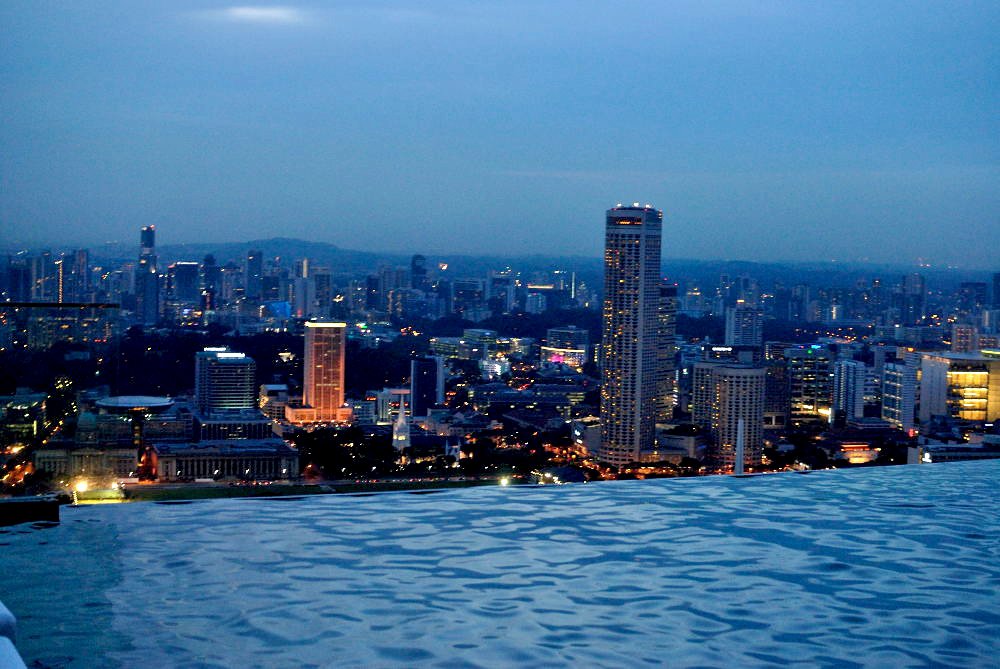
This hotel sounds sort of terrifying with its endless supply of luxury items and services. A hotel, shopping mall, casino, and even museum, it’s a monument to capitalism and aspirational living. I’m curious to see the place as a whole, but the main attraction is the infinity pool. Check out this photo!

over the edge

The infinity pool at Marina Bay Sands

Photo courtesy of Hale Cho.

It looks like you go right over the edge! The pool is totally secured there, but the water runs over it in such a way that it looks like a sheer dropoff, an edge to tumble over and a glittering city to fall into below. I am most definitely going in this pool and taking many heart-stopping photos of me “falling,” because if you can’t cause your parents heart palpitations from thousands of miles away, what kind of daughter are you?

The Southern Ridges
This is some of that unexpected parkland, and it looks delightful. There are all sorts of green spaces here, from meticulously planned gardens to a canopy walk through the tops of trees in the lush tropical forest. There’s also a famous bridge, the Henderson Waves, which gives the appearance of rolling gently through the air from one park to the next.

Look! Up in the air! It's an ocean! It's a bridge! It's... sightseeing!

Photo from http://www.nparks.gov.sg.

You can join guided tours through different parts of the park, learning about all the animals scampering about and the plants practically glowing their green at you. The canopy walk takes you right to a museum. Several different trails take you on different kinds of walks, with differing levels of difficulty. This kind of city/nature integration is a model I’d like Chicago to learn from, for sure.

So! There are a couple places I will definitely visit when I’m in Singapore. I’ve had a couple couchsurfers from Singapore, and I’m hoping I can stay with them each for a couple nights and catch up. In fact, one of my couchsurfers, the lovely Mindy, is a biology genius and a nature guide, so I might be able to snag a personal tour! Work your connections, people.

Running the Numbers: Where to Go

Hello, dearest fellow travelers! Sorry about the unannounced break; there were weddings and BBQs and many delightful things that kept me away, but now I’m back for our regular Tuesday/Thursday schedule. Today I’m introducing a new recurring feature called Running the Numbers. It’s time to get serious about budgeting for this world trip next year (NEXT YEAR JUMP BACK), so I’ll be working out what I can reasonably afford and sharing those insights with you so we can all furrow our brows in a shared nervousness about RTW budgets. Fun times, right? The budget I’m planning to work with is $30,000 over the course of a little under two years.

When I tell people I plan to travel around the world for about two years, the questions usually go: Really? By yourself? Is that safe? How can you afford it? To which I respond, yep, yep, as safe as living in a major American city, and I sure hope so! Since I plan to leave in 15 months, it’s time for me to get serious about that last part, and I’m starting to break down the budget and be judicious in which places I can realistically visit on that budget.

Every single blog written by world travelers contains at least one post on how much money the authors spent on their trip, so there’s a lot of info out there to analyze. I like the breakdowns on this blog and this one, although I do get dispirited when I see that our routes are different enough that they might not make the greatest basis for comparison. In fact, they go to many fewer countries than I had been planning to visit, so I’m starting to seriously considering pruning the itinerary. I don’t want to visit lots of places only to not have enough money to see all I want to see in each.

Currently I say I want to start in Australia and then see a lot of Asia, take the Trans-Siberian, and work my way down to some of Africa, then end in India. Looking at the phenomenal cost of visas ($80 to get into Kenya! $70 to visit India!), carefully plotting a course seems an even better idea.

So now I’m thinking my best course would look something like this:

Australia
New Zealand
Indonesia
Singapore
Thailand
Cambodia
Vietnam
China
Japan
South Korea
Russia
Poland
Hungary
Serbia
Turkey
Israel
Egypt
Morocco
Senegal
Kenya
Zimbabwe
South Africa
India

I’m sad to cut out Scandinavia, but those countries are super expensive and one of the main reasons I’d want to go, the aurora borealis, is never a certain sighting, so it’s smarter to come back another time when I can focus on patiently waiting for the lights to appear. I’m still not totally sure about each of the countries in Africa, because unlike in Asia they are much farther apart from one another and therefore they add quite a bit to transportation costs, but there are specific sights and cultures I want to experience in each of the countries listed, so I’m keeping them on for now.

Don’t forget that the plan is to return to the States after India, spend time with all the loved ones I missed, and save up a bit of money so I can go to Latin America (for those who are about to comment, “how can you not go to Peru/Argentina/Mexico?”).

Right then, dearest fellow travelers, what do you think? You’ll be reading about each of these places for the next several years, so chip in if you think I’m really missing out on a particular spot, or if you’re especially excited to hear about a place listed here.