The Good in People

Just a short post today. I’ve had a rotten time lately with a roommate not paying his rent, a super busy schedule at work, and some painful physical therapy to heal my sprained ankle. It was a rainy weekend and I spent it cleaning. Suffice it to say it’s not been the best of weeks.

But then. But then, dearest fellow travelers! I hosted some couch surfers tonight, and they are lovely. I’d said I could host them about a month ago, but once today actually arrived, I felt exhausted at the thought of being a sociable tour guide. Most Mondays, I write a blog post and watch a lot of TV online. I couldn’t fathom doing anything more tonight. But they got here, and we got to talking, and I made some dinner while we chatted, and we made plans to do the same tomorrow. We looked at the funny-shaped map on my wall and pointed out where we each want to travel next. We talked about our shared interest in publishing, and they told me how in France, you can major in publishing at university, like any other profession. (Neato.)

They spent all day traveling and wanted to call it an early night, so I didn’t even have to put on my party shoes and show them the town. I was able to have the relaxing evening I’d hoped for and still have good conversation and new experiences. They can’t pay the rent my ex-roommate owes or take back the insults I received from clients last week, but I immediately felt at ease with them and happier about the world in general after our dinner. There are too many good people out there to stay stuck on the bad ones, and travel is the perfect way to be reminded of this, as you’ll undoubtedly encounter many more good than bad. In fact, travel is mostly about people, and a good thing too, because all in all, people make the whole endeavor worthwhile.

Book Report: Australia, Part 2

Oh my goodness, an actual post about travel! What’s more, it’s a post about the A Country a Month challenge, which at this point should be named the Country Maybe Every Six Months, Seriously It’s Been Years Since College and I’m Out of Practice on All This Nonfiction Reading challenge.

But now — Australia! Last time, I mentioned the national narrative. Now, most of my historical information is coming from Macintyre’s Concise History, so whatever basic narrative arc he’s giving the country is going to influence how I see it. Also I’m thinking of the various ideas, stereotypes, jokes, random facts, and anecdotes about Australia I’ve heard and read over the years. And maybe I’m not reading enough or thinking critically enough, but my original understanding of the Australian story remains much the same: the white narrative is one of hardships overcome, an unforgiving land tamed, and a hardy people always down for a drink or a trek or both. To be clear, this is not how all Australians actually are, but it is the carefully cultivated national story and image.

There’s a lot to admire in that story — pursuing your dreams, making your own way, and doing it with a cheerfulness and willingness that makes the whole endeavor worthwhile. There’s also a whole lot that needs reexamining or outright condemnation. The narrative doesn’t just forget women and non-whites, it forcibly keeps them out of the history of their own country. The fragile ecosystem of this huge, dry continent has been almost entirely destroyed, and obtaining water is a real concern in an increasing number of communities. Not only did whites steal the land of the people who lived here for 40,000 years before Cook showed up, but they also stole thousands of children in an attempt to steal and destroy Aboriginal culture entirely — The Stolen Generations (for which the federal government has expressed regret, but not apologized). Those same friendly blokes willing to share a pint or five with you at the bar are also pretty likely to go home and hurt their partners — an IVAWS survey in 2003 found that 57% of women surveyed had been physically and/or sexually assaulted in their lifetimes, and 34% of those incidents were in the home (this survey also underreported the experiences of indigenous and non-English speaking women, who statistically experience a higher percentage of assaults than white women).

One of the things I was most surprised to learn about was the White Australia movement. Almost all of the early colonizers were whites, both the convicts and shortly thereafter, the gentry and entrepreneurs who bought up huge tracts of land for sheep grazing and mining (including gold). Clearly, the Aborigines were not white, and many of them did fight for their land or take a small plot to work when shut off into reservations, but from the beginning, they were not granted the rights of citizenship that Britain extended to whites. Other workers were also shut out of not just the national story, but the practical benefits of equal rights and freedom as well, especially the Chinese miners. When times got hard, as they always do, the whites blamed the non-whites, as  they always do (the world over).  Main publications like the Bulletin and eventually official government policy touted the importance of keeping Australia white and safe from foreign invaders. This was devastating on so many fronts — white women were explicitly referred to as breeders of the correct race, non-white women were forcibly sterilized to keep from reproducing, non-white men were denied jobs, and it’s not like this policy actually created more jobs for white men or made it easier to live on the Australian frontier. The White Australia policy had a huge impact on immigration, severely limiting or even outright denying the attempts of non-whites to enter the country. You can imagine how well this played with the Asian Pacific nations that surround the island country. It wasn’t until after World War II that restrictions were eased so the labor pool could be increased, and it wasn’t until freaking 1966 that the policy was mostly dismantled, and 1973 when immigration laws were changed in a meaningful way. No Statue of Liberty here; this was a country founded as a prison, and the bars keep people out as well as in.*

White Australia still holds sway in Australian politics, although of course it goes by different names — the One Nation party, mandatory detention, and an English language and “Australian values” citizenship test. As Kristin mentioned in a comment several months ago, a lot of people want to move to a rich, industrialized nation like Australia, but when they get there, they find seriously racist policies and everyday behaviors. It looks like the conservative Liberal/National parties held power for 11 damaging years, until the 2007 elections. Now the Labor party is in power, although I’m not sure what effect this has had on legislation relating to progressive issues concerning race, gender, class, etc.

White Australia policy today comic

White Australia policy today

One last thing that surprised me about Australia’s history — and pleasantly, too. The labor unions fought bitter, violent battles for years with the business owners, pastoral companies, and mining firms. According to Macintyre, the latter half of the 19th century was really rough, and the unions made some advances only to lose them a short time later. However, in 1907 the Australian Settlement was reached, which established a living wage for working men. It was specifically designed for men supporting families, which of course left out women, who weren’t guaranteed such a decent amount. I’m not sure if it left out non-white men as well, although it wouldn’t surprise me. The basic wage was guaranteed to every working man in the country, and was raised as necessary to keep up with inflation. At first, I was surprised at the long history of wage guarantees in Australia (the earliest minimum wage was introduced in 1824 in Victoria), since it’s a country so proud of hard work and individualism. But this law, combined with the efforts by the Labor Party pre-WWII to create jobs for every man in the country, fits in that picture of hard work and individualism. If you could be pretty sure of getting a job, and certain of a decent wage once you got it, you could work hard at it and really earn that wage. It wasn’t hand-outs, it was earned, was the thinking. Again, things have changed in the last 50 years, but there’s still a decent minimum wage in Australia and an expectation of available jobs. (I don’t know how this expectation squares with immigration, more women in the workplace, etc.)

There’s so much more to learn about Australia, of course, but the point of the A Country a Month challenge is to get a general idea of the country itself, both its history and its current events. I’ve tried to do that in this post, and there may be future posts on Australia. I’m especially interested in learning more about dreamwalking and how Australia’s past intersects with the current trend of Australians abroad.

Finally, please don’t think that all I want to do is find the flaws in a country. Far from it! I learned a lot about Australia that makes me even more excited to go there — the countryside, the cultural aspects, etc. But as I’ve mentioned before, I don’t believe neutralized/neutered travel writing does anyone any favors. I don’t intend this post as pointing fingers and laying blame, or an un-self-aware criticism, but please advise me if it reads like that. I’m still figuring out how to write about other cultures, places, and people without Otherizing them to oblivion or choking on my own sanctimony, but I hope this is a start.

Apologies for the imperfect coherence of this long post, but thanks for reading, and as always, please leave comments and help me keep the conversation going.

*I am perfectly aware that US immigration policies have generally been much more severely restrictive than Lady Liberty would have us remember, and of course we currently have some fucked-up approaches to the whole issue, with Arizona leading the way.
Pretty Awesome Scoundrels

I recently watched a movie about a smart, lying, double-crossing, two-faced woman, and she was not called a bitch. This is such an incredible thing that it merits its own post.

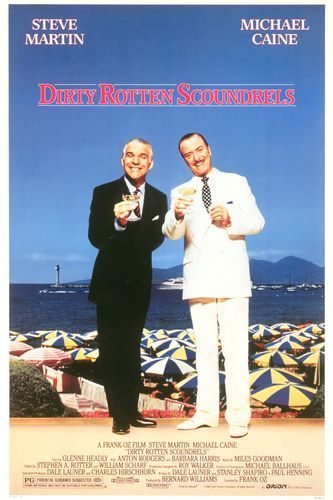
The movie is Dirty Rotten Scoundrels, a Michael Caine/Steve Martin vehicle that plays to each of their strengths perfectly. Michael Caine gets to be a genteel know-it-all, and Steve Martin gets to be an obnoxious loudmouth. They are both con men, although Caine works only among the upper crust and does very well for himself, whereas Martin considers himself well off when he cons a woman out of twenty bucks. The entire movie consists of Caine trying to get Martin out of his small French Riviera town, so he can go back to working it by himself, conning rich women out of their jewels and pocketbooks by pretending to be a prince in need of funds to battle communists in his home country. Hilarity ensues. (No, really, it’s very funny.) The main plot unfolds when they bet that the first one to get $50,000 out of Glenne Headly, an American heiress, wins the rights to stay in Beaumont-sur-Mer, and the loser leaves town.

Dirty Rotten Scoundrels

Hide your valuables, ladies, the charm offensive is on

*SPOILER ALERT* The problem is, the heiress turns out not to be an heiress, but rather a woman who is touring Europe as the winner of a contest for a detergent company. She’s promised both men the $50,000, but has to bankrupt herself in order to get it. Caine turns out to have scruples and calls off the bet. Martin, unsurprisingly, has no scruples and wants to continue the bet, or at least amend it — the first man to bed her wins. Caine shows even more character when he says that he won’t try to woo her himself, but he’ll bet against Martin’s success. *NO REALLY, THIS IS THE FINAL TWIST OF THE FILM* Headly declares herself in love with Martin, and visits his bedroom. Caine hears of this and is ready to admit defeat, but then Headly shows up at his house, crying that Martin took her $50,000 and she has nothing now. Caine gives her $50,000 of his own money and takes her to the airport, where she thrusts the bag of his money back in his hands, declaring she can’t take it and running onto the plane. Only then does Martin appear, screaming that Headly took HIS money, and when Caine opens the bag, he finds instead a note from Headly that reveals she knew their con all along and played them the whole time.

Martin’s reaction: “Of all the lousy… She is disgusting! She is lying, deceitful, two-faced. She is conniving and she is dishonest!” Caine’s response: “Yes. Isn’t she wonderful?”

Now, in just about any other Hollywood film from the last fifty years, Martin’s reaction would’ve included “That bitch!” in there somewhere — we’d need to know that she is not just another player in the game, but that her gender makes her a particularly despicable one. She would not be a worthy opponent with individual skills to assess and combat, but a generic enemy in need of crushing. We would have had lingering shots of her legs and chest throughout the film. We probably would’ve seen her get naked in preparation for sleeping with Martin.

Not only that, but the other women Caine and Martin con would be bimbos, sluts, easy marks not just for being rich and stupid but for being rich and stupid in a gendered way. Instead, they are easy marks because, in Caine’s words, they’re “screened. They’re wealthy and corrupt.” His scams always involve women, yes, and they hinge on the need of these particular women for flattery, romance, and a distraction from the stultifying boredom of extreme wealth. But the scams don’t involve sexual humiliation, or dick-waving bragging afterward, or even stripping the women of all their material wealth. Caine takes a large amount of money, possibly after a mutually satisfying sexual liaison, and then slips away. And when things go badly, say, for example, when he is robbed of $50,000, he does not blame the woman who played him, or call her a bitch for outsmarting him, or plot revenge. No, he calls her wonderful, seeing her as an equal, a great challenger to his title as master con artist of the Riviera.

The movie even ends with Martin put firmly in place. Unlike Caine, he did try to degrade Headly by betting on his ability to conquer her sexually. The I-bet-I-can-screw-her-oh-wait-now-I-love-her-so-I-will-be-honorable-and-at-the-last-minute-not-continue-in-my-lie-and-take-her-clothes-off-but-it’s-cool-because-that-one-moment-of-restraint-is-enough-to-convince-her-of-my-love-so-she’ll-totally-screw-me-later-so-the-moral-of-the-story-is-I-get-laid-either-way trope is so tired, and it was refreshing to see it turned inside out here. Not only does Martin not get with Headly, and not only does she not fall in love with him, but she steals his money and leaves him naked in a hotel room. And at the end of the film, when she returns to the two men to pull them into working a con with her, she introduces Caine by name and has him talk as an integral part of the con, but then introduces Martin — “he’s a mute.” Caine was going to dupe her out of her money but not her dignity. Martin was going for whatever he could get, and what he got was shut the hell up. Fantastic.

The remarkable thing about Headly’s deception is that the movie is clear that she does this not because all women are evil, or cold-hearted, or only in it for the money, but because she is the same creature as these men, a brilliant liar who lives for the con. I don’t know how you feel about movies based on crooks swindling hard-earned money out of honest folks, but I love them. Con movies — Trouble in Paradise, The Sting, etc. — are delightful works of sparkling wit, fine-tuned plot, and great reaction shots. Morals shmorals, give me Paul Newman’s nose-scratching signal any day. This is one of the few films I know of that is so devoted to the wonder of the con that it lets women play too. And that’s pretty awesome.

Your Spring Mix 2010

Greetings, dearest fellow travelers! It’s Just- spring, the trees are in bud, the ground’s squelching into mud, and the goat man’s afoot. Time for some tunes! Here’s your Spring Mix 2010. Guaranteed to have you warbling like the robins in the trees as you bounce down the street with daffodils in your hands and a grin on your face.

If you sign into Lala, you’ll be able to play the music and see how you like it (sorry, I can’t embed the playlist here; WordPress doesn’t support it): http://www.lala.com/#playlist/5493P107114

Spring in Your Step 2010

Warmer—Beulah
Laura—Girls
I Can’t See Nobody—Nina Simone
Be My Baby—Ronettes
Never Forget You—Noisettes
Love Me Til the Sun Shines—The Kinks
Two Weeks—Grizzly Bear
Louie—Ida Maria
Wanderlust King—Gogol Bordello
Holiday—Vampire Weekend
When Water Comes to Life—Cloud Cult
Ambling Alp—Yeasayer
Blue Sky—Joan Baez
Town Called Malice—The Jam
1901—Phoenix
We Came to Dance—The Gaslight Anthem
Searching for the Ghost—Heartless Bastards
I Wish, I Wish—Cat Stevens

Bonus: A (NSFW if your work is against nonsexual nudity) video for Yeasayer’s “Ambling Alp”: