Travel as Exploitation, or Whatever

Oh the hilarity! I mean, also sad, because I have definitely met far too many travelers whose inner monologue is probably shockingly close to this little satirical piece (without that hard-hitting bit at the end). And I have to watch myself closely to not go too far into this territory, too. But mostly it’s hilarious. Check it out:

“When I reached the end of the alley I saw this really elderly and impoverished Guatemalan woman, with like, missing teeth weaving brightly colored cloths on this big weaving apparatus. And I stopped, for like a whole three minutes and we exchanged a really long glance. I felt like I could see into her soul. I took some photos of her, like, without asking. I remember how pleased I felt, that I actually found something in that alley entirely mine. Like, I owned it or something.”

When we travel, what are we learning, what are we taking, and what right have we to do any of it? Those are the questions I hope we’re grappling with in this here blog.

Note: No need to be familiar with My So-Called Life for this to be entertaining. The author’s writing in the style of a 16-year-old TV character from the early ’90s, but that’s just icing if you know the show. (Which honestly, I don’t; I think I’ve seen one and a half episodes, and it was in this past year, so I missed out on the part where I strongly identify with Angela and draw parallels between her life and mine.)

Sex on the Road

Nerve.com had a feature up this week asking travelers about their love and sex lives. (This being Nerve, you might not want to click through if your office has filters up, and you might not want to read on if you don’t want to read about my views on sex while traveling.) It’s a quick round-up of questions they asked a few people at a bar in Colombia, but I think it’s a pretty accurate slice of the average backpacking population. (ETA: I realize they’re asked very leading questions in the vein of “make your travel sound as sexy and illicit as possible,” but still, you can choose how to answer those.)

If I knew how to Photoshop, I'd put some suggestive silhouette on here to show you what the Sexy UN looks like.

The main themes seem to be:

1) Travel is better when you’re single because you can get laid more.

2) In fact, even when you’re dating someone while traveling, be quick to emphasize just how complicated and non-serious the situation is lest you feel too tied down.

3) Indulge yourself in broad generalizations about the sexual proclivities and romantic tendencies of different ethnicities.

I can really only sign off on #1, and that only if you’re not traveling with your partner. If you’re traveling with your partner, that’s a whole different kind of fun travel.

#2 just makes it sound like backpacking is the ultimate refuge of commitment-phobes, and #3 is not only inaccurate but gross.

I’ve certainly met plenty such travelers on the road, people who consider themselves ambassadors to the sexual United Nations. They use much the same checklist for their dicks as they do for their backpacks; has it been inside as many countries as possible?

And yeah, I just generalized them to be guys. There are women out there with a similar attitude, but overwhelmingly it’s dudes doing this kind of sexual tourism. Even in that Nerve interview, the woman who says she prefers to be single talks about being happy with oneself and enjoying sexual partners as they come along, not as notches on a mobile bedpost.

I think it all ties back into your general approach to travel. If you see travel as a way to meet exotic peoples with strange customs in foreign lands, you’re going to fetishize your sexual experiences with those people as times when you touched the Other. If you see travel as a way to integrate yourself into foreign cultures and look with disdain on those who stayed home, unenlightened about the wide world that you’ve just discovered, you’re going to fetishize your sexual experiences with people in the foreign culture as proof that you’re a citizen of the world to whom no label can be affixed.

If, however, you see travel as a way to meet people on their own terms, in their own lands, in their own time, as fellow travelers in the world, you’re more likely to have sexual experiences with real people rather than stereotypes and personal checklists.

Photo from here.

An Australian Tradition: Welcome to Country

Hello dearest fellow travelers! This week I saw a cool blog post that ties into my travels. Check out this post at Feministe, which explains the Australian Aboriginal tradition of the “welcome to country.” Here’s an excerpt from that post, explaining the concept:

The Welcome to Country and Acknowledgement of Country are protocols performed in Australia to (allegedly) indicate respect for Aboriginal history and culture, as well as to indicate respect for Aboriginal people who may be attending the event. A Welcome can be performed by a local Aboriginal elder, and represents the traditional owners of a place giving their blessing to an event and welcoming the guests onto their lands. A Welcome is one of the many services that local Aboriginal Lands Councils offer for a small fee, although Welcomes do not have to be performed by Lands Councils.

text for welcome to country in Australia

An example of a "Welcome to Country"

What a wonderful way to acknowledge the complex history of a conquered and colonized country. The tradition goes way back, when an Aboriginal group traveling to another group’s land would be formally welcomed by that group before any other business was attended to. In the last century, it also became a way for non-Indigenous people to show their respect when starting an event or ceremony.

As Hexy explains in the post and Australians write in the comments, sometimes the Welcome or Acknowledgment is done as a rote part of a ceremony, with no sincerity, which obviously misses the point of doing it. But the general idea of saying these words is still good, taking time out to specifically acknowledge and appreciate people who have endured horrifying attacks on their lives and culture. Here in the United States, if this were something we did, it would also be an important way to emphasize that it’s not like Native Americans disappeared, after white people killed them all in a tragic, romanticized West (which is a disturbingly popular view), since the Welcome explicitly welcomes Indigenous folks who may be present.

Of course Australia and the United States do not have the same history, and the indigenous peoples of both lands are very different, but there is a similarity in the way white colonizers treated them brutally, attempted to eradicate them, and now consider them an embarrassing aberration in the national history of white people’s dominance. Making even cursory attempts to acknowledge that bloody history is more than we do here, and it’s something I think would make us a better country. I am not aware of a Native American tradition of such a Welcome or Acknowledgment, and it’s not like you can just slot in one cultural tradition for another, so I don’t see this happening in the States any time soon.

But I’ll be sure to keep a sharp eye out when I’m in Australia to see which communities perform the Welcome/Acknowledgment at their events and ceremonies. I marvel at the wide world of the Internet–here’s a custom that didn’t show up in my ACAM research but is so fascinating!

Abandoned Cities, Tourist Hotspots

Well, I don’t know about hotspots, per se, but this Salon slideshow of “the world’s most beautiful wastelands” makes a compelling argument for why travelers and adventurers might enjoy scrambling over eroded walls and darting across dusty plazas. These places all used to mean a lot to the people who lived in them, and now they’re crumbling into nothingness. They served different functions but now just take up space. They’re a visual reminder of our transience, a melancholy ode to human achievement and fragility. Like stumbling across Atlantis on land.

photo from Salon.com

The splendor of days gone by in Detroit

Photo by Albert Duce, from http://www.salon.com/life/feature/2011/07/10/trazzler_slideshow_beautiful_wastelands/slideshow.html

ACAM: Singapore — Where to Go, Part 2

Hello dearest fellow travelers! Last month I took a look at some of the things to do and places to go in Singapore, and got some great suggestions for further ideas both here and on Facebook. (By the way, did you know that you can now use your FB login to leave a comment in the field below, so you don’t have to go through a login process every time you want to comment? Neat!) Here I list a few more sites and attractions I’m interested in checking out when I visit Singapore.

Singapore Zoo

Several people recommended visiting the zoo in Singapore, and taking a look around their website, I can see why. The zoo has a huge range of ecosystems to explore, and it’s affiliated with other wildlife parks like the Jurong Bird Park and the Night Safari (they’re all owned by one large company). Sure, it’s corporate, but the parks are designated rescue centers for injured and at-risk wildlife, and they have breeding programs for endangered species. They also seem to have a large educational component that encourages a lot of visitor interaction, which sounds more interesting than a lot of zoos that stick to a few signs next to an animal’s cage. Also, it is in a rainforest! I’ve only ever seen rainforest animals in Midwestern climes, and I’m sure it’ll be different to see them in a place that’s naturally what they’re used to, rather than a reconstruction.

Welcome to the Jungle

Photo from http://www.asiaexplorers.com/singapore/singapore-zoo.htm

Delicious Dining Options

Everyone who has been to Singapore or knows someone who has been to Singapore has immediately mentioned the food. Oh, the food! So many dishes I’ve never heard of, like chili crab, barbequed stingray, and bak kuh teh. The blog GastroNOMmy has a wonderful list of food for first-time visitors to the city, including specific restaurants to go to when you’re there. The city is known to be a foodie’s paradise, and I can’t wait to taste just what that means.

Pulau Semakau

My friend Mindy suggested I visit this place. It’s a fascinating study in environmental care and waste management. Pulau Semakau started out as a small island and is now a gigantic garbage dump. Unlike most city dumps, however, this one serves as a multipurpose site; on top of the garbage dump rests an island of green space, mangrove plots, and trailways for walking. Since it’s essentially a pile of garbage tossed right on top of the water, engineers were careful to put screens and filters in place to keep the garbage from seeping into the water, and so far it has been successful (the island was built in 1999). However, as this article points out, most of the garbage is incinerated before being transported to the dump, and that process isn’t entirely environmentally friendly, so the cost/benefit analysis is still uncertain. I’d like to see the island and take a tour to find out more about how sustainable a model this is for other cities.

Running the Numbers: How to Save for a World Trip

The title of this post is a little misleading, since this is less a top ten list of ways to cut down on costs and ramp up saving (there are tons of those out there), and more of a question about how much of that is good to do and how much is too much. Can I save up for a round-the-world trip while still enjoying my life here in Chicago, or do I need to radically alter my lifestyle?

counting my pennies

Photo from http://igotmompower.com/2011/06/pennies-from-heaven/

I’ve been planning to go on a round-the-world trip for several years now, and I’ve been putting money aside that whole time, but the amount has varied over the years. I’ve never had a special account for it; I just designate my savings account as the place I save for the trip. It’s a little scary how very basic my financial situation is (no stocks or bonds, a 401(k) with like a grand in it), and that 30 Rock episode a few seasons ago, in which Liz’s nearly identical financial situation is roundly mocked, hit a little close to home. Part of that lack of funds is because I worked in publishing for a couple years, and as anyone who ever copy edited can tell you, you lose money doing that in the first few years. So it wasn’t until recently that I was able to put aside a set amount each month, which really ramped up the saving.

I’ve worked the math a few times, and so long as my employment situation stays steady and major disasters are kept at bay (knock on wood), I should be able to make my goal of $30,000 next August, and then I’ll be off. I’m proud of my ability to save more than I made at my first office job, but on the other hand, I don’t have any dependents, I live in a pretty affordable part of town, and I’ve been supposedly saving for years. Couldn’t I have saved more, faster? Where did it all go?

The answer is: it all went into my life. I’ve been spending my money on enjoying my time here in Chicago, and that has slowed down the saving noticeably. I’ve gone back and forth on whether this is the right way to do it, and usually I think it is. Several years ago, at the end of college, my then-boyfriend and I were considering taking this trip together, and we argued over how to go about it. I wanted to hoard all our pennies as quickly as possible, so we could be on the road right away. He wanted to explore the city we’d be moving to and have enough money to enjoy it fully. He didn’t want to have to miss hanging out with friends because they were going to a bar and we’d only budgeted two beers each that month. What’s the point in saving for fun if it means not having any in the meantime?

Now I think he was mostly right. I should have been saving more aggressively in the last couple years, when my salary got to a comfortable, reliable point, but otherwise I don’t have regrets about the way I’ve been going about it. I like being able to go out with friends and occasionally buy a round, or pick up the check on a dinner with a friend who’s a little cash poor at the moment. I think this kind of relative openness with money is healthy for friendships, much better than everyone counting out their share to the decimal and holding grudges against those who deviate. (Of course, it’s a different story when people between jobs or in a different economic stratum are in the mix, in which case common sense and compassion should reign.)

I also think a general kind of karma is involved. When I was a broke 18-year-old in Berlin, two Australians bought me a drink in a cafe and we spent the afternoon chatting about our travels. I offered to pay my share, but they were several years older, on a break from good-paying jobs, and they cheerfully waved my money aside. All they required was that I pass the favor on later in my travels, when I was in a position to do the same for someone else. A simple pay it forward concept, sure, but that doesn’t make it less important, and why shouldn’t it apply in our daily lives as well as our more exotic travels? Not that I walk around peeling twenties off a giant roll I keep in my pocket, and it’s not that I’m doing any better financially than most of my friends and acquaintances, but it is a conscious choice about how to spend what I have at my disposal.

After all, generosity doesn’t save nearly so well as money, so sometimes you have to spend a little of both and trust that it’ll balance in the end.

How I Nearly Blew Off a Cliff in Ireland But Lived to Tell the Tale

Today was a wet and blustery day in Chicago, and as I did a duck-and-weave through the raindrops on my way home from work, I found that I wasn’t irritated at the rain. In fact, I was feeling pretty good, thanks in no small part to the outpouring of goodwill I’ve received since I yelled to the world that the International Business Times had reprinted my post from Tuesday. But if I tried to tell you the last time I felt this giddy in a rainstorm, it’d probably be January 2004, when I was almost blown off a cliff and swept out to sea in Ireland.

a sheer, exhilarating drop from the Aran Islands into the Atlantic below

Image from http://www.travelpod.com/photos/0/Ireland/Aran%20Islands.html

I’d finished my study abroad program in Rome and was visiting friends living in other European countries easily accessible by Ryanair. It so happened that one of my good friends from high school, Miranda, was abroad at the same time, so we decided to meet up in Dublin, take a bus across the country to Galway, and return after visiting the Aran Islands. This is, in fact, what we did, only slightly derailed by the part where the winds tried to destroy us.

The Aran Islands, on the west coast of Ireland, had been described to me as the most Irish part of Ireland. I’m not sure exactly what that was supposed to mean, but I gathered it meant strikingly beautiful landscapes, quaint towns, and locals speaking the mother tongue. This is pretty much the case, although everyone speaks English as well as Irish, especially since tourism is the main industry there now.

The main tourist attractions of the islands are the ruins of stone forts such as Dún Aengus (or Aonghasa), which were probably built in the 2nd century BCE. It’s unclear whether they were entirely defensive forts, or if they also held religious or commercial value, positioned as they are with a view of a large part of the coast and therefore a good look at trading vessels coming and going. In later centuries, many structures on the islands were made over to monasteries, and farming on the shallow, rocky soil remained the main occupation until very recently, when tourism became big industry.

Miranda and I took the ferry over to Inishmore from Galway and picked up a map at a small shop we got a bit of food at. Keep in mind that this was late January, not exactly the height of tourist season, so there were very few other people around, and we considered ourselves lucky for having the island mostly to ourselves. Armed with the basic trail map and our cameras, we headed off to find one of the ruined forts, Dún Dúchatair (the Black Fort), and soon we really did have the place to ourselves, aside from a few grazing cows. We were walking on a basic kind of trail, which often seemed to devolve into just a field for a space, and the wind was picking up something fierce, but we had our destination in our sights, so we pressed on.

The Black Fort -- see how much rock was all around, too? (obvs this is a postcard; I was not blown so high off the cliff that I was able to take an aerial shot)

The rocks were everywhere, stacked to form low walls marking off small plots of land, and when they weren’t stacked in an orderly pile, they were underfoot, tripping us up. We had to tread carefully, but the sky was expansive and the island a lovely mixture of green-brown grass and slate-gray rock, and we were inordinately proud of ourselves for taking ourselves on tour rather than signing up for a guided one. We reached the fort, perched on the edge of a cliff, and it was worth the trip. The Black Fort itself was an orderly collection of rocks, small walls shaped into overlapping horseshoes, which were themselves shaped like halves of concentric circles rippling out from a stone being dropped in water. It wasn’t hard to imagine that stone being a chunk of island, either, since the center was almost at the edge of the cliff, and that cliff dropped off sharply and steeply.

We’d been scrambling over the fort for a bit, but now we needed to see the ocean, and not from far away, either. No, we needed to get real close and personal. We walked right up to the edge (there are no railings here, you litigious Americans) and leaned over, not far enough to fall in, but just far enough to feel adventurous. But whoops, the wind was still quite strong, and I found myself pulled closer to that edge than I liked. I was an arrogant 20-year-old, convinced of my travel savvy and basic immortality, but I was also a little scared of heights and a lot clumsy; the possibility of me plunging over the edge into the (beautiful, deeply blue, whitecapped) sea was now far too real. I lurched backward and stumbled over to a more stable location, like one of the handily ubiquitous gray rocks, to catch my breath.

At this point, it became clear that the fierce wind was not just a consequence of being so close to the ocean; rain was starting to fall from the sky, and it was coming down fast. Miranda and I turned around and headed back, but we found ourselves a bit lost. Our map suddenly wasn’t so helpful in the torrential downpour, and anyway the wind was doing its best to tear it from our hands. We leaned into each other, and into Miranda’s umbrella, and did what we could to follow the right set of squiggly rock walls down to the village.

Now at this point in most travel stories, I’d share with you that things were tense. After all, despite the Gulf Stream current that keeps the western Irish coast unusually warm, this was still January, and we were dressed in our winter coats and gloves, and this was a small gale bearing down on us. We weren’t sure where we were, the only living creatures we could see were cows sensibly huddling together, and I’ll wager we were both hungry and in need of a bathroom. But all I remember is enjoying every minute of it. Miranda and I both saw the absurdity of our situation and decided that rather than grumble or despair, we’d laugh. Far the better option. Talking in the storm was difficult, so we’d just walk a little, turn to each other and raise our shoulders exaggeratedly, shake our heads like “what’re you gonna do?” and laugh, then repeat.

Utterly given over to the storm and enjoying ourselves enormously

Eventually we did make it down out of the fields and rocks, and we found ourselves on the edge of the road. It didn’t take too long for a car to slow down, and a middle-aged man rolled down the window and offered us a ride into the village. We hesitated for a moment (young women, strangers, foreign country), but we quickly realized that he was just being nice, and was probably genuinely worried for us, since we looked like two barely resuscitated near-drowning victims. We got cheap, hot drinks at the same store we’d left so confidently a few hours before, shivered ourselves slightly warmer, and congratulated ourselves on being badasses. I don’t remember anything about the ferry back to Galway or the bus back to Dublin, but I clearly remember the wind whipping my hair into my face, the rain turning the gray rock a slick black, Miranda shouting with laughter, and a sense of wild freedom.

Once I was safely twenty paces back from the cliff, of course.

ACAM: Singapore — Where to Go, Part 1

Thanks for all the fantastic suggestions on the last couple of posts, dearest fellow travelers! It feels good to have the main outline of the trip more clearly sketched out. I believe we left off ACAM in Indonesia, which means that now we turn to the city-state of Singapore.

Every time I look at a map of the world, I see the tiny dot of Singapore on the tip of Southeast Asia and assume it’s a small city perched at the end of Malaysia. In fact, it actually consists of 63 islands, and it’s not a small city, it’s rather large. It’s true that most of it consists of city, but there’s a surprisingly large swath of public park land to explore as well. An old friend recently visited Singapore, and the pictures of his trip make me even more excited to go there and see what else about it will surprise me.

Marina Bay Sands
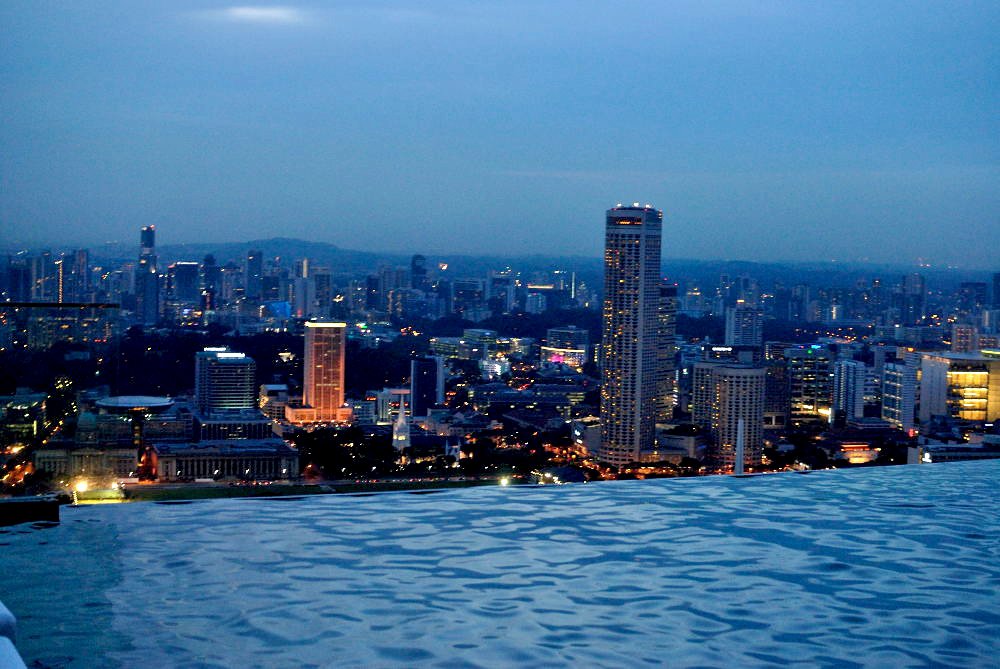
This hotel sounds sort of terrifying with its endless supply of luxury items and services. A hotel, shopping mall, casino, and even museum, it’s a monument to capitalism and aspirational living. I’m curious to see the place as a whole, but the main attraction is the infinity pool. Check out this photo!

over the edge

The infinity pool at Marina Bay Sands

Photo courtesy of Hale Cho.

It looks like you go right over the edge! The pool is totally secured there, but the water runs over it in such a way that it looks like a sheer dropoff, an edge to tumble over and a glittering city to fall into below. I am most definitely going in this pool and taking many heart-stopping photos of me “falling,” because if you can’t cause your parents heart palpitations from thousands of miles away, what kind of daughter are you?

The Southern Ridges
This is some of that unexpected parkland, and it looks delightful. There are all sorts of green spaces here, from meticulously planned gardens to a canopy walk through the tops of trees in the lush tropical forest. There’s also a famous bridge, the Henderson Waves, which gives the appearance of rolling gently through the air from one park to the next.

Look! Up in the air! It's an ocean! It's a bridge! It's... sightseeing!

Photo from http://www.nparks.gov.sg.

You can join guided tours through different parts of the park, learning about all the animals scampering about and the plants practically glowing their green at you. The canopy walk takes you right to a museum. Several different trails take you on different kinds of walks, with differing levels of difficulty. This kind of city/nature integration is a model I’d like Chicago to learn from, for sure.

So! There are a couple places I will definitely visit when I’m in Singapore. I’ve had a couple couchsurfers from Singapore, and I’m hoping I can stay with them each for a couple nights and catch up. In fact, one of my couchsurfers, the lovely Mindy, is a biology genius and a nature guide, so I might be able to snag a personal tour! Work your connections, people.

Running the Numbers: Where to Go

Hello, dearest fellow travelers! Sorry about the unannounced break; there were weddings and BBQs and many delightful things that kept me away, but now I’m back for our regular Tuesday/Thursday schedule. Today I’m introducing a new recurring feature called Running the Numbers. It’s time to get serious about budgeting for this world trip next year (NEXT YEAR JUMP BACK), so I’ll be working out what I can reasonably afford and sharing those insights with you so we can all furrow our brows in a shared nervousness about RTW budgets. Fun times, right? The budget I’m planning to work with is $30,000 over the course of a little under two years.

When I tell people I plan to travel around the world for about two years, the questions usually go: Really? By yourself? Is that safe? How can you afford it? To which I respond, yep, yep, as safe as living in a major American city, and I sure hope so! Since I plan to leave in 15 months, it’s time for me to get serious about that last part, and I’m starting to break down the budget and be judicious in which places I can realistically visit on that budget.

Every single blog written by world travelers contains at least one post on how much money the authors spent on their trip, so there’s a lot of info out there to analyze. I like the breakdowns on this blog and this one, although I do get dispirited when I see that our routes are different enough that they might not make the greatest basis for comparison. In fact, they go to many fewer countries than I had been planning to visit, so I’m starting to seriously considering pruning the itinerary. I don’t want to visit lots of places only to not have enough money to see all I want to see in each.

Currently I say I want to start in Australia and then see a lot of Asia, take the Trans-Siberian, and work my way down to some of Africa, then end in India. Looking at the phenomenal cost of visas ($80 to get into Kenya! $70 to visit India!), carefully plotting a course seems an even better idea.

So now I’m thinking my best course would look something like this:

Australia
New Zealand
Indonesia
Singapore
Thailand
Cambodia
Vietnam
China
Japan
South Korea
Russia
Poland
Hungary
Serbia
Turkey
Israel
Egypt
Morocco
Senegal
Kenya
Zimbabwe
South Africa
India

I’m sad to cut out Scandinavia, but those countries are super expensive and one of the main reasons I’d want to go, the aurora borealis, is never a certain sighting, so it’s smarter to come back another time when I can focus on patiently waiting for the lights to appear. I’m still not totally sure about each of the countries in Africa, because unlike in Asia they are much farther apart from one another and therefore they add quite a bit to transportation costs, but there are specific sights and cultures I want to experience in each of the countries listed, so I’m keeping them on for now.

Don’t forget that the plan is to return to the States after India, spend time with all the loved ones I missed, and save up a bit of money so I can go to Latin America (for those who are about to comment, “how can you not go to Peru/Argentina/Mexico?”).

Right then, dearest fellow travelers, what do you think? You’ll be reading about each of these places for the next several years, so chip in if you think I’m really missing out on a particular spot, or if you’re especially excited to hear about a place listed here.

Destination: Brooklyn

New York City. It’s one of the capitals of the world, a city teeming with sights to see, performances to take in, restaurants to savor. Of course, when we think of all the wonders of New York, we think of Manhattan. While there are certainly many years’ worth of things to see and do there, other boroughs have their own, less frenetic, charm. Since my sister lives in Brooklyn, I’ve spent a good portion of my two New York trips there, and I’m here to tell you it’s easy to make a whole visit out of Brooklyn alone. Here are some ideas:

This slideshow requires JavaScript.

Prospect Park

Saturday was the first nice day in a long time, and we went for a walk in Prospect Park, which stretches along over twenty city blocks, topped by a giant statue in Grand Army Plaza. The whole park was full of kids and their families playing catch, flying kites, and riding scooters all over, and we strolled along past cyclists and joggers on our way to the farmer’s market. A perfect afternoon!

Cocoa Bar

I whiled away an hour or two at this Park Slope café, drinking a tasty hot chocolate and eating a divine piece of cake called Death by Chocolate. It involved cake, pudding, AND mousse, and no, I did not perish (but I didn’t finish it either). They have a garden backed by a colorful mural, which makes it even more appealing in warmer times.

Park Slope Food Coop

(No, I’m not sure why they don’t hyphenate.) One of the most established co-ops in the country, this place is highly organized. You can’t shop there unless you’re a member, you can only visit if you sign in and wear a visitor’s badge, and if you’re a member, you have to work at least one shift a month or find yourself no longer allowed to shop there because you aren’t contributing your part. The rules make sense for a small place that has over 14,000 members, but it is a bit daunting. Pro tip: don’t go at 5pm on a Sunday. It’s a little scarring. But! The food is cheap, and so much of it is local and organic, and it sure does beat giving your money to a giant conglomerate. Plus, just this week they were raffling off a classic Schwinn, so, y’know, hipster cred is always maintained. So find a friend who’s a member and head on in.

Brooklyn Bridge and Original Brooklyn Ice Cream Factory

Back when I visited during the summer, Emily took me to Brooklyn Heights, where we had delicious ice cream at the Original Brooklyn Ice Cream Factory while strolling along the pier right under this giant bridge that I hear is being sold for a really good price. (Aw, poor NYC, maybe we shouldn’t make Brooklyn Bridge jokes when their mayor is renaming other bridges nearby.)

Coney Island

Just take the F train all the way to the end of the line and ta da! You’re at the beach, complete with an old-timey carnival and boardwalk. When my flight was delayed on my summer visit, I spent a couple hours sunning in the sand, eating a hot dog, and peeking at the Ferris wheel at Coney Island. This place was a resort destination as early as the 1830s, back when it was still an island and landfills hadn’t connected it to the mainland. Nowadays it’s a bit run-down, but you can still buy an ice cream, a useless souvenir, and an amusement park ride ticket for under $20, so what else could you ask for?

Outpost

Outpost seems to be one of those places that can be a little bit of everything for everybody–café, bar, restaurant, gallery, performance spot. When I visited during Gay Pride Weekend in ’09, a queer party group called Banned threw a delightful fête here with cupcakes, dance music, and burlesque performers who stood on tabletops and set their tassels on fire. It was pretty exciting. Also, there is a charming garden in the back with cozy seating to share a beer or three with your friends.

Park Slope shops

This neighborhood has a well-deserved reputation for being full of yuppie parents steamrolling over the sidewalks with their giant strollers, but as long as you stay nimble and avoid getting run over, there are a lot of neat shops to see. Emily and I walked along 7th Ave and poked our heads in many independent stores, places built up by locals and supported by the same. I think after a few hours I’d find it all a bit precious, but until then, the many stationery, framing, book, jewelry, and boutique pet stores are a fun way to while away an afternoon.

Re/Dress

Emily found out about Re/Dress through a friend and knew it would becomeo an immediate favorite of mine. It’s a used and vintage store for women sizes 14 and up, and unlike most thrift stores, it’s huge. (Puns!) The staff is friendly and affirmative, the décor is zany and bright, and the clothes are affordable and good quality. Emily found me the perfect LBD there, and I stocked up on summer dresses in ’09 that get me compliments every time I wear them. Highly recommended if you’re in the size range and in the neighborhood (which I think is Brooklyn Heights?).

I know there’s much, much more to see, but next time I visit Brooklyn I’m sure I’ll have even more suggestions to bring back for y’all. In the meantime, enjoy!