Helpful Advice When Someone You Know Is Robbed

Things Not to Say to Someone Who Has Just Been the Victim of a Nonviolent Robbery (all true things I heard within hours of having my purse snatched in Peru)

“You really have to be careful with your things.”

“So you were just sitting there writing? He didn’t hold a knife to you or anything? How did you not notice?”

“You know the police aren’t going to do anything, right?”

“They’re only material items.”

“Oh, you’ll be upset for a couple days, but after that you’ll feel so free and unburdened by the things of this world.”
Note that it is particularly vile to pontificate thusly while holding an iPhone 5.


The One Truly Helpful Thing to Say to Someone Who Has Just Been the Victim of a Nonviolent Robbery

“That’s terrible. I’m so sorry! Can I buy you a drink?”

ACAM: What to Do in China

China is a giant country, and I could easily spend my entire trip exploring its large cities and rural villages. But I’ll probably have more like six weeks to spend there, and I want to spend that time well. Here are some ideas to start me off–do you have any other suggestions?

Dissonance

The Forbidden City, Beijing
Foreign visitors to Beijing always make it to at least the Forbidden City and the Great Wall, and for good reason. The vast complex that is the Forbidden City is impressive for its scale alone, not to mention the imposing architecture, the royal treasury, and the centuries of history seeping through the walls. Just seeing a giant portrait of Communist crusader Mao gracing the southern entrance of a formerly imperial residence should be enough to set my head spinning.

No, you can’t actually see it from space with the naked eye, but it’s still plenty impressive.

The Great Wall
I’m not sure what there is to say about the Great Wall of China that hasn’t already been said. It’s a giant, mostly failed border policy built and added to over centuries of rule by various dynasties. It’s a testament to human perseverance and a monument to the thousands of laborers who died working on it. It’s falling apart in some places and extensively restored in others. It’s a glorious thing to see and climb, and I can’t wait.

Colonial architecture meets night lights

The Bund, Shanghai
I’d never heard of The Bund until I started ACAM research on China. Apparently, “bund” means “embankment” and in this case, it’s a stretch along the Huangpu River in Shanghai of various colonial buildings. These buildings housed the major banks of the country, as well as hotels for visiting dignitaries and financial folks. I’m not sure why the buildings weren’t razed during the fervor of Mao’s reign, but they remain and in the last thirty years they were renovated and put to use for government departments and pricy hotels. It looks like a nice place for a walk.

Arty design for an art museum

Shanghai Museum
This art museum has eleven galleries, one for each material or medium (jade, calligraphy, sculpture, etc.). Eleven galleries of ancient art! And apparently, if I get there early, I can get one of the free tickets they pass out every day. Cultural nerdy paradise.

Image 1. Image 2. Image 3. Image 4.

Hometown Tourist: Chicago Cultural Center

What’s that saying about the hidden gem of a city? I’ve found Chicago’s, and when I say “gem” I mean “it looks like a beautiful jewelbox on the inside.” The Chicago Cultural Center is a neoclassical building running the length of a city block on Michigan Avenue. Even though it’s across the street from Millennium Park, I’d never heard of it before a few of my friends went on a tour and urged me to visit. What an odd and lovely building it is.

Chicago Cultural Center

You start out at the Randolph Street entrance and the tour works its way up and across the building until you’re at the Washington Street entrance. We had a wonderful guide, a lifelong Chicagoan who used to come to the Reading Room back when the building was still the city library. She knew everything there was to know, and editorialized subtly enough that you could miss it if you were so inclined, or hear her little digs at Daley’s 1989 plan to turn the building into a mall and such.

Recessed ceilings, as the Romans did

Apparently, after the Great Fire of 1871, Queen Victoria helpfully sent over thousands of book to replenish the city’s library–except Chicago had never had a library to replenish. So a library board was formed, and after fighting over the land with the city and then with Civil War veterans who wanted that land for a museum, they finally agreed to share for awhile, and went over budget to finish building it in twice the allotted time. Chicago!

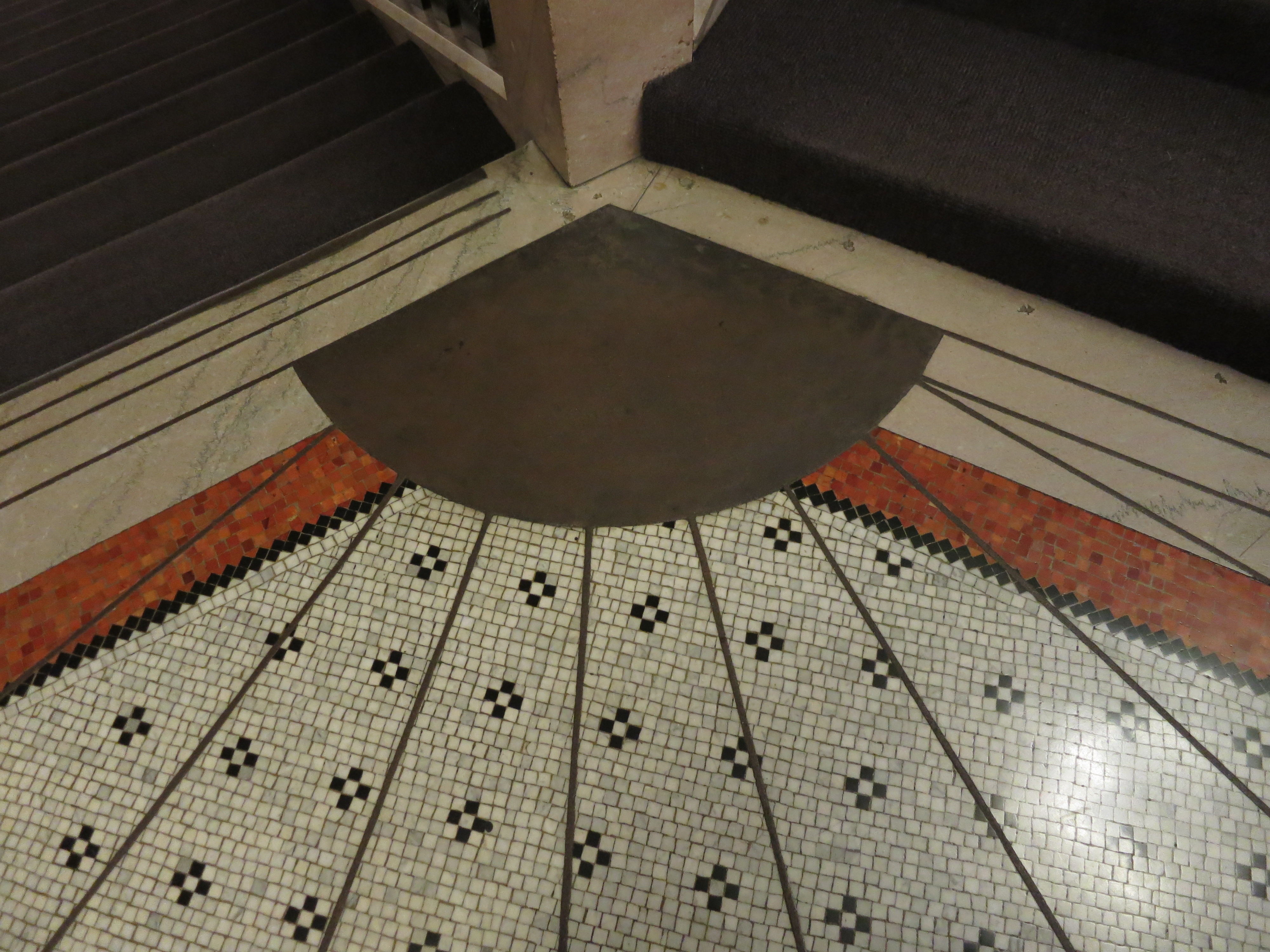
Sunburst on the stairs

Even when it was finished, it was an unusual thing. You can only go from one part of the building to another on the first and fourth floors, one side of the building has a fifth floor and one doesn’t, and the second floor isn’t even the same height all the way across the building. You’d never know this from looking at the building’s facade, and I’m still not clear on why it ended up this way, but it’s quite an adventure walking around inside. A guide definitely came in handy.
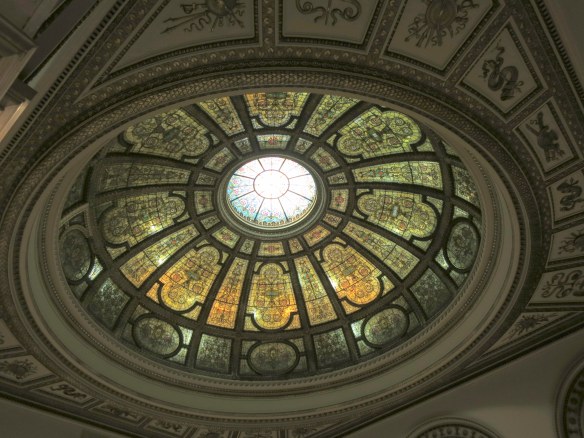
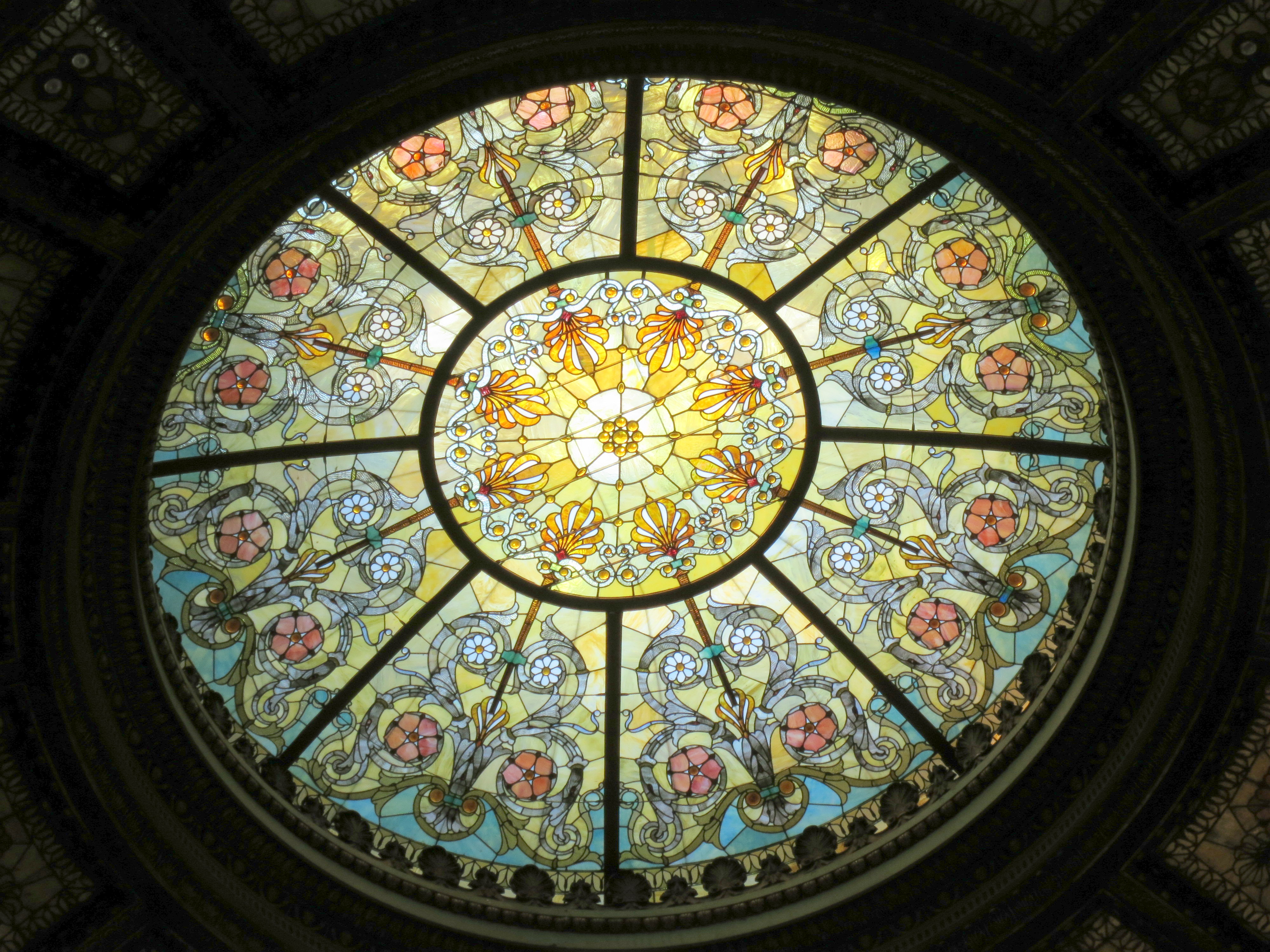
The dome in the Grand Army of the Republic Hall — they covered it up to protect it form the weather and it muted the colors.

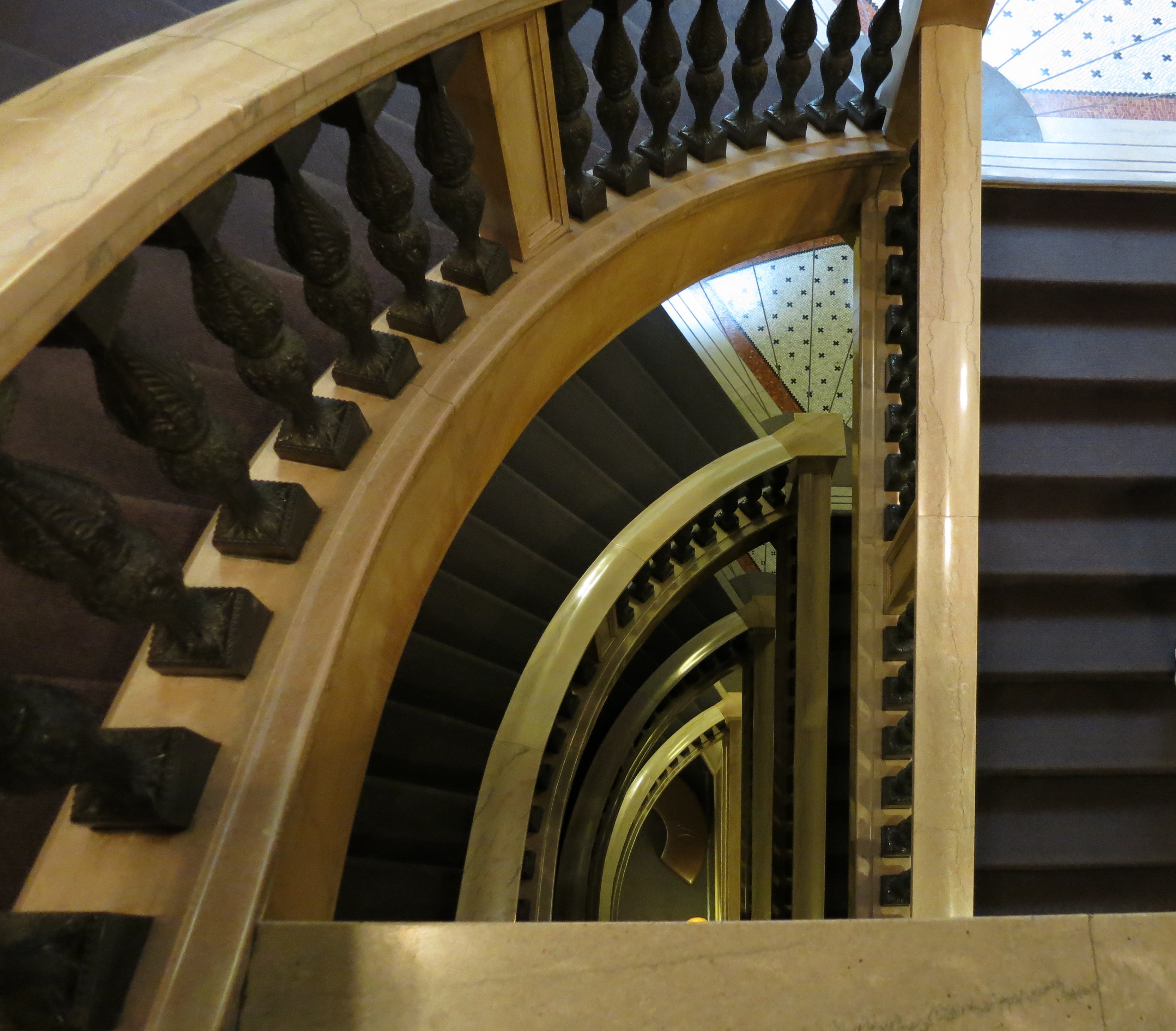
The Randolph entrance is all delayed gratification: through hand-carved mahogany doors, under a recessed ceiling pained white and gold, through a lobby full of people escaping the heat under more recessed ceiling, and finally to the two-sided staircase. Everything is made of marble, one of many safeguards against fire. Marble walls, marble staircase, inlaid tile on the ceiling… I don’t think I would have noticed if our guide hadn’t pointed it out, but much of the building didn’t have any painted surface at all, because there was no plaster to paint over. Everything was just solid. And it looked great; I can see why emperors and rich folks are so fond of using it.

They carpeted over the marble — quel horreur!

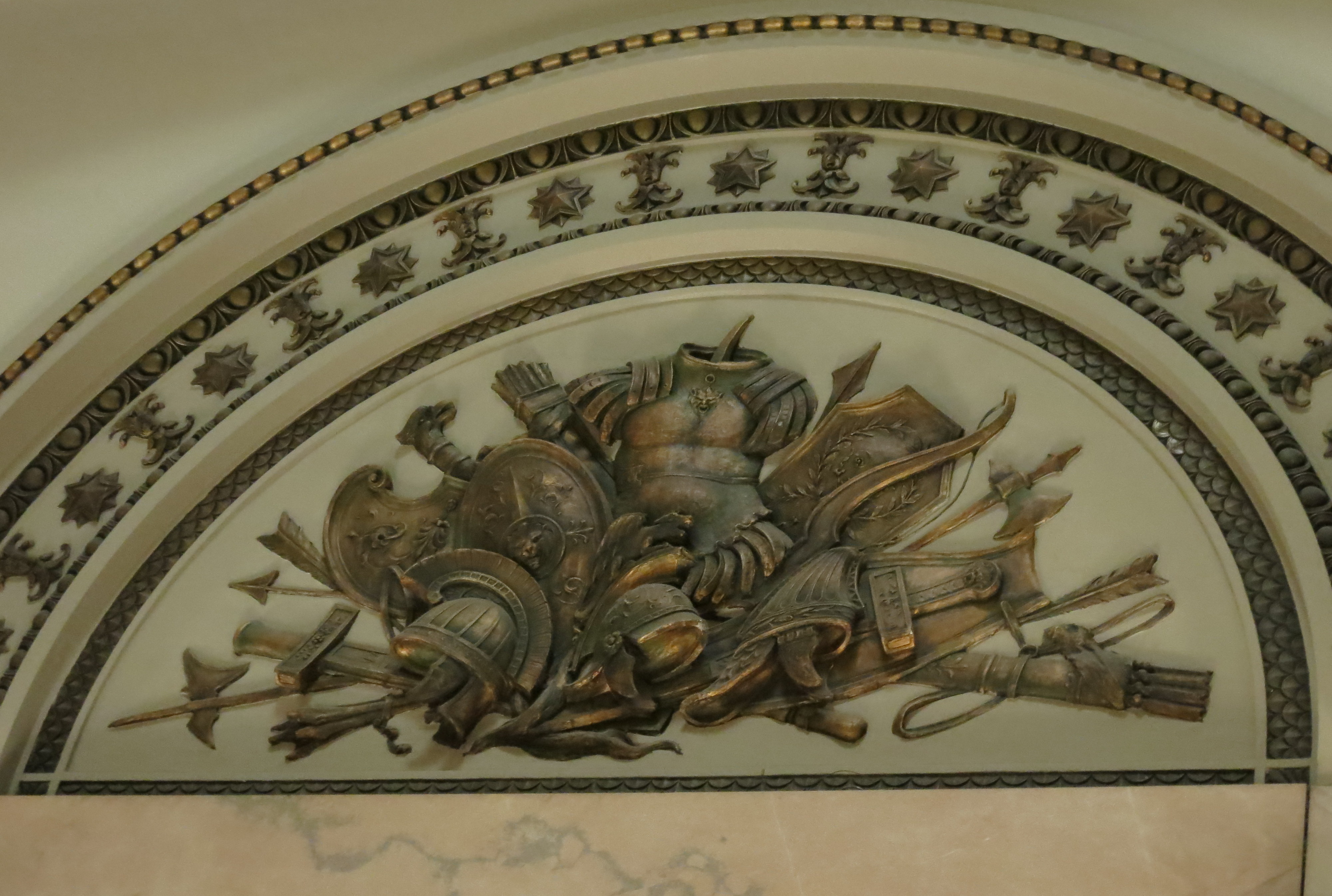
We looked at what was once the museum of the Grand Army of the Republic (those Civil War veterans from earlier). The view from that room is amazing, and they do $50 civil service weddings there every Saturday, in 15-minute increments. The walls under the dome of the GAR are decorated with brass bas-reliefs of piles of weapons. Just piles of them, haphazardly thrown together over archways. Very strange.
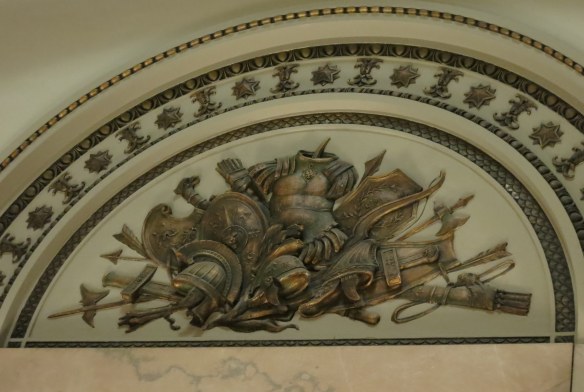
I like how the giant sword is sticking up through the top of the breastplate

They uncovered the cupola in the GAR dome a few years ago, and look at the difference!

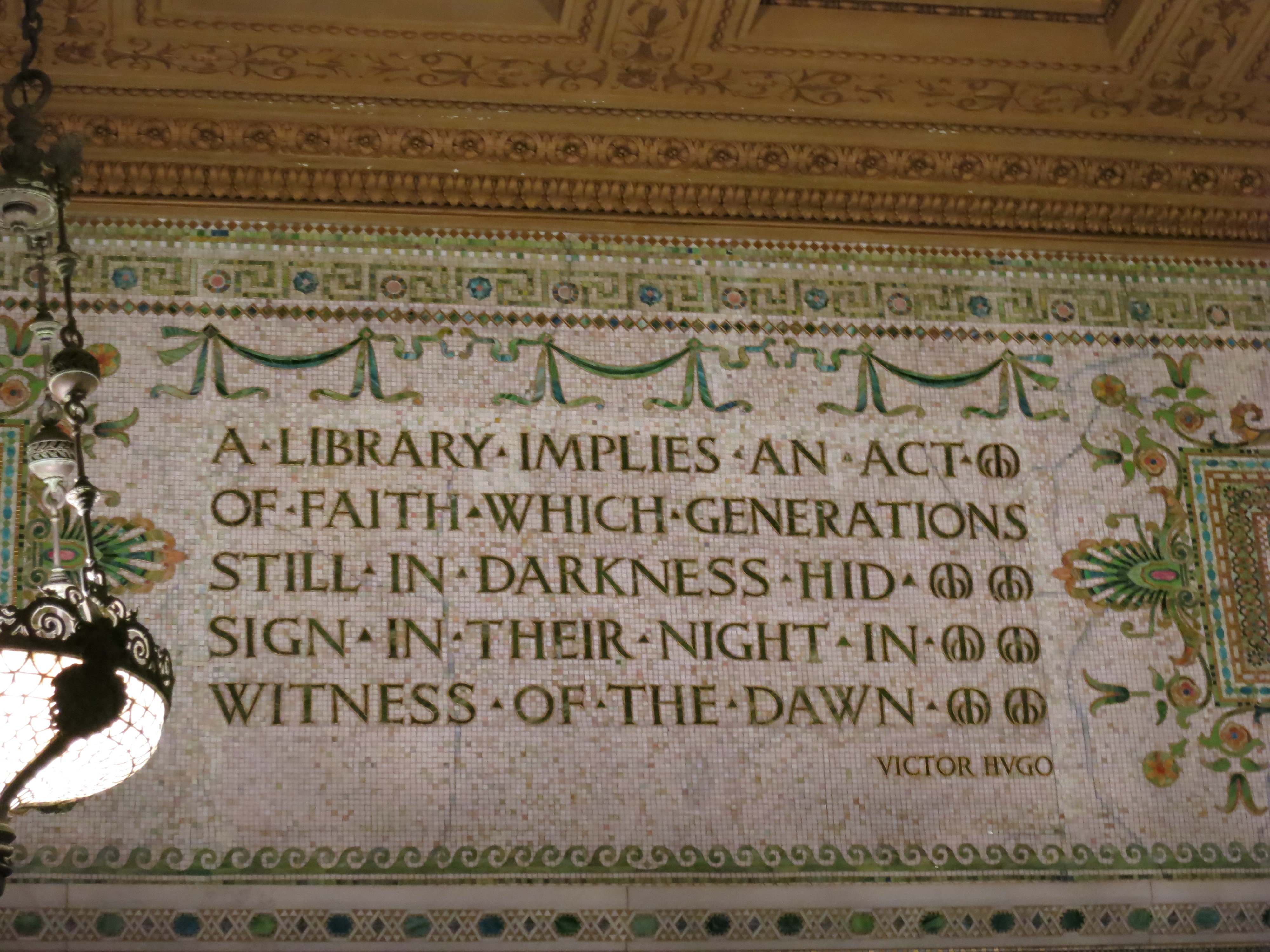
The other side of the building carries on the marble theme, but here it’s white marble from Italy, inlaid with brightly colored glass and gold leaf that glistens in the light, brightening up the whole area. There’s more inlaid tile here, too, in intricate patterns naming famous authors and spelling out quotes about literature in various languages. If you were to enter the building from this side, you’d be immediately struck with the size and beauty of the staircase leading up to the hall with the Tiffany dome. But I’m glad we came in from the side; we made a progression from impressive site to impressive site (we had to skip a couple rooms because they’re switching out the exhibitions, but those are meant to be lovely too), and then we walked down a rather dull and small corridor, rounded the corner, and voila! Stunning.

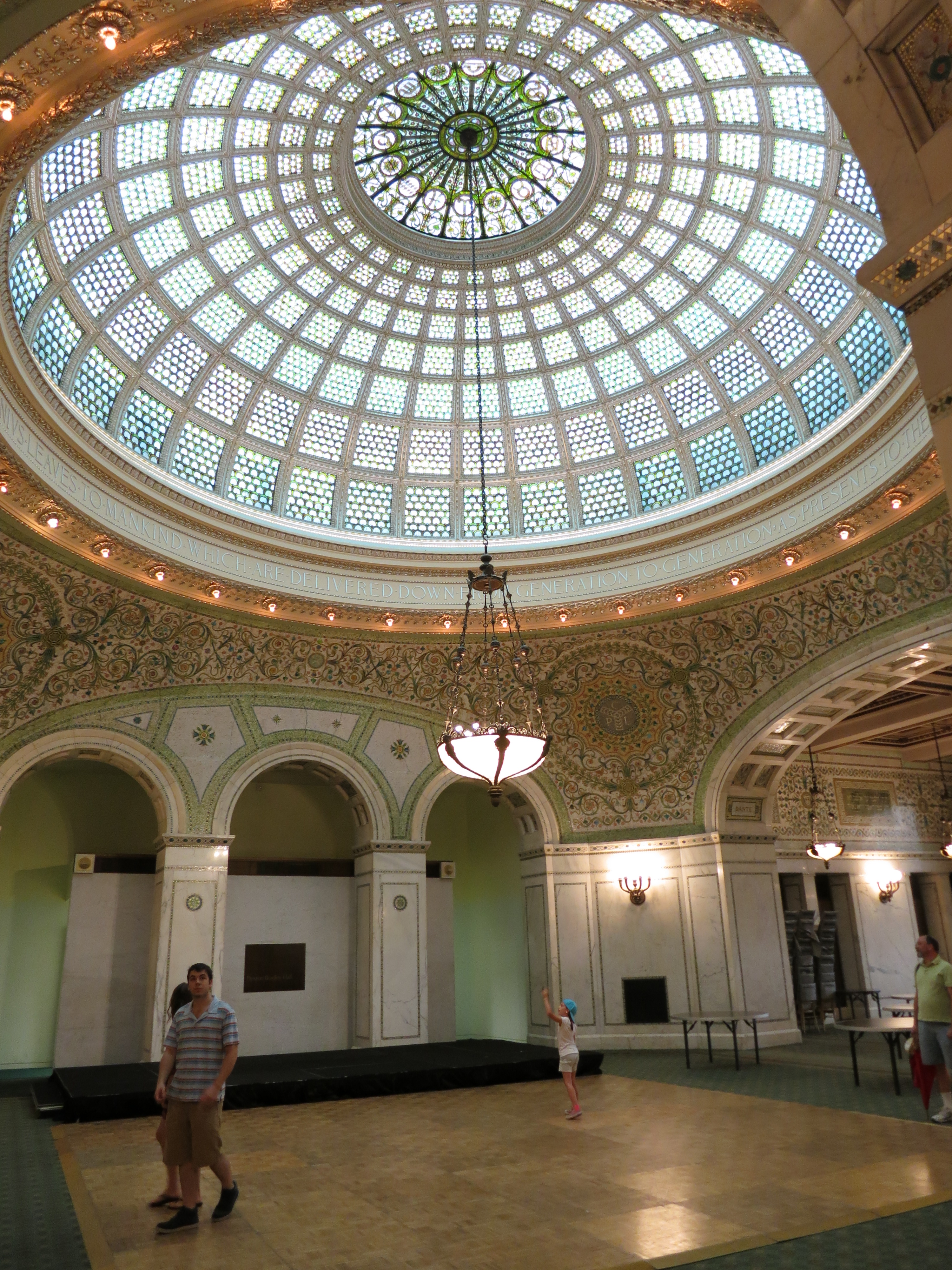
Quite an entrance
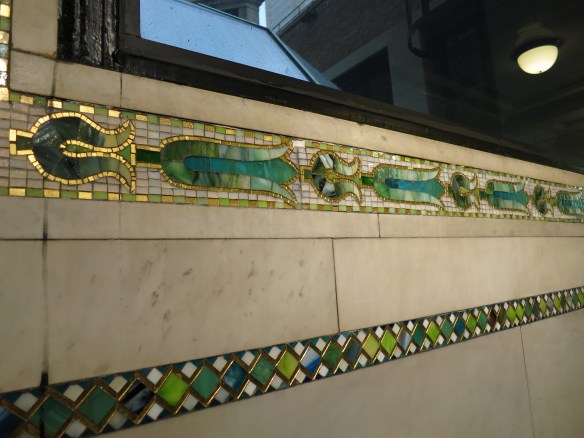
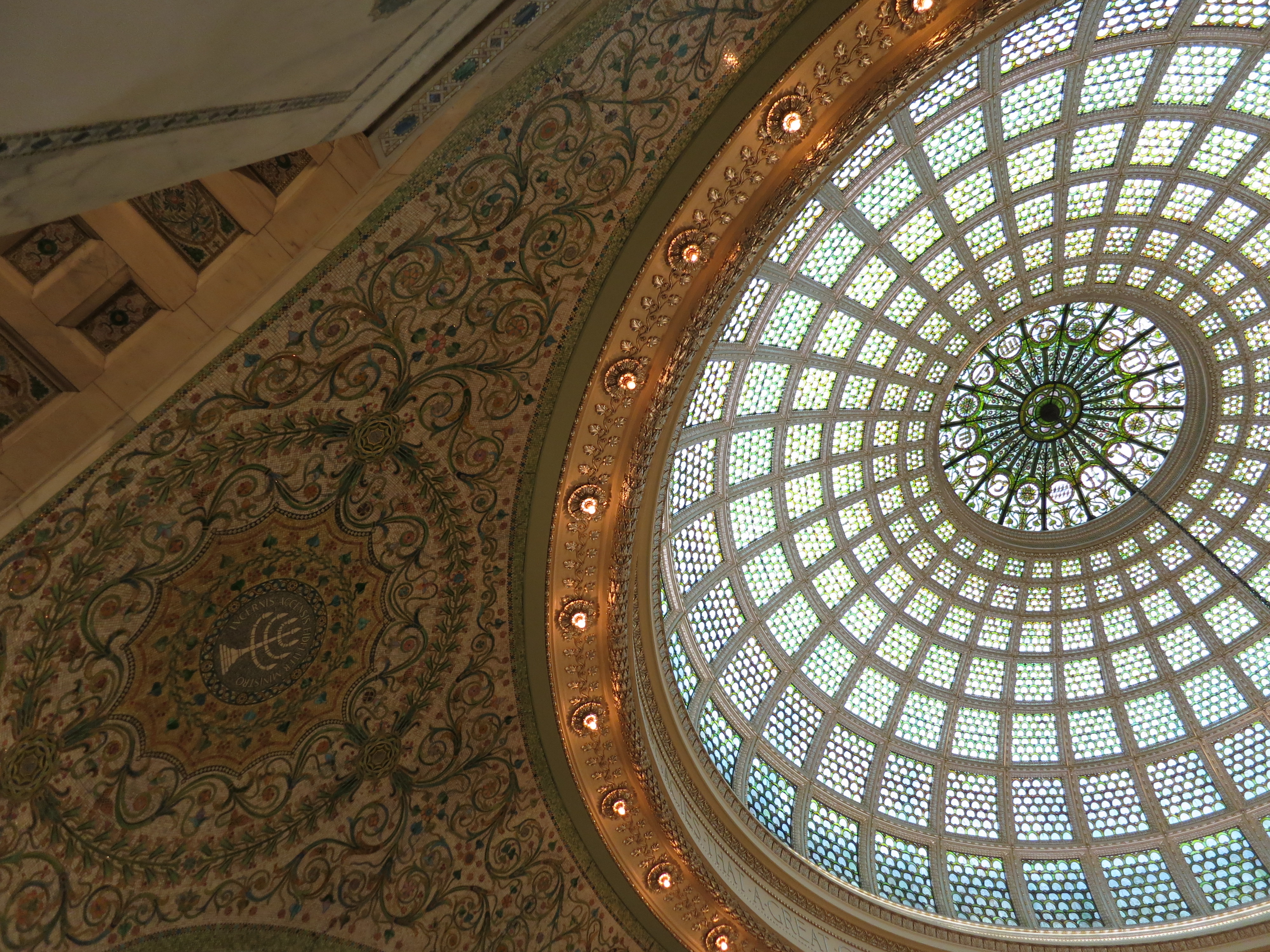
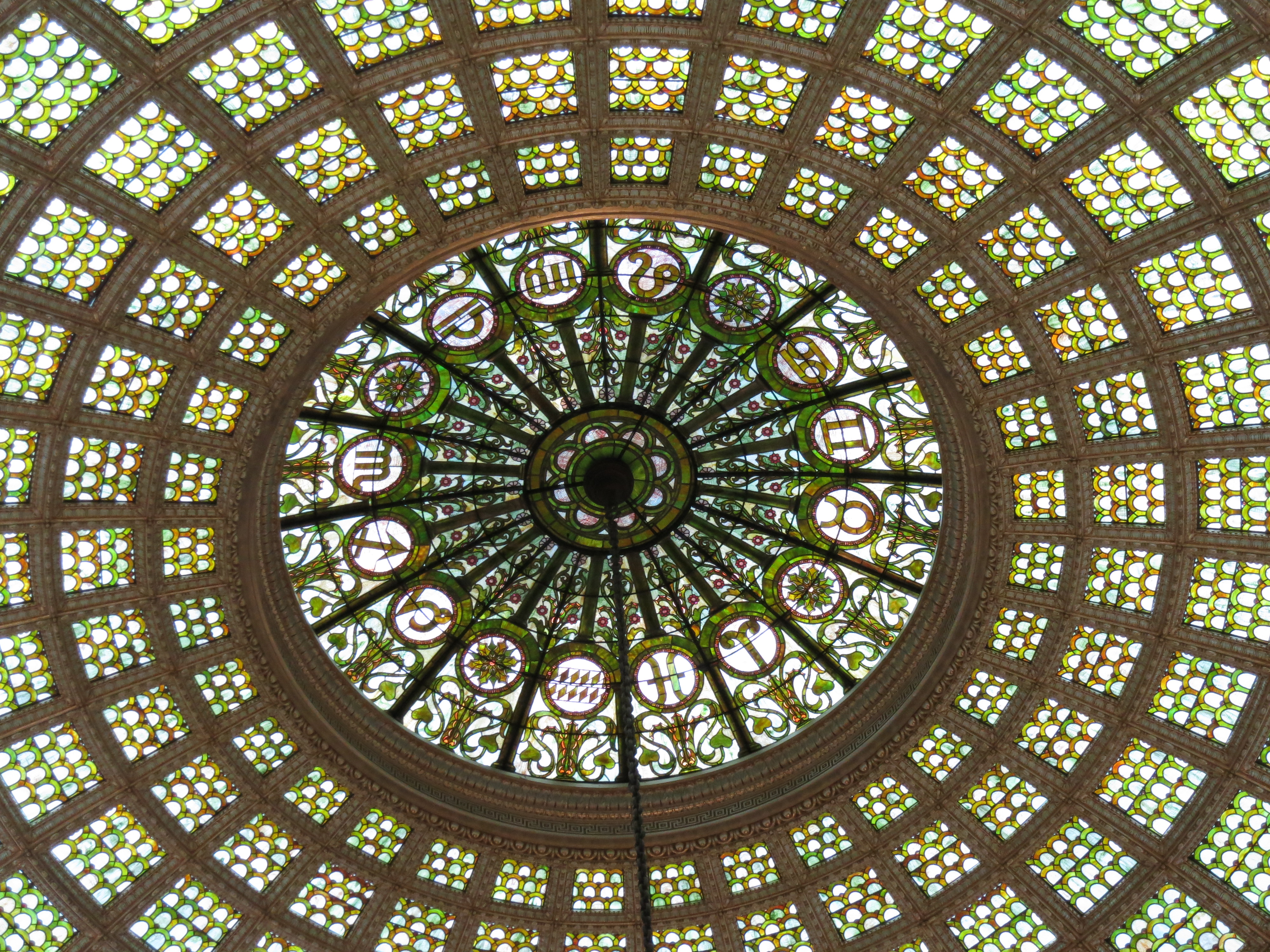
Preston Bradley Hall contains the largest Tiffany dome in the world, and the largest display of intricate inlaid tile in the country, outside of a church in St. Louis.
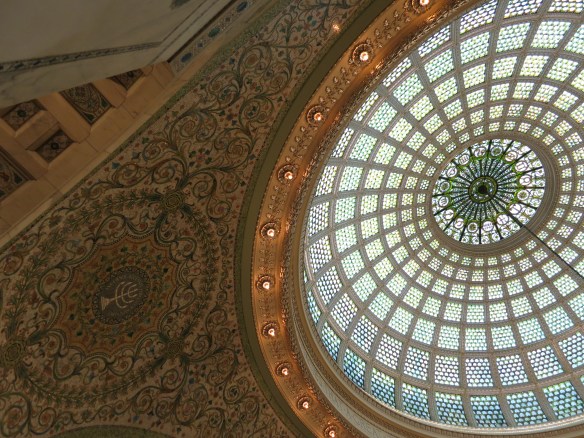
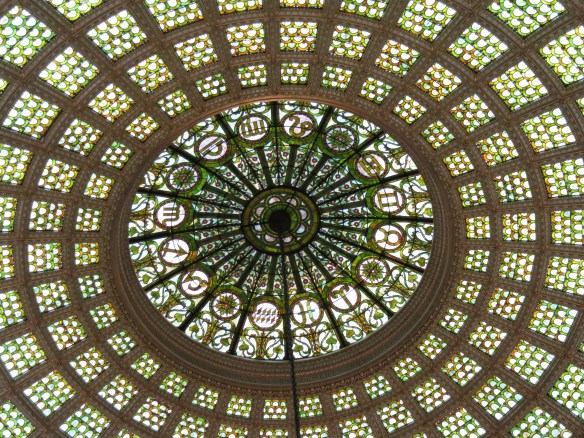
Are those symbols of the zodiac?

I found the Cultural Center to be a lovely surprise, and a place I wish I’d visited years ago. Get going!

Where it is: The official address is 78 E. Washington St., but if you go for the tour, you’ll enter on Randolph.

When to go: The free tours are Wednesdays, Fridays and Saturdays at 1:15 pm. They last about an hour and a half, and that time flies by.

What to see: The tour points out all the architectural features, but of course this is an active cultural center, so you can come here for concerts, art exhibitions, and lectures. You can visit the art studio and gallery for mentally and physically disabled artists on the first floor, and buy some of their artwork. You can use one of the lobby areas to relax, eat a lunch, use the wireless. You can duck into the Visitor Center and get some official info on touring Chicago. You can convince some rich friends to hold their reception in Preston Bradley Hall so you can dance under that Tiffany dome.

Cost: For the most part, free!

Image 1. All other images mine.
Hometown Tourist: Humboldt Park

Hometown Tourist is a series that hears that chipper tip, “be a tourist in your hometown!” and says, “Okay!” When friends come to visit, I like to show them a combination of standard tourist spots and the neighborhood places they’d never know to look for. Why not write about all those places? If you have suggestions on Chicago places you’d like to see covered for Hometown Tourist, add it in the comments.

I might never have started this blog were it not for Humboldt Park. Humboldt is bordered by North Ave, California, Kedzie, and Division, a vast expanse of green on the west side of Chicago. When I lived on California, I would walk the seven-tenths of a mile down the street and find a spot next to the lake to sit and read. In 2009, I’d been thinking of starting a blog (nothing like joining a trend a year or two late). On a few sunny September afternoons, feeling stifled and uncreative in my apartment, I walked down to Humboldt Park, sprawled out on the grass, and wrote. Surrounded by families barbequing and teenagers biking and old men fishing, I scrawled some ideas in a notebook and decided they would be enough to go on.

A typical summer day in Humboldt Park

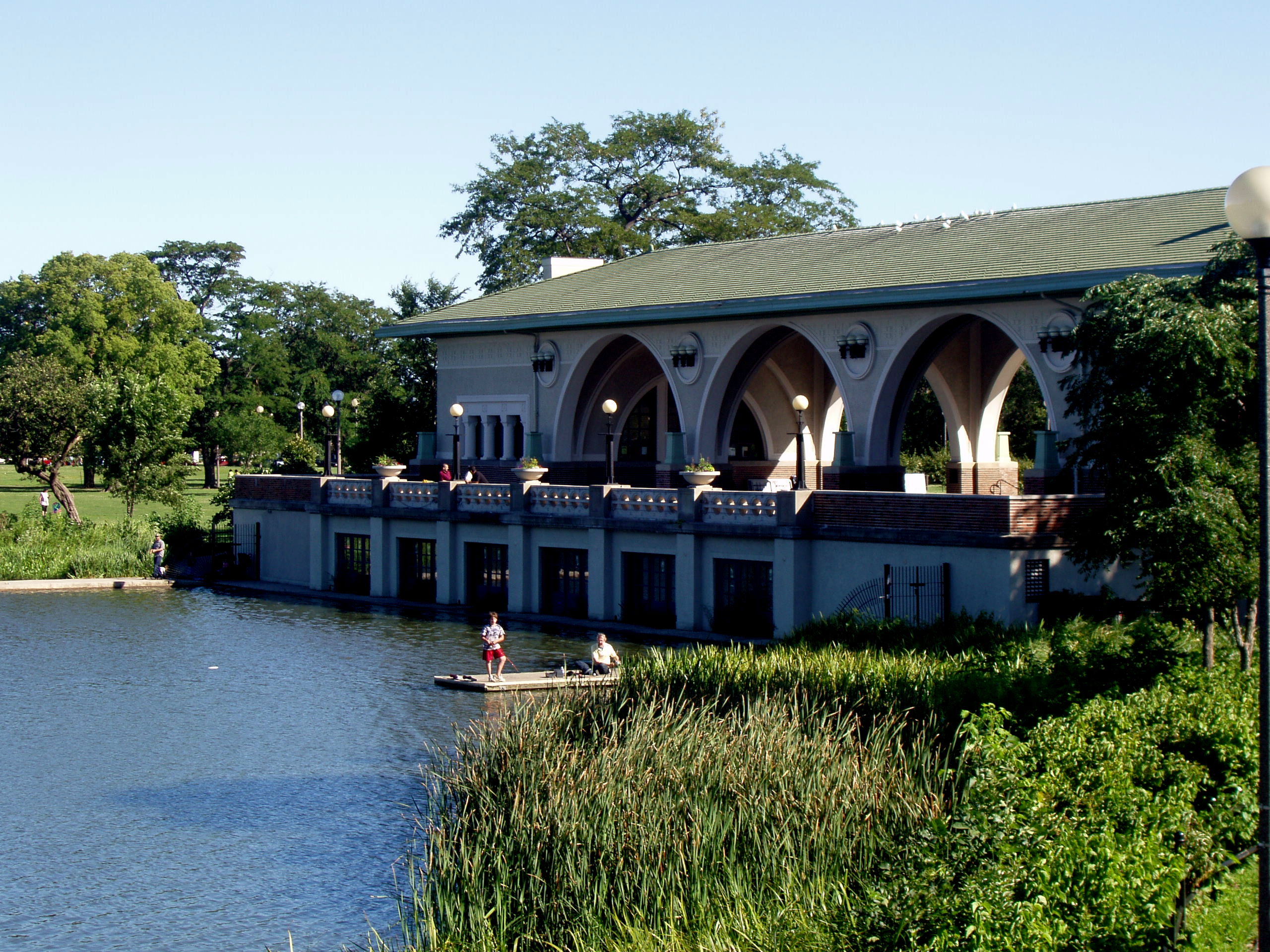
The manmade lake is stocked with fish, and the patient and hopeful find many places around the perimeter to set up their poles and see what they can catch. The boat house is basically a big pavilion covered by graceful arches, and I mostly look at it from afar, although it can give a nice view of the lake when you’re standing on it. Also, there are barebones bathrooms in there, which is useful.

Native plants

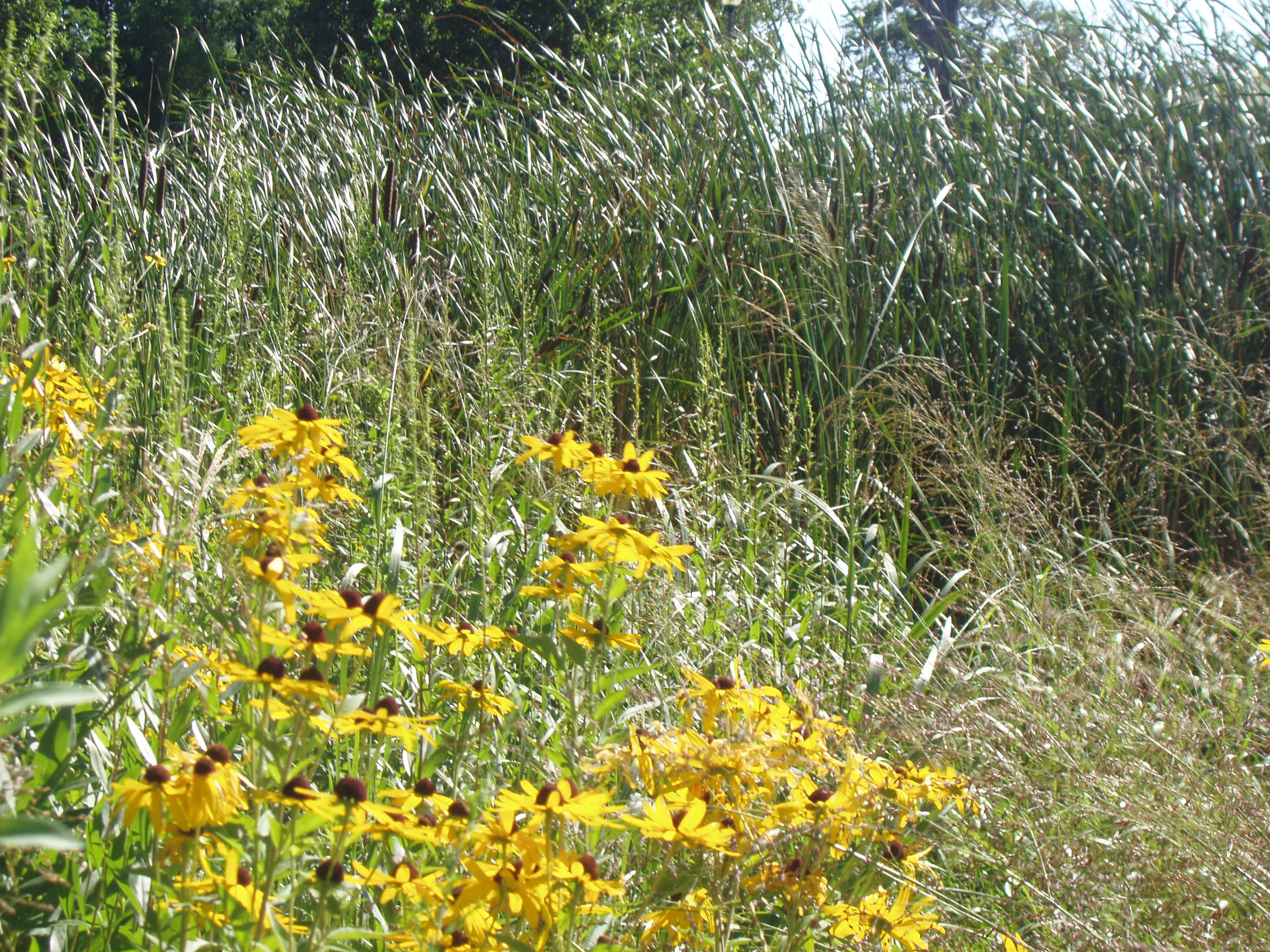
The park was designed by Jens Jensen, who designed various other parks in Chicago and throughout the Midwest. One of Jensen’s main principles was using native plants in landscape design, rather than importing exotic plants. He believed that a space was most beautiful when it used the materials at hand, and looking at the prairie design of Humboldt, it’s easy to agree. I also think of my friend Matthew, who works for a parks department in Michigan and spends a large part of his time removing invasive plants and educating homeowners about the dangers of invasives and the benefits of natives. Looks like Jensen may have been ahead of his time on this one!

You can see the Sears Tower (or Willis, sure) in the distance

The park is so large that a road runs through it so cars aren’t inconvenienced. All the pictures here are ones I took in the eastern side of the park, but the western side has great stuff too: a fancy fieldhouse, a small lagoon with a sand beach (the only such beach in the city that’s not on Lake Michigan), and a little river flanked by benches sheltered by plants in just such a way as to make them perfect makeout spots. A bike path meanders through the whole park, baseball fields host games all summer, and the playground is almost always covered in children squealing with delight.

The boat house

Humboldt Park is the name of the surrounding neighborhood as well as the green space, and it’s a predominantly Puerto Rican neighborhood. Giant, metal Puerto Rican flags straddle two of the streets, and almost every other storefront is a restaurant with delicious foods. The city of Chicago hasn’t really caught up to the street food craze sweeping the nation, but there are several food huts and carts at the park with tasty jibaritos and alcapurrias for sale. In June of each year, the streets host an official parade and also an unofficial parade of jubilant, flag-waving people in slow-moving cars for the Fiestas Puertorriquenas. People sit out on their porches and grill food, bomba and salsa music blasts from stereos, and everyone’s in a great mood. All this is concentrated in the park, where a large carnival is set up and live music plays. It’s a good time, and a total change to the usually peaceful park.

In short, if you’re anywhere west of Western and north of the Eisenhower, stop by! It’s a lovely place to spend an afternoon.

Where it is: In the square created by North Ave, California Ave, Kedzie Ave, and Division Street

When to go: Whenever! Obviously, it’s not as active in the winter, although the scenery is just as beautiful as it is in the summer, if different.

What to see: The lake and boat house, the gardens tucked away in the shade, a baseball game at one of the diamonds, the shallow swimming lake on those hot summer days

Cost: Free

The More Things Change…

From Mark Twain’s A Tramp Abroad (published in 1880):

Travel isn’t what it used to be
“Seventy or eighty years ago Napoleon was the only man in Europe who could really be called a traveler; he was the only man who had devoted his attention to it and taken a powerful interest in it; he was the only man who had traveled extensively; but now everybody goes everywhere; and Switzerland, and many other regions which were unvisited and unknown remotenesses a hundred years ago, are in our days a buzzing hive of restless strangers every summer.” (p. 225)

I saw this really cool thing… on the Discovery channel
“[The Ladders] are built against the perpendicular face of a cliff two or three hundred feet high. The peasants, of both sexes, were climbing up and down them, with heavy loads on their backs. I ordered Harris [hired man] to make the ascent, so I could put the thrill and horror of it in my book, and he accomplished the feat successfully, through a sub-agent for three francs, which I paid. It makes me shudder yet when I think of what I felt when I was clinging there between heaven and earth in the person of that proxy.” (p. 255)

I never go to tourist spots. I prefer to see the REAL places in a new country.
“I flit,–and flit,–for I am ever on the wing,–but I avoid the herd. Today I am in Paris, tomorrow in Berlin, anon in Rome; but you would look for me in vain in the galleries of the Louvre or the common resorts of the gazers in those other capitals. If you would find me, you must look in the unvisited nooks and corners where others never think of going. One day you will find me making myself at home in some obscure peasant’s cabin, another day you will find me in some forgotten castle worshiping some little gem of art which the careless eye has overlooked and which the unexperienced would despise; again you will find me a guest in the inner sanctuaries of palaces while the herd is content to get a hurried glimpse of the unused chambers by feeing a servant.” (p. 284)

Hometown Tourist: The Lyric Opera

Hometown Tourist is a series that hears that chipper tip, “be a tourist in your hometown!” and says, “Okay!” When friends come to visit, I like to show them a combination of standard tourist spots and the neighborhood places they’d never know to look for. Why not write about all those places? If you have suggestions on Chicago places you’d like to see covered for Hometown Tourist, add it in the comments.

For the inaugural Hometown Tourist post, I thought I’d start classy: the Lyric Opera. “Ugh, Lisa,” I hear you all groan. “How boring! And overpriced!” But dearest fellow travelers, let me assure you that it is not boring! And it doesn’t have to be too expensive! I’ve seen three operas at the Lyric over the past five years, and I’ve never spent more than $75 on a ticket. That’s no pocket change, sure, but it’s maybe twice what you’d pay for a show at The Riv, and no one will be spilling beer on you or elbowing past for a better view of the stage here.

The Civic Opera House in Chicago

As to the boring part: I was raised on a lot of different kinds of music, but opera wasn’t one of them, so it’s not like I have an ear for it. But the tunes are stirring and the singing is powerful stuff. When I saw Aida on Tuesday, there were a few moments during Hui He’s solos that actually caused me to catch my breath, they were so lovely. The stories are never too hard to follow, so even when they’re told in Italian or German, they’re easy enough to follow. The emotions expressed onstage would be overblown if they were spoken in a play, but they take on more gravity in song form, and it becomes clear that the only way to truly express love or heartbreak is to devote an aria to it.

Right, so: opera can be riveting stuff, and it can be enjoyed without breaking the bank. Where do you go to see opera? In Chicago, there are a few companies that put on shows, but the biggest, most established one is the Lyric Opera. They have their own building on the Chicago River, and it is beautiful. It was built in 1929, and when they renovated it from 1993 to 1996, they kept the Art Deco style. This means that not only are you classing it up by going to the opera, you are classing it up flapper-style. What more could you ask for?

The theater seats almost 3,600 people, and when my friend Hannah and I were there on Tuesday, it looked to be just about sold out. On a Tuesday night! That’s a lot of music and theater lovers in Chicago, which warms my artsy heart.

That's a lot of aria appreciators

Where is it: Civic Opera House, 20 North Wacker Drive, on the northwest corner of Madison and Wacker

When to go: Weekday shows are cheaper, straight up. If you have a job that isn’t 9-5, they even have matinees, which are much cheaper. The season runs October through April, and show runs overlap.

What to see: Whatever your heart desires! If you wait past opening night, you can read reviews and see if something sounds particularly good. For example, Show Boat is getting raves this year. The only downside to this strategy is that tickets will be few and far between by the time the show run starts.

Cost: Tickets range from $35 to $200. Full-time students can get $20 tickets to some shows.

Some practical tips:

  • Unless you are an opera buff, you probably aren’t familiar with the various shows. (I definitely am not.) Do a little research beforehand; I always thought of opera as solos alternating with big choral numbers, so I was disappointed that Tristan und Isolde never had more than six people on stage at once. I listened to clips of operas before buying tickets this season, and found that Aida had a lot of choruses, so I went with that one. (And it did not disappoint. There were easily over 100 people on stage at one point on Tuesday, including dancers who really livened things up during the instrumental portions of the show.)
  • They are obsessive about starting on time here, so do not be late! The ushers will shut you out until intermission if you are late, so give yourself enough time to float elegantly up the stairs to your seat.
  • Speaking of seating, unless you’re shelling out, you’re probably going to be in either the First or the Upper Balcony. Try to get a seat closer to the front of the balcony, because it can get pretty claustrophobic at the back, with the balcony above crowding in on you and the rows of people in front of you partially obstructing your view of the stage. In fact, the Upper Balcony is less claustrophobic, so if you are looking at seats in the back of the Upper Balcony versus seats in the back of the First Balcony, I’d recommend going against instinct and choosing the Upper Balcony seats. You’ll get a clearer view and save money, too!

Oh look, I made a 30-second video of Tuesday’s trip to the opera.

Image 1. Image 2.

Tourist Traps That Don’t Suck

Ah, the tourist trap. A danger well-known to the savvy traveler, and one best avoided. It’s usually a cesspool of gaudy, overpriced trinkets, loud fellow tourists and shopkeepers, and somewhere in there, a pretty pitiful excuse for a landmark. Whether it’s a pit stop on a cross-country tour or a planned part of the itinerary, a tourist trap is, to those of us saving pennies and looking for more than plastic souvenirs, a hellish place.

Except when it’s not.

Hear me out, dearest fellow travelers! I’m certainly not saying that I’m planning my next vacation around a day at Wall Drug or an afternoon in Times Square, but the fact is that this is a pretty fantastic world we live in, and in even the most commercialized of places, there’s usually something of real value. Most of the time, this is because the people working the place have some interesting facts to share about it or a friendly perspective on the local culture. As we know, it’s the people who make the difference in where we go and what we see when we get there.

But sometimes it’s the place itself that’s worth seeing, honestly. My best example is Navy Pier. This is a giant pier originally built in 1916 to dock cargo boats and the like, as well as some pleasure boats. It has since grown into Chicago’s #1 tourist attraction, with a giant Ferris wheel (modeled after the first one ever, which debuted at the Chicago World’s Fair in 1893), several theaters, restaurants, bars, and docking for many pleasure boats. It is generally considered by most Chicagoans to be a hideous place, only visited when clueless relatives are in town. It has an indoor arcade of shop after cheap shop, a nasty little fast food court, and low ceilings lit by glaring fluorescence. In the summer especially, the entire pier is overrun with screaming children careening all over, drunk parents yelling after them, and slouching teenagers forming impassable knots on the throughways. Everything costs three times what it does in the rest of the city, the lines go on for miles, and it’s not like it’s even a famous or historical site.

Navy Pier

Navy Pier: Not So Bad! (photo via americanrail.com)

But! There’s a lot of good stuff going on at Navy Pier, underneath that hokey exterior. In the past few months alone, I’ve gone on a delightful brunch cruise, seen Taming of the Shrew at the Chicago Shakespeare Theater, and watched the acrobats of Cirque Shanghai tumble across the stage at sunset. Granted, these were all made considerably more enjoyable because they were free or nearly free (thank you, friends involved in theater). But the fact that they were there at all is impressive. Sure, the cruise had a cheesy DJ, but the brunch was tasty, and you can’t argue against a turn around the harbor on a bright summer day. The CST does some fantastic shows (even Shakespeare’s most blatantly misogynistic number was acted and costumed well), and the acrobatics of Cirque Shanghai are quite literally breathtaking. Each time I met up with friends to attend these events, I grumbled about getting all the way over there (it’s a two-bus destination) and dealing with the crowds, but once I got there, the crowds weren’t so bad, and the shows and rides were totally worth it.

There’s a lot of neat stuff packed onto that pier, and I’m now less likely to dismiss it as a whole. Some people might call that personal growth. I just call it application of advanced travel skills. You too can learn these skills of finding the fun and interesting wherever you go, and apply them to your own tourist traps.

So tell me, what tourist traps do you know of that don’t suck? Which ones have hidden gems and specific times to go? Which ones would you recommend (even with qualifications) to friends and visitors? Let everyone know in the comments!