
Several months ago, the video “Stand by Me” went viral, and the eyes of many all over the world welled up with tears at the sight of musicians all over the world playing the same song, separated by distance but united by song. Turns out the organization that distributed that video, Playing for Change, has been busy making many more such videos, touring the United States with some of the featured musicians, and starting up a foundation to build music schools in communities worldwide. The snazzy website features some fun and some touching videos, like “One Love,” “La Tierra del Olvido,” “Satchita,” and “Gimme Shelter.” And at first I was a little wary of the whole operation.
“Good grief, Lisa, will you never just be satisfied with a good thing when you see it?” I hear you asking. And the answer is no, I will always want to look critically at an organization to find its shortcomings, so that I can 1) be fully aware of what efforts I’m supporting, and 2) be in a position to offer constructive criticism to that organization. Mostly, I saw the artists page, which looks like this:
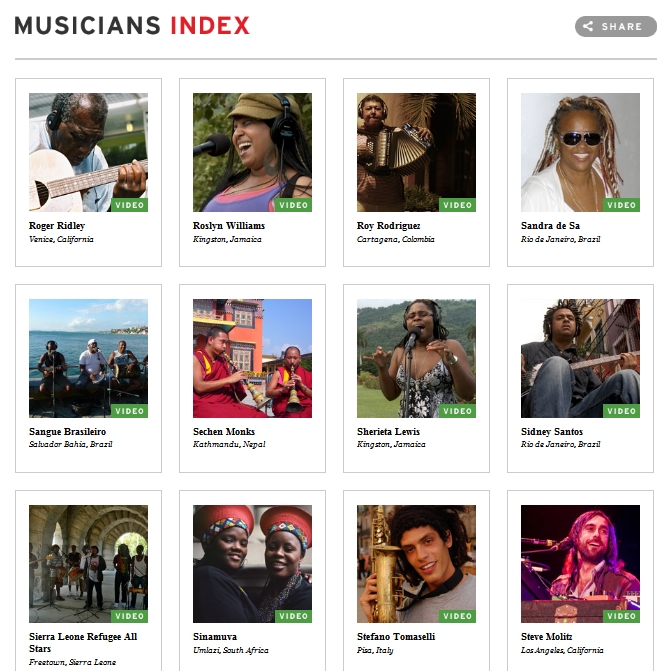 And then I saw the crew page, which looks like this:
 And I thought, “Uh oh, white people, what are you doing?”
Because we are so terrified of being called racists that we won’t even talk about racism in this country, white Americans are sorely uneducated about their own privilege and what they can do about it. This leads to a whole lot of nastiness on the more conservative side of the spectrum, and well-meaning condescension of the “let us tell you how to fix your life” variety on the liberal side. None of which goes very far toward mending race relations in the US.
Granted, the whole aim of this project is to go global, to not be confined to the United States. But look at that crew, and the founder, and the company that owns their for-profit arm; they’re all white folks who are likely living a pretty comfortable lifestyle. Contrast that with the artist pages, which shows many people of color in small, poor villages, and maybe you can see why I’m wary of the relationship.
But after I looked into the site more and saw more videos about the foundation, I’m happy to say I think there’s much more good than harm going on here.
Saving the world is a wonderful goal, of course, so long as you’re aware that you can’t do it on your own or all your way. Fortunately, PFC seems to get this. They hold a passionate belief that music is a uniting force that can and will bring peace to the world. They find musicians who share the same belief, and they work together to put the ideal into practice.
Their foundation came about from asking some of the musicians who came from poorer backgrounds, “What can we do to help?” Not “you should do this” — a crucial difference. It was the musicians who said they wanted to schools to teach the next generation how to make music and be a force for peace. The people of Kirina in Mali took the money and supplies provided and built their own school; no outsider crusaders doing it for them and expecting gratitude. This is the kind of assistance — monetary, material, non-invasive — that activists the world over consistently say is the best, most sustainable kind. Kudos to PFC for getting that right.
Everyone involved in the project is devoted to the idea that music can and must be a force for good in the world, that the act of creating music is a unifying one. I absolutely agree, and it’s encouraging to watch thousands of musicians, videographers, editors, villagers, and audience members from all corners of the earth enthusiastically supporting this idea. Check out the participation page on the PFC site to see how you can support an organization supporting the work of musicians and peacemakers all over the world.
And enjoy the music.
 Stowaway Travel Writing & Editorial Services