The Good, The Bad, and The Silly

Hello dearest fellow travelers. Here’s something new! I thought I’d start a feature that rounds up some of the best and worst of the political/cultural news I run across each week, so you can get even further inside my brain without getting too Malkovich about it. And since usually the good and bad news is still news and therefore always kind of a downer, how about a silly element on the end of it? Something lighthearted, cheerful, adorable, or otherwise Unserious. If you’re already reading blogs with a political or cultural slant, probably you’re running into similar features, and maybe you won’t find much new here. But maybe you will, and then you will feel enlightened. Also, you can put links to other interesting articles in the comments and this blog will become a veritable font of information.

So here we go — the inaugural The Good, The Bad, and The Silly!

The Good

“Papers, Please” portion of AZ law SB1070 put on hold by federal judge — it’s a start

Erin Andrews urges Congress to pass a stricter anti-stalking law, one that would include high-tech types of stalking and emotional threats

The Bad

As is so often the case, human rights are traded for money — prisons are set to profit big time off SB1070

As the Kalamazoo area reels from an oil spill, Democrats decide a majority in both houses and the White House, plus an oil spill disaster in the Gulf that has the country fuming, isn’t enough to actually push through tough energy reform (Via)

Also, check out this site and be sure to place it over your city. It’s truly disturbing. http://www.ifitwasmyhome.com/

The Silly

A mother makes fantastical dreamscapes starring her baby (Via)

What have you run across?

Storytelling as Action

I don’t have much time today to expound on this, but here’s a fascinating excerpt from the book Telling Stories: Indigenous history and memory in Australia and New Zealand, edited by Bain Attwood and Fiona Magowan (Allen & Unwin, 2001). In the entry “The saga of Captain Cook: Remembrance and morality,” Deborah Bird Rose relates the story of Captain Cook as told by Hobbles Danaiyarri, who is an Aborigine living in Yarralin in the Northern Territory of Australia. His story is told in a mix of past and present tenses, and relates the injustices his people suffered at the hands of Captain Cook and other Europeans. After reprinting Danaiyarri’s remembrance, Rose explains how history and morality are tied up in Aboriginal thinking, explaining that this remembrance is a saga as opposed to a Dreaming myth:

…the saga is set in a time frame that is conceptualised as part of the present (ordinary time), whereas Dreaming myths are set in a time frame conceptualised both as the past and as a concurrent present. The latter are source of moral principles, and moral action is judged by reference to these principles, which are deemed to be permanent rather than subject to change and negotiation. Captain Cook’s law, by contrast, is seen as immoral, and this presents Danaiyarri and others with a problem: how to account for immoral action that is reproduced through time and thus appears to endure, just as Dreaming law endures. I contend that Yarralin people’s logic requires that the Captain Cook saga be kept in ordinary time — that it not be allowed to become part of the Dreaming past. (p. 70)

Moral action is seen to endure, and actions that do not fit the moral frame of reference cannot be part of the same timeline as moral actions. So these immoral actions are framed in the present, in ordinary time, as a current problem, even if they happened hundreds of years ago. By viewing morality and history as intertwined in this way, wrongs can be addressed in the present day, even if a linear timeframe would see those wrongs as too far in the past to warrant redressing. The very act of telling these stories is a move for social justice, keeping history literally alive in the general consciousness and demanding recognition and action. As Rose concludes, “far from being the consolation of the powerless, remembrance is an active force for social change” (p. 79).

What a powerful way of viewing history, storytelling, and collective action! What do you think? What stories should we be telling in “ordinary time”?

History is Not Inevitable — and That Matters for Today

History is not inevitable. Perhaps this is something they go over with history majors (although I will say I never encountered the idea in the several history courses I took in college), but for me and I think for the general populace, it’s an unusual idea. After all, events unfolded the way they did and now we are here, so how could it have been otherwise? It’s like a kind of Q.E.D. — it happened, therefore it is proven; it happened, therefore it must have been meant to happen. I know that this shows up in several religious schools of thought, like determinism in Christianity, and also in general ideas about fate. But it’s a poor approach to history.

This way of thinking sees history as static, and usually consisting of political, military, and economic events rather than a synthesis of these with social, religious, artistic, and scientific events and movements. But history is a living, breathing thing that we are creating right now. If we view ourselves as not only part of the history we know but also the part of the history future generations will learn about, it becomes easier to see past historical events as not inevitable or fated, but part of a series of individual and communal decisions made in constantly shifting circumstances. That’s not to say that I can quite wrap my linear-focused brain around the Australian Aboriginal concept of Dreamtime (in which you are here now but also in the past and the future, all at once) or the physics concept of nonlinear time. All that fluid space and time is nifty but makes me dizzy. But I can grasp the interlocking moments, motivations, and actions that make up our history, as opposed to the clear-cut line from Cause A to Effect B.

Understanding history as more complex than a straight series of inevitable events is crucial to understanding the ways we interact now — legally, socially, personally. For example, the colonization of New Zealand by the British is often seen as something that was bound to happen. The British had more efficient killing machines and more of them, they had thousands more people to populate the land, and they had the backing of an entire empire. But even if colonization were inevitable, the way it happened was drastically different from, say, the colonization of Australia. The British imported convicts to Australia and swept aside the Aborigines as if they were only a small obstacle to populating a continent, rather than the original inhabitants of that continent. In New Zealand, however, they found the Maori not only ready to fight for their land (as many Australian Aborigines were), but organized in a way the British could better understand, with recognizable leaders and specific land boundaries. So the British decided the Maori were more advanced than the Aborigines, and much more likely to respond well to being “civilized.”

Because the British saw the Maori as more civilized and basically more human than the Aborigines, they gave the Maori more consideration when taking their land, and that different historical approach has repercussions today. Unlike Australia, which was declared terra nullius (“empty land”) despite the very obvious presence of Aborigines, the British negotiated for land sales with the Maori of New Zealand. The Treaty of Waitangi was signed by the Pakeha Lieutenant-Governor and most Maori chiefs on February 6, 1840. The document was written in English and immediately translated so the Maori could know what they were signing, but the translation has some key differences from the English version. Notably, the treaty states that New Zealand is part of the British Crown, and only the Crown has the right to purchase land from Maori – or at least, one version states that. Another states that the Crown does not have this right of pre-emption. All versions were introduced with Lieutenant-Governor William Hobson stating, “We are one people.” As Philippa Mein Smith says in A Concise History of New Zealand,

Did ‘one people’ mean all the same, including one law, which in British thought meant civilising and assimilating Maori? Or did it endorse the idea of a new community of Maori and Pakeha, two ethnic groups henceforth defined in relation to each other? (p. 47)

Did the treaty mean Maori chiefs were giving up their sovereignty, or did it mean they were ruling alongside the British monarch and Pakeha governor?

These questions reverberated through the next century and a half, as first the Pakeha poured into New Zealand and bought up Maori land at ridiculously cheap prices (after the Crown bought them at even cheaper prices; an insulting way to get around that provision of the treaty) and later Maori asserted their land rights and citizenship rights. The Waitangi Tribunal in the latter half of the twentieth century resulted not only in recognition of Maori as an official language of the nation and the recognition of the importance of environmental considerations in indigenous rights, but in actual money settlements for breach of treaty (p. 231-236). Central to the arguments for money settlements and land renegotiations in the 1980s and 1990s were questions of not just what had taken place in 1840 but what kind of future both Pakeha and Maori were envisioning when they signed that treaty.

I find it fascinating that the New Zealand national government actually had a public discourse about what its intentions had been 150 years previous, and what effect those intentions and actions had on its citizens subsequently. The government recognized a breach of treaty and redressed that breach to the descendants of the wrong party. It’s all very proper Western legal action, but it’s also a bold step in acknowledging history as a living thing with no inevitable outcome and no fixed endpoint. Just because New Zealand is now a part of the British Commonwealth and overwhelmingly run by people of European descent doesn’t mean that that’s how it has to stay. Maori have regained some fishing and land rights, and they have also gained seats in parliament due to proportional representation measures, so they have more of a voice in the shaping of history going forward and not just looking back. Asians, instead of being legally shut out of the country and considered a threat to New Zealanders, are now being welcomed and encouraged to settle in New Zealand.

Certainly New Zealand has its share of bigots and racist policies, but I do find it heartening that a country that had a strong “White New Zealand” movement for decades (much like the “White Australia” movement that has unfortunately not died out as quickly it should) has made conscious efforts to not erase that history but to repudiate it and build a better one. Of course, it took the tireless efforts of thousands of ordinary citizens, activists, and politicians to bring about these changes, and I find that even more encouraging. The more people recognize history as living and evolving, the more we can build a just and peaceful history for ourselves and those who come after us.

Arizona’s Racism Hurts Little Girl in Maryland

And this is just one public moment of heartbreak that shows why 1) states shouldn’t get to make their own laws on a national issue like immigration and 2) anyone making laws on immigration had better make sure those laws are humane, just, and carefully considered.

http://thelede.blogs.nytimes.com/2010/05/19/worried-girl-asks-michelle-obama-if-her-mother-will-be-deported/

Film Club: Whale Rider

Dearest fellow travelers, come with me to the beautiful coastline of New Zealand, where we’ll cover some Film Club and some A Country a Month at the same time. Whale Rider is a 2002 film directed by Niki Caro, from a screenplay by Caro and Witi Ihimaera (who authored the book it’s based off of). Several people recommended this film to me, telling me how much I would enjoy the story of a young girl overcoming a thousand years of patriarchal rule to become the next leader of her tribe. This was an accurate prediction on your part. Whale Rider is a lovely movie.

Whale Rider movie poster

Whale Rider movie poster

Paikea is named after the legendary Maori figure who rode on the back of a whale from the homeland of Hawaiki to reach Aotearoa (the islands of New Zealand). Pai is a delightful 11-year-old who adores her crotchety old grandfather, Koro, the chief of the tribe. Yes, there is some of that well-worn gruff old man with a soft spot for a precocious young child — a tiresome cliché that flattens out both characters in many films — but it’s kept from getting too sentimental because Koro really does resent Pai for being a girl instead of a boy and thus unable to assume leadership of the tribe. Throughout the movie, he has many opportunities to relent and acknowledge her as his heir, but he refuses right up until the end. He does love Pai but says several cruel things about her and actively keeps her from learning the rites of chieftainship. She loves Koro but consistently disobeys his orders to keep her place as a girl. It’s more painful to watch a film like this, because the characters are acting more like real people than characters in other movies, and real people can be pretty awful to each other, but that’s what makes it so great, and also what makes the eventual reconciliation much more meaningful.

Another thing I liked about the movie is the film’s and Pai’s refusal to make her a saint or ideal. Koro is searching for a prophet to lead his people out of the troubled times they find themselves in (encroaching crime and drug use). Pai knows she is the next leader of the tribe, but she also knows she is no prophet. She is a gifted, sensitive girl, with a strong link to her ancestors and the natural world that her community lives in, but she is not superhuman. She doesn’t want to be a savior; she wants her whole community to come together and bring themselves out of the bad times and into a brighter future. How rarely do films, books, or even real life leaders express this wish? We are so accustomed to looking for saviors (and that’s not even counting religious figures) who will make everything right that we miss countless opportunities to fix our own problems and improve our own communities. Pai knows that the only way to be a strong group is to work as a group, and we see a beautiful illustration of that communal effort at the end of the film, when she leads a giant waka (Maori canoe) full of her neighbors into the sea as part of a celebratory ceremony. We need leaders who know how to bring out the best in us, not saviors who bring the best to us.

And yes, that happens to be my political philosophy. Heroes and saviors make great action figures and film stars, but they rarely make great history without a strong community to build on their vision. Whale Rider shows that truly humble people can also be compelling on the screen, and the numerous regular people in our lives working for a better world show how compelling they are in making history.

Arizona’s New Era of Racism: The Ethics of Traveling to Repressive Places

The state of Arizona recently passed SB 1070, which is a terrifying piece of legislation that mandates racial profiling, rewards paranoia and hate, and puts Arizona back at least 50 years. This is no exaggeration. Take a look at that NYT article — this law REQUIRES police officers to demand identification papers from anyone they suspect might be in the country illegally; it makes it a misdemeanor to not carry immigration papers; and it lets any citizen sue local law enforcement if they think this law isn’t being enforced. First we have Driving While Black; now we have Living While Brown.

This is the only law of its kind in the United States, but don’t think that doesn’t mean other states aren’t running to catch up. And don’t think for a second it isn’t racist. Check out Rachel Maddow’s short but effective rundown of the authors of the bill — longstanding members of groups whose explicit purpose is to make sure America’s majority is white. Who are most of the undocumented immigrants in Arizona? Latinos. So a law aimed at cracking down on illegal immigration is aimed at cracking down on Latinos. And how do you determine which Latinos are US citizens, legal immigrants, tourists, etc. and which are crossing the border from Mexico without official approval? No really, how do you tell? Even Governor Jan Brewer, who signed the bill into law, couldn’t answer that question. “I do not know what an illegal immigrant looks like,” she said when asked. But the police are supposed to know and make arrests based on that unknowable qualification? Is this like porn — I know it when I see it? Nope, pretty sure it’s like mandatory racial profiling — all brown people are immediately suspect.
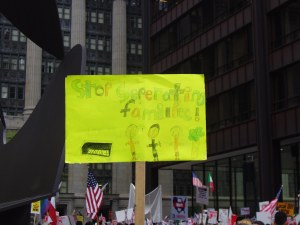
handmade sign at the May Day rally

no child should know what a SWAT truck looks like

My dad is always concerned that I consider the other side of the matter before taking a stand, which is good advice. So okay, people who support this bill are concerned about what, exactly? Sharing increasingly scarce resources with people who weren’t born here? Talk to your representatives about spreading the wealth a little more evenly. Losing your job to someone who braved brutal conditions, rape and murder on the trip from Mexico to the States? Even fairly conservative groups will agree that many undocumented immigrants do the work you don’t want to do, and in some cases their presence even raises wages. The increasing rate of crime in your state? Take a look at those who say they’re protecting the American way and then talk to me about rising crime rates. But mostly the support for this bill comes from many white Arizonans’ discomfort at the many brown faces they encounter on a daily basis. I hate to break it to you, but you weren’t exactly here first, and you were never really the majority.

I think the reasoning that most kindhearted but ignorant Americans hold is that it’s already illegal for these people to be here, so what’s the big deal if they get caught? Well, a whole lot of people who have every legal right to be here are going to be caught up in this giant net that’s been cast, simply based on the way they look. What if they run a red light, as anyone is liable to do, and they forgot their immigration papers at home? White Arizonans would be ticketed for running the red light and sent on their way. Latino Arizonans will be ticketed, handcuffed, and brought to the police station for holding and questioning while they’re run through the system to see if they’re allowed to be here. Everyday lives will be dramatically circumscribed, as every action is weighed against the possible consequences from a hostile law enforcement body. And that’s just legal immigrants and citizens.

Undocumented immigrants (“illegal immigrants” confers illegality on a person’s very being and thus dehumanizes them, and anyway is less accurate than “undocumented immigrants,” so I won’t use it) face grave consequences for simply being out on the street when a police officer happens along and decides to take a closer look at them. The category of “undocumented immigrants” encompasses a whole host of people, including people who were brought here by their parents when they were young and know no other home than the States, people who are escaping brutal regimes and couldn’t gain refugee status but are still terrified to return to their homeland, and women who are escaping the more commonplace but equally terrifying regimes of their brutal partners. “Undocumented immigrants” does not equal “job-stealing criminals.” It equals “people.” It equals “you or me in a different situation, in a different stroke of luck or fate.” The consequences for undocumented immigrants under this law is families being ripped apart, wretched treatment in detainment facilities, forced deportation, and uncertain and dangerous futures. That’s the big deal if they get caught.

This law is not “misguided,” as President Obama has called it. It is hateful and wrong.

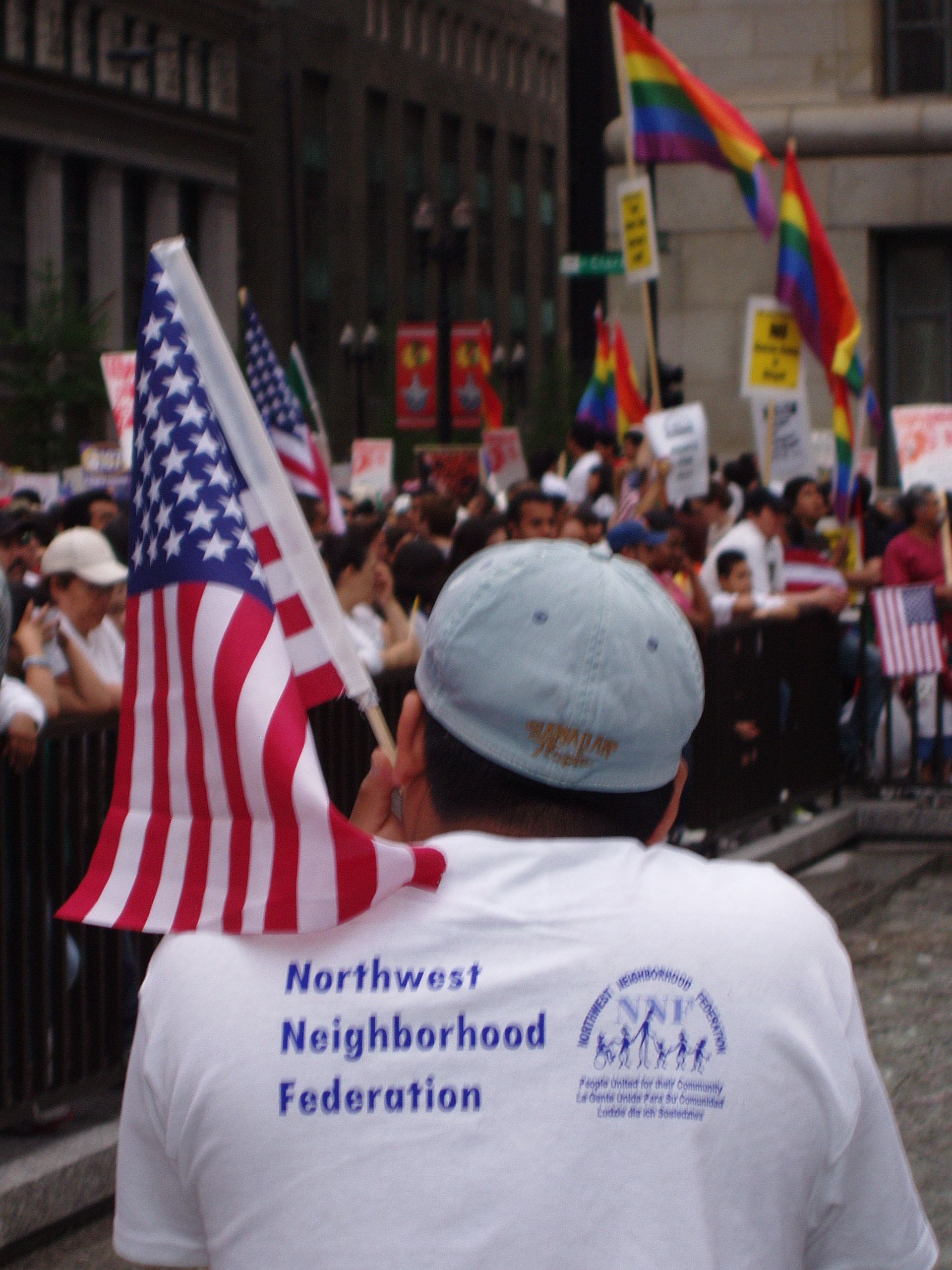
May Day Rally at Daley Plaza 2010

May Day Workers' Rights and Immigration Reform Rally at Daley Plaza 2010

So what do we do about it? This roundup at Feministe has some suggestions. The May Day rally I attended in Daley Plaza certainly united people in a loud, strong voice against it. Even some law enforcement officials are outright refusing to obey the law. Write to your Congressperson and Senators; encourage them to work on strong immigration reform legislation in this next congressional session. Write to President Obama and tell him “okay job on health care, we’ll see if Wall Street reform works, now let’s get to immigration reform.”

And since this is a travel blog, as my friend Pam suggested, let’s consider the travel implications. It might seem a small thing, but I do believe every stand we take matters. Representative Grijalva has called for a convention boycott of his own state in protest of the law, and the city of San Francisco has already voiced its support. I’m just one traveler, but I can keep my money away from Arizona and its repressive ways. This isn’t even the only racist law they’ve instated recently — ethnic studies courses are now banned as treasonous, and the state Department of Education is removing teachers who speak with too thick a Spanish accent (even though a study shows that accented teachers might be better for their students). This is a state intent on enforcing a very narrow definition of “normal” and “acceptable,” and it is a state that needs to be stopped. Whatever we can do to turn back this tide of racism, xenophobia, and hatred, we must do. Of course, there are many people in Arizona and out of state who have worked tirelessly for years for human rights in Arizona, and there was a big push from a lot of groups prior to the signing of this law to stop it before it got to the governor’s desk. Unfortunately, their calls for reason and basic decency went unanswered in this case, but that doesn’t mean that’s the only answer they’ll ever get. Americans are scared, and scared people often do stupid things. We must help people see that fear is not the right way to live, or the right way to vote.

And that’s where travel boycotts come in. Pam asked me to consider the ethics of traveling to repressive places, and what I’ve come up with is this: There are varying degrees of repression in every single human-occupied place on this planet, so of course I can’t avoid them all, nor would it be right to do so. But I can refuse to support local economies with my money and my high praise if I find their laws reprehensible. This is a work in progress kind of rule, but I think it comes down to agency and power (as so much does). The residents of Burma, for example, have agency, as every human being does, but they have very little real power, because the ruling junta has it all. The brutal laws of Burma are terrible, but I might still visit there to aid locals (if they wanted me — not all foreigners are welcome, since Americans especially can cause more trouble than they’re worth there). A boycott of Burma might hurt the residents more than the state, and the residents haven’t yet been able to oust their repressive government in favor of another.

The residents of Arizona, on the other hand, have agency AND power. They have the power to nominate and elect legislators who will pass just laws and protect the interests of ALL residents, documented and undocumented alike. Instead, an unfortunate majority of Arizonans has elected cowards, racists, and calculating fearmongers to lead them, and so we get laws like SB 1070. I will not visit a state that elects such people. I will not give money to citizens who support such legislation. This is rough for the many, many Arizonans who work so tirelessly for equality and justice, but I think it is an important statement to make against those who work for the degradation of fellow humans. Arizonans have the power to change their government, their laws, and their way of life, and so I will hold them responsible for doing just that. I have a very good friend in Tucson, but I don’t think I can visit her until her fellow residents have worked out some of their problems. People are rightfully quoting the “First they came for…” poem, but as Problem Chylde says in a brilliant and impassioned post, “We no longer wait for them to come. First we fight.”

What do you think? What is the ethical approach to visiting repressive states? What is the right response as a traveler to unjust laws and fear-filled populations?
May Day Rally 2010

Rallying for change and hope

P.S. I know I’ve used the word “racist” a lot in this post, and I know that makes a lot of people uncomfortable. Generally I agree with Jay Smooth when he says that you need to address the action rather than the sentiment behind it, but sometimes you have to call a racist a fucking racist.