#BlackLivesMatter and #ICantBreathe: Resources for a Post-Ferguson America

Watching the murderers of Mike Brown and Eric Garner walk away unpunished in any way has been infuriating and heartbreaking. These two cases (and there are more cases coming to light every day, such as that of Tamir Rice) highlight the extreme racism and injustice at the root of American law and culture. Following people on Twitter and reading blog posts and articles linked from Facebook has helped me learn more and direct my energies and monies to movements that are responding on the ground (since I’m in London and can’t be there in person to march).

From blacklivesmatter.com

I’ve compiled some pieces here for Learning and Taking Action. This is mostly for my fellow white people, since a lot of this is explanatory in a way that people of color don’t need to hear because they’re living it. There are a range of pieces, from beginner to advanced stage anti-racism, so don’t be scared if you’re new to listening and talking about race in an informed way. Certainly I’m not any kind of expert, but a lot of the writers here are, so please take a look. I can especially recommend Ta-Nehisi Coates, Melissa Harris-Perry, Jay Smooth, Janet Mock, and Latoya Peterson as people to follow, read, and learn from.

Let’s not look away. Let’s look this straight in the face and tell it where to go.

Please go to the comments to share any other links you’ve found helpful.

From blacklivesmatter.tumblr.com

LEARN

If you’re only going to read one link from this post, read this one by the excellent Luvvie. It’s smart and comprehensive but succinct, and she uses funny GIFs.

White and not really understanding why people are so upset about Ferguson and Eric Garner? It’s probably because you’re mostly talking to other white people–that’s the norm in the US, as this article explains. Time to broaden what you read and who you talk to.

Here’s an even more accessible article on how acknowledging white privilege and working against racism doesn’t mean you have to hate white people, just the terrible racist system that white people put into place and now perpetuate.

The devastating new rules for being black in the United States. My friends have a baby not yet two months old, and knowing he’ll learn these rules makes me furious.

Eric Garner’s widow, Esaw, is not accepting the apology of her husband’s killer. She’s furious, she’s grieving, and she’s not letting Pantaleo make himself feel better by getting her to forgive him.

Bevin’s great collection of resources and reflections over at Queer Fat Femme highlighted this article, which reveals that #BlackLivesMatter is a specific movement founded by queer black women. It’s good to be aware of the origins of this widely-used hashtag.

Ta-Nehisi Coates continues to be one of the foremost writers on a lot of things, but especially race. Here he talks about Obama’s reaction to Ferguson, and what the system is set up to do and not do.

One piece of laminated plastic means this Vassar College professor experiences humiliating, dangerous situations rather than life-threatening situations –and he’s never allowed to forget it.

Don’t repeat the ignorant ‘but what about black-on-black crime?’ question. Coates has you covered.

The last words of some black and brown people murdered in the United States, in artwork.

We like to think that the non-indictments in the Eric Garner and Michael Brown case (and the acquittal of George Zimmerman in the murder of Trayvon Martin) are evidence of flaws in the American justice system, but this straightforward piece argues that they’re just links in the chain of a justice system doing what it’s designed to do–oppress people of color for the benefit of white people in this country.

From blacklivesmatter.blogspot.co.uk

ACT

Steps to take as a white person if the Ferguson case is just shaking you awake to the trenchant racism alive and well in the United States. Self-educate and get involved! (I especially like the intro, in which the author Janee Woods wonders why so few reactions to the case appeared on her Facebook wall–something I wondered about when looking at my wall, too.)

You want facts to convince you of the unfairness of what happened? You want convincing that protests are worthwhile? Check out this post on how to talk about Ferguson and the aftermath.

Support people taking anti-racist action in the aftermath of Ferguson by making a gift to various organizations. ‘Tis the season, right?

Do you interact with kids as a teacher, parent, guardian, relative, friend? Here’s a great resource on how to talk with them about what’s been going on.

If you already consider yourself an active ally, take a look at this piece that challenges us to be accomplices rather than allies.

Don’t contribute to #CrimingWhileWhite–keep the focus on #AliveWhileBlack.

Visit Ferguson Action and Ferguson Response for actions you can join in on.

AND SOME HOPE

Look, redirect your money for militarizing police forces to these trainings instead, and eliminate police killings of citizens in under a decade! It truly is a culture we can change, not a given we must resign ourselves to.

Don’t Shoot rally at Howard University (From http://www.cbc.ca)
Playing for Change

Several months ago, the video “Stand by Me” went viral, and the eyes of many all over the world welled up with tears at the sight of musicians all over the world playing the same song, separated by distance but united by song. Turns out the organization that distributed that video, Playing for Change, has been busy making many more such videos, touring the United States with some of the featured musicians, and starting up a foundation to build music schools in communities worldwide. The snazzy website features some fun and some touching videos, like “One Love,” “La Tierra del Olvido,” “Satchita,” and “Gimme Shelter.” And at first I was a little wary of the whole operation.

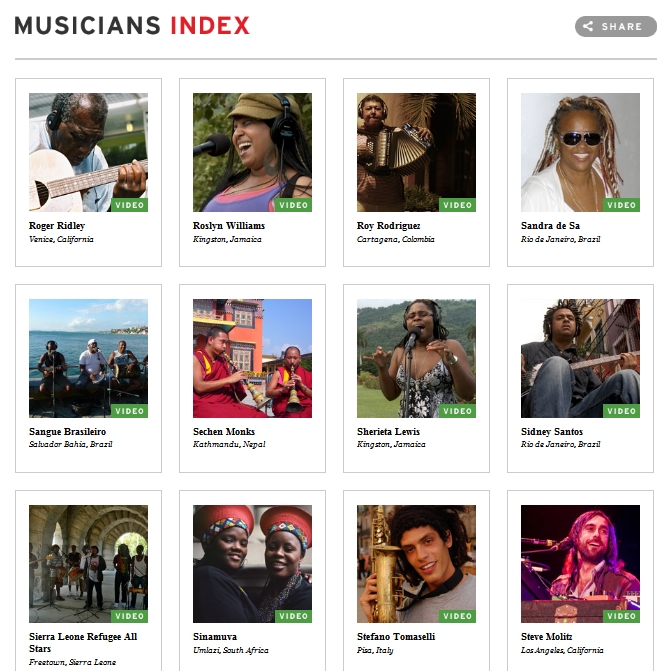
“Good grief, Lisa, will you never just be satisfied with a good thing when you see it?” I hear you asking. And the answer is no, I will always want to look critically at an organization to find its shortcomings, so that I can 1) be fully aware of what efforts I’m supporting, and 2) be in a position to offer constructive criticism to that organization. Mostly, I saw the artists page, which looks like this:

And then I saw the crew page, which looks like this:

And I thought, “Uh oh, white people, what are you doing?”

Because we are so terrified of being called racists that we won’t even talk about racism in this country, white Americans are sorely uneducated about their own privilege and what they can do about it. This leads to a whole lot of nastiness on the more conservative side of the spectrum, and well-meaning condescension of the “let us tell you how to fix your life” variety on the liberal side. None of which goes very far toward mending race relations in the US.

Granted, the whole aim of this project is to go global, to not be confined to the United States. But look at that crew, and the founder, and the company that owns their for-profit arm; they’re all white folks who are likely living a pretty comfortable lifestyle. Contrast that with the artist pages, which shows many people of color in small, poor villages, and maybe you can see why I’m wary of the relationship.

But after I looked into the site more and saw more videos about the foundation, I’m happy to say I think there’s much more good than harm going on here.

Saving the world is a wonderful goal, of course, so long as you’re aware that you can’t do it on your own or all your way. Fortunately, PFC seems to get this. They hold a passionate belief that music is a uniting force that can and will bring peace to the world. They find musicians who share the same belief, and they work together to put the ideal into practice.

Their foundation came about from asking some of the musicians who came from poorer backgrounds, “What can we do to help?” Not “you should do this” — a crucial difference. It was the musicians who said they wanted to schools to teach the next generation how to make music and be a force for peace. The people of Kirina in Mali took the money and supplies provided and built their own school; no outsider crusaders doing it for them and expecting gratitude. This is the kind of assistance — monetary, material, non-invasive — that activists the world over consistently say is the best, most sustainable kind. Kudos to PFC for getting that right.

Everyone involved in the project is devoted to the idea that music can and must be a force for good in the world, that the act of creating music is a unifying one. I absolutely agree, and it’s encouraging to watch thousands of musicians, videographers, editors, villagers, and audience members from all corners of the earth enthusiastically supporting this idea. Check out the participation page on the PFC site to see how you can support an organization supporting the work of musicians and peacemakers all over the world.

And enjoy the music.

ACAM: Indonesia, or How a 19th Century Dutchman Helped Me Refine My Political Manifesto

While the people of the Middle East and northern Africa are staging wonderful revolutions based on the people’s will, we in the States are fighting hard to serve the needs of the many, and I tell you what, it is a discouraging time. I don’t have the energy to argue with people anymore about why cutting Title X funding is immoral or how disbanding unions will only hurt the economy, not fix state budgets. Things seem to be getting worse and worse, with fewer and fewer victories to brighten the mood.

When I first read the selection from Max Havelaar in The Indonesian Reader, I just got even more depressed. Here’s a piece published in 1860 by a Dutch administrator in colonial Java, written anonymously because it was so damning about the colonial government, and it spells out many of the same problems of inequality, passing the buck, and exploitation that plague the modern world. The excerpt describes a system that exploited the native people of Java and surrounding islands (not united into the country of Indonesia until 1949) as a labor force for Dutch business interests. This same system employed civil servants, regional administrators, and others who were too worried about keeping their jobs to report horrific abuses and deaths, lest those reports draw unfavorable attention to their regions. Rather than look to the needs of the people they were charged with protecting, they looked only to the bottom line and worked people harder to turn a bigger profit and get more acclaim from those back in the Netherlands.

I’m not saying that the union workers in Wisconsin, Indiana, and Ohio are in the same situation as the Javanese workers in the 19th century. But the same impulse to human greed and domination runs through both stories, and the government happens to play the role of villain in both. That same story is played out over and over again throughout history, and that’s what struck me as I read this piece for the ACAM project. George Santayana’s famous “those who cannot remember the past are condemned to repeat it” has been trotted out far too many times for it to hold much meaning anymore, but it’s still true, and that’s what scares me. Are we just going to repeat the same stories of oppression and futile resistance over and over, in various horrible forms the world over? And if so, of course the question then becomes, what’s the point in fighting?

I think the answer lies in how we view history. The popular view, certainly the American view, is the linear one; we’re moving in a straight line from barbarism to civilization, and it’s just one grand march of progress and improvement. The other view sees history as a big circle, with highs and lows coming and going as the natural course of things, an inevitable turning of fortune’s wheel. The strictly linear view is clearly false; we can see people reverting to customs and laws from the bad old days all the time, so we can’t always be moving forward. The circle view is too depressing; the human experience becomes an exercise in literally spinning our wheels.

How about a Hegelian compromise? I wish I had artistic skills, because I would draw you this picture I see in my head: a series of circles, moving along a line. Those circles are various wheels of progress, regression, enlightenment, and repression, and we move through those circles as ideas are introduced, developed, and tested. We jump to new circles once those ideas have been accepted into the common understanding, and those wheels keep us spinning slowly forward through history.

It’s the development of ideas that really gets us moving into new wheels of progress and improvement. For example, right now Walker and other politicians are doing their damnedest to do away with collective bargaining in their states and eventually the country as a whole, and they very well may succeed for a period of time. But the idea of collective bargaining, which at one point in history wasn’t even a possibility, has settled firmly in the national consciousness, and what’s more, the practice of that idea has shown how easily it can be done. That’s going to make it harder to kill the idea completely, and if an idea is still alive, a movement can still survive. What’s more (and here I’m trying real hard to be positive about the current national situation), when the idea of collective bargaining survives, it should survive as a stronger idea. Right now, we see collective bargaining as a luxury afforded to certain professions, rather than a basic right of workers worldwide. As we spin about in this wheel of government bullying and corporate greed, those who fight for workers’ rights may be able to convince the general public of this difference between luxury and human right, and at that moment, we will jump into the next wheel. That will have its own ups and downs, as spinning wheels do, but it will be within this broadened national consciousness, and the discussion will grow ever more equitable.

Just as slavery was once a fact of life and is now a banned and abhorred practice, though we still fight to free trafficked persons; just as women were once the property of their husbands and now hold national office, though we still fight for their bodily autonomy; just as sodomy was once a crime and now gays and lesbians live openly, though we still fight for their right to marry and raise families — in these ways, will we continue to make strides for human rights in a world of greed and corruption.

I still feel my blood pressure rise every time I read a newspaper, and I still cry when election results are announced, but throwing up my hands in despair and deeming it all too big a problem to fix just puts me at the mercy of that spinning wheel; if I stick with it and join with others for our collective good, I can help push us over to the next one, the one with a better starting point than the one I was born into.

As Multatuli says in Max Havelaar:

After all, who would maintain that he had seen a country where no wrong was ever done? But Havelaar held that this was no reason for allowing abuses to continue where one found them, especially when one was explicitly called upon to resist them.

And we are all called. Decency calls us, history calls us, the future calls us.

The Good, The Bad, and The Silly

The Good

Okay, it’s not good that these wanted posters for abortion providers are making a comeback. But it is good that Flip Benham is being found guilty in a court of law for posting these dangerous, vile things.

Michelle and Barack get down in Indonesia! Love it.

I know I read in some Forster novel (I think it was Howards End) an argument among hoity-toities about the foolishness of just giving money to poor people, instead of attaching strings to tell them how to spend it. But those characters may have been on to something — apparently giving people even a dollar a day that they can spend any way they like is more effective than any other program at getting more poor kids in school, for example. Sure, some people will spend that money on drugs or drink, but so will some people who work in an office, and you don’t see us stipulating how salaries are spent. Most of the time, though, people just want money to feed, shelter, and clothe their families, and this is one way to help them do that.

The Bad

Damn it, government officials who knowingly destroy evidence of government wrongdoing should be prosecuted for their crimes, not given a free pass. But the Obama administration disagrees.

This is a month late, but it’s still worth seeing this compilation of hateful, untrue, and dangerous things that Tea Partiers have said. You know they’ll be back in 2012. Know your enemy, etc.

Oh don’t worry, John Shikmus (R-IL), who hopes to chair the House Energy Committee, reassures us, “The earth will end only when God declares its time to be over. Man will not destroy this earth. This earth will not be destroyed by a flood.” I’m so very comforted.

The organization that Thurgood Marshall called the “uptown Klan” is funding some schools in Mississippi. Take action to ask the Mississippi Association of Independent Schools why it accredits those schools and encourage the corporations that donate to the MAIS to make sure their donations aren’t being funneled to white supremacist, anti-gay schools.

Ask the Obama administration to change its policy on not sending condolence letters to the families of servicemembers who died by suicide. (I especially like Melissa’s point that there are many deaths in the military that are called suicide that may be anything but.)

The Silly

Here’s a cool interview with Brian Eno, a man more equipped than most to coax new and interesting sounds out of any machine on hand. I like what he says about how different forms of listening to music affect how we listen to music and also the music itself, and how he’s getting more and more interested in studio sessions that don’t sound quite so perfect.

Leave your interesting links in the comments, as usual, and have a great weekend!