At My Pace: In Defense of Slow Walking

Sometimes when I’m ambling down the street and fellow city workers rush past me, I sing a little song to myself: “I’m a slow walker and you think it’s not fair, but I’m a slow walker and I don’t care.

Slow Walkers on Track sign

...on track to my destination! Boo-yah?

Friends have tried to make me speed up but that just makes me want to drag my feet out of stubbornness. City walkers move impatiently past me, but I don’t rush from place to place and I don’t see why I should. I don’t stand and gawp in the middle of the sidewalk, and I keep to the right so it’s easy for people to pass me, so I don’t understand the sighs of frustration as people do pass me. There’s sidewalk enough to share!

At my pace, I’m able to see little things to brighten my day or amuse me, like a kid making up a hopscotch game as she waits for the bus with her mom. At my pace, I can look around and enjoy the sights, and feel like I’m really a part of whatever place I’m in.

I’m a slow walker at home and I’m sure that won’t change when I go on my trip. Since most of the time I’ll be doing my own thing, it shouldn’t be an issue. I will have to speed up some if I go on tours, so as not to slow down the whole group, but otherwise I’ll see foreign sights as I see hometown ones–at my own pace.

Image from here.

Elegy for the Saturn

This past weekend, I sold the Saturn. You may remember this car from a post I wrote last year pleading for just a few more miles of functionality. The car came through wonderfully, I’m happy to report, but seasons have changed, and even in this bizarrely mild winter we’re having, the car isn’t holding up so well. That, plus the registration and insurance fees and the always-high gas prices, and it became clear that I should say farewell to the car sooner than expected. But who knew it would be such a sad experience?

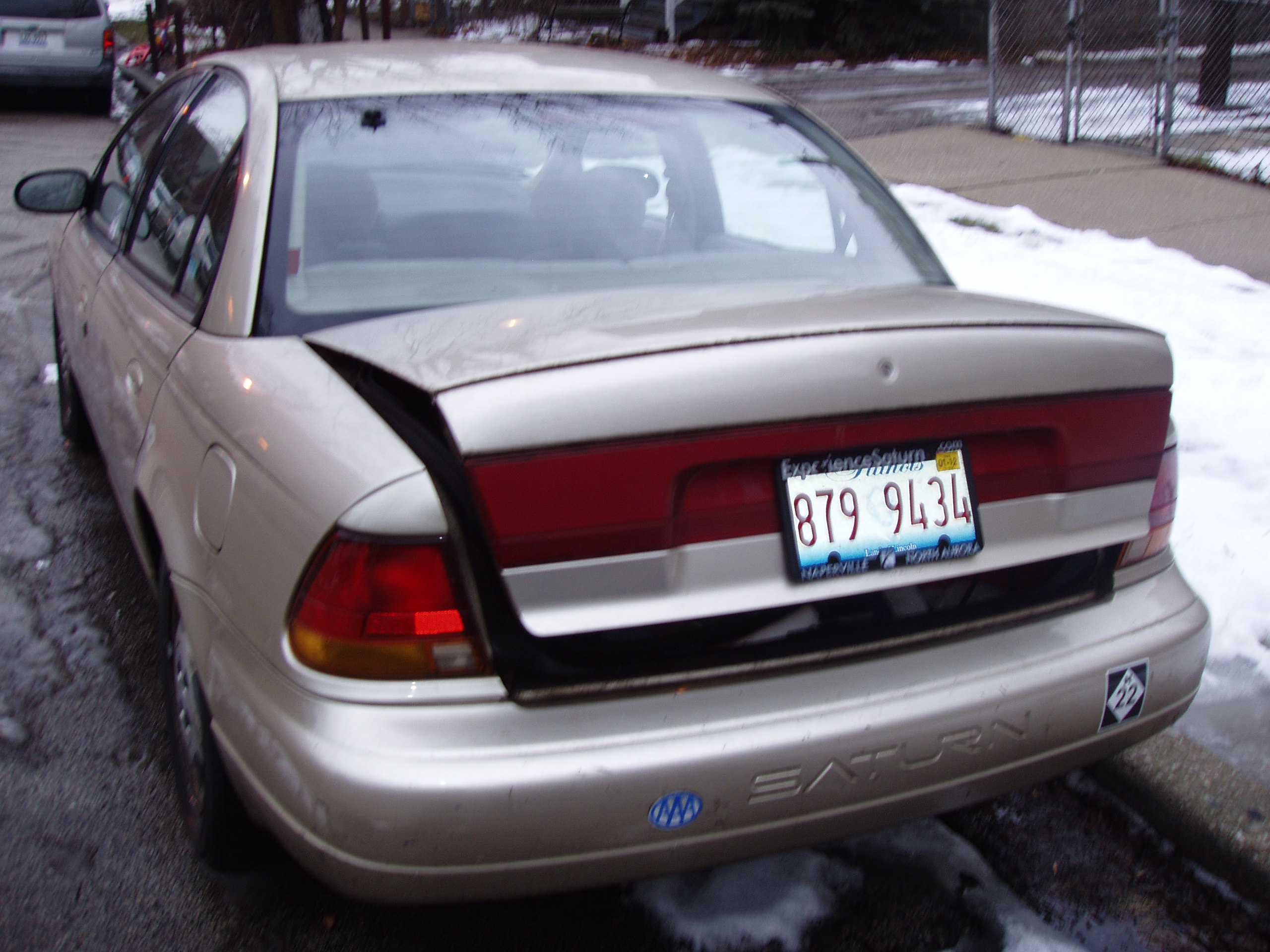
The M-22 sticker says you're a Michigan car forever, no matter what the license plate claims

The actual selling of the car was really easy. I went to the CarMax out in Glencoe, and after a short wait, a nice gentleman chatted with me about his tour of duty as a medic in Vietnam while an appraiser checked out the car. The company offered me $200 (oh how far you have fallen, Mme. Sunroof), I filled out the paperwork, and voila! They had my car, I had a bank draft, and my friends T&K picked me up to take me back to the city. No problem. But I was almost teary-eyed as I signed the paperwork. I don’t think my parents or siblings were untouched either, when I told them about it. This car has been in our family a long time.

It’s a ’96, and my dad bought it new in September of 1995 to use on his trips around the state selling phone systems for AT&T. After a few years, he got another car and the Saturn became the main vehicle the twins and I learned to drive in. We used it through high school, and after they graduated, my parents sold it to me and I took it from Kalamazoo to Naperville to Chicago. It’s sixteen years old and has seen a lot.

This car has been to Ohio, Pennsylvania, New York, and New Jersey. It’s crossed the Canadian border. It’s been up north in Michigan and in the western suburbs in Illinois. It’s been through Indiana as quickly as possible (“Crossroads of America,” indeed). This car has been in two fender benders, at least two traffic stops, and no major accidents. It’s been through ice, wind, snow, fog, and a summer hailstorm. It’s been to beaches, farms, forests, cities, and the very edge of a swamp.

This car has been the site of acts of passion–raging fights, tearful make-up talks, and fevered make-out sessions. It’s blasted hip hop, rock n roll, Beethoven, and Beyonce. It’s seen feasts of candy, pop, fast food, homemade granola, and giant sandwiches. It’s been the designated driver. It’s been the speeding driver. This car has been the solution to problems, the means for movement, the impetus for plans. It’s been the starting point for road trip dreams and fantasies of escape, and finally, it’s always been the way home.

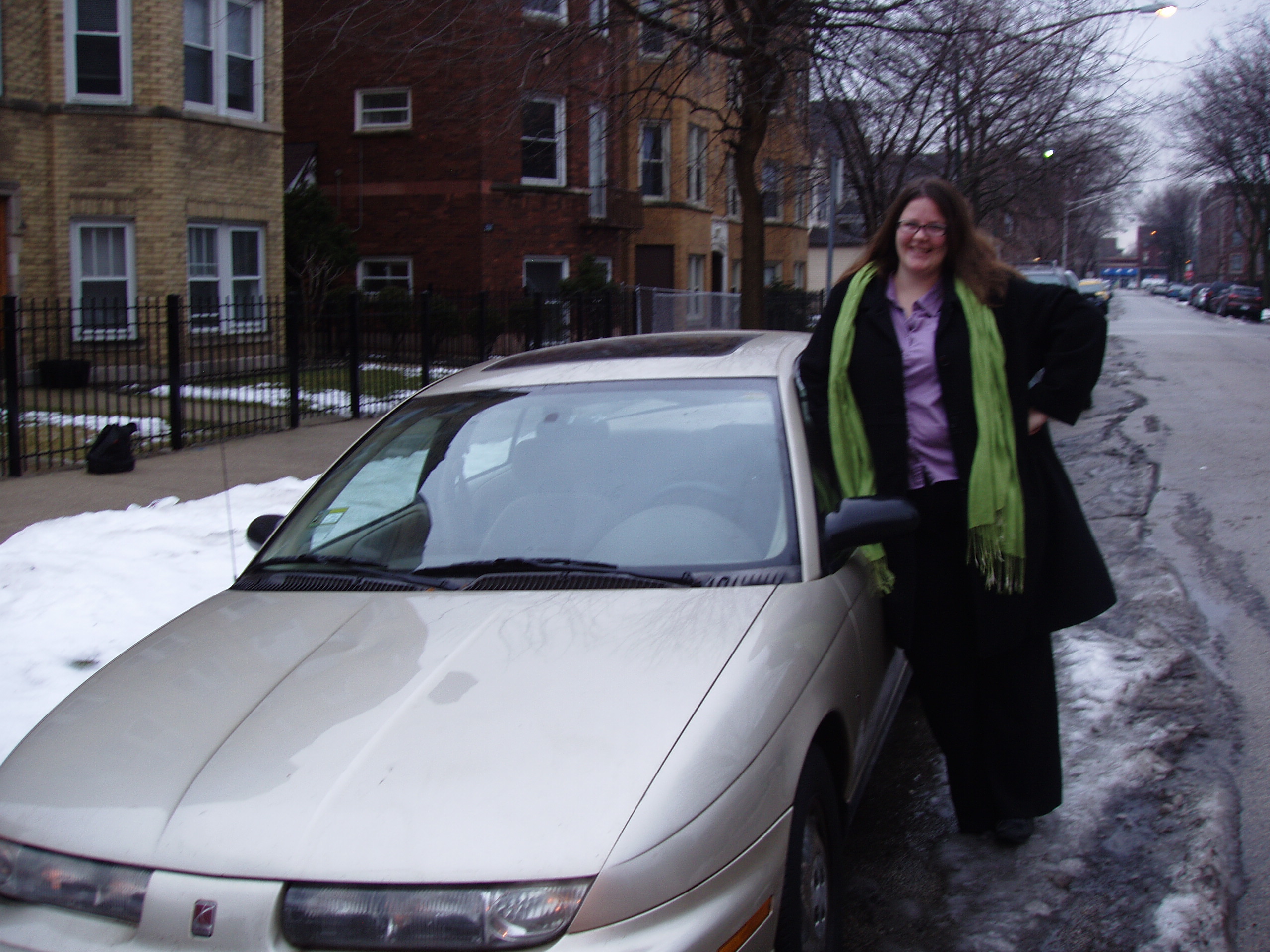
BFFs forever

Here are some things I found when cleaning out the Saturn:
48 cents in change
1 euro coin
11 maps
1 baggie of q-tips
2 safety pins
an entire winter wardrobe in the trunk (hat, sweatpants, jeans, two shirts, even undies–you need to be prepared in the Midwest for whatever the weather might throw at you)
3 quarts of motor oil
1 first aid kit circa 2003 (judging by the expiration dates)
2 flashlights
1 mostly-working umbrella
2 hair brushes
1 fossilized French fry
1 snow shovel
2 blankets
handwritten driving directions to my dorm room freshman year of college

Rest well, Mme. Sunroof. And in the words of Neil Young:

We’ve been through some things together
With trunks of memories still to come.
We found things to do in stormy weather
Long may you run.

Long may you run, long may you run,
Although these changes have come.
With your chrome heart shining in the sun,
Long may you run.

Quick Blog Note

Do you “like” Stowaway on Facebook? I’ve set up a page on FB so I can remind people to check into the blog, and I’ve also started posting links to interesting travel articles I read on other sites, so that it can become a hub of travel talk in general. (Check out today’s post, for example.) I usually post on the Stowaway wall 2-3 days a week, so you definitely won’t be inundated with FB wall spam. Also, anyone can write on the Stowaway FB wall, so if you find your own interesting link, just post it there, and be sure to use the “Everyone (Most Recent)” view of the wall to see posts made by not me. Click that “like” button today!

You can also sign up to have Stowaway added to your RSS feed, or set it up so that you receive an email each time there’s a new post. You can do that right here on this page (see the “follow this blog” box to the left).

There are a lot of ways to make sure Stowaway is a daily, integral, essential, more-important-than-brushing-your-teeth part of your life, is what I’m saying. And isn’t that all what we’re looking for–a blog to shape our every waking moment?

Have a good weekend, dearest fellow travelers. See you next week!

New Centerstage Review Up

I saw another play! It was… unsatisfying. A story about two hoarding brothers in 1930s Manhattan has a lot of possibility, and yet we spend more time with a pair of stereotypical Irish cops than with the eccentric hoarders. This could’ve been a kind of Grey Gardens, if it had stayed focused. Ah well–there were some good parts, especially the physical comedy bits. Here’s an excerpt of my review:

Homer spends the entire first act of the play trying to get away from Langley, although he’s bound by a promise to his father to take care of his naïve younger brother. When the tables are turned in the second act and Langley takes care of Homer, there’s an opportunity to explore what that means to each of them, but instead we’re asked, “Am I my brother’s keeper?” and are told, without subtlety, “yes.”

You can read the rest of the review at Centerstage.

Aesthetically Speaking: Lizzie McAdam

Please welcome Lizzie McAdam to the Stowaway team of travelers. Lizzie did a lot of theater in high school and college, has taught in the NYC public school system, and is currently getting a master’s in drama therapy at NYU. She’s a lovely and talented person, and here she shares with us a bit about what it’s like to combine an artistic format with a therapeutic goal. Thanks for sharing, Lizzie!

What is your name and city of residence?
My name is Lizzie McAdam, and I currently live in Brooklyn.

What medium do you work in?
I am currently working towards a Master’s degree in Drama Therapy at New York University. I am training as a therapist that uses theater-based techniques as part of the therapeutic process.

How often do you work on your art–is it a full-time endeavor or something you work on in your spare time?
I am engaged in the program full time. In terms of making art, I am currently working on a theater piece with some of my fellow classmates entitled Race as Performance. This project is a theater performance, but is also part of an arts-based research project that explores the question, “Is race playable?” This project arose out of our experiences engaging in dialogues around race that felt unplayable, stuck, or even harmful. We wanted to create a piece that would encourage dialogue and playability around the (sometimes scary!) topic of race.

How does art fit into your life, in general? Is it something you think about and talk about every day, or every week, or only in certain situations, etc.?
I think about theater and art all of the time! My work as a therapist involves working in metaphor and thinking about aesthetics. I also try to get out and see as many concerts and shows as my budget will allow.

When you start on a piece, what kind of end result do you have in mind? Does it get performed or published, put in a permanent form or is it more temporary?
This specific research project came out of our general desire to engage in a dialogue about race that allowed people to be safe while also taking risks. The performance was an end-product designed to engage audiences in this dialogue, but the rehearsal process–wherein we told our own stories around race–was essential to exploring the playability of race for ourselves. As we often say in drama therapy, we can’t ask our audiences to go to a place we haven’t been ourselves.

What goals do you set in relation to your art, both short- and long-term? Is it something you hope to make money doing, or is it something you want to keep uncommercialized? Does the term “sell-out” hold meaning for you or do you see the art/commerce relationship as a necessary one?
We have no financial goals for this project–admission is free. Instead, our research process is focused on the experience of the audience and whether or not they are able to play with race–in short, we seek the answer to our research question, “is race playable?” I think the answer for all of us is that we want it to be, and it’s important that we engage with the audience in a talk back after the performance in order to further the dialogue. I think it’s probably not surprising that a group of therapists-in-training are interested in the process and experience of the audience!

What role does collaboration with others play in your art, if any?
Without collaboration this piece would not have been possible.

How conscious are you of your artistic influences? Who are your artistic influences?
We have many artistic influences in the drama therapy world, but I have to say that our director, Nisha Sajnani, has been an incredible role model for us all as burgeoning therapists and arts-based researchers. Nisha is the President-Elect for the National Association for Drama Therapy, and currently works as the director of the Drama Therapy, Community Health and Prevention program at the Post Traumatic Stress Center in New Haven, CT. In addition to her extensive background in trauma work, she writes extensively about social justice and advocacy issues and is, in short, an inspiration.

For those people interested in learning more about drama therapy and arts-based research, I am including a list of references for further reading! 🙂

Since this is a travel blog, how does travel relate to or affect your art? (Themes in what you produce, road trips to perform your music, thoughts on what happens to your painting when you ship it across the country to a customer, etc.)
We hope to take this current project to various conferences, schools, and lectures as an educational piece that encourages discussion around the topic of race. We hope to reach both the drama therapy community, as well as the wider community of anyone working in the helping professions or who is interested in dialoguing about race. We may also write about the research process for this piece to contribute to the larger field of arts-based research.

And finally, a right-brain question: If your art was a map, what would it be a map of?
I think it would be more like a web that connects people to one another. So a map of human relationships, I guess!

If you’d like, share your website/Facebook page and any upcoming gigs/plans you’d like readers to know about.
Here is the info on the performance:

New York University
Steinhardt School of Culture, Education, and Human Development
Department of Music and Performing Arts Professions
Drama Therapy Program Presents:

Mama Always Said, ‘Don’t Play with Fire’
Race as Performance
With Ashley Kleinman, Lizzie McAdam, Amber Smith, Dana Trottier and Britton Williams
Directed by Nisha Sajnani

An arts-based research performance exploring the question: Is race playable?

WHEN: Friday, January 27th, 8:00pm

WHERE: Black Box Theatre, Pless Hall, 82 Washington Square East, New York, NY

TICKETS: Admission is free, but you must reserve your tickets. To reserve your tickets, please call the NYU drama therapy office at (212) 998-5402.

This performance is a part of the Drama Therapy Program series, “…as Performance,” made possible by a grant from The Billy Rose Foundation.

Continue reading

New Centerstage Review Up

I forgot to post this when the review came out last week, whoops. Last week I saw Twyla Tharp’s “Come Fly Away” at the Bank of America Theatre (does any other theater name make you feel less in the mood to see a show?). I don’t know much about dance, so I cannot speak to the technicalities of the performance. But I know about grace and sensuality, and I can tell you that there was so much of this on display in this show. Definitely worth it if you have the spare cash!

The show is 80 minutes of dance set to a combination of a live big band and Frank Sinatra recordings. Here’s an excerpt of my review:

Each set of principals delights, but the two duets by Ashley Blair Fitzgerald and Anthony Burrell stand out. Their tense, charged “That’s Life” thrills, and the lonely “One for My Baby” saddens and soothes. Tharp features the men as often as the women, and the various moves they perform highlight just how versatile and graceful the human body is.

You can read the rest of the review at Centerstage.