
Garden of the Gods, Colorado, July 2005
Garden of the Gods, Colorado, July 2005
Here’s a fun one: Pulp Fiction as told in Shakespearean verse. Well, only sometimes in verse, but always in olde tyme language, which makes for some great moments of recognition when the audience hears an infamous Tarantino line translated into Jacobean vocabulary. Here’s an excerpt of my play review:
Zagoren’s Vincenzio has a good amount of John Travolta’s take on the character, but he adds a wonderful hangdog quality that bounces off King’s angry Julius well. Christopher Kidder’s direction is fast-paced, and the production finds a rhythm that suits both the prince of pop culture and the true Bard.
You can read the rest of the review here. It definitely needs to be shorter, and do we need the whole offstage rape scene? I think we do not.
But otherwise, it’s a good romp. Tarantino’s films are talky anyway, so moving this to the stage didn’t lose much in visual terms. And then there are the little touches: The guy doing Butch’s dad has Christopher Walken’s cadence down pat. Pumpkin, the guy who robs the diner with his girlfriend, wears a Hawaiian shirt–with leather laces down the middle, just like men’s blouses of old.
It’s fun. Grab a drink (looks like you can have them in the theater), settle in for the first half, and frankly, skip out on the second half to make your own bard-inspired mischief.

Superdawg, Milwaukee & Devon, Chicago, IL, April 2009
I’ve traveled by plane, train, and automobile. I’ve taken taxis, subways, horseback rides, and the English Channel ferry. But I’ve never traveled by sailboat or large ship, and I think this trip might be the time to start.

Luxury liner
Now someday Heather will convince the rest of us in the family to join her on a cruise, and that will be fun. But in the meantime, it’s possible to travel by large ship with a little less glamour but just as much comfort. You can hitch a ride with a cargo ship. When I first heard about this mode of transport, I envisioned rattling around in a vast ship full of container boxes, peeking my head out from below deck occasionally.
But the reality is much nicer: you pay for a room with its own bathroom, you dine in the officers’ mess, and there’s usually even a swimming pool on board. It actually sounds like the perfect way for me to travel; there are no more than 10 other passengers on the ship (since if there are 12 or more, they’re required to pay to have a doctor on board), and the crew is all busy with sailing the ship and looking after the cargo, which means little need to socialize and lots of time to kick back and relax. Of course, it’s more expensive to travel by ship than it is by air, because it takes many days as opposed to many hours. But the slower pace, and the endless ocean views, are appealing.

the sailing life
The other boating method popular among travelers is sailing. You can join up as part of a crew and work for passage, or you can pay a certain amount per day and sail as a passenger. I’ve been on a sailboat all of once in my life–although that was in the little harbor of a Greek island, not bad–so I’m not sure any crew would hire me on. I’m also not entirely convinced of my abilities if they did let me on, but maybe I’d be a fast learner whose muscles would be much stronger than expected? But sailing as a passenger, chipping in with cooking, rocking to sleep on the waves… I could do that.
Anyone have sailing experience and access to a sailboat this summer? Want to show me the ropes? (Ooh, I bet that’s where that phrase came from.)

Houses of Parliament, London, January 17, 2004
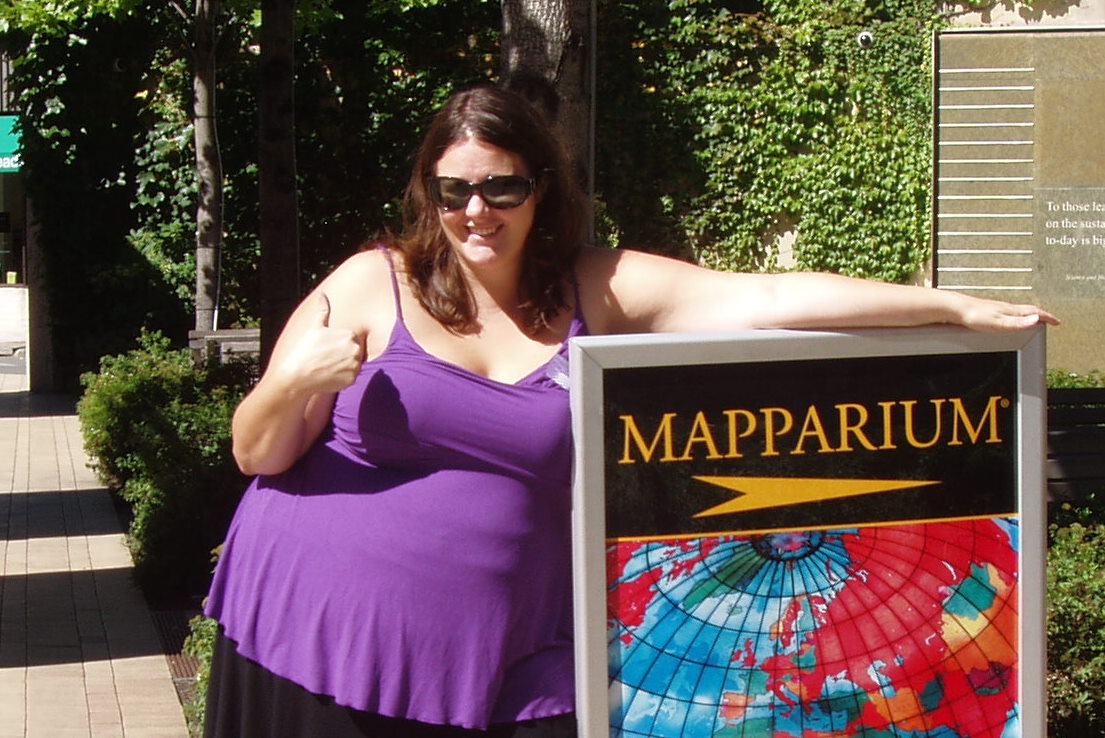
“You get to walk into the middle of the world! You can be inside a map! This is basically all I’ve ever wanted out of life,” I said with only slight exaggeration. Luckily, my friend Mike agreed that a three-story glass globe sounded like a good tourist destination, so I put the Mapparium on the itinerary for when I visited him in Boston over Labor Day weekend in 2010.
tourist pose!

Christian Science headquarters

Journey to the center of the earth
The Mapparium was finished in 1935 and has been refinished but not changed since then. This means that the map shows the political world as it was pre-World War II. Many countries that don’t exist anymore appear: the Soviet Union, the Belgian Congo, French Indochina. Many countries that now exist didn’t then: Israel, all the ‘stan countries. The recorded message man talks about the decision to keep the map as an historical document, rather than updating it when wars and politics redraw the borders.
And then the propaganda sets in. The recorded guide describes the story of modern history as one of humanitarian triumph and progress. I’m not against this idea on principle (although a healthy dash of “and things are messed up too” would help). But the Mapparium takes a pretty selective view of what that story arc looks like; the disembodied voice talks about how democracy saved the world, and the map lights up with democratic countries. Then we hear that some countries still need to join the democracy train, and the map lights up behind those benighted countries. Democratic countries: the United States, the UK, and… Iraq. Non-democratic countries: North Korea, China, and… France. Hmm.

France, the non-democracy
But the slightly silly presentation aside, it’s awesome to be inside the Mapparium. Rather than being in the center of the earth looking out, we’re looking at a globe turned inside-out. The colors are deep and the writing is a little like calligraphy. And it’s endlessly fascinating to look at the changeable borders from eighty years ago. Being literally surrounded by the huge, colorful world was just as lovely and strange as I’d hoped. If you’re in Boston, I recommend it!

1st day of spring, March 20, 2010, near California and Shakespeare, Chicago, IL
Hometown Tourist is a series that hears that chipper tip, “be a tourist in your hometown!” and says, “Okay!” When friends come to visit, I like to show them a combination of standard tourist spots and the neighborhood places they’d never know to look for. Why not write about all those places? If you have suggestions on Chicago places you’d like to see covered for Hometown Tourist, add it in the comments.
For the inaugural Hometown Tourist post, I thought I’d start classy: the Lyric Opera. “Ugh, Lisa,” I hear you all groan. “How boring! And overpriced!” But dearest fellow travelers, let me assure you that it is not boring! And it doesn’t have to be too expensive! I’ve seen three operas at the Lyric over the past five years, and I’ve never spent more than $75 on a ticket. That’s no pocket change, sure, but it’s maybe twice what you’d pay for a show at The Riv, and no one will be spilling beer on you or elbowing past for a better view of the stage here.

The Civic Opera House in Chicago
As to the boring part: I was raised on a lot of different kinds of music, but opera wasn’t one of them, so it’s not like I have an ear for it. But the tunes are stirring and the singing is powerful stuff. When I saw Aida on Tuesday, there were a few moments during Hui He’s solos that actually caused me to catch my breath, they were so lovely. The stories are never too hard to follow, so even when they’re told in Italian or German, they’re easy enough to follow. The emotions expressed onstage would be overblown if they were spoken in a play, but they take on more gravity in song form, and it becomes clear that the only way to truly express love or heartbreak is to devote an aria to it.
Right, so: opera can be riveting stuff, and it can be enjoyed without breaking the bank. Where do you go to see opera? In Chicago, there are a few companies that put on shows, but the biggest, most established one is the Lyric Opera. They have their own building on the Chicago River, and it is beautiful. It was built in 1929, and when they renovated it from 1993 to 1996, they kept the Art Deco style. This means that not only are you classing it up by going to the opera, you are classing it up flapper-style. What more could you ask for?
The theater seats almost 3,600 people, and when my friend Hannah and I were there on Tuesday, it looked to be just about sold out. On a Tuesday night! That’s a lot of music and theater lovers in Chicago, which warms my artsy heart.

That's a lot of aria appreciators
Where is it: Civic Opera House, 20 North Wacker Drive, on the northwest corner of Madison and Wacker
When to go: Weekday shows are cheaper, straight up. If you have a job that isn’t 9-5, they even have matinees, which are much cheaper. The season runs October through April, and show runs overlap.
What to see: Whatever your heart desires! If you wait past opening night, you can read reviews and see if something sounds particularly good. For example, Show Boat is getting raves this year. The only downside to this strategy is that tickets will be few and far between by the time the show run starts.
Cost: Tickets range from $35 to $200. Full-time students can get $20 tickets to some shows.
Some practical tips:
Oh look, I made a 30-second video of Tuesday’s trip to the opera.

East Lansing, MI, February 4, 2012
Here is a shameful secret: I’ve been planning to do some version of a trip around the world for 10 years, and seriously looking at where I want to go for 5, but I didn’t start making any real saving decisions til 3 years before I planned to leave. And I didn’t invest serious money til about a year and a half out. Spoiler alert: this was not smart planning. So although it pains me to admit it, here are the top 3 stupid money mistakes I made while planning for this RTW trip.

Would that this were my personal bank account
1. I didn’t automatically deduct from my paycheck until last year.
My parents had told me since college that the best way to save consistently is to have money automatically deducted from your paycheck and put into savings. This made sense to me, but my first post-college job was a classic publishing starter position in that I made less than I spent (and I only spent on rent, utilities, food, and the occasional movie out). So I was going into debt paying back loans, and by the time I got a decent-paying job in the city, I had enough debt that my new paycheck went mostly toward paying that off for a couple years.
I then looked at automatically deducting from my paycheck and putting it in my savings, but my company doesn’t deduct percentages (like 90% to checking, 10% to savings), only exact amounts. Since I infrequently work overtime that changes the amount of my income, that would cause headaches. I took out money from checking here and there and called it good, but of course that meant I wasn’t saving as much as I should have been, and not as consistently. It wasn’t until last year that I realized, hey, I could let the whole paycheck go into checking, then set it up so the bank automatically moved money into savings once a month. Voila.
2. I didn’t get an airline rewards card until this year.
I didn’t know I could have one! I got a Capital One credit card when I was 18, which my parents had to co-sign. They were taken off the card a few years later, but it’s still the only credit card I’ve ever had. Capital One sends me promotional stuff all the time, but never once have they sent me information on a card that gives airline rewards. None of the other major credit card companies have even spammed me with their offers, which is just an inconsiderate lack of junk mailing.
I always thought of credit cards as ways to accumulate debt, and maybe enough credit to do me good if I applied for a loan on a house or a car. I never thought of them as things that could work for me in other ways. If I’d had a rewards card, I could have enough miles for a couple of flights on my trip already! Oh well. I’m late to the game, but I’m in it. I got a United Airlines Visa and am putting all I can on it until the annual fee kicks in.
3. I didn’t set aside any money for my return to the States.
I’ve always joked that I’d go on this trip and come back broke, but I haven’t really put much thought into just how very broke I’ll be. Lots of world travelers are location independent earners, but I don’t have any freelance writing or editing gigs set up and I’ve found it a hard market to break into, so earning money on the road seems unlikely. This means it’ll be a blank slate when I get back, and depending on the kindness of loved ones until I can get set up with a job, home, etc. My parents weren’t keen to have me rent-free for long when I was 22, so they’ll probably be even less so when I’m 32!
I’ve set up an ING savings account and put a couple hundred in there. I’ll let the compound interest help me out, and make deposits as I’m able, but for now, this is the mistake that’s potentially going to cause the most trouble in the long run. Still, part of long-term travel is accepting that circumstances change all the time and there will be opportunities I’m not yet aware of. I’ll hold on to that for now.
Learn from my mistakes
There you have it! For all my big talk, I sure have been shortsighted and unresourceful in the numbers part of planning. It’s embarrassing to admit, but maybe by laying them out here for you, other travelers can learn from my mistakes. I wish someone had given me this advice years ago, so I’m passing it on in true pay it forward style.
(Money joke!)
 Stowaway Travel Writing & Editorial Services