I’ve finished John Tully’s A Short History of Cambodia: From Empire to Survival, and damn if it isn’t a discouraging read. It’s all right there in the subtitle–Cambodia was once a strong empire with the largest city in pre-Industrial times, an intricate system of canals and farmland, and an impressive collection of intricately carved temples, and now it is one of the poorest countries in the world, riddled with corruption, and desperately trying to pump up a tourism industry centered around the ruins of the greatness that once was.

A Short History of Cambodia
Of course, every country has its ups and downs, and no empire lasts forever. But the way in which Cambodia got totally screwed, over and over, from the mid-19th century through today, is both upsetting and instructive. Basically, although European colonization came late to Cambodia, it came with a vengeance. The French used an anti-missionary assault in Saigon as an excuse to send over a “protective mission” that quickly became a “permanent occupation force” (p.80). From Saigon to Cambodia, and soon they had control over Indochina (the colonialist term for much of Southeast Asia). Cambodia was officially a protectorate, but basically France treated them like a badly behaved colony, giving them strict governors and overhauling their entire system of government with no local input so it never had mass support (even measures like abolishing slavery and setting up schools for children).
By 1954, Cambodia had been caught up in the French fight with the Vietnamese, and the people wanted out. Prince Norodom Sihanouk successfully maneuvered to have the Geneva conference name Cambodia a sovereign nation, albeit with strings attached. I mentioned in another post that the intersectionality of world politics in the 20th century astonishes me, and while I’m sure that makes me sound naive, the extent to which the Cold War affected politics in literally ever corner of the globe in the latter half of the century can’t really be overstated, I don’t think. For example, the only way Sihanouk managed to get Cambodia free of French rule was by promising up and down and back and forth that Cambodia was a neutral country that would never enter into military alliances with any other country. Not to mention he had to beg to have his country back in the first place, and the US and USSR, along with some other countries, granted that. (This granting of sovereignty to nations that already existed and just need their colonizers off their backs is deeply puzzling to me. See reservations, Native American.)

Prince Sihanouk
This is not to say that either world power gave up hopes of using Cambodia in its Southeast Asian chess game, and the US presence in Vietnam went far toward stirring up discontent in Cambodia with the US and any pro-US factions. The Khmer Rouge, staunchly anti-US, started gaining followers. (“Khmer Rouge” means “Red Khmer,” the Khmer being the ethnic people of Cambodia, and the Red being a reference to their Communist affiliation–a context I never knew about or wondered about before. Funny how names can hold one meaning for you–deadly Pol Pot regime!–when they started out with quite another meaning entirely.)
Eventually, the country descended into civil war, with the war-weary Vietnamese, the jungle-hardened Khmer Rouge, the covert-bombing Americans, and the under-supplied national army all entangled in a mess of a fight. When the US and Vietnam got out, it became unwinnable for the national army, and Pol Pot and the Khmer Rouge stormed into power.

Pol Pot, looking creepily cheerful as he palms a gun and plots genocide
Pol Pot’s socialist agenda was extreme. He immediately banned all private property, currency, manufacturing, and education. He force-marched his fellow Cambodians out of the “corrupt” cities and into the countryside, and along the way murdered thousands of people the infamous killing fields outside the city. Displacing hundreds of thousands of people, killing as many, and utterly changing the basic structure of everyday life was not, surprise surprise, a successful plan. The country plunged into disrepair, and Pol Pot went back to war with Vietnam, which no one was equipped to handle. At the end of 1978, the Vietnamese invaded Cambodia and took over for the next ten years.
The sickening thing about this post-DK (Democratic Kampuchea, Pol Pot’s name for his regime) era is the international response. The bloody and drawn-out Vietnam War had done nothing to convince the US that that country wasn’t out to conquer and convert all neighboring countries to communism (the domino theory! a real winner of an idea), and China was equally upset with Vietnam’s perceived overreach into its physical and ideological domain. They were both dead-set on punishing Vietnam for its ambition, so since Vietnam had invaded/liberated Cambodia, that meant Cambodia got to suffer too. The People’s Republic of Kampuchea (PRK, the post-DK regime name) “was cut off from assistance from the UN Development Programme, the Asian Development Bank, the IMF and the World Bank, with only a trickle of humanitarian aid from UNICEF and the International Red Cross” (p. 207). In effect, the international community abandoned Cambodia.

Apparently this is how it was all gonna go down.
Not only that, but Pol Pot had fled when the Vietnamese invaded, and he ran guerrilla options for many years in the jungles, ratcheting up Cambodian civilian deaths with no one pursuing him on any serious level. The Western world was so concerned about the threat of Vietnam ruling Cambodia as a puppet state that it gave tacit (and sometimes material) support to Pol Pot and the Khmer Rouge. I repeat: we supported Pol Pot. Ask anyone with a basic knowledge of the world history of the last century who Pol Pot is, and they’ll tell you, a dictator, a genocidal madman, a brutal murderer. And yet, because it seemed politically expedient to do so, the United States and other countries supported him for a number of years, until Cambodia proved it was no Vietnamese puppet nor Communist state, and aid could be sent without troubling the conscience about the red threat (p. 213). And Pol Pot died peacefully in his sleep in 1998.
The PRK government had its fair share of gross human rights abuses, yes, but if the international community had stepped in with aid right away, and called for the swift and impartial trials of Khmer Rouge war criminals, then it would have been a very different story. Basing foreign policy a paranoid idea like the domino theory is not only foolish, it’s dangerous. It has real consequences for millions of people on the ground. The United States’ treatment of Cambodia in that twenty-year period–from Nixon’s bombings, through the support of the Khmer Rouge, to the lack of basic aid during a famine in 1979–is inhumane and unjustifiable.
So, see what I mean about Cambodia getting the wrong end of the stick for decades? The corrupt nature of its officials on every level, combined with the self-interested interference of neighboring countries and world powers, led to a war-torn nation in which the people suffered mightily. Nowadays, the country is run by a corrupt prime minister, Hun Sen, and millions of people remain in dire poverty. But aid from outside countries (especially China) does help, and the textile and tourism industries have grown the country’s economy rapidly in the last ten years. Education and health levels are rising, as well, and a healthy, educated population is much more in a position to tackle its issues and guide its own path. Cambodia’s recent history is dark, yes, but that doesn’t mean the country doesn’t have a bright future.
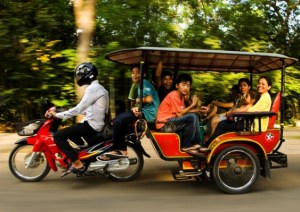
Cambodians moving on
Image 1 from here. Image 2 from here. Image 3 from here. Image 4 from here. Image 5 from here, credit Felix Hug.


 Vietnam in the late ’90s was still recovering from the war of the ’60s and ’70s, and corruption pervaded every level of government, which made traveling outside the rigid parameters of officially sanctioned tourism difficult. Muller wasn’t allowed to go outside the city limits of Saigon on her own, so she had to travel with two guides selected for her by the Communist Party. Her guides fleeced her for at least twice as much as the agreed-upon price, took her to suburbs instead of the villages she was promised, and even hid her shoes during their naptime to keep her from exploring on her own. Later, she shook off her guides and met up with an American with a motorbike, and the two of them went north off the beaten path. But the roads were terrible, the bike broke down literally every day, and they had to dodge any military personnel who might ask for the travel papers they didn’t have. Muller and her American companion didn’t get along very well, but she stuck with him because she needed someone to train the video camera on her for the documentary. She didn’t make friends, and until the last few weeks of her trip, she didn’t see any of the remote villages she’d flown to Vietnam to see. It sounds miserable!



 Stowaway Travel Writing & Editorial Services