Scripts For Your Consideration

Idea #1: Cashing in on the Wedding Movie Trend

Mlle. O’Leary and I were discussing the many weddings we are both attending this year, and we decided we could totally make money off the Hollywood wedding movie trend by borrowing liberally from real life and hokey clichés alike. Girl has ten weddings to attend in one year, and they’re all her close friends and cousins, so she’s a bridesmaid in each. Girl is an Etsy maven, so rather than buy a new dress for each occasion (which she can’t possibly afford, and which she wouldn’t want to anyway because she is Independent and Quirky), she makes over the same dress for each wedding. Of course, she keeps running into the same Boy at all the weddings, and he is always wearing ties that look really familiar but Girl can’t figure out why. There is much malarkey over mistaken identities, wardrobe malfunctions, etc., and in the end Girl’s dress can’t handle any more reworking and it falls apart at the last wedding in a dramatic fashion.

I'm gonna rock that green dress, once it's made into a miniskirt and the sleeves disappear

Image from http://www.ioffer.com/i/McCalls-7847-Wedding-Bridesmaid-Dress-Sewing-Pattern-14898800

In the Hollywood version, Boy helps Girl get to a David’s Bridal, where she realizes she just wants to be like everyone else anyway, and she buys the dress. In the indie version, Boy reveals that he comes from a long line of tailors, and works some magic that makes her dress more beautiful than it ever was before. (Even indie movies have to let the boy save the day, after all.) Boy and Girl realize that the ties he’s been sporting at all these events are from her Etsy shop, so it was Totally Meant to Be.

Hollywood title: Sew in Love. Indie title: Fitting In.

Idea #2: Punking the MBAEs

I saw an ad on the train for an MBAE program — a Master’s of Business Administration for Executives. So instead of just getting a post-graduate degree in how to make more money than everybody else, you can get a post-grad degree in how to make way too much more money than everybody else. Yay?

it ain't good

Image from http://www.financialsense.com/contributors/james-quinn/the-age-of-mammon

Script goes like this: A fresh batch of MBAE students, eager to learn how to make hard deals, screw over their workers, and buy ten yachts in the process, enters the class of Teacher. Teacher is actually a plant from the unions (evil unions!) sent to fix the American Dream from the top down, but passing as a billionaire coming out from retirement to share his pearls of wisdom (it has to be a he, or they won’t listen) with this generation of CEOs. So eager are they to learn Teacher’s secrets, the MBAEs take all sorts of lessons in ethics, collaborative work, and diversity. They’re transformed from evil future CEOs into decent people, and they wield their power for good, bringing the pay disparity back down to a reasonable level and redistributing wealth across the land.

Hmm, that is perhaps less a great movie idea than a utopian fantasy, but I’m seeing it as a comedy, with all these middle-aged men doing homework on collective bargaining, first certain that this will help them learn how to crush such bargaining, and then looking bewildered as they realize they don’t want to. “What is happening to me?” they’ll cry, as tears stream down their faces and they don’t even call each other homos for crying like a little girl. They’ll all be too busy hugging and setting up universal health care.

Investors interested in making these ideas a reality, please apply within.

The Headly Surprise: Up in the Air

Welcome back to another round of The Headly Surprise! Today’s honoree is Vera Farmiga as Alex in Up in the Air. This 2009 film follows middle-aged Ryan (George Clooney) as he crisscrosses the country firing people for companies too chicken to do the firing themselves. It’s a bleak premise, and the movie carries that feeling throughout, not least because Ryan is, by nature and by habit, kind of a dick. He gives lectures on how to stay emotionally disconnected from others, and he has a trunkful of reasons why his job is helping people rather than devastating them. Of course, Ryan is played by the puppy-dog eyes and aww-whatever-I-did-I-promise-not-to-do-it-again-baby half-smile of George Clooney, so we can’t totally hate him.

Vera Farmiga Up in the Air

I ain't lookin' for love, but I am looking at you. (photo from http://www.altfg.com/blog/awards/sag-awards-2010-best-supporting-actress-7894/)

Our wayward hero meets Alex in a VIP airline lounge, and they bond over car rental discounts and credit card miles before having a passionate night in Ryan’s hotel room. They sync their calendars to meet up again in various cities around the country, as both their jobs keep them almost perpetually on the move. All goes well until Ryan’s young colleague Natalie lectures him on using Alex instead of committing to her. [**SPOILER ALERT**] Ryan feels inspired to ditch his emotionally stunted viewpoint, and he surprises Alex at her Chicago home in one of those grand romantic gestures that the movies have primed us to receive for decades. But uh oh! Alex is furious that he’s shown up, since she’s married with two kids, and he could ruin her home life with any displays of affection. Ryan returns to Omaha and his previous life a bit sadder and, of course, a bit wiser.

Alex’s Headly Surprise status rests in the way the movie handles this big reveal. There’s no commentary on how her cheating is immoral, or how it makes her a bad mother. In fact, the movie does a neat job of setting Alex up to be a Manic Pixie Dream Girl character, there to help Ryan find himself without having her own personality, needs, or desires; it then inverts those expectations by showing that this part of her life, which is so central to Ryan and the movie, is merely in her periphery. Her real life is with her family, and Ryan, fond as she is of him, is just an escape.

And she made no bones about that. Sure, she never told Ryan she was married, but from their first encounter, she sets up their boundaries so they’re both on the same page; she wants a no-strings-attached, uncomplicated, passionate affair. This is what Ryan wants too, and it’s why they work so well together, at least until he starts to fall in love with her. Then Natalie gives him that push over the edge into acknowledging his feelings and suddenly he doesn’t just want a passionate affair anymore.

About Natalie’s speech: she’s not wrong to tell a grown man to stop leading a woman on and tell her how he really feels and take steps toward building a life with her. She just happens to be wrong in this instance because she doesn’t know what Ryan does, namely, that Alex explicitly said what she did and did not want. Alex even expresses this at the end of the movie, saying how surprised she is at Ryan’s hurt, since she never said she wanted more than what they had and she’d thought they were on the same page with that.

This is a wonderful example of listening to what a woman says instead of listening to what you think she means, or what you want to hear. We are far too ready in these United States to dismiss a woman’s words as game playing or indecisiveness, rather than her actual thoughts and feelings. This has very real and dangerous consequences, of course–see all the men who stalk women who have told them they aren’t interested, or the men who rape women who say no, or the legislators who tell women that they don’t really want an abortion no matter what they say. There are other, less physically harmful, consequences to this line of thinking, too, like assuming a woman must be coyly angling for a commitment when she says she needs no such thing. This robs women of their agency and reinforces the idea that they’re untrustworthy, scheming beings instead of autonomous individuals fully capable of making their own decisions and expressing their own desires. If our needs and wants aren’t heard when we plainly state them, it’s no wonder some women start speaking in the code that’s expected of us, just to eventually get the desired result one way or another.

Anyway, Ryan is clearly upset by what he sees as Alex’s betrayal, but he doesn’t argue with her that she was anything but upfront about their relationship. The film honors her character as a three-dimensional person who makes the possibly ill-advised decision to cheat on her husband without punishing her explicitly. It hurts her to lose Ryan, but we get the sense that her life will carry on without him pretty well, and she’ll maybe think of him wistfully in a hotel here and there. That kind of complex characterization is rarely afforded to women who cheat in film; they’re usually shown as sluts or too simpleminded to make up their minds about which man to love more. Alex knows which man she loves and builds a life with, but she’s not above finding some good times on the side as she travels for one-third of the year. She’s not perfect, but she’s not a devil, and for that, she earns The Headly Surprise.

By the Way

I figured out how to embed non-YouTube videos, so if you read Tuesday’s post, you can now play that video right in the post.

Also a little late, I figured out how to insert animated gifs too! So the awesomeness of the Jump Back! gif can now be seen in the original post.

Just figuring out all this new-fangled media that the kids today are talking about. Someday I’ll ride in a flying machine too!

Have a great weekend.

Heckling the Hecklers

When someone’s an asshole to you, what kind of asshole do you get to be back at them? Can you find enough in the situation to destroy their position without destroying their personhood? Such are the weighty questions I pondered after watching some videos on a comedy site. Like ya do.

The premise of Splitsider’s “Eight Types of Hecklers and the Comedians Who Shut Them Up” by Megh Wright is great–what are the different types of people who interrupt stand-up comedy routines and how do comedians respond? But too many of the comedians Wright chose as examples of great heckler shut-downs were unmitigated assholes. I don’t mean they were mean; most comedians have a scale of “a little to a lot” when it comes to being mean in their acts, and frankly that’s usually why we find them so funny. And especially if some jerk in the audience is going to interrupt your carefully crafted routine and your limited stage time with some inane comment or drunken insult, I say rip ’em to shreds. And then call security.

But there’s being mean and funny, and there’s being a bigoted asshole. I suppose it shouldn’t surprise me that so many comedians choose the latter, since I don’t watch a lot of stand-up precisely because they include terrible jokes in their acts, but it still got to me. With few exceptions, if the heckler was male, the comedian joked about his supposed homosexuality and also about fucking his mother, and if the heckler was female, the comedian called her a bitch/slut/whore and usually crazy too. Ugh. I went from being on the comedian’s side to wishing the video would end sooner so I wouldn’t have to hear the audience laugh at the awful attacks.

Here’s a sample [TW, definitely]: Joe Rogan called his female heckler a “fucking crazy bitch.” George Carlin said his male heckler was “a cocksucker in disguise” and that he only had his mouth open “because he wants someone to come in it.”  Bill Hicks, whose profanity is a normal part of his routine, went way too far when he screamed at his female heckler, “you fucking cunt, get the fuck out of here right now, you’re everything that America should be flushed down the toilet, get out you fucking drunk bitch.” But definitely the worst was Ari Shaffir, whose response to his female heckler was, “I wish upon you the greatest success in 2008 and hopefully you will get raped many times before you leave here tonight. But I don’t wanna give the rapist any VD that you have… what did they do? all they wanted to do was get laid, they didn’t know.”

Whew. That was a whole lotta ugly.

And there’s no need! Other comedians in the list had great comeback lines without once employing homophobia or misogyny.

Jacqueline Novak rolls right with her male heckler’s comment and explains just how wrong he is, while remaining in the same joke she had been setting up before she was so rudely interrupted. Steve Hofstetter similarly riffs on his male heckler’s stupid interruption without once making reference to the heckler’s sexuality or his mother’s sexual proclivities. Amy Schumer shut her female heckler down quickly, and then told her to be like the losing chess player in “Searching for Bobby Fischer” and “take the draw” if she felt like talking again. My favorite was Patton Oswalt, who went on a lovely long rant about what a douchebag his male heckler was and how his future was filled with douchebaggery.

Being a stand-up is hard work, I know that, but once you have an audience on your side, it’s real easy to get laughs out of them by dealing low blows to a heckler. Why be satisfied with that? Presumably you actually want to be funny, so skip the bigotry and go straight for the withering put-down.

Jump Back!

Attention! Next week this space will feature a Very Special three-day blogging event. Rory Leahy, dear friend, playwright, and producer, will be sharing with you the road trips he has undertaken in the last two years that have ended in the demise of whatever vehicle he happened to be traveling in at the time. This kind of bad luck and witty writing must be read to be believed, so be sure to stop back here next  Tuesday, Wednesday, AND Thursday!

I had houseguests all weekend, spent last night watching Netflix On Demand while eating goat cheese and crackers, and am currently dealing with a beach house crisis, so I didn’t write a big blog post for you all today, just this small one. (That is probably the bougie-est sentence I’ve ever written.)

For years now, I’ve been trying to introduce “Jump back!” into the lexicon. It’s from Footloose, that seminal dance movie of the ’80s. When the kids tell newcomer Kevin Bacon that dancing is banned in their town, he’s so surprised that he leans back in his chair and says, “Jump back!” I find it the most delightful way to express surprise. I got someone on the Internet to make me an animated gif, is how much I like this:

JUMP BACK! Kevin Bacon in "Footloose"

JUMP BACK!

Jump back!

So go forth and spread the word, spread the gif. It’s even family friendly enough for your grandma or little nephew to use. Be a pioneer! And then rock out to Kenny Loggins!

Your life just got more awesome.

The Headley Surprise: Before Sunrise

Ladies and gents, it’s time for that occasionally recurring Stowaway feature — The Headley Surprise! Today we welcome Julie Delpy and her Before Sunrise character Celine to the canon, and I tell you, I was so pleased with her. In Richard Linklater’s Before Sunrise, French college student Celine (Julie Delpy) meets American post-grad Jesse (Ethan Hawke) on the train from Budapest, and soon they’re disembarking in Vienna and spending the whole night talking, kissing, and watching the morning arrive, before parting ways with promises to meet again in six months. This movie is 15 years old, so I knew the basic story before ever putting it in my Netflix queue, but the execution of that story was more beautiful than I’d expected.

julie delpy before sunrise looks at Ethan Hawke in the train

Julie Delpy, another Headley Surprise

Linklater’s favorite technique is to take a movie consisting entirely of long monologues and philosophical debates, shoot it in an interesting locale or format, and hope that the speeches are good enough to carry the plotless film. (This strategy even mostly worked in Waking Life.) In Before Sunrise, it works magnificently, due in no small part to the magnetic performance of Delpy, who is instantly likeable and entirely believable as a young woman trying to figure out how to move away from her loving parents into a life of her own.

Before Sunrise is often described as a romantic comedy, although it’s more of a straight romance. Either way, Celine defies genre convention. If this were a normal romantic comedy of the last thirty years, Celine would be desperate for a man, but too uptight to get one (in adult rom coms) OR she’d be too strange or superficially unattractive and in need of a makeover in order to realize she wants a man and can win one (in teen rom coms).

Some of it is a function of the age of the characters; in adult rom coms, it is all about MARRIAGE and BABIES and THAT BLAND POTTERY BARN FURNITURE SET THAT PROVES OUR ETERNAL LOVE,

The Proposal Sandra Bullock

"I am telling you for the last time, I have a very busy career -- oh all right, if you're going to insult me like that, I give in. Kisses!"

and in teen rom coms, it is all about POPULARITY and DEFLOWERING and ADMITTING THAT NO MATTER HOW SMART YOU ARE, WHAT YOU REALLY WANT IS A HOT GUY TO LOOK AT YOU TWICE.

Rachel Leigh Cook in She's All That wears glasses

"Wait, did you just glance my way? I never thought to brush my hair before now! All my artistic dreams seem silly compared to being your prom date!"

Celine is in her last year of university at the Sorbonne,  so she’s in that particular place of in-betweenness and uncertainty, as you start to realize that you are not as worldly as you thought you were at age eighteen, and that actually the world is kind of terrifying if you have to navigate it totally on your own. She’s not in any popularity contests anymore, and people haven’t started asking when she’s going to settle down yet.

Ages 21-24 are pretty scary territory to navigate, but they’re also a time of great freedom in Western society, when it’s ok to not be just like everyone else. You were expected to toe the party line in high school, and you’d better start cultivating domesticity soon, but for right now, you can try other things, maybe even see who you are without all those expectations. So age is definitely a factor.

But Celine could still be desperate for Jesse to find her attractive and do whatever he liked to get that attention. She could find herself in a dangerous situation with this strange man and be told she asked for it by not being more careful. She could laugh at all his jokes and agree with whatever he said so as not to appear too smart or threatening. But she does none of these things (ok, she does laugh at his jokes, but fair enough, she seems quick to laugh in general). She has her own opinions and she states them. She is comfortable in her own skin and doesn’t seem at all concerned by wearing her rumpled traveling clothes while flirting with Jesse. Here’s the other factor – she’s no Manic Pixie Dream Girl (damn Nathan Rabin for coining a term I’ve been trying to define for years).

MPDGs are women with childlike interests and worldviews who spontaneously attach themselves to the mopey hero of the tale, who is in serious need of some life-altering sex and full-fledged adoration from a woman with no discernible personality other than “quirky helpmeet.” (See Garden State, Along Came Polly, half the cast of Love Actually.) MPDGs are usually assigned to comedies, but they can be found in dramas and romances, too, especially in death dramas like (Sweet November, Love Story, etc.).  Jesse is clearly a mopey man in need of some life altering, but Celine doesn’t exist just for that purpose; you can see the story equally as that of an energetic woman in need of some conversation and life affirmation. (Hint: if you can switch the focus of the story fairly easily from one major character to another, you have two fully developed characters.)

Celine and Jesse do eventually have sex, but not until two important things are said: 1) Celine goes back and forth a bit on the issue, but not as a tease; she’s genuinely trying to figure out if this will ruin or perfect a lovely night. She expresses her concerns to Jesse, saying something along the lines of, “I think I wanted to sleep with you as soon as we got off the train, but now I don’t know.” She tells him she doesn’t want to sleep with him just so he can go home and brag to all his buddies about banging a French girl in Europe. 2) Jesse responds by saying that it’s not that important that they have sex, and even though he clearly really wants to, there’s no implication that he thinks she’s a frigid bitch for not doing it, and it’s clear that she is a person he cares about and so she wouldn’t just become bragging rights.

How often do we hear these kinds of conversations take place in the movies? These are real concerns in the real world, and they have a lot of dramatic potential, too, from an artistic perspective. They humanize the characters so much, and when they do start kissing and roll over into the dark to begin undressing, it is sexy and sweet at the same time, and not a boring inevitability or titillating display.

julie and ethan stare deeply into one another's eyes

Oh yeah, they totally do it later

A palm reader appears at one point and tells Celine that she will grow into a great woman. She then gestures to Jesse and says “he’s learning,” which Jesse finds insulting, as if he doesn’t matter, but it’s true that his outlook is much less mature than Celine’s. We get no sense that Celine is settling, though, when she spends the night with him. She’s figuring out what she wants in life, and for this night, she wanted him. There’s no slut-shaming and she didn’t do what he wanted to do without regard for her own wishes. She really is growing into a great woman, and this lovely film captures one of the days on that journey.

Of course, there’s a sequel (Before Sunset), and I’m apprehensive about seeing it, but probably I will. I hope Linklater keeps Celine’s intelligence and independence, because these really made her a terrific Headley Surprise.

**********************************************************************************

Post Script:

Another Richard Linklater film that really surprises me with its occasional tip of the hat to strong women characters is Dazed and Confused. In his best-known work, the Parker Posey character is the female version of the Ben Affleck character; both of them take gender roles at their crudest and harshest and make those their rules to live by, which, if not easy to watch, is interesting to see portrayed. And the movie has other teenage girls with their own personalities, thoughts, and dreams; maybe not as many as the boys, since they’re not the main focus, but they’re not all relegated to being just props, either. (Some are – the sophomore who spends the night with the freshman, among others.)  Sure, the boys talk about them the ways teenage boys talk about girls, as sexual conquests to be made, T&A to check out, and girlfriends to be avoided. But we get to see the girls as themselves, by themselves, too, whether it’s having feminist lite conversations about the gender politics of Gilligan’s Island or worrying over whether other girls like them.

I find the movie as a whole too unpleasant to watch anymore, with its relentless focus on vicious “initiation” scenes that are cast in the same nostalgic glow as the pool hall or the Aerosmith concert, but the last time I watched it, I was struck by how many of the female characters were as fully realized as the male characters.
Total Recall: Totally Badass Heroine

This weekend I watched Total Recall for the first time, and while it’s not my most favorite action movie, it features what I’m going to call The Headly Surprise. Remember that review of Dirty Rotten Scoundrels I wrote a while back? (If not, go read and enjoy.) The happy surprise in that movie was that a pretty woman (Glenne Headly) deceived the male leads and was not punished for it, but rather was celebrated. It’s so rare to see that happen in mainstream culture, including Hollywood movies. So rare, in fact, that I think we should point it out when it happens and jump up and down a little with excitement.

And so I bring you a sporadic feature, The Headly Surprise. Whenever I see a movie that features a woman not punished by the film for something women usually get punished for, I’ll mention it here. This doesn’t necessarily mean a physical punishment, but can include the way the woman is talked about or the way the movie frames her. A Headly Surprise movie may include: a woman is smart but isn’t labeled uppity, a bitch, or cold-hearted; a woman is not white but survives the end of the film (if it’s an action film) or isn’t the sassy best friend (if it’s a comedy with a white protagonist); a woman is pretty but there are no nude shots or lingering shots of her body; a woman is fat but her desire for sex isn’t laughed at; a woman has no desire to have sex with men and isn’t derisively called a lesbian or a bitch; a woman saves her own damn self from the villain; etc. The Headly Surprise is usually a movie showing love for, instead of fear of, a badass woman.

Glenne Headley

Glenne Headly, Hollywood badass (image via reelmovienews.com)

Which brings us to today’s entry in the canon of The Headly Surprise: Rachel Ticotin as Melina in Total Recall. The basic plot of the movie (which is loosely based on a Philip K. Dick story I haven’t read called “We Can Remember It For You Wholesale”) is thus: After a bad trip to the implanted-memory doctor, Arnold Schwarzenegger (Quaid) realizes that he is not the married construction worker he thinks he is, but instead is some type of government agent whose memory was erased because he knew too much. He travels to Mars, where he first learned the dangerous information that he can now no longer remember, and sorts out the twists and turns of who he is and who he’s fighting as he meets up with a former flame (Ticotin) and journeys into the underground world of a planet so corrupt that its rulers sell air.

Rachel Ticotin

Rachel Ticotin, inaugural Headly Surprise honoree (image via wearysloth.com)

It is not necessary to tell you how it ends to tell you that Melina is awesome. First, Quaid starts out “married” to Lori (Sharon Stone), who is, as we all know, a gorgeous blond, but even brain surgery can’t make him forget the woman he truly loves — Melina, who is a gorgeous woman of color. Unexpected Hollywood Moment #1, right there. #2 arrives when we are introduced to Melina in the shitty bar/brothel she works at. We see right away that Melina is a prostitute, but we don’t get lingering shots of her body or even revealing clothing. We also don’t see any condemnation that she works as a prostitute; that’s just her job and there’s nothing titillating or sad or morally wrong with it, according to the film. Love it.

But my favorite Unexpected Hollywood Moment is #3, when Quaid is dragged to an elevator by Lori and some thugs to be delivered to the big boss for even more of an ass-kicking. The elevator door opens and BAM! It’s Melina, and she came prepared. She mows down all the thugs without missing a beat, then gets into a mighty brawl with Lori. Unexpected Hollywood Moment #4 — this ain’t no catfight. There is no hair pulling, nail scratching, or (always a favorite) accidental-ripping-of-clothing-in-curvaceous-places. These women are fighting to the death, and it shows; there’s punching, kicking, and general ass-kicking by both.

Not only does Melina save Quaid’s life at the elevator, [MILD SPOILER] she also saves his life at the very end of the film, when he’s face to face with the bad guy. This time Quaid is about to be killed, and Melina shows up armed and ready, and BAM! takes out the bad guy. Love it! Now teeeechnically Quaid still saves the day just after that, by pushing an all-important button, so technically the man still saves the world, but it is still a big deal for the woman to save the man from the villain instead of the other way around.

The best part is that it’s an ambiguous ending — did this movie really happen or is it another false memory or fantasy of Quaid’s? — because if it is Quaid’s fantasy, then it is his fantasy that a kickass woman kicks ass and saves his! Fantastic.

I don’t know how many of these elements of the film were drawn from the Dick story, how many were the ideas of the three writers credited with the screenplay, and how many were director Paul Verhoeven’s, but kudos to Verhoeven for producing a Hollywood blockbuster with a Headly Surprise.

Do you have any Headly Surprise suggestions?

Film Club: Rabbit-Proof Fence

Damn, another movie that made me cry. Ask my family and they’ll tell you how rare that is — I’m the only one out of all five of us who is more likely, while watching sentimental schlock and genuinely moving fare alike, to roll my eyes than to have tears in them. Make no mistake, the director of Rabbit-Proof Fence fully intended to make me cry, and tugged my heartstrings all sorts of ways to make sure I did. But the story itself, plus three forlorn children onscreen, was enough to have me welling up at the end.

Rabbit-Proof Fence is an adaptation of Doris Pilkington Garimara’s book about her mother, Molly Craig. When Molly was 14, she, her sister and her cousin were forcibly removed from their home in Jigalong, in western Australia, and placed in the “re-education facility” Moore River Native Settlement. Under the White Australia plan of government, “protectors” of Aborigines were assigned to each state and territory in the country. They were supposedly meant to make sure Aborigines’ rights were looked out for, but in reality, they said who could and could not marry, where they were allowed to live, and whether they could keep their own children. It was established policy by 1931, when this movie is set, that mixed-race Aboriginal children were stolen from their families and placed in boarding schools that trained them for a life of working in white women’s houses (for the girls) or in white men’s fields (for the boys). The reasoning, like similar policies in the United States with Native Americans, was that it was best to assimilate the native population into the colonizing society, for their own benefit. Clearly it was better to be white, so whites were doing a public service by erasing Aborigines’ cultural heritage, never mind that grossly erroneous premise or the deep and lasting trauma to the parents and children.

The movie has a clear agenda, but for once I didn’t mind. The girls missed their family deeply, they couldn’t trust any whites they encountered because they would probably report the girls to the authorities and send them back to the settlement, and they walked 1500 miles to be reunited with the life and loved ones they knew. The movie didn’t have to try very hard to show that this was a really bad policy and a horrible affront to human rights — in fact, the movie tried a little too hard to show that the protector, A. O. Neville, truly believed that he was helping the Aborigines and couldn’t understand why they would possibly run away from the settlement. I mean, I guess that perspective is important, to show people that there was a majority of voting opinion that held this belief, because otherwise you’d just assume it was made-up, that it’s too obvious that you shouldn’t separate families based on racial prejudice. Because that is pretty damn obvious, but it wasn’t obvious enough to enough people until the 1970s, when the last children were ripped from their homes with official sanction before the government ended the program.

The most upsetting part about the movie was the very end. The last scene shows 2 of the 3 girls reunited with their mother and grandmother, the music swells, and we all feel relieved that they made it home. But then the voiceover comes up and says that Molly was sent back to Moore River with her own two children nine years later. She escaped with one of her two daughters and once again walked 1500 miles to get home, but that daughter was stolen from her and it was many years before she met the daughter she’d had to leave behind at Moore River. So Molly lost one of her children forever and reunited with her other child only after over 20 years of separation. This is why it’s called the Stolen Generations, plural; family after family was ripped apart in the name of racial purity and superiority.

Molly was torn from her mother, and then her children were torn from her. She was time and again denied her own family, her own choices, her own life. Despite this, she worked alongside her husband and became a mainstay in the desert community she knew and loved; in other words, she carved out her own life in spite of her country telling her she shouldn’t. I admire her immensely for that, and also her daughter for writing down her story and getting it published. Now, because of the movie, it’s a story that millions of people know, and that part of Australian history has been added back into the public consciousness. There are Stolen Generations deniers and former prime minister John Howard refused to apologize to Aborigines for the government’s actions, yes, but they know. People know. And that is the first step to action, right?

Film Club: Whale Rider

Dearest fellow travelers, come with me to the beautiful coastline of New Zealand, where we’ll cover some Film Club and some A Country a Month at the same time. Whale Rider is a 2002 film directed by Niki Caro, from a screenplay by Caro and Witi Ihimaera (who authored the book it’s based off of). Several people recommended this film to me, telling me how much I would enjoy the story of a young girl overcoming a thousand years of patriarchal rule to become the next leader of her tribe. This was an accurate prediction on your part. Whale Rider is a lovely movie.

Whale Rider movie poster

Whale Rider movie poster

Paikea is named after the legendary Maori figure who rode on the back of a whale from the homeland of Hawaiki to reach Aotearoa (the islands of New Zealand). Pai is a delightful 11-year-old who adores her crotchety old grandfather, Koro, the chief of the tribe. Yes, there is some of that well-worn gruff old man with a soft spot for a precocious young child — a tiresome cliché that flattens out both characters in many films — but it’s kept from getting too sentimental because Koro really does resent Pai for being a girl instead of a boy and thus unable to assume leadership of the tribe. Throughout the movie, he has many opportunities to relent and acknowledge her as his heir, but he refuses right up until the end. He does love Pai but says several cruel things about her and actively keeps her from learning the rites of chieftainship. She loves Koro but consistently disobeys his orders to keep her place as a girl. It’s more painful to watch a film like this, because the characters are acting more like real people than characters in other movies, and real people can be pretty awful to each other, but that’s what makes it so great, and also what makes the eventual reconciliation much more meaningful.

Another thing I liked about the movie is the film’s and Pai’s refusal to make her a saint or ideal. Koro is searching for a prophet to lead his people out of the troubled times they find themselves in (encroaching crime and drug use). Pai knows she is the next leader of the tribe, but she also knows she is no prophet. She is a gifted, sensitive girl, with a strong link to her ancestors and the natural world that her community lives in, but she is not superhuman. She doesn’t want to be a savior; she wants her whole community to come together and bring themselves out of the bad times and into a brighter future. How rarely do films, books, or even real life leaders express this wish? We are so accustomed to looking for saviors (and that’s not even counting religious figures) who will make everything right that we miss countless opportunities to fix our own problems and improve our own communities. Pai knows that the only way to be a strong group is to work as a group, and we see a beautiful illustration of that communal effort at the end of the film, when she leads a giant waka (Maori canoe) full of her neighbors into the sea as part of a celebratory ceremony. We need leaders who know how to bring out the best in us, not saviors who bring the best to us.

And yes, that happens to be my political philosophy. Heroes and saviors make great action figures and film stars, but they rarely make great history without a strong community to build on their vision. Whale Rider shows that truly humble people can also be compelling on the screen, and the numerous regular people in our lives working for a better world show how compelling they are in making history.

Pretty Awesome Scoundrels

I recently watched a movie about a smart, lying, double-crossing, two-faced woman, and she was not called a bitch. This is such an incredible thing that it merits its own post.

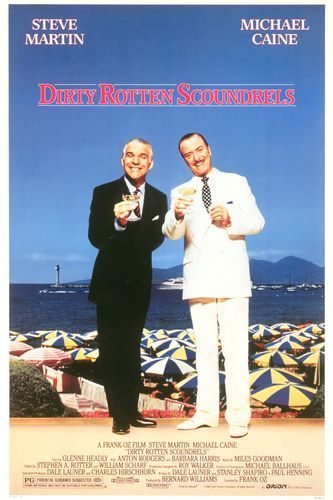
The movie is Dirty Rotten Scoundrels, a Michael Caine/Steve Martin vehicle that plays to each of their strengths perfectly. Michael Caine gets to be a genteel know-it-all, and Steve Martin gets to be an obnoxious loudmouth. They are both con men, although Caine works only among the upper crust and does very well for himself, whereas Martin considers himself well off when he cons a woman out of twenty bucks. The entire movie consists of Caine trying to get Martin out of his small French Riviera town, so he can go back to working it by himself, conning rich women out of their jewels and pocketbooks by pretending to be a prince in need of funds to battle communists in his home country. Hilarity ensues. (No, really, it’s very funny.) The main plot unfolds when they bet that the first one to get $50,000 out of Glenne Headly, an American heiress, wins the rights to stay in Beaumont-sur-Mer, and the loser leaves town.

Dirty Rotten Scoundrels

Hide your valuables, ladies, the charm offensive is on

*SPOILER ALERT* The problem is, the heiress turns out not to be an heiress, but rather a woman who is touring Europe as the winner of a contest for a detergent company. She’s promised both men the $50,000, but has to bankrupt herself in order to get it. Caine turns out to have scruples and calls off the bet. Martin, unsurprisingly, has no scruples and wants to continue the bet, or at least amend it — the first man to bed her wins. Caine shows even more character when he says that he won’t try to woo her himself, but he’ll bet against Martin’s success. *NO REALLY, THIS IS THE FINAL TWIST OF THE FILM* Headly declares herself in love with Martin, and visits his bedroom. Caine hears of this and is ready to admit defeat, but then Headly shows up at his house, crying that Martin took her $50,000 and she has nothing now. Caine gives her $50,000 of his own money and takes her to the airport, where she thrusts the bag of his money back in his hands, declaring she can’t take it and running onto the plane. Only then does Martin appear, screaming that Headly took HIS money, and when Caine opens the bag, he finds instead a note from Headly that reveals she knew their con all along and played them the whole time.

Martin’s reaction: “Of all the lousy… She is disgusting! She is lying, deceitful, two-faced. She is conniving and she is dishonest!” Caine’s response: “Yes. Isn’t she wonderful?”

Now, in just about any other Hollywood film from the last fifty years, Martin’s reaction would’ve included “That bitch!” in there somewhere — we’d need to know that she is not just another player in the game, but that her gender makes her a particularly despicable one. She would not be a worthy opponent with individual skills to assess and combat, but a generic enemy in need of crushing. We would have had lingering shots of her legs and chest throughout the film. We probably would’ve seen her get naked in preparation for sleeping with Martin.

Not only that, but the other women Caine and Martin con would be bimbos, sluts, easy marks not just for being rich and stupid but for being rich and stupid in a gendered way. Instead, they are easy marks because, in Caine’s words, they’re “screened. They’re wealthy and corrupt.” His scams always involve women, yes, and they hinge on the need of these particular women for flattery, romance, and a distraction from the stultifying boredom of extreme wealth. But the scams don’t involve sexual humiliation, or dick-waving bragging afterward, or even stripping the women of all their material wealth. Caine takes a large amount of money, possibly after a mutually satisfying sexual liaison, and then slips away. And when things go badly, say, for example, when he is robbed of $50,000, he does not blame the woman who played him, or call her a bitch for outsmarting him, or plot revenge. No, he calls her wonderful, seeing her as an equal, a great challenger to his title as master con artist of the Riviera.

The movie even ends with Martin put firmly in place. Unlike Caine, he did try to degrade Headly by betting on his ability to conquer her sexually. The I-bet-I-can-screw-her-oh-wait-now-I-love-her-so-I-will-be-honorable-and-at-the-last-minute-not-continue-in-my-lie-and-take-her-clothes-off-but-it’s-cool-because-that-one-moment-of-restraint-is-enough-to-convince-her-of-my-love-so-she’ll-totally-screw-me-later-so-the-moral-of-the-story-is-I-get-laid-either-way trope is so tired, and it was refreshing to see it turned inside out here. Not only does Martin not get with Headly, and not only does she not fall in love with him, but she steals his money and leaves him naked in a hotel room. And at the end of the film, when she returns to the two men to pull them into working a con with her, she introduces Caine by name and has him talk as an integral part of the con, but then introduces Martin — “he’s a mute.” Caine was going to dupe her out of her money but not her dignity. Martin was going for whatever he could get, and what he got was shut the hell up. Fantastic.

The remarkable thing about Headly’s deception is that the movie is clear that she does this not because all women are evil, or cold-hearted, or only in it for the money, but because she is the same creature as these men, a brilliant liar who lives for the con. I don’t know how you feel about movies based on crooks swindling hard-earned money out of honest folks, but I love them. Con movies — Trouble in Paradise, The Sting, etc. — are delightful works of sparkling wit, fine-tuned plot, and great reaction shots. Morals shmorals, give me Paul Newman’s nose-scratching signal any day. This is one of the few films I know of that is so devoted to the wonder of the con that it lets women play too. And that’s pretty awesome.