
Two Days in Bangkok

If the title of this post put that awful song in your head, I apologize. My first night in Bangkok was as grating as that song, and the first day was kind of a wash, but things picked up for the latter half of my stay there. Including infuriating political discussions on a street full of escorts.

Wat Po

Wat Po

I arrived late at night and wandered around Khaosan Road, and the next day I moved across town to a quieter hostel. On the way, I stopped at the central train station to buy a ticket out of town, and not only was the ticket I wanted not available, but I had to change transit three times just to get to the train station and then twice to carry on to the new hostel. All with a 30-pound backpack on and the tropical heat making me dizzy. My mood didn’t improve when I checked in at the hostel and learned that the Grand Palace closes at 3:30pm and there’s no way I’d make it in time, so I’d have to try to go the next day, although I’d have to go early in the morning because I needed to leave town by noon so I could get my train out of Ayutthaya in the evening. Ugh, just writing about my poor planning and the inconvenience of the sprawling city is frustrating me all over again!

Buy coupons for your every need

Buy coupons for your every need

I decided the solution to my bad mood was ice cream, so I went to the Magnum Bar downtown. I bought an electronics converter for $5 from one of those odds n ends stalls near the train station, the kind of stall probably entirely stocked with stuff that fell off a truck somewhere. But that converter is still working today, keeping my electronics from frying in the changing voltages in new countries, so I’m not asking any questions.

That night, I went out with two women I met at the hostel; H and K* are both teachers in China, in a “small” city about 2 hours west of Beijing. (“Small” in China means only a few million people, of course.) We thought we were going to a ladyboy cabaret, but K’s phone directed us to Soi Cowboy, which is a street that combines all the stereotypes about the seedier side of Thailand: neon everywhere, girls wearing next to nothing idling outside their clubs, lackluster table dancing inside the clubs, old white men at all the clubs, and a general sense that everyone is trying really hard to pretend it’s all normal and not sad.

Soi Cowboy

Soi Cowboy

We walked the length of it–the only tourist women there except for a few middle-aged women we spotted with their husbands–and ended up on the patio of Cowboy, which had a cover band inside instead of dancing girls. H had a lot of uninformed things to say about gender and sex work, which frustrated me to no end. She kept asking about ladyboys: “What are they, women or men? What parts do they have? What are they, really?” Do your homework. Even a cursory glance at a guidebook will clarify for you that ladyboys (who usually refer to themselves in other terms, actually, like “kathoey” or “a second type of woman”) are usually biologically male, but their chosen gender expression is female. Asking what gender someone is “really” is hugely insulting, no matter the culture, but especially in a place like Thailand, where information is readily available on this prominent part of the population, it’s inexcusably ignorant.
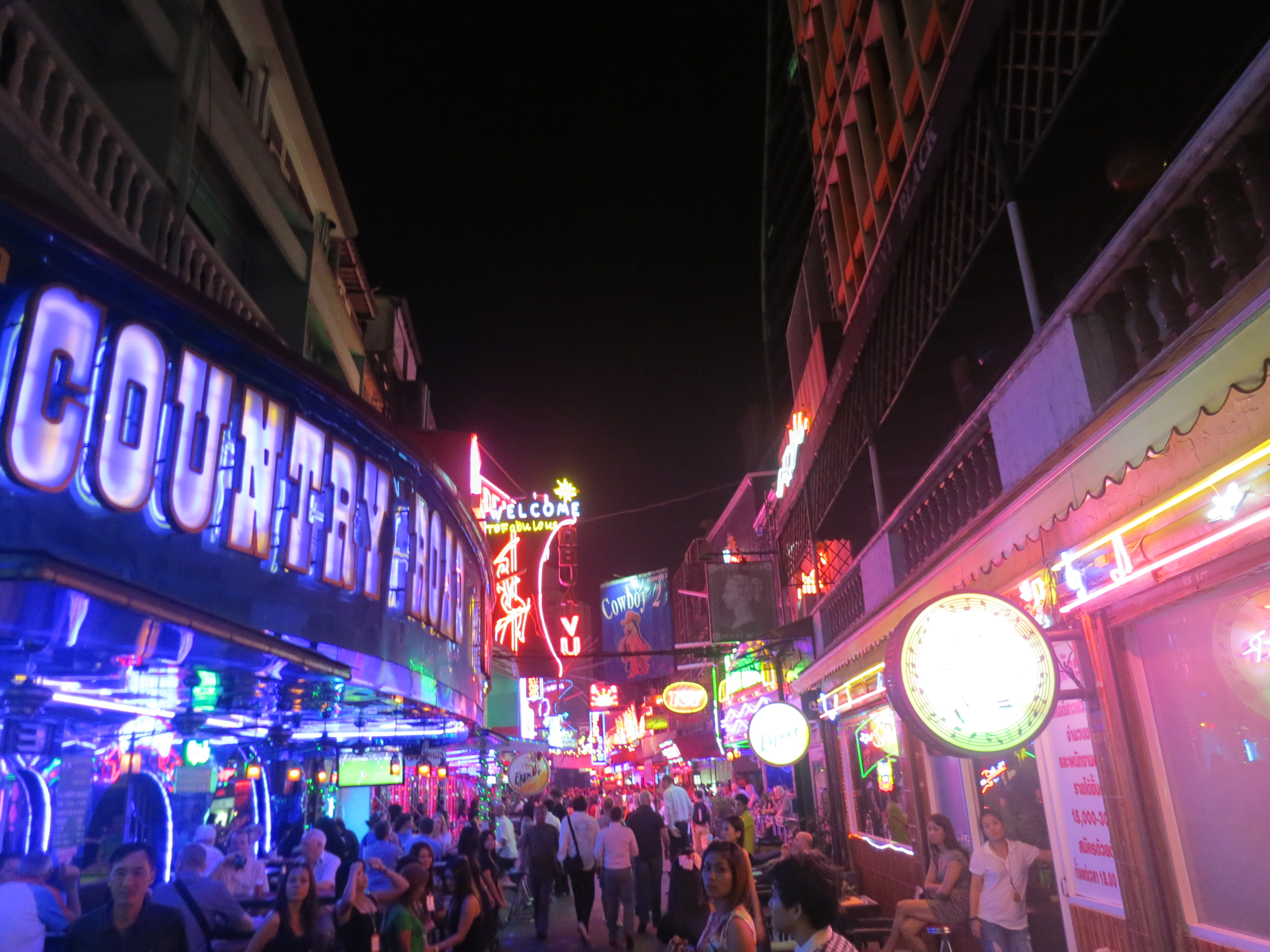
Soi Cowboy bangkokHer other favorite topic for the evening was whether the women working here had chosen this life. She’d read all sorts of stories about the “white slave trade” in Southeast Asia, which… what. But she also thinks that some Thai girls, while not kidnapped for the sex slave trade like white girls from America (WHAT), are still forced into the job. If they chose the job, though, she was okay with it. I did a little “choosing from super limited options isn’t a true choice” (my main line when encountering “feminism is about choice” defenders), but mostly I was irritated that she insisted on talking about this while we were sitting right there. If this scene bothers you, that is perfectly understandable, but there’s no reason you have to stay here. As soon as we arrived, we could see it for what it was; babbling about how worried you are for these women as you drink cocktails they bring you is useless and almost insulting.
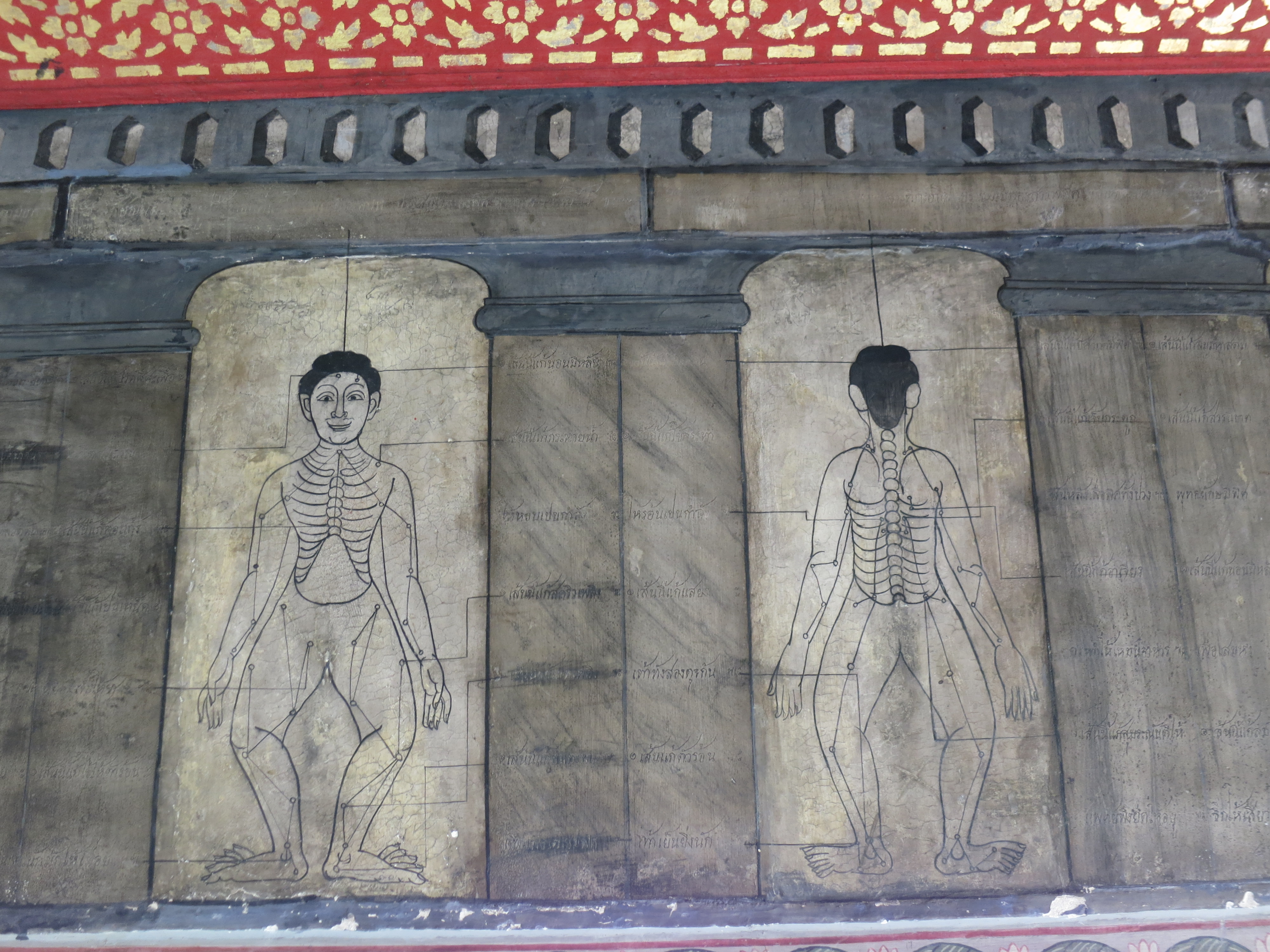
Medical diagrams at Wat Pho

Medical diagrams at Wat Pho

Anyway, when we steered clear of those conversations, we had a good time, and I was glad to have gone out for one night in Bangkok. (Oh no, I did it again.) The next day I went to the Grand Palace, but by the time I got there, every tour group in Thailand was shoving its way into the gates, and it was too overwhelming. I walked along the outer wall and crossed the street to Wat Pho instead.

Reclining Buddha in Wat Po

Reclining Buddha in Wat Po

Wat Pho (or Po) is a beautiful complex. It contains the largest reclining Buddha in Thailand, covered in gold leaf and housed in a building barely big enough for it. Pillars hold up the roof and split up the view of the buddha, which is too bad for taking in its magnificence in one look, but did give intriguing glimpses as I walked down toward the feet. The soles of the buddha’s feet are covered in intricate mother-of-pearl decorations, which were lovely. The rest of the grounds contain a massage school, a shrine to a seated buddha, and small stupas. There was also a small display on President Obama’s visit to the temple in November 2012, including the gift he brought with him–a candle from Chesapeake Bay. A candle? Really? A candle is what you get someone when you don’t know them well enough to know what to get them. Surely someone on the team could’ve tried a little harder.

The feet of the reclining buddha

The feet of the reclining buddha

After I walked around the wat, I collected my luggage, spent far too long finding a minibus, and got to Ayutthaya for a few hours of sightseeing before headed farther north. A whirlwind trip to Bangkok.

*Usually I use full names in my stories, but since I dwell on the negative parts of my time with H, I thought that imprudent.

Traveling From Your Living Room

Time for another story gushing about the wonders of Couch Surfing! This past weekend I hosted two women who were on break from their master’s programs in St. Louis. Ainur, from Kazakhstan, is studying American law, and Shushanik, from Armenia, is studying education. They’re in their 30s, they have jobs and personal lives to return to in their home countries, but they took the plunge on expanding their horizons thousands of miles from home, which I greatly admire. They were in Chicago to sightsee, but we found time to hang out and chat, and had some cultural exchange over omelets and ice creams.

Ainur, me, Shushanik

We talked about American politics a little; they had both come to the States with the impression that we were “the most atheistic” country in the world, so they were shocked to see how much religion dictates government decisions here. Then I talked about classroom overcrowding, and not paying teachers enough, and how testing is strangling education, and Shushanik said her main research interest lies in determining which standards and methods of testing are actually useful and which are part of the problems I bemoaned.

Both Ainur and Shushanik were born under the rule of the Soviet Union, and they remember the bad old days with little fondness. For example, Ainur speaks better Russian than Kazakh because she was only allowed to speak Russian at school. They both spoke with envy of the infrastructure we have here, and the reliability of the legal system (even taking into account my rants on the prison-industrial complex).

A gorgeous March day

But they’re both very proud and fond of their homelands, as most people are, of course. Neither has any plans to settle out of her country, and they enjoy travel for the same reason most of us do: to meet new people and see new things, but not to relocate. And some things about the US upset them. Somehow, sex ed came up, and I said that kids today are only taught abstinence, and abortion is practically legal in name only. They hardly believed me; the idea that a woman’s health is her concern and hers only is so basic to them, that the thought of putting it up for public debate and legislative oversight is repugnant to them.

All this is to say that I only spent a short time with these women, but our shared love of travel and meeting new people opened us up to wonderful conversations and a free exchange of ideas and information. I know couchsurfing isn’t for everyone, but it’s been a great way for me to travel without leaving my living room, just by hosting people visiting from all over the world. I highly recommend it if you’re considering hosting or surfing. You can also go to group outings in your hometown if you want to meet likeminded folk but can’t open up your home.

ice cream break

Finally, it’s fun! I think I made it sound a bit like a UN summit, but we had brunch, wandered around Millennium Park, picked out shiny souvenirs, and had ice cream in the shade while people watching. In other words, I had a relaxing weekend with friends. They just happened to be new friends from far-flung lands.

Images 1 and 3 courtesy of Shushanik. Image 2 is mine.

Stop SOPA and PIPA!

I can’t figure out how to put the Stop SOPA blackout page on this site today, but I’m not posting new material because I want to draw your attention to these terrible bills that the Senate and House are working on. Check out this site to get a quick rundown of why these bills are a terrible idea.

The kindest light to read them in is that legislators (and their powerful lobbyists like the Motion Picture Association of America and the Recording Industry Association of America) want to stop copyright violations. But the actual end result of the legislation as written is the ability of the government to shut down any part of the Internet it wants to. That’s right, any time it wants to, the government can just shut down a site and say it’s copyright violation — and they can do it without even allowing the affected site to defend itself. Also, no sites (like Google or Facebook or anything) will be able to direct traffic to the affected site.

Your own site disappeared by a government organization because someone doesn’t like it? Sounds like censorship to me.

Stop SOPA and PIPA. Write and call your senator and representative. Obama has come out against the bills as written, but that’s not stopping Congress from trying to push them through anyway. Take action!

Occupy Chicago Protest March — November 17 Day of Action

Yesterday, my friend Hannah and I joined in the Occupy Chicago march down Michigan Ave. after we left the office. We took over the northbound lane from Congress up to Randolph and then Randolph to the Thompson Center. (We were headed for Daley Plaza, but the Christkindlmarket was being set up.)

me at the Occupy Chicago Day of Action 11-17-11

"People, Not Profits!"

There was lots of chanting — “We are the 99%!” “People, Not Profits, Occupy Chicago!” “ONE, we are the people, TWO, we are united, THREE, the occupation is. not. leaving!” — and also some cries of “join us, join us!” to onlookers.

Protesters marching during Occupy Chicago Day of Action 11-17-11

Taking over Michigan Ave. was cool.

A helicopter followed our route, but I couldn’t tell if it was a police chopper anticipating a turn for the worse, or a news crew looking for an aerial view. The cops formed bicycle barricades to keep us from crossing to the southbound lane (although I must point out, which the newspapers do not, that there are several people in the Occupy group who wear reflective vests and direct the group to make sure we all stay pretty orderly, and that’s a service to our fellow citizens that goes unrecognized in the mainstream media).

Occupy Chicago Day of Action 11-17-11 signs

Hey, that's your beloved capitalism for ya. Better hand over that cash!

We saw a lot of great signs, the most simple being “I can’t believe we still have to protest this crap.” There was a mix of people, a lot of young students, yes, but quite a few middle-aged and older folks as well; and it was a racially diverse group of righteously angry people. Hannah and I stayed for the first couple speeches at the General Assembly and then gave in to the cold and our growling stomachs and headed home.

I got 99 problems but the rich ain't 1

Dig it.

I do love me a good protest march; there’s nothing quite like it for feeling part of something greater and more noble than your daily life, which is to say, the cause of making everyone’s daily lives better.

Images courtesy of Hannah.

Occupy Movement Graphics

It will surprise few readers of this blog to learn that I support the Occupy Movement (it basically comes down to Corporate Needs aren’t the same as Corporate Greed). If you’re still unsure about the focus of the protests or what people are so mad about, check out this easy-to-read, graph-heavy article that I highly recommend. And here are another couple articles with great, thoughtful responses to people who wonder why Occupy folks can’t just work harder to get a leg up. And here’s an image from the disastrous police response to the Occupy Oakland group last week that shows the scary side of simply showing up to state your discontent with the system as it stands. I encourage you to take a look at http://www.occupytogether.org/ to see what’s going on in your community and how you can get involved. And for a fun way to stick it to the banks and get rid of your junk mail at the same time, check out this video (although I don’t think adding weight to the envelope actually adds to what they pay the USPS).

In the meantime, cartoons! Here are some great images from Facebook about the Occupy Movement. Enjoy!

Oh Monopoly man, your walrus mustache used to be cute, but in this context, well, it's just sinister.

How many people do you think would LOVE to get a job?

Thanksgiving's looking pretty sad for most of the country this year, and how many more years? (Click on the image for 9 more images.)

Okay, I don't agree that the Tea Party is fascist, but I definitely agree that the Occupy Movement is democratic. Celebrate it! Support it!

Image 1 from here. Image 2 from here. Image 3 from here. Image 4 from here.

RIP Troy Davis

Last night, at 11:08pm Eastern Time, the State of Georgia executed Troy Davis by lethal injection. Davis was convicted in 1991 for the 1989 slaying of a police officer. Davis maintained his innocence until the end, and considering there was no physical evidence against him and seven of the nine witnesses identifying him as the killer have since recanted, I am one of the many people who believe him. His death is a perfect example of how very flawed the legal system is, and how blind to justice those who work it are willing to be.

"I Am Troy Davis" supporters keeping vigil

There are a lot of smart arguments against the death penalty (it’s heinously expensive to taxpayers, it’s applied disproportionately to poor and non-white people, it does not actually deter violent crimes), but the possibility of innocence is perhaps the most compelling for people who otherwise think capital punishment is just. Groups like The Innocence Project meticulously track the many cases in which the reasonable doubt is too strong to justify a conviction, let alone the extinguishment of a life. In some cases, DNA testing has proven innocence posthumously, which ought to be as clear-cut and scientific proof as anyone could ask for. Yet it’s legal in almost every state in the country, and as the recent presidential debate showed, a lot of people are enthusiastically for the death penalty.

I want safe streets and punishment for violent crimes, just like anyone else. But I don’t want it at the expense of real justice.

Last night I attended a rally in Daley Plaza attended by some 100 people who waited anxiously to hear whether there would be a last-minute stay of execution. I left at 7pm Central Time when it was announced that he’d been given a seven-day stay and there was more fighting to be done. We cheered and grinned at one another at this new glimmer of hope. It turns out we were misinformed or the court decision changed, of course. But that doesn’t mean there isn’t more fighting to be done. There are hundreds of capital punishment cases throughout the United States, and laws on the books at the state and federal level. There’s a whole system to transform.

Troy Davis’s last words were: “I ask my family and friends to continue to fight this fight. For those about to take my life, God have mercy on your souls. And may God bless your souls.”

Rest in peace, Troy Davis, and know that you will not be forgotten. We will continue to fight this fight.

Troy Davis

Troy Davis, October 9, 1968 – September 21, 2011

Image 1 from here. Image 2 from here.

UPDATED: People inspired to help can donate to www.innocenceproject.org and www.amnesty.org, and find action points on both sites.

ACAM: Cambodia’s Dark Past and Bright Future

I’ve finished John Tully’s A Short History of Cambodia: From Empire to Survival, and damn if it isn’t a discouraging read. It’s all right there in the subtitle–Cambodia was once a strong empire with the largest city in pre-Industrial times, an intricate system of canals and farmland, and an impressive collection of intricately carved temples, and now it is one of the poorest countries in the world, riddled with corruption, and desperately trying to pump up a tourism industry centered around the ruins of the greatness that once was.

cover of A Short History of Cambodia

A Short History of Cambodia

Of course, every country has its ups and downs, and no empire lasts forever. But the way in which Cambodia got totally screwed, over and over, from the mid-19th century through today, is both upsetting and instructive. Basically, although European colonization came late to Cambodia, it came with a vengeance. The French used an anti-missionary assault in Saigon as an excuse to send over a “protective mission” that quickly became a “permanent occupation force” (p.80). From Saigon to Cambodia, and soon they had control over Indochina (the colonialist term for much of Southeast Asia). Cambodia was officially a protectorate, but basically France treated them like a badly behaved colony, giving them strict governors and overhauling their entire system of government with no local input so it never had mass support (even measures like abolishing slavery and setting up schools for children).

By 1954, Cambodia had been caught up in the French fight with the Vietnamese, and the people wanted out. Prince Norodom Sihanouk successfully maneuvered to have the Geneva conference name Cambodia a sovereign nation, albeit with strings attached. I mentioned in another post that the intersectionality of world politics in the 20th century astonishes me, and while I’m sure that makes me sound naive, the extent to which the Cold War affected politics in literally ever corner of the globe in the latter half of the century can’t really be overstated, I don’t think. For example, the only way Sihanouk managed to get Cambodia free of French rule was by promising up and down and back and forth that Cambodia was a neutral country that would never enter into military alliances with any other country. Not to mention he had to beg to have his country back in the first place, and the US and USSR, along with some other countries, granted that. (This granting of sovereignty to nations that already existed and just need their colonizers off their backs is deeply puzzling to me. See reservations, Native American.)

Prince Sihanouk

Prince Sihanouk

This is not to say that either world power gave up hopes of using Cambodia in its Southeast Asian chess game, and the US presence in Vietnam went far toward stirring up discontent in Cambodia with the US and any pro-US factions. The Khmer Rouge, staunchly anti-US, started gaining followers. (“Khmer Rouge” means “Red Khmer,” the Khmer being the ethnic people of Cambodia, and the Red being a reference to their Communist affiliation–a context I never knew about or wondered about before. Funny how names can hold one meaning for you–deadly Pol Pot regime!–when they started out with quite another meaning entirely.)

Eventually, the country descended into civil war, with the war-weary Vietnamese, the jungle-hardened Khmer Rouge, the covert-bombing Americans, and the under-supplied national army all entangled in a mess of a fight. When the US and Vietnam got out, it became unwinnable for the national army, and Pol Pot and the Khmer Rouge stormed into power.

Pol Pot

Pol Pot, looking creepily cheerful as he palms a gun and plots genocide

Pol Pot’s socialist agenda was extreme. He immediately banned all private property, currency, manufacturing, and education. He force-marched his fellow Cambodians out of the “corrupt” cities and into the countryside, and along the way murdered thousands of people the infamous killing fields outside the city. Displacing hundreds of thousands of people, killing as many, and utterly changing the basic structure of everyday life was not, surprise surprise, a successful plan. The country plunged into disrepair, and Pol Pot went back to war with Vietnam, which no one was equipped to handle. At the end of 1978, the Vietnamese invaded Cambodia and took over for the next ten years.

The sickening thing about this post-DK (Democratic Kampuchea, Pol Pot’s name for his regime) era is the international response. The bloody and drawn-out Vietnam War had done nothing to convince the US that that country wasn’t out to conquer and convert all neighboring countries to communism (the domino theory! a real winner of an idea), and China was equally upset with Vietnam’s perceived overreach into its physical and ideological domain. They were both dead-set on punishing Vietnam for its ambition, so since Vietnam had invaded/liberated Cambodia, that meant Cambodia got to suffer too. The People’s Republic of Kampuchea (PRK, the post-DK regime name) “was cut off from assistance from the UN Development Programme, the Asian Development Bank, the IMF and the World Bank, with only a trickle of humanitarian aid from UNICEF and the International Red Cross” (p. 207). In effect, the international community abandoned Cambodia.

domino theory graphic

Apparently this is how it was all gonna go down.

Not only that, but Pol Pot had fled when the Vietnamese invaded, and he ran guerrilla options for many years in the jungles, ratcheting up Cambodian civilian deaths with no one pursuing him on any serious level. The Western world was so concerned about the threat of Vietnam ruling Cambodia as a puppet state that it gave tacit (and sometimes material) support to Pol Pot and the Khmer Rouge. I repeat: we supported Pol Pot. Ask anyone with a basic knowledge of the world history of the last century who Pol Pot is, and they’ll tell you, a dictator, a genocidal madman, a brutal murderer. And yet, because it seemed politically expedient to do so, the United States and other countries supported him for a number of years, until Cambodia proved it was no Vietnamese puppet nor Communist state, and aid could be sent without troubling the conscience about the red threat (p. 213). And Pol Pot died peacefully in his sleep in 1998.

The PRK government had its fair share of gross human rights abuses, yes, but if the international community had stepped in with aid right away, and called for the swift and impartial trials of Khmer Rouge war criminals, then it would have been a very different story. Basing foreign policy a paranoid idea like the domino theory is not only foolish, it’s dangerous. It has real consequences for millions of people on the ground. The United States’ treatment of Cambodia in that twenty-year period–from Nixon’s bombings, through the support of the Khmer Rouge, to the lack of basic aid during a famine in 1979–is inhumane and unjustifiable.

So, see what I mean about Cambodia getting the wrong end of the stick for decades? The corrupt nature of its officials on every level, combined with the self-interested interference of neighboring countries and world powers, led to a war-torn nation in which the people suffered mightily. Nowadays, the country is run by a corrupt prime minister, Hun Sen, and millions of people remain in dire poverty. But aid from outside countries (especially China) does help, and the textile and tourism industries have grown the country’s economy rapidly in the last ten years. Education and health levels are rising, as well, and a healthy, educated population is much more in a position to tackle its issues and guide its own path. Cambodia’s recent history is dark, yes, but that doesn’t mean the country doesn’t have a bright future.

Remorque-moto travel in Siem Riep

Cambodians moving on

Image 1 from here. Image 2 from here. Image 3 from here. Image 4 from here. Image 5 from here, credit Felix Hug.

Food for Thought

Food for Thought

Not a proper GBS, but here are a couple neat things I’ve found on the Internets lately:

Two easy-to-read infographics on why health care in the US costs more than any other developed nation. I think my favorite part is the angel halos around the “Truth!” bullets in that second one, and also the fact that they say outright that lack of regulation is what allows providers and insurance to charge more here than they would be able to in countries that keep that kind of thing in check.

The ever-brilliant Rebecca Traister has been watching and commenting on the last week of Oprah’s network talk show. This article is a great reminder of why Oprah matters so much — she started out with just about nothing and now is one of the most powerful women in the country. (Funny how she’s not often held up as the example of the American Dream by politicians and media pundits. I’m sure her gender and race have nothing to do with that.) Her departure will remind Americans of just how white and male the rest of the media landscape is, and what a loss that is for all of us.

Personal Notes

Also, thanks to all who have made suggestions for where the twins and I should vacation this fall! We’ve never had a sisters-only vacation before and we’re pretty psyched. I’ll keep you updated on what we choose.

Lastly, but perhaps most importantly, who is inviting me to their Memorial Day BBQ this Monday?? It promises to be a hot and sunny day, and I promise to bring tasty beverages. Let’s do it.

ACAM: Indonesia, or How a 19th Century Dutchman Helped Me Refine My Political Manifesto

While the people of the Middle East and northern Africa are staging wonderful revolutions based on the people’s will, we in the States are fighting hard to serve the needs of the many, and I tell you what, it is a discouraging time. I don’t have the energy to argue with people anymore about why cutting Title X funding is immoral or how disbanding unions will only hurt the economy, not fix state budgets. Things seem to be getting worse and worse, with fewer and fewer victories to brighten the mood.

When I first read the selection from Max Havelaar in The Indonesian Reader, I just got even more depressed. Here’s a piece published in 1860 by a Dutch administrator in colonial Java, written anonymously because it was so damning about the colonial government, and it spells out many of the same problems of inequality, passing the buck, and exploitation that plague the modern world. The excerpt describes a system that exploited the native people of Java and surrounding islands (not united into the country of Indonesia until 1949) as a labor force for Dutch business interests. This same system employed civil servants, regional administrators, and others who were too worried about keeping their jobs to report horrific abuses and deaths, lest those reports draw unfavorable attention to their regions. Rather than look to the needs of the people they were charged with protecting, they looked only to the bottom line and worked people harder to turn a bigger profit and get more acclaim from those back in the Netherlands.

I’m not saying that the union workers in Wisconsin, Indiana, and Ohio are in the same situation as the Javanese workers in the 19th century. But the same impulse to human greed and domination runs through both stories, and the government happens to play the role of villain in both. That same story is played out over and over again throughout history, and that’s what struck me as I read this piece for the ACAM project. George Santayana’s famous “those who cannot remember the past are condemned to repeat it” has been trotted out far too many times for it to hold much meaning anymore, but it’s still true, and that’s what scares me. Are we just going to repeat the same stories of oppression and futile resistance over and over, in various horrible forms the world over? And if so, of course the question then becomes, what’s the point in fighting?

I think the answer lies in how we view history. The popular view, certainly the American view, is the linear one; we’re moving in a straight line from barbarism to civilization, and it’s just one grand march of progress and improvement. The other view sees history as a big circle, with highs and lows coming and going as the natural course of things, an inevitable turning of fortune’s wheel. The strictly linear view is clearly false; we can see people reverting to customs and laws from the bad old days all the time, so we can’t always be moving forward. The circle view is too depressing; the human experience becomes an exercise in literally spinning our wheels.

How about a Hegelian compromise? I wish I had artistic skills, because I would draw you this picture I see in my head: a series of circles, moving along a line. Those circles are various wheels of progress, regression, enlightenment, and repression, and we move through those circles as ideas are introduced, developed, and tested. We jump to new circles once those ideas have been accepted into the common understanding, and those wheels keep us spinning slowly forward through history.

It’s the development of ideas that really gets us moving into new wheels of progress and improvement. For example, right now Walker and other politicians are doing their damnedest to do away with collective bargaining in their states and eventually the country as a whole, and they very well may succeed for a period of time. But the idea of collective bargaining, which at one point in history wasn’t even a possibility, has settled firmly in the national consciousness, and what’s more, the practice of that idea has shown how easily it can be done. That’s going to make it harder to kill the idea completely, and if an idea is still alive, a movement can still survive. What’s more (and here I’m trying real hard to be positive about the current national situation), when the idea of collective bargaining survives, it should survive as a stronger idea. Right now, we see collective bargaining as a luxury afforded to certain professions, rather than a basic right of workers worldwide. As we spin about in this wheel of government bullying and corporate greed, those who fight for workers’ rights may be able to convince the general public of this difference between luxury and human right, and at that moment, we will jump into the next wheel. That will have its own ups and downs, as spinning wheels do, but it will be within this broadened national consciousness, and the discussion will grow ever more equitable.

Just as slavery was once a fact of life and is now a banned and abhorred practice, though we still fight to free trafficked persons; just as women were once the property of their husbands and now hold national office, though we still fight for their bodily autonomy; just as sodomy was once a crime and now gays and lesbians live openly, though we still fight for their right to marry and raise families — in these ways, will we continue to make strides for human rights in a world of greed and corruption.

I still feel my blood pressure rise every time I read a newspaper, and I still cry when election results are announced, but throwing up my hands in despair and deeming it all too big a problem to fix just puts me at the mercy of that spinning wheel; if I stick with it and join with others for our collective good, I can help push us over to the next one, the one with a better starting point than the one I was born into.

As Multatuli says in Max Havelaar:

After all, who would maintain that he had seen a country where no wrong was ever done? But Havelaar held that this was no reason for allowing abuses to continue where one found them, especially when one was explicitly called upon to resist them.

And we are all called. Decency calls us, history calls us, the future calls us.

A Few Quick Notes

Hello dearest fellow travelers. Some quick notes on this busy Tuesday:

  • We have one or two posts to go for ACAM: Indonesia (depending on timing — one for sure will be up this Thursday), and then it’s on to Singapore!
  • The Suggestion Box is a little bare. If you have a spare moment this week, please stop by and add your favorite restaurants, sightseeing spots, city parks, etc. to your favorite cities around the world. It’ll help with my trip so much. Thanks!
  • The Walk for Choice and Save the American Dream rallies were great! Good turnout on a chilly, snowy day, and a lot of camaraderie between the two groups. My friends and I started at the Walk for Choice, and then peeled off to strain to hear speakers at the workers’ rights rally and cheer with the crowd. I made two signs, one of which was straightforward–“Union Busting is Bad for Business”–and one of which led people to believe I was pro-life! Oh dear. It said “Why is Congress Sentencing American Women to Death?” and then in smaller letters “Stop HR 3 and HR 358.” Sessily pointed out that if you didn’t know about HR 358’s legislation of medical neglect, you might see “Death” and think I was talking about “killing babies.” Oh well! We tried to meet up with the Walk for Choice at its endpoint, but all we saw were pro-lifers releasing a hundred balloons labeled “Life” into the air; we couldn’t decide whether abandoning Life to the elements meant they are now no longer pro-life or if it just turned into a euthanasia rally. Also, someone dressed in a full Chewbacca costume was there, on the wrong side, dancing with the pro-lifers. Perhaps he was just confused without Han there to translate for him. Really, it is a metaphor for the American public. Just Wookieing around until Han comes back with some terse words of direction and a new sense of purpose.