I’m headed up north for a week of family vacation, but I’ve set up some picture posts to keep you company while I’m gone, so be sure to check here for them! Have a lovely summer week.

Lake Michigan
I’m headed up north for a week of family vacation, but I’ve set up some picture posts to keep you company while I’m gone, so be sure to check here for them! Have a lovely summer week.
Lake Michigan
This past weekend, I sold the Saturn. You may remember this car from a post I wrote last year pleading for just a few more miles of functionality. The car came through wonderfully, I’m happy to report, but seasons have changed, and even in this bizarrely mild winter we’re having, the car isn’t holding up so well. That, plus the registration and insurance fees and the always-high gas prices, and it became clear that I should say farewell to the car sooner than expected. But who knew it would be such a sad experience?

The M-22 sticker says you're a Michigan car forever, no matter what the license plate claims
The actual selling of the car was really easy. I went to the CarMax out in Glencoe, and after a short wait, a nice gentleman chatted with me about his tour of duty as a medic in Vietnam while an appraiser checked out the car. The company offered me $200 (oh how far you have fallen, Mme. Sunroof), I filled out the paperwork, and voila! They had my car, I had a bank draft, and my friends T&K picked me up to take me back to the city. No problem. But I was almost teary-eyed as I signed the paperwork. I don’t think my parents or siblings were untouched either, when I told them about it. This car has been in our family a long time.
It’s a ’96, and my dad bought it new in September of 1995 to use on his trips around the state selling phone systems for AT&T. After a few years, he got another car and the Saturn became the main vehicle the twins and I learned to drive in. We used it through high school, and after they graduated, my parents sold it to me and I took it from Kalamazoo to Naperville to Chicago. It’s sixteen years old and has seen a lot.
This car has been to Ohio, Pennsylvania, New York, and New Jersey. It’s crossed the Canadian border. It’s been up north in Michigan and in the western suburbs in Illinois. It’s been through Indiana as quickly as possible (“Crossroads of America,” indeed). This car has been in two fender benders, at least two traffic stops, and no major accidents. It’s been through ice, wind, snow, fog, and a summer hailstorm. It’s been to beaches, farms, forests, cities, and the very edge of a swamp.
This car has been the site of acts of passion–raging fights, tearful make-up talks, and fevered make-out sessions. It’s blasted hip hop, rock n roll, Beethoven, and Beyonce. It’s seen feasts of candy, pop, fast food, homemade granola, and giant sandwiches. It’s been the designated driver. It’s been the speeding driver. This car has been the solution to problems, the means for movement, the impetus for plans. It’s been the starting point for road trip dreams and fantasies of escape, and finally, it’s always been the way home.
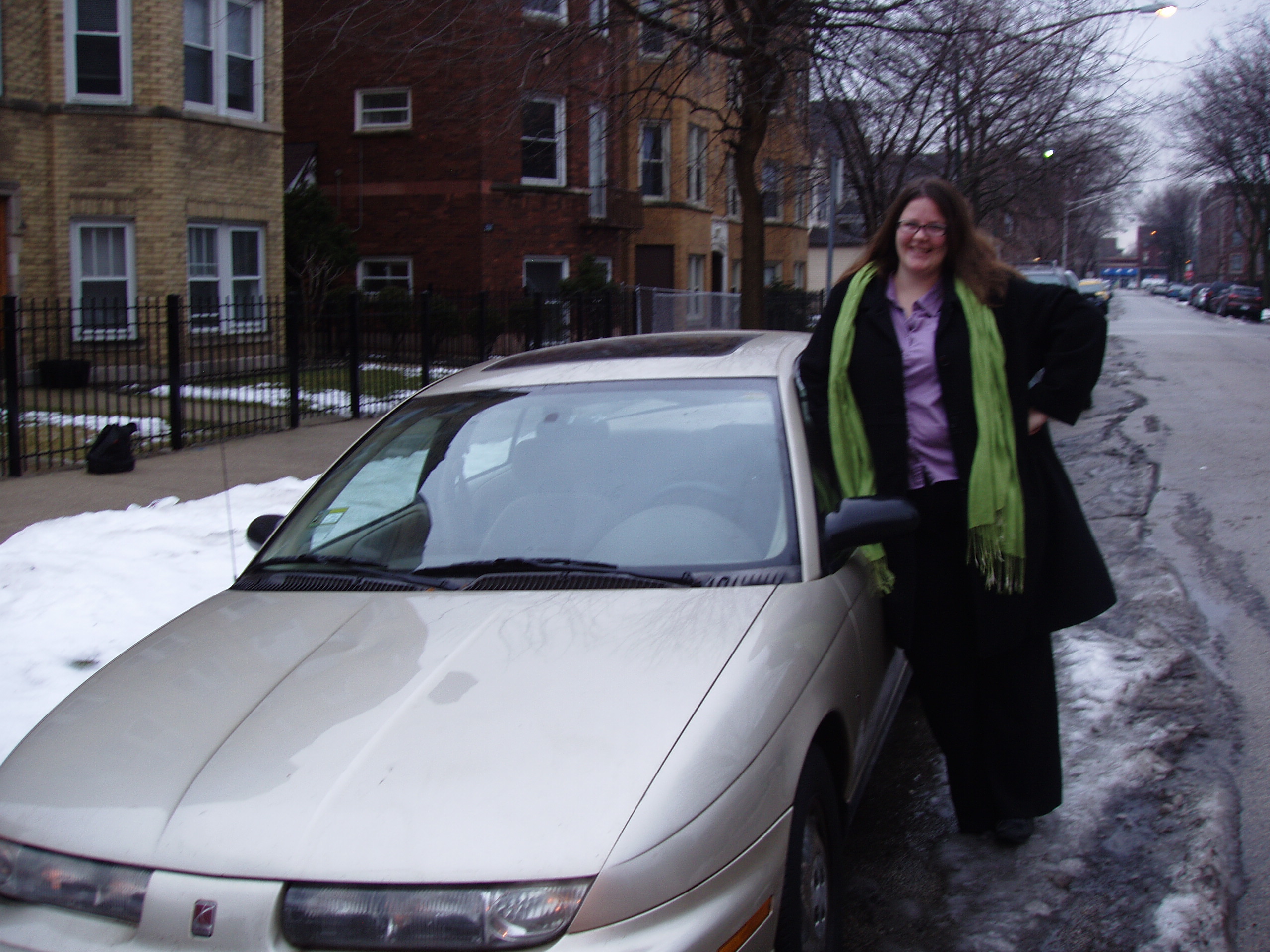
BFFs forever
Here are some things I found when cleaning out the Saturn:
48 cents in change
1 euro coin
11 maps
1 baggie of q-tips
2 safety pins
an entire winter wardrobe in the trunk (hat, sweatpants, jeans, two shirts, even undies–you need to be prepared in the Midwest for whatever the weather might throw at you)
3 quarts of motor oil
1 first aid kit circa 2003 (judging by the expiration dates)
2 flashlights
1 mostly-working umbrella
2 hair brushes
1 fossilized French fry
1 snow shovel
2 blankets
handwritten driving directions to my dorm room freshman year of college
Rest well, Mme. Sunroof. And in the words of Neil Young:
We’ve been through some things together
With trunks of memories still to come.
We found things to do in stormy weather
Long may you run.Long may you run, long may you run,
Although these changes have come.
With your chrome heart shining in the sun,
Long may you run.
I realize that not everyone celebrates Christmas. I have no trouble putting my head around the idea that most of the world’s population doesn’t believe in the immaculate birth of Jesus or even in the sacred maxing out of credit cards for plastic toys and cheap rum in late December. Those who do celebrate live all around the world, so there are plenty of Christmas revelers rockin’ around a palm tree or building sandcastles instead of snowmen. Despite the movies and songs about the season, it’s clear to any logical person that Christmas is not just a season expressed in gently falling snow and presents ’round a pine tree. But! If you are from a northern clime, celebrate Christmas, and have the space and money for it, I don’t see how you can go through your whole life without once cutting down your own tree.
I recently learned that one of my friends, who is from Michigan, has never cut down her own tree. Not only that, she’s only ever had artificial trees. Her family was worried about fire hazards, and I get that, but if you’re vigilant about keeping the tree watered and turning off the tree lights when you leave the house, a real tree is safe. And if you’re from Michigan, there are hundreds of places to go where you can select your own tree from a planted forest of them, which is a whole level of fun and adventure you can’t get from going to a lot.
I was in my hometown this past weekend for a couple of events, and while I was there, my parents and I got a tree. After an early setback (the first place we drove to was “closed for the season” — before Christmas?), we went on to Peacock Tree Farm in Laingsburg. Snow really was gently falling, so softly and slowly that I could inspect the individual flakes on my coat and see how different they were from one another. Not too many people were there, since a week before Christmas is too late for most folks (which is probably why the other place was closed), but we liked it that way. Just some fresh-faced workers, several red-nosed families, and a few eager dogs. I took some video of the afternoon so we can all take a look at what it’s like to cut down your own tree and get it back home for decorating. Don’t forget the egg nog.
I’ll be back in 2012 with more photos, essays, travel guides, guest posts, and interviews. Just nine months til I take off on my world trip–glad to have you readers along for the ride. Have a safe and restful holiday and see you in the new year!
Hello dearest fellow travelers! I posted this musing on the original reason for the season last year, but since I feel pretty much the same about it now and am about to begin my time off of work, I’m re-posting it today. Also, stay tuned Thursday for a brand-new post, with video!
I went to church with my family every week for eighteen years, so even though I don’t practice anymore, I’m very interested in the theories and workings of Christianity and people who believe. Don’t get all upset that I’m going to proselytize at you just because I say “Jesus” a lot in this post. Oh and in case any clarification is needed, Pastor Kit graciously allowed me to read the written version of her sermon and quote from it, but don’t take that to mean she endorses any of the rest of this post. That religious right rant is all me, so don’t hold it against her.
Two years ago, I was sitting in my parents’ church on Christmas Eve when the priest, Pastor Kit Carlson, blew my mind. In her sermon, she suggested the idea that Jesus was not born in a lonely stable, but rather in a house full of extended family. Apparently, when Luke writes in his Gospel that “there was no room at the inn,” the word he used for “inn” was actually kataluma, which is more accurately translated as the guest room, or the upper room. And he’d used a totally different word for “inn” later on, when talking about the Good Samaritan, indicating that he wasn’t talking about an inn when he said Mary and Joseph couldn’t stay in the kataluma. The couple was returning to Joseph’s ancestral home for the census, after all; it is more likely than not that he had many relatives in town. Surely those relatives were ready to squeeze in and make room for Joseph and his very pregnant wife, and since there was no space available in the guest room, Mary and Joseph settled down in the main room on the first floor of the house. The homes of the time and region had a split-level first floor, with one side reserved for the humans and the lower side reserved for the animals. There was a gap in the wall between the two, and straw was placed here for the animals to eat. So Mary goes into labor, the women of the house gather ’round to help with the birth, and when Jesus arrives, he is indeed “wrapped in swaddling cloths and laid in a manger” — it’s just that the manger happens to be in the family home, rather than in a cold outdoor cave or stable.
JUMP BACK. What?
 This family picture was photoshopped
This could really change how we think about Jesus not just as the son of God (however you may feel about that), but also as a human, someone who was part of a larger family from his very first breath. As Pastor Kit said, “Jesus was not born into a simple nuclear family. Jesus was born into a clan… And this was how God chose to come into the world.” Obviously the Christmas story is one chock-full of symbolism, whether that symbolism indicates to you a larger truth or not. What does the symbolism of the traditional story say to us as opposed to this new view?
The usual way of looking at the story has Mary and Joseph as social outcasts, their only visitors people driven to the stable by supernatural forces. Only a few special people noticed how special Jesus was, and everyone else was cruelly indifferent or outright hostile to him and his parents. He had a hard and lonely road laid out for him, and that was clear from the start.
But if we look at the story from this new perspective, everything changes. Sure, the family still flees the country because King Herod is after them, but other than that, his parents are not rejected or treated badly. Jesus isn’t born into an uncaring world, but rather one full to bursting with extended family (all of them likely sharing conflicting advice with Mary the moment he pops out). His life path is still a difficult one, but the man who preaches love and peace for all humankind might have believed in these concepts more deeply based on a childhood full of both.
Perhaps Jesus’ extended family bickered a lot, or perhaps they got on well with one another. Maybe they blamed Mary for becoming pregnant before her wedding to Joseph or maybe they accepted the story that Jesus was a premie. The family might have been close or only seen each other once in a blue moon. Regardless of the exact make-up of the family, if they were there at Jesus’ birth and the days that followed, they were an important part of his early life. No matter what kind of family we’re born into, there’s no denying that they shape us, and now we can see how this might have been true for Jesus too.

A final note: Not to get too political (not that that’s a surprise on this blog, eh?), but I also think Jesus born into a large family can have implications for Americans in particular. Christians throughout history have clung to the idea of their persecution in the early days of the faith, and there are varying degrees of accuracy to that. However, the religious right in America is steadfast in the belief that this applies to contemporary America and themselves all the time. They seem to truly believe that they are being persecuted for their beliefs, despite the fact that Christianity is overwhelmingly the dominant religion in this country, and God is mentioned in our Pledge of Allegiance, our presidential oath, etc., not to mention you can’t get elected in this country without swearing up, down, and sideways that there has never been a more devoted follower of Jesus than yourself. Despite the fact that it’s non-Christians who continue to bear the brunt of intolerance, the religious right remains convinced.
I’m not saying there’s a direct line between the nativity and this false belief, but think about it: In the traditional story, Jesus and his family are turned away from inn after inn, ignored by their neighbors, and chased out of the country by a ruthless leader intent on their destruction. Jesus is all the more special because only a few recognize his specialness. Too much time focused on how special you are as compared to everyone else, and you can start to treat everyone else badly, which let’s face it, the religious right is really good at doing.
Okay, I know I’ve lost some of you here, and granted, it’s not the most well-thought-out theory, but man, they get so angry and exclusive, despite all Jesus’ actual teachings. They talk about a human family, but they make that family smaller and smaller — no gays, no non-Christians, no powerful women, no one too different from a narrowly defined category.
What if they thought of Jesus being born into a large, loving family instead? What if many people witnessed the birth and celebrated it? What if instead of being a misunderstood prophet from the start, Jesus was an appreciated addition to the family, despite the odd signs and portents surrounding his conception and birth? What if Jesus’ problems with fitting in only came later, and in the beginning his family accepted him for who he was and what he meant to them? What an inclusive way to view the virgin birth. What a wonderful way to start a story.
American Christians, instead of feeling put-upon and misunderstood, can look at this story and see a new way to view their current situation: just like all of us, they are born into this large, loud, extended family of humanity, and just like all of us, they can grow up and give back to this weird and wonderful family with love and joy. Just like Jesus.
Heather, Em, and I took a road trip in September, and recorded much of the silliness that took place. Part 1 of that video debuted last week, and now Part 2 is here, the three days we spent in Montréal. Soundtrack choices, while sure to get me hit up by the RIAA, were made for maximum comic and dramatic effect. Laugh, cry, gaze enviously at the rain-soaked city–it’s all here. Enjoy!
Dearest fellow travelers, I’ve put together a video of the first part of the grand road trip Heather, Em, and I took in late September. The video has some silly inside jokes, a few nice shots of the misty scenery, and far too much of Timbaland’s dumbest but most earworm-y collaboration.
I had a lot of fun putting it together, and you’ll see that we had even more fun filming it. Enjoy!
Update: Part 2 is up now!
Most Mother’s Day pieces talk about how inspiring and brave the mother in question is, and how the daughter wanted to be just like her when she grew up. Well, my mom visited most of the national parks west of the Mississippi on her own at age 19; she moved across an ocean to marry the man she loved and start a career; she went back to school fifteen years later and now is department chair of her college’s Department of Education. Together with the man she changed continents for, she’s raised three daughters and she is still happily married. So yes, my mother is damn inspiring and quite brave, and of course I want to be just like her when I grow up. (Good thing, if the inevitability of turning into your mother is to be believed.)
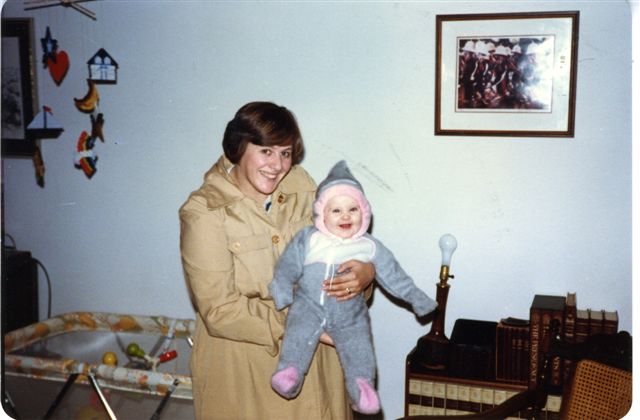
Look how delighted I was just to be held by her!
But when I was younger, rather than finding kinship in books with loving, caring mothers, three of my favorite books centered on absent, selfish, sometimes cruel mothers. I read Time Windows by Kathryn Reiss, A Solitary Blue by Cynthia Voigt, and Midnight Hour Encores by Bruce Brooks over and over. The details of each story differ, of course, but in each, the mother puts her own needs before those of her children, and the children suffer for it. In Time Windows, the mother feels trapped by domesticity and wants her own career (to be fair, it is 1904 and this was unheard of for white, middle-class women); in her anger, she locks her daughter in an attic as punishment for clumsiness. In A Solitary Blue, the mother leaves her much older husband for a bohemian lifestyle, and only returns to her son’s life when she needs money to fuel a drug scheme with her new lover. In Midnight Hour Encores, the hippie mother gives her daughter to the father within a week of the child’s birth, unable to face the huge responsibility of raising a child; years later, she gets her life together and becomes a successful businesswoman willing to set up a tentative friendship when her estranged daughter contacts her.
Why on earth would I want to read about these women? My own armchair self-analysis finds a few reasons: I wanted to see Bad Mothers punished in order to feel more secure with my Good Mother. I secretly feared my Good Mother might turn Bad and abandon me.
I think both of these are true. My mom was at home, insisting on breakfast every morning so I’d grow up strong, checking that I’d done my homework, wiping away my tears when the kids at school were mean to me. But when I was age 11 and devouring these books, she was also going to classes, doing her own homework, and writing her dissertation. In my confused adolescent mind, I saw her having a career (where before I hadn’t noticed one, since she’d taught at the school I attended so she seemingly extended her mother role to school just for me–ah, the utter narcissism of children!) and I freaked out. She’d never shown an interest in leaving home before, but what if Having a Job lured her away, as it seemed to for the mothers in these books? At age 11, I was just starting to see how taking care of my sisters and me might be a major pain in the ass, so I could easily see how she might chuck it all in to focus on her career and herself rather than on tending to our whiny needs.
But before I could get too into this strange fantasy of abandonment, the very books that led me down that path turned me right ’round again. The advantage of being an obsessive reader is that multiple meanings make themselves available on multiple readings. The protagonists of A Solitary Blue and Midnight Hour Encores start to see how their mothers had made difficult decisions when they’d left their kids. Not that this made them feel much better about how hurt they were to be left behind, but they did understand a little more how their mothers had their own interests that were separate from them, the kids, and how they’d pursued those interests instead.
Now, one of the things my mom has always said is how fortunate she feels that she was able to stay at home with us when we were little and then go back to school to continue her career, rather than having to do it all at the same time and missing out on my sisters’ and my young childhood. Unlike the mothers in these books, she didn’t have to make that hard choice. Here I was worrying about her doing something drastic, but she felt no need to do something drastic, because after those early broke years on the south side of Chicago, her husband was making a decent income that opened up possibilities.
But even if she’d had to choose, she would have chosen us. I asked her recently if she ever felt like putting us first meant putting herself last, and she said it never felt like that, because it was always about putting the family as a whole first. She didn’t see a divide between her interests and ours, because they were the same. Even when she decided to return to school and get her PhD, she saw how that had a benefit for us, too. After all, she wanted we three girls to grow into independent young women who were confident of their ability to do anything they desired, and making her own professional dreams come true was setting a good example for us.
Another good example she set, though of course it didn’t become clear to me until years later, when we’d all left the house, was that she never lost her sense of herself in us. She drove the twins to basketball practice, she listened to me practice scales on the piano, she bent over our math homework with us, she read stories aloud to us before bed, she commiserated with us on our tales of woe from school, she went to parent-teacher conferences, she joined the marching band boosters club, and so on ad infinitum. But she only came to basketball games, not practices; she didn’t sit through my piano lesson, just the recital; she only helped on homework we were stuck on, rather than checking each assignment to make sure we’d completed it. These are all things other parents do, other parents who perhaps do not have enough hobbies of their own or who don’t know what to do with the precious free time they find themselves with.
When I was growing up, this was simply the norm; from time to time, Mom had her dissertation to write, or a magazine to read, or a friend to chat with. If we were hurt or needed something or whatever, of course we could interrupt and she’d drop everything in a second. Otherwise, we could amuse ourselves, and she was not at our beck and call. Again, this was not just a good choice for her own sanity, but for our well-being and growth; we learned that everyone needs their space and that we could rely on ourselves for entertainment instead of needing someone else to feed it to us. She’s told me that she saw two dangers in losing yourself in your children: you either become resentful of the time and energy they take from you, or you expect something in return, like “I put my whole world into you, so why didn’t you turn out perfectly?” No one needs that kind of pressure, and no one ends up happy. I remember seeing Khalil Gibran’s The Prophet on her nightstand, with the “On Children” essay bookmarked. You know the one:
“Your children are not your children.
They are the sons and daughters of Life’s longing for itself.
They come through you but not from you,
And though they are with you yet they belong not to you.”
The astonishing thing to me then, that adolescent reader of books and dreamer of dire events, was that she was choosing us. The astonishing thing to me now, a single woman of 28, is that she chose us so consciously and conscientiously. She thought ever so carefully about every choice before making it, and she had good reasons for each parenting decision she made. (Note: none of this is to discount my dad, who is his own wonder but not the topic of this essay. The two of them were really big on making all parenting decisions together, and their united front was impenetrable.) She wasn’t on mothering autopilot, which is a relief to me now, since the idea of mothering is exciting but also terrifying, because how do you figure it out? By doing it, and doing it mindfully, as it turns out.
That’s the final message I got from these middle school books, too. Mothers aren’t just mothers whose only focus is their children; they’re people who have a vast array of interests, needs, and desires. That’s what was so scary to me. I was just starting to realize that mothers didn’t have to be as good as mine was, that they didn’t have to be there for us whenever we needed them, that they didn’t have to show their unconditional love on a daily basis.
I think my mom would say that she did have to do those things, that her love for us was so strong that she couldn’t imagine doing it any other way. But there were so many other ways she could have raised us, and she chose this way, the way of love, humor, strength, intelligence, curiosity, and kindness. That takes not just a good mother but a good person, and when I realized my mother was not just a good mother to me but a good person in the world, I saw more clearly why I wanted to be like her.
Happy Mother’s Day, Mom.

at Inspiration Point -- relevant, no?
 Stowaway Travel Writing & Editorial Services