The More Things Change…

From Mark Twain’s A Tramp Abroad (published in 1880):

Travel isn’t what it used to be
“Seventy or eighty years ago Napoleon was the only man in Europe who could really be called a traveler; he was the only man who had devoted his attention to it and taken a powerful interest in it; he was the only man who had traveled extensively; but now everybody goes everywhere; and Switzerland, and many other regions which were unvisited and unknown remotenesses a hundred years ago, are in our days a buzzing hive of restless strangers every summer.” (p. 225)

I saw this really cool thing… on the Discovery channel
“[The Ladders] are built against the perpendicular face of a cliff two or three hundred feet high. The peasants, of both sexes, were climbing up and down them, with heavy loads on their backs. I ordered Harris [hired man] to make the ascent, so I could put the thrill and horror of it in my book, and he accomplished the feat successfully, through a sub-agent for three francs, which I paid. It makes me shudder yet when I think of what I felt when I was clinging there between heaven and earth in the person of that proxy.” (p. 255)

I never go to tourist spots. I prefer to see the REAL places in a new country.
“I flit,–and flit,–for I am ever on the wing,–but I avoid the herd. Today I am in Paris, tomorrow in Berlin, anon in Rome; but you would look for me in vain in the galleries of the Louvre or the common resorts of the gazers in those other capitals. If you would find me, you must look in the unvisited nooks and corners where others never think of going. One day you will find me making myself at home in some obscure peasant’s cabin, another day you will find me in some forgotten castle worshiping some little gem of art which the careless eye has overlooked and which the unexperienced would despise; again you will find me a guest in the inner sanctuaries of palaces while the herd is content to get a hurried glimpse of the unused chambers by feeing a servant.” (p. 284)

Book Progress

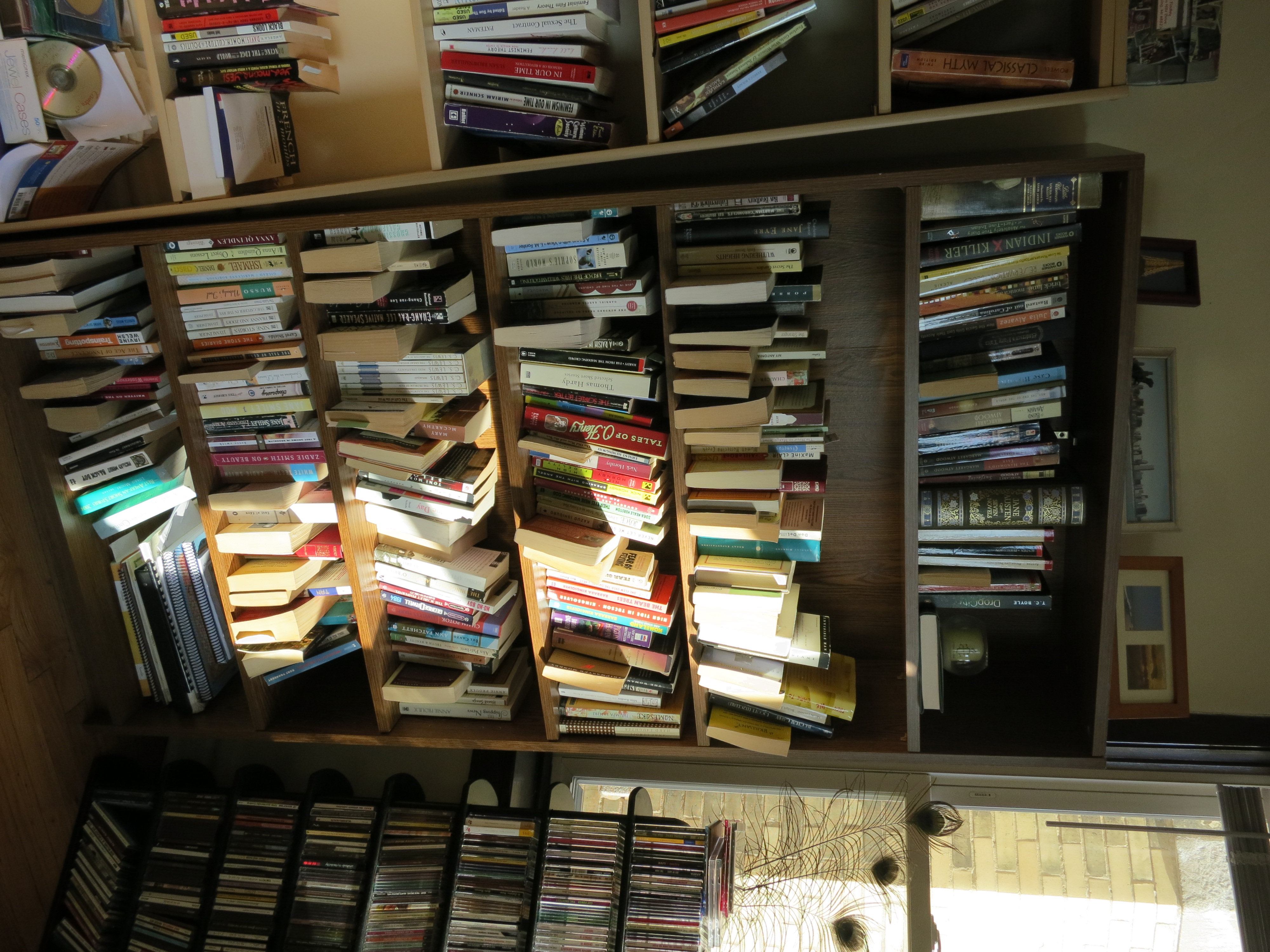
Sometimes all it takes to do something you’d been meaning to do for awhile is to say out loud that you’re going to do it. I’ve seen my bookshelf for years and thought, “I really need to read everything I own, and not just let them sit there as decoration,” but it wasn’t til I changed the appearance of the shelf that I saw just how many books I own but have never read. I wrote last month that I was going to change that, and whaddya know, it worked.

The Before Picture

Since then, I’ve read four of the novels/short story collections on that shelf, and a Christmas present and borrowed book besides. It feels good! I’m not sure you can see my Goodreads reviews unless you have an account, but here’s a link to my Goodreads list in case you’re interested in what I thought of them.

How’s your 2012 reading list coming along?

New Year, New Books

Happy New Year! I hope this finds you all well and rested after the holiday festivities. It finds me recovering from a cold and nursing a minor head wound sustained from extreme clumsiness, but I’m still riding high on a happy Christmastime, so I’ll take what I can get.

Books are the MAP to my heart. Ba dum bum.

This year, I asked my family to not get me too many new things because I’m trying to focus on only obtaining material items that will be specifically useful on my trip, which as you all know starts in September. So rather than the usual books and CDs, I received some wonderful items off my REI wishlist, and a few fun surprises.

But normally, Christmas is a time for exchanging books and stocking up on new reads for the new year. Is this true for you? What new books have you acquired that you can’t wait to read? Is anyone switched over completely to e-readers and squirreling new books away there?

Only a few of my unread books are as old as these. Defoe, I shall tangle with you yet!

This year, I’ve made a change to my fiction bookshelf (there’s also a nonfiction/politics shelf, a plays/poetry shelf, and a YA shelf). I’ve found all the novels I own but haven’t read yet, and I’ve turned the books down so their tops stick out rather than their spines. Over the course of the next eight months, I’m going to read through as many of those as I can. I love using my local library, and I certainly love buying new books, but I think it makes sense to at least get through what I already own before acquiring more. Looks like about 45 titles — maybe I’ll make finishing half of those my goal?

Image 1. Image 2.

ACAM: The Time Warp Effect of Travelogues

I’ve just finished Hard Travel to Sacred Places by Rudolph Wurlitzer, and I was struck by how of its time it is. Published in 1994 (written in ’93), it’s about Wurlitzer and his wife traveling to sacred sites in Thailand, Burma, and Cambodia as they grieve the sudden death of their son. They’re American Buddhists looking for some measure of peace at various temples and shrines, and the book is full of quotes from various Buddhist texts and religious thinkers.

book cover of Hard Travel to Sacred Places by Rudy Wurlitzer

travelogue/time machine

The jacket copy on the book mentions the word “classic” more than once, and certainly Wurlitzer’s meditations on grief and loss are moving and timeless. How do we cope with the death of a child? How do we hold that unspeakably personal sadness and also hold the tragedies of deaths on a massive scale in various parts of the world? How does the death of a loved one force us to face our own mortality? Wurlitzer’s prose is simple and swift as he grapples with these questions, and I appreciated his insight even while I, as someone who doesn’t practice a religion, couldn’t quite grasp the religious framework he’s working with.

So that part was, despite the personal nature of his grief, universal and timeless. But the rest of it was so specific to 1993! He’s horrified by the commercialization of Thailand, specifically the Coke-drinking, sex trade-working, neon-lit city of Bangkok. Now, of course, the seediness and Westernization of Bangkok is well-known and few travelers are surprised by it when they visit.

In Burma–wait, he visits Burma (Myanmar). That, right there, is different from now. According to Wikipedia, about 800,000 people visited the country in 2010, compared to 1.13 million overseas tourists visiting Chicago alone in 2009. When Wurlitzer visited, Aung San Suu Kyi had only been under house arrest for a few years, after the 1990 elections that saw her party overwhelmingly elected were disregarded and the military junta decided to stop having them for awhile. Wurlitzer talks about an antiquated country, one with very little new industry or commerce since the outside world isn’t dealing with the junta (his descriptions sound like descriptions I’ve read of Cuba), and while he wonders at the brutality of the junta, he sounds relieved to be in a calm, quiet country after the electric buzz of Thailand. Nowadays, some groups advocate tourism to Burma to bring money to the local people and help them keep in contact with the outside world, but most activist groups discourage it, since the junta has forced labor in tourist destinations and the industry mostly supports the junta and not the people. A far cry from the sleepy country Wurlitzer visited almost 20 years ago.

In Cambodia in 1993, the Khmer Rouge were still a major threat; Wurlitzer heard gunfire and saw holy sculptures vandalized by people taking parts of them over the border into Thailand to sell on the black market. He describes a country in chaos, with elections right around the corner, but no one sure of who will win or who ought to win. Today, Cambodia has finally prosecuted some Khmer Rouge as war criminals, and humanitarian groups have sprung up all over the place, but its prime minister, Hun Sen, has kept in power through some very shady means, and the country is still one of the poorest in the world. The biggest change on the ground is the lack of Khmer Rouge with guns around every corner, although the mines from the civil war that could blow up at any time in 1993 can still blow up on any unlucky pedestrian today.

I enjoyed reading Hard Travel to Sacred Places both for Wurlitzer’s thoughts on death and grieving, and also for the time warp experience. It’s fascinating to read a contemporary travelogue alongside a history textbook and see how personal experience intersects with facts.

Image from here.

Stowaway Featured on International Business Times Site!

I hope you enjoyed yesterday’s post, dearest fellow travelers. If you haven’t had a chance to read it yet, you can check it out at the International Business Times website! That’s right, yesterday’s post, “How Reading Disturbing YA Books Made Me a Better Person,” was selected to be featured on the Books section of the prestigious IBT website here: http://www.ibtimes.com/articles/163335/20110615/disturbing-ya-books-meghan-cox-gurdon-sherman-alexie.htm. They’re building up a neat little corner of discussion on books over there, so be sure to take a look around.

Tell all your friends and link them here so we can keep the momentum going on making Stowaway a regular destination for people interested in reading and talking about travel, literature, and social justice. As ever, thanks for reading.

How Reading Disturbing YA Books Made Me a Better Person

The lit and library corner of the Internet was all aflutter last week over a Wall Street Journal article written by Meghan Cox Gurdon on the depravity of young adult (YA) literature today, and Sherman Alexie‘s response to that article. Gurdon tries to preempt those who would contradict her by saying they’re too interested in free speech and not interested enough in the well-being of teenagers who read books about truly horrible things like rape, abduction, drug use, and child abuse. She wants to protect young readers from being exposed to the horrors of the world, and I can understand a parent’s impulse to shelter children from bad things.

Lock up the children! It's a fantastic, truth-tellin' book!

Image from http://www.indiebound.org/book/9780316013697

But as Alexie points out in his response, it’s too late for too many young readers to be sheltered from those same horrors, because they’re experiencing them themselves. He lists several examples of teens who connected with characters in his books, who saw themselves and their dark secrets in the lives of his characters, and who found hope and redemption in the pages of those books. The people who wring their hands over the lost innocence of teens who read about tough realities are the same people who can’t or won’t acknowledge how rampant those problems are in the real world, and don’t help the teenagers who are living those tough realities every day. As Alexie says, “they are simply trying to protect their privileged notions of what literature is and should be. They are trying to protect privileged children.”

I was one of those privileged children, and I will say that some of the books I read as an adolescent were utterly surprising and terrifying to me. Books about war, and child abuse, and the sudden and inexplicable death of a friend scared and confused me. I’d never had to think about these things before, because I was fortunate enough to grow up in a family and an environment that had succeeded in protecting me from experiencing or even knowing about them. I had little in my life to compare to the lives of the characters in these books, except for that reliable adolescent feeling of isolation and fretful yearning that the best YA books capture so well.

The power of books, of course, is that we don’t have to be anything like the characters to relate to them, or to care about what happens them. Books are the purest gateway to new perspectives, and an ideal way to nurture empathy. The hope is that when those of us who were lucky enough to escape trauma in our young years encounter it later in life (and we all will, since that’s the nature of things), we will have a stronger sense of commonality gleaned from the pages of those disturbing, almost always redemptive novels of our youth.

I am positive that I am a better person for having read a wide range of books when I was growing up — from L.M. Montgomery to Cynthia Voigt, from Chris Crutcher to Lloyd Alexander. I wouldn’t want to read only books about depressing topics, but nor would I want to read only books about fairytale lives and happy endings. I found Dicey in Alanna, and Will Beech in Peter, and any number of characters and themes in various books, until I had a much more complete picture of the world than my own happy upbringing had given me (and let’s be clear, I am thrilled my childhood was so happy, and I don’t think my parents should have sat me down to tell me about bad things in the world in some big speech; reading them on my own allowed me to discover them at my own pace and ask questions as I needed). Reading was sometimes overwhelming in the new worlds it opened up, but I was never sorry that I’d learned more or considered a new point of view or felt closer to my fellow teens. It only made me determined to help end the bad things I could, and to endure those that I couldn’t.

“Books written in blood,” as Alexie puts it, are necessary for all adolescents; they’re lifesavers for those already bearing the scars of experience and for those whose wounds will come later, for those needing a guide out of a dark tunnel and for those who walk with them.

Mamet: Overrated and Half-Baked

I’ve more than once found myself in arguments at bars that start out as civilized discussions of theater and What It Means To Us Today, and quickly devolve into screaming matches like this:

Argument Partner: MAMET
Lisa: OVERRATED
AP: INCISIVE
L: BORING AND REPETITIVE
AP: GLENGARRRRRRRRY
L: UGH SAD MEN BEING SAD ABOUT BEING MEN

And then some cussing, to stay true to the playwright.

That pretty much sums up my feelings on Mamet, but in sentence form, here it is: David Mamet has a solid grasp of craft, and very often a witty turn of phrase or bitter monologue, but he doesn’t seem to like people very much, he has yet to conceive of a woman as a fully realized character, and his work leaves me exhausted and despondent. The message of his plays or movies generally seems to be, “Being a man is hard but instead of investigating why that might be or the different ways I might be a man and interact with others, I’m going to fuck up a lot and be angry about it.” Looking at it that way, he’s apparently Judd Apatow’s muse.

And now he’s come out as a cheerleader for Free Enterprise and an enemy of Higher Education. As Tom Scocca notes, Mamet’s new book on his conversion from indifferent Democrat to passionate Republican isn’t saying anything new that conservatives haven’t been saying for years, including the part where he doesn’t seem to have done much critical thinking (such as not recognizing that participating in a capitalist society doesn’t automatically preclude you from being able to oppose capitalism). His attacks on American universities are the same tripe you can hear on any conservative talk radio station–they make our children hate America! they actually prevent independent thinking!–and reveal a similarly disappointing investment in research, reflection, or dialogue with others.

Of course his liberal fans are going to be all torn up about this, because he’s a GENIUS who went to the OTHER SIDE, but it seems like a natural progression for me. Here’s a guy who saw that the world is very often fucked up, and that people do fucked up things to each other, but instead of investigating why this was so, or finding a solution, he just ranted and sulked. “Converting” to Republicanism just puts a political label on that kind of thinking.

Three Pro Tips on Writing

#1: Author Joanna Russ died on April 29th. She wrote science fiction and literary criticism, and I have The Female Man waiting in my Goodreads queue. Another one of her books had the best book cover:

It's sad and funny 'cause it's true

#2: Zadie Smith has shared the shortest, most to to the point, list of ten rules for writers at the Guardian:

1 When still a child, make sure you read a lot of books. Spend more time doing this than anything else.

2 When an adult, try to read your own work as a stranger would read it, or even better, as an enemy would.

3 Don’t romanticise your “vocation”. You can either write good sentences or you can’t. There is no “writer’s lifestyle”. All that matters is what you leave on the page.

So far I have #1 down! Excellent. (Read the rest here.)

#3: The Rejectionist has a delightful (as usual) post on using female characters’ deaths as plot devices:

Racking up the (hot, slutty, dismembered) Lady Character body count to prove just how Depraved your serial killer is: NOT APPROPRIATE

The Lady Character randomly kills herself/is murdered solely to add Dramatic Interest to a Conflict between two Gentlemen Characters (aka the “Christopher Nolan”): NOT APPROPRIATE

I love that she named that last one. (Read the rest here.)

For Mother’s Day: Choosing Love

Most Mother’s Day pieces talk about how inspiring and brave the mother in question is, and how the daughter wanted to be just like her when she grew up. Well, my mom visited most of the national parks west of the Mississippi on her own at age 19; she moved across an ocean to marry the man she loved and start a career; she went back to school fifteen years later and now is department chair of her college’s Department of Education. Together with the man she changed continents for, she’s raised three daughters and she is still happily married. So yes, my mother is damn inspiring and quite brave, and of course I want to be just like her when I grow up. (Good thing, if the inevitability of turning into your mother is to be believed.)
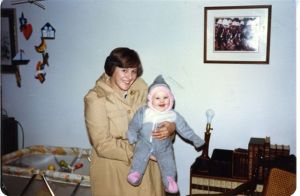
Look how delighted I was just to be held by her!

But when I was younger, rather than finding kinship in books with loving, caring mothers, three of my favorite books centered on absent, selfish, sometimes cruel mothers. I read Time Windows by Kathryn Reiss, A Solitary Blue by Cynthia Voigt, and Midnight Hour Encores by Bruce Brooks over and over. The details of each story differ, of course, but in each, the mother puts her own needs before those of her children, and the children suffer for it. In Time Windows, the mother feels trapped by domesticity and wants her own career (to be fair, it is 1904 and this was unheard of for white, middle-class women); in her anger, she locks her daughter in an attic as punishment for clumsiness. In A Solitary Blue, the mother leaves her much older husband for a bohemian lifestyle, and only returns to her son’s life when she needs money to fuel a drug scheme with her new lover. In Midnight Hour Encores, the hippie mother gives her daughter to the father within a week of the child’s birth, unable to face the huge responsibility of raising a child; years later, she gets her life together and becomes a successful businesswoman willing to set up a tentative friendship when her estranged daughter contacts her.

Why on earth would I want to read about these women? My own armchair self-analysis finds a few reasons: I wanted to see Bad Mothers punished in order to feel more secure with my Good Mother. I secretly feared my Good Mother might turn Bad and abandon me.

I think both of these are true. My mom was at home, insisting on breakfast every morning so I’d grow up strong, checking that I’d done my homework, wiping away my tears when the kids at school were mean to me. But when I was age 11 and devouring these books, she was also going to classes, doing her own homework, and writing her dissertation. In my confused adolescent mind, I saw her having a career (where before I hadn’t noticed one, since she’d taught at the school I attended so she seemingly extended her mother role to school just for me–ah, the utter narcissism of children!) and I freaked out. She’d never shown an interest in leaving home before, but what if Having a Job lured her away, as it seemed to for the mothers in these books? At age 11, I was just starting to see how taking care of my sisters and me might be a major pain in the ass, so I could easily see how she might chuck it all in to focus on her career and herself rather than on tending to our whiny needs.

But before I could get too into this strange fantasy of abandonment, the very books that led me down that path turned me right ’round again. The advantage of being an obsessive reader is that multiple meanings make themselves available on multiple readings. The protagonists of A Solitary Blue and Midnight Hour Encores start to see how their mothers had made difficult decisions when they’d left their kids. Not that this made them feel much better about how hurt they were to be left behind, but they did understand a little more how their mothers had their own interests that were separate from them, the kids, and how they’d pursued those interests instead.

Now, one of the things my mom has always said is how fortunate she feels that she was able to stay at home with us when we were little and then go back to school to continue her career, rather than having to do it all at the same time and missing out on my sisters’ and my young childhood. Unlike the mothers in these books, she didn’t have to make that hard choice. Here I was worrying about her doing something drastic, but she felt no need to do something drastic, because after those early broke years on the south side of Chicago, her husband was making a decent income that opened up possibilities.

But even if she’d had to choose, she would have chosen us. I asked her recently if she ever felt like putting us first meant putting herself last, and she said it never felt like that, because it was always about putting the family as a whole first. She didn’t see a divide between her interests and ours, because they were the same. Even when she decided to return to school and get her PhD, she saw how that had a benefit for us, too. After all, she wanted we three girls to grow into independent young women who were confident of their ability to do anything they desired, and making her own professional dreams come true was setting a good example for us.

Another good example she set, though of course it didn’t become clear to me until years later, when we’d all left the house, was that she never lost her sense of herself in us. She drove the twins to basketball practice, she listened to me practice scales on the piano, she bent over our math homework with us, she read stories aloud to us before bed, she commiserated with us on our tales of woe from school, she went to parent-teacher conferences, she joined the marching band boosters club, and so on ad infinitum. But she only came to basketball games, not practices; she didn’t sit through my piano lesson, just the recital; she only helped on homework we were stuck on, rather than checking each assignment to make sure we’d completed it. These are all things other parents do, other parents who perhaps do not have enough hobbies of their own or who don’t know what to do with the precious free time they find themselves with.

When I was growing up, this was simply the norm; from time to time, Mom had her dissertation to write, or a magazine to read, or a friend to chat with. If we were hurt or needed something or whatever, of course we could interrupt and she’d drop everything in a second. Otherwise, we could amuse ourselves, and she was not at our beck and call. Again, this was not just a good choice for her own sanity, but for our well-being and growth; we learned that everyone needs their space and that we could rely on ourselves for entertainment instead of needing someone else to feed it to us. She’s told me that she saw two dangers in losing yourself in your children: you either become resentful of the time and energy they take from you, or you expect something in return, like “I put my whole world into you, so why didn’t you turn out perfectly?” No one needs that kind of pressure, and no one ends up happy. I remember seeing Khalil Gibran’s The Prophet on her nightstand, with the “On Children” essay bookmarked. You know the one:

“Your children are not your children.
They are the sons and daughters of Life’s longing for itself.
They come through you but not from you,
And though they are with you yet they belong not to you.”

The astonishing thing to me then, that adolescent reader of books and dreamer of dire events, was that she was choosing us. The astonishing thing to me now, a single woman of 28, is that she chose us so consciously and conscientiously. She thought ever so carefully about every choice before making it, and she had good reasons for each parenting decision she made. (Note: none of this is to discount my dad, who is his own wonder but not the topic of this essay. The two of them were really big on making all parenting decisions together, and their united front was impenetrable.) She wasn’t on mothering autopilot, which is a relief to me now, since the idea of mothering is exciting but also terrifying, because how do you figure it out? By doing it, and doing it mindfully, as it turns out.

That’s the final message I got from these middle school books, too. Mothers aren’t just mothers whose only focus is their children; they’re people who have a vast array of interests, needs, and desires. That’s what was so scary to me. I was just starting to realize that mothers didn’t have to be as good as mine was, that they didn’t have to be there for us whenever we needed them, that they didn’t have to show their unconditional love on a daily basis.

I think my mom would say that she did have to do those things, that her love for us was so strong that she couldn’t imagine doing it any other way. But there were so many other ways she could have raised us, and she chose this way, the way of love, humor, strength, intelligence, curiosity, and kindness. That takes not just a good mother but a good person, and when I realized my mother was not just a good mother to me but a good person in the world, I saw more clearly why I wanted to be like her.

Happy Mother’s Day, Mom.
at Inspiration Point -- relevant, no?
Readers vs. Writers?

This post is a month late and maybe a dollar short, but I think it’s worth talking about anyway. Last month, Laura Miller, co-founder of Salon, wrote a piece that basically stated NaNoWriMo is not only worthless, but damaging to books and the literary community. Many bloggers took umbrage with this, notably Campatron, who said that NaNoWriMo is vital to keeping creativity alive in this country. At the risk of sounding controversial, I’m going to say that they’re both a bit right and a bit wrong. (And possibly a little bit country and/or rock and roll, although that rumor is unconfirmed.)

Readers vs. Writers?

Miller’s main points are: NaNoWriMo participants would write regardless of whether they devoted a month to meeting daily writing quotas. The material they produce in this time period is crap. They submit that crap for publication, and we don’t need to publish more crap. Too many writers don’t read. Readers are underappreciated and not enough people read. People should read more.

Campatron’s main points are: NaNoWriMo participants wouldn’t write regardless, because the world doesn’t value creativity enough. There aren’t too many books already in the world. Not everyone who participates tries to publish. All the writers she knows read, and in fact the NaNoWriMo organization puts together book drives and young writer programs. Miller’s piece is part of the problem in a country that doesn’t support creativity among kids and adults alike.

Seems to me that both authors are looking at the whole thing with too narrow a focus. Laura Miller’s looking at it from the book publishing side of things, and Campatron’s looking at it from the unpublished writer’s side of things, so they both miss realities the other sees all too clearly.

Miller’s right in that there aren’t as many readers as there used to be — just look at this National Endowment for the Arts report on declining reading rates among young people especially. Maybe Campatron is privileged to be surrounded with writing AND reading friends, but I know writers who don’t make the time to read, despite the wise adage that in order to be a good writer, you need to be a good reader. People aren’t reading a diverse array of books, is one of the main problems. The past fifteen years has seen the rise of the mega-blockbuster, which makes some people very, very rich, and keeps more oddball or esoteric efforts on the edges with no money from the publishing houses to support even a small print run on them. Everyone’s reading Dan Brown, and all the money Random House pumps into publicity and print runs on his latest novel means there’s that much less available for a debut novel or poetry chapbook. Publishing houses and readers play the blame game with each other, but the fact is that publishing houses are taking fewer and fewer risks in publishing unknown authors and unusual literature, and readers are buying fewer and fewer books that aren’t on the bestselling shelves. Hardworking indie publishers are doing their best to combat this, and I commend them for their efforts, but it is too bad that major publishing houses are so convinced that their industry is dying that they’re all scrambling to hoard a piece of the pie they’re familiar with instead of, I dunno, baking a whole new pie.

Miller’s point that writers need readers sounds simplistic, but it’s true and I agree it’s a point that doesn’t get as much attention as it ought. As my adviser in college once told me, reading is a creative act just as important as writing. We don’t need readers only for book sales; we need them to share interpretations and inspirations and disagreements with other readers, and to talk about what those books mean to their lives. We need readers to share in the imagination of the writers. I totally agree with Miller’s fear of the decline of reading and the attendant decline in quality writing. Reading gives writers ideas for new ways to say what they want to say, and enriches their own imagination. A well-read author is an author I want to read.

But Campatron is right when she says that discouraging writers from participating in something like NaNoWriMo is a disgraceful thing for someone involved in literature to be saying. Miller’s focused on the idea that all these writers are submitting their first drafts for publication, and no doubt some do. There are always going to be some people who are convinced their every word is a perfect pearl and they deserve publication and a seat next to Dan Brown and Stephenie Meyer at the Hot Shit Writers’ Table. But there are more writers out there with a realistic view of things, who don’t print out hundreds of pages on November 30 and cram it all into envelopes bound for the overworked editors of Little, Brown. These writers participate in NaNoEdMo in March, devoting their time to revising and editing those novels they pumped out the previous November. These writers are on writers’ forums online, and perhaps in writing groups in their hometowns. These writers are serious about the act of writing, and when the NaNoWriMo website admits that writers will write a lot of crap during November, those serious writers know that doesn’t mean they should just be done with it. They know there are many more steps to publication. Or alternately, as Campatron points out, they don’t even aim for publication but write just for the joy of writing, and why would you ever be against someone doing something that brings them joy like that? Miller says, “there’s not much glory in finally writing that novel if it turns out there’s no one left to read it,” which is true if your ultimate goal is to have people read your work. But if you write only for yourself, then fine, keep your novel in your home and enjoy it yourself. It’s not hurting anyone and why would Miller have a problem with that?

Campatron is 100% wrong when she says, “the world DOES need bad books. Without the bad books there would be no good books because you need to start somewhere goddammit.” The world needs bad DRAFTS of books, but there is no need to have dreck published and sent out into the world to be consumed and tossed aside. Writers need to start somewhere, sure, but that somewhere should be in something like a NaNoWriMo session or a writing group, not in a published book. How many authors admit they spent years on their first novel, only to realize they needed to get it out of their system so they could write their second, much better novel? (Many, is the answer.) Not every published book has to be perfect, but it has to be more than the first effort, because books are too precious to waste. And that is something that both Campatron and Miller seem to agree on, if nothing else.