
Sunrise, on the road in Iceland

Sunrise, on the road in Iceland
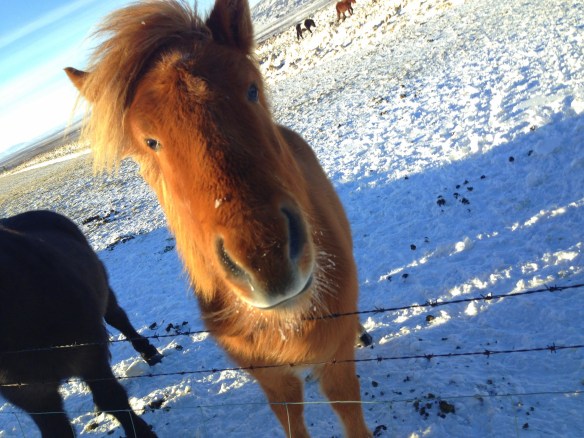
Along the road in Iceland; February 9, 2016
Despite the fact that I grew up in the Midwest and have driven through some white-knuckle weather in my time, it’s been two years since I last grappled with winter driving conditions and I might have lost my edge, so when I went to Iceland in early February I decided to go on tours rather than rent a car. This was absolutely the right choice, given how much I stared out the window and snapped blurry photos during the drive, and also the fact that I saw two cars in a ditch within a mile of each other.

10am sunrise

Iceland landscape

Hekla, the most active volcano on Iceland (about six years overdue for an eruption)
My first tour was to the south shore of the island (Icelanders always refer to it as “the island,” not “Iceland” or “the country” or anything–fair enough, it is half the size of the isle of Great Britain, which is itself the size of the state of Michigan; it’s not big, is what I mean). I went on a Reykjavik Excursions bus with about 50 other tourists, our driver, and our guide, whose name in Icelandic means “Raven Battle,” but we could just call her Raven. Iceland: where your tour guide is definitely descended from Vikings.

Seljalandsfoss
Sunrise in Iceland in February is around 10am, which means that we had some great views from the bus as we headed south and east. Our first stop was a quick one, at the entrance to the farm that sits at the bottom of Eyjafjallajökull, the volcano that erupted in 2010 and stranded travelers for days because of all the ash it threw into the atmosphere. It was dozing peacefully when I saw it.

Eyjafjallajökull
Next came the part of the tour that reminded me I was on a guided tour for 50 people. We disembarked in the parking lot of the Mýrdalsjökull glacier, and Raven told us to be back in a strict thirty minutes because we had a schedule to keep to. If I hadn’t had my friend’s Yaktrax strapped to my boots, I wouldn’t have made it more than a few hundred yards in that whole time. But with those, I was able to walk on the ice rather than slip-slide along it tentatively. Still, with only a few breaks for photos, I didn’t make it to the viewing point. I got just around the corner so I could see that particular shade of glacial blue, and then I had to rush back. Even so, I was the last one on the bus. Worth it.


As we drove to our next destination, Reynisfjara, Raven warned us at length and in some detail about the extreme dangers of the riptides at this beach. I started to wonder if she was giving us safety tips or just describing our impending doom. But I didn’t touch the water’s edge even once, and I made it through okay. The black sand of the beach here is a dramatic contrast to the whitecapped blue of the ocean, and some stepping stone-type rocks near a cave on the southeastern edge are a big attraction.


After lunch in the town of Vík, we went to the Skógar Museum and listened to an excellent introduction to how Icelanders lived for centuries. In sum: it was really difficult. The only mammal native to the island is the Arctic fox, so the original settlers brought over cows, horses, sheep, etc. Then there was a “little Ice Age” that started in the 14th century, during which time many people and animals died, and the settlers were no longer able to grow most of the crops they’d grown before. All because temperatures had dropped by a couple degrees Celsius. People built turf houses, which are literally blocks of earth cut out of the ground and piled up like bricks to make a small house. Then they’d search the beaches for driftwood to use as roofing material. Seeing as how the original settlers chopped down anything resembling a tree in a very short period of time, there was no wood or other fuel on the island, so they just didn’t have heat. They used the geothermal hot spots when they could for cooking and such, but they didn’t really master that til the 20th century.


The original settlers came from Norway and Ireland; basically Vikings stopped by Ireland and stole a bunch of women for wives on their way to Iceland, a horrible but effective method of diversifying your gene pool. Some think the fact that Iceland has sagas while other Nordic countries aren’t well-known for them is because of the strong storytelling tradition of the Celts.
Unsurprisingly, the Skógafoss waterfall is next to the Skóga Museum. (The suffix “foss” means “falls” so I guess “the Skógafoss waterfall” is redundant in the way of “the ATM machine” but anyway.) Despite the freezing temperatures, the river rushed down the cliff impressively. I was surprised by the grey color of the water as it fell, especially as the snow on the banks of the river was a clean white and the sky was a bright blue. That’s probably due to the sediment that was in the river, I suppose. Whatever color it was, it was a sight to behold, and I liked the fairly unusual angle we got to approach the falls from–I walked along the riverside right up to the base of the falls, with no barriers or anything in the way, and no forest to walk like you usually have to when getting to a waterfall.
Our last stop was another waterfall–Seljalandsfoss. Just as at Skógafoss, you walk along the river right up to the base of the falls. I love waterfalls in any setting, but I really enjoyed the unusual approach of an empty landscape, the magnificence of the snow-covered plains, the craggy cliff, the waterfall rushing down. There’s even another, smaller waterfall a little way down the cliff, so I got a bonus waterfall. I was very happy.
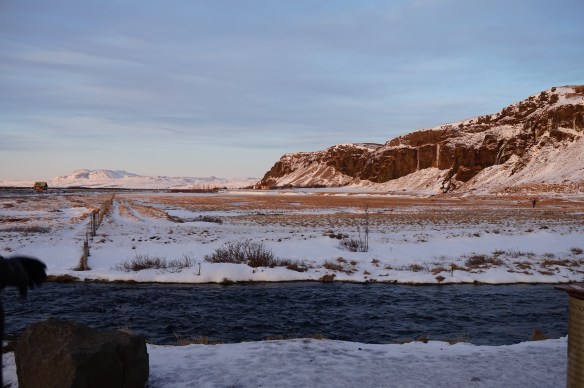

The beginning of sunset

Misty reflections

We drove back along the coast, mountains climbing up out of farmland on the right, the sun setting over the Atlantic Ocean to my left. Even in dark winter, I don’t usually see sunrise and sunset in the same day, so kudos to the latitudinal position of this lovely island for allowing that.

Sunset on the ride home

Colchester, England; April 18, 2015
“You have to really menace me with those swords,” I reminded my friends. “Don’t hold back.” They rolled their eyes at me, but obliged by brandishing their sticks more threateningly. The woman taking our photo looked bemused. Welcome to traveling with me–there’s probably going to be some ridiculous posing, and it might well involve liberal interpretations of what a historical moment might have looked like. In this case, the signing of the Magna Carta at Runnymede.
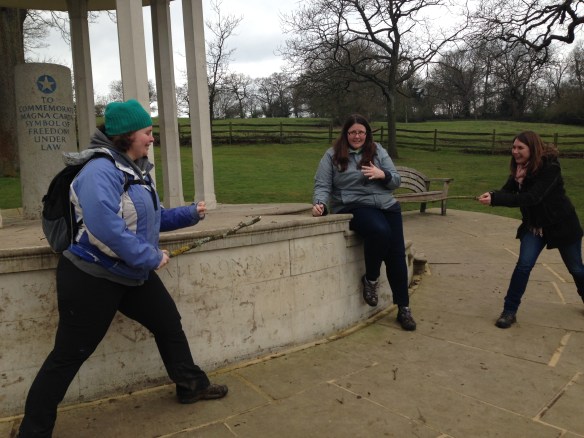
“Okay, okay, I’ll sign it! You can have your property rights!”

The Magna Carta Memorial
The Magna Carta is held up as a sort of proto-democratic document, the fledgling beginnings of constitutional rights. And it was the first document in Western society of its kind, even if it was an agreement reached between a weak king and his disgruntled barons, dealing in large part with the property rights of those barons. But never mind, it’s got a lot of symbolic power. It was used throughout the centuries as the basis for laws granting liberties in England, and the Founding Fathers looked to it when they were drawing up the United States Constitution.
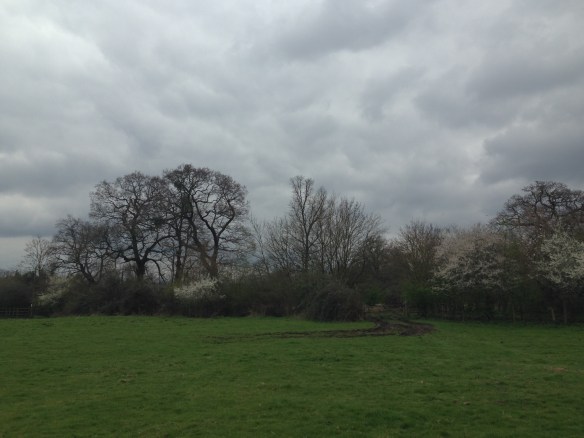
The walk to Runnymede
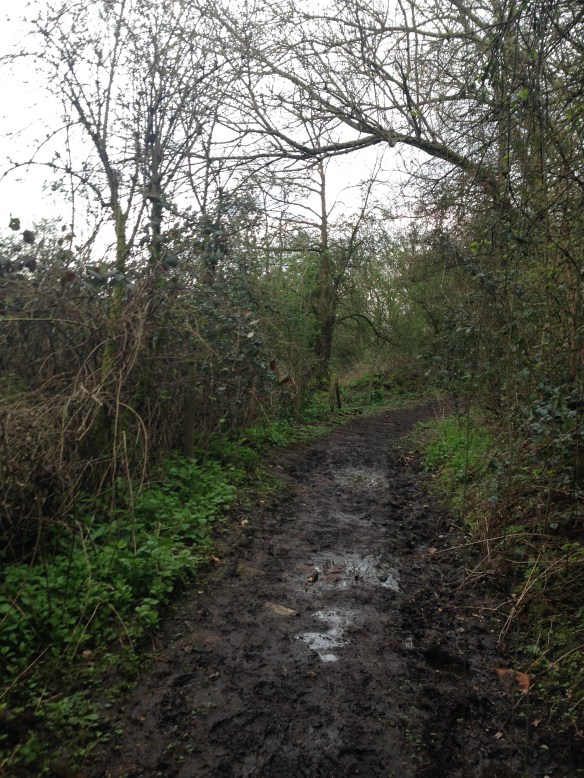
It was really, really, really muddy

The green of spring
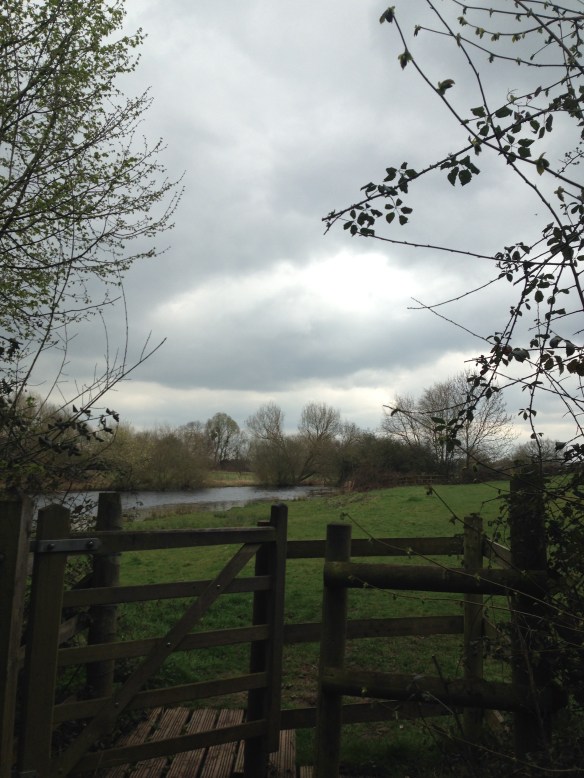
King John signed the Magna Carta on June 15, 1215, which means that when I visited last year, it was nearly the 800th anniversary of the signing. There were probably some ceremonies in June last year to commemorate the anniversary, but on that overcast April day, the site was pretty empty. We met only a few people on our walk from the start of the National Trust trail, through the woods and fields, to the monument itself.
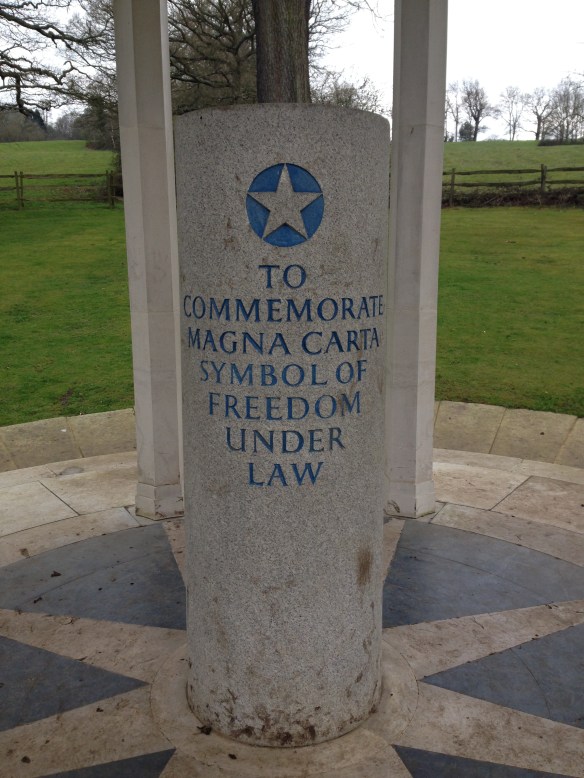
Set up by the ABA

Sure, why not
Once at the monument, we saw that the American Bar Association had put it up and maintained it. There was also a monument to John F Kennedy, and a tree planted to commemorate the bicentennial of the United States–that last seems a bit cheeky on English soil. So pretty much everything there was put up by the Americans. My mom said it was typical of both countries: the English took it for granted that this major historical site was just there, and the Americans needed to mark it ostentatiously. Sounds about right.

Action shot along the Thames


Wouldn’t have minded a ride back to town on that boat
When I mentioned to my mom that I’d gone to Runnymede, she asked how I’d got on the island. What island, I wanted to know. She’d been taught at school that the Magna Carta was signed on an island in the Thames. I didn’t even see an island when I was there. I did see the ruins of a priory across the river, unreachable from where we were, and an old yew tree near it, which the Internet tells me is likely the actual spot the document was signed. So the memorial isn’t quite in the right spot. We can only fetishize historical places so much, because it’s all an approximation. I suppose, as usual, it’s what we’ve done with that historical moment that matters.

You can spot the ruins of the priory across the river there

Two stone plinths stood on either side of the two-lane highway that buzzed right through the medes. One of the plinths had this grand inscription.

Ah yes, the tearoom of the major historical and political document. Two scones, please.
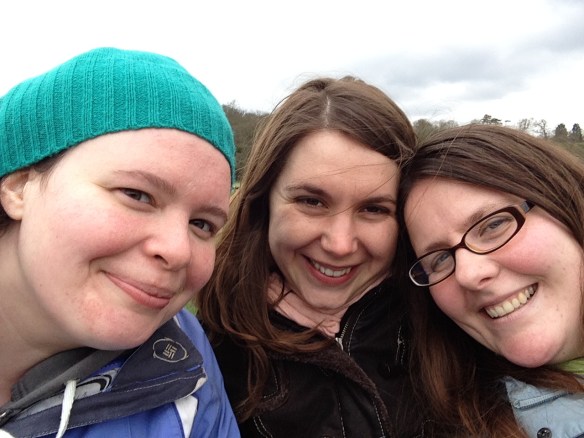
Lovely day out with Liz and Michal
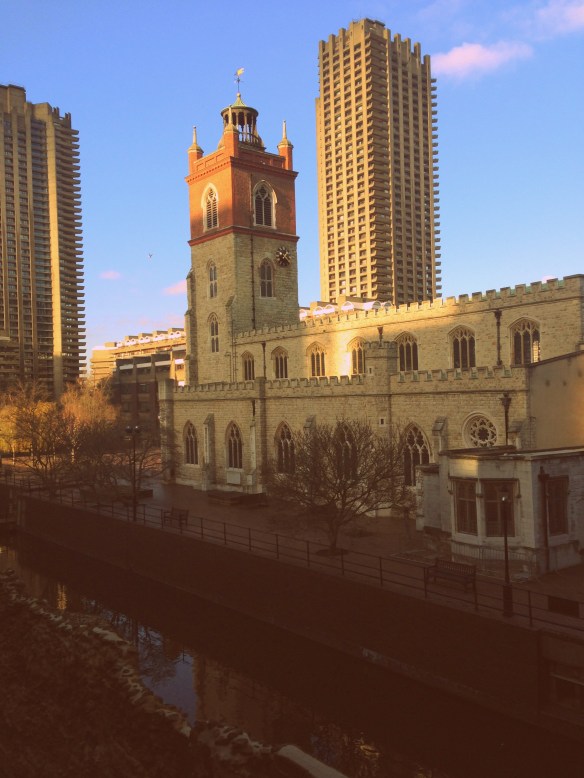
St Giles-without-Cripplegate, Barbican, London, England; January 19, 2015
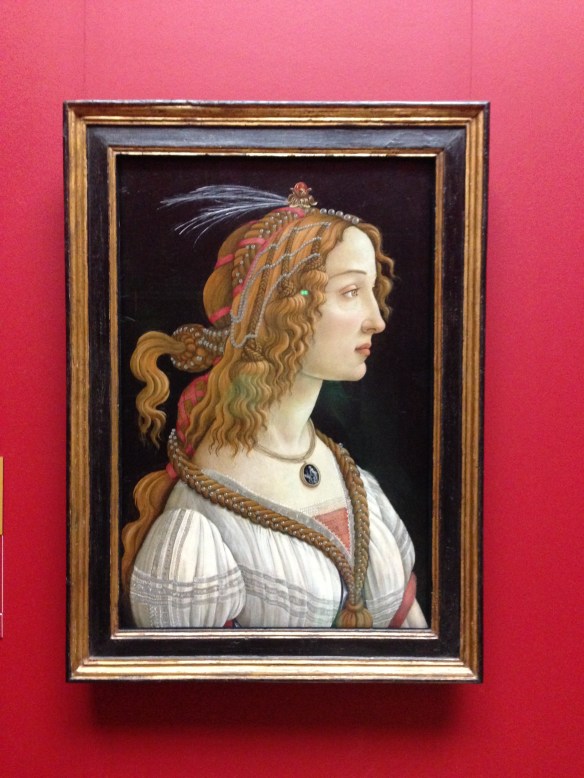
Sandro Botticelli, Idealized Portrait of a Lady
Idealized or not, I want to try that hairstyle.
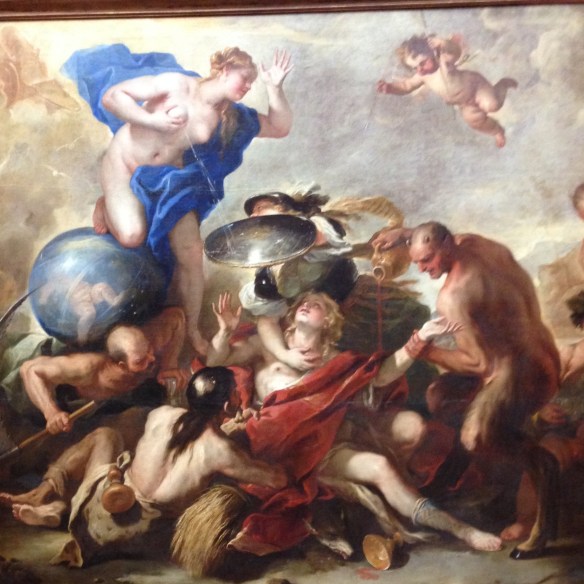
Luca Giordano, Youth Tempted by the Vices
I like how one of the tempters in this temptation scene is cockblocking the lady in blue, who is so desperately trying to get her temptation through to the temptee lad in red that she is squirting breast milk at him. Which, to be fair, it looks like he wants some of that.

Hans Holbein the Younger, Portrait of Simon George of Cornwall
Oh hey, it’s my new bae. So hot, so stylish, with a particularly suggestive broach (it’s Leda and the Swan). Yeah, okay, so he’s bringing me a carnation as a symbol of his love, but that’s just the flower of choice from his time, okay? He doesn’t know how unfashionable they are now.

Rhenish Master, Altenberg Altarpiece
I just like that Mary and Elizabeth get a panel to themselves. They get to have a breath here and exclaim over the news they’ve just received before it’s all about angels and holy sons again.
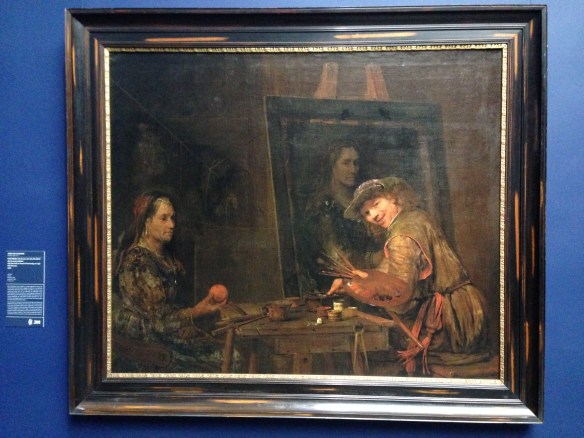
Aert de Gelder, Self-Portrait as Zeuxis Portraying an Ugly Old Woman
THIS dickweed. Here we have a self-portrait of the artist painting a middle-aged, ‘ugly’ lady so that she appears younger and more conventionally attractive. The smirk on his face says it all: ‘Delusional bitches, huh? But ya gotta pay the rent.’

Artemisia Gentileschi, Judith Slaying Holofernes
I really admire the way she’s working hard to keep blood splatter off their dresses.

Pompeo Girolamo Batoni, Allegory of the Arts
Architecture and Music in the background all, ‘No it’s fine, we like it back here in the dark, we prefer it actually, we’re pretty sensitive to light, we know you didn’t mean to imply that we’re unimportant or anything, yeah we understand, it’s just for the layout of the painting, sure, sure.’
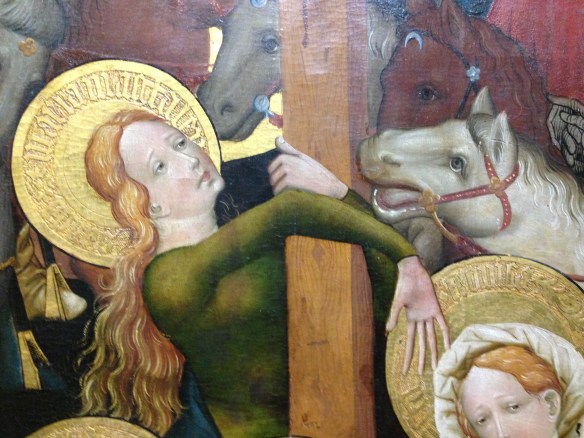
Middle Rhenish master, Crucifixion Altarpiece allegedly from St Peter’s in Frankfurt
Poor woman, she’s clinging to the crucifix and mourning the death of Jesus, and then along comes this horse that clearly wants a piece of her.

Strasbourg master, The Preparation of the Cross
Wardrobe & makeup doing some fix-up work on Jesus between takes on set.

Adriaen Brouwer, The Bitter Potion
Ordered ale. Got lager.

Northern Netherlandish master, Triptych with the Crucifixion, Saints and Donors
‘We’re definitely in the wrong triptych.’
‘I told you we went to the wrong one.’
‘I know, I’m sorry! I just got nervous and jumped in. What are we going to do now?’
‘Smile. Look like you’re praying. Maybe they won’t notice.’
The Staedel Museum in Frankfurt, Germany is a wonderful place. I spent three hours on the Old Masters’ floor alone. Many beautiful pieces to discover–if you’re ever in Frankfurt, be sure to visit!
 Stowaway Travel Writing & Editorial Services