
Sunset, Kailua, Hawaii
Sunset, Kailua, Hawaii
Pre Rup

Pre Rup

Banteay Srei
This temple is called the “lady temple” because it’s shorter than the other temples, lady-sized. No one seems to be sure why it was built on such a small scale. It’s built of red sandstone, rather than the mix of sandstone, laterite, and brick used in some of the other temples. It’s also covered in beautiful decorative carvings, and because the buildings are only a little taller than eye level, it’s easy to admire the art.
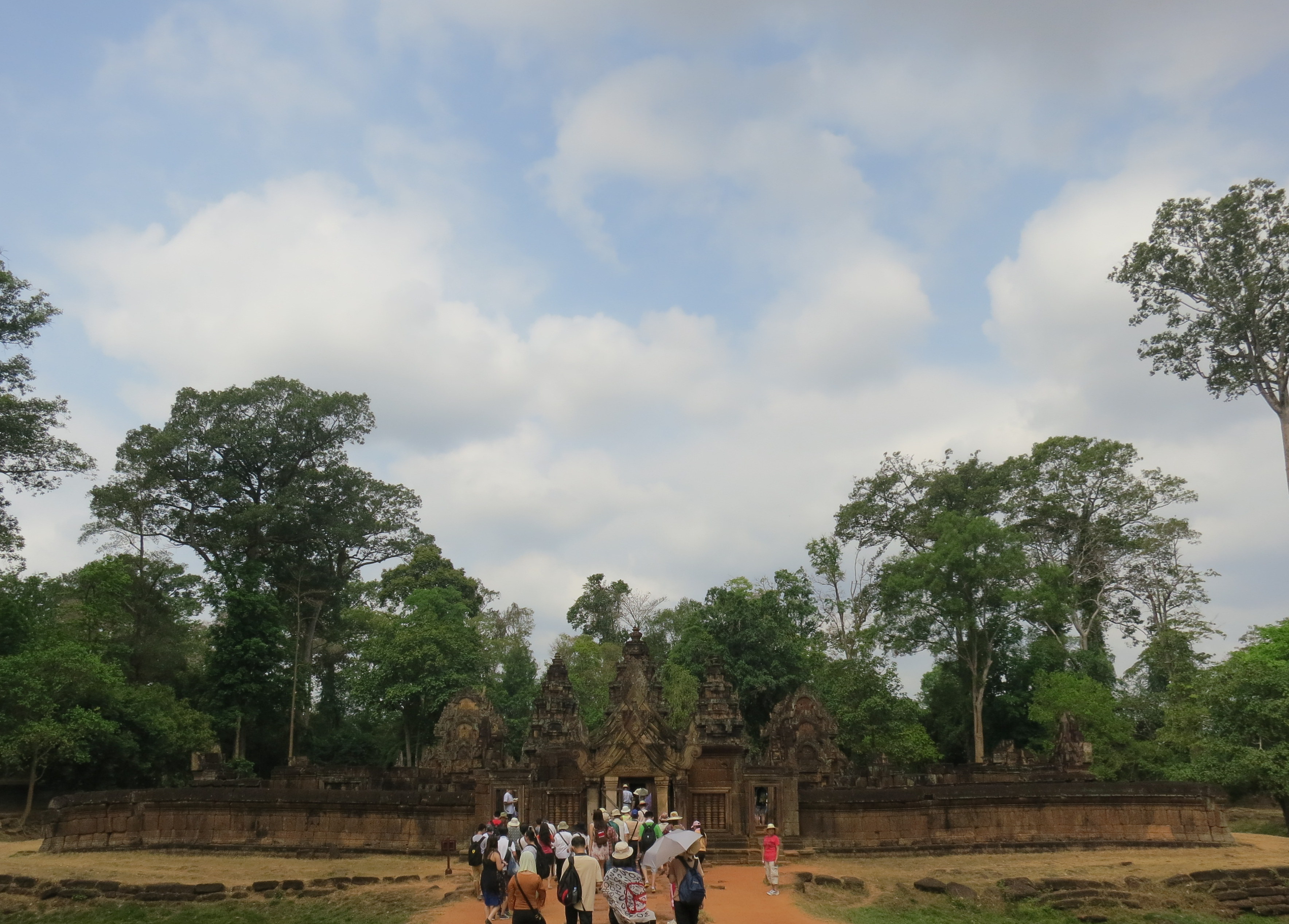
On the approach, you can see how the temple is so much smaller than the other temples.

Banteay Srei

Most of the statues in the park are copies because the originals kept losing their heads to vandals.
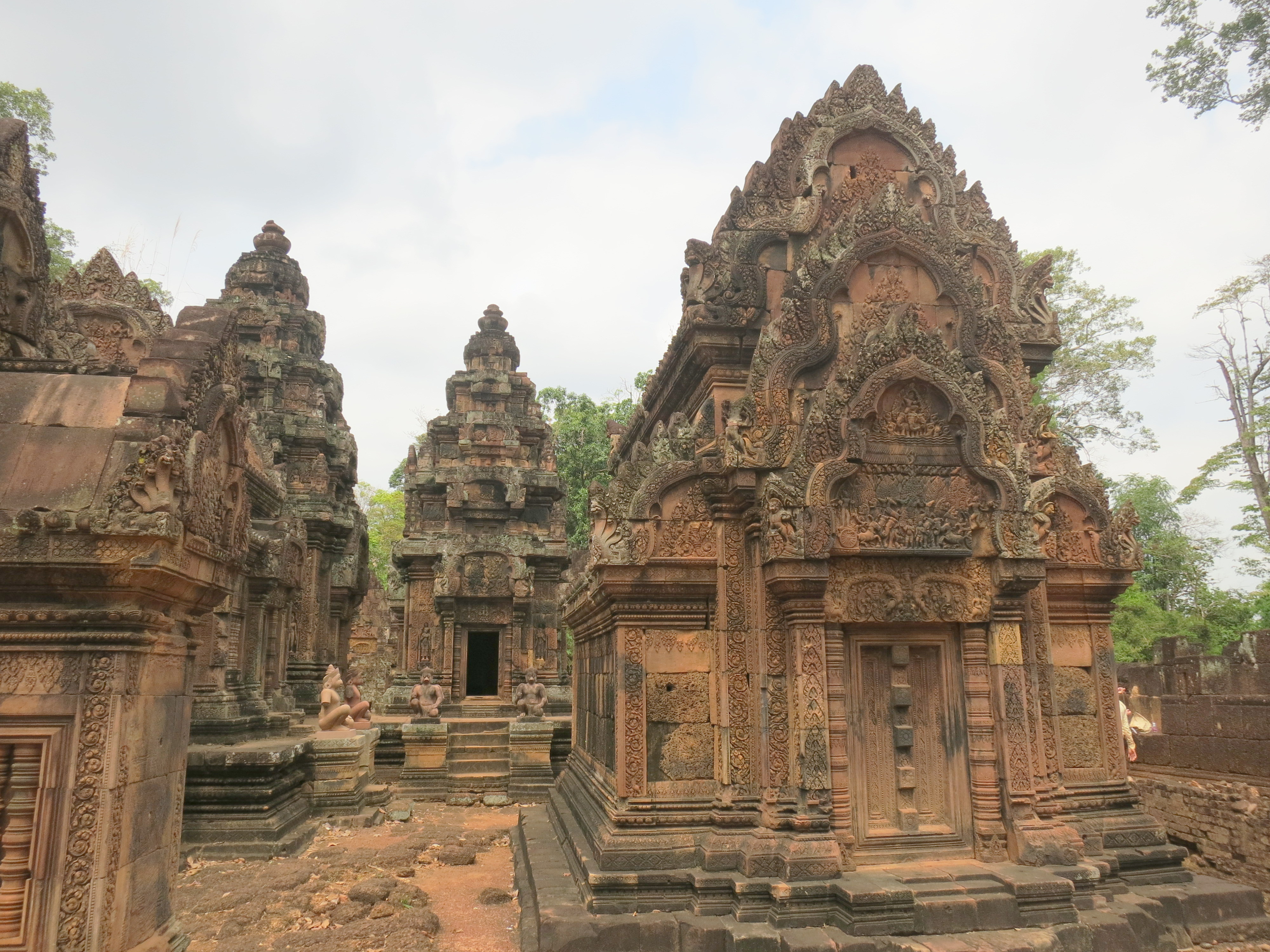

Gorgeous detail in Banteay Srei
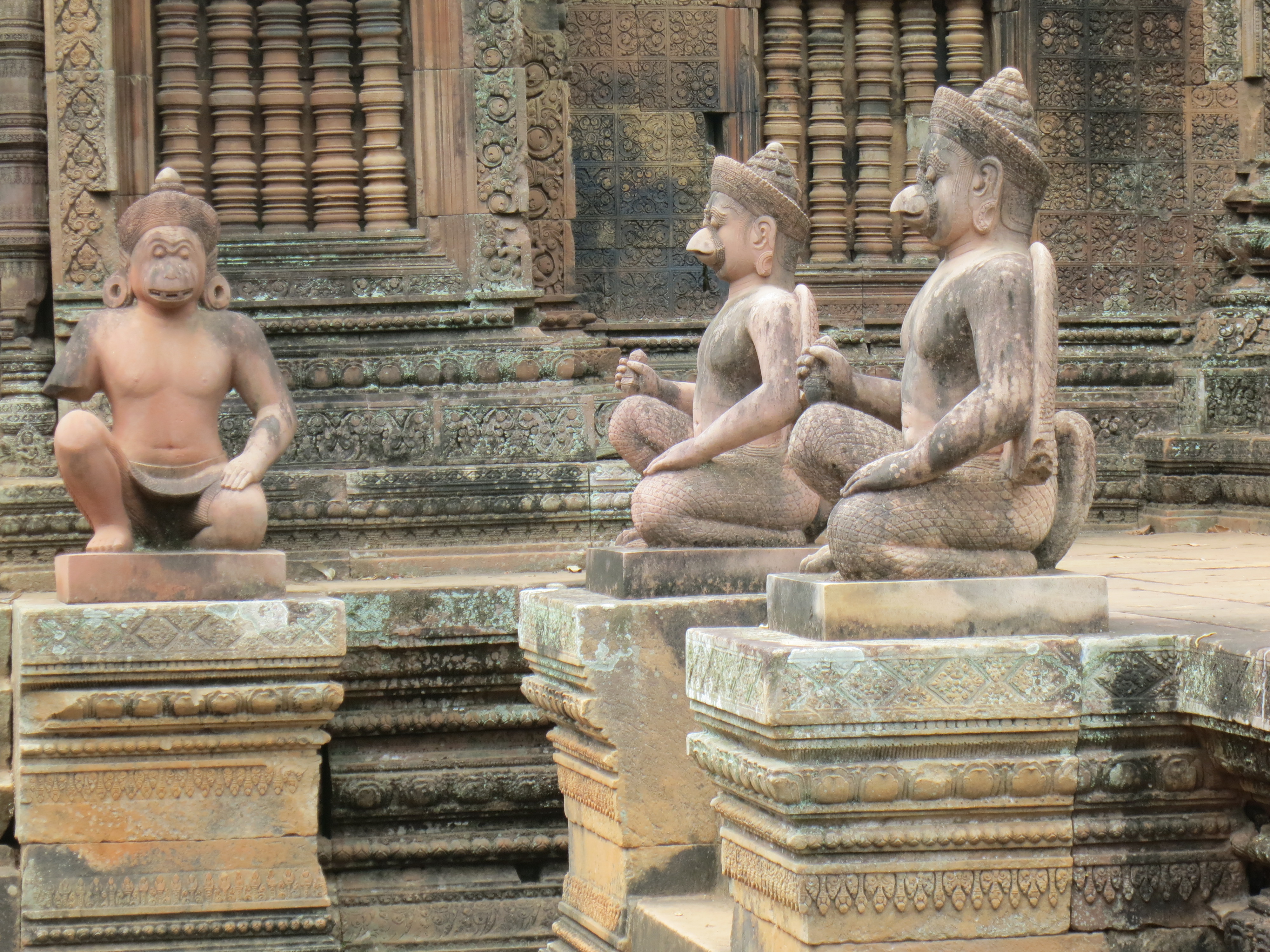
Also monkeys
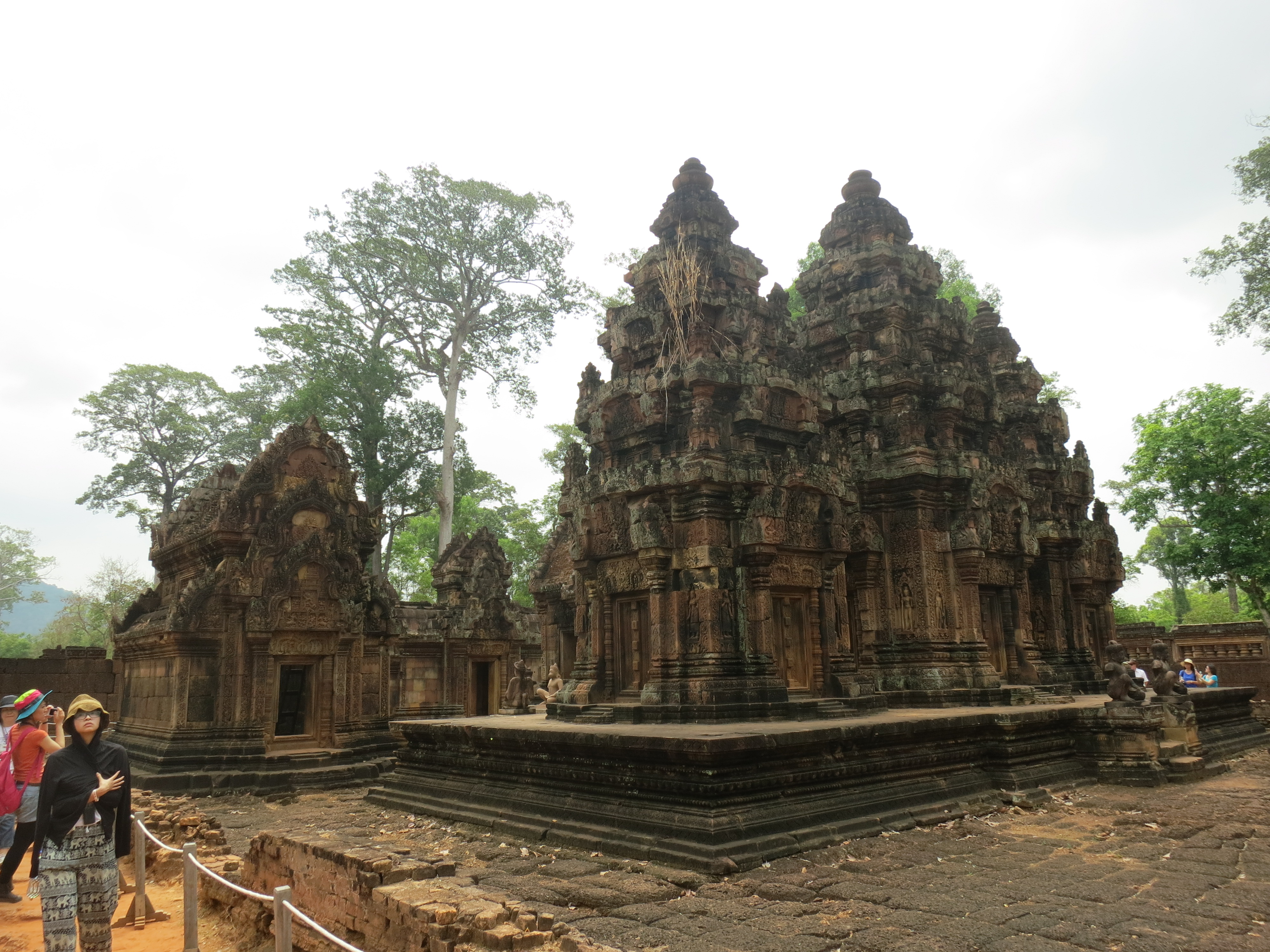
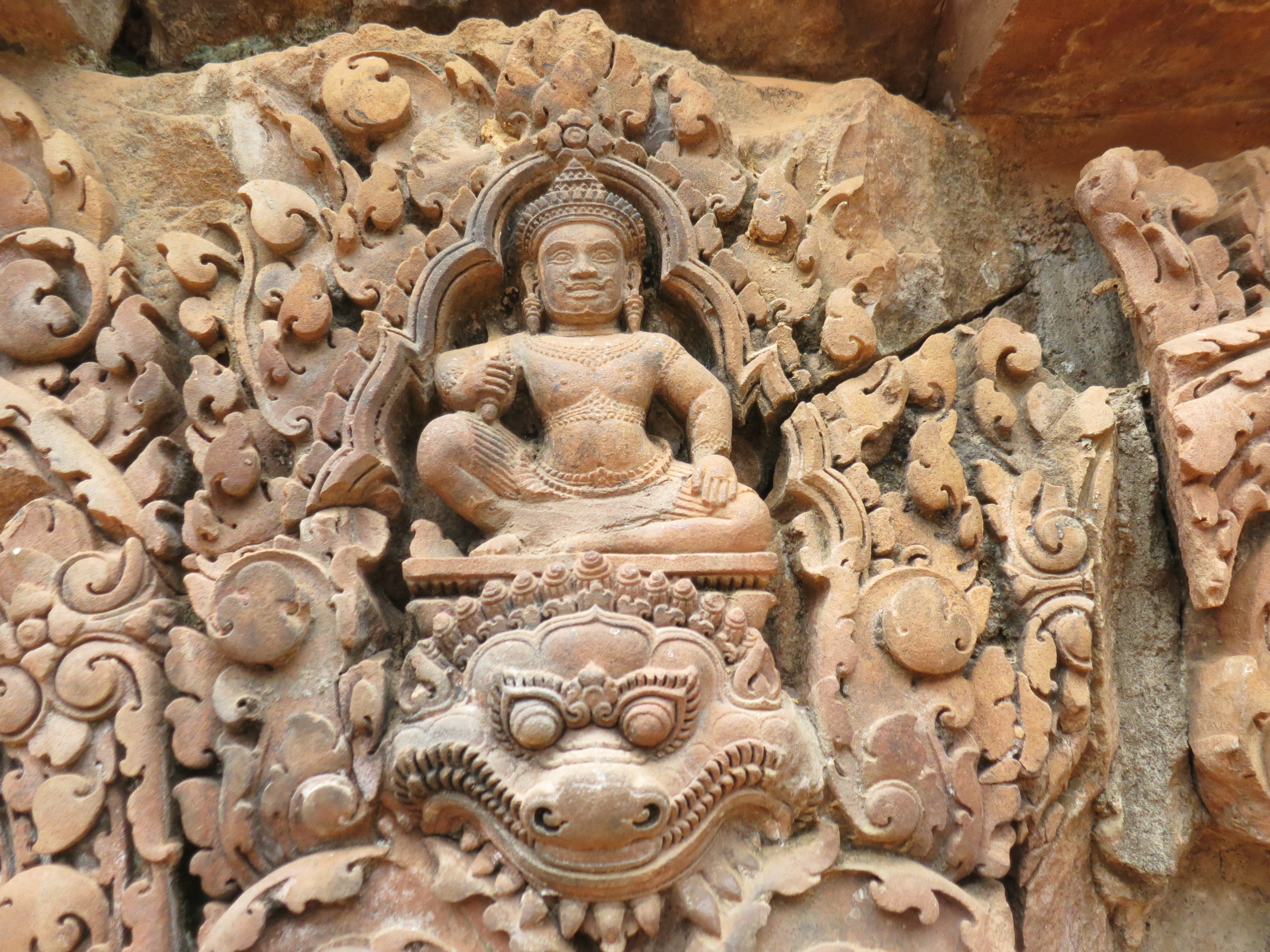
Such cool detail
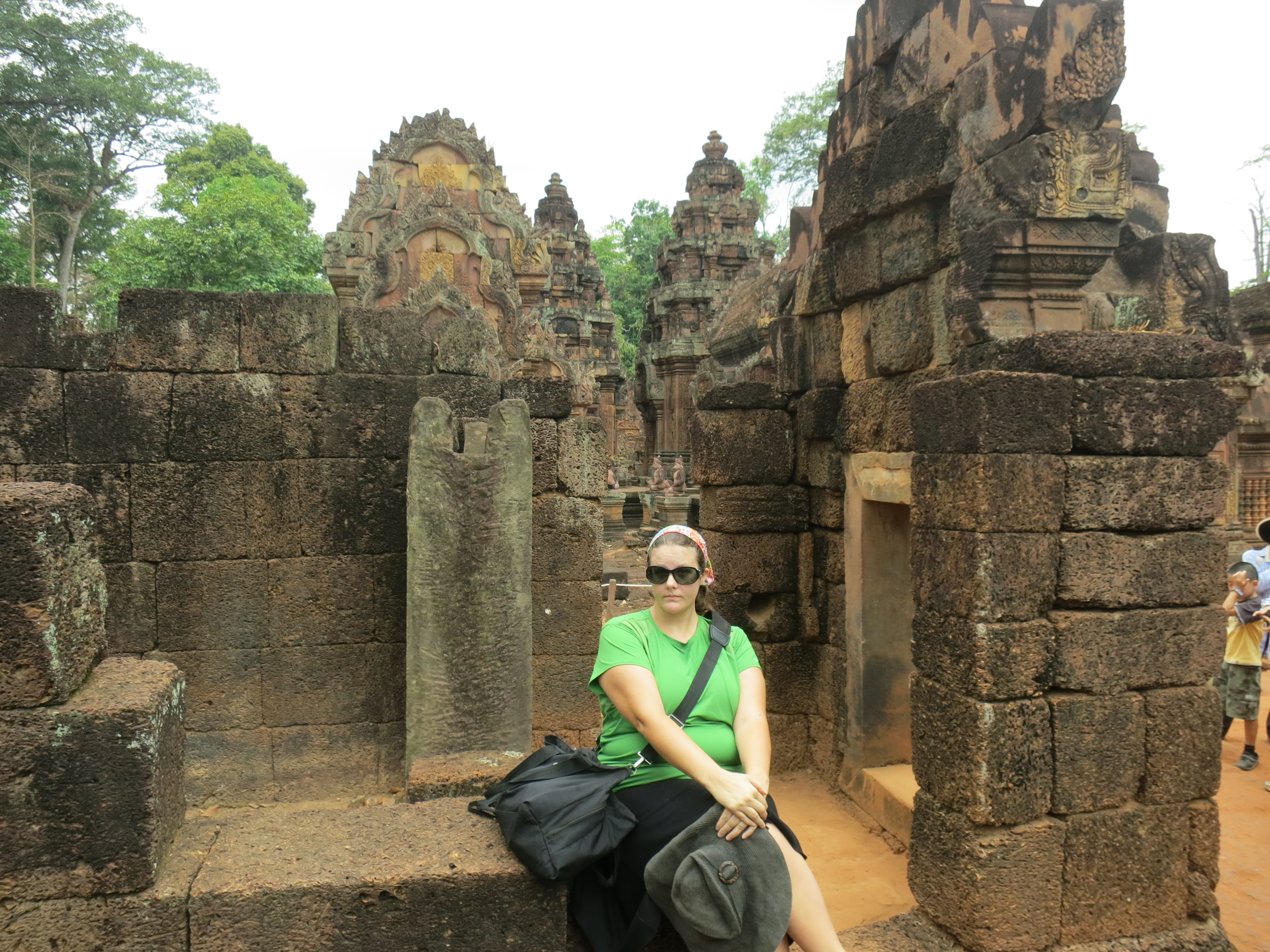
Being demure in the lady temple

Banteay Samré
More than other temples I visited, Banteay Samré seemed like it was missing water. Everything was raised off the ground–the outer walls, the inner libraries, the inner temple–and since it was all closer together than Angkor Wat or similar, I got the feeling that there should have been water filling in all the empty spots. Like a floating temple. This was just what I wanted, though, and probably isn’t at all what it would have looked like in the 12th century.

Banteay Samre
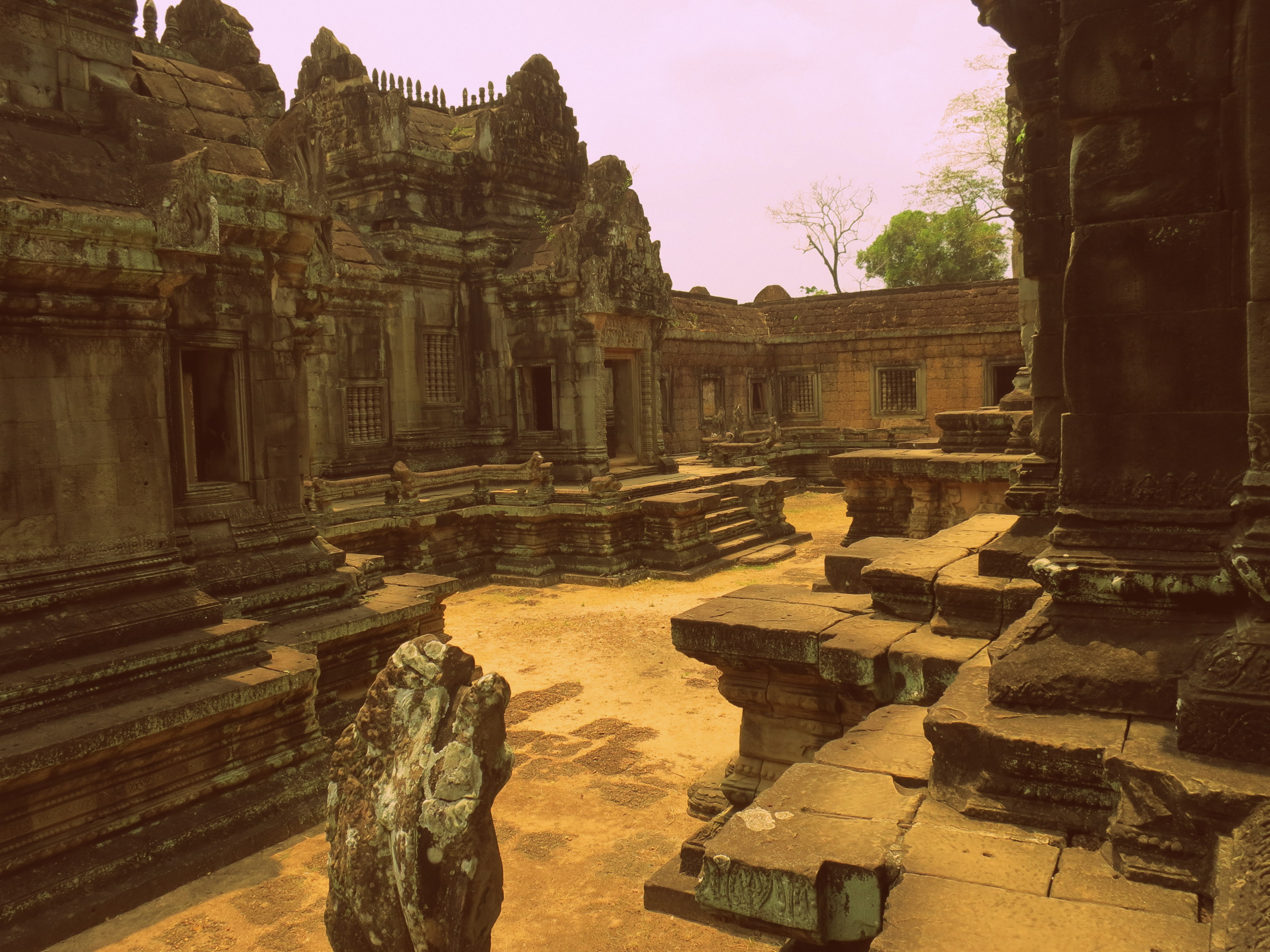
Can’t you just see water filling in all those spaces?
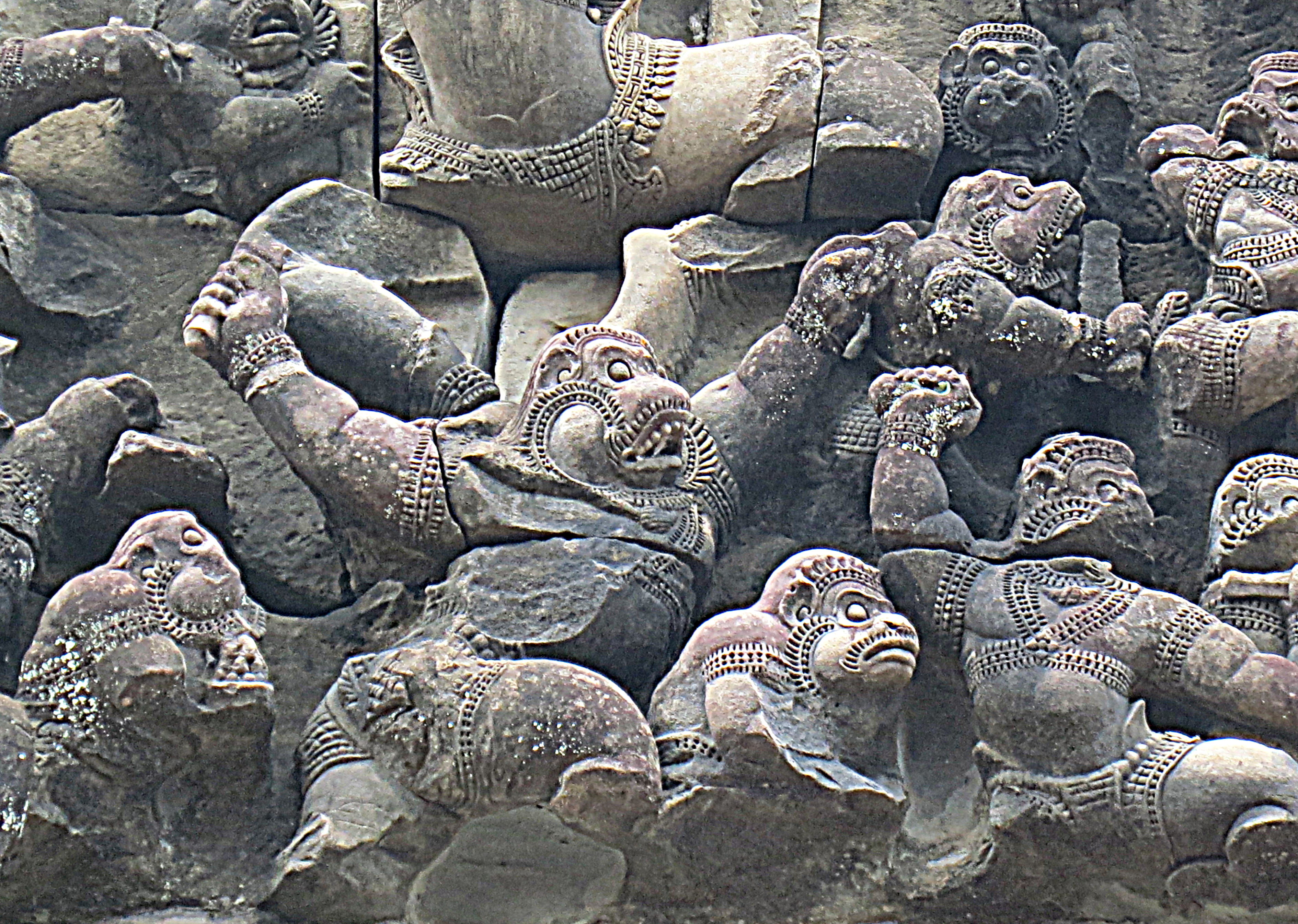
That detail again

East Mebon

East Mebon

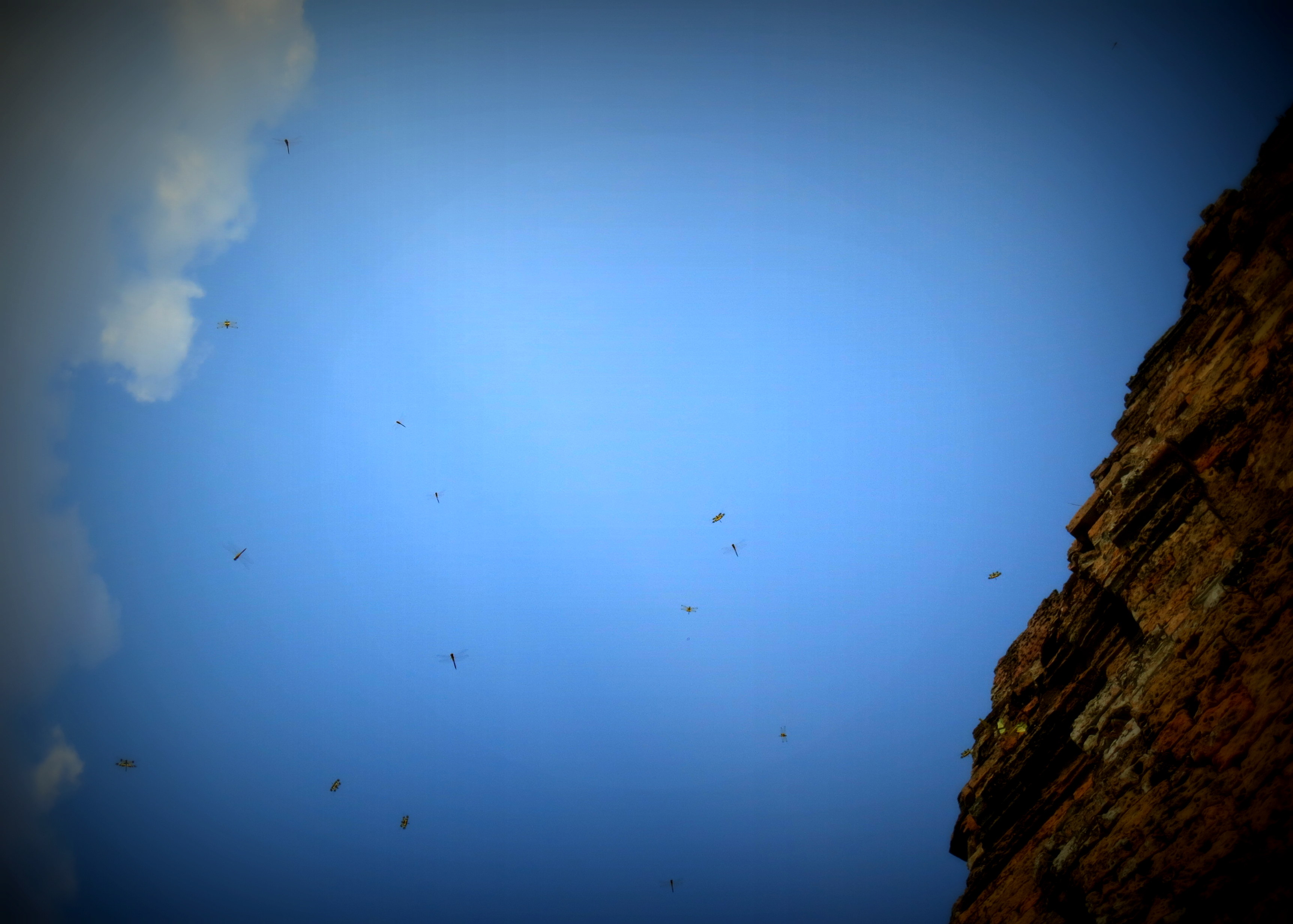
Dragonflies everywhere
Ta Som

Ta Som
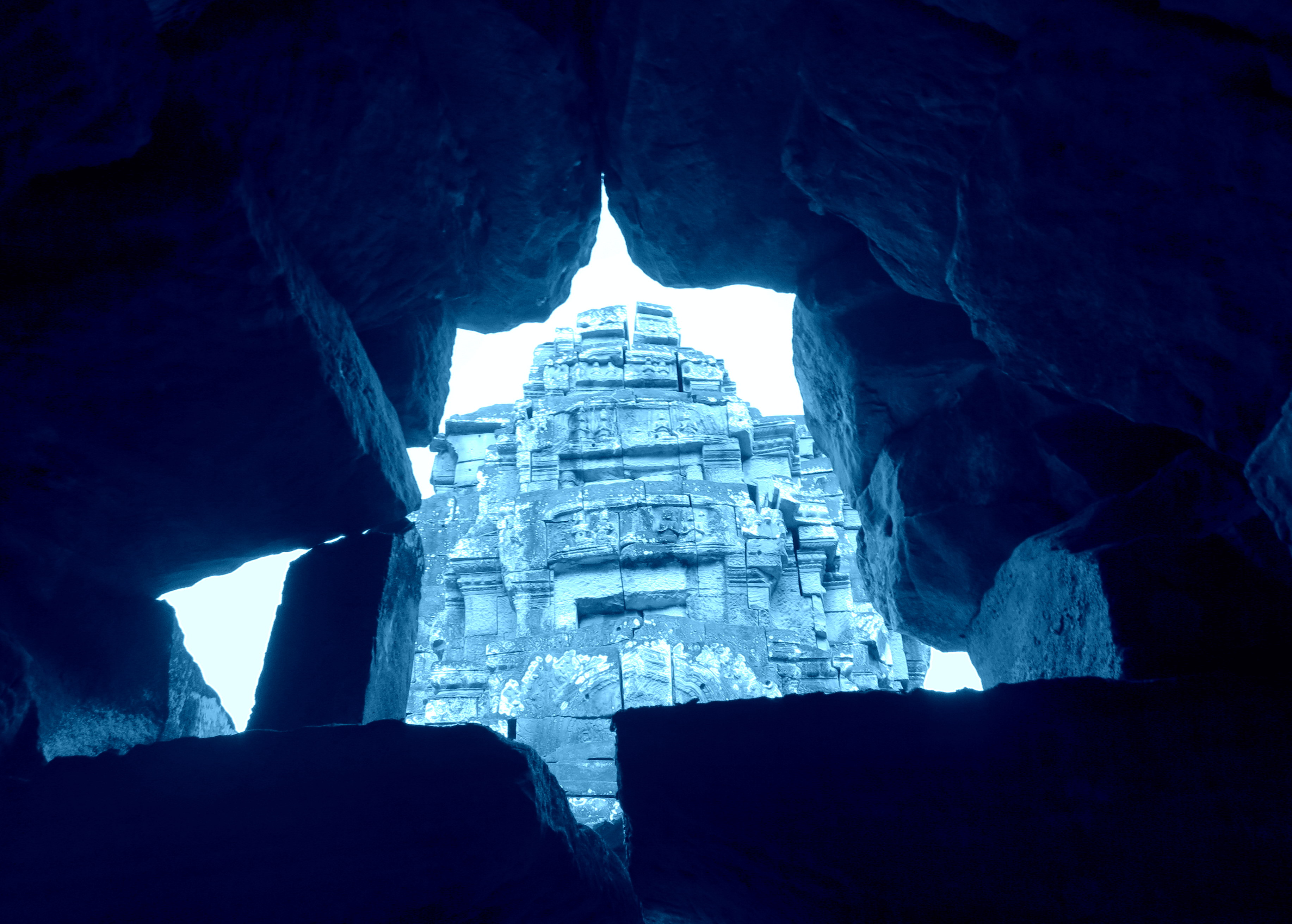
Neak Pean
A royal lake, and a long walk through some pretty marshy areas to get to it. Tiny temples at the lake.

The long path to Neak Pean
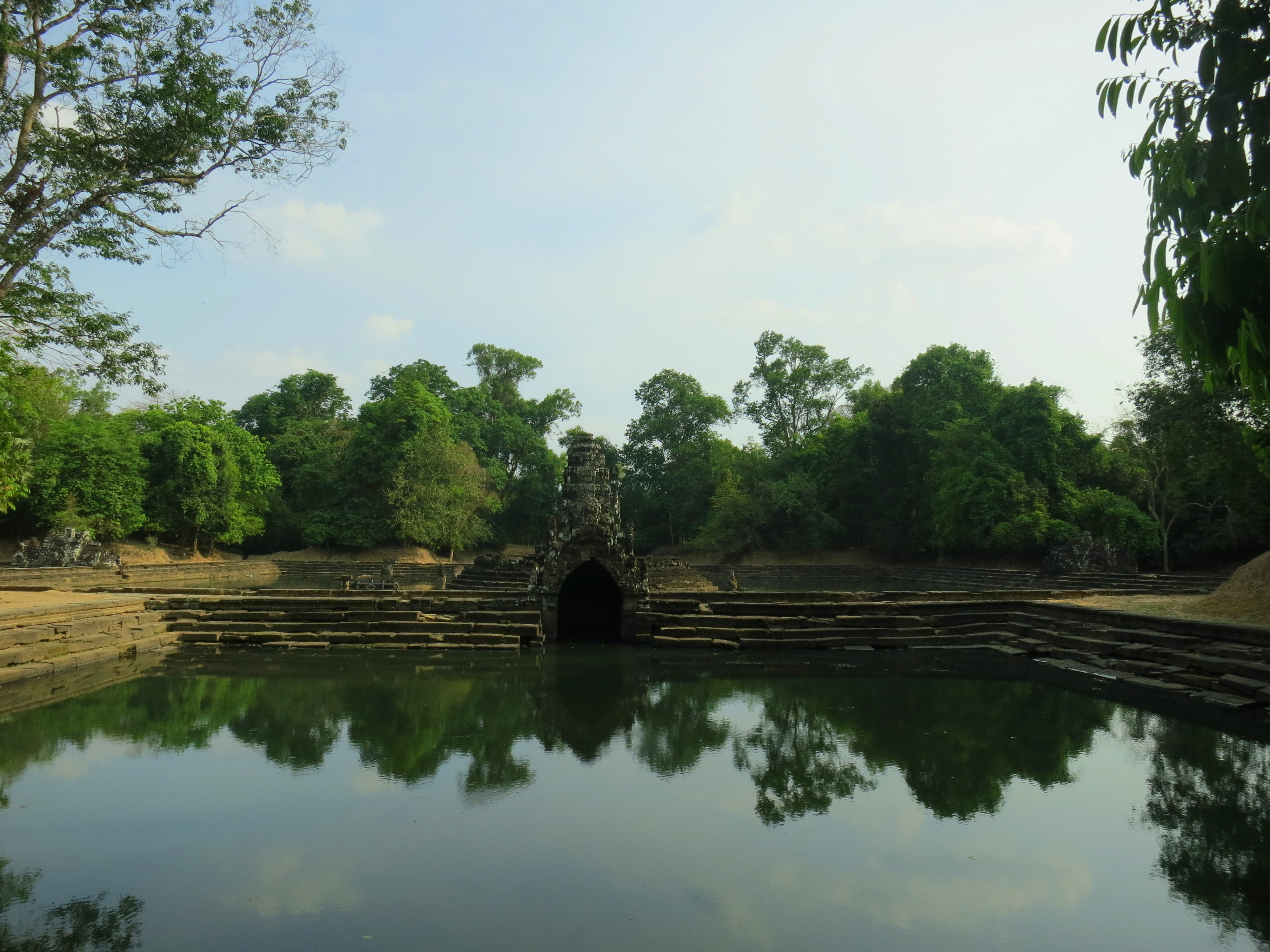
Love the symmetry of these lakes
Preah Khan
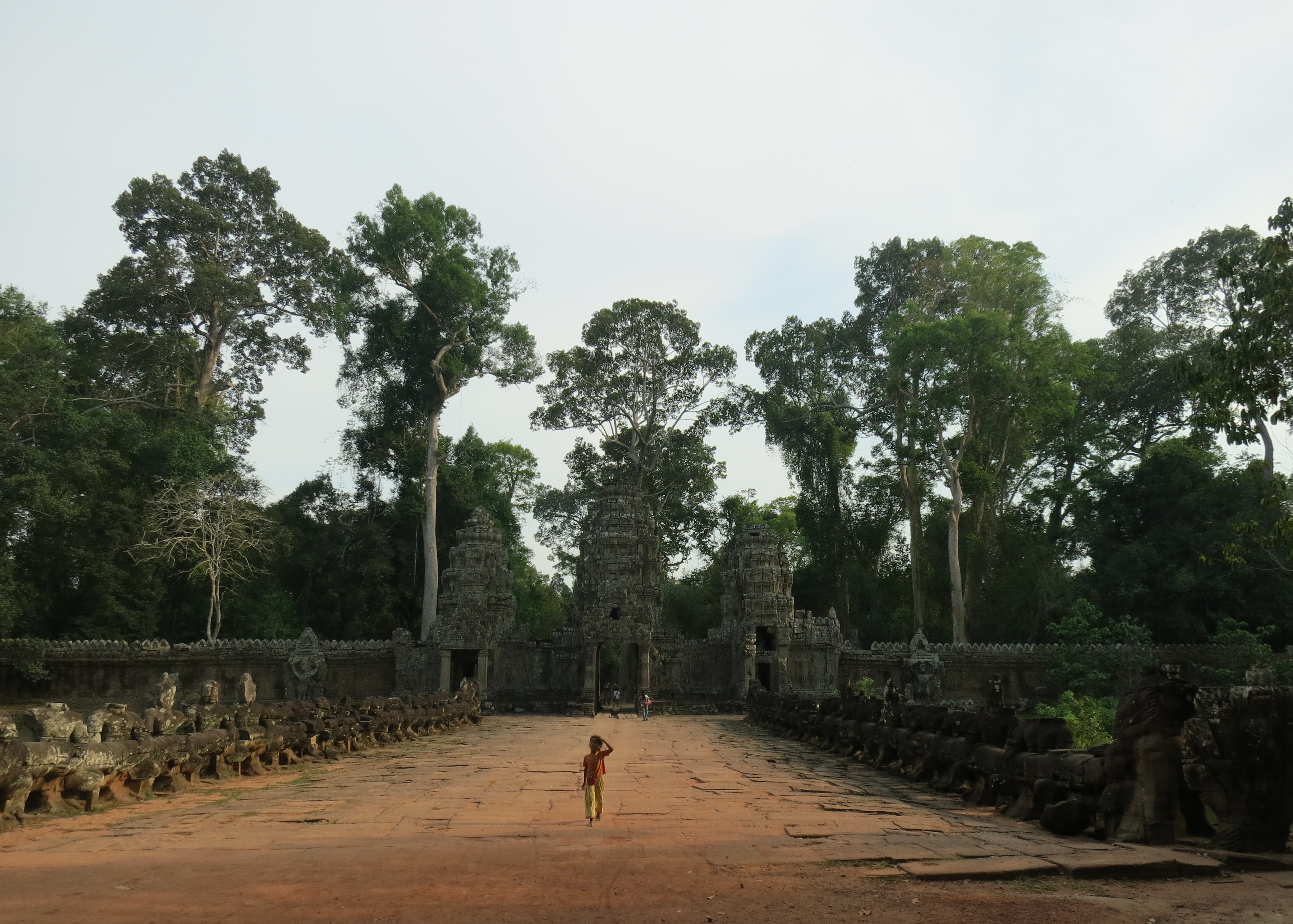
Preah Khan


The hall of dancers at Preah Khan

The library at Preah Khan


Queenstown, New Zealand; January 2, 2013
One of my favorite memories of the temples of Angkor doesn’t involve the temples at all–it involves a sticky plastic seat, a table in the shade, and two hours of conversation. After a morning at a couple temples, I took my driver’s advice and ate at the little restaurant across from Banteay Samre.
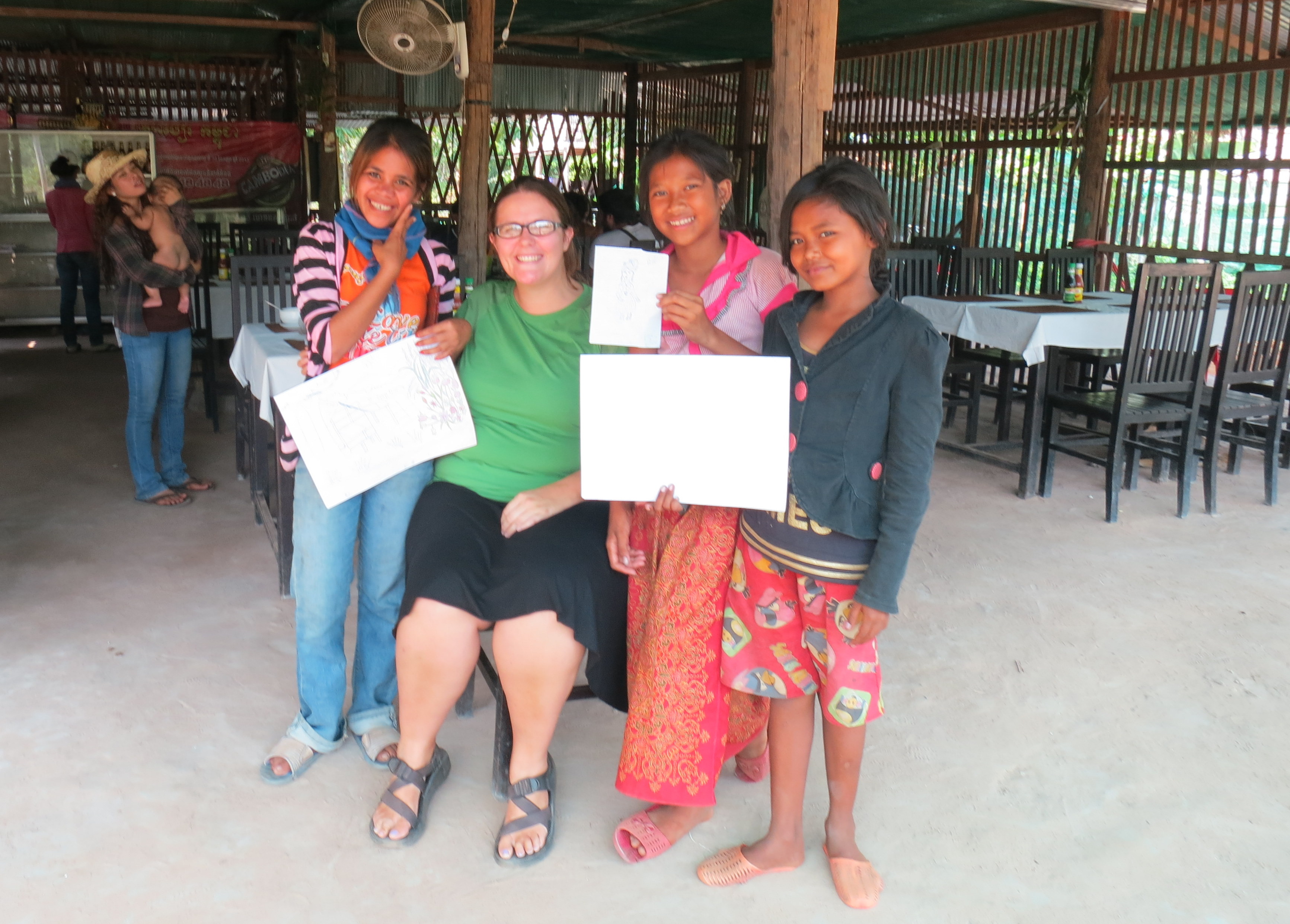
My My, Jo, and Tui show off their drawings
Two teenage girls took my order, and their mother brought out a delicious fish amok soup. One of the girls disappeared in the back with her mother, but the other one stayed out with me and chatted. My My, as she introduced herself, was sweet and silly, giggling after every sentence. Her friends, Jo and Tui, joined us, and they talked with me about school–which they sometimes go to and sometimes skip–and boys–one of My My’s friends, age 15 like her, has just had a baby. Tui’s English was almost perfect, but Jo and My My were able to hold a conversation just fine as well. I brought out a packet of coconut crackers and handed them around for everyone to share.

Fish amok soup–so good
But as with nearly all the friendly conversations I had with locals throughout Southeast Asia, I felt an undercurrent of discomfort because the income inequality was always so evident. All three girls were trying to sell me something over lunch; My My had bottles of water and Tui had little ornaments. For me, the two hours we spent talking over my soup were a midday break, a relaxing lunch, but they were still on the clock. Every so often, one of the girls would break into the conversation with “Buy this one, just one, please help”; Tui, especially, was persistent. I didn’t buy anything til I was leaving, at which point I bought a water from each of them. They were very clear that buying just one water would only help that one girl; is there a system of quotas going on? I’m not sure if I shouldn’t have bought a lot more things, or overpaid by a lot, or if that would contribute to their staying out of school even more often, or what. Not sure what the Good Tourist move was.
But before I bought the waters, My My ran into the back and came out with large pieces of paper. I loaned them my pens, and each girl drew a picture, which they then gave to me to keep. I played several games of tic-tac-toe with Jo and My My showed me how to write her name in Khmer script. They teased me about not having a boyfriend and turned shyly away when I asked them if they had boyfriends. We took a photo before I left, and My My shouted my name as I got into the back of the tuk-tuk and the driver headed down the road.

My favorite lunch spot in Cambodia
I was a walking wallet but also a source of fun for them. To me, they were an intimidating reminder of how much I have and how much others don’t have, and also lovely individuals with personalities I can clearly remember now, months later. I hope we were something good to each other and that they had as much fun as I did laughing over soup and crackers.
My friends and I didn’t drink in high school, but we found plenty of other ways to amuse ourselves. If we could annoy some adults while we were at it, all the better. So for a little while we liked playing Liberation Lettuce, named after a head of iceberg lettuce we found in the socks section of our local superstore one day. We decided someone had liberated that lettuce from captivity in the produce section, and we wanted to free other grocery store items too. Move socks next to the cheese. Shift some Sharpies over to the contact lens section. It was silly, and hopefully we never moved enough stuff to make the employees’ jobs harder. But a couple weeks ago, I saw an inspired example of Liberation Lettuce, which brought the game to new heights. Whoever you are, chocolate sauce aficionado, I salute you.

And it’s on sale!

Sunset, Berlin, Germany
Looks like it’s Angkor Week here at Stowaway! The temples were so amazing that I took at least 1,000 photos, so I suppose it’s not too surprising that I’m using four days to show them off. Enjoy!

Ta Keo
The most interesting part of Ta Keo was the fact that it was undergoing renovations when I was there, so all the workings of the structure were laid out, labeled, and slowly put back together. Different nations sponsor renovations on different parts of the park at Angkor; Japan, the US, Australia, and India are among the countries that have contributed to restoring the temples to some of their former glory. Part of Ta Keo was covered in scaffolding, and the peace of the morning was broken by the sound of a large crane moving stones into place, a modern update to the never completed temple of the 11th century.

Every stone is labeled for the giant jigsaw that is renovation

When the glass breaks, they know the stones have shifted, and they can adjust their renovations accordingly

The stairs, which I actually climbed more like a ladder because they were so steep
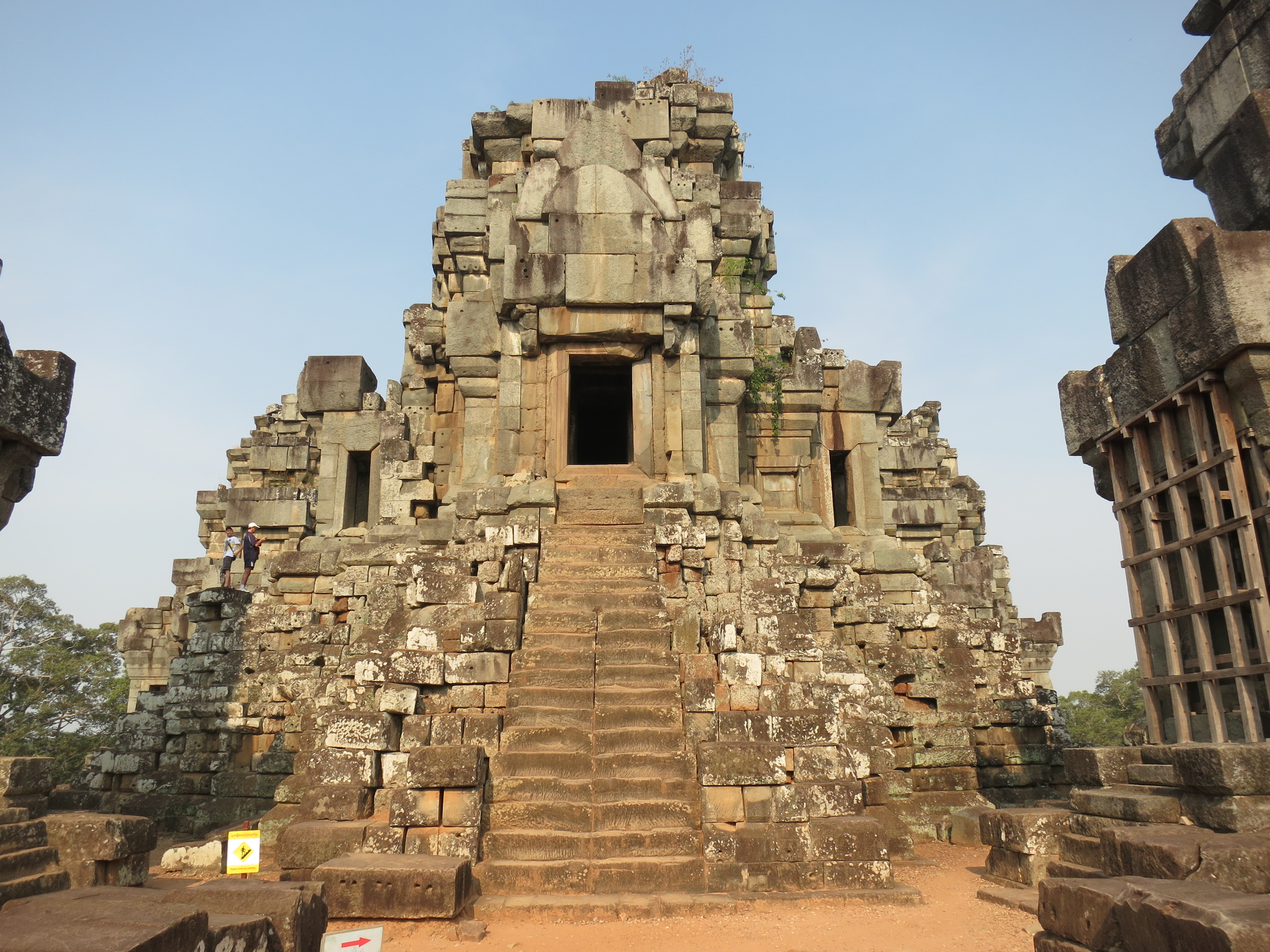
A little higgledy-piggledy
Ta Prohm brings to mind Indiana Jones movies, but it’s actually the site of filming for several scenes from Lara Croft: Tomb Raider, so all the touts and drivers I encountered called it the Tomb Raider temple. The French Ecole Francaise d’Extreme-Orient, which decided what to do with the Angkor temples when France had control of Cambodia, decided to leave Ta Prohm as it was, to show how most of Angkor looked when Westerners stumbled upon it in the 19th century. So the jungle has crept over the bridge and wriggled through the walls, and the result is a beautiful blend of nature and architecture.
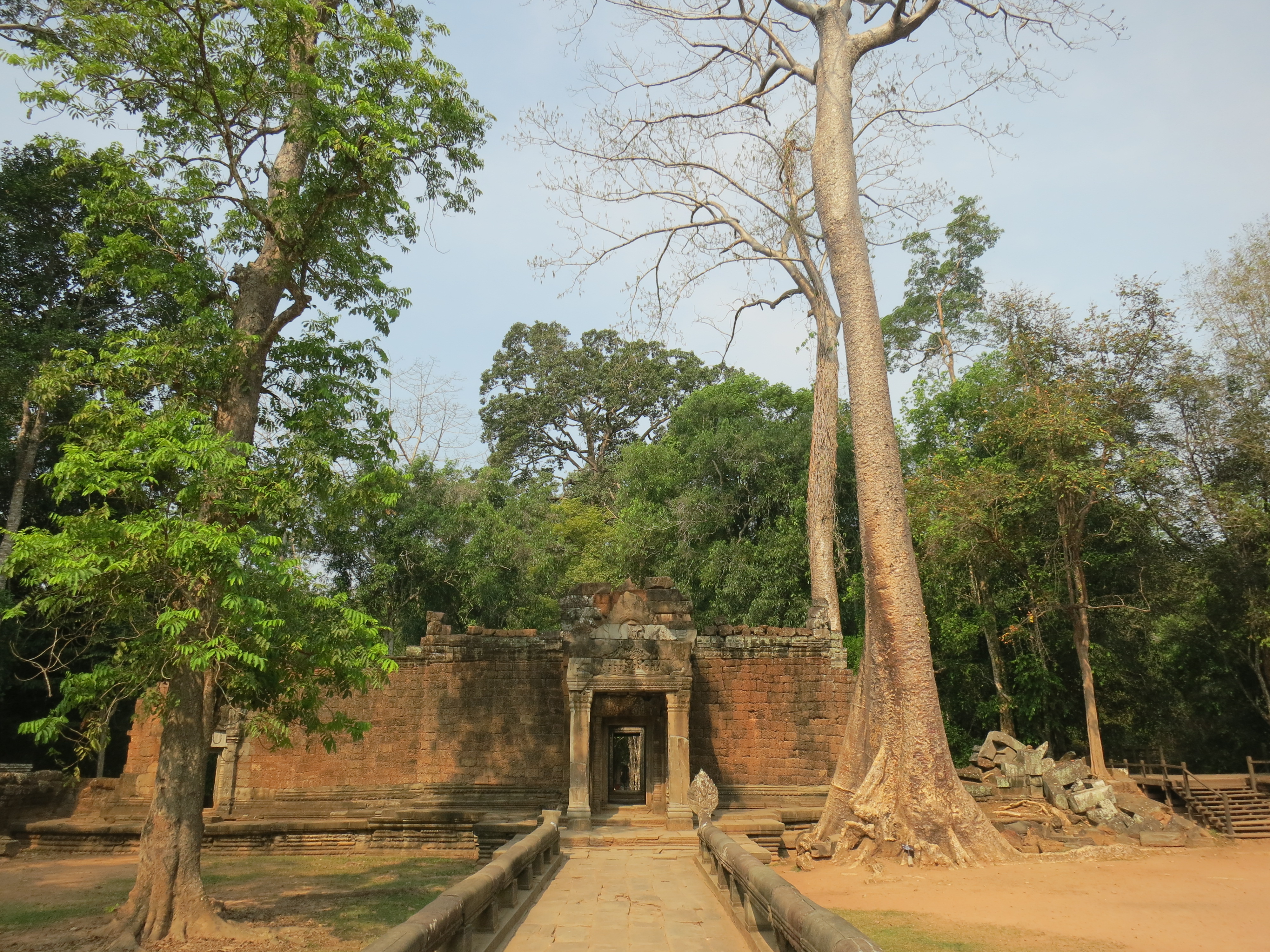
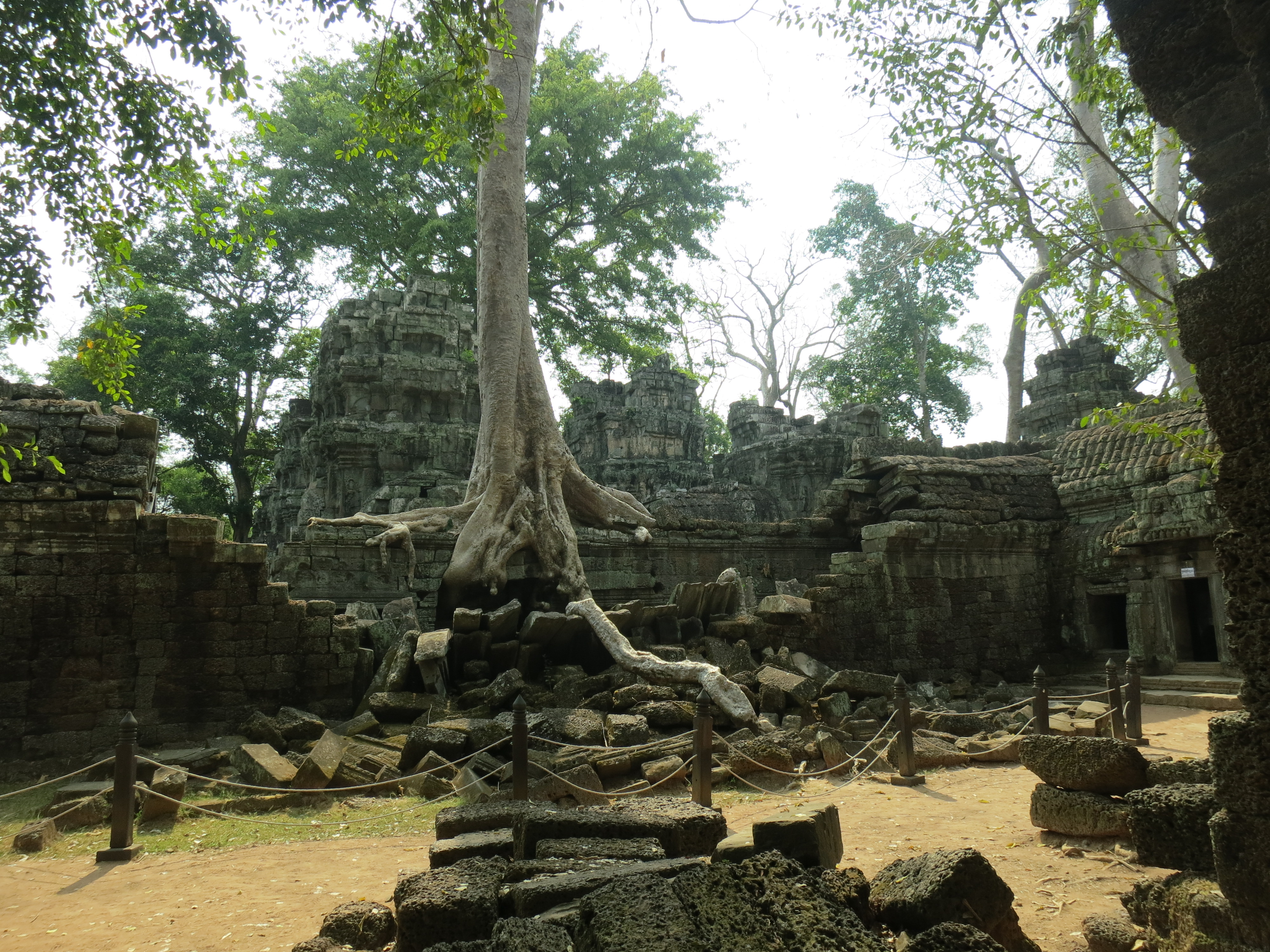
Ta Prohm


They do a lot of work to make sure that the places open to visitors are structurally sound, while leaving the “classical ruins” look in place

A sense of scale


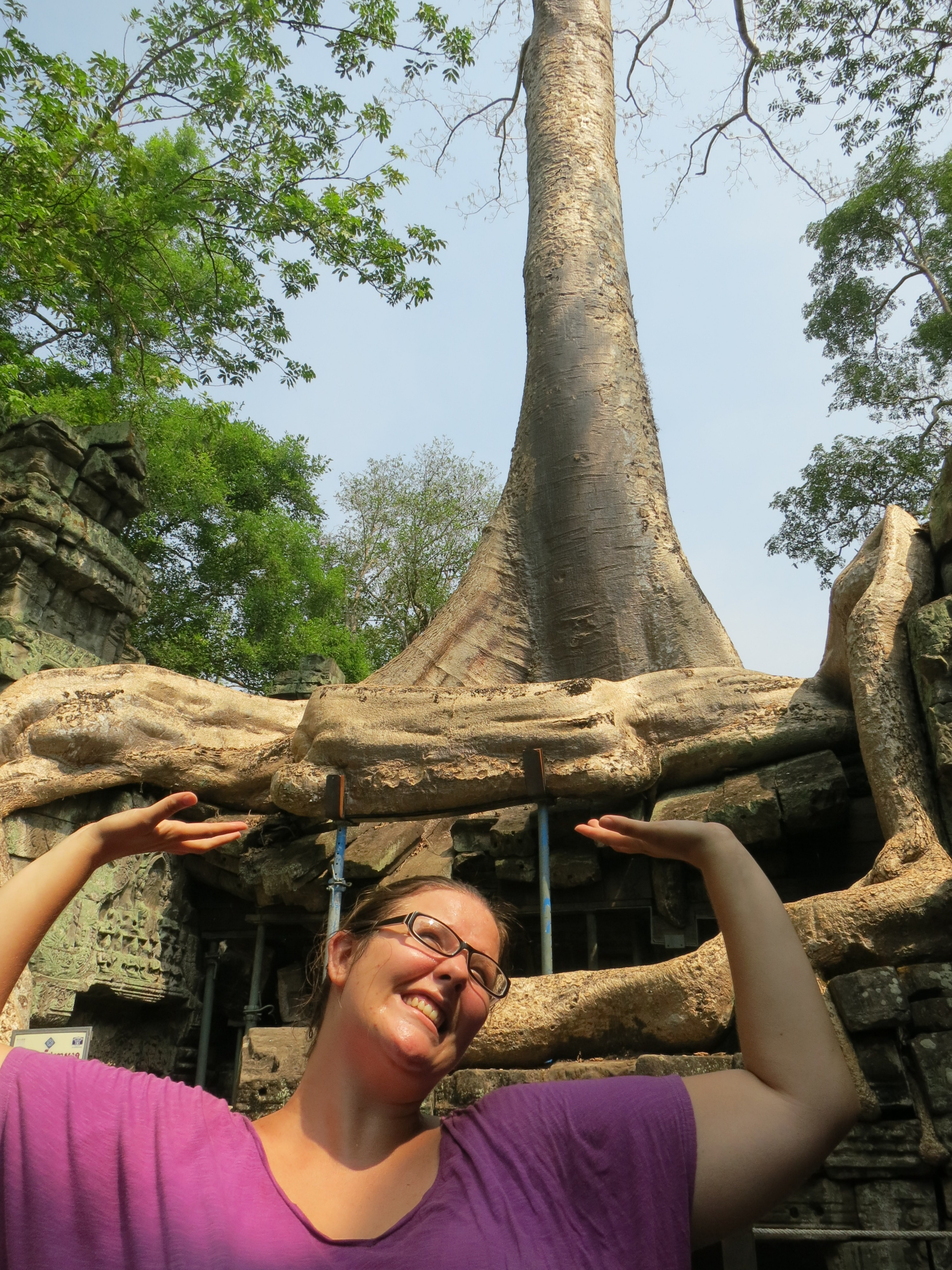
Superwoman
If I visit Angkor again, I’ll go to Sra Srang during sunrise; going during the middle of the day revealed that it was a large man-made lake (or baray, to use the term from my guidebook) that may or may not have once had a temple in the middle of it, but currently has nothing else. It was apparently a bathing pool for just about anyone to use (despite its current name meaning “royal baths”), which is a nice touch for an ancient kingdom.

Sra Srang
On my last day in the park, I walked up the hill to Phnom Bakheng to see the sunset from there. As I mentioned in a post last week, I almost didn’t get to go in at all. I’m still annoyed that there are no signs or warnings at the base of the hill, and that you walk all the way to the top, and then stand in line, before someone says, “You can’t go in because you’re not dressed right.” Apparently, the scarf around my shoulders wasn’t enough. I wasn’t about to give up, so I looked around for someone who, in this heat, was wearing a shoulder-covering shirt and a shirt over that. I found someone! I turned to a woman waiting with her tour group, and asked if I could borrow the thin raincoat she was wearing. We had to overcome some language barriers for her to realize I wanted to borrow, not steal, her coat, and then she smiled and handed it over. The Clothing Police waved me in, and I ascended the stairs of the temple.

The path to the top of the hill
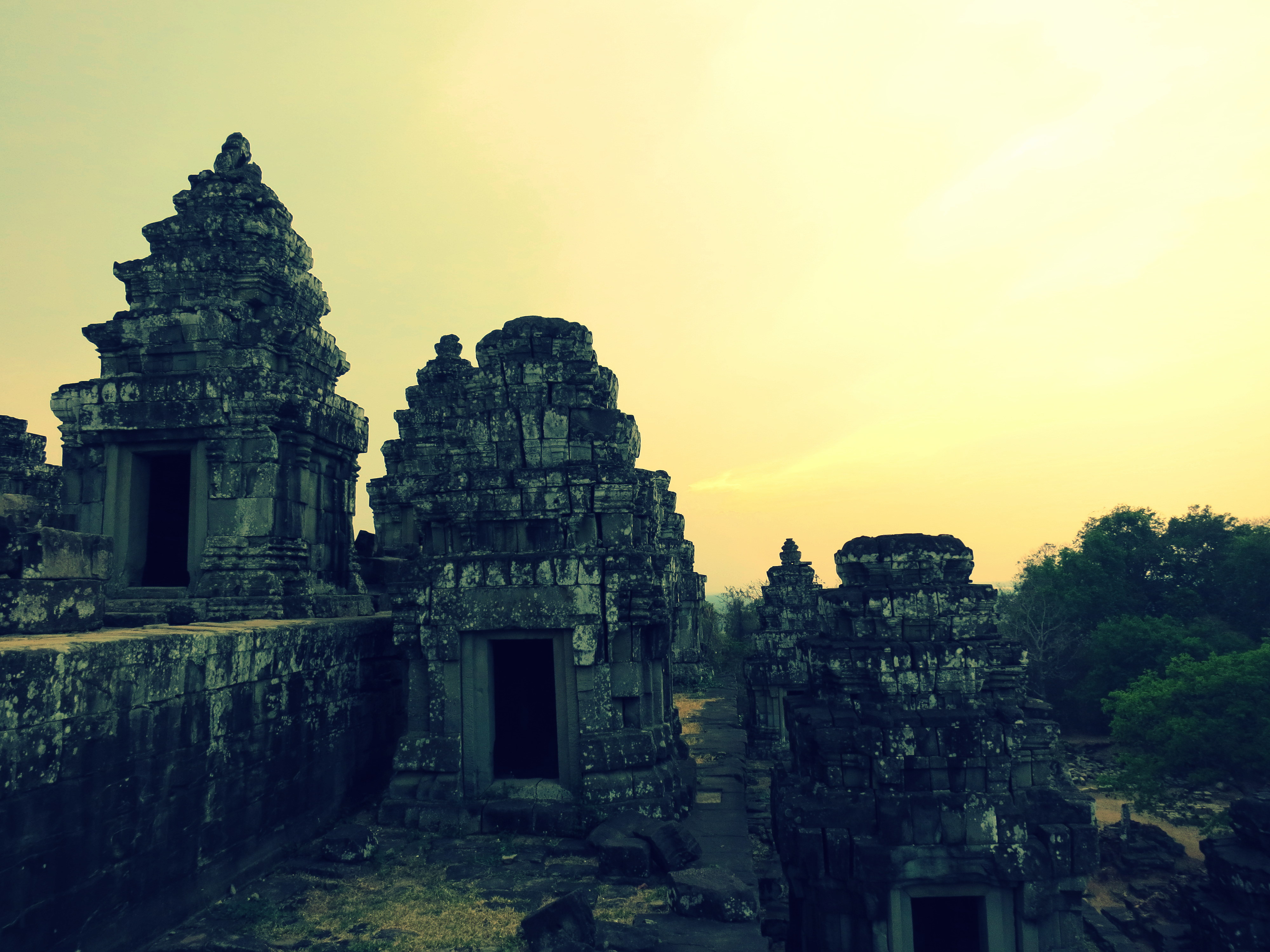
The view was lovely–forests and barays and temples as far as the eye could see, in all directions. The sunset wasn’t very dramatic, as there was too much haze, but it was cool to look down at Angkor Wat from this height. I also liked the walk up and down the hill, when I got a glimpse of the small Baksei Chamkrong in the distance.

Baksei Chamkrong
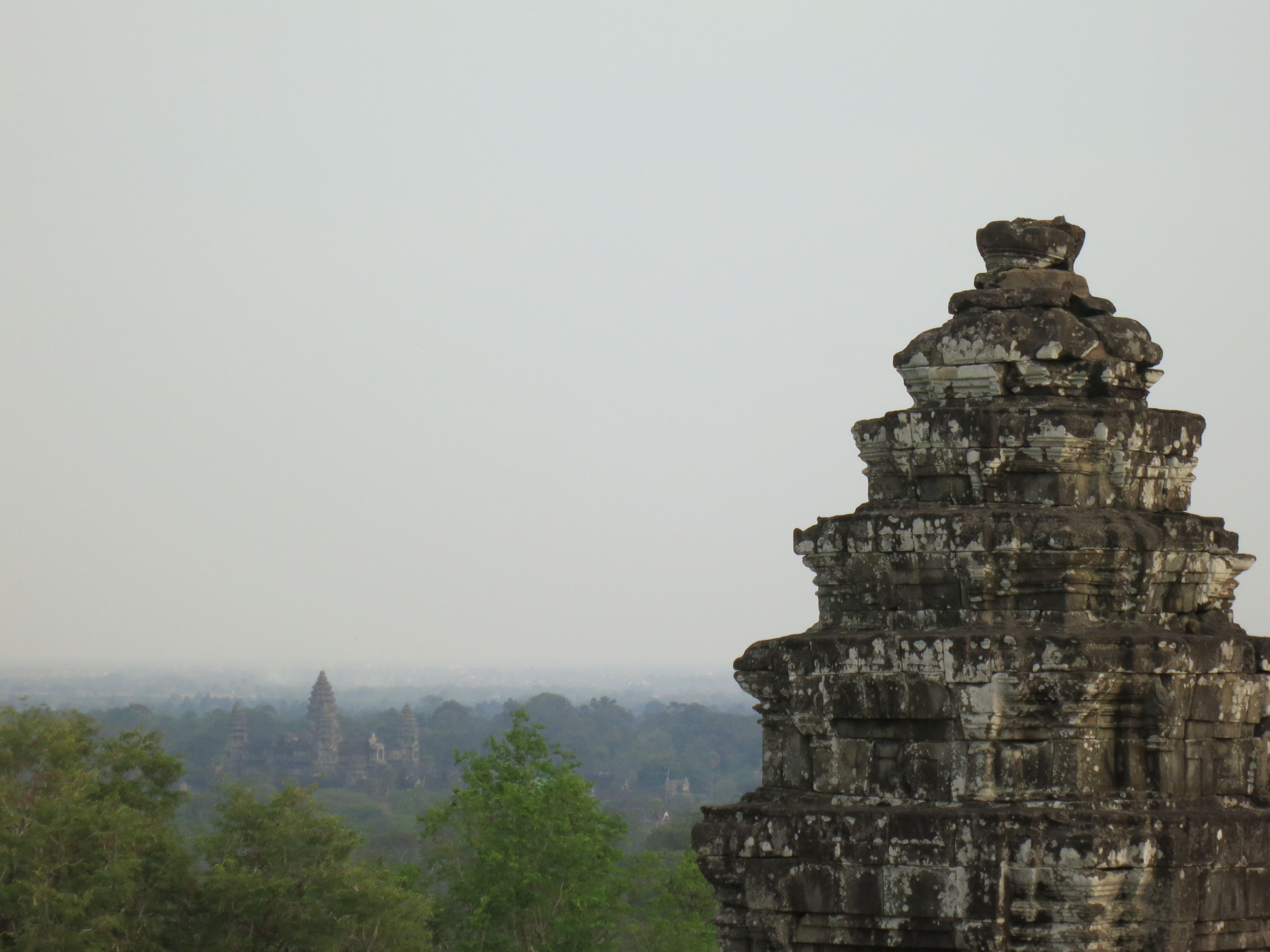
From Phnom Bakheng

View of Angkor Wat from Phnom Bakheng

Karangahake Gorge, Coromandel Peninsula, New Zealand; December 9, 2012
Angkor Thom was the first stop on my first day in the park, and it turned out to be my last stop of the day, because there’s so much to see and it’s too hot to move quickly from one site to the next. (Have I mentioned how hot it was in Southeast Asia yet? Don’t worry, I’ll be sure to dwell on that point for the next several weeks, because even summers spent in muggy Michigan swamplands and concrete-baked Chicago porches could not prepare me for the humid heat of this part of the world.) Anyway, heat aside, Angkor Thom was a great introduction to the wonders of the park at Angkor.

At Bayon in Angkor Thom (there I am for a sense of scale)
The South Gate
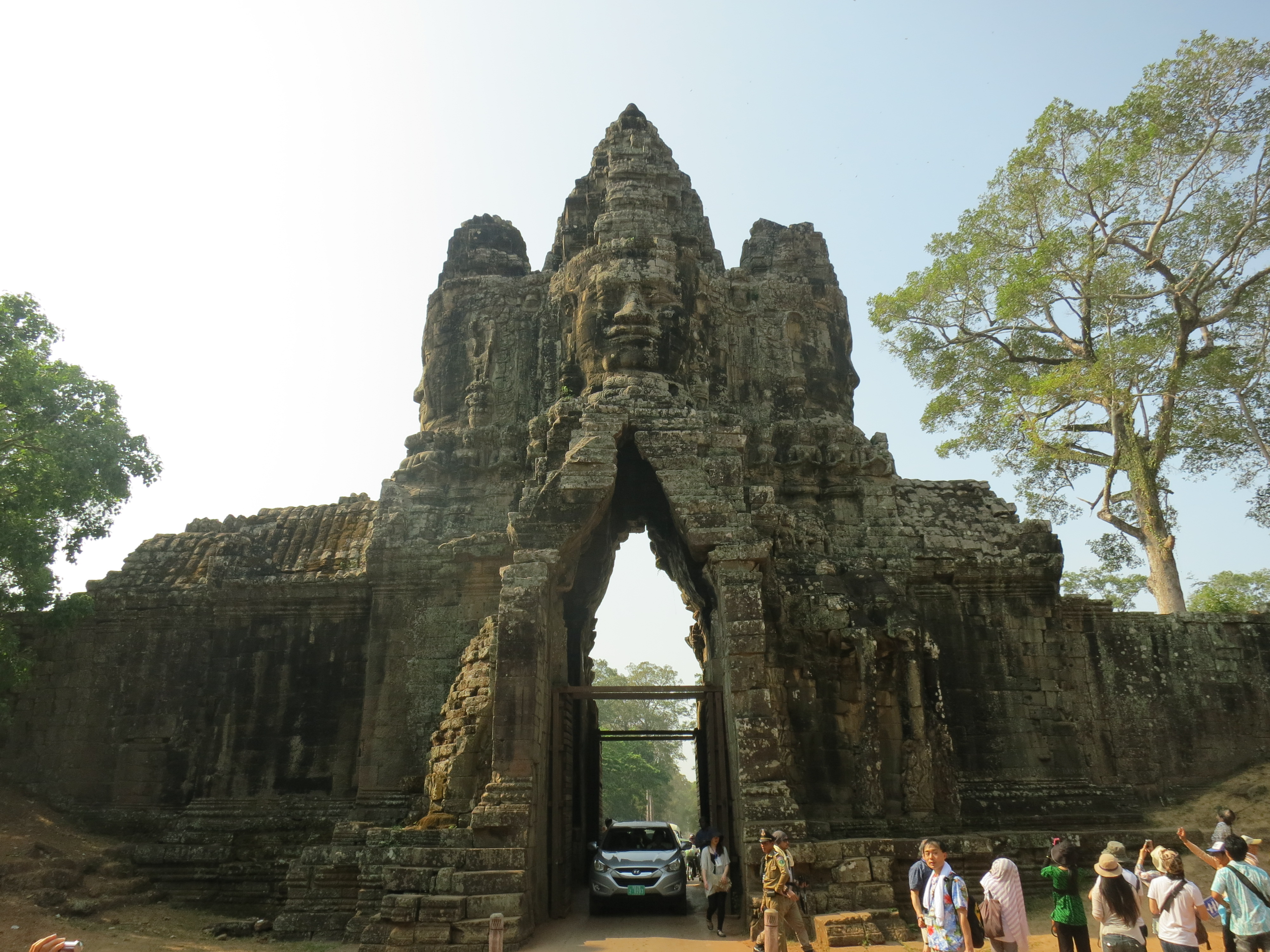
The south gate is the main entrance point for modern visitors, and it’s an impressive introduction to King Jayavarman VII’s city-temple. The bridge over the moat is flanked by two rows of figures–gods on the left, demons on the right–and each group of figures holds the body of the rainbow naga, a giant serpent, which is either meant to bridge the world of the gods and the world of humans, or to show the creation myth the Churning of the Sea of Milk, making the center of the city the created world. That’s a difference between Angkor Thom and most of the other temples in the area–there’s no moat or wall around the main temple inside, Bayon, so archaeologists theorize that the whole city is meant to represent Mount Meru, rather than just the temple, which would seem to bring up a lot of theological questions in terms of the inhabitants of the city, what activities were and weren’t holy in the city, etc.
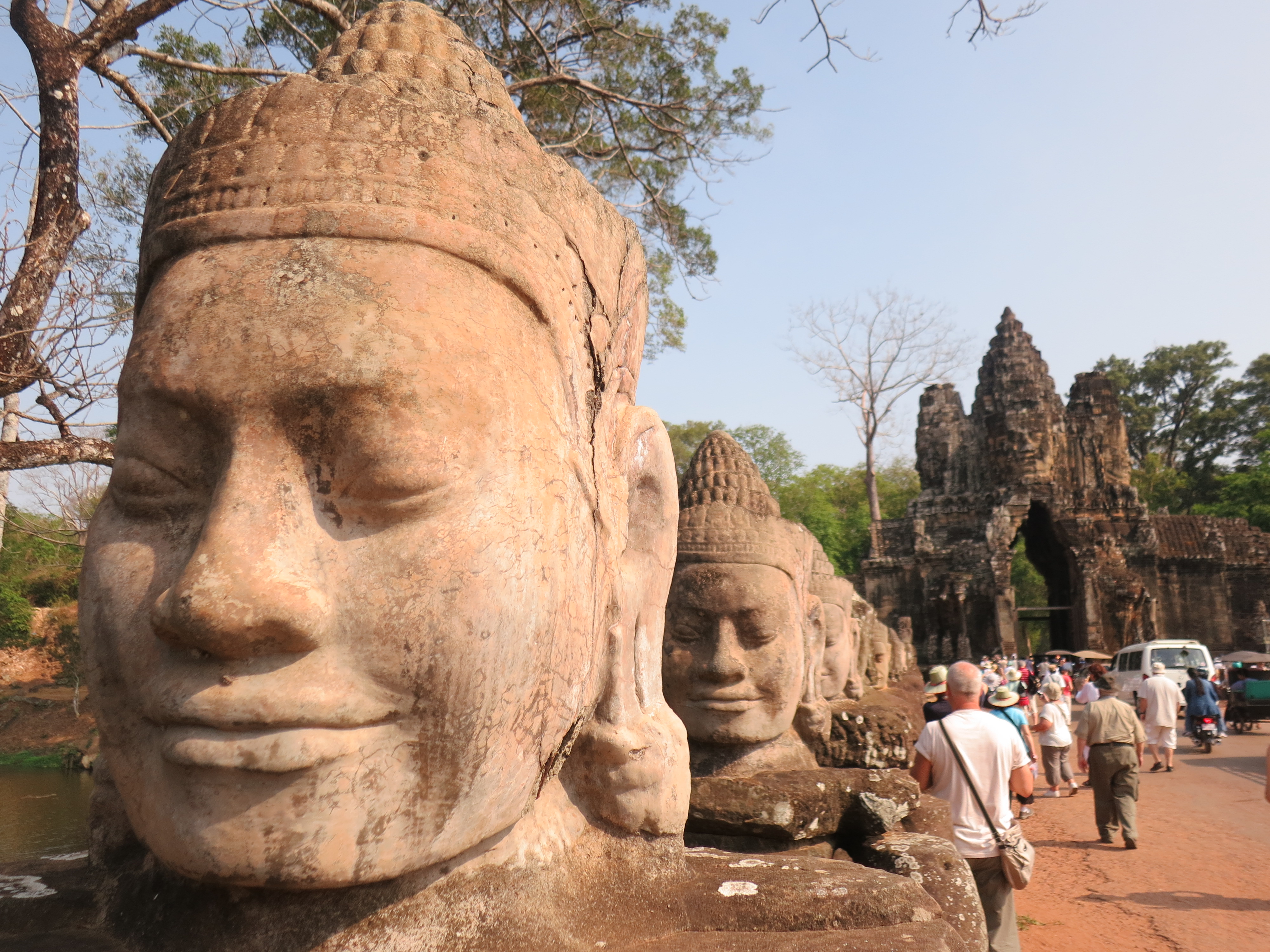
Serene gods
Anyway, this is how I reacted to these interesting archaeological and theological questions:

Holding up the snake
Bayon

Bayon
The Bayon is a weird and wonderful temple. Its central portion is filled with face towers: large blocks of stone with a face carved in each of the four sides. The faces might resemble King Jayavarman VII or Lokesvara, the bodhisattva of compassion in the Buddhist tradition, or they might resemble Jayavarman as Lokesvara. There’s a long tradition of rulers around the world having their likeness dressed up as historical heroes or religious figures; it lends majesty. Apparently there are 216 faces in this one temple alone, but there used to be more, or maybe less. It’s hard to tell with all the renovations made over the centuries. So there may have been some significance to the number of faces found in the temple, but it’s hard to know what it would be.

So many faces at Bayon
The many face towers contribute to the crowded feeling of this temple, since there’s a tower cropping up just about everywhere you turn, unlike at other temples, where there were carefully planned distances between the considerably fewer towers. Apparently, the Bayon was just added to and added to over the years, and built up higher than it was originally intended to be, so we see more towers, and also narrower hallways, than at other temples.

Crowded hallways in Bayon
The Bayon also has one of the most extensive collections of bas-relief friezes in the park. Like Angkor Wat, the Bayon does include friezes depicting mythological scenes from Hindusim, but there are also huge walls of bas-reliefs showing everyday life in the late 12th century in Angkor, as well as some historical events. There’s a wrestling match, a chess game, a cockfight, and a market scene, among many others.

Cockfighting
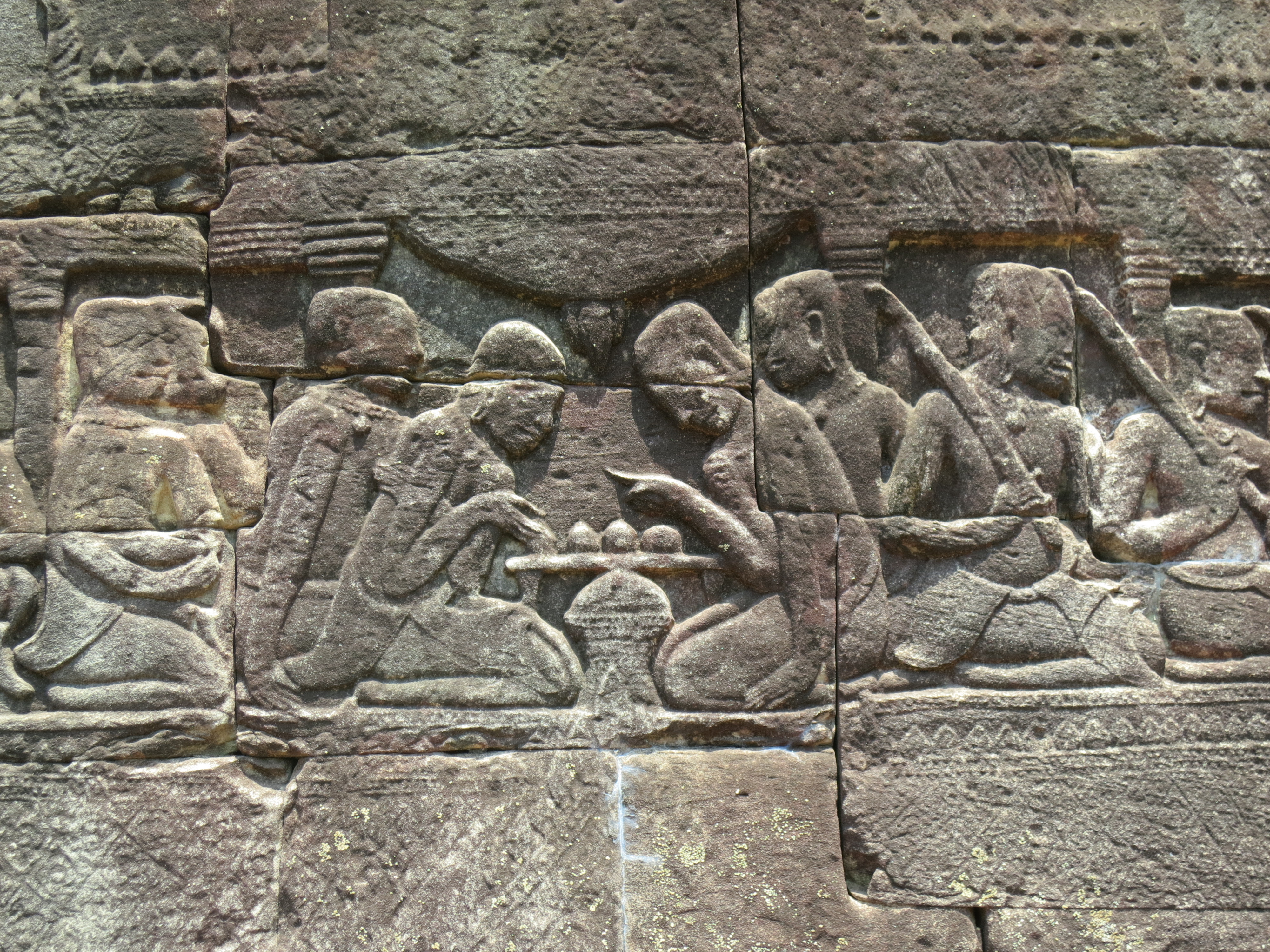
Chess game
There are also naval battles between the Khmer and their traditional enemies the Cham, and some processionals involving Khmer generals atop their elephants. I really enjoyed poring over all these scenes.
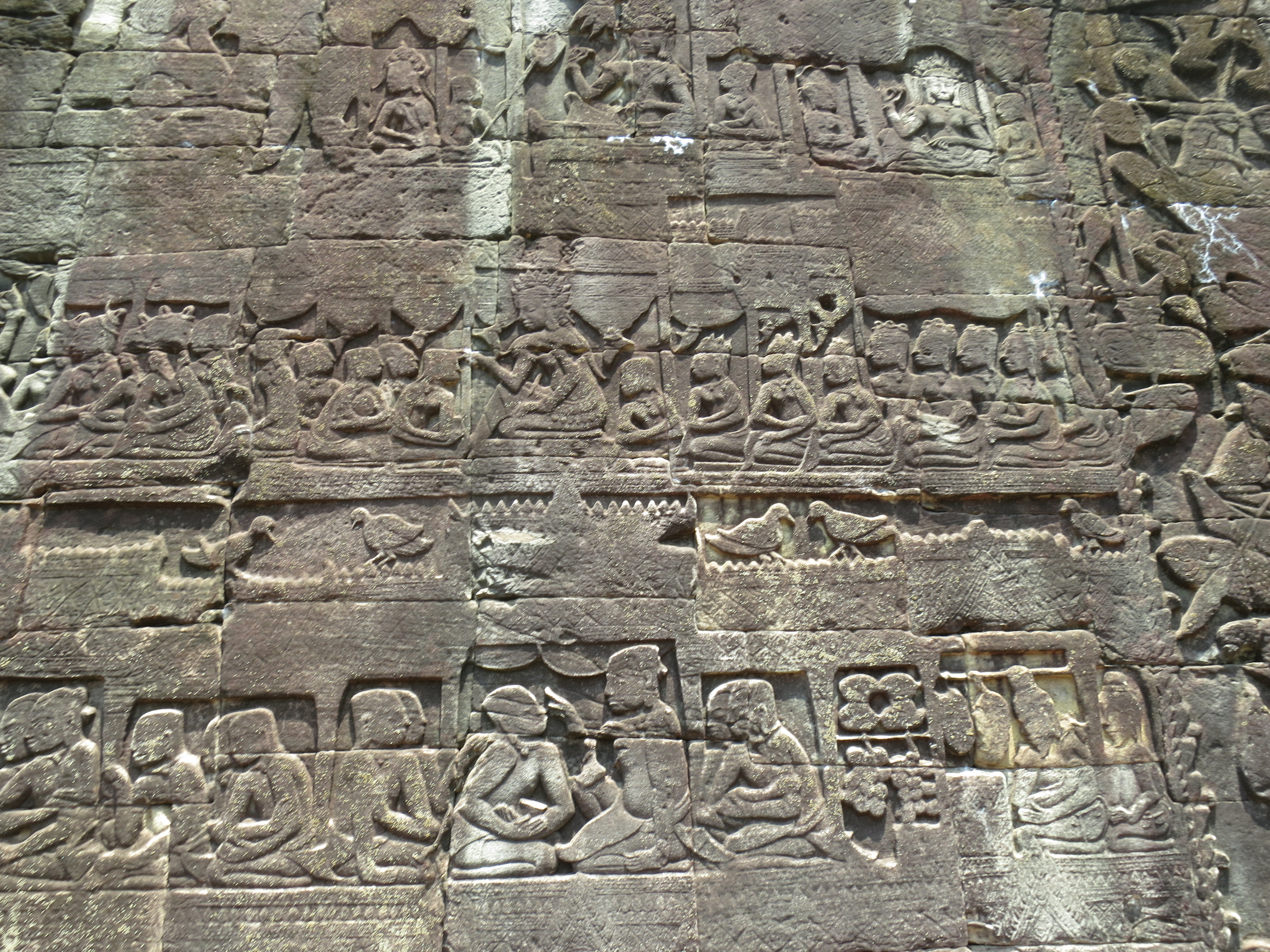
The friezes were multilevel
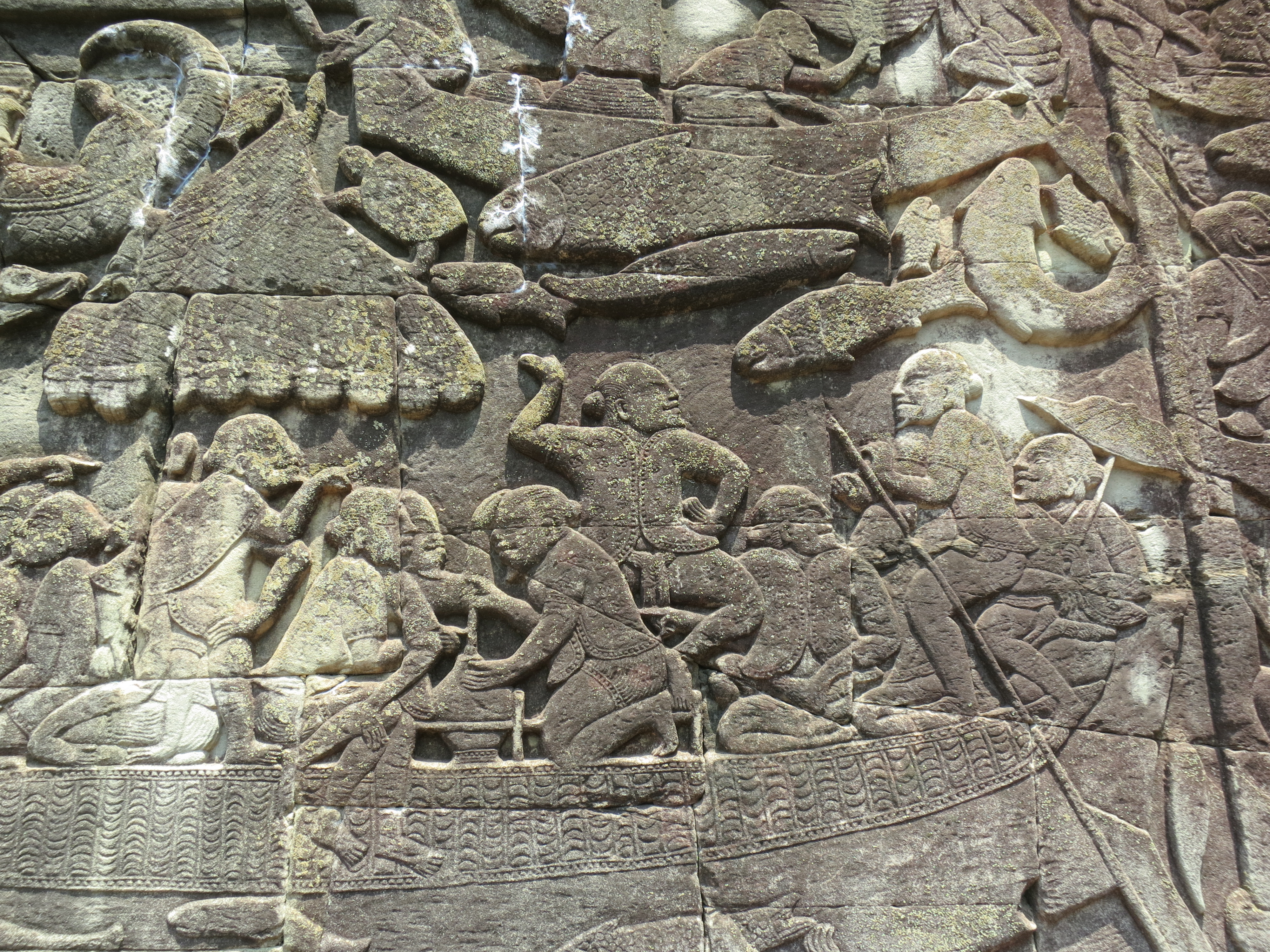
Dancing on a boat
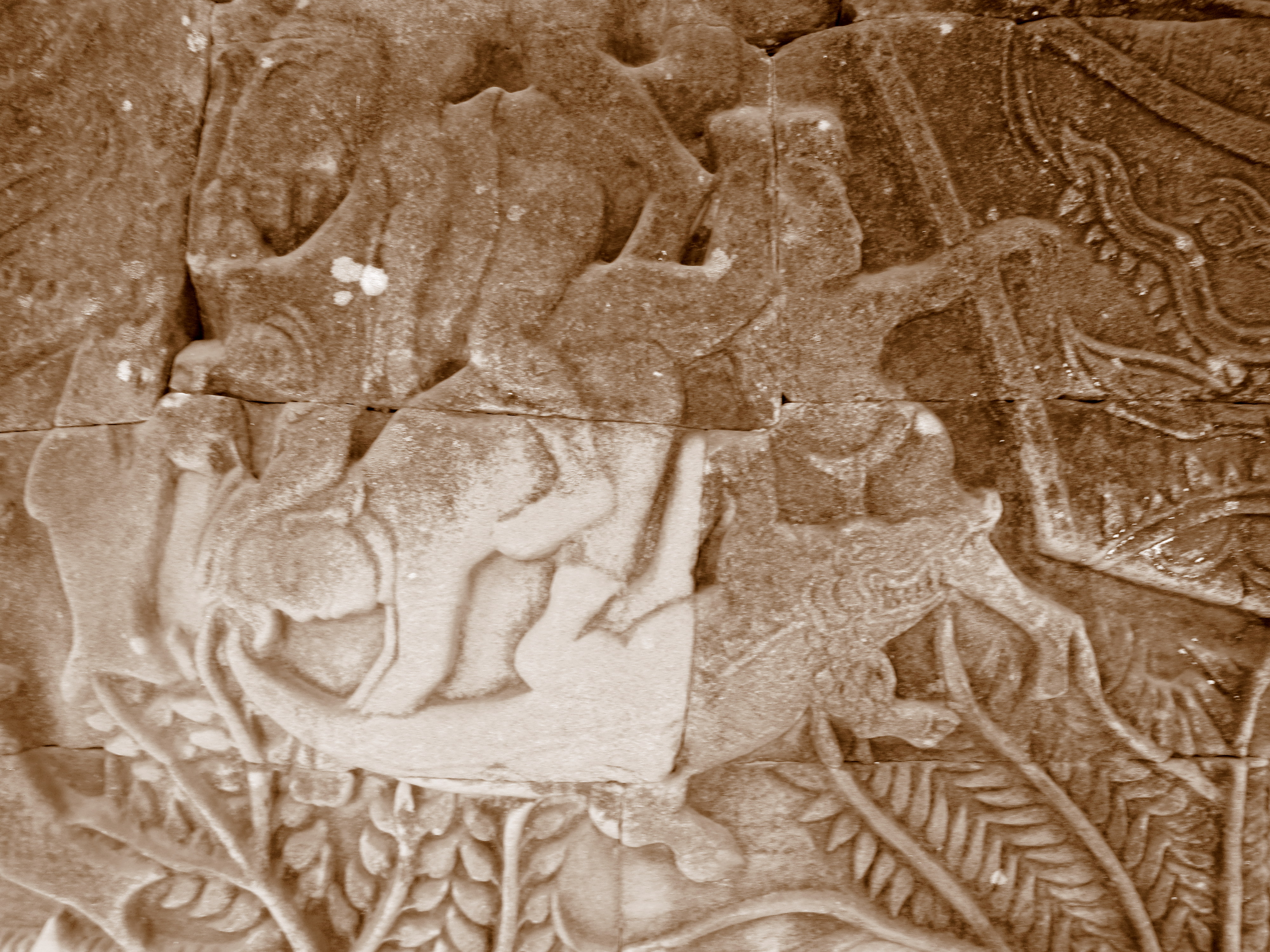
Crocodile mishaps
Bapuon

Bapuon
Here is where my guidebook’s last update (2003) came in sharp contrast with reality. The book shows photos of a grass-covered mound, and vaguely describes the massive temple as once more impressive than even the Bayon. Reality shows a completely restored, impressively massive temple, complete with ridiculously long bridge with a couple ponds on either side, and my first introduction to just how steep the steps of Angkor temples can be.

Everyone made jokes about what a workout it was to go up and down these stairs
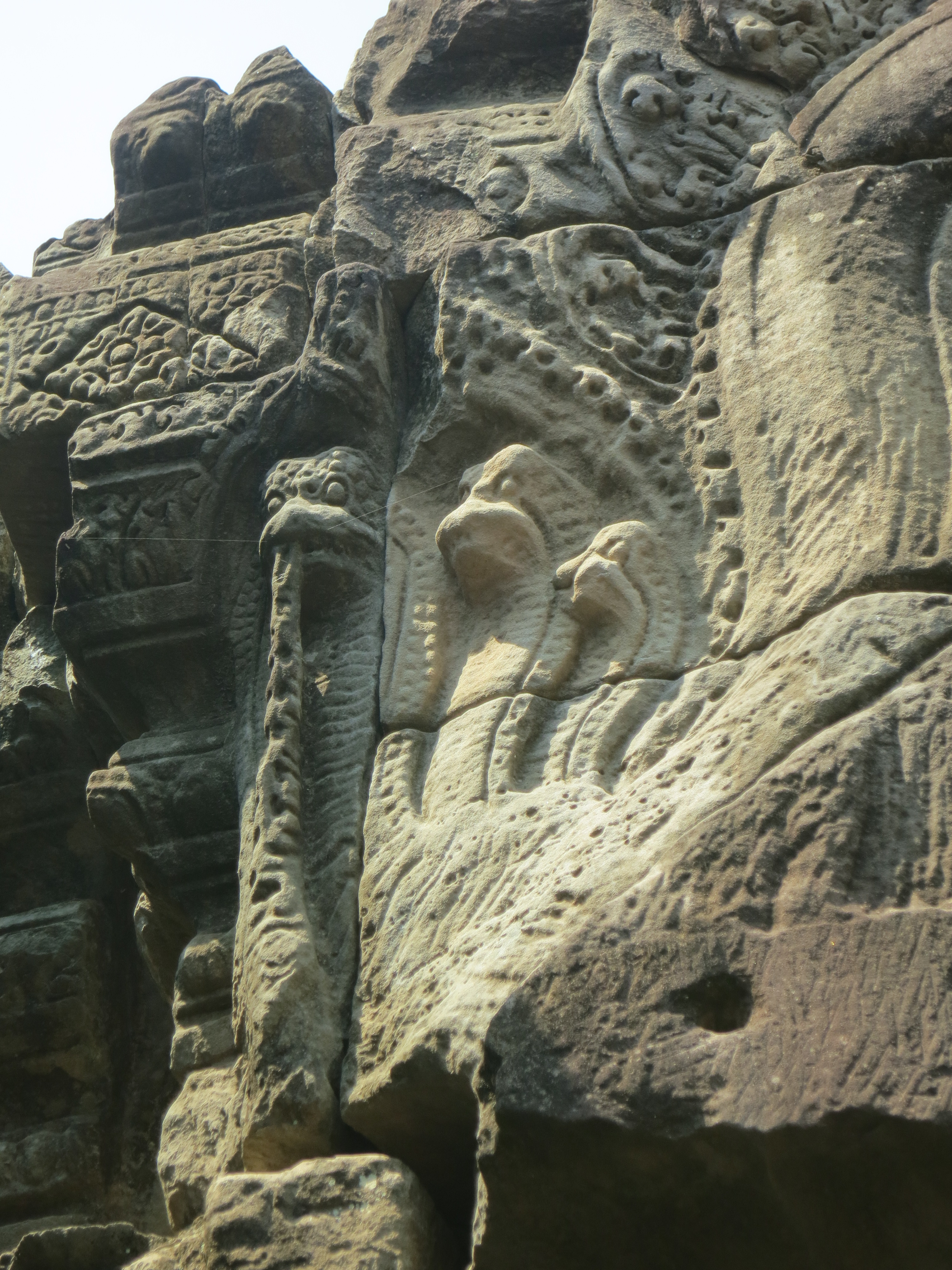
Ssssstone carvings

Not sure who carved the arrow–the ancients or modern restoration workers–but the hole was probably used to hold wooden pegs as stones were maneuvered into place, then removed when the stones were snugly fitted
The Royal Palace and Phimeanakas
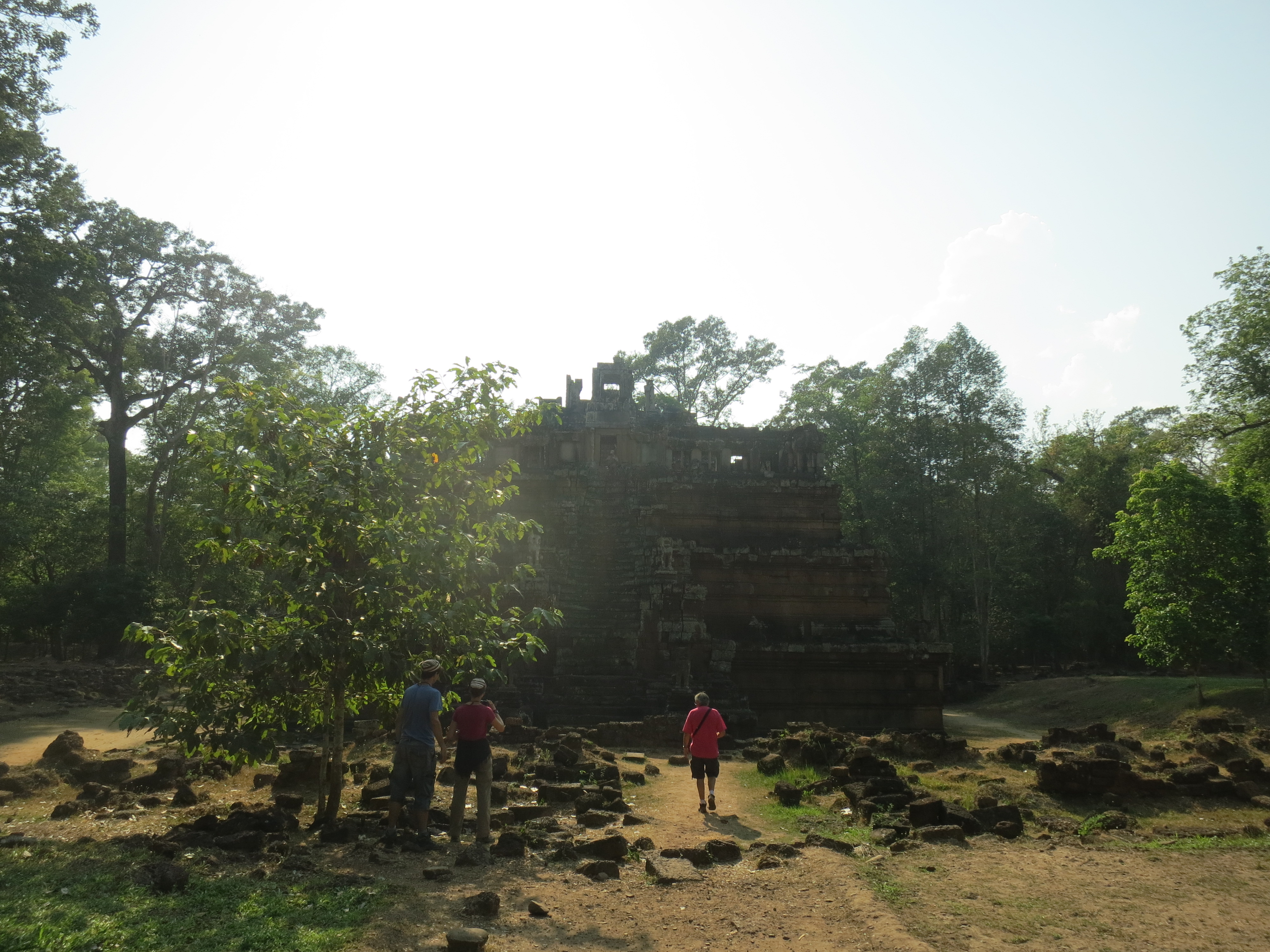
Phimeanakas
I tried to follow my guidebook’s plan to get to the Elephant Terrace after the Bapuon, but found myself going through a side entrance to the grounds of the Royal Palace. Tucked back here is the Phimeanakas, the temple of the king. It wasn’t in great condition and couldn’t be climbed on. A dusty path led away from the temple toward what was left of the gate of the palace.
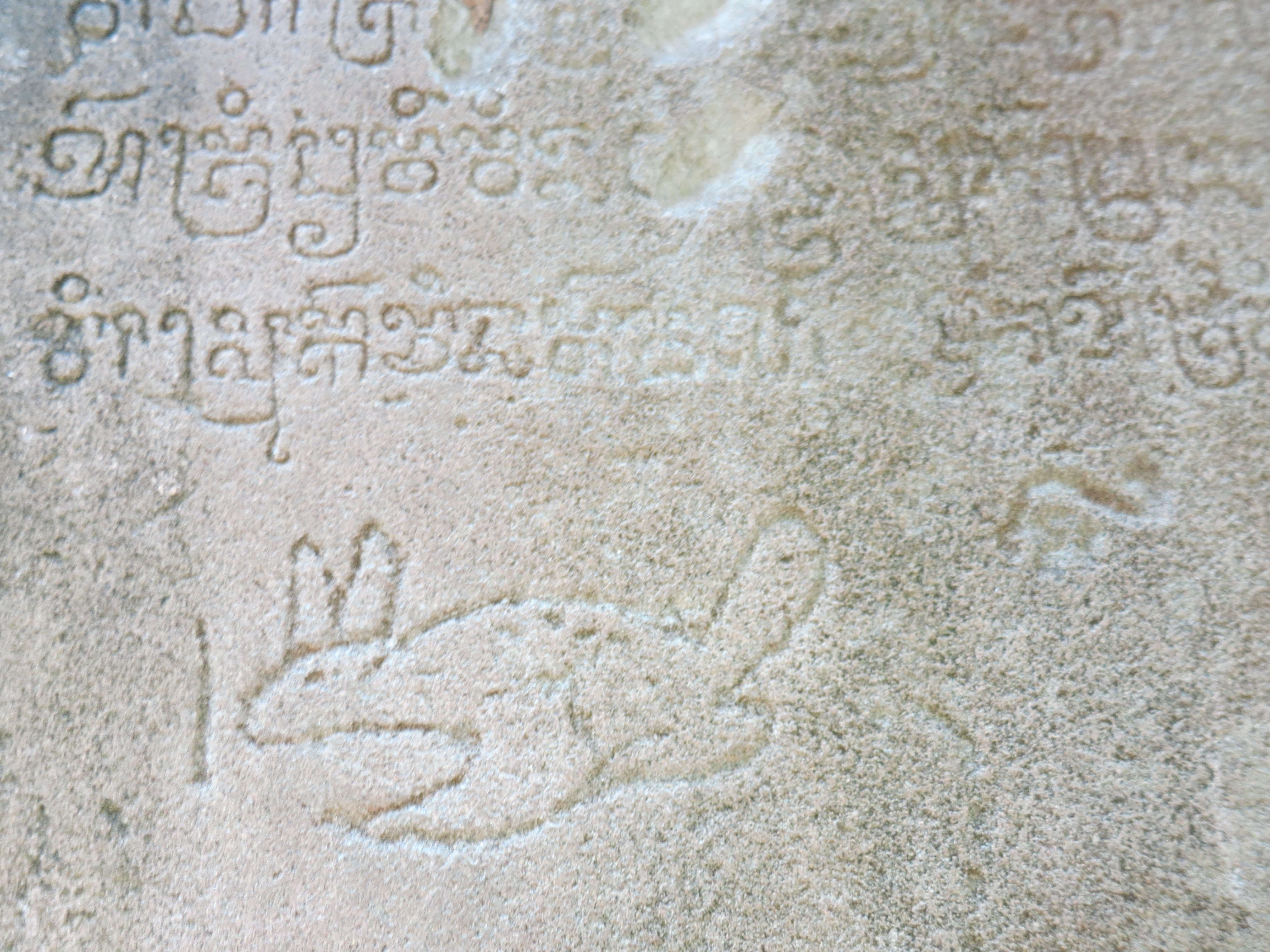
A rare instance of Khmer writing at Angkor
In a small grove of trees to the right, I saw a group of Cambodians eating lunch and resting from the heat of midday, kids running around playing games and screeching as kids do. Pretty much everyone I saw touristing at Angkor was white or East Asian, so I guessed these families were working here, and were taking a break. Then I saw a couple of the women stand up and grab plastic bags and long poles and realized that they were part of the crew I’d seen picking up litter all along the roadways on the way here. They were why Angkor was so much cleaner than most tourist sites I’d visited in Thailand.
Snack Break
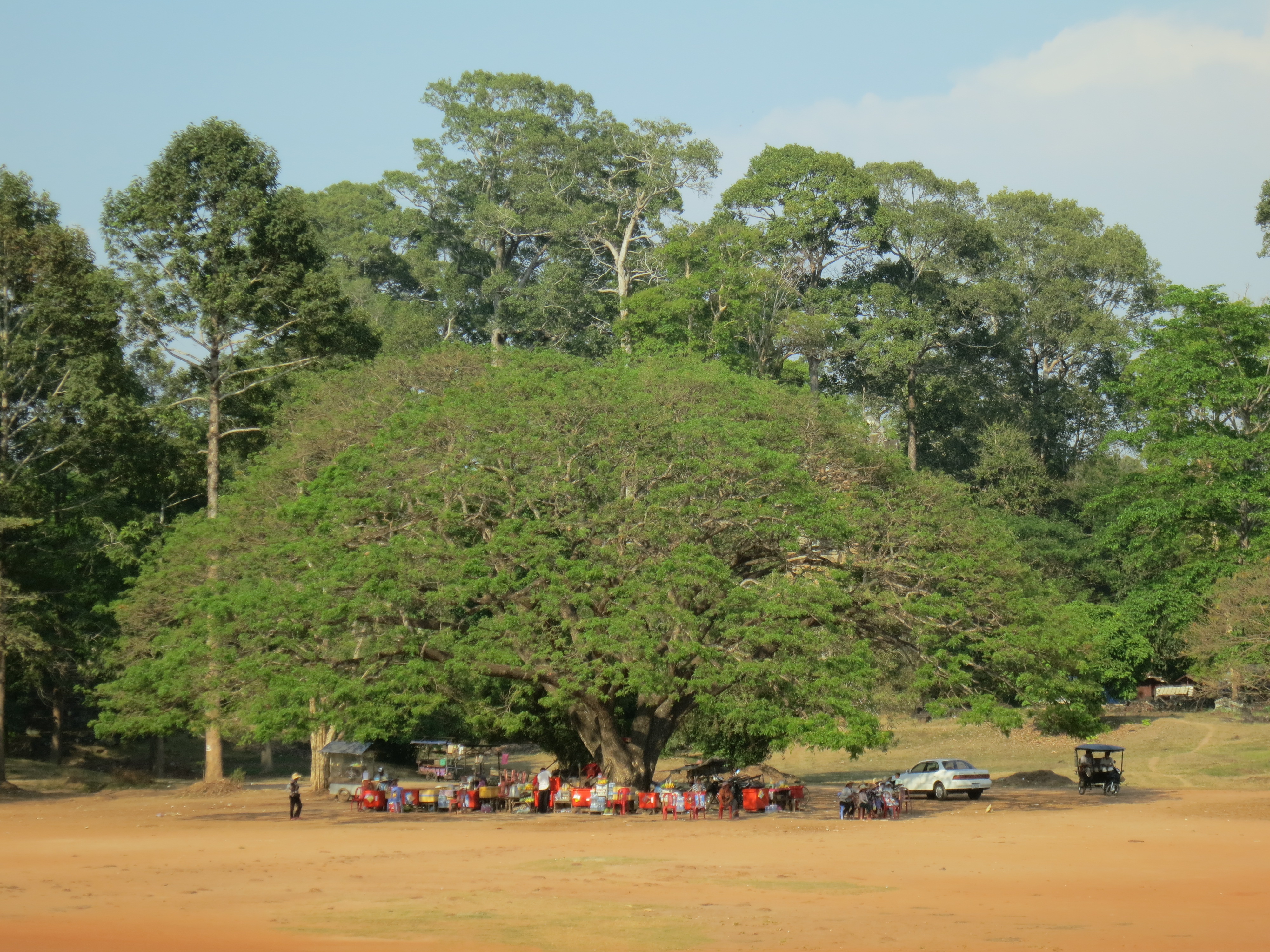
The snacks tree
I left the palace and went across the road to find some refreshment. As soon as I started crossing that road, at least three women started screaming out for me to visit their stall. I headed across the field toward the large tree under which the snack stalls were set up, but the women literally ran toward me in order to be the one to get me to buy a $1 bottle of water. It was disconcerting to be the focus of such a ferocious sales pitch, and saddening to get to the shelter of the tree and buy my mango slices and bottled water from the 10-year-old daughter of one of the women who had run to greet me. Several girls vied for my attention and my dollars, and they all talked to me in good English. They’d all learned English by selling snacks to thirsty tourists, and none of them could be spared by their parents to go to school, or if they could be spared, they couldn’t afford the uniforms required to attend.
I swallowed my privileged American white lady guilt along with the mango slices and went back across the road to see the rest of the structures, but I’d lost the enthusiasm I’d had earlier.

Elephant Terrace
I admired the Elephant Terrace (so named for the long-trunked animals carved into the side of the terrace) and smiled as kids chased each other through the narrow walkways of the Leper King Terrace (so named for the king of legend who had leprosy, whose likeness might be seen in one of the carvings–or who might be called to mind simply because the lichen has eaten away the carving of the king figure here).

Restoration work is a giant jigsaw
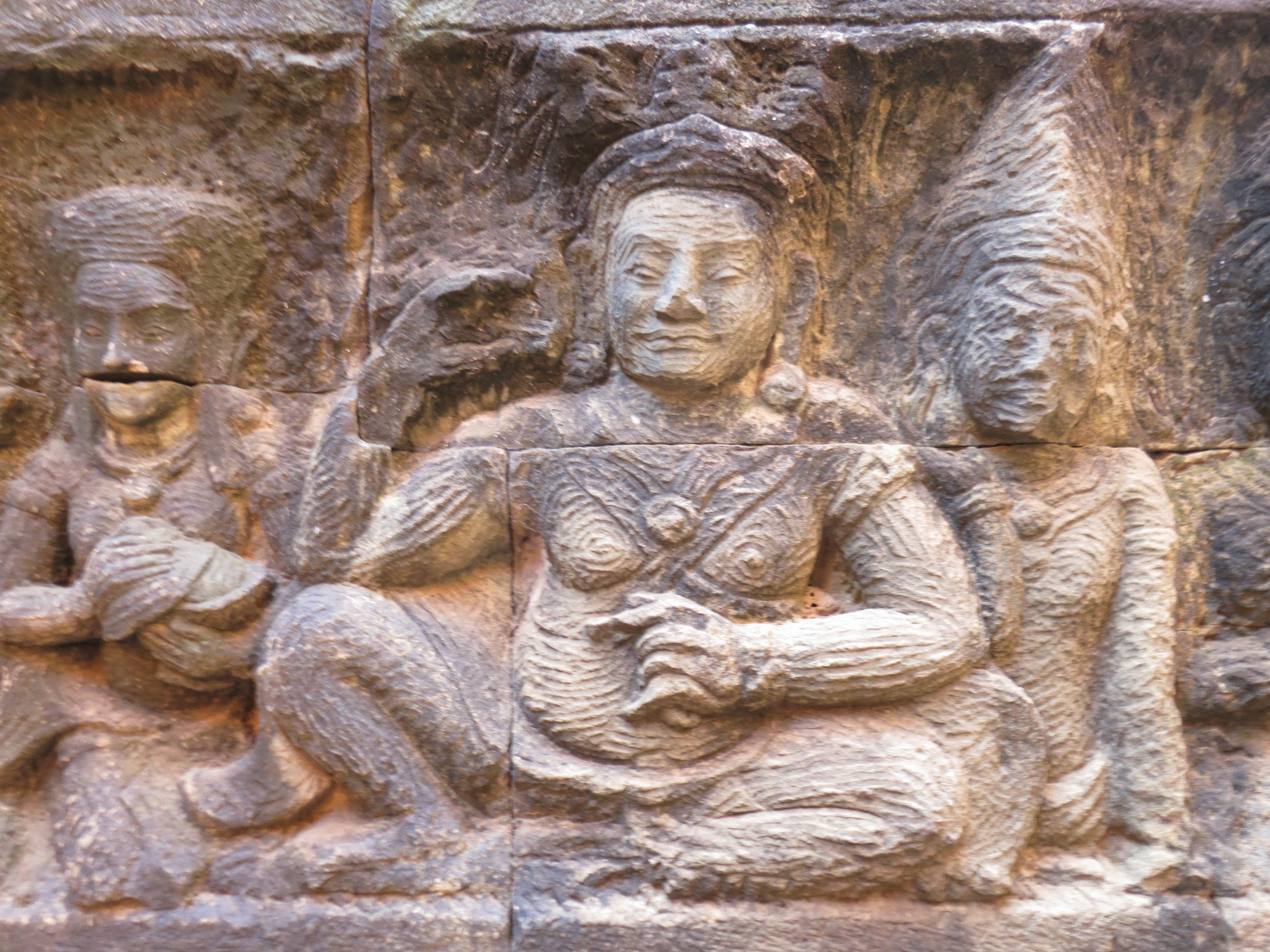
Dig the groovy swirls
Then it was time to catch a sunset at Angkor Wat and head back to the air-conditioned comfort of the guesthouse before another day in the splendid ruins.

So. Hot.
When I say I’ve been to Angkor Wat, people sometimes reply, “where?” but when I show them this photo, they nod in recognition:

Angkor Wat at sunrise
Oh yeah, that place. The giant temple thing in Cambodia. In fact, Angkor Wat is the largest single religious monument in the world. (I guess that’s under dispute by Those Who Measure Religious Monuments or something, because most of the info I can find on it won’t give me a hard yes or no on the topic. Regardless, it’s huge–the outer wall runs over 2 miles long.) Of course it’s big, when you learn that “angkor” roughly translates to “city” and of course we know “wat” is fairly synonymous with “temple.” Angkor Wat is a temple and also a city.

Angkor Wat
Khmer king Suryavarman II built Angkor Wat in the beginning of the 12th century. He broke from tradition by dedicating it to Vishnu rather than Shiva, and orienting the temple complex to the west, rather than the east. In the next century, the main religion of the Khmers changed from Hinduism to Buddhism, so the religion associated with the temple changed, too. One of the main statues of the temple, which was somehow not destroyed during the reign of the Khmer Rouge (as most of the statuary was), is an eight-armed Vishnu whose head has been swapped out for a buddha’s head.

Vishnu/Buddha
Other decorations, however, are not so easily changed from one religion to another. Angkor Wat is impressive not just for its size and age, but for the bas-relief friezes that run around a large part of one of the inner walls. These friezes show scenes from the Ramayana and the Mahabharata, two Hindu epics. Many of the friezes have been restored by various conservation groups over the past few decades, and I’m so glad I got to see this artwork dusted off and cleaned up. It’s much easier to appreciate the incredible detail of each carving when the accumulated grime of centuries has been swept away.

The Churning of the Ocean of Milk
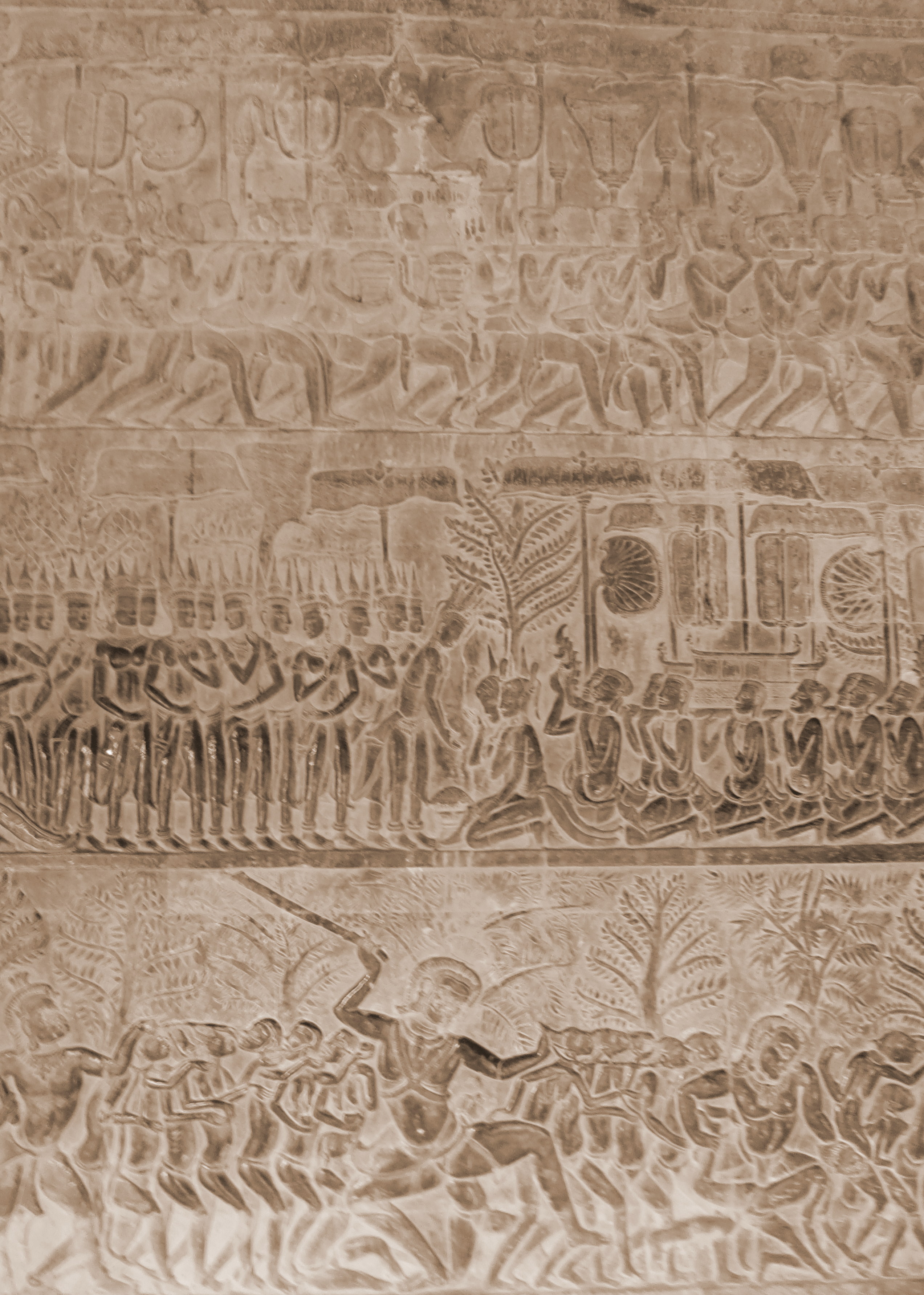
Bas-relief frieze
Angkor Wat is built in the temple mountain style: it’s meant to resemble Mount Meru, the home of the gods in Hindu mythology. There are always outer walls representing mountains, and usually a moat to represent the ocean. The inner temple is made up of five pyramids representing the five peaks of Mount Meru–usually four in the corners, and an elevated one in the center, the innermost sanctum of the gods.
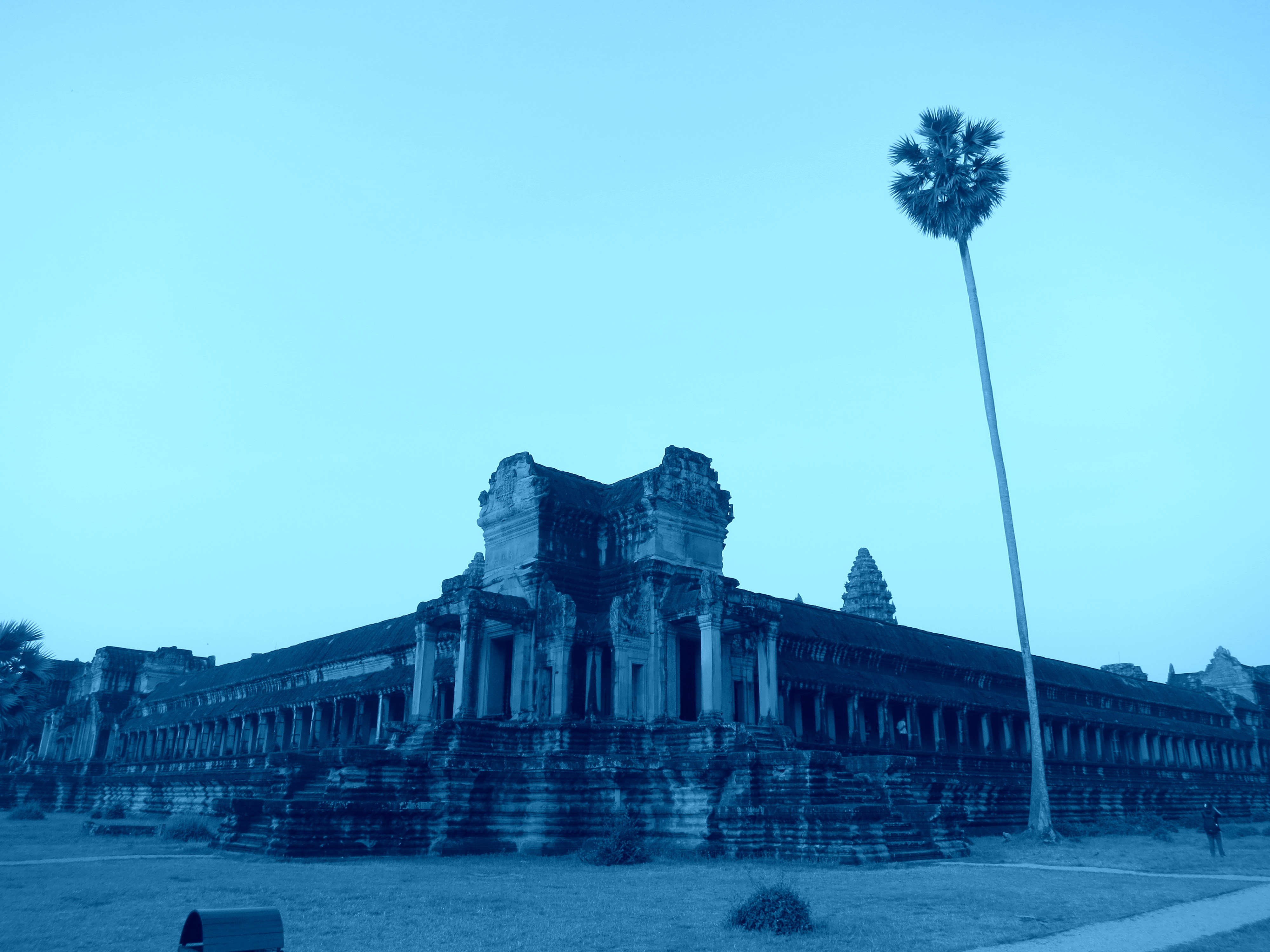
One of the distinctive features of Khmer architecture, according to my architecture guidebook, was the “trick of perspective” achieved by progressively reducing the height of each structure from the center outwards, making the central towers appear even taller and more impressive. This architectural trick expresses the religious beliefs of its builders, too, since it emphasizes the importance of the home of the gods and the humility of the rest of creation in comparison to it–even the oceans are reduced to flat moats calmly reflecting Mount Meru’s glory back to it.

For those of us who haven’t made a study of Khmer architecture or Angkor period temples (and that’s most of us, isn’t it), it’s good to keep in mind that a Khmer temple “was not a meeting place for the faithful but the palace of a god,” as Michael Freeman and Claude Jacques note in Ancient Angkor. Thus, the tiny space in the interior of the central pyramid, made only to house the statue of the god and not for crowds of worshipers; the super steep stairs that were usually only scaled by a few temple workers; and small buildings housing various gods, the grouping of which made up one large temple, rather than one temple per god. This is such a different approach to religious architecture from the Western, Christian one that I hadn’t even realized I had been making assumptions about what a temple was for and how that affected the architecture until this book pointed it out.

I’m used to vast cathedrals built to house masses of congregants; the altar is often large and ostentatiously decorated, and it’s easy to see from just about anywhere in the building. The temple mountain structure of the Khmer Hindu places of worship also accommodates large crowds, but in the outer areas of the grounds; the inner areas are difficult to reach, and the sacred space is small and hidden from the casual eye. I love that the book made me look at the temple in a different way, and also had me reflect anew on the churches I’d been to before.

None of the buildings from the city surrounding the temple (the “angkor” part of “Angkor Wat”) have survived. They were likely made from wood, unlike the sandstone, brick, and laterite of the temples. This means that a lot of imagination is required to envision what it must have looked like in its heyday, a little harder than putting paint on the Forum in Rome, but not as difficult as seeing the cooking fires smoking at the side of Uluru. I stood on the east end of one of the interior walls of the temple and looked out over the forest that stretched to the moat nearly two miles away. All this forest was once royal palace, regular houses, streets, food stalls, markets–all populated with one of the largest concentrations of humanity in the pre-industrial age.
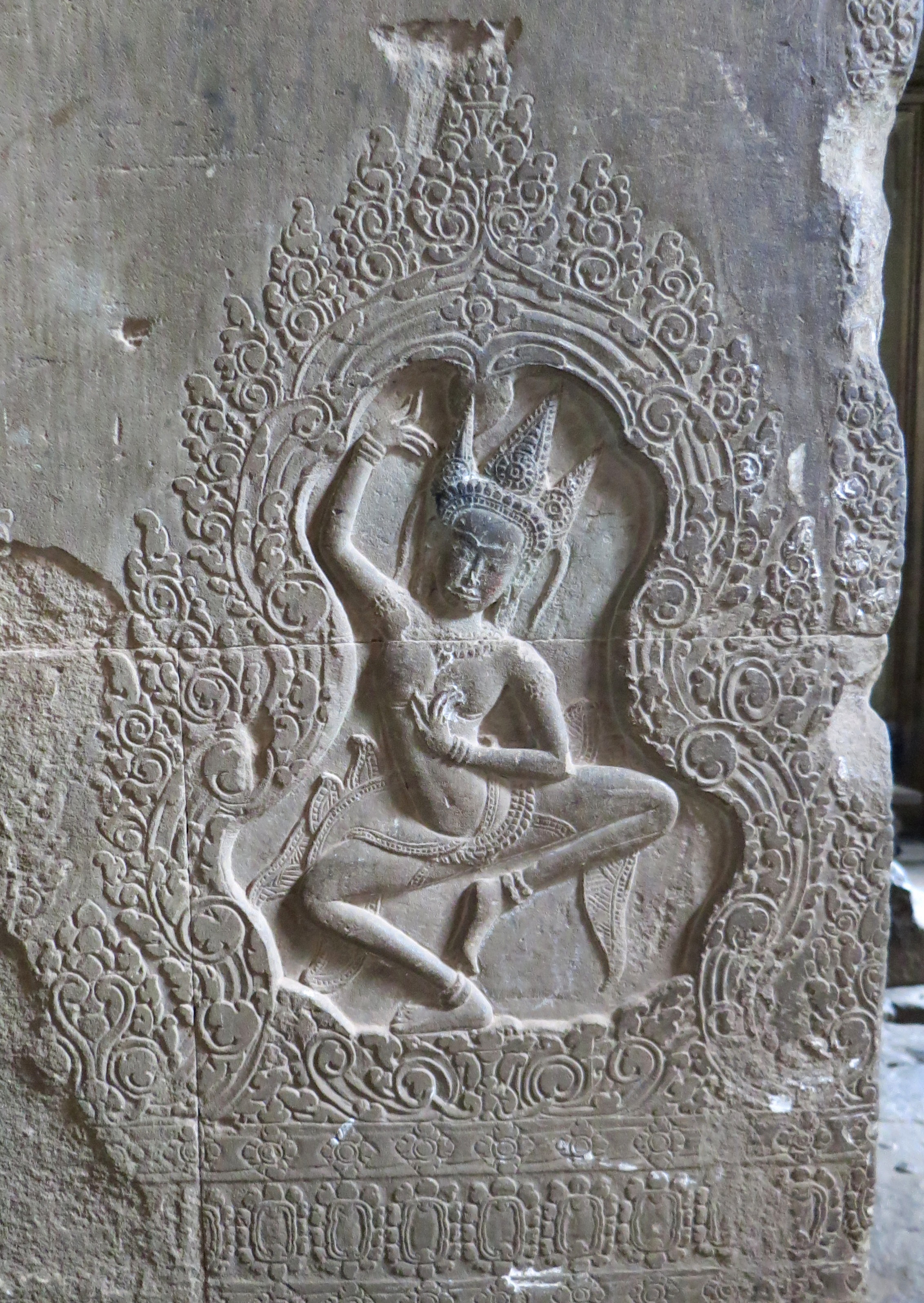
Aspara
This is all about Angkor Wat, but let’s not forget that the Angkor period lasted several hundred years, and almost every king built at least one temple (perhaps as a mausoleum for himself, the god-king), so there are nearly a thousand temples in the area. Dozens of these have been restored and opened to the public. It all seems an embarrassment of riches once you see Angkor Wat. Not only is there this magnificent complex, but there are more–and in different styles, with their own delightful carvings and architectural quirks? I enjoyed discovering those temples as well; stay tuned this week for more on those.

Embracing the sunrise
 Stowaway Travel Writing & Editorial Services