New Centerstage Review Up

Here’s a fun one for your weekend viewing: My Name is Mudd at the Viaduct. A non-linear production of zany antics and broad gestures, it’s about 75 minutes of laughs. Here’s an excerpt of my review:

“Mudd” succeeds by not taking itself too seriously while dealing with a serious topic, thus pushing the bounds of what historical theater can be. After all, you can go just about anywhere with a production when you start with six actors earnestly asking the newly widowed Mrs. Lincoln, “Yes, yes, but other than that, how did you like the play?”

You can read the rest of the review here. It’s a dudely play that didn’t give me a bad taste in my mouth — a rare and wondrous thing! Tickets are like $10, so enjoy.

Aesthetically Speaking: Jeannie Miernik

This week’s artist interview was conducted with Jeannie, a writer living in mid-Michigan. Jeannie and I met at Kalamazoo College and studied abroad together in Rome junior year. Jeannie and her husband are raising a gorgeous baby daughter in Lansing, and she’s also writing a novel. I’m definitely impressed with her devotion to the craft, and her blog is a great source of writing tips and ruminations. Thanks for sharing, Jeannie!

What is your name and city of residence?
I’m Jeannie Miernik from Lansing, Michigan.

What medium do you work in?
I am writing a fantasy novel based on European folklore. The working title is Briars and Black Hellebore. On one level, it’s a retelling of fairy tales like many writers have done before, but on another level it’s a story about storytelling itself, about oral and literary traditions and the transmission of culture. It’s about the power of words and narratives to shape our realities. As I work on this novel, I am exploring what I call “metamyth,” the stories behind stories.

How often do you work on your art–is it a full-time endeavor or something you work on in your spare time?
Right now, I am a total guerilla writer. I have a six-month-old baby and two jobs, so I steal minutes here and there to write, only up to a few hours a week. It depends on how long my daughter naps!

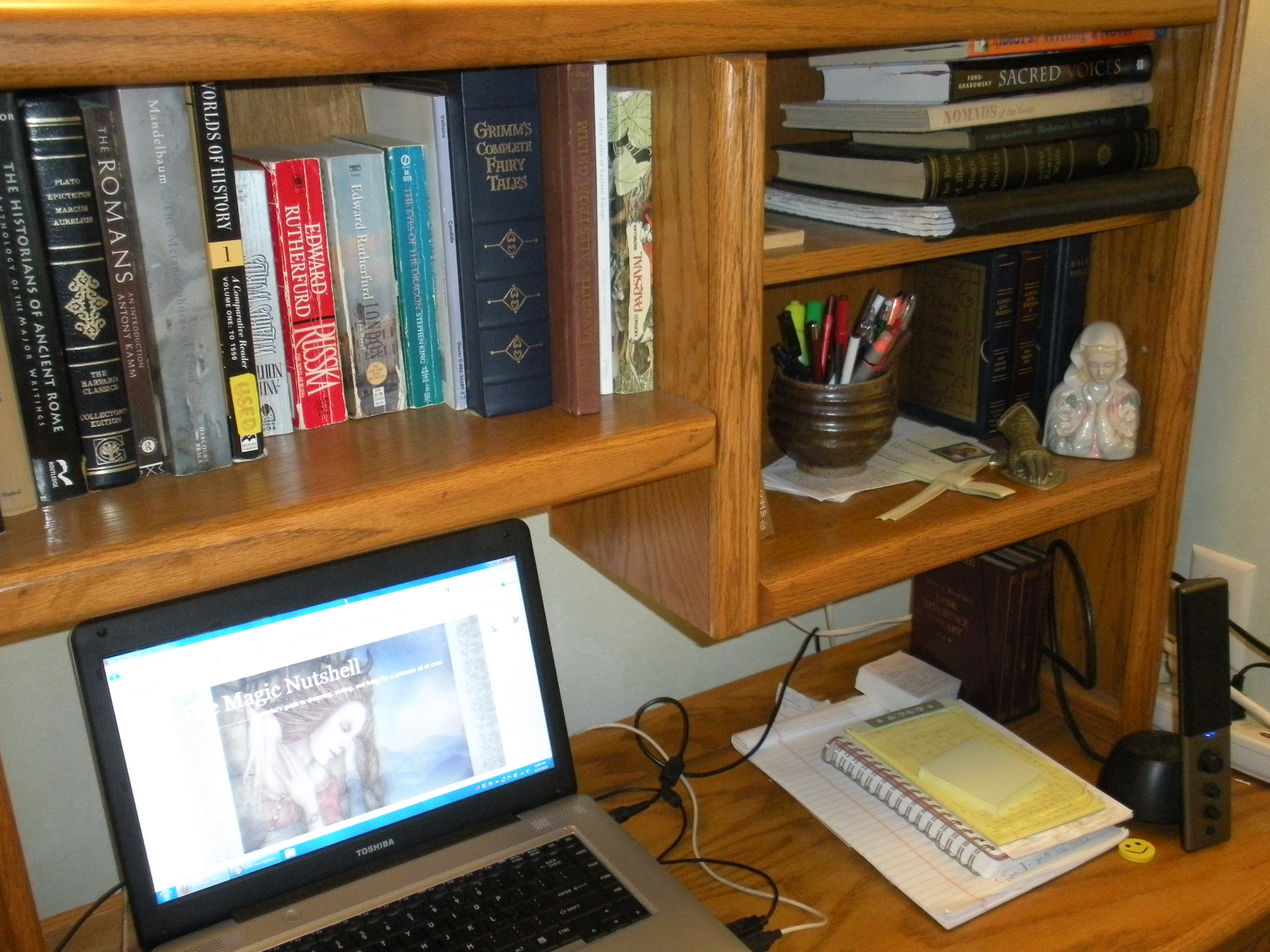
Jeannie's workspace

Jeannie's workspace

How does art fit into your life, in general? Is it something you think about and talk about every day, or every week, or only in certain situations, etc.?
Writing is solitary work, but I think about my plot, characters, and word choices every day—in the car, in the shower, during lulls at work, and even in dreams. Films, paintings, architecture, plays, nature, and all kinds of unlikely experiences give me ideas. Although I don’t have much time to sit down and write, I do read about European history and myth at every opportunity. I keep books and articles packed in my breast pump bag and my nightstand. I talk about concepts and interesting stories and history facts all the time with my family and friends. They will probably be bored with everything I’ve learned before I’ve finished my book!

When you start on a piece, what kind of end result do you have in mind? Does it get performed or published, put in a permanent form or is it more temporary?
I would like to see my book published one day. I hope to craft a novel of high enough quality and broad enough appeal to land a contract that could lead to an ongoing fiction writing career. I realize that such publishing deals are going the way of tenured professorships, but they still do exist, and that is my dream.

What goals do you set in relation to your art, both short- and long-term? Is it something you hope to make money doing, or is it something you want to keep uncommercialized? Does the term “sell-out” hold meaning for you or do you see the art/commerce relationship as a necessary one?
In the short term, while I’m caring for a baby, family is my top priority and takes most of my energy. So my goal for the next year or two is just to keep the writing momentum going, adding something to my manuscript every few days.

In the long term, I hope to reach many readers through publication of many novels. I hope to make enough money to support myself in continuing to write fiction—without having to maintain two “day jobs” in the meantime. It would be a great pleasure to reach a large readership who might enjoy my stories and interpret them in different ways.

Selling a work of art is not the same as selling out. I have always understood the term “selling out” to mean compromising a work’s integrity for a profit. But the difference between selling and selling out is complex and subjective. Not all changes or amendments to a work to prepare it for sale compromise its integrity. For example, an editor’s suggestions to fix errors within a manuscript to improve its quality for sale would likely improve the work from an artistic standpoint and not subvert its purpose. On the other hand, product placement within a novel that has nothing to do with the story would be a sell-out. But there is plenty of gray area between those obvious examples. I think it’s a distinction made in the gut of the artist in relation to each individual work.

The art/commerce relationship is not always necessary; many people express themselves creatively without selling their works. But the creation of any piece of art does take time and money, so if the artist cannot independently support her or his own work, it must be made possible through sales or grants or patronage, which are not entirely different arrangements. For me, selling my novel could give me the freedom to spend time writing more and better novels and improving my craft in a way that would be difficult or impossible if writing time were always forced into the periphery of my daily life.

What role does collaboration with others play in your art, if any?
The text of my novel itself I write completely on my own. But indirectly, many others have assisted me. My writing has benefited from a good critique partner who is encouraging, honest, and skilled at close reading and reviewing. Every time she says, “I don’t like this,” she points out a way to make the scene or chapter a hundred times better. Other help has been even more indirect, but no less important. My husband has been supportive in providing me some time and space to write, and I have learned a lot from networking online with authors and readers.

How conscious are you of your artistic influences? Who are your artistic influences?
I couldn’t possibly be conscious of all of them—in some way, I am influenced by every word I’ve ever heard or read—but I can name many that I intentionally draw upon.

A major influence of my current manuscript is Gregory Maguire, author of Wicked, Confessions of an Ugly Stepsister, and other creative retellings of fairy tales.

I try to read classic stories, old and new, in the hope that I can learn even a tiny bit from the literary masters. I like to read Shakespeare, the ultimate master of witty dialogue, and novelists like Vladimir Nabokov, Virginia Woolfe, Tolstoy, and Jane Austen.

I also admire J.K. Rowling for her world-building, her whimsical names and made-up words, and her fun and accessible storytelling.

My favorite modern storytellers, famous but still underrated, are American Indian authors Sherman Alexie and Louise Erdrich, who paint such vivid, inscrutable, and true faces of humanity. My own life experience is limited, and I feel that reading poignant stories of other people’s experiences, real or fictional, broadens my understanding of what it means to be human and helps me write better characters.

To keep my use of language fresh and interesting, I like to study prose and poetry in other languages as much as I can. Although I don’t read or understand Japanese, I enjoy the elegance of the haiku poetry form, and I like to read English translations of medieval Japanese love and Zen poetry. In Spanish, I have read some prose by Paolo Cuelho (translated from Portuguese) and Laura Esquivel and the poetry of Pablo Neruda. I love listening to Italian, French, and German opera and playing with different ways of translating the libretti into English to capture—or modify—meaning, tone, and lyrical rhythm in different ways. My husband and I practically worship the band Rammstein for Till Lindemann’s lyrics with their subversive and brilliant triple-entendres and wonderful turns of phrase. Some of the songs echo concepts and themes from medieval and ancient German folklore, which is perfect for my current project. Listening to Rammstein while writing has inspired a few of the scenes in my book.

With Briars and Black Hellebore in particular, I am drawing from extensive readings of Western European folklore, which is connected to the folk traditions and fairy tales of Eastern Europe and Southeast Asia and the Far East. As a child, I loved the Grimm brothers’ iterations of German fairy tales and also modern Disney movies based on fairy tales.

As an adult, I am having a great time tracing those storylines further and further back into pre-Christian epic poetry and cross-cultural traditions. I read Homer and Ovid in college, and just now I am delving into Beowulf and the Nibelungenlied, the great Germanic epic that splintered into many of the fairy tales recorded by the Grimm brothers. I am amazed at how downright entertaining and fascinating the Nibelungenlied is and how few Americans have even heard of it. I feel the same way about the story of Camaralzaman and Badoura in the Arabian Nights tales.

Old stories rooted in oral tradition have made me think deeply about the ways stories and cultural ideas evolve through time and across geo-political space, sometimes organically and sometimes intentionally by a single author. The stories within the Nibelungenlied and the Arabian Nights are influenced by true events and people, the stories of other cultures, bizarre misconceptions of other cultures, and editorial opinions and interpretations of the people who finally wrote them down. German fairy tales, often told by the lower classes and probably mostly by women, were edited, censored, and modified by the Grimm brothers in order to sell them in book form to a wealthy, male readership. (See “selling out,” above!) It is so exciting to plunge down the rabbit holes of revisionist history, cultural misappropriation, political and moral censorship, mistranslation, and divergent narratives following migrations and culture shifts.

I also have a fascination with sacred texts, Christian and otherwise. The “metamyth” of sacred texts is as interesting as the writings themselves. It is amazing how controversial and loaded the line between “myth” and “religion” is drawn in modern Western society, but the difference is impossible to define coherently or justify.


Since this is a travel blog, how does travel relate to or affect your art? (Themes in what you produce, road trips to perform your music, thoughts on what happens to your painting when you ship it across the country to a customer, etc.)

I love to create rich, purposeful settings for my stories. Traveling anywhere, to a nearby city or a distant country, to somewhere beautiful or ugly, for business or pleasure, stimulates my senses, layers and deepens my store of memories, and opens my mind and spirit to fresh insights and observations. Like a painter who builds up the “negative space” around the subject of a picture, I try to use setting to reflect and influence characters’ internal motivations, set moods, foreshadow, and become part of the action. As a novel reader, I like to be “taken away” on a journey outside myself, so I try to offer that experience in my own writing.


And finally, a right-brain question: If your art was a map, what would it be a map of?

It would be a map of Western culture. Ultimately, that is what I am exploring as I work on Briars and Black Hellebore.

If you’d like, share your website/Facebook page and any upcoming gigs/plans you’d like readers to know about.
http://magicnutshell.blogspot.com/
New Centerstage Review Up

The House Theatre specializes in grandiose stories, generally involving a hugely ambitious main character and a lot of quick action. I’ve enjoyed The Attempters and All the Fame of Lofty Deeds, and I like the story of Cyrano de Bergerac, so I was excited to see Cyrano. Here’s an excerpt:

“Matt Hawkins’ adaption is a House Theatre production, a company infinitely familiar with the flamboyant confidence and ambitious drive associated with the word, so it will come as no surprise that ‘Cyrano’ has plenty of panache.”

You can read the rest of the review here.

Some additional thoughts:

The fighting was fantastic, like leap out of your seat and grab a sword to join in fantastic. The acting was great, too. Characters leaping on and off the grand piano in the center of the stage make for good visuals, but the actual songs played on the piano are mostly forgettable, except for the “fool in love” melody.

Mostly, I forget that the Cyrano story is not the plot of the Steve Martin movie Roxanne, no matter that the movie is loosely based on the original play. Roxanne is a comedy with a happy ending, and Cyrano is an often funny tragedy wherein most everyone dies. So manage your expectations on that front and you’ll be fine.

I have no idea why they chose Rasputin-like imagery for the poster and promotional materials. It doesn’t fit at all. Ah well.

ACAM: Cambodia’s Dark Past and Bright Future

I’ve finished John Tully’s A Short History of Cambodia: From Empire to Survival, and damn if it isn’t a discouraging read. It’s all right there in the subtitle–Cambodia was once a strong empire with the largest city in pre-Industrial times, an intricate system of canals and farmland, and an impressive collection of intricately carved temples, and now it is one of the poorest countries in the world, riddled with corruption, and desperately trying to pump up a tourism industry centered around the ruins of the greatness that once was.

cover of A Short History of Cambodia

A Short History of Cambodia

Of course, every country has its ups and downs, and no empire lasts forever. But the way in which Cambodia got totally screwed, over and over, from the mid-19th century through today, is both upsetting and instructive. Basically, although European colonization came late to Cambodia, it came with a vengeance. The French used an anti-missionary assault in Saigon as an excuse to send over a “protective mission” that quickly became a “permanent occupation force” (p.80). From Saigon to Cambodia, and soon they had control over Indochina (the colonialist term for much of Southeast Asia). Cambodia was officially a protectorate, but basically France treated them like a badly behaved colony, giving them strict governors and overhauling their entire system of government with no local input so it never had mass support (even measures like abolishing slavery and setting up schools for children).

By 1954, Cambodia had been caught up in the French fight with the Vietnamese, and the people wanted out. Prince Norodom Sihanouk successfully maneuvered to have the Geneva conference name Cambodia a sovereign nation, albeit with strings attached. I mentioned in another post that the intersectionality of world politics in the 20th century astonishes me, and while I’m sure that makes me sound naive, the extent to which the Cold War affected politics in literally ever corner of the globe in the latter half of the century can’t really be overstated, I don’t think. For example, the only way Sihanouk managed to get Cambodia free of French rule was by promising up and down and back and forth that Cambodia was a neutral country that would never enter into military alliances with any other country. Not to mention he had to beg to have his country back in the first place, and the US and USSR, along with some other countries, granted that. (This granting of sovereignty to nations that already existed and just need their colonizers off their backs is deeply puzzling to me. See reservations, Native American.)

Prince Sihanouk

Prince Sihanouk

This is not to say that either world power gave up hopes of using Cambodia in its Southeast Asian chess game, and the US presence in Vietnam went far toward stirring up discontent in Cambodia with the US and any pro-US factions. The Khmer Rouge, staunchly anti-US, started gaining followers. (“Khmer Rouge” means “Red Khmer,” the Khmer being the ethnic people of Cambodia, and the Red being a reference to their Communist affiliation–a context I never knew about or wondered about before. Funny how names can hold one meaning for you–deadly Pol Pot regime!–when they started out with quite another meaning entirely.)

Eventually, the country descended into civil war, with the war-weary Vietnamese, the jungle-hardened Khmer Rouge, the covert-bombing Americans, and the under-supplied national army all entangled in a mess of a fight. When the US and Vietnam got out, it became unwinnable for the national army, and Pol Pot and the Khmer Rouge stormed into power.

Pol Pot

Pol Pot, looking creepily cheerful as he palms a gun and plots genocide

Pol Pot’s socialist agenda was extreme. He immediately banned all private property, currency, manufacturing, and education. He force-marched his fellow Cambodians out of the “corrupt” cities and into the countryside, and along the way murdered thousands of people the infamous killing fields outside the city. Displacing hundreds of thousands of people, killing as many, and utterly changing the basic structure of everyday life was not, surprise surprise, a successful plan. The country plunged into disrepair, and Pol Pot went back to war with Vietnam, which no one was equipped to handle. At the end of 1978, the Vietnamese invaded Cambodia and took over for the next ten years.

The sickening thing about this post-DK (Democratic Kampuchea, Pol Pot’s name for his regime) era is the international response. The bloody and drawn-out Vietnam War had done nothing to convince the US that that country wasn’t out to conquer and convert all neighboring countries to communism (the domino theory! a real winner of an idea), and China was equally upset with Vietnam’s perceived overreach into its physical and ideological domain. They were both dead-set on punishing Vietnam for its ambition, so since Vietnam had invaded/liberated Cambodia, that meant Cambodia got to suffer too. The People’s Republic of Kampuchea (PRK, the post-DK regime name) “was cut off from assistance from the UN Development Programme, the Asian Development Bank, the IMF and the World Bank, with only a trickle of humanitarian aid from UNICEF and the International Red Cross” (p. 207). In effect, the international community abandoned Cambodia.

domino theory graphic

Apparently this is how it was all gonna go down.

Not only that, but Pol Pot had fled when the Vietnamese invaded, and he ran guerrilla options for many years in the jungles, ratcheting up Cambodian civilian deaths with no one pursuing him on any serious level. The Western world was so concerned about the threat of Vietnam ruling Cambodia as a puppet state that it gave tacit (and sometimes material) support to Pol Pot and the Khmer Rouge. I repeat: we supported Pol Pot. Ask anyone with a basic knowledge of the world history of the last century who Pol Pot is, and they’ll tell you, a dictator, a genocidal madman, a brutal murderer. And yet, because it seemed politically expedient to do so, the United States and other countries supported him for a number of years, until Cambodia proved it was no Vietnamese puppet nor Communist state, and aid could be sent without troubling the conscience about the red threat (p. 213). And Pol Pot died peacefully in his sleep in 1998.

The PRK government had its fair share of gross human rights abuses, yes, but if the international community had stepped in with aid right away, and called for the swift and impartial trials of Khmer Rouge war criminals, then it would have been a very different story. Basing foreign policy a paranoid idea like the domino theory is not only foolish, it’s dangerous. It has real consequences for millions of people on the ground. The United States’ treatment of Cambodia in that twenty-year period–from Nixon’s bombings, through the support of the Khmer Rouge, to the lack of basic aid during a famine in 1979–is inhumane and unjustifiable.

So, see what I mean about Cambodia getting the wrong end of the stick for decades? The corrupt nature of its officials on every level, combined with the self-interested interference of neighboring countries and world powers, led to a war-torn nation in which the people suffered mightily. Nowadays, the country is run by a corrupt prime minister, Hun Sen, and millions of people remain in dire poverty. But aid from outside countries (especially China) does help, and the textile and tourism industries have grown the country’s economy rapidly in the last ten years. Education and health levels are rising, as well, and a healthy, educated population is much more in a position to tackle its issues and guide its own path. Cambodia’s recent history is dark, yes, but that doesn’t mean the country doesn’t have a bright future.

Remorque-moto travel in Siem Riep

Cambodians moving on

Image 1 from here. Image 2 from here. Image 3 from here. Image 4 from here. Image 5 from here, credit Felix Hug.

Where in the World Wednesday

Image

Adams and Clark, Chicago, IL

Adams and Clark, Chicago, IL, June 29, 2008

Here’s a new feature: Where in the World Wednesday. I figured, I talk about places I’ve been enough, but maybe there aren’t enough photos. Everyone loves a picture. So every Wednesday, I’ll post a photo from someplace I’ve traveled for your viewing pleasure. Enjoy!

Aesthetically Speaking: Kelsay Myers

Hello, dearest fellow travelers! I’m very excited to introduce a new recurring feature here on Stowaway: The Aesthetically Speaking series of artist interviews. I know so many people who make art, whether as a main occupation or something they pursue whenever they can, and I wanted to hear more about their processes and philosophies. So I wrote up a list of questions and sent them out to friends far and wide, and each week I’ll post their answers here. I strongly encourage you to ask questions in the comments and check out their websites, shows, etc. Many thanks to all the artists who sent me such thoughtful responses. I appreciate your taking the time and sharing insight into what art means to you.

The inaugural interview is with Kelsay Myers, a friend of mine from Kalamazoo College. I remember Kelsay as an energetic force in our campus’s feminist organization, and when we did the feminist fashion show her keen artist’s eye was invaluable. Kelsay lives in San Francisco and, as you’ll see from her interview, is totally immersed in the arts scene there. Thanks for sharing, Kelsay!

What is your name and city of residence?
Kelsay Elizabeth Myers, San Francisco Bay Area

What medium do you work in?
Creative writing and found art installation

How often do you work on your art–is it a full-time endeavor or something you work on in your spare time?
Currently, I spend most of my time working on writing, art or arts-related projects. I am trying to live the artist’s, or writer’s life and go wherever the work takes me.

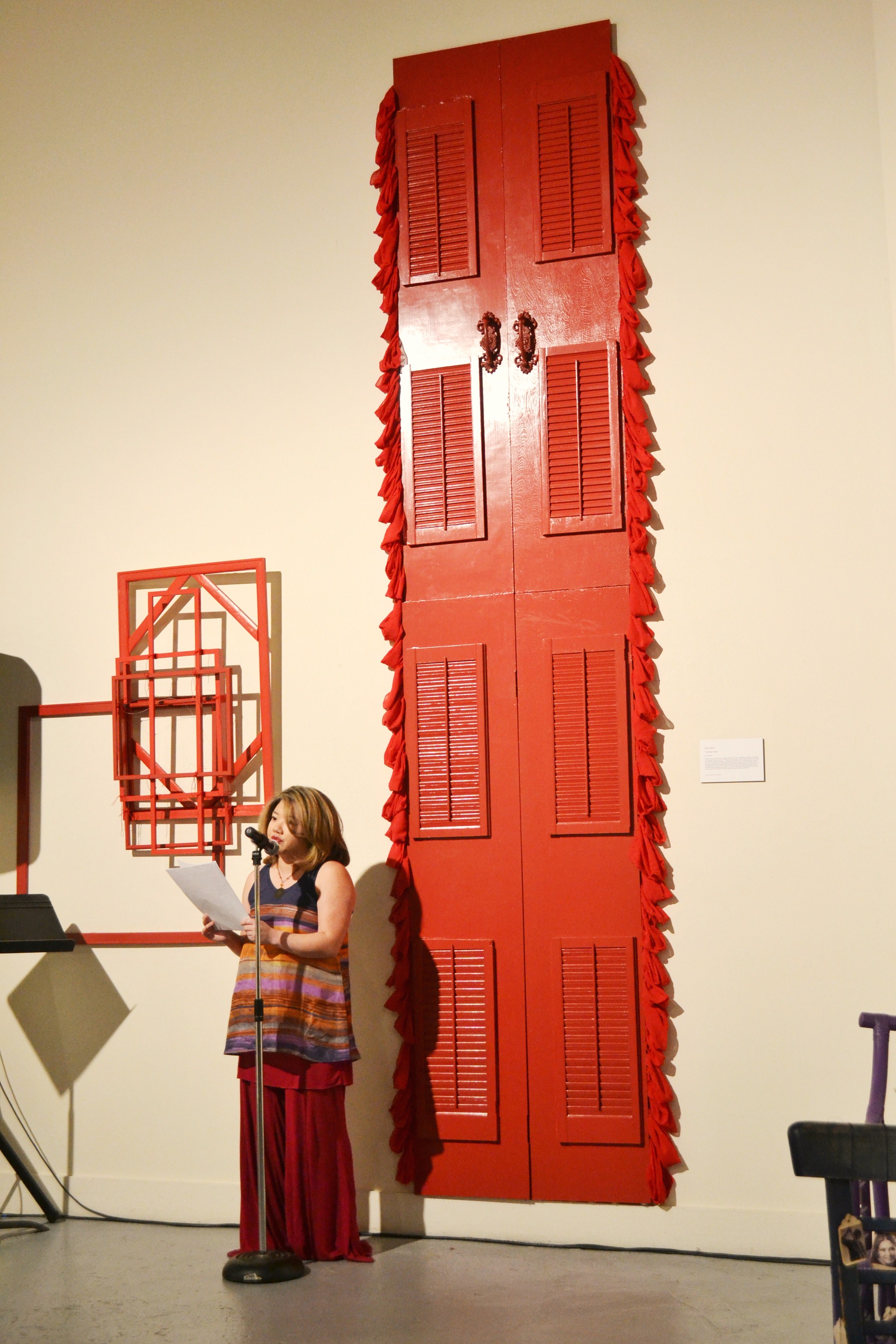
The Red Frame by Kelsay Myers

The Red Frame by Kelsay Myers


How does art fit into your life, in general? Is it something you think about and talk about every day, or every week, or only in certain situations, etc.?

I admit that I might be a bit of an art-a-holic. I am thinking about my writing, or future writing projects, or future art projects, or ideas for art projects, or what I should or could be doing with my writing constantly. I talk about it with my friends, colleagues and family. I tweet about it with some consistency. I do it with somewhat greater consistency than tweeting about it.

This might be a by-product of moving to California and falling into both a writers’ community (the MFA Writing community at Saint Mary’s College of California) and an artists’ community (Asian American Women Artists Association). Or, it could be because when I moved to the East Bay, I was ready to devote myself to my writing, and I tend to go full-throttle when I decide to do something.


When you start on a piece, what kind of end result do you have in mind? Does it get performed or published, put in a permanent form or is it more temporary?
It’s different each time. Each piece has a life of its own, but some things are the same. I always create for myself, but I also always want to share my work whether it’s through publication, a literary reading or a performance. It’s part of the Di Seuss model of creating—write because you have to, because you have no other choice and then send it out into the world to hopefully connect with others. Then move on.


What goals do you set in relation to your art, both short- and long-term? Is it something you hope to make money doing, or is it something you want to keep uncommercialized? Does the term “sell-out” hold meaning for you or do you see the art/commerce relationship as a necessary one?

“Sell-out” is something I’m concerned about. Not from the art/commerce side of things since the ability to make money doing art or writing is the ideal for me. I worry about becoming complacent, not challenging myself to move into new artistic territory, repeating myself or being convinced to make choices that I know would be a disservice to the integrity of the work. But I’d like to think that I would never allow that to happen. I guess time will tell.


What role does collaboration with others play in your art, if any?

Collaboration hasn’t come up for me very often, but I would love to collaborate. I think a piece can benefit from having more than one voice and more than one person’s mission influencing it. 


How conscious are you of your artistic influences? Who are your artistic influences?
Risa Nye said it best when she told me that my writing is very inspired and inspiring. While I cannot really speak to that last part, I do think my writing is very inspired and purposefully so. My goal is for someone else to find my writing half as inspiring as I find other writers’ to be. I haven’t written anything without directly quoting at least one of my artistic influences because I don’t see my work as being created in a vacuum, either in content or in structure. I want to honor the voices of the people who influence my work within my work, and this is something I will not compromise on.

I don’t think it’s merely the academic in me wanting to re-enforce my argument with the evidence of others either. Actress Fanny Ardant captured the idea brilliantly when she said: “As a girl, whenever I read a beautiful passage in a book I would run to my sister and read it to her. It is the feeling that you have to share the beautiful with someone else.” I find beauty everywhere: in a painting, in a book, on the silver screen, in my friends and colleagues, and I want to share that beauty with the whole world.

Aside from the women I have already mentioned in this interview (Di, Risa and Fanny), specific artistic influences are Carole Maso, Friedrich Nietzsche, Kimiko Hahn, Yoko Ono, John Irving, Walt Whitman, SØren Kierkegaard and Marilyn Abildskov.

Kelsay at the "A Place of Her Own" exhibition at SOMArts Cultural Center

Kelsay at the "A Place of Her Own" exhibition at SOMArts Cultural Center

Since this is a travel blog, how does travel relate to or affect your art? (Themes in what you produce, road trips to perform your music, thoughts on what happens to your painting when you ship it across the country to a customer, etc.)
Travel comes across in a lot of my work in some way or another. As a transracial and transnational adoptee, a certain amount of displacement exists in everything that I write. For example, the large red doors I constructed from found objects in my first art installation at SOMArts Cultural Center in San Francisco this past May were dubbed “very Asian” by some other artists in the show, which I found interesting since the lyrical essay that inspired my installation included a lot of imaginary scenes that take place in Busan, South Korea. It’s an essay where I imagine my birth parents and birth story in different ways, and I suppose the Asian side of me came out, too, in ways that it hasn’t been able to before.

Even if travel itself isn’t mentioned, place is important in all of my writing. I have lived in quite a few cities, and all of them have impacted me, which tends to come out in the writing, depending on which city I was living in during the time of the piece. Budapest, Hungary, where I lived for five months during my Study Abroad in college, is a place I associate with themes of freedom and escape. California and Korea are both places that have lived in my imagination for years as ideals and foils to my hometown of Lowell, Michigan. All of these are issues I write about or work out in my art.


And finally, a right-brain question: If your art was a map, what would it be a map of?

The United States of Asian America, as lived by one Korean American adoptee.


If you’d like, share your website/Facebook page and any upcoming gigs/plans you’d like readers to know about.

Photo 1 credit Markus Storzer. Photo 2 credit Nicole C. Roldan.

ACAM: The Time Warp Effect of Travelogues

I’ve just finished Hard Travel to Sacred Places by Rudolph Wurlitzer, and I was struck by how of its time it is. Published in 1994 (written in ’93), it’s about Wurlitzer and his wife traveling to sacred sites in Thailand, Burma, and Cambodia as they grieve the sudden death of their son. They’re American Buddhists looking for some measure of peace at various temples and shrines, and the book is full of quotes from various Buddhist texts and religious thinkers.

book cover of Hard Travel to Sacred Places by Rudy Wurlitzer

travelogue/time machine

The jacket copy on the book mentions the word “classic” more than once, and certainly Wurlitzer’s meditations on grief and loss are moving and timeless. How do we cope with the death of a child? How do we hold that unspeakably personal sadness and also hold the tragedies of deaths on a massive scale in various parts of the world? How does the death of a loved one force us to face our own mortality? Wurlitzer’s prose is simple and swift as he grapples with these questions, and I appreciated his insight even while I, as someone who doesn’t practice a religion, couldn’t quite grasp the religious framework he’s working with.

So that part was, despite the personal nature of his grief, universal and timeless. But the rest of it was so specific to 1993! He’s horrified by the commercialization of Thailand, specifically the Coke-drinking, sex trade-working, neon-lit city of Bangkok. Now, of course, the seediness and Westernization of Bangkok is well-known and few travelers are surprised by it when they visit.

In Burma–wait, he visits Burma (Myanmar). That, right there, is different from now. According to Wikipedia, about 800,000 people visited the country in 2010, compared to 1.13 million overseas tourists visiting Chicago alone in 2009. When Wurlitzer visited, Aung San Suu Kyi had only been under house arrest for a few years, after the 1990 elections that saw her party overwhelmingly elected were disregarded and the military junta decided to stop having them for awhile. Wurlitzer talks about an antiquated country, one with very little new industry or commerce since the outside world isn’t dealing with the junta (his descriptions sound like descriptions I’ve read of Cuba), and while he wonders at the brutality of the junta, he sounds relieved to be in a calm, quiet country after the electric buzz of Thailand. Nowadays, some groups advocate tourism to Burma to bring money to the local people and help them keep in contact with the outside world, but most activist groups discourage it, since the junta has forced labor in tourist destinations and the industry mostly supports the junta and not the people. A far cry from the sleepy country Wurlitzer visited almost 20 years ago.

In Cambodia in 1993, the Khmer Rouge were still a major threat; Wurlitzer heard gunfire and saw holy sculptures vandalized by people taking parts of them over the border into Thailand to sell on the black market. He describes a country in chaos, with elections right around the corner, but no one sure of who will win or who ought to win. Today, Cambodia has finally prosecuted some Khmer Rouge as war criminals, and humanitarian groups have sprung up all over the place, but its prime minister, Hun Sen, has kept in power through some very shady means, and the country is still one of the poorest in the world. The biggest change on the ground is the lack of Khmer Rouge with guns around every corner, although the mines from the civil war that could blow up at any time in 1993 can still blow up on any unlucky pedestrian today.

I enjoyed reading Hard Travel to Sacred Places both for Wurlitzer’s thoughts on death and grieving, and also for the time warp experience. It’s fascinating to read a contemporary travelogue alongside a history textbook and see how personal experience intersects with facts.

Image from here.