Dearest fellow travelers, in the words of Gob Bluth, I’ve made a huge mistake. Not quite on par with selling out my brother or denying parentage of my son, but still scarring — I watched The Proposal. It was a slow Wednesday night, it showed up in my Netflix On Demand queue, and I like Sandra Bullock, so I thought, “Why not?” OH MY GOODNESS, SO MANY REASONS WHY NOT.
I should have turned it off within the first three minutes, when it became apparent the movie is not grounded in any version of reality I’m aware of. Sandra Bullock’s character, Margaret, is the top editor at some fancy book publishing house. In the opening scenes, we follow her as she barrels through the streets of New York on her way to the office; she spends the whole walk arguing on her cell with one of her best-selling authors. The argument? She got him a slot on Oprah to talk about his book, and he doesn’t want to do it. JUMP BACK. There is no author in the history of ever who would pass up the opportunity to appear on Oprah’s show to promote their book. Austen wanted on Oprah. Dickens owes half his popularity to his delightful Oprah appearances. Poe never got an Oprah interview, and he ended up roaming the streets of Baltimore, raving mad and hours from death. The only author to have not gone on Oprah after originally offered a slot is Jonathan Franzen, and even that was a rejection of Oprah’s Book Club and not a TV appearance (she pulled the interview after he revealed he didn’t want the book club sticker because men might find it off-putting (which, ew, men, get it together)). Every writer, published or unpublished, believes that their book is just the right one to fit between a celebrity interview and a spa package giveaway on the Queen of Talk’s show. Every newly signed author eagerly sits down with the publicist assigned to them and says, “I’ve got a great idea for publicity. I should go on Oprah!” The publicist then groans inwardly, because the percentage of authors who make it on Oprah is minuscule, and out of that, the percentage of new authors who get to sit in Harpo Studios is infinitesimal. So you’d better believe that when an editor finagles an Oprah appearance (and by the way, I bet the publicist is a little pissed at being shoved out of their job on this one), the only response she’s going to receive is hysterical screaming, tears of joy, and possibly the offer to name their firstborn after her. When one of the plot points of your movie centers around something so deeply misguided as an author refusing to appear on Oprah, you know your movie is already in serious trouble.
But I didn’t turn it off, much to the detriment of my psyche. Apparently, when The Proposal first came out in June, critics didn’t think the movie was anything to write home about, but they didn’t think it was the worst of the breed. Oh my word are they wrong. It’s heavy-handed where it should be lighthearted, mean-spirited where it should be heartwarming, and dull where it should be lively. Not to mention, it’s a feminist’s nightmare.
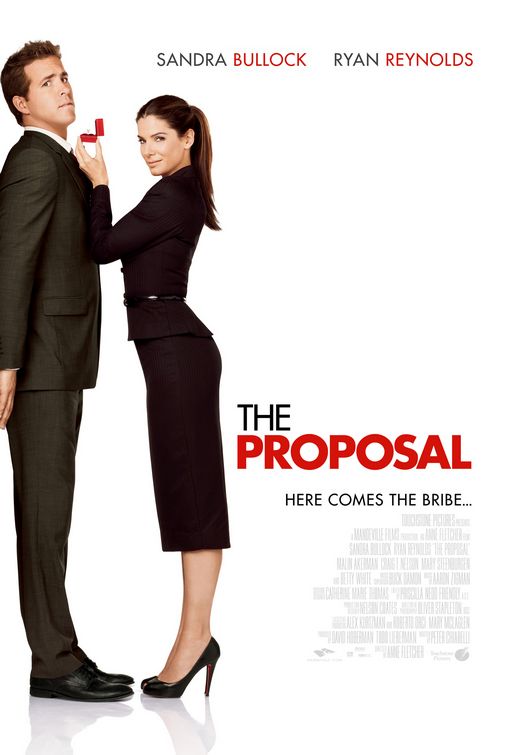
source of severe psychic damage
First, the form. I am a fan of romantic comedies; they are, at their best, vehicles for rapier wit, brilliantly timed physical humor, and genuine warmth between two likable leads gamely playing out gender politics and societal tensions on their way to the altar. It Happened One Night, The Philadelphia Story, Trouble in Paradise, Bringing Up Baby — all fantastic romantic comedies. Also all pre-WWII. Way back in 1999, Stephanie Zacharek at Salon wrote a great piece on what is wrong with the rom coms of the ’90s. Things haven’t improved since then. Think Valentine’s Day, Sex and the City, 27 Dresses, He’s Just Not That Into You — all films that seem to revel in women as catty, desperate, pathetic creatures, and men as clueless, boorish, and somehow just right for you. Many feminist sites comment regularly on the dearth of decent rom coms — Feministing even has a regular series about it, which I recommend. So I’m just joining these highly intelligent and perceptive women when I say romantic comedies ain’t what they used to be.
Generally, romantic comedies follow a predictable formula — boy and girl meet (ok, in Hollywood, heteronormative movies, it’s always boy and girl), boy and girl hate each other, boy and girl spend the rest of the movie figuring out that they love each other, usually with the help of some quirky friends. In the best ones, the obstacles are there for real character development, not just as haphazard roadblocks against the inevitable conclusion.
In The Proposal, however, the main obstacle is the slimmest of excuses — Margaret is a Canadian citizen who violated the terms of her visa and will be deported if she can’t come up with a legitimate reason she should stay in the country, so she pretends she and her assistant, Ryan Reynolds’ Andrew, are engaged. But they have to fool the evil USCIS agent who doesn’t believe their story! And they have to fly to Alaska to meet Andrew’s family and fool them into thinking it’s a real engagement, too! And Andrew has to learn how to be a man again! And Margaret needs to learn over and over and over again that what she really wants is the love of a good man!
Right. About that. Aside from the glaring publishing industry inaccuracies (throwing in a reference to the Frankfurt Book Fair does not make you up on your game, screenwriters), the movie’s main problem is its obsessive focus on taking the most extreme elements of Taming of the Shrew and applying them to the modern age. Margaret is a successful businesswoman, therefore she must be bitter, alone, and a total domineering bitch. We know this because the office underlings call her “it” (gee, that’s not unnecessarily dehumanizing), she doesn’t smile, and she fires someone when he doesn’t do his job. She must be stopped. Placing her in Alaska gives her lots of opportunities to learn the valuable lesson of humility — or rather, humiliation, which is not the same thing. Andrew grabs her ass on two different occasions, both in front of people; a stripper brings her onstage against her will to gyrate on top of her and stick his junk in her face, much to her discomfort; she takes a huge spill off a bike only to find herself in the middle of some faux-Native American spirit dance whose main purpose seems to be allowing Andrew to see her jump about and grunt so he can call her weird; she gets self-conscious around Andrew in the morning and puts on makeup in bed so he won’t notice what she actually looks like when she wakes up; he sticks his erection in her ass as they try to snuggle for the benefit of his family; she reveals secrets about herself in an attempt to bond with Andrew and show him her softer side, and he laughs at the fact that she hasn’t been laid in a year and a half; and finally, she falls out of a boat into the ocean, and flails about in panic because she can’t swim, and Andrew must save her. Literally save her. The gods of subtlety were not with these screenwriters.
In contrast, the only lesson Andrew seems to need to learn is to turn his sarcasm meter up to “high” every time he talks to Margaret and get into arguments with his father that he can stomp away from so he can do some good wood chopping (not a euphemism). We’re supposed to believe that he’s nothing but belittled by Margaret, and so not only does she have what’s coming to her, but he has to be the one to give it to her. And how is he belittled? He wakes up late (not her fault, as far as I can see) and runs with two hot coffees and slams into the mail guy, who he then berates (not the mail guy’s fault, as far as I can see). She makes fun of him for ordering the same coffee as she does, tells him she won’t buy the manuscript he’s selected from the slush pile, and makes him accompany her to the firing of another editor. She does force him to be fake engaged to her so that she doesn’t get deported. Except, well, he could just not do that. She counter-argues that he has to because he needs this job and he won’t be able to move up in the publishing world if he doesn’t make her happy, but one of the main markers of publishing is that people change companies all the time. Even if it were another industry, I’m pretty sure he’d make it. So that’s it. Those are the many, many ways she emasculates him, and those are the moments he makes up for by continually mocking and molesting her throughout the film. I call foul.
One of the great hallmarks of terrific romantic comedies is that both main characters grow and become more suited for one another. It Happened One Night is another kind of Taming of the Shrew, and there’s some ass-slapping and “shut up”s that are a little jarring, but even those instances are part of both characters letting go of stereotypes and learning how to be kinder toward one another — and that was made in 1934, not 2009. In Bringing Up Baby, Katharine Hepburn’s character is a bit MPDG, with the key difference being that she actually has her own wants and needs. But those wants and needs, while pursued to ridiculous ends, aren’t portrayed as totally unreasonable or the province of an overly demanding or pathetically desperate woman. Rather, she’s a bubbly young woman who falls for Cary Grant (who wouldn’t?) and enacts several schemes to win his heart. This proves successful, and while he becomes a little more adventurous, she isn’t knocked down a peg or two. There’s no sense that she has to give up an essential part of herself to be worthy of love.
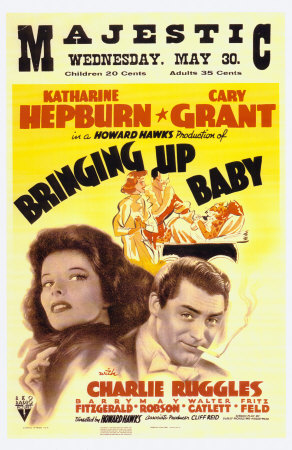
this is how it's done
In The Proposal, there wasn’t much to define Margaret’s character to begin with, but at least we knew that she was good at her job, appeared to enjoy it, and had built herself up after the devastating loss of both her parents when she was only a teenager. That all gets broken down as she is shown to be hopeless at the Internet (really? she didn’t recognize the sound of a modem connecting?), so her very competence is brought into question; scared of Andrew’s family’s dog, which makes her even more of a weak woman because it’s a tiny dog and who’s scared of those?; and ultimately sacrificing herself for the well-being of Andrew (which wouldn’t at all be a bad thing if he’d sacrificed anything for her, or if she’d learned a lesson other than “I’m not worth a family’s love and will go cry in Canada now”). She gives up every part of herself, he gives up no part of himself, and it’s supposed to be a happy ending. I’ve rarely been more depressed when a movie ended.
There was no chemistry between the leads, we had only Betty White to carry all the comedic relief, and the dialogue was wretched. The Proposal is a failure purely from a basic cinematic point of view. But its failure as a romantic comedy — and one directed and produced by women, no less — is what really upsets me. I think the term “feminist’s nightmare” might be a bit overused, but in this case, it’s true. The lessons we learn are thus: Women shouldn’t be in charge, women should find a man and settle down, men should be jerks to women if they want their respect and love, and we should pervert love so that this is all done in love’s name. Pretty nightmarish.
At the very end of the film, as Margaret and Andrew kiss in an office full of coworkers, someone yells out, “Show her who’s boss, Andrew!” As if we were in any danger of forgetting.
 Stowaway Travel Writing & Editorial Services
Good post. Since you admittedly like the genre, can you think of any more contemporary romantic comedies you like or are you strictly pre-WWII?
Oh no, I like many contemporary ones as well. Even some that are kinda bad.
Here, in no particular order, is a partial list of romantic comedies post-1980 that I enjoy watching:
Moonstruck (even though Post-Nasal Drip Personified, aka Nicolas Cage, is the romantic male lead)
When Harry Met Sally (despite Nora Ephron’s later attempts to kill the romantic comedy entirely, and despite the occasional High Obnoxiousness factor in both leads — plus, “You’re right, you’re right, I know you’re right”)
French Kiss (Kevin Kline is French! Meg Ryan still pulls off adorable! Jean Reno is charming!)
While You Were Sleeping (Stephanie Zacharek doesn’t like it, but this is one of my favorites — they’re both a little adrift but not incomplete people, which makes their romance believable and gratifying; and also, the family makes me happy)
10 Things I Hate About You (has some major issues, yes, but oh Heath Ledger, we miss you, and JGL, you turned out MUCH better than this movie could predict)
Bridget Jones’s Diary (a pretty straightforward “be true to yourself to find true love” story, but with British accents)
Nick & Norah’s Infinite Playlist (music! shy kids! I must read the book)
Kissing Jessica Stein (women lovin’ each other for their own benefit and NOT that of the dudes, and also, it’s hilarious)
Roxanne (Cyrano de Bergerac for the modern age, before Steve Martin’s descent into hellish “family” movies)
I.Q. (Meg Ryan again, good grief, but this is a romantic comedy featuring Einstein as played by Walter Matthau, and Stephen Fry as a bad guy — you cannot go wrong)
Benny & Joon (a little more heartbreaking than the rest here, but oh those grilled cheeses at the end, and all that silent movie physical comedy)
But I’m a Cheerleader (an imperfect satire, but a sweet story and some killer lines)
Strictly Ballroom (romance: check, comedy: check, intergenerational drama and intrigue: check, Australian accents: check)
Some movies I’ve heard people describe as romantic comedies but aren’t really enough of the romantic part of things to count:
Sixteen Candles and Better Off Dead
I do NOT enjoy You’ve Got Motherlovin’ Mail or Sleepless and Insipid in Seattle
Sandra Bullock was nominated for a Golden Globe for The Proposal. In case you were confused for a moment and thought awards meant anything.
Anyway, because I’m feeling like a masochist, I kinda want to watch All About Steve now, and find out just how bad it is.
I will only watch All About Steve with a bottle of wine firmly in hand, should you care for company on that adventure.
Oh yes. Wine is required. Let’s do it! We can count all the ways the screenwriters/director made her character creepy, whereas male stalking behavior is, OF COURSE, evidence of a deep and true love that his love interest is just too stupid to recognize.
I’ve recently become disenfranchised with the whole romantic comedy genre. However, one of the redeeming sub-genres I have seen is the reconciliation comedy.
This is a couple who got married young or have just drifted apart, and then have to relearn who each other is and fall in love with that. It strikes me that in these cases it generally takes both in equal measure to make it work. You take your blockbuster hollywood film like Mr. and Mrs. Smith to your low budget British comedy Keeping Mum, both about coming back together. You might even be able to argue that Knocked Up is just such a comedy. The classic of this being my all time favourite Philadelphia Story, so so so good.
There’s also the sub-genre of the post-breakup rom com. Where the main character has recently been devastated by the love of his or her life and with the friendship and eventual love of total stranger they come out of it, Forgetting Sarah Marshall.
Maybe the traditional Rom Com is just reaching a natural end as the reality of the complexity of adult relationships stands in stark contrast. We’ll always have Darcy/Elizabeth and we’ll always have Paris.
I love reconciliation comedies, too! The Awful Truth is a great one.
And I’m sure it’s not the end of the rom com. It’s been perverted to become an anti-romance revenge/humiliation story (think not just The Proposal but How to Lose a Guy in 10 Days, Couples Retreat), but that just means the writers who know and love what a romantic comedy can be need to be given funding! I love me some Darcy & Elizabeth but I need updates.
I laughed several times through this and I think when you’re in town we should have our own Mystery Science Theater meets RomCom night.
Reading your act-by-act take down of ‘The Proposal’ (and thank you for taking that grenade) I found myself thinking “The narrative pull of this story is that Sandra’s character will lose her job and all she knows if she doesn’t get a visa extension/green card. That’s it. The comedy here is misdirected. This shouldn’t be a romantic comedy, it should be a screwball comedy. The comedy should be in the myriad of ways one tries to stay in the US and fails to do so and keeps trying to the point of absurdity. A romantic interlude doesn’t necessarily have to occur. It could even be a buddy film.”
But that would validate Sandra’s character’s life choices. And then her lifestyle wouldn’t be the butt of jokes, it would be the stabilizing force. And then I cried. Maybe the original screenwriter did too.
Hurrah! Making a hilarious writer like yourself laugh out loud = life goal complete.
And YES. It’s the wrong movie for the story, and this brings in so much of the awkwardness. Great point!
Nice post. I briefly heard Ruthie mention this movie to Beth this morning and she disliked it too (not sure for the same reasons or not).
Ok, finally, my exclamation was regarding The Proposition (which if I’m understanding you correctly, you still think is a horrible movie). I’ve never seen The Proposal but since it involves marriage AND Sandra Bullock it undoubtedly sucks, so well played. However, The Proposition with Guy Pearce and Ray Winstone is not a horrible movie and only makes me think you found yourself in the wrong aisle of your local dvd store.
I have seen The Proposition starring Guy Pearce and Ray Winstone and did not enjoy it at all. None of the drama was inherent enough to keep me going through the many dull parts. Although I did laugh when the one bandit gets increasingly ambitious in his bragging when they’re dressed as policeman on their way to the jail.
Also, I love Emily Watson, but all she was given to do in this film was worry about being raped and then experience being raped. Great.
Pingback: Smokin’! « Stowaway