Aesthetically Speaking: C.S.E. Cooney

Today’s Aesthetically Speaking interviewee is a published author and writer of many things, from novels to poems, plays to blog posts. I especially appreciate the honesty of how tough it is to find good readers of your writing, who you can trust and whose advice you can take. Thanks for sharing, C.S.E.!

What is your name and city of residence?
C.S.E. Cooney, almost-formerly-of-Chicago. Soon to be “Somewhere, Rhode Island.” I’m moving in a few weeks, east. 

What medium do you work in?
Words! Stories, novels, poetry, plays, reviews, blogs, whatever!

Jack o the Hills book cover CSE Cooney

Jack o' the Hills

How often do you work on your art–is it a full-time endeavor or something you work on in your spare time?
It’s like a second job that wants to be my first job. Nights and weekends sort of thing. These days, writing is not so much an escape from the day-job, as it is that the day-job (and everything else) serves the writing. 

How does art fit into your life, in general? Is it something you think about and talk about every day, or every week, or only in certain situations, etc.?
It’s the sort of thing that creeps into almost every conversation. The sort of thing where you’re babbling at someone about whatever book you’re reading, story you’re writing, writing convention you’ve just gone to, this new writer you’re corresponding with, this play of yours that you’ve just seen produced, and thinking, “Is this all I ever talk about? Am I more boring than any bore that ever lived? Talk about something else. Talk about that Wampug you just saw on YouTube…” 

(http://www.youtube.com/watch?v=ey2L_ExKWuI)

But there’s this: whatever else I talk about — movies, science, that creep on the train, the etymology of the word “yawn” — there’s a voice in the back of my head that says, “Remember this. Use it in a story.”

When you start on a piece, what kind of end result do you have in mind? Does it get performed or published, put in a permanent form or is it more temporary?
I write short stories with the idea of submitting them as soon as possible. They have to accumulate a number of both drafts and rejection slips before they’re either trunked for good or finally accepted somewhere. 

Sometimes an idea starts out a poem, morphs into a play, and then it turns out it’d make a better story. I rarely know this starting out. Some ideas require many structures before its ultimate shape is refined.

Plays I either write for fun, or competitions, or festivals. I usually write them only if someone out there’s interested in something from me specifically. But there have been a few cases of me waking up in the morning and saying, “I’m gonna write a play today.” No one wants them necessarily, but at least I had fun pulling them out of the ether for their own sakes and no one else’s.

Poetry is usually a visceral reaction I have to something. Either that, or I stumbled onto a moment I want frozen in all its glorious hyperbole. Those times I’m feeling something strongly I may never feel again, something effervescent in its novelty, I’ll try and capture to examine more closely later. And also to show it off… My wild menagerie of past experiences.

With novels, I don’t know — I’ve not had one published yet. With the one I’m working on now, a fantasy called Shadowstalkers, the end in sight is, “Finish the danged thing, go on a Great Agent Quest, and then from there we’ll see.” I’m fewer than 100 pages away from writing The End on this present draft.

What goals do you set in relation to your art, both short- and long-term? Is it something you hope to make money doing, or is it something you want to keep uncommercialized? Does the term “sell-out” hold meaning for you or do you see the art/commerce relationship as a necessary one?
I certainly want to make money with my writing. The times I already have are kind of addictive. The trick is getting the production and quality up to a level where my earnings from the writing are at least as consistent at whatever day-job I’m working in order to eat and pay rent while writing. I may never get there. It’s a goal, anyway.

I hate the term “sell-out.” What does that even mean? Producing something you hate for loads of cash? If that’s what a “sell-out” does, then I couldn’t do it. Just judging from past day jobs: if I’m in a position I consider toxic, I quit — for my own health’s sake, which I value. I want to wake up and like myself. It’d be great to wake up, like myself, and make money too. I don’t mind compromise or flexibility. I often don’t even know my own boundaries until I come smack up against them. I try to keep an open mind until confronted with an ethical crisis, and make my decision then.

Also, just because I create something, recognize that it’s well-constructed, and even publish it — that doesn’t mean it’s good art.  I have failed at making the kind of art I want to make — failed spectacularly. Sometimes it’s not possible to recognize that something is a splattering huge mess when you’re right in the middle of it, looking out. Someone might come along and point out this huge, raw flaw you’d never intended, never in a million years, and you wish you could take it all back and put it down somewhere in the dark, but it’s out in the world now. You suck it up. Learn something about yourself and the world you live in. What it makes you. What you make of it.You just learn from it, try not to do it again, and hopefully do something better with the next project.

Every story I write seems to require something utterly different from me than the last.  I have to learn a whole new skill set with each thing I write. It’s completely fascinating, but I hardly ever feel like I know what I’m doing. I’m trying to become more conscious of my process, without stymying the process. That gets tricky. But it’s never boring.

The Big Bah-Ha by C.S.E. Cooney book cover

The Big Bah-Ha

What role does collaboration with others play in your art, if any?
Well, you can’t have theatre without collaboration. That’s a given. So, with a play — collaboration’s built in. Actors might give a script a read, directors will piece it apart, everybody’s input informs the next draft. The script often morphs during the rehearsal process. So far, that’s been my experience. My experience is pretty limited. 

But stories, at least in the initial stages, are more personal. For myself, I have a handful of friends, who are all writers or editors at varying levels of their career — from award-winning, published novelists to people like me who’ve only just traded their apprenticeship for journeyman’s rank — and I often send them early drafts of things for their critique.

There’s much trial and error involved in this. Trust must be built up over time. Few people come through the crucible of this process, but those who do I value highly. I have to be careful to whom I send a story, because a certain kind of criticism too early, or given tactlessly, can ruin my enthusiasm for months. Some friends I can take a pummeling from and bounce up grinning. Some friends, even at their gentlest, slay my desire to create. It’s not their fault, or mine. It’s simply a matter of personalities.

After a draft is done, of course, and a story is submitted, it takes a small army of slush readers, associate editors, editors, designers, and artists to put together a magazine. Without them, I’m just a writer with a few thousand words in a Microsoft Document.

How conscious are you of your artistic influences? Who are your artistic influences?
Pretty conscious, I’d say. Stephen Sondheim, Caryl Churchill, Shakespeare, Ogden Nash, Dorothy Dunnett, Gene Wolfe (probably him above all, as he’s been my mentor since I was 18 years old), Robin McKinley, Patricia McKillip, Victor Hugo, Flaubert, the Brontës, Jane Austen, Lois McMaster Bujold, Neil Gaiman, Stephanie Shaw, Alexandre Dumas, Lloyd Alexander, Tolkien and Lewis, Diana Wynne Jones, Georgette Heyer, Frances Hodgson Burnett, Elizabeth Peters, Ursula K. LeGuin, Octavia E. Butler, Shirley Jackson, James Enge, Pablo Neruda, Peter S. Beagle, Stephen King… Can you tell I’m mainly a Fantasy writer? 

Since this is a travel blog, how does travel relate to or affect your art? (Themes in what you produce, road trips to perform your music, thoughts on what happens to your painting when you ship it across the country to a customer, etc.)
Much of the traveling I’ve done in the last nine years has been to writing conventions. That’s where you meet folks in your field. That’s where you meet your influences, hear them read out loud and answer interview questions and shake their hands. It’s where they become human. And suddenly you think, “If they can do it, I can do it.” 

Road trips — especially with other writer friends — to these sorts of things are where character, plot and story are all born.

There’s something about movement, the freedom of the road, really late nights in highway darkness, that get all the good weird stuff of the soul stirred up. There’s also a great deal of history moving outside your window. The good, the bad, the pretty and the ugly all buried in that landscape with the bones. Horizons you’ve never seen. Roads you’ve never traveled. Music on your friend’s iPod you’d never listen to on your own. Really vulgar jokes. Weird roadside pranks. All of it full of story.

There’s a reason there’s a whole genre of novels called “picaresque.”

And finally, a right-brain question: If your art was a map, what would it be a map of?
You know those ragged, half-scorched parts of ancient maps that say “Here Be Monsters”? Everything beyond that. 

If you’d like, share your website/Facebook page and any upcoming gigs/plans you’d like readers to know about.
I keep a blog at csecooney.livejournal.com. On my profile page is everything I’ve done writing-wise and where to find it. 

If you want to buy my book “Jack o’ the Hills,” being two stories in one of a very twisted fairy tale, check out Papaveria Press.


Aesthetically Speaking: Branden Johnson

Please welcome Branden Johsnon to Aesthetically Speaking. He’s a renaissance man of the arts, playing music and writing many things. I’ve seen These Guys These Guys perform, and they do a great live show of moody, Peter-Gabriel-era-Genesis-type instrumental music. They have a show on Friday, October 14 so check them out. Thanks for sharing, Branden!

What is your name and city of residence?
Branden Johnson – Resident of Oak Forest, IL, a suburb of Chicago

What medium do you work in?
I’m primarily a writer and a musician. It really does fall about 50/50. I write novels and short stories, as well as screenplays (specifically for a web series called Kole’s Law), and I play piano and guitar in post-rock band These Guys These Guys.

How often do you work on your art–is it a full-time endeavor or something you work on in your spare time?
As much as I would love to be creative full-time, I’m a wage slave like most everyone else. My passion for working on my art comes and goes in waves. When I’m not working on music to prepare for a gig, I’m writing alone at my desk or collaborating on a screenplay.

How does art fit into your life, in general? Is it something you think about and talk about every day, or every week, or only in certain situations, etc.?
My creative work is incredibly important to me. Sometimes I forget that. Those are the times I find myself the most down. When I remember the joy I get from creating, it’s like getting a second wind in a big race, and I can’t wait to get off work so I can get home and create some more.

Branden Johnson

on keys

When you start on a piece, what kind of end result do you have in mind? Does it get performed or published, put in a permanent form or is it more temporary?
It varies, really. I’ve had a few short stories published in some journals, which felt great at the time. And when the band plays a gig, we get the satisfaction of interacting with the crowd, which is immediate feedback.

What goals do you set in relation to your art, both short- and long-term? Is it something you hope to make money doing, or is it something you want to keep uncommercialized? Does the term “sell-out” hold meaning for you or do you see the art/commerce relationship as a necessary one?
The term “sell-out” to me is far from a bad word. It really depends on the artist’s intention. If my goal is to write a novel and get it published, then certainly I’d like it to sell. If it’s not selling, why did I work to get it published? But if I create an intensely personal piece, I may only want to share it with some close friends or family. In the long term, I want to create for a living. And I’m at a place where the term “create” has a bit of flexibility. If my band scored a big recording contract — great! If a novel I write is published — awesome! If one of my web series is discovered and appreciated by a Hollywood big-wig — terrific! I so enjoy the various projects I’m involved in that any one of them could become a career for me and I would be perfectly happy.

What role does collaboration with others play in your art, if any?
Our collaboration in the band is incredibly important. We write together. We make all our decisions together. If a compromise has to be reached, we reach it. My solo writing, of course, is primarily just me — but even then, writers’ groups (like online group Zoetrope.com) have provided me with valuable feedback that has helped me grow as a writer.

How conscious are you of your artistic influences? Who are your artistic influences?
I’ve been influenced by a number of writers. One of the major writers would be Neil Gaiman. I never read his comics, but his novels, and particularly his short fiction, have really spoken to me. Musically, I grew up listening to video game scores (being then, as now, a huge nerd), and have taken a great deal of inspiration from Japanese composers such as Yasunori Mitsuda and Nobuo Uematsu.

Branden Johnson

the glasses mean "writer"

Since this is a travel blog, how does travel relate to or affect your art? (Themes in what you produce, road trips to perform your music, thoughts on what happens to your painting when you ship it across the country to a customer, etc.)
I don’t want to only write what I know. I want to learn more, grow more. Staying put doesn’t do much to help with that. My experiences in other places have helped me extend my perspective, which can only benefit my writing. As far as my music goes, well… We haven’t really toured yet. But that could happen soon!

And finally, a right-brain question: If your art was a map, what would it be a map of?
It would be a map of the Midwest as drawn by a maniacal 4th grader.

If you’d like, share your website/Facebook page and any upcoming gigs/plans you’d like readers to know about.
Twitter: @brandenjohnson
Facebook: www.facebook.com/brandenjohnson
These Guys These Guys: www.theseguystheseguys.com
TGTG on Facebook: www.facebook.com/theseguystheseguys

Kole’s Law: www.koleslawshow.com
Kole’s Law on Facebook: www.facebook.com/koleslawshow

Upcoming Show Details:
El Mamey
Friday, October 14
2645 W. North Ave, Chicago, IL
21+/8:00pm/$7
With: Mountains For Clouds & I Know Everything

Photo 1 credit Keith Kosmal. Photo 2 credit Jenny Schuler.

Aesthetically Speaking: Catherine Adel West

This week’s interview was conducted with Catherine West, a colleague of mine at work. We found out we actually grew up blocks from each other in Evergreen Park, and now years later we’re working as editors in a small office in downtown Chicago. Small world. Catherine’s blog makes me laugh every time I read it, and I’m looking forward to reading more as the inspiration strikes her. Thanks for sharing, Catherine!

What is your name and city of residence?
My name is Catherine Adel West and I live in Chicago, IL.

What medium do you work in?
I am a writer. Whether or not I am a legendary writer remains to be seen.

Catherine West

Catherine West, legendary writer

How often do you work on your art–is it a full-time endeavor or something you work on in your spare time?
I write in my spare time. Mostly I write after work or during breaks. It’s for the most part when inspiration hits me, which is more and more often these days.

How does art fit into your life, in general? Is it something you think about and talk about every day, or every week, or only in certain situations, etc.?
As I have to edit other people’s words, I think about my work and my words all the time, every time. It actually helps to know what techniques work in writing and which ones do not.

When you start on a piece, what kind of end result do you have in mind? Does it get performed or published, put in a permanent form or is it more temporary?
When I begin a story, it is very fluid. I never know where I’m going to end up which is most of the fun. My result varies with each story I create; I want to make you laugh; I want to make you cry. My overall goal is always the same and that’s to make the reader feel something powerful. I will publish my work on a blog. I am, however, experimenting with the idea of being more aggressive and entering short story competitions.

What goals do you set in relation to your art, both short- and long-term? Is it something you hope to make money doing, or is it something you want to keep uncommercialized? Does the term “sell-out” hold meaning for you or do you see the art/commerce relationship as a necessary one?
My ultimate dream or goal has always been two-fold. Become a successful writer both literary and screenwriting (maybe an Oscar or two in my future). To me, sell-out is not a dirty word as I have never been the “starving artist” type. We do have to make a living and we all, as artists, want to reach as many people as we can with our words, music, images, etc.

I think the lines that one is willing to cross determine the extent to whether they will be able to ultimately live with their decisions or not. I think in the end, I will be able to live with my decisions and do so happily.

What role does collaboration with others play in your art, if any?
Collaboration, if any, for me comes mostly in the editing process. I give my stories to a few trusted people and they give me their honest feedback. We will go back and forth about things that can be edited or changed. However, writing is mostly a very single and lonely process.

How conscious are you of your artistic influences? Who are your artistic influences?
I think anyone who performs music, paints, writes, or whatever is constantly trying to live up to an ideal person. With every note played, word written, or brush stroke comes a constant questioning of how would this person handle it or how can I put my own unique spin on my art form. I am no different.

 I read and re-read every line and compare myself. How I write, every word used has little bits of Zora Neale Hurston or Dean Koontz or Anne Rice or Chuck Palahniuk. I try to write to combine love of ethnicity and mystery and description and dark humor. I want my writing to be all of these things in a unique shell.

Since this is a travel blog, how does travel relate to or affect your art? (Themes in what you produce, road trips to perform your music, thoughts on what happens to your painting when you ship it across the country to a customer, etc.)
Travel mainly affects the way I describe a place in my writings. A lot of it I pull from different places I’ve visited. A hotel room in Paris; a casino in Vegas; the way the Pacific Ocean beats the sand in Santa Monica — all this helps me give a place or setting as much depth and feeling as the characters themselves.

And finally, a right-brain question: If your art was a map, what would it be a map of?
As much as I dislike the wilderness, I would actually compare my art to the forest. There is a lot of beauty, dense and raw, and it can be hard to get through, but once you hit that beautiful meadow, and the sun is shining off the picturesque lake, the trek was totally worth it!

If you’d like, share your website/Facebook page and any upcoming gigs/plans you’d like readers to know about.
I have a wonderful blog titled “Ghetto Yuppies.” It’s funny and crazy and a good read so I invite all people to check it out! http://catherineadelwest.blogspot.com/

Aesthetically Speaking: Jeannie Miernik

This week’s artist interview was conducted with Jeannie, a writer living in mid-Michigan. Jeannie and I met at Kalamazoo College and studied abroad together in Rome junior year. Jeannie and her husband are raising a gorgeous baby daughter in Lansing, and she’s also writing a novel. I’m definitely impressed with her devotion to the craft, and her blog is a great source of writing tips and ruminations. Thanks for sharing, Jeannie!

What is your name and city of residence?
I’m Jeannie Miernik from Lansing, Michigan.

What medium do you work in?
I am writing a fantasy novel based on European folklore. The working title is Briars and Black Hellebore. On one level, it’s a retelling of fairy tales like many writers have done before, but on another level it’s a story about storytelling itself, about oral and literary traditions and the transmission of culture. It’s about the power of words and narratives to shape our realities. As I work on this novel, I am exploring what I call “metamyth,” the stories behind stories.

How often do you work on your art–is it a full-time endeavor or something you work on in your spare time?
Right now, I am a total guerilla writer. I have a six-month-old baby and two jobs, so I steal minutes here and there to write, only up to a few hours a week. It depends on how long my daughter naps!

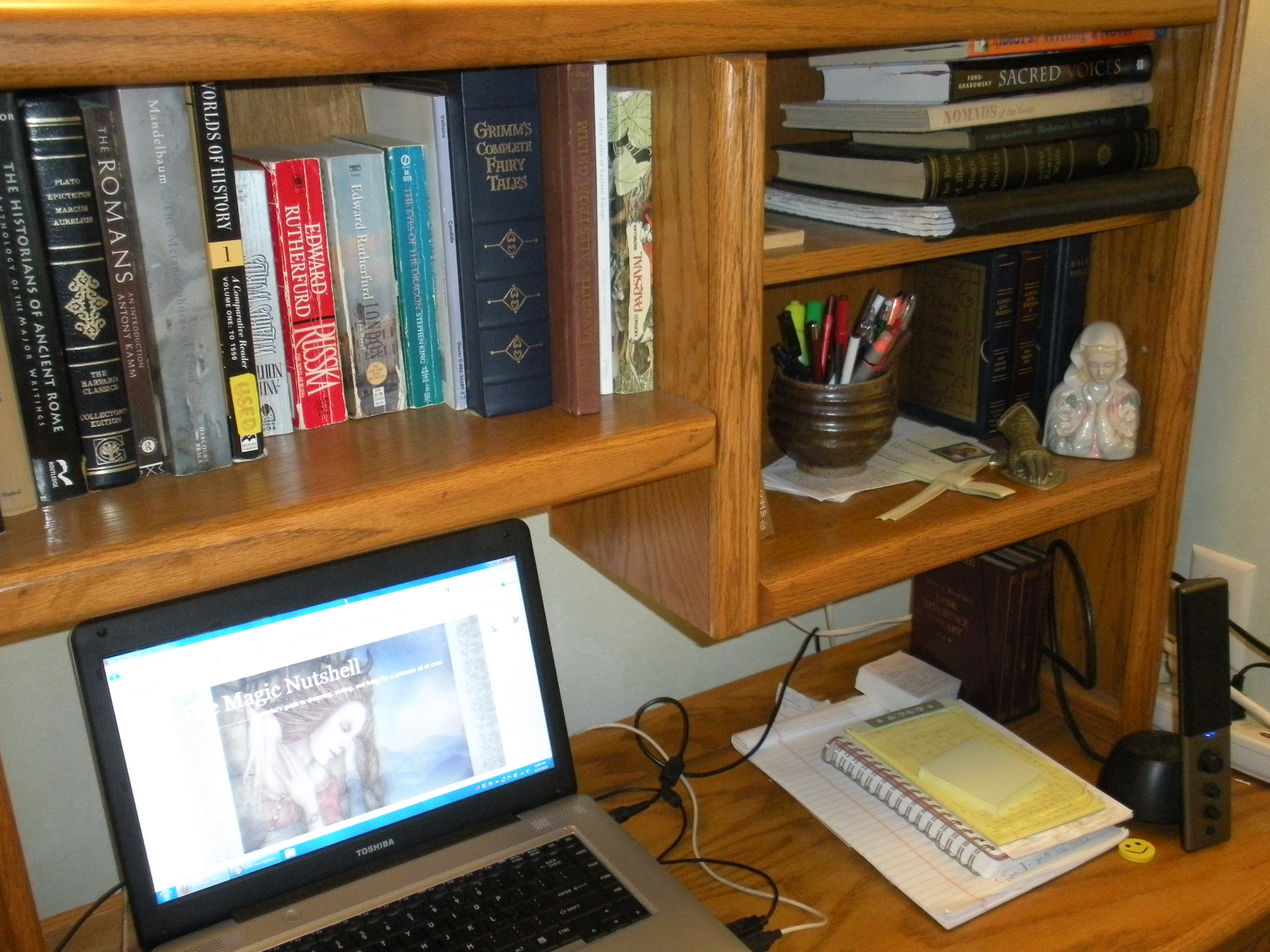
Jeannie's workspace

Jeannie's workspace

How does art fit into your life, in general? Is it something you think about and talk about every day, or every week, or only in certain situations, etc.?
Writing is solitary work, but I think about my plot, characters, and word choices every day—in the car, in the shower, during lulls at work, and even in dreams. Films, paintings, architecture, plays, nature, and all kinds of unlikely experiences give me ideas. Although I don’t have much time to sit down and write, I do read about European history and myth at every opportunity. I keep books and articles packed in my breast pump bag and my nightstand. I talk about concepts and interesting stories and history facts all the time with my family and friends. They will probably be bored with everything I’ve learned before I’ve finished my book!

When you start on a piece, what kind of end result do you have in mind? Does it get performed or published, put in a permanent form or is it more temporary?
I would like to see my book published one day. I hope to craft a novel of high enough quality and broad enough appeal to land a contract that could lead to an ongoing fiction writing career. I realize that such publishing deals are going the way of tenured professorships, but they still do exist, and that is my dream.

What goals do you set in relation to your art, both short- and long-term? Is it something you hope to make money doing, or is it something you want to keep uncommercialized? Does the term “sell-out” hold meaning for you or do you see the art/commerce relationship as a necessary one?
In the short term, while I’m caring for a baby, family is my top priority and takes most of my energy. So my goal for the next year or two is just to keep the writing momentum going, adding something to my manuscript every few days.

In the long term, I hope to reach many readers through publication of many novels. I hope to make enough money to support myself in continuing to write fiction—without having to maintain two “day jobs” in the meantime. It would be a great pleasure to reach a large readership who might enjoy my stories and interpret them in different ways.

Selling a work of art is not the same as selling out. I have always understood the term “selling out” to mean compromising a work’s integrity for a profit. But the difference between selling and selling out is complex and subjective. Not all changes or amendments to a work to prepare it for sale compromise its integrity. For example, an editor’s suggestions to fix errors within a manuscript to improve its quality for sale would likely improve the work from an artistic standpoint and not subvert its purpose. On the other hand, product placement within a novel that has nothing to do with the story would be a sell-out. But there is plenty of gray area between those obvious examples. I think it’s a distinction made in the gut of the artist in relation to each individual work.

The art/commerce relationship is not always necessary; many people express themselves creatively without selling their works. But the creation of any piece of art does take time and money, so if the artist cannot independently support her or his own work, it must be made possible through sales or grants or patronage, which are not entirely different arrangements. For me, selling my novel could give me the freedom to spend time writing more and better novels and improving my craft in a way that would be difficult or impossible if writing time were always forced into the periphery of my daily life.

What role does collaboration with others play in your art, if any?
The text of my novel itself I write completely on my own. But indirectly, many others have assisted me. My writing has benefited from a good critique partner who is encouraging, honest, and skilled at close reading and reviewing. Every time she says, “I don’t like this,” she points out a way to make the scene or chapter a hundred times better. Other help has been even more indirect, but no less important. My husband has been supportive in providing me some time and space to write, and I have learned a lot from networking online with authors and readers.

How conscious are you of your artistic influences? Who are your artistic influences?
I couldn’t possibly be conscious of all of them—in some way, I am influenced by every word I’ve ever heard or read—but I can name many that I intentionally draw upon.

A major influence of my current manuscript is Gregory Maguire, author of Wicked, Confessions of an Ugly Stepsister, and other creative retellings of fairy tales.

I try to read classic stories, old and new, in the hope that I can learn even a tiny bit from the literary masters. I like to read Shakespeare, the ultimate master of witty dialogue, and novelists like Vladimir Nabokov, Virginia Woolfe, Tolstoy, and Jane Austen.

I also admire J.K. Rowling for her world-building, her whimsical names and made-up words, and her fun and accessible storytelling.

My favorite modern storytellers, famous but still underrated, are American Indian authors Sherman Alexie and Louise Erdrich, who paint such vivid, inscrutable, and true faces of humanity. My own life experience is limited, and I feel that reading poignant stories of other people’s experiences, real or fictional, broadens my understanding of what it means to be human and helps me write better characters.

To keep my use of language fresh and interesting, I like to study prose and poetry in other languages as much as I can. Although I don’t read or understand Japanese, I enjoy the elegance of the haiku poetry form, and I like to read English translations of medieval Japanese love and Zen poetry. In Spanish, I have read some prose by Paolo Cuelho (translated from Portuguese) and Laura Esquivel and the poetry of Pablo Neruda. I love listening to Italian, French, and German opera and playing with different ways of translating the libretti into English to capture—or modify—meaning, tone, and lyrical rhythm in different ways. My husband and I practically worship the band Rammstein for Till Lindemann’s lyrics with their subversive and brilliant triple-entendres and wonderful turns of phrase. Some of the songs echo concepts and themes from medieval and ancient German folklore, which is perfect for my current project. Listening to Rammstein while writing has inspired a few of the scenes in my book.

With Briars and Black Hellebore in particular, I am drawing from extensive readings of Western European folklore, which is connected to the folk traditions and fairy tales of Eastern Europe and Southeast Asia and the Far East. As a child, I loved the Grimm brothers’ iterations of German fairy tales and also modern Disney movies based on fairy tales.

As an adult, I am having a great time tracing those storylines further and further back into pre-Christian epic poetry and cross-cultural traditions. I read Homer and Ovid in college, and just now I am delving into Beowulf and the Nibelungenlied, the great Germanic epic that splintered into many of the fairy tales recorded by the Grimm brothers. I am amazed at how downright entertaining and fascinating the Nibelungenlied is and how few Americans have even heard of it. I feel the same way about the story of Camaralzaman and Badoura in the Arabian Nights tales.

Old stories rooted in oral tradition have made me think deeply about the ways stories and cultural ideas evolve through time and across geo-political space, sometimes organically and sometimes intentionally by a single author. The stories within the Nibelungenlied and the Arabian Nights are influenced by true events and people, the stories of other cultures, bizarre misconceptions of other cultures, and editorial opinions and interpretations of the people who finally wrote them down. German fairy tales, often told by the lower classes and probably mostly by women, were edited, censored, and modified by the Grimm brothers in order to sell them in book form to a wealthy, male readership. (See “selling out,” above!) It is so exciting to plunge down the rabbit holes of revisionist history, cultural misappropriation, political and moral censorship, mistranslation, and divergent narratives following migrations and culture shifts.

I also have a fascination with sacred texts, Christian and otherwise. The “metamyth” of sacred texts is as interesting as the writings themselves. It is amazing how controversial and loaded the line between “myth” and “religion” is drawn in modern Western society, but the difference is impossible to define coherently or justify.


Since this is a travel blog, how does travel relate to or affect your art? (Themes in what you produce, road trips to perform your music, thoughts on what happens to your painting when you ship it across the country to a customer, etc.)

I love to create rich, purposeful settings for my stories. Traveling anywhere, to a nearby city or a distant country, to somewhere beautiful or ugly, for business or pleasure, stimulates my senses, layers and deepens my store of memories, and opens my mind and spirit to fresh insights and observations. Like a painter who builds up the “negative space” around the subject of a picture, I try to use setting to reflect and influence characters’ internal motivations, set moods, foreshadow, and become part of the action. As a novel reader, I like to be “taken away” on a journey outside myself, so I try to offer that experience in my own writing.


And finally, a right-brain question: If your art was a map, what would it be a map of?

It would be a map of Western culture. Ultimately, that is what I am exploring as I work on Briars and Black Hellebore.

If you’d like, share your website/Facebook page and any upcoming gigs/plans you’d like readers to know about.
http://magicnutshell.blogspot.com/

Three Pro Tips on Writing

#1: Author Joanna Russ died on April 29th. She wrote science fiction and literary criticism, and I have The Female Man waiting in my Goodreads queue. Another one of her books had the best book cover:

It's sad and funny 'cause it's true

#2: Zadie Smith has shared the shortest, most to to the point, list of ten rules for writers at the Guardian:

1 When still a child, make sure you read a lot of books. Spend more time doing this than anything else.

2 When an adult, try to read your own work as a stranger would read it, or even better, as an enemy would.

3 Don’t romanticise your “vocation”. You can either write good sentences or you can’t. There is no “writer’s lifestyle”. All that matters is what you leave on the page.

So far I have #1 down! Excellent. (Read the rest here.)

#3: The Rejectionist has a delightful (as usual) post on using female characters’ deaths as plot devices:

Racking up the (hot, slutty, dismembered) Lady Character body count to prove just how Depraved your serial killer is: NOT APPROPRIATE

The Lady Character randomly kills herself/is murdered solely to add Dramatic Interest to a Conflict between two Gentlemen Characters (aka the “Christopher Nolan”): NOT APPROPRIATE

I love that she named that last one. (Read the rest here.)

Readers vs. Writers?

This post is a month late and maybe a dollar short, but I think it’s worth talking about anyway. Last month, Laura Miller, co-founder of Salon, wrote a piece that basically stated NaNoWriMo is not only worthless, but damaging to books and the literary community. Many bloggers took umbrage with this, notably Campatron, who said that NaNoWriMo is vital to keeping creativity alive in this country. At the risk of sounding controversial, I’m going to say that they’re both a bit right and a bit wrong. (And possibly a little bit country and/or rock and roll, although that rumor is unconfirmed.)

Readers vs. Writers?

Miller’s main points are: NaNoWriMo participants would write regardless of whether they devoted a month to meeting daily writing quotas. The material they produce in this time period is crap. They submit that crap for publication, and we don’t need to publish more crap. Too many writers don’t read. Readers are underappreciated and not enough people read. People should read more.

Campatron’s main points are: NaNoWriMo participants wouldn’t write regardless, because the world doesn’t value creativity enough. There aren’t too many books already in the world. Not everyone who participates tries to publish. All the writers she knows read, and in fact the NaNoWriMo organization puts together book drives and young writer programs. Miller’s piece is part of the problem in a country that doesn’t support creativity among kids and adults alike.

Seems to me that both authors are looking at the whole thing with too narrow a focus. Laura Miller’s looking at it from the book publishing side of things, and Campatron’s looking at it from the unpublished writer’s side of things, so they both miss realities the other sees all too clearly.

Miller’s right in that there aren’t as many readers as there used to be — just look at this National Endowment for the Arts report on declining reading rates among young people especially. Maybe Campatron is privileged to be surrounded with writing AND reading friends, but I know writers who don’t make the time to read, despite the wise adage that in order to be a good writer, you need to be a good reader. People aren’t reading a diverse array of books, is one of the main problems. The past fifteen years has seen the rise of the mega-blockbuster, which makes some people very, very rich, and keeps more oddball or esoteric efforts on the edges with no money from the publishing houses to support even a small print run on them. Everyone’s reading Dan Brown, and all the money Random House pumps into publicity and print runs on his latest novel means there’s that much less available for a debut novel or poetry chapbook. Publishing houses and readers play the blame game with each other, but the fact is that publishing houses are taking fewer and fewer risks in publishing unknown authors and unusual literature, and readers are buying fewer and fewer books that aren’t on the bestselling shelves. Hardworking indie publishers are doing their best to combat this, and I commend them for their efforts, but it is too bad that major publishing houses are so convinced that their industry is dying that they’re all scrambling to hoard a piece of the pie they’re familiar with instead of, I dunno, baking a whole new pie.

Miller’s point that writers need readers sounds simplistic, but it’s true and I agree it’s a point that doesn’t get as much attention as it ought. As my adviser in college once told me, reading is a creative act just as important as writing. We don’t need readers only for book sales; we need them to share interpretations and inspirations and disagreements with other readers, and to talk about what those books mean to their lives. We need readers to share in the imagination of the writers. I totally agree with Miller’s fear of the decline of reading and the attendant decline in quality writing. Reading gives writers ideas for new ways to say what they want to say, and enriches their own imagination. A well-read author is an author I want to read.

But Campatron is right when she says that discouraging writers from participating in something like NaNoWriMo is a disgraceful thing for someone involved in literature to be saying. Miller’s focused on the idea that all these writers are submitting their first drafts for publication, and no doubt some do. There are always going to be some people who are convinced their every word is a perfect pearl and they deserve publication and a seat next to Dan Brown and Stephenie Meyer at the Hot Shit Writers’ Table. But there are more writers out there with a realistic view of things, who don’t print out hundreds of pages on November 30 and cram it all into envelopes bound for the overworked editors of Little, Brown. These writers participate in NaNoEdMo in March, devoting their time to revising and editing those novels they pumped out the previous November. These writers are on writers’ forums online, and perhaps in writing groups in their hometowns. These writers are serious about the act of writing, and when the NaNoWriMo website admits that writers will write a lot of crap during November, those serious writers know that doesn’t mean they should just be done with it. They know there are many more steps to publication. Or alternately, as Campatron points out, they don’t even aim for publication but write just for the joy of writing, and why would you ever be against someone doing something that brings them joy like that? Miller says, “there’s not much glory in finally writing that novel if it turns out there’s no one left to read it,” which is true if your ultimate goal is to have people read your work. But if you write only for yourself, then fine, keep your novel in your home and enjoy it yourself. It’s not hurting anyone and why would Miller have a problem with that?

Campatron is 100% wrong when she says, “the world DOES need bad books. Without the bad books there would be no good books because you need to start somewhere goddammit.” The world needs bad DRAFTS of books, but there is no need to have dreck published and sent out into the world to be consumed and tossed aside. Writers need to start somewhere, sure, but that somewhere should be in something like a NaNoWriMo session or a writing group, not in a published book. How many authors admit they spent years on their first novel, only to realize they needed to get it out of their system so they could write their second, much better novel? (Many, is the answer.) Not every published book has to be perfect, but it has to be more than the first effort, because books are too precious to waste. And that is something that both Campatron and Miller seem to agree on, if nothing else.

Guest Post: 3 Easy Steps to Becoming a World-Class Postcard Correspondent

Dearest fellow travelers, please join me in welcoming to these pages one of the great comic writers of our time, a dear friend of mine and world traveler in her own right, Mlle. O’Leary. She has lived in Venice, New York, Seoul, and northern Ohio, and she’s traveled all over, from Dublin to Tibet. She’s a skilled postcard writer and the perfect person to guide you all in that dying art. Here we go!


vintage postcard from Chicago

Postcards: mini works of art


You’ve set the itinerary, you’ve broken in the backpack, you’ve burned any necessary bridges and left for adventures in greener pastures. You’re doing amazing, interesting things every day. Or maybe you’re doing the same old shit only now you’re doing it abroad! There is one thing you should seriously do when you travel and rarely does anyone think to do it. You should send postcards. You don’t, do you. But you buy them right? Ask yourself this: do you hand your written postcards over to your friends after coming back home, maybe with their first name written in the address column? If you answered yes, you are a terrible person. Yes, you are. Your friends hate this and they just put up with three weeks of your mass-emails. Stop it.

This post is part appeal, part advice on the plight of the postcard.  It is easier and easier to send an email out to everyone at once telling them that you are still alive, now broke and loving life. So with the internet in a growing stage of ubiquity, postcards seem more and more like an afterthought. A hassle. But they aren’t. Postcards are fun. They are timeless. More to the point: they are quick, or at least they should be. There are five things you need to write and to send a postcard: a postcard, a stamp, a pen, an address, and a message. Of these five things, three hinder sending the most. Here is some troubleshooting advice:

1. I don’t have stamps/didn’t get them/don’t know where the post office is (and similar iterations)

Get your stamps immediately. Even if you’re going on a huge hike or a crazy long train ride you will be in a major city before and after. Yes, this will take a little effort on your part but that’s part of the fun (see below). Many airports have post offices within or just outside customs (I believe this is the case with Greece’s airport). Other countries have dual Bank & Post Offices, making it a great catch-all: grab some currency, buy some stamps, spend the rest on beer. Kiosks are a great place to inquire for stamps, if you really have an aversion to post offices after your cousin was shot by a mail carrier. By picking up stamps ASAP you can write and send your postcards out at whim, which is the whole essence of the postcard.

2. I forgot your address

You planned the trip, right? Make ‘addresses’ part of that to-do list. Get the ones you need and keep them handy at all times. Some write them all in the back of a travel journal. Others fold up loose-leaf paper and stash it in pockets or carry-on. Tattoo street names and zip codes on your partner’s arm (always ask first). I used the Contacts feature on my iPod while traveling. Find a method that works best for you. If this falls through, depending on your country of choice, you are bound to have internet access at some point. Send an email to your desired recipient. I would much rather receive that email than another link to your Flickr account (a photo’s worth a thousand words but that don’t mean I can cash in on it).

3. I don’t know what to write

It’s the size of an index card. What did you eat today? Cobb Salad? Was it good? Did you find it weird they serve Cobb Salad in Bangkok? There, you’ve used up all of the space without even remarking that maybe you should have ordered Pad Thai. Focus on one cool/weird thing and you’ll send your friends postcards without sentences like “the weather’s really great!” or “I’m really enjoying seeing everything.” Which means you’ll be sending your friends really wonderful postcards! See? Easy.

It all boils down to accessibility. Keep everything in reach, always: stamps, postcards, addresses, pens. This makes it easier, which makes it stress free, which makes it fun, which makes you do it more frequently, which makes it easier. And then your friends won’t think you’re a dick. They will know you’re a good person.

The fact is that postcards – and ­sending postcards from their place of origin – are invaluable to the travel experience. Postcards can be your MacGuffin to hilarious antics. They can force you to learn more than “Hello!” and “Bathroom?” They can push you off the major tourist circuits: rather than stopping by the souvenir stores around major sites, seek postcards out in old bookstores, quirky shops, even grocery stores. And then look around. Chat up the proprietor. You might make a friend. You might find your newest favorite place in the world. You might even walk out with better postcards. If you’re taking any excuse to seek out undiscovered places, why not the excuse to write to your friends?

Maybe you’re somewhere without a recognizable writing system. Or maybe you’re in a land that missed out on the Indo-European fad (Magyar, I’m looking at you!). “How much are stamps?” isn’t the first thing you’re going to learn in a new country, which will make you seem that much more impressive. Ask a local to teach you some phrases. Hell, go all out:

“Are those the most interesting stamps you have?”

“Who is that man? Why are you honoring him? Oh that isn’t an honor?”

Sure, you’re bound to screw up but you only stared learning the language at the airport. Give yourself a break and keep at it. Remember: English is becoming the dominant language across the world. These exchanges might be a dying breed if you don’t make the effort. Take advantage of every opportunity. Even by asking for postcards.

You will also LOOK COOL writing postcards. There is only so long you can spend looking pensive in front of your Moleskine and that’s twenty minutes. This is a great way to unwind, take some deserved downtime. If you’re traveling alone, bring them to dinner. And yes, you will look cooler with a stack of postcards in front of your meal than your diary. Come on.

There used to be a tactile sense to our correspondence. Now, hardly anyone writes letters. People write postcards if they write at all and as more people forget to write postcards, the intimacy that comes with physical mail becomes more endangered. But the postcard comes with its own type of intimacy: with its limited space, the postcard asks for a snapshot of the writer’s feelings and for that moment, that second, the writer thinks only of the recipient, with no expectation of receiving anything in return. Unlike a letter, a postcard is not expected to have a return address. There’s no room for it. There’s no immediate way to respond in kind. The postcard exists solely for the recipient’s pleasure. That is what makes postcard sending so beautiful. Go send a few today.

**********************************************************************************

Keen to start writing postcards? Not going anywhere for a while? Maxed out your friends’ patience? Try www.postcrossing.com. Get mail from strangers, but not like that.

What I Do When I Read

I am now in the middle of a couple good books, and I’m realizing that the editor’s voice in the back of my mind can never be fully turned off. I find bad word choices jarring, I cringe at stilted dialogue, and I just about pass out when I find a spelling error. As a former lowly worker in the publishing industry, I know how little editors are paid and appreciated, but every time I wince while reading a new novel, I want to call up the editor in charge and offer my services gratis.

Of course, some of this impulse to edit on the go comes from being a voracious reader, and I know many bookish non-editor types who confess to the same reading habits. I was an English major in college, trained to read closely and carefully, looking for broad themes, detailed characterization, and turns of phrase. I was also a Women’s Studies minor, which means that I read everything closely and carefully in an entirely different manner — not looking for the artistic merit of the work, but rather for the politics at play in the writing, the subject matter, what is omitted and what is left in. The former kind of reading is often best suited for fiction and poetry, but a feminist lens can be trained on fiction and nonfiction alike. As I referenced in my post and comments a couple weeks ago, I love reading any kind of media critically. I feel much more involved in whatever I’m reading/viewing/consuming.

I’m currently tearing through Suzanne Collins’ The Hunger Games, the first in a popular YA series of novels about a post-American-apocalypse society that requires 24 kids a year to fight to the death in the wilderness, on camera. It’s like Death Race 2000, but with teenagers and no speedy cars. It’s an engrossing read, as you might imagine, and the main character, Katniss, is easy to like and also easy to sympathize with as she makes rash decisions, hurts people who care for her, and generally behaves like a teenager, albeit one faced with the horrifying task of hunting and killing her peers before they kill her.

Nifty cover design on The Hunger Games

When I’m reading this book, I am first and foremost looking to have fun, to immerse myself in a strange-but-scarily-not-so-strange world, and eagerly anticipate what happens next. I’m reading for tight plotting, characters who change in interesting ways, and, uh, brutal deaths. I’m two-thirds of the way through, and so far I’m not disappointed, but I did have to put the book down and huff about “these editors today” when I read a line about a noise that PROCEEDED a certain action. No, it did not. It quite possibly CAME BEFORE, in a PRE kind of way, like maybe it PRECEDED that action. I never took a single Latin class, but I’ve read enough to understand the basics of prefixes and suffixes, and how they fit into words we use on a pretty regular basis. An editor should be a reader first, and the other necessary skills follow. If you’ve read enough, and paid enough attention to the words themselves as you’re reading (and not just the story), and you don’t have a problem with spelling in general (I know that’s a real thing) or another learning disability, you will start to notice that things like “The gong proceeded the announcer arriving” are ridiculous, and you will open your red pen with a flourish as you go to work. Ahem. Anyway. Get off my lawn.

The other book I’m reading is A Concise History of Australia by Stuart Macintyre. (I know, right? Finally! Get on that ACAM project, already, Lisa!) I am only 10 pages in, and it is already leagues better than A Traveller’s History of Australia by John Chambers. Both books start off with some discussion of the Aborigines’ arrival in Australia and way of life there for thousands of years before Cook showed up in 1770. But Chambers’ book starts with Cook, fills in the Aborigines for a couple of pages, writes them off basically as uncivilized savages, and then gets back to the white people. Macintyre, on the other hand, starts with Cook, describes that popular history timeline, then introduces the Aboriginal arrival as the more accurate starting point, and delves into what this means for history and the national Australian story.

I’m ditching Chambers for Macintyre, no question. His whole worldview is more comprehensive and more complex than Chambers’, and that is the kind of worldview I’m looking for when learning about new places. Every record of history will have its own perspective, prejudices, and problems, but I’m going to seek out those histories that at least acknowledge that fact and engage with the challenges in recording history — what you leave in, what you leave out, whose point of view you use (let’s be clear that third person does not equal objectivity; everyone has a specific point of view), what conclusions you draw, etc.

Which I suppose brings me back to the two kinds of reading I do — the literary and the analytical. The truth is that good analytical thinking is applicable to any kind of writing, and literary analysis can be applied to even dry nonfiction (does the writer return to her themes? does she use clear, concise language — or, if she’s experimenting with a different form, does she use that form to good effect?).

A good reader uses different tools for reading different types of writing, but the basics are the same. In my case, being a good reader (of this Macintyre book but also of the Collins book) means reading not just for style and content, but also for context, intent, and implications. Learning about new countries is useless if that knowledge is based on faulty logic, privileged premises, and shortsighted analysis. When readers insist on seeing books that go beyond this limited, damaging writing to writing that engages in complex, challenging concepts and discussions, we’ll see more of such writing. The writing will improve, the discussions centered around that writing will improve, and eventually the social and political mindset will improve. Yes, art is that powerful.

I once told my English professor that I wished I were a better writer. “All I’m good at,” I told him morosely, “is reading.” He looked right at me and said, “Actually, I think being a good reader is just as important as being a good writer.” I’m beginning to see what he meant.

I ❤ Reading

The Questions

This blog will generally be a travel blog, but there will probably also be posts on music, books, and the hilarious misadventures of my life in Chicago. I’m opening this up to the (what I’m sure will be tiny) public so we can exchange ideas, tips, ruminations. Do you write about travel–why, and how, and for what audience? Do you travel a lot–what kind of trips do you take, how often, with others or by yourself? Got practical tips and advice, a funny story, or a rambling reflection on why we do what we do? Have a follow-up to something I’ve written? Please share.

Without further ado, here are the big questions I’m pondering:

Why travel? Why write about traveling? How do I answer these questions without diving into the murky waters of self-importance and clichés?

Okay, so maybe I don’t answer those questions, or at least not right away. But it’s time to start considering them in a serious way, and to start writing about what I figure out, because it’s T minus three years from my trip around the world, and I’m not going to set off on a trip I’ve planned for 10 years without feeling confident that I’m ready for it. And by ready for it, I mean ready for the adventures, the mundane details, and my sincere involvement with the people I meet and the places I go. I don’t mean ready in the sense that I’ll have plenty of money or have every minute of my itinerary planned—that’s ridiculous and sad (okay, not the money part; that’d be kickass). I mean I want to be prepared for anything, because that’s what’ll happen. I mean I want to be prepared to change a bit, because that’d better happen. I mean I want to be prepared to engage with people in a real way, and not simply check places visited off my list, because being fully engaged is the best that can happen.

I’m starting to read some travel blogs and travel writing tips websites, and I’ll check some books out of the library. Let’s see what the pros do, what the dedicated amateurs do, and where I might fit in. There are many ways to cock it up, but some quick notes to self: My viewpoint is central to my life and no one else’s, so I shouldn’t discount any of my own emotions or thoughts, but I’d sure as hell think twice before expressing them in person or in print, to make sure that they have value for others. Even though I can get very list-oriented and methodical, I enjoy my spontaneous moments and need to leave plenty of room for them on my travels. This also means that I need to shift some of my thinking from checklists (“where are you going?” “Australia, New Zealand, Indonesia…”) to a compilation of experiences. How do I write about my own travels as a privileged white American woman in this world without falling into the traps of racism, classism, nationalism, etc.? How do I travel without falling into those traps? How do I travel in a conscionable manner, giving something back to each place I visit, without getting a bit noblesse oblige? How do I expand my own horizons without making it all about me, and how do I make my writing reflect that?