Hello dearest fellow travelers! I posted this musing on the original reason for the season last year, but since I feel pretty much the same about it now and am about to begin my time off of work, I’m re-posting it today. Also, stay tuned Thursday for a brand-new post, with video!
I went to church with my family every week for eighteen years, so even though I don’t practice anymore, I’m very interested in the theories and workings of Christianity and people who believe. Don’t get all upset that I’m going to proselytize at you just because I say “Jesus” a lot in this post. Oh and in case any clarification is needed, Pastor Kit graciously allowed me to read the written version of her sermon and quote from it, but don’t take that to mean she endorses any of the rest of this post. That religious right rant is all me, so don’t hold it against her.
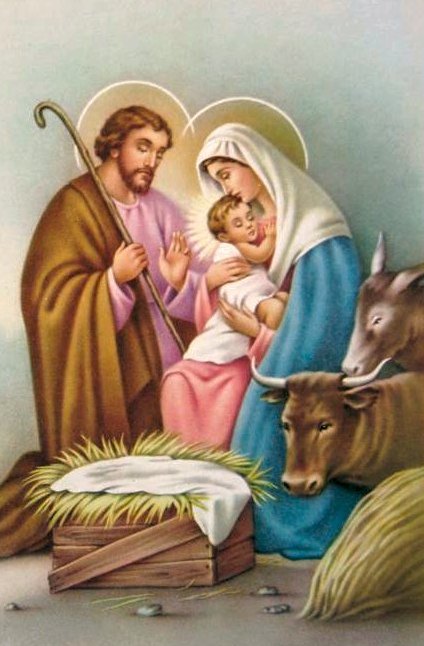
Two years ago, I was sitting in my parents’ church on Christmas Eve when the priest, Pastor Kit Carlson, blew my mind. In her sermon, she suggested the idea that Jesus was not born in a lonely stable, but rather in a house full of extended family. Apparently, when Luke writes in his Gospel that “there was no room at the inn,” the word he used for “inn” was actually kataluma, which is more accurately translated as the guest room, or the upper room. And he’d used a totally different word for “inn” later on, when talking about the Good Samaritan, indicating that he wasn’t talking about an inn when he said Mary and Joseph couldn’t stay in the kataluma. The couple was returning to Joseph’s ancestral home for the census, after all; it is more likely than not that he had many relatives in town. Surely those relatives were ready to squeeze in and make room for Joseph and his very pregnant wife, and since there was no space available in the guest room, Mary and Joseph settled down in the main room on the first floor of the house. The homes of the time and region had a split-level first floor, with one side reserved for the humans and the lower side reserved for the animals. There was a gap in the wall between the two, and straw was placed here for the animals to eat. So Mary goes into labor, the women of the house gather ’round to help with the birth, and when Jesus arrives, he is indeed “wrapped in swaddling cloths and laid in a manger” — it’s just that the manger happens to be in the family home, rather than in a cold outdoor cave or stable.
JUMP BACK. What?

This family picture was photoshopped
This could really change how we think about Jesus not just as the son of God (however you may feel about that), but also as a human, someone who was part of a larger family from his very first breath. As Pastor Kit said, “Jesus was not born into a simple nuclear family. Jesus was born into a clan… And this was how God chose to come into the world.” Obviously the Christmas story is one chock-full of symbolism, whether that symbolism indicates to you a larger truth or not. What does the symbolism of the traditional story say to us as opposed to this new view?
The usual way of looking at the story has Mary and Joseph as social outcasts, their only visitors people driven to the stable by supernatural forces. Only a few special people noticed how special Jesus was, and everyone else was cruelly indifferent or outright hostile to him and his parents. He had a hard and lonely road laid out for him, and that was clear from the start.
But if we look at the story from this new perspective, everything changes. Sure, the family still flees the country because King Herod is after them, but other than that, his parents are not rejected or treated badly. Jesus isn’t born into an uncaring world, but rather one full to bursting with extended family (all of them likely sharing conflicting advice with Mary the moment he pops out). His life path is still a difficult one, but the man who preaches love and peace for all humankind might have believed in these concepts more deeply based on a childhood full of both.
Perhaps Jesus’ extended family bickered a lot, or perhaps they got on well with one another. Maybe they blamed Mary for becoming pregnant before her wedding to Joseph or maybe they accepted the story that Jesus was a premie. The family might have been close or only seen each other once in a blue moon. Regardless of the exact make-up of the family, if they were there at Jesus’ birth and the days that followed, they were an important part of his early life. No matter what kind of family we’re born into, there’s no denying that they shape us, and now we can see how this might have been true for Jesus too.
Welcome to the world, kiddo! Here’s your family
A final note: Not to get too political (not that that’s a surprise on this blog, eh?), but I also think Jesus born into a large family can have implications for Americans in particular. Christians throughout history have clung to the idea of their persecution in the early days of the faith, and there are varying degrees of accuracy to that. However, the religious right in America is steadfast in the belief that this applies to contemporary America and themselves all the time. They seem to truly believe that they are being persecuted for their beliefs, despite the fact that Christianity is overwhelmingly the dominant religion in this country, and God is mentioned in our Pledge of Allegiance, our presidential oath, etc., not to mention you can’t get elected in this country without swearing up, down, and sideways that there has never been a more devoted follower of Jesus than yourself. Despite the fact that it’s non-Christians who continue to bear the brunt of intolerance, the religious right remains convinced.
I’m not saying there’s a direct line between the nativity and this false belief, but think about it: In the traditional story, Jesus and his family are turned away from inn after inn, ignored by their neighbors, and chased out of the country by a ruthless leader intent on their destruction. Jesus is all the more special because only a few recognize his specialness. Too much time focused on how special you are as compared to everyone else, and you can start to treat everyone else badly, which let’s face it, the religious right is really good at doing.
Okay, I know I’ve lost some of you here, and granted, it’s not the most well-thought-out theory, but man, they get so angry and exclusive, despite all Jesus’ actual teachings. They talk about a human family, but they make that family smaller and smaller — no gays, no non-Christians, no powerful women, no one too different from a narrowly defined category.
What if they thought of Jesus being born into a large, loving family instead? What if many people witnessed the birth and celebrated it? What if instead of being a misunderstood prophet from the start, Jesus was an appreciated addition to the family, despite the odd signs and portents surrounding his conception and birth? What if Jesus’ problems with fitting in only came later, and in the beginning his family accepted him for who he was and what he meant to them? What an inclusive way to view the virgin birth. What a wonderful way to start a story.
American Christians, instead of feeling put-upon and misunderstood, can look at this story and see a new way to view their current situation: just like all of us, they are born into this large, loud, extended family of humanity, and just like all of us, they can grow up and give back to this weird and wonderful family with love and joy. Just like Jesus.









 Stowaway Travel Writing & Editorial Services