Guest Post — Tourist/Non-Tourist

Dearest fellow travelers, it gives me great pleasure to introduce a guest post from Sessily Watt, a good friend and fellow K alum. A few weeks ago, she and I were discussing the comments on the Great Expectations post, and about what it means to live in a different country rather than simply visit it for a short time. Sessily is a writer living in Chicago, and her post reflects on her time spent living in Ecuador in 2005. Enjoy!

*********************************************************************************************

We were standing on a sidewalk between several medical buildings, in the middle of a tour of a small hospital in Ecuador, when the woman approached us. (Or maybe she was our guide through the buildings, and it was at this point that she asked us about who we were. Time has passed. The memories have shifted.) After a flurry of conversation she was under the impression that some or all of us were medical students, and offered for us to come and observe a birth that was happening at that very moment. She led us back through the buildings to the doorway to the delivery room, where it became clear that observing a birth meant all ten of us (nine students and one of our program directors) crowding into the delivery room and its doorway. Four of us had already felt uncomfortable as we approached the room, and our discomfort increased. We waited a moment, but it was soon clear the rest were planning to stay and watch, so we left them there, walked out of the building, through the waiting area where the pregnant woman’s family was waiting, out the front door to a set of benches in front of the building. We sat down.

Out on the benches, we were split again by the cause of our discomfort. Two, male, were personally uncomfortable with watching a woman give birth. Two, female, were uncomfortable that we had been welcomed into that room without permission being asked or granted from the woman who was lying on that table with her legs spread. Our fellow students were back in that room, with their cameras out. We waited.

The nine of us had been together in Ecuador for five months at this point. One of our program directors, who was with us that day, had led us on three previous trips as a group. We had already passed through that stretch of time where we got on each other’s nerves, and now we were a more or less cohesive group. The people who chose to stay in that delivery room and watch the birth were (and are) perfectly nice, lovely people. I enjoyed traveling with them. But I judged them for staying in that room.

Traveling, especially as a tourist to another country, can lead to a sense of entitlement to see anything and everything. In my opinion, the people who stayed in that room were acting out that entitlement. They weren’t medical students. Their presence served no purpose for the woman lying on the table. They were simply there to see what it was like. (In the case of at least two people, who have since gone on to medical school, I can see how this experience was edifying. And, who knows, maybe in some way it will prompt them into actions that improve the delivery of medicine, etc etc, but those benefits move us further and further away from that woman on the table who was not helped by them and who did not give her consent for them to be there.)

A study abroad program like the one in Ecuador is designed to encourage students to take part in society as if they aren’t tourists: we lived with host families, attended an Ecuadorian university, and ended the program with an internship/volunteer position in an Ecuadorian organization. One would hope these experiences would lessen that feeling of entitlement to see everything. To a certain extent, we lived in Ecuador for six and a half months, rather than traveling there. Especially during my last month in the country, volunteering at an organization where I worked with Ecuadorians, Germans, and French, I felt like I had found a niche for myself. I woke up in the morning, rode the bus for eight stops, picked up a copy of El Comercio from the newsstand, and walked three blocks to the corner building where the organization had a series of rooms on the second floor. Sometimes I went to lunch with my coworkers, sometimes I walked to a sandwich place that was nearby. My coworkers and I tutored kids in the afternoon. Some afternoons I was bored, others I was outraged, or sad, or content. In the evening, I visited with my host family for a little while before I went to bed. Some nights I went out. By living in Ecuador I learned that I enjoy large cities, can’t imagine living without public transportation (though I grew up in a small town without it), and when I’ve moved to a new place I feel anxious about leaving home until I get out and walk around, take a bus or two, and maybe get lost. Without living in Ecuador, I may never have considered moving to Chicago.

La Casa Amigos, where I volunteered during my last month in Ecuador

But no matter how well designed, a study abroad program couldn’t make us Ecuadorian, and the trappings and support of the program at times increased the feeling of being a tourist. When we went on the program-designed trips, we traveled in our own bus, a little bubble of pirated American movies and Seinfeld episodes. There were always nine of us to compare to all of them, emphasizing our differences. Like any other tourist, we were there to see the country, to experience those cultural differences we heard about in our pre-trip lectures. Perhaps even to “broaden our horizons.” Yes, there are real benefits to exposing ourselves to differences–not to mention that it can be a lot of fun–but that focus on cultural differences, in combination with other factors, leads to forgetting that those people aren’t there to open themselves up for us to examine.

the bus we traveled around in for our program trips

Every traveler has a different line they draw in how far they will go to experience it all. The other students in my program didn’t feel uncomfortable with their experience in the delivery room. The doctors were fine with their presence. The woman supposedly thanked them after it was all done (cynically, I ask, “Did she even know why they were there?”). As a very private person, I imagine that my line comes much earlier than others. By not staying in that room, I may have missed out on an amazing experience. I’m willing to imagine there are other instances where, if I had been willing to press a little harder, to dig in a little more, I might have had other theoretically amazing experiences. But.

I traveled by myself once while I was in Ecuador, right at the end of my time there. Throughout that trip, I often felt different from the people I was with, and like I didn’t belong. But it was during that trip I felt the least like a tourist. I wasn’t there to see the sites. I wasn’t there to see what life was like in this coastal city. I was there to visit a specific person, because I thought I would regret it if I didn’t visit her. It was in those moments when I was living my life and just happened to be in a country different from the one I grew up in–traveling by myself, volunteering–that I felt like I had the clearest glimpses of Ecuador.

Great Expectations

And now, dearest fellow travelers, for the flip side of the coin. Last week I talked about how great it is when you go somewhere new and it’s better than expected. I didn’t mean that I go to new places not expecting to like them, but that I sometimes have to overcome some preconceptions to really appreciate them. Also, when you’re visiting a city for the first time, it’s hardly unusual to feel some trepidation at what you might find there, and the nervousness mixes up with the excitement until you have a little knot of energy in your stomach, making you kind of nauseated and kind of buzzed at the same time.

At least, this is what I experience when I’m visiting a new place, and I feel this regardless of whether I’m visiting for a few days or staying for several months. When I physically approach a place that I’ve previously only known through pictures, guidebooks, and secondhand stories, my whole body vibrates with the sensation of moving from the familiar to the unfamiliar and also from the unfamiliar to the familiar — from my home to a new place, but also from not being personally connected to this place to being bodily in and of it. I love that feeling of being on the edge of knowing the unknowable, of reaching out to touch the as-yet-nonexistent with your fingertips, crossing over from plans of the future to realities of the present. This is one of the biggest thrills of travel, and I have yet to tire of it.

Some people, however, freak out at the whole idea. My junior year of college, I lived in Rome for 5 months and studied classical history, archeology, and Renaissance art. I approached those months with a jumble of feelings, but the overriding emotion was excitement. I couldn’t believe I was living in this place, which was simultaneously a living monument to history and a bustling modern city. My roommates, on the other hand, couldn’t believe they were living in this dirty, noisy, badly run city, and they commented on it almost daily.

The Pantheon in Rome, Italy

K College has several very good study abroad programs, but Rome is not one of them. They don’t run it; it’s farmed out to the American University in Rome, which is kept busy bringing in students from a lot of different schools. The 16 of us from K got lost in the shuffle — we lived with each other in small apartments, we didn’t speak any Italian, and we had no class trips or on-site director (unlike programs in most other countries). So we weren’t a cohesive unit by any means, but still, we were all there because we were in the Classics department back home, so that was a kind of place to start.

But it was apparent in the first week alone that I had a very different idea about living in Rome than my roommates did. The five of us weren’t friends before living together, and I don’t think any of us went home very close, so on top of the stress of starting a new school and living in a new country thousands of miles from home, we all added the stress of living in close quarters with virtual strangers. At first, it was like freshman year all over again; we’d go places in groups with the other K kids, who were rooming together in various combinations, and we’d stay up late talking and drinking cheap wine (the difference from freshman year — cheap here meant literally one or two euros). Conversation ranged from the people we’d left behind to the professors and students we were just coming to know, from assignments on ancient sculptures to how to ask for chicken at the supermarket. But somehow conversation always morphed into complaints. I was astonished to learn that my roommates and fellow students of the arts thought Rome was a pit.

They complained about how dirty it was, with graffiti all along the walls of the city and dog poop up and down its sidewalks. They whined about how noisy it was, with nonstop traffic (we lived just up the street from a hospital and became very familiar with the yowl of the Italian ambulance) and inefficient buses. And the buses! Don’t get them started on the buses. They were never on time, they didn’t seem to follow any reliable route, and you practically had to flag them down like a taxi just to get a ride. The people were unfriendly, the clothes were expensive, the streets were labyrinthine, the monuments were rundown, the food wasn’t as good as the Italian places back home… It went on and on and on.

I discovered potato and rosemary pizza when in Rome, and I'm a better person for it (doesn't seem to actually be pictured here, but these Roman style pizzas are also as good as they look)

Why on earth did they go to Rome in the first place? I’m still not entirely sure on that one. When I asked them, they said they wanted to go on study abroad like the rest of our school did, and they thought Rome would be cooler than it turned out to be. Each of them admitted to not really enjoying cities. Did they think Rome was a small, quaint town? It’s been a massive city teeming with life for literally thousands of years.

It seems that their expectations for Rome weren’t founded in fact or forethought, but rather in a vague idea of European cosmopolitanism and romantic stories of blissful honeymoons. This is the key — plan ahead! Now, before you accuse me of being a list maker and not a risk taker, let me say that yes, I tend towards that way, and it does irk me (but that’s a topic for another post). What I mean is that even if you don’t like to laminate an itinerary before heading out on your travels, you should at least do some preliminary research so you have a basic understanding of the place you’re going and the people who live there. I love hearing stories from fellow travelers, but I am always aware that we’re different people with different tastes, and their idea of fun people or good food is possibly not at all the same as mine. I’ll note down the restaurant and sightseeing recommendations and keep them in mind as possibilities, but not must-sees. Guidebooks, too, are written by people with individual tastes, budgets, and travel companions, but at least I can get an idea of the lay of the land and its history. From these, too, I get possibilities. Guidebooks, friends, blog posts, travel sites, library books, maps — I gather it all up and sort through it for my own interests, then head out to the unknown with at least these knowns in reserve.

I do think that you can have a different approach here for simply visiting a place for a few days. When P and I went to Memphis, we knew we were going to Graceland but we didn’t know anything about Beale Street, and we ended up at an all-ages bar watching a riotous rockabilly act. It was even more fun for being something I didn’t know ahead of time, and then we moved on. But if you’re going to be living in a place for more than a couple weeks, I don’t understand why you wouldn’t prepare yourself as best you can for the customs and people of the place you’ll be living.

This is not to say that I adjusted perfectly well and knew all about every Italian custom before moving there — not at all. In fact, the negativity of my roommates really affected me and I found myself in a weekslong funk, simultaneously resenting every nuance in culture between Italy and the States as well as my roommates for pointing out those nuances every damn day. But I did get out of that funk, and managed to make the best of a bad living situation, and it was actually thanks to those very same roommates.

The Italians take siesta, as do all Mediterranean countries, and in Rome, any time between 1 and 4, shops, offices, and restaurants close for a couple hours as all the workers take a nap from the midday sun. It’s a surreal experience, as an American, to walk down an empty street at 2 in the afternoon, passing shuttered shop after shuttered shop. And then at 4 or 5 they’re all back open for business for another couple hours. My roommates complained about this custom; when were they going to go to the grocery store? What if they got hungry? When were they going to buy school supplies? Why did the whole city have to shut down?

I fell into siesta quite easily; what is there to dislike about citywide naptime? The day I realized I could reclaim my own expectations of living in Rome and reject these false ones my roommates had, it was about 1:30pm and I heard the complaints drifting in from the living room as I climbed into bed. I pulled the covers over my head and thought, “Damn, if there is any time for this phrase, it is now: WHEN IN ROME. Good night!”

an approximation of my cot bed in Rome

P.S. Get excited! Comments on last week’s post about the difference between visiting a place and living there inspired this post, and also a forthcoming guest post from my friend S. Witness the power of your I’m-procrastinating-at-work-so-I’ll-comment-on-Lisa’s-blog energies!

Better Than Expected

Dearest fellow travelers, how often have you been obligated to do something that sounded dreadful, only to find yourself having a wonderful time? Or maybe it wasn’t even going to be dreadful, merely kind of dull, like a coworker’s wedding or your second cousin’s bar mitzvah, but the DJ played MIA and ABBA and other artists whose awesomeness requires that their names be in all caps, and the buffet had those tasty bacon-wrapped dates and slabs of Gouda (none of that cubed stuff), and you spent the night dancing with a highly attractive friend of the family who was very willing to share their hotel room with you at the end of the evening? In these situations, you might look back on the experience and conclude, “Well, that was better than expected.”

My mom is very fond of the phrase “better than expected,” and it’s become somewhat of a thing in our family to admit our pessimistic outlook was proved wrong and we were pleasantly surprised. Why, just a few weeks ago, when I was visiting EL, H and I went to a church party with our parents and had so much fun talking to people we hadn’t seen in months that we stayed an hour and a half later than we’d planned to. Better than expected.

When I went to New York City this past May, it was a classic case. I was, of course, immensely excited to visit my sister E, but that was separate from how I felt about visiting the city itself. See, I’ve had a bias against the East Coast for over ten years now, based on all the literature and movies that assume everyone is aware the Midwest is for uncultured oafs, and the only place to be, if you’re going to be anybody, is New York (followed by Boston or DC if you have to settle). Unfortunately, many of the people I’ve met from New York support this theory, and I can’t stand their smug superiority.

I’ll be damned if people are going to tell me my city is second rate to any other, especially a city as overblown and overdone as New York. People in New York are proud to be assholes to tourists, whereas people in Chicago might get annoyed at having to point out the Sears Tower over and over, but we’re still going to say excuse me when we bump into you on the street. Everyone in theater knows that there are two towns for theater in the US — New York and Chicago. New York has a giant park and a dirty ocean, but Chicago has miles of park running alongside a lake you can actually swim in. Bands might move to New York when they need to cut a record deal, but they’re just as likely to record that album in Chicago. And if you’re a hip hop act, Chicago is the place to be. If you want to eat at one of the hot restaurants in New York, you have to make reservations before the place even exists. In Chicago, I’m pretty sure I could get a reservation at Alinea or the Publican a week or two out, and in the meantime, there’s Kuma’s Corner. Chicago has the perfect combination of Midwestern manners and big city excitement, and I honestly don’t want to live anywhere else for at least a few years.

Oops. I got off on a tangent there. But that’s exactly what I mean — I get so defensive about Chicago when I’m talking to East Coasters, and New Yorkers in particular. Of course I still wanted to go to New York. It’s not that I think there’s nothing special about the place, or that it’s inferior to Chicago, or that I wouldn’t enjoy myself. Not at all! New York has many unique sights and a fascinating history. That’s what I had to keep reminding myself as I prepared to go there. I had a mental block about the people I’d meet and the city’s relation to my city, but if I could just get past that, there was a world class city waiting for me.

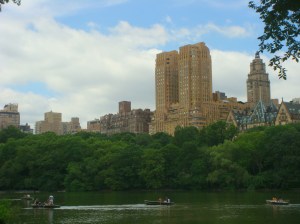
Indeed, I had a wonderful time. Granted, E introduced me to her friends, so everyone I met was friendly, but I was kind of expecting to get straight up shoved into the street for walking too slowly on the sidewalk, and that did not happen. I was also fairly confident that I’d get “tourist” hurled at me as an angry epithet when I stopped to take my 400th photo (in five days. not kidding.), but instead, I was twice stopped for directions from other tourists who took me for a native. And the sights did not disappoint. I am a firm believer in seeing lots of tourist sites when visiting a new place, since you never know when you’ll be back, and there’s usually a reason something got famous enough to be a tourist destination in the first place. Accordingly, I packed it in: Empire State Building, the Metropolitan Museum of Art, Staten Island Ferry, Central Park, Greenwich Village, Little Italy, Chinatown, a show on Broadway, Times Square (for ten bewildering and terrifying minutes), the Modern Museum of Art, and even Coney Island when my return flight was delayed by several hours.


Central Park

Central Park


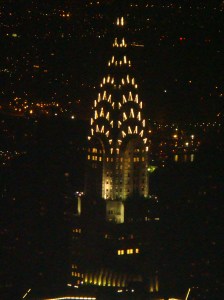
Chrysler Building

Chrysler Building from the top of the Empire State Building

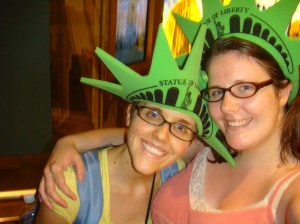
The Classy Tourists

as touristy as possible, and mighty happy


What’s that? Okay. Yes. I’ll admit it, and gladly. New York was better than expected.

Redrawing the Maps

Two weekends ago, I went up to Michigan to visit some friends and admire the autumn colors. I went to the Barking Tuna Fest in Kalamazoo on Friday and walked around Lake Lansing North on Saturday. I grew up in East Lansing and went to college in Kalamazoo; I go back to visit my family five or six times a year, but I haven’t been to Kalamazoo in a couple years. I have some complicated feelings about my four years at Kalamazoo College, and no strong affection for the city. So when the train pulled into the station that Friday, I was a little unsure how I’d like it.  Would I see the city as it was, or as I remembered it?

Lake Lansing North

Lake Lansing North

I have maps of all kinds tacked up to my walls at home — subway maps, walking maps, maps of the world. I think of my relationship to any given place in terms of a map. I see the layout of the place, major landmarks, and a “you are here” star for myself. I like to be oriented in time and space, and maps are the perfect way to do that; they anchor you in a place, but only as that place was conceived by the mapmaker at the time it was made. A map is an artifact and only a guide — just because it’s been printed with in ink and paper doesn’t mean it has marked the landmarks you need. Your reading of the map is what fixes you in time and space. When I run one finger down a street and another finger along the cross street, I pinpoint myself at that place at a time of my choosing — either in memory, or in a daydream about the future, or in the here and now.

As I walked down a rainy Kalamazoo Ave last week, I was thinking about the night before, when I’d met up with some friends at a bar in Chicago, but the act of walking down that street brought to mind other thoughts, memories of trekking out to Bell’s or Kraftbrau for a rare night out during college or driving back into town after a weekend at my then-boyfriend’s place. Being in the physical space that I used to call home didn’t throw me back into that older time, more like they just layered on top of one another. I was 26 and visiting a friend for the weekend, but I was also 19 and venturing downtown for the first time, and I was 21 and going to see my English professor and her husband in their rock band, and I was 22 and amazed that it was time to leave town. The memories and attendant emotions layered on top of one another like onion-skin paper maps laid carefully one over the other, the old feelings of newness and vulnerability running in shaky pencil under the steady brushstrokes of confidence and age.

So I saw the city both as it was and as I remembered it, and I suppose this is true of any place that was once familiar and is now a travel destination. No wonder people get anxious about going home for the holidays; that’s years of maps layered one on top of the other, a lifetime of landmarks lost, wrong turns taken, street names changed over to honor new heroes. Orienting yourself in the vast time and space of a place you knew so well is a dizzying task. For those with unpleasant or seriously complicated memories of home, it’s not even a welcome one. Sometimes it’s easier to spin a globe and stick a finger on it at random. “Here. Let’s go here. I’ve never been here before. I don’t even have a map for this place.”

Still, I’ll continue to go home for the holidays and I’ll probably visit Kalamazoo again in the next couple months. It’s partly the place and partly the place as I know it through people. The love of my family and friends draws me daily, but I see them all too rarely. When I do visit home, however, all sorts of maps get pulled out and re-drawn. There are hundreds of spots all over town that signify whispered secrets, blowout fights, midnight moonlight dances; a joint snuck behind the pine trees here, a naked encounter with the cops here.

One swing set at the park near my parents’ home reminds me of: the day we moved to Michigan from Illinois and my sisters and I had to play at the park but I really had to go to the bathroom and I was sure I’d pee in front of all these kids who were about to be my classmates; the weekend my three surviving grandparents and six aunts and uncles flew in for my sisters’ birthday and the whole family went on a glorious walk of silliness in which my grandpa did pull-ups and my mom walked on the balance beam with me; prom night junior year, when my friend K and I were the only ones without dates, so we dressed up and ran around town golfballing people’s houses and having a whole lot of fun; the night I pushed my curfew past its breaking point by staying up til 6am in the back of T’s station wagon in the parking lot of our elementary school playground; and the night, not long after T had broken up with me and I had graduated from college with no plans, that I sat on a swing right here on this swing set and sobbed at 2 in the morning, feeling more lonely and lost than I ever had before. One swing set.

Of course, on this last trip home, I saw that they’ve torn down that particular swing set to put up a plastic one. I was disappointed, and it’s harder to draw up memories without the physical reminders, but really, none of the maps are gone. They’re just redrawn.

Dark Moments on Pitch-Black Roads

Entirely too many words have been written about America’s love affair with the open road. Some of the these words are pretty damn decent (Blue Highways and, yes, On the Road) and some are self-important “journeys of the soul” (I hope these quotes indicate how little I think of that phrase). So I won’t add too many, just enough to say that I, like every red-blooded American, find a distinct pleasure in turning up the radio and heading for points west in my very own gas guzzler.

P and I lived this dream in 2002, of course, and although we would both do it much differently now, I think we fared well on that trip. We were pretty good at balancing joint activities with solo ventures, and we weren’t bad at compromise.

One thing I didn’t compromise on too well was speed. P is a cautious driver, and while I wouldn’t consider myself reckless, I do take to heart my dad’s (certified driving instructor!) advice to take the speed limit as a minimum, except in inclement weather. I had the most fun with the gentle ups and downs of US-95 through the desert of Nevada, and with the serpentine twists and turns of Highway 1 on the California coast. P, I’d like to apologize again for shaving about three years off your life on those roads — but hey, at least it wasn’t as bad as that railroad crossing in Idaho, right? Yikes. (As of this writing, P is still speaking to me, but never in a moving vehicle.)

If you’re prone to flashbacks, P, read no further. This past March I went to California for a week’s vacation. I visited my friend J in the Haight in San Francisco, then rented a car and took Highway 1 down to Los Angeles. What was meant to be a leisurely exploration of the coast ended up being a frantic experiment in just how fast I could take stretches of pitch-black asphalt curves without ending up in a dazzling explosion on the rocks of the Pacific.

(I should add that any romanticism inherent in this type of adventure was severely undercut by the fact that the first car I ever rented turned out to be a PT Cruiser — the one that looks like a bowler hat. Unsexy.)

Still, it was just me, my car, and that breathtaking expanse of rolling blue water, and all was right with my world. It was a beautiful day, the sun shone on the ocean, spring flowers were blooming all along the road, and I was in high spirits. I’d planned to drive from San Francisco to San Luis Obispo, stay the night in a hostel, and complete the other half of the drive to LA. This is where I should have done more planning and investigation — not usually a problem for me. Usually, I write an itinerary including time slots for each event/place visited. It’s laughable, sure, but I’ve learned it’s what often works for me. But on this trip, I decided to be less strict. See the coast, take pictures, sleep, repeat. I found out, however, that the SF-SLO leg of the trip is not only twice as beautiful as the SLO-LA leg (half of the latter is inland and the rest is in traffic by rich houses in Malibu), it also takes twice as long.

very pretty

very pretty

not nearly as pretty

not nearly as pretty

I had to be at the hostel at 10pm or they’d lock me out and keep my $25. This was March, so the sun started setting at 7pm, which put me three hours in the dark. As I sped merrily along on the increasingly empty road, I admired the sunset, oblivious to my time/distance problem. But when the sun dipped below the horizon, I pulled over to take a picture and consulted my map.

Well, shit. I had 92 miles to go and 3 hours to do it in — easily doable on just about any road in the States but this one. The charming curves of Highway 1 demand you keep to about 30 mph. Basic math says this is cutting it very close. Also, there were about two gas stations between me and my destination.

Suddenly, my relaxing solo ramble turned into an intense, exhausting race. I wished for a companion — so I could switch off driving and rest, but also so we could consider pulling over and sleeping in shifts for safety. Rarely in my travels have I felt so alone and vulnerable as I did that night, and I started to feel foolish, a woman alone in the dark. I couldn’t pull over by myself and spend the night in my car. That’s how people get attacked, right? I’m still not sure I’m that untrusting of the world, but at the time, I was in a feverish state and not really able to rationally weigh pros and cons. I couldn’t evaluate just how bad things were or were not, because I was fixated on making it to the hostel by 10.

The minutes ticked by, the radio only tuned into one station (talk radio, which I can’t abide), and I felt a little desperate. It was now totally dark, I was the only car on the road, and holy hell did I have to pee. I’d already passed Big Sur, so that was one of the two gas stations gone, and the other one wasn’t showing up nearly soon enough. Finally, I pulled over at a lookout, at what must be a magnificent vista in daylight, walked to the edge of the cliff, and popped a squat.

Apologies, dear readers (especially parents, other relatives, and past and future lovers) for using my fourth blog entry to discuss pissing in the ocean, but it was the turning point in my night. After I used the one napkin I could find in the car and put myself back together, I looked out at the sliver of moonlight slicing across the waves, and I said to myself, “Well, Lisa, it sure was stupid not to have planned this better, and you sure did come close to falling apart earlier. But your mind and body are still in working order, your car has enough gas to get you to the next station, and you just peed off the edge of a cliff rather than insist on waiting for a bathroom. I’d say you’re fully prepared for any and all eventualities. And admit it, you like proving your self-sufficiency like this.” Okay, I admitted it. I like the challenge of taking discomfort on the road and turning it into a triumph, or at least a good story. And if I had been traveling with someone, they likely would have pushed me off the cliff by this point for such poor foresight, so it’s just as well no one was there with me. I decided that if I didn’t make the hostel in time, it wouldn’t be the end of the world; there are motels and I’d just have to eat that $25. I didn’t have to wait for an appointed bathroom to pee, and I didn’t have to stick to the original plan if it simply wasn’t going to work. (As it turned out, I did make the hostel in time, and slept soundly all night, but that seemed almost incidental by that point.)

I got back in my car and sang loudly to myself, careening around corners with just enough control to keep on the right side of the glimmering yellow double lines, and just a few feet away, the waves continued to crash in rhythm, steady and alluring as rubber on the road.

The Plan, In Sum

Travel the world. The end.

Okay, a slightly more detailed summary: Take my paltry savings and two years, and travel around much of the globe, on my own and ready to make friends.

Still not enough? All right. The summer after I graduated high school, I took my money from working in a second-run movie theater and the cafe of a local bookshop, and went to Europe for six weeks. This mini-Grand Tour was a solo affair and a revelation in self-sufficiency and finding happiness in independence. The summer after my freshman year of college, my friend P and I borrowed P’s mom’s minivan and drove around the Western part of the U.S. for five weeks, figuring out how to travel together and still be good friends at the end of it. (That worked out just fine, by the way.)

So I’ve long been a fan of taking extended, multi-stop trips, and by the time I graduated college, I’d decided to travel the world. Several people have suggested various ways of accomplishing this goal, including doing it in many mini-trips, working with a volunteer organization, and going on a group tour. Thing is, I want to be moving, not vacationing, so I need a long period of time, and the thought of paying for a package tour running around the big tourist stops with my drunken peers is not appealing. I’d like to volunteer with various organizations, and there are some good ones out there, but most of them require you pay a fee, so that won’t work for the whole trip.

It comes back to me, a backpack, and the very necessary spirit of adventure. I’ll happily meet up with friends along the way, so if you have any place in particular that you’ve always wanted to visit, or if you’re fluent in any of the languages of the countries I’ll be visiting (please!), let me know.

For now, the idea is to go to New Zealand/Australia in January of 2013, then work my way up Southeast Asia, Central Asia, Transiberian Railway to Moscow, Eastern Europe, Western Africa, South Africa, and India. Back to the States to make a bit of money, then down to Central and South America, and possibly Antarctica.

All of it’s changeable, except the date of departure. I turn 30 in 2013, and I’ve said since I was 18 that I’d start this trip before I was 30, before I started to settle down, move up in a career, or feel tied to a particular place. Life isn’t over when you’re 30, but if you’re not careful, the urge to try new things and become a different and better person is. So winter of 2012/2013 it is!

The Questions

This blog will generally be a travel blog, but there will probably also be posts on music, books, and the hilarious misadventures of my life in Chicago. I’m opening this up to the (what I’m sure will be tiny) public so we can exchange ideas, tips, ruminations. Do you write about travel–why, and how, and for what audience? Do you travel a lot–what kind of trips do you take, how often, with others or by yourself? Got practical tips and advice, a funny story, or a rambling reflection on why we do what we do? Have a follow-up to something I’ve written? Please share.

Without further ado, here are the big questions I’m pondering:

Why travel? Why write about traveling? How do I answer these questions without diving into the murky waters of self-importance and clichés?

Okay, so maybe I don’t answer those questions, or at least not right away. But it’s time to start considering them in a serious way, and to start writing about what I figure out, because it’s T minus three years from my trip around the world, and I’m not going to set off on a trip I’ve planned for 10 years without feeling confident that I’m ready for it. And by ready for it, I mean ready for the adventures, the mundane details, and my sincere involvement with the people I meet and the places I go. I don’t mean ready in the sense that I’ll have plenty of money or have every minute of my itinerary planned—that’s ridiculous and sad (okay, not the money part; that’d be kickass). I mean I want to be prepared for anything, because that’s what’ll happen. I mean I want to be prepared to change a bit, because that’d better happen. I mean I want to be prepared to engage with people in a real way, and not simply check places visited off my list, because being fully engaged is the best that can happen.

I’m starting to read some travel blogs and travel writing tips websites, and I’ll check some books out of the library. Let’s see what the pros do, what the dedicated amateurs do, and where I might fit in. There are many ways to cock it up, but some quick notes to self: My viewpoint is central to my life and no one else’s, so I shouldn’t discount any of my own emotions or thoughts, but I’d sure as hell think twice before expressing them in person or in print, to make sure that they have value for others. Even though I can get very list-oriented and methodical, I enjoy my spontaneous moments and need to leave plenty of room for them on my travels. This also means that I need to shift some of my thinking from checklists (“where are you going?” “Australia, New Zealand, Indonesia…”) to a compilation of experiences. How do I write about my own travels as a privileged white American woman in this world without falling into the traps of racism, classism, nationalism, etc.? How do I travel without falling into those traps? How do I travel in a conscionable manner, giving something back to each place I visit, without getting a bit noblesse oblige? How do I expand my own horizons without making it all about me, and how do I make my writing reflect that?