Two weekends ago, I went up to Michigan to visit some friends and admire the autumn colors. I went to the Barking Tuna Fest in Kalamazoo on Friday and walked around Lake Lansing North on Saturday. I grew up in East Lansing and went to college in Kalamazoo; I go back to visit my family five or six times a year, but I haven’t been to Kalamazoo in a couple years. I have some complicated feelings about my four years at Kalamazoo College, and no strong affection for the city. So when the train pulled into the station that Friday, I was a little unsure how I’d like it. Would I see the city as it was, or as I remembered it?

Lake Lansing North
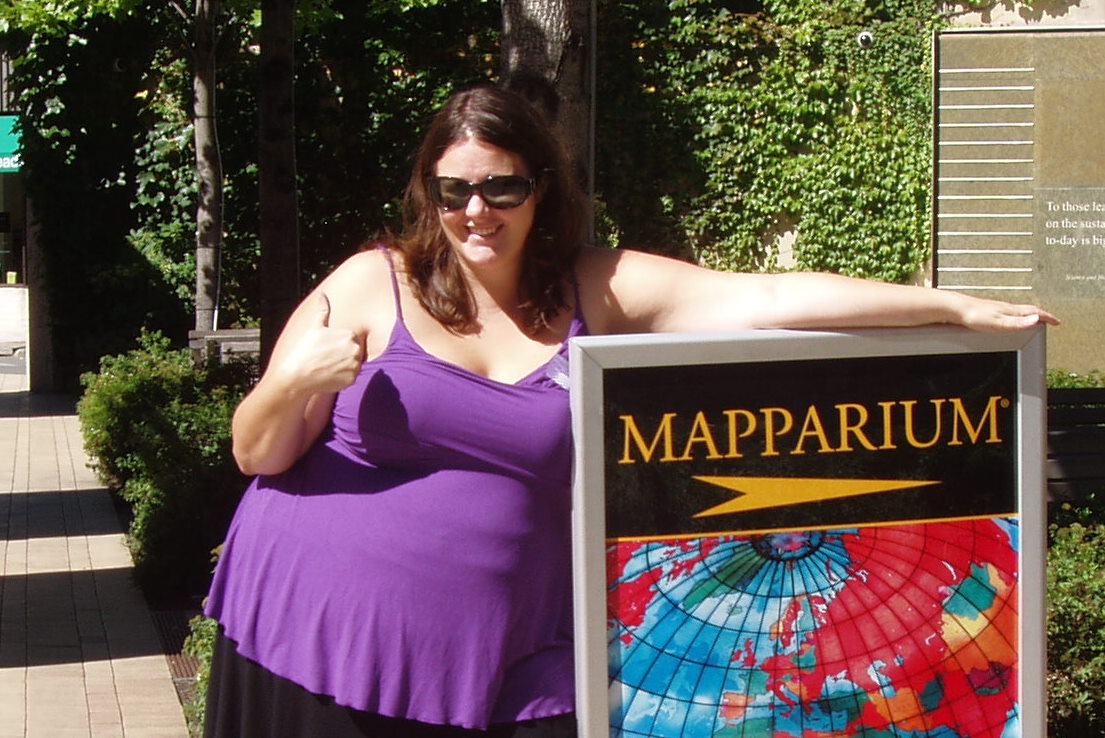
I have maps of all kinds tacked up to my walls at home — subway maps, walking maps, maps of the world. I think of my relationship to any given place in terms of a map. I see the layout of the place, major landmarks, and a “you are here” star for myself. I like to be oriented in time and space, and maps are the perfect way to do that; they anchor you in a place, but only as that place was conceived by the mapmaker at the time it was made. A map is an artifact and only a guide — just because it’s been printed with in ink and paper doesn’t mean it has marked the landmarks you need. Your reading of the map is what fixes you in time and space. When I run one finger down a street and another finger along the cross street, I pinpoint myself at that place at a time of my choosing — either in memory, or in a daydream about the future, or in the here and now.

As I walked down a rainy Kalamazoo Ave last week, I was thinking about the night before, when I’d met up with some friends at a bar in Chicago, but the act of walking down that street brought to mind other thoughts, memories of trekking out to Bell’s or Kraftbrau for a rare night out during college or driving back into town after a weekend at my then-boyfriend’s place. Being in the physical space that I used to call home didn’t throw me back into that older time, more like they just layered on top of one another. I was 26 and visiting a friend for the weekend, but I was also 19 and venturing downtown for the first time, and I was 21 and going to see my English professor and her husband in their rock band, and I was 22 and amazed that it was time to leave town. The memories and attendant emotions layered on top of one another like onion-skin paper maps laid carefully one over the other, the old feelings of newness and vulnerability running in shaky pencil under the steady brushstrokes of confidence and age.
So I saw the city both as it was and as I remembered it, and I suppose this is true of any place that was once familiar and is now a travel destination. No wonder people get anxious about going home for the holidays; that’s years of maps layered one on top of the other, a lifetime of landmarks lost, wrong turns taken, street names changed over to honor new heroes. Orienting yourself in the vast time and space of a place you knew so well is a dizzying task. For those with unpleasant or seriously complicated memories of home, it’s not even a welcome one. Sometimes it’s easier to spin a globe and stick a finger on it at random. “Here. Let’s go here. I’ve never been here before. I don’t even have a map for this place.”
Still, I’ll continue to go home for the holidays and I’ll probably visit Kalamazoo again in the next couple months. It’s partly the place and partly the place as I know it through people. The love of my family and friends draws me daily, but I see them all too rarely. When I do visit home, however, all sorts of maps get pulled out and re-drawn. There are hundreds of spots all over town that signify whispered secrets, blowout fights, midnight moonlight dances; a joint snuck behind the pine trees here, a naked encounter with the cops here.
One swing set at the park near my parents’ home reminds me of: the day we moved to Michigan from Illinois and my sisters and I had to play at the park but I really had to go to the bathroom and I was sure I’d pee in front of all these kids who were about to be my classmates; the weekend my three surviving grandparents and six aunts and uncles flew in for my sisters’ birthday and the whole family went on a glorious walk of silliness in which my grandpa did pull-ups and my mom walked on the balance beam with me; prom night junior year, when my friend K and I were the only ones without dates, so we dressed up and ran around town golfballing people’s houses and having a whole lot of fun; the night I pushed my curfew past its breaking point by staying up til 6am in the back of T’s station wagon in the parking lot of our elementary school playground; and the night, not long after T had broken up with me and I had graduated from college with no plans, that I sat on a swing right here on this swing set and sobbed at 2 in the morning, feeling more lonely and lost than I ever had before. One swing set.
Of course, on this last trip home, I saw that they’ve torn down that particular swing set to put up a plastic one. I was disappointed, and it’s harder to draw up memories without the physical reminders, but really, none of the maps are gone. They’re just redrawn.



 Stowaway Travel Writing & Editorial Services