
S-21: A Place of Learning Becomes a Place of Torture

Every totalitarian regime has an apparatus for maintaining control: trusted government officials and spies, torture facilities to get information from those the spies turn in, secret prisons to stash uncooperatives away. Every totalitarian regime finds that the paranoia this system engenders results in the very same officials and spies who turned people in being themselves brought in on charges of sedition. If your government is run on fear, that fear is going to turn against the government and the people who work in it.

S-21

S-21

Pol Pot’s Khmer Rouge regime was no different. Pol Pot and his top advisers, including Comrade Duch, set up prisons throughout the country. I visited S-21, a high school that was converted to Security Prison 21, now called Tuol Sleng, which apparently means “Hill of the Poisonous Trees” or “Strychnine Hill.” Unlike the killing fields at Choeung Ek, S-21 wasn’t torn down during the liberation. Instead, it looks like the prison was left exactly as it was when the prisoners were freed. The bed frames sat at an angle in the center of the floor, the doors creaked on the hinges of the wooden barracks built in classrooms. The floors were dirty and the walls covered in grime and what was probably dried blood. It’s like the prisoners who were here only just left. History as recent as yesterday. Ghosts in every room.

S-21 in Phnom Penh, Cambodia

One of the prison rooms

One of the prison rooms

S-21 is a complex of buildings. Most of them were open to the public but unlabeled, and only a few had placards explaining what went on in there. One building had thin metal frame beds, small lockboxes used as chamber pots, and shackles along the wall. Another building had cells made of wood on one floor and cells of brick on another. They were tiny, barely big enough for me to stand in, and I don’t think I could stretch out my legs if I sat on the floor. The cells were built as the regime brought in more and more prisoners, accusing more and more people of crimes against the state. They needed room to put them.

Wooden cells

Wooden cells

Bricked-up cells

Bricked-up cells

Some rooms were emptied of artifacts and filled with fading posters explaining who the leaders of the Khmer Rouge were and what the status of their trials was as of 2011. So far, Comrade Duch is one of the only ones to be convicted of war crimes. The posters included snippets of communication between the top Khmer Rouge officials and their families; these letters were filled with rants against capitalists and those who opposed the regime.
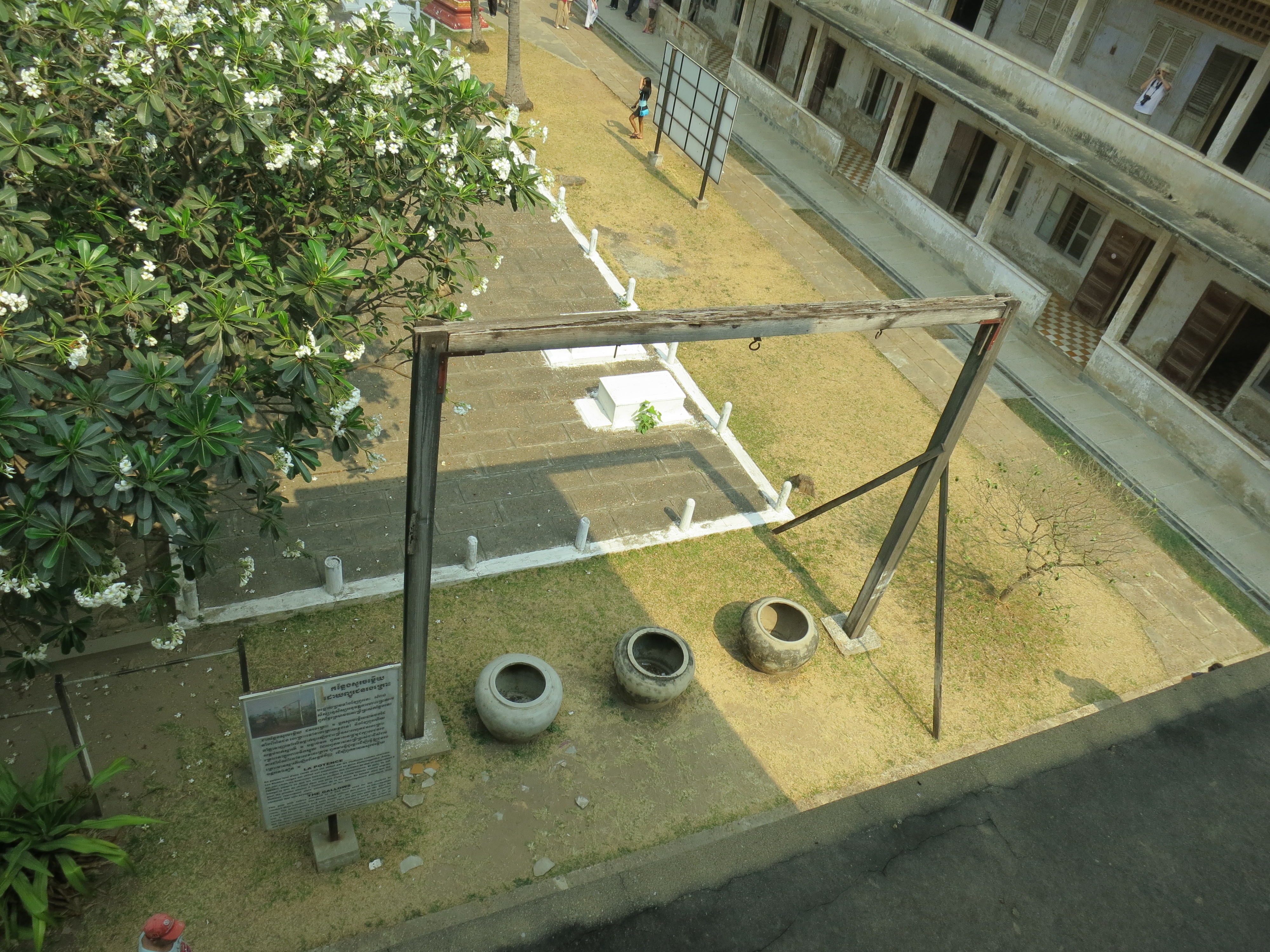
The gallows

The gallows

An artist's map of the country after the war

An artist’s map of the country after the regime

One floor showed photos of victims and of guards, and copies of statements they signed when confessing crimes–seeing as how some of the guards became victims as the paranoia of the state increased. One binder included confessions by foreign nationals who happened to be in the country at the wrong time. A popular crime to confess to was working for the American CIA.

A written confession and English translation

A written confession and English translation

One floor was dedicated to peace; it had photos of a place that was the site of the only land battle in Japan in WWII, and also a room of drawings by kids calling for peace. All in a building with barbed wire strung in front of the balconies so prisoners couldn’t attempt suicide by jumping. In the courtyard, plumeria trees bloomed.

Barbed wire to prevent suicide jumpers
Barbed wire to prevent suicide jumpers

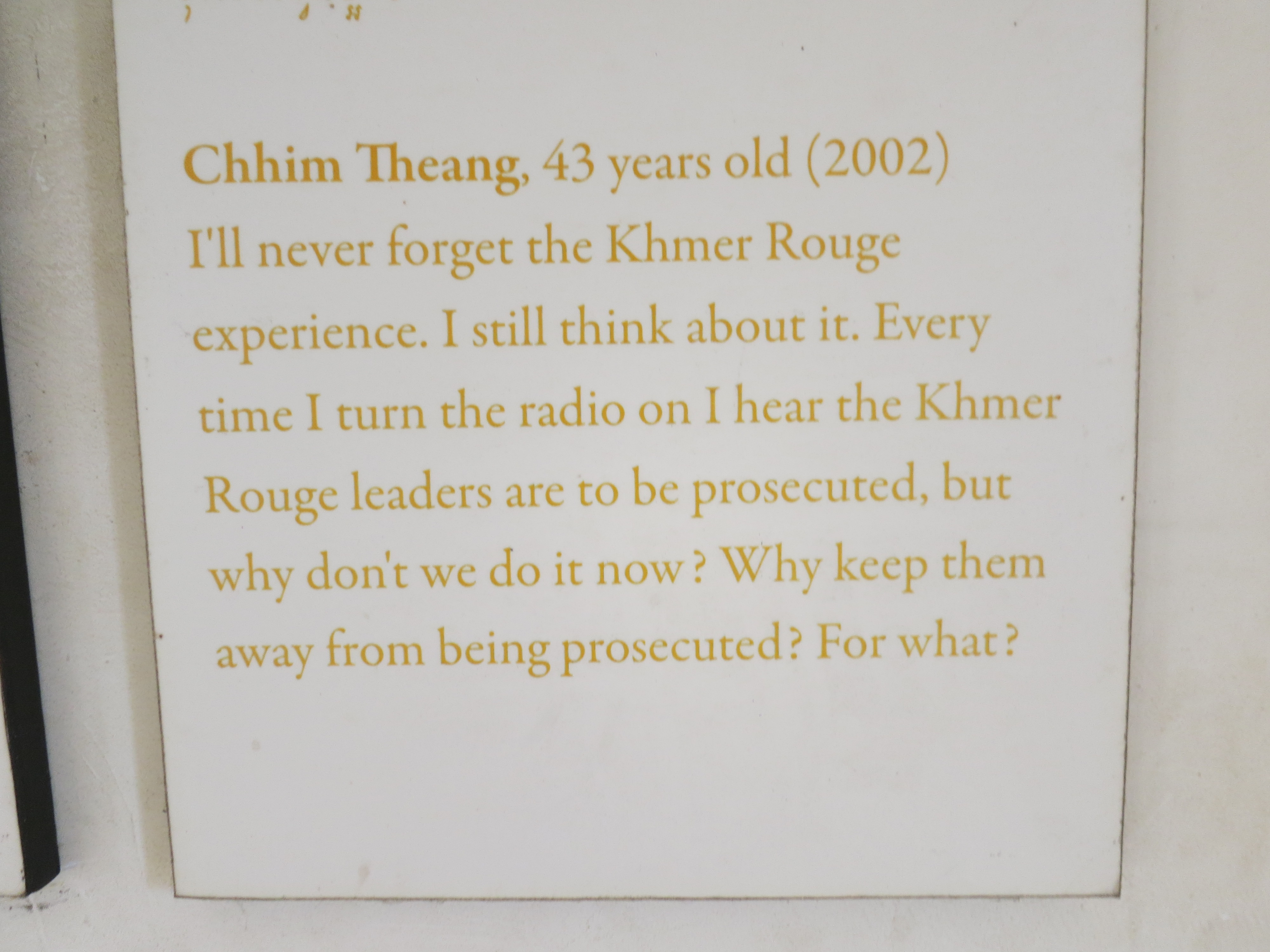
Part of an art project that asked former workers at S-21 about their memories of the place

Part of an art project that asked former workers at S-21 about their memories of the place

There were signs posted outside some of the rooms with a person smiling/laughing and a line through it, but I can’t imagine who would go through these rooms and have any desire to smile. Outside, a poorly translated sign proclaimed the rules of the place, which included “While getting lashes or electrification you must not cry at all” and “Don’t make pretext about Kampuchea Krom in order to hide your secret or traitor.” Duch said the Vietnamese who set up the museum at Tuol Sleng invented these rules, but others claim they were real.

Security regulations at S-21

Security regulations at S-21

Graves of prisoners

Graves of prisoners

In one disconcertingly bright room, past a row of rusted foot shackles used to immobilize prisoners, down a long corridor of bricked-up cells barely large enough to fit in sideways, behind the barbed wire fence, I saw a graffitied message a tourist had left at some point. It was a hard message to read in that horrible place, one that seemed nearly impossible under the weight of this very recent, very terrible history. But it was vital to see, and to keep close when returning to the recovering city outside: Give us hope.

Give us hope

The Silence of the Killing Fields

Today’s post contains some disturbing imagery of the remains of victims of Pol Pot’s reign in Cambodia. 

The sites were chosen for their relative isolation. Space was cleared out in the middle of farmers’ fields, fences erected to keep the curious out and the doomed in. Prisoners arrived in the dead of night and dug their own graves. Patriotic music blasted from loudspeakers–there were no gunshots to hear, but the shrill music covered the dull thud of machetes hitting flesh and the screaming that followed. In the morning, guards sprayed the graves with DDT to ensure everyone in them was dead, and to cover the smell of the corpses. These were the killing fields.

At the Killing Fields

At the Killing Fields

During Pol Pot’s reign in Cambodia, the Khmer Rouge murdered somewhere between 1.7 and 2.5 million fellow Cambodians. Most of the murders took place in what have come to be known as the killing fields. There were dozens of such sites, mostly concentrated around the capital, Phnom Penh. So many people died, but there are very few records that show names, which is part of the reason it’s hard to get an accurate number. After the defeat of the Khmer Rouge by the Vietnamese in 1979, one of those sites, Choeung Ek, was made into the memorial for the dead.

Walking on the bones at the Killing Fields, an eerie and humbling experience

Mass graves at the killing fields

The memorial stupa, containing 17 levels of skulls and bones

The memorial stupa, containing 17 levels of skulls and bones

I visited Choeung Ek in March, and I was impressed by the audio guide, which was one of the most thorough and thoughtful I heard on my whole trip. The guide took me past dusty stretches of land, which once contained a small hut to house prisoners when there were too many to execute in one day, and several sheds that held the machetes, hoes, knives, hatchets, cart axles, and other weapons. Bullets were expensive, so while farmers in the surrounding fields grew crops with shovels and hoes, the guards used the same implements to hack humans to death.

Some of the weapons used to kill victims

Some of the weapons used to kill victims

Sometimes the guards even used the sharp edges of palm fronds to cut throats

Sometimes the guards even used the sharp edges of palm fronds to cut throats

The fencing today only keeps out neighbors' chickens

The fencing today only keeps out neighbors’ chickens

None of the original structures remain. They were all destroyed in 1979, upon liberation. Now, the fields are dusty brown and empty of buildings, except for the Buddhist stupa towering over the dry grass and containing 17 levels of human skulls recovered from the mass graves here. The path went along a few fenced-off areas, where the museum had grouped some victims, such as children who were beat to death against a nearby tree.

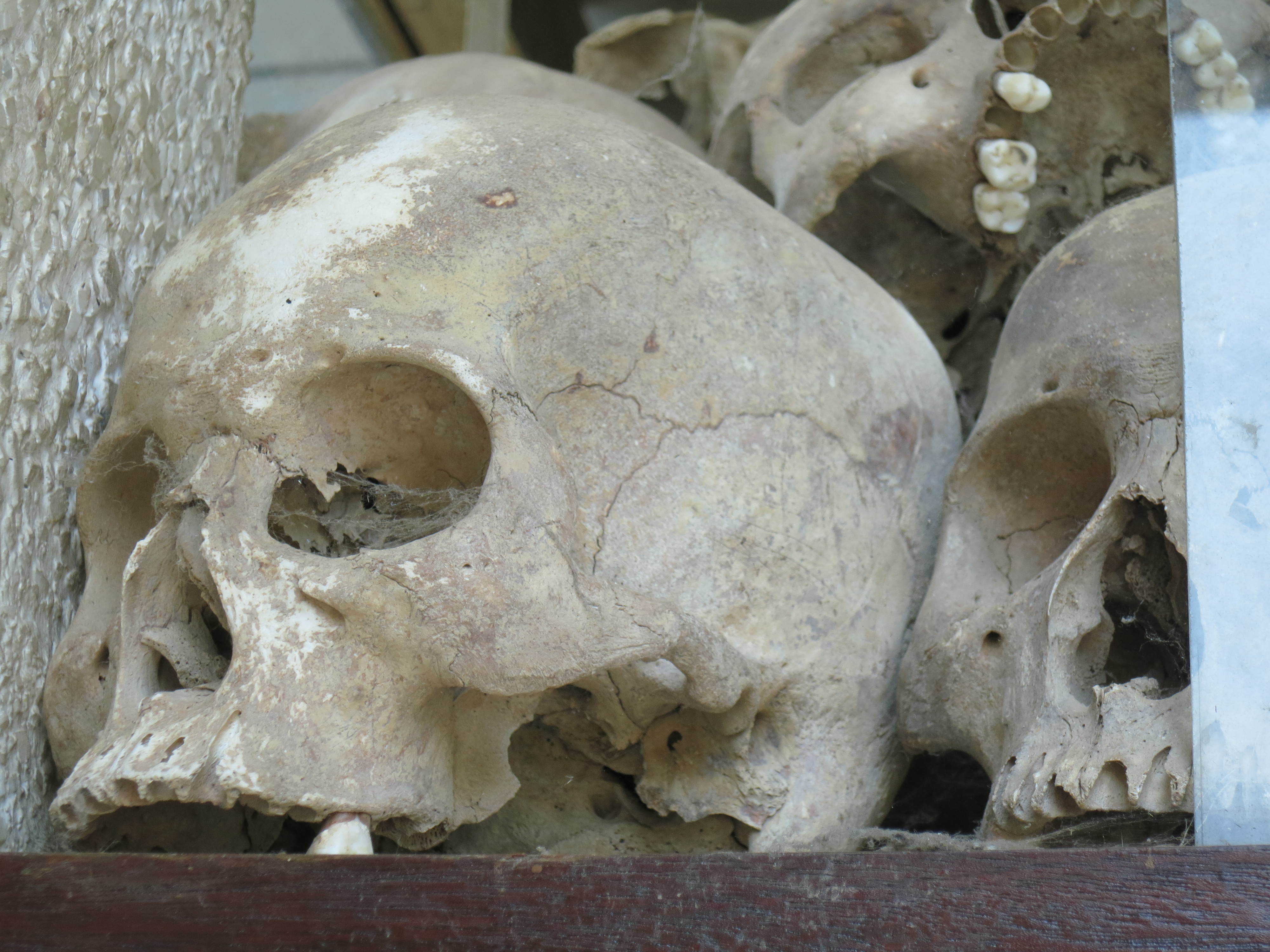
Bones that surface after heavy rains are placed in this box

Bones that surface after heavy rains are placed in this box

killing fields

Human bone in the path--history near the surface

Human bone in the path–history near the surface

Perhaps the most upsetting thing for me, during this hugely (and rightly so) upsetting visit, was when I stumbled over human bones. There are so many bodies buried here that they haven’t finished exhuming them all, so even though I didn’t walk on the mass graves, I twice found myself looking underfoot to find a piece of bone sticking out of the path. The skulls in the stupa, even the bones piled haphazardly in a glass box on the path–these were hard to see, but they were behind glass, they had been processed by officials, they had been counted as part of history. The bones I trod upon in the path were raw reminders of the brutality that took place here, over and over again, and the enormity of trying to order and record it, and the futility of ever knowing who died here.

These skulls are shelved behind sliding doors of glass. Most skulls show some form of trauma.

These skulls are shelved behind sliding doors of glass. Most skulls show some form of trauma.

Bracelets left in memoriam

Bracelets left in memoriam

When I removed the headphones of the audio guide, I heard nothing. A little noise from neighboring animals, a man quietly selling flowers for people to place outside the stupa, but otherwise–silence. I’ve seen hungover, loud tourists at just about every place I’ve visited, but not here. The horror was too great, the history too recent. Everyone maintained a respectful silence for the barely buried victims, whose screams echo in the humid air.

ACAM: Cambodia’s Dark Past and Bright Future

I’ve finished John Tully’s A Short History of Cambodia: From Empire to Survival, and damn if it isn’t a discouraging read. It’s all right there in the subtitle–Cambodia was once a strong empire with the largest city in pre-Industrial times, an intricate system of canals and farmland, and an impressive collection of intricately carved temples, and now it is one of the poorest countries in the world, riddled with corruption, and desperately trying to pump up a tourism industry centered around the ruins of the greatness that once was.

cover of A Short History of Cambodia

A Short History of Cambodia

Of course, every country has its ups and downs, and no empire lasts forever. But the way in which Cambodia got totally screwed, over and over, from the mid-19th century through today, is both upsetting and instructive. Basically, although European colonization came late to Cambodia, it came with a vengeance. The French used an anti-missionary assault in Saigon as an excuse to send over a “protective mission” that quickly became a “permanent occupation force” (p.80). From Saigon to Cambodia, and soon they had control over Indochina (the colonialist term for much of Southeast Asia). Cambodia was officially a protectorate, but basically France treated them like a badly behaved colony, giving them strict governors and overhauling their entire system of government with no local input so it never had mass support (even measures like abolishing slavery and setting up schools for children).

By 1954, Cambodia had been caught up in the French fight with the Vietnamese, and the people wanted out. Prince Norodom Sihanouk successfully maneuvered to have the Geneva conference name Cambodia a sovereign nation, albeit with strings attached. I mentioned in another post that the intersectionality of world politics in the 20th century astonishes me, and while I’m sure that makes me sound naive, the extent to which the Cold War affected politics in literally ever corner of the globe in the latter half of the century can’t really be overstated, I don’t think. For example, the only way Sihanouk managed to get Cambodia free of French rule was by promising up and down and back and forth that Cambodia was a neutral country that would never enter into military alliances with any other country. Not to mention he had to beg to have his country back in the first place, and the US and USSR, along with some other countries, granted that. (This granting of sovereignty to nations that already existed and just need their colonizers off their backs is deeply puzzling to me. See reservations, Native American.)

Prince Sihanouk

Prince Sihanouk

This is not to say that either world power gave up hopes of using Cambodia in its Southeast Asian chess game, and the US presence in Vietnam went far toward stirring up discontent in Cambodia with the US and any pro-US factions. The Khmer Rouge, staunchly anti-US, started gaining followers. (“Khmer Rouge” means “Red Khmer,” the Khmer being the ethnic people of Cambodia, and the Red being a reference to their Communist affiliation–a context I never knew about or wondered about before. Funny how names can hold one meaning for you–deadly Pol Pot regime!–when they started out with quite another meaning entirely.)

Eventually, the country descended into civil war, with the war-weary Vietnamese, the jungle-hardened Khmer Rouge, the covert-bombing Americans, and the under-supplied national army all entangled in a mess of a fight. When the US and Vietnam got out, it became unwinnable for the national army, and Pol Pot and the Khmer Rouge stormed into power.

Pol Pot

Pol Pot, looking creepily cheerful as he palms a gun and plots genocide

Pol Pot’s socialist agenda was extreme. He immediately banned all private property, currency, manufacturing, and education. He force-marched his fellow Cambodians out of the “corrupt” cities and into the countryside, and along the way murdered thousands of people the infamous killing fields outside the city. Displacing hundreds of thousands of people, killing as many, and utterly changing the basic structure of everyday life was not, surprise surprise, a successful plan. The country plunged into disrepair, and Pol Pot went back to war with Vietnam, which no one was equipped to handle. At the end of 1978, the Vietnamese invaded Cambodia and took over for the next ten years.

The sickening thing about this post-DK (Democratic Kampuchea, Pol Pot’s name for his regime) era is the international response. The bloody and drawn-out Vietnam War had done nothing to convince the US that that country wasn’t out to conquer and convert all neighboring countries to communism (the domino theory! a real winner of an idea), and China was equally upset with Vietnam’s perceived overreach into its physical and ideological domain. They were both dead-set on punishing Vietnam for its ambition, so since Vietnam had invaded/liberated Cambodia, that meant Cambodia got to suffer too. The People’s Republic of Kampuchea (PRK, the post-DK regime name) “was cut off from assistance from the UN Development Programme, the Asian Development Bank, the IMF and the World Bank, with only a trickle of humanitarian aid from UNICEF and the International Red Cross” (p. 207). In effect, the international community abandoned Cambodia.

domino theory graphic

Apparently this is how it was all gonna go down.

Not only that, but Pol Pot had fled when the Vietnamese invaded, and he ran guerrilla options for many years in the jungles, ratcheting up Cambodian civilian deaths with no one pursuing him on any serious level. The Western world was so concerned about the threat of Vietnam ruling Cambodia as a puppet state that it gave tacit (and sometimes material) support to Pol Pot and the Khmer Rouge. I repeat: we supported Pol Pot. Ask anyone with a basic knowledge of the world history of the last century who Pol Pot is, and they’ll tell you, a dictator, a genocidal madman, a brutal murderer. And yet, because it seemed politically expedient to do so, the United States and other countries supported him for a number of years, until Cambodia proved it was no Vietnamese puppet nor Communist state, and aid could be sent without troubling the conscience about the red threat (p. 213). And Pol Pot died peacefully in his sleep in 1998.

The PRK government had its fair share of gross human rights abuses, yes, but if the international community had stepped in with aid right away, and called for the swift and impartial trials of Khmer Rouge war criminals, then it would have been a very different story. Basing foreign policy a paranoid idea like the domino theory is not only foolish, it’s dangerous. It has real consequences for millions of people on the ground. The United States’ treatment of Cambodia in that twenty-year period–from Nixon’s bombings, through the support of the Khmer Rouge, to the lack of basic aid during a famine in 1979–is inhumane and unjustifiable.

So, see what I mean about Cambodia getting the wrong end of the stick for decades? The corrupt nature of its officials on every level, combined with the self-interested interference of neighboring countries and world powers, led to a war-torn nation in which the people suffered mightily. Nowadays, the country is run by a corrupt prime minister, Hun Sen, and millions of people remain in dire poverty. But aid from outside countries (especially China) does help, and the textile and tourism industries have grown the country’s economy rapidly in the last ten years. Education and health levels are rising, as well, and a healthy, educated population is much more in a position to tackle its issues and guide its own path. Cambodia’s recent history is dark, yes, but that doesn’t mean the country doesn’t have a bright future.

Remorque-moto travel in Siem Riep

Cambodians moving on

Image 1 from here. Image 2 from here. Image 3 from here. Image 4 from here. Image 5 from here, credit Felix Hug.