Angkor Wat: A Temple, A City, A Breathtaking Sight

When I say I’ve been to Angkor Wat, people sometimes reply, “where?” but when I show them this photo, they nod in recognition:

Angkor Wat at sunrise

Angkor Wat at sunrise

Oh yeah, that place. The giant temple thing in Cambodia. In fact, Angkor Wat is the largest single religious monument in the world. (I guess that’s under dispute by Those Who Measure Religious Monuments or something, because most of the info I can find on it won’t give me a hard yes or no on the topic. Regardless, it’s huge–the outer wall runs over 2 miles long.) Of course it’s big, when you learn that “angkor” roughly translates to “city” and of course we know “wat” is fairly synonymous with “temple.” Angkor Wat is a temple and also a city.

Angkor Wat

Angkor Wat

Khmer king Suryavarman II built Angkor Wat in the beginning of the 12th century. He broke from tradition by dedicating it to Vishnu rather than Shiva, and orienting the temple complex to the west, rather than the east. In the next century, the main religion of the Khmers changed from Hinduism to Buddhism, so the religion associated with the temple changed, too. One of the main statues of the temple, which was somehow not destroyed during the reign of the Khmer Rouge (as most of the statuary was), is an eight-armed Vishnu whose head has been swapped out for a buddha’s head.

Vishnu/Buddha

Vishnu/Buddha

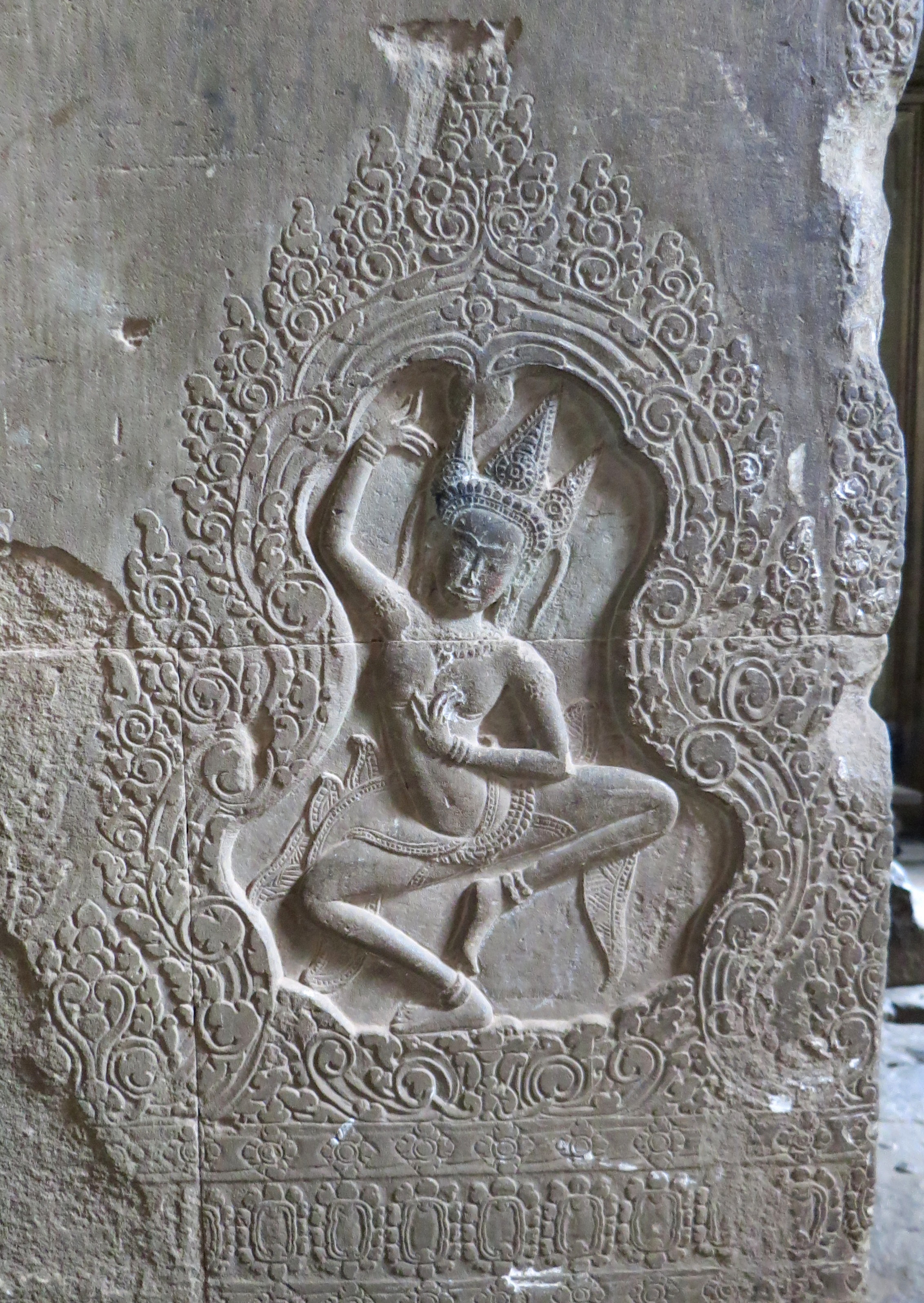
Other decorations, however, are not so easily changed from one religion to another. Angkor Wat is impressive not just for its size and age, but for the bas-relief friezes that run around a large part of one of the inner walls. These friezes show scenes from the Ramayana and the Mahabharata, two Hindu epics. Many of the friezes have been restored by various conservation groups over the past few decades, and I’m so glad I got to see this artwork dusted off and cleaned up. It’s much easier to appreciate the incredible detail of each carving when the accumulated grime of centuries has been swept away.

The Churning of the Ocean of Milk
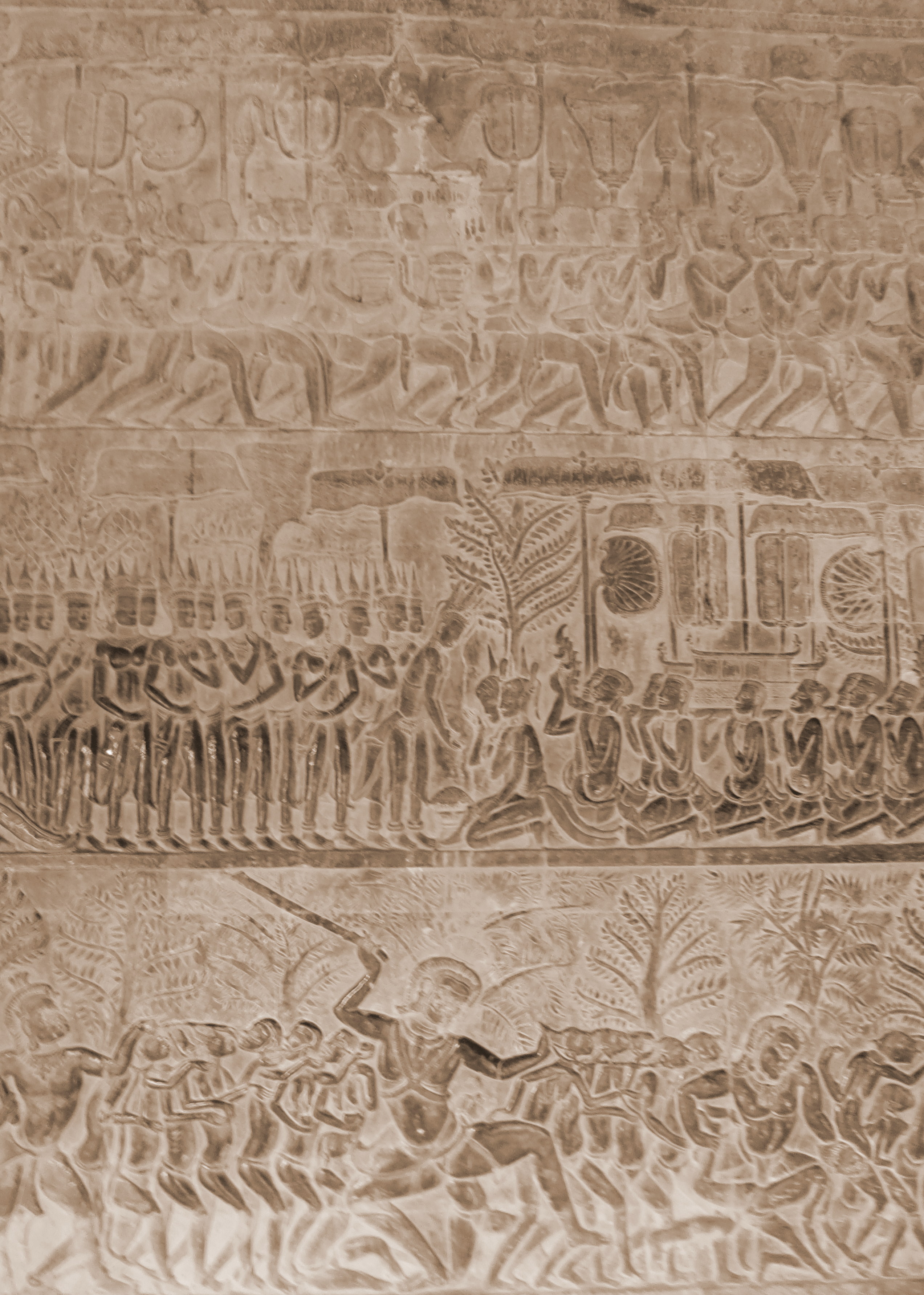
The Churning of the Ocean of Milk

Bas-relief frieze

Bas-relief frieze

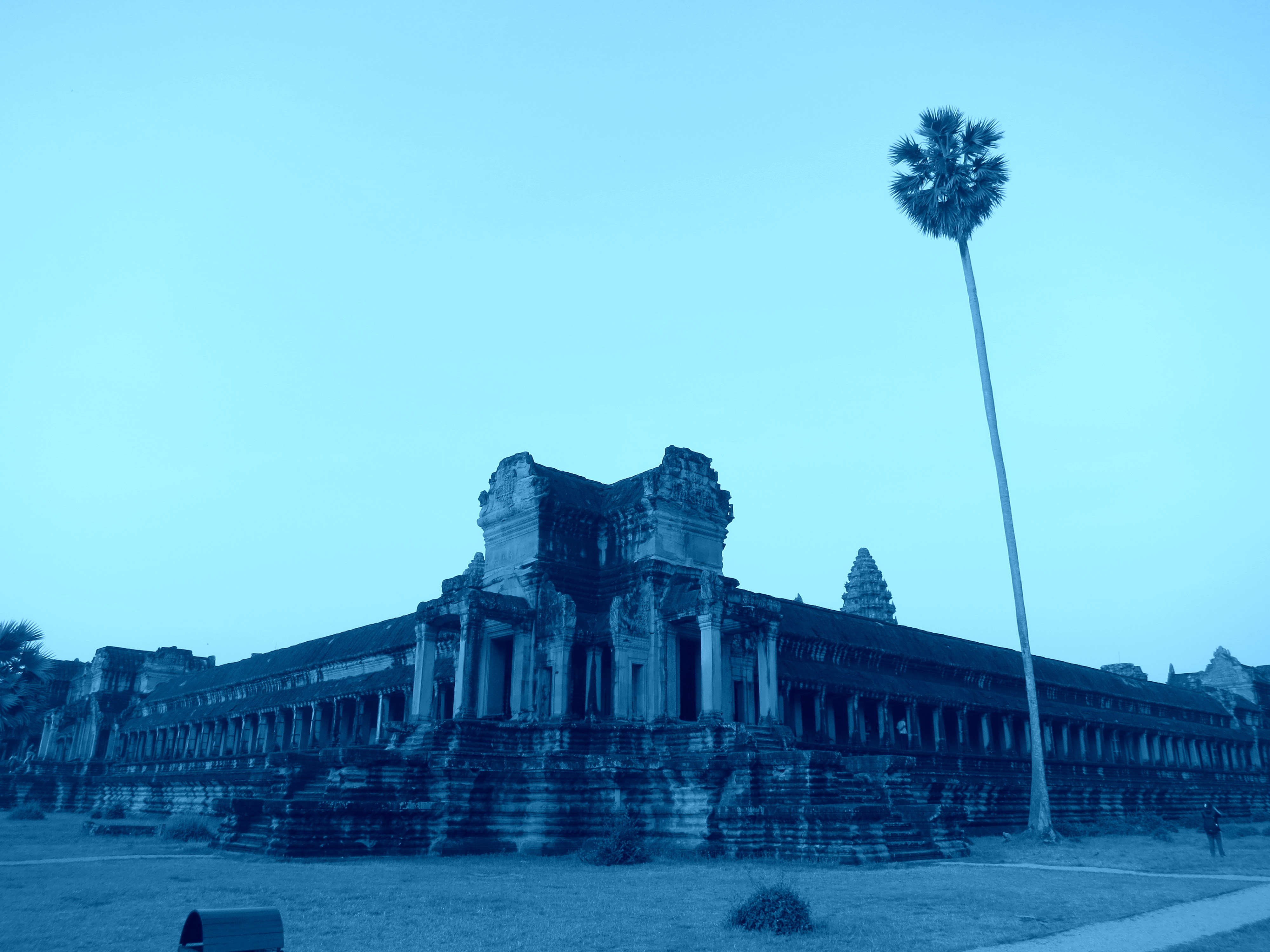
Angkor Wat is built in the temple mountain style: it’s meant to resemble Mount Meru, the home of the gods in Hindu mythology. There are always outer walls representing mountains, and usually a moat to represent the ocean. The inner temple is made up of five pyramids representing the five peaks of Mount Meru–usually four in the corners, and an elevated one in the center, the innermost sanctum of the gods.
angkor wat

One of the distinctive features of Khmer architecture, according to my architecture guidebook, was the “trick of perspective” achieved by progressively reducing the height of each structure from the center outwards, making the central towers appear even taller and more impressive. This architectural trick expresses the religious beliefs of its builders, too, since it emphasizes the importance of the home of the gods and the humility of the rest of creation in comparison to it–even the oceans are reduced to flat moats calmly reflecting Mount Meru’s glory back to it.

angkor wat

For those of us who haven’t made a study of Khmer architecture or Angkor period temples (and that’s most of us, isn’t it), it’s good to keep in mind that a Khmer temple “was not a meeting place for the faithful but the palace of a god,” as Michael Freeman and Claude Jacques note in Ancient Angkor. Thus, the tiny space in the interior of the central pyramid, made only to house the statue of the god and not for crowds of worshipers; the super steep stairs that were usually only scaled by a few temple workers; and small buildings housing various gods, the grouping of which made up one large temple, rather than one temple per god. This is such a different approach to religious architecture from the Western, Christian one that I hadn’t even realized I had been making assumptions about what a temple was for and how that affected the architecture until this book pointed it out.

angkor wat

I’m used to vast cathedrals built to house masses of congregants; the altar is often large and ostentatiously decorated, and it’s easy to see from just about anywhere in the building. The temple mountain structure of the Khmer Hindu places of worship also accommodates large crowds, but in the outer areas of the grounds; the inner areas are difficult to reach, and the sacred space is small and hidden from the casual eye. I love that the book made me look at the temple in a different way, and also had me reflect anew on the churches I’d been to before.

angkor wat

None of the buildings from the city surrounding the temple (the “angkor” part of “Angkor Wat”) have survived. They were likely made from wood, unlike the sandstone, brick, and laterite of the temples. This means that a lot of imagination is required to envision what it must have looked like in its heyday, a little harder than putting paint on the Forum in Rome, but not as difficult as seeing the cooking fires smoking at the side of Uluru. I stood on the east end of one of the interior walls of the temple and looked out over the forest that stretched to the moat nearly two miles away. All this forest was once royal palace, regular houses, streets, food stalls, markets–all populated with one of the largest concentrations of humanity in the pre-industrial age.
Aspara

Aspara

This is all about Angkor Wat, but let’s not forget that the Angkor period lasted several hundred years, and almost every king built at least one temple (perhaps as a mausoleum for himself, the god-king), so there are nearly a thousand temples in the area. Dozens of these have been restored and opened to the public. It all seems an embarrassment of riches once you see Angkor Wat. Not only is there this magnificent complex, but there are more–and in different styles, with their own delightful carvings and architectural quirks? I enjoyed discovering those temples as well; stay tuned this week for more on those.

Embracing the sunrise

Embracing the sunrise
Do’s and Don’ts at Angkor

I went to Angkor, World Heritage site and location of dozens of ancient temples renowned for their architecture, carvings, and historical importance, in March of this year. I read up a little on what to expect before I went, but was still tripped up by a few things I discovered on the ground. Here’s my advice for how to visit the temples with minimum fuss and maximum enjoyment. Share your own tips in the comments!

Angkor Wat at sunrise

Angkor Wat at sunrise

DO:

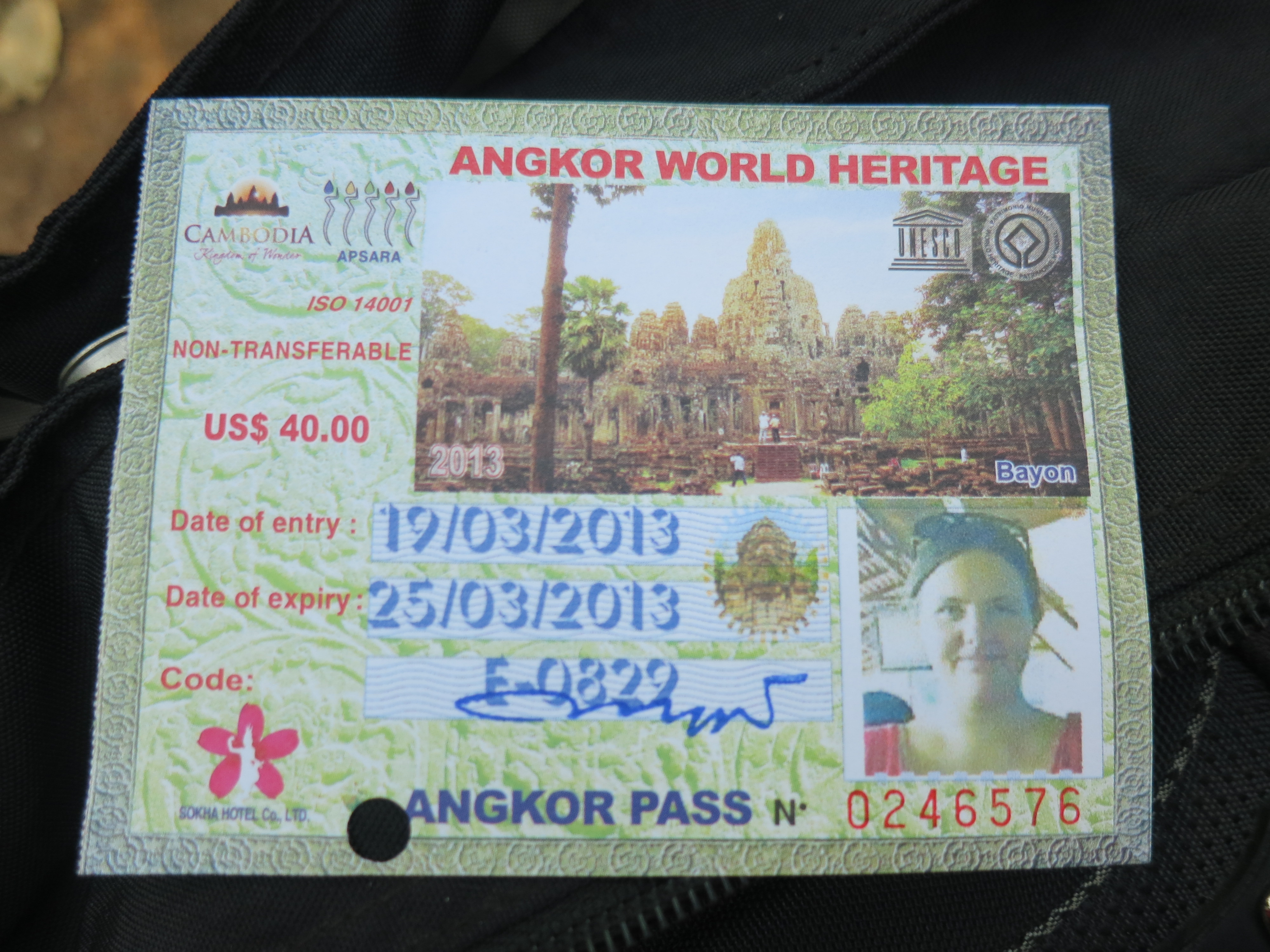
Buy the 7-day pass for $60, if you have a flexible schedule and at least four days in the area. I bought the 3-day pass for $40, intending to use every day in full, but then I stepped outside and almost fainted from the humid heat (we’re talking over 100 degrees Fahrenheit every day). If I’d had the 7-day pass I could have done half-days in the mornings and escaped to air conditioning in the afternoons, but as it was I had to push on through the heat. I still didn’t fit in everything I wanted to see, so I had to buy a 1-day pass for $20 for my last trip out there. If I’d spent that $60 upfront, I’d have had more time in the park for the same amount of money.

angkor

Bring at least a liter of water to drink and plan to buy at least another liter while at the park. It is 40*C/104*F on a regular basis here.

Bring a bandana or handkerchief. You’ll use it as a sweat rag during the amazingly humid days, and also as a face mask during your tuk-tuk rides on the often dusty roads.

Bring snacks, and a full lunch if you can swing it. Unlike in town, no one’s pulling a food cart all over the parks, and there are just a few places where restaurants are set up. I got hungry climbing up and down the many stairs of the temples, and was glad of the fruit and granola I had in my bag. Of course, your driver will know of the perfect little place to take you when it’s lunchtime, and they all seemed more or less the same to me, so why not say yes and let him have his commission?

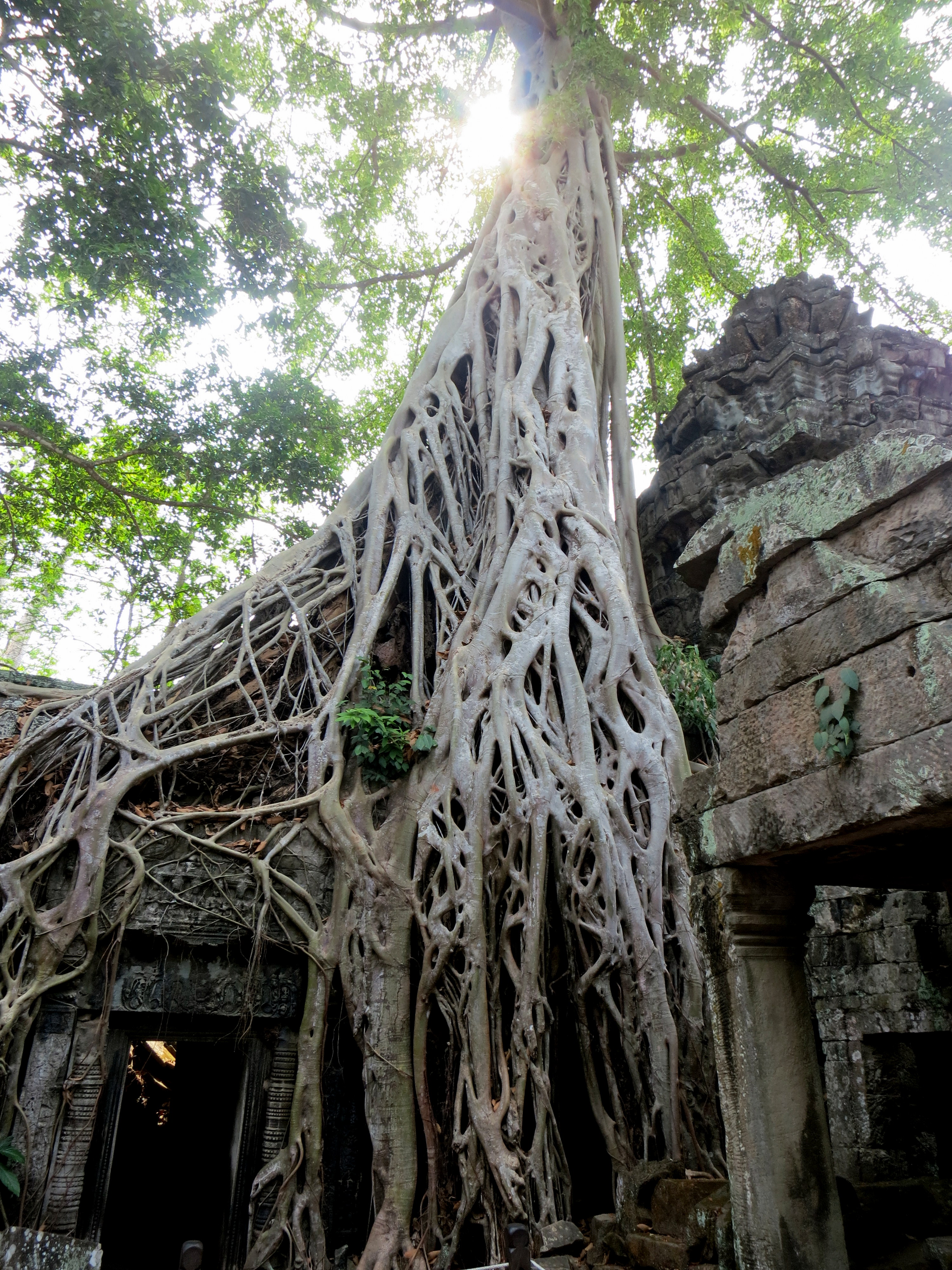
Plot your trip ahead of time. If you’re just going for a day and you want to catch sunrise and sunset at Angkor Wat and maybe see the Tomb Raider temple, then you’re fine and your tuk-tuk driver will have no trouble getting you to each place with plenty of time. However, if you have more time and want to explore the temples in more depth, work out with your driver ahead of time exactly where you want to go and in what order, and generally at about what time. My driver thought I would take less time than I did at each temple I went to, so he was surprised I couldn’t do his normal itinerary in one day, but I know I take a long time seeing sights, so I wasn’t surprised. I should have communicated better with my driver about timing, though, so that we both knew what to expect.

Bring a proper cardigan or long-sleeved shirt when going to Angkor Wat and Phnom Bakheng. I had a scarf to cover my shoulders as a sign of respect, which was fine at other temples, but at Angkor Wat and Bakheng I was turned away. I was told I needed to have a proper shirt–because a scarf is too easy to take off? I’m not sure what the reasoning was, but the guards were absolutely strict on this, despite there being no warnings about such rules at the ticket office or anywhere else, and as a result I never got to climb to the very top of Angkor Wat (yep, I planned to do it on my last day there, oops).

Plan more than one sunrise at Angkor Wat, if your schedule and sleepyhead ways can swing it. I only made it to one, and it was gorgeous, but I was torn between staying by the pond with the hundreds of other visitors to see the full sunrise, and scooting into the temple after a few minutes to explore while it was mostly still empty. I ended up doing the latter, and I do not regret that at all, but it would have been nice to have gone another time and just relaxed for sunrise.

angkor

DON’T:

Lose your pass. That ticket just cost you at least $20, and they won’t replace it. At nearly every temple I entered, I needed to show my pass before I could climb the steps of the actual temple, so don’t think you only need it at the entrance, either. They take your photo and put it on the pass when you buy the ticket, so there’s no mistaking whose ticket is whose.

angkor

Pay attention to guidebooks that say you need a special ticket to get non-consecutive passes. That may have been true in past years, but not anymore. If you buy a 3-day pass, you can use it on any three days in a week, and you can use a 7-day pass any seven days in a month.

Forget to bring or buy a guidebook. There are no helpful placards here, no clear markers next to exhibits of note. You can hire a guide for the day, and I overheard some great guides sharing in-depth information, but I also heard some impenetrable accents and bare-bones introductions to the sites, so the quality of the guides varies and it can get pricey to hire one if you’re on your own. I bought Ancient Angkor by Michael Freeman and Claude Jacques, and it proved pretty useful. There’s a lot of history up front and then the sections on specific temples focus more on the architecture. It was last updated in 2003 and there have been improvements to the park since then, so some of the info on what is accessible is outdated. I got the book for $8 at a bookstore in town, and then six different touts tried to sell me the same one for $1 at the park itself. You can go that route, but realize it’s probably an illegal copy so the publisher isn’t getting paid, and of course the tout sees maybe a few pennies of that money.

angkor

Stress about getting from Siem Reap to the park. Your guesthouse/hostel/hotel will have tuk-tuk drivers they can call, guaranteed. The only thing you’ll need to do is negotiate price, which you can prepare for by looking online to see what other people have paid in the past. If you’re fancy, you can take an air-conditioned car, but tuk-tuks are much more affordable and perfectly comfortable (see above about a face mask, though). Hopping on the back of a motorcycle is even cheaper, but if you’re fat they might not let you, even if you’ve done this before and you know it’ll be fine. You can also bicycle there, if bicycling in 90% humidity at 100 degree temperatures appeals to you. Pretty decent roads, not sure where you’d lock it up, scary drivers to share the road with, but you do get to set your own pace and schedule.

Try to go against the grain on the prescribed routes in the temples. There are no markers telling you what you’re looking at, as I mentioned, but there are plenty of signs telling you which way to walk once you’re in the temple. These are set up to manage the flow of the crowds, and are really helpful. You can always dart off to the side and come back or take a seat if you need a breather, but try not to turn around and head the opposite way everyone else is going. You’re gumming up the works. Of course, some temples don’t have a prescribed path, so you can hop about all you like there.

angkor

A Siem Reap Backpacker’s Spa Night

There are probably some really nice spas in Siem Reap, Cambodia (entrance to the wonders of Angkor), but I’m on a budget, so I made my own spa experience while I was there.

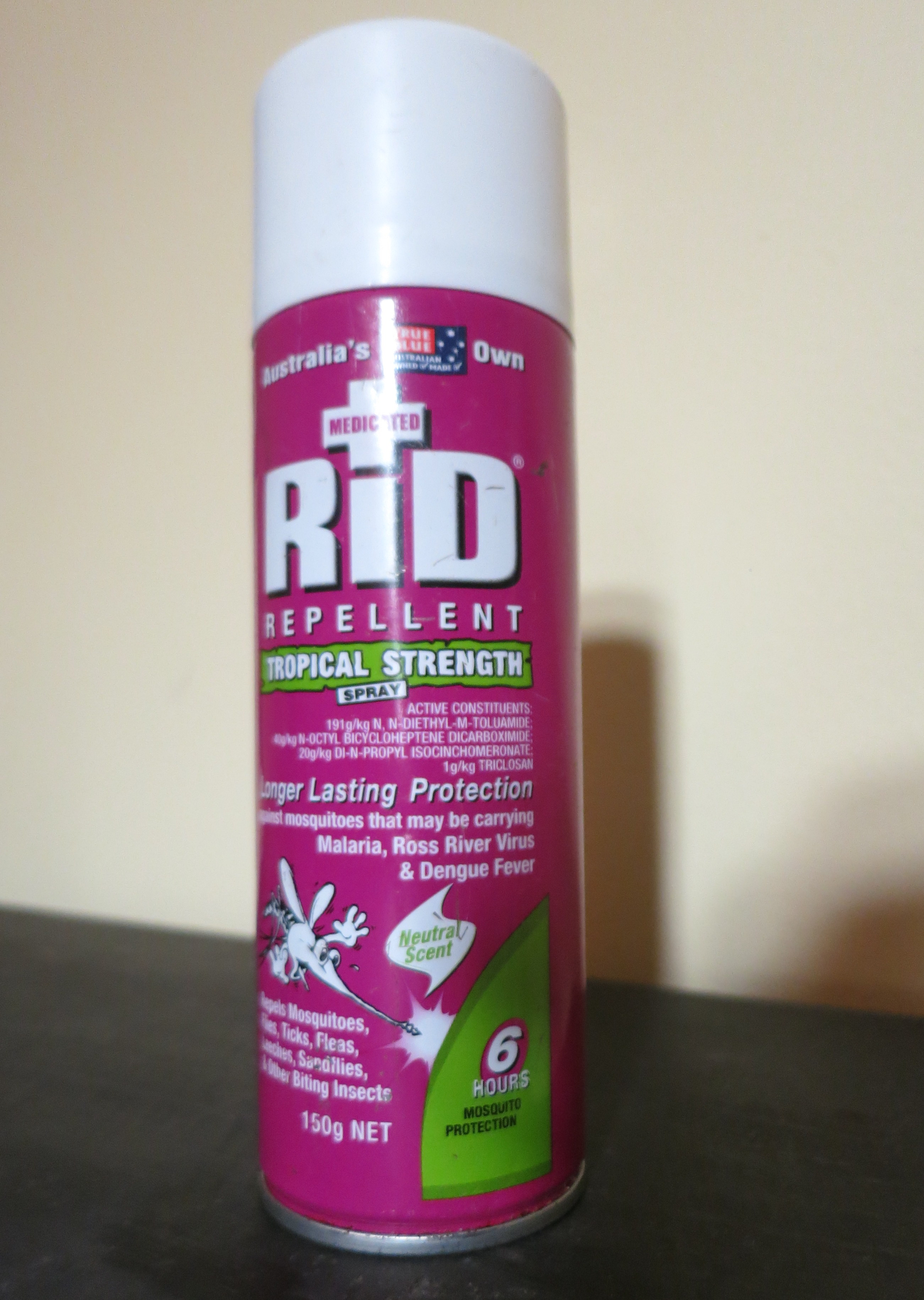
First, I put on just the right amount of scent:

Eau de DEET

Eau de DEET

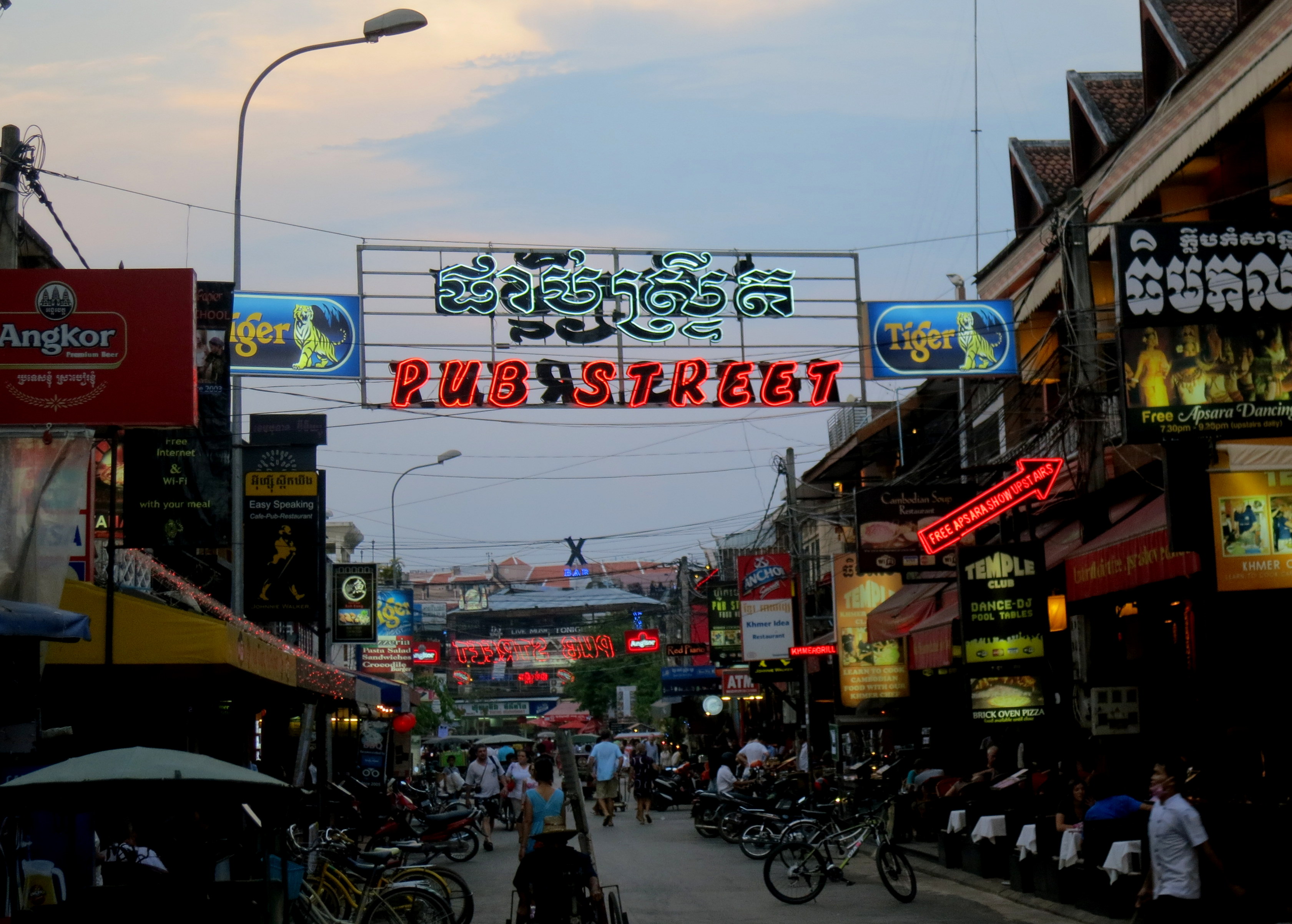
Then I went down to the classy tourist area of town:

Yes, that's a neon sign reading "Pub Street" not 10 miles from the majesty of Angkor Wat

Yes, that’s a neon sign reading “Pub Street” not 10 miles from the majesty of Angkor Wat

I didn’t want my skin to end up scaly like these guys:

Get these dudes some lotion

Get these dudes some lotion

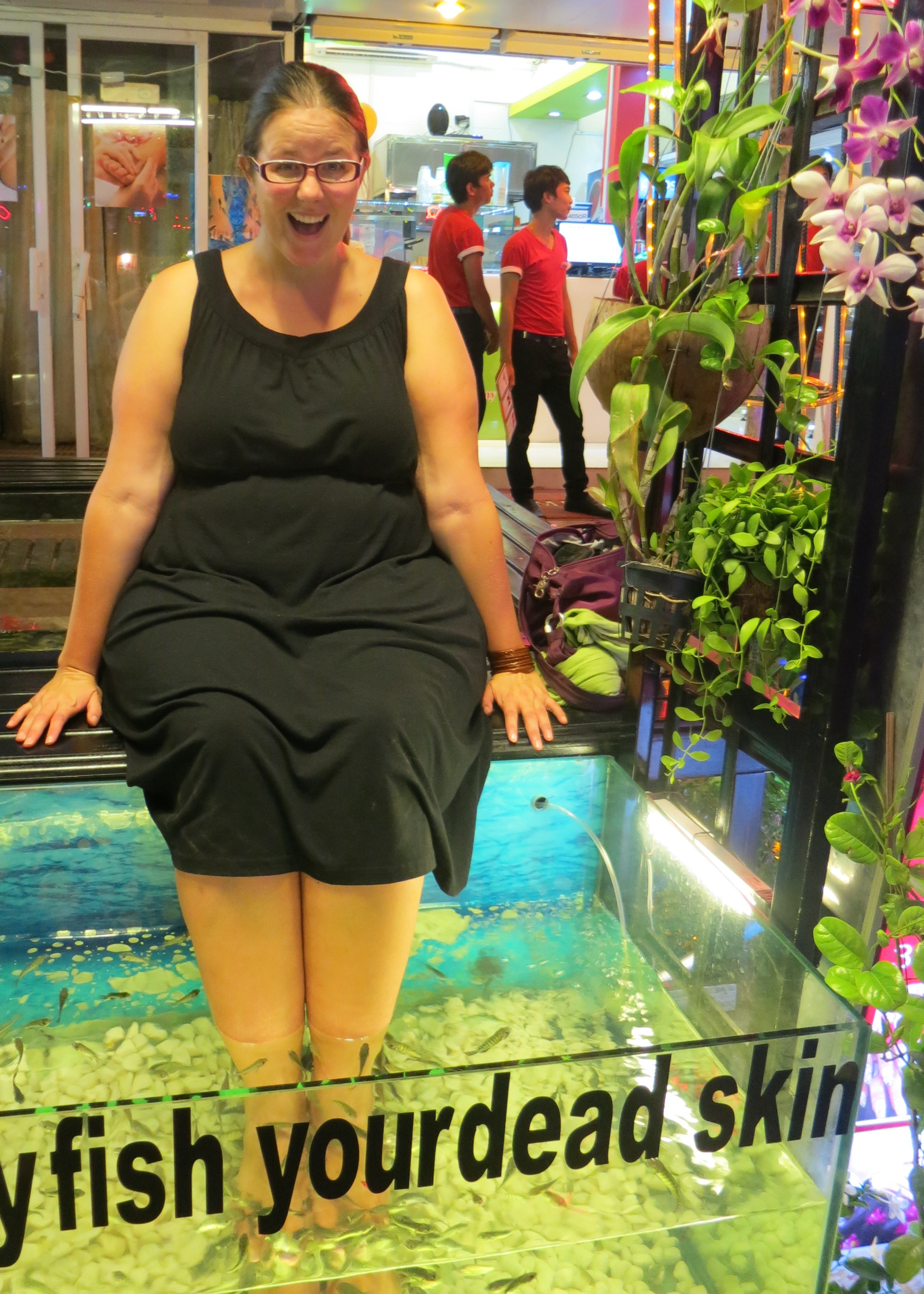
So I went to this spa, where a hundred attentive employees went to work on my feet and calves, until I felt tingly and revitalized:

The sign on the tank reads, "Please feed our hungry fish your dead skin"

The sign on the tank reads, “Please feed our hungry fish your dead skin”

It was a little alarming to see just how much dead skin there was for them to eat

It was a little alarming to see just how much dead skin there was for them to eat

(I am totally aware that these fish tanks aren’t exactly the most hygienic things around, but I seem to still be standing, so I guess it turned out okay.)

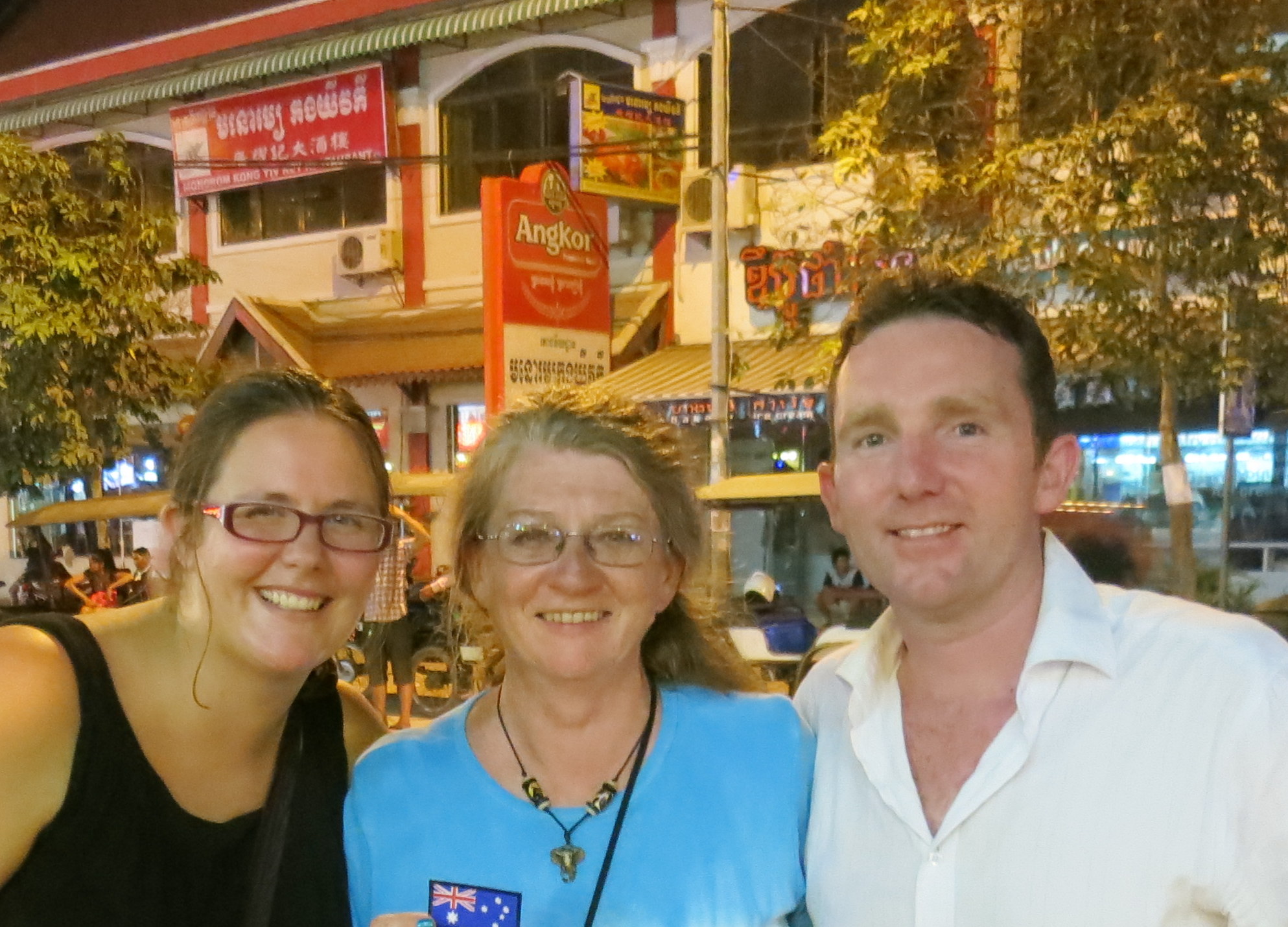
After all that, it was time for a healthy drink or two with friends:

I've had too many close calls on St. Patrick's Day not wearing green and getting pinched for it--I wasn't going to risk it, even in Cambodia

I’ve had too many close calls on St. Patrick’s Day not wearing green and getting pinched for it–I wasn’t going to risk it, even in Cambodia

Out with Viv and Russ from Australia

Out with Viv and Russ from Australia

Total cost: about $8. You can make your own spa night too!

ACAM: Cambodia’s Dark Past and Bright Future

I’ve finished John Tully’s A Short History of Cambodia: From Empire to Survival, and damn if it isn’t a discouraging read. It’s all right there in the subtitle–Cambodia was once a strong empire with the largest city in pre-Industrial times, an intricate system of canals and farmland, and an impressive collection of intricately carved temples, and now it is one of the poorest countries in the world, riddled with corruption, and desperately trying to pump up a tourism industry centered around the ruins of the greatness that once was.

cover of A Short History of Cambodia

A Short History of Cambodia

Of course, every country has its ups and downs, and no empire lasts forever. But the way in which Cambodia got totally screwed, over and over, from the mid-19th century through today, is both upsetting and instructive. Basically, although European colonization came late to Cambodia, it came with a vengeance. The French used an anti-missionary assault in Saigon as an excuse to send over a “protective mission” that quickly became a “permanent occupation force” (p.80). From Saigon to Cambodia, and soon they had control over Indochina (the colonialist term for much of Southeast Asia). Cambodia was officially a protectorate, but basically France treated them like a badly behaved colony, giving them strict governors and overhauling their entire system of government with no local input so it never had mass support (even measures like abolishing slavery and setting up schools for children).

By 1954, Cambodia had been caught up in the French fight with the Vietnamese, and the people wanted out. Prince Norodom Sihanouk successfully maneuvered to have the Geneva conference name Cambodia a sovereign nation, albeit with strings attached. I mentioned in another post that the intersectionality of world politics in the 20th century astonishes me, and while I’m sure that makes me sound naive, the extent to which the Cold War affected politics in literally ever corner of the globe in the latter half of the century can’t really be overstated, I don’t think. For example, the only way Sihanouk managed to get Cambodia free of French rule was by promising up and down and back and forth that Cambodia was a neutral country that would never enter into military alliances with any other country. Not to mention he had to beg to have his country back in the first place, and the US and USSR, along with some other countries, granted that. (This granting of sovereignty to nations that already existed and just need their colonizers off their backs is deeply puzzling to me. See reservations, Native American.)

Prince Sihanouk

Prince Sihanouk

This is not to say that either world power gave up hopes of using Cambodia in its Southeast Asian chess game, and the US presence in Vietnam went far toward stirring up discontent in Cambodia with the US and any pro-US factions. The Khmer Rouge, staunchly anti-US, started gaining followers. (“Khmer Rouge” means “Red Khmer,” the Khmer being the ethnic people of Cambodia, and the Red being a reference to their Communist affiliation–a context I never knew about or wondered about before. Funny how names can hold one meaning for you–deadly Pol Pot regime!–when they started out with quite another meaning entirely.)

Eventually, the country descended into civil war, with the war-weary Vietnamese, the jungle-hardened Khmer Rouge, the covert-bombing Americans, and the under-supplied national army all entangled in a mess of a fight. When the US and Vietnam got out, it became unwinnable for the national army, and Pol Pot and the Khmer Rouge stormed into power.

Pol Pot

Pol Pot, looking creepily cheerful as he palms a gun and plots genocide

Pol Pot’s socialist agenda was extreme. He immediately banned all private property, currency, manufacturing, and education. He force-marched his fellow Cambodians out of the “corrupt” cities and into the countryside, and along the way murdered thousands of people the infamous killing fields outside the city. Displacing hundreds of thousands of people, killing as many, and utterly changing the basic structure of everyday life was not, surprise surprise, a successful plan. The country plunged into disrepair, and Pol Pot went back to war with Vietnam, which no one was equipped to handle. At the end of 1978, the Vietnamese invaded Cambodia and took over for the next ten years.

The sickening thing about this post-DK (Democratic Kampuchea, Pol Pot’s name for his regime) era is the international response. The bloody and drawn-out Vietnam War had done nothing to convince the US that that country wasn’t out to conquer and convert all neighboring countries to communism (the domino theory! a real winner of an idea), and China was equally upset with Vietnam’s perceived overreach into its physical and ideological domain. They were both dead-set on punishing Vietnam for its ambition, so since Vietnam had invaded/liberated Cambodia, that meant Cambodia got to suffer too. The People’s Republic of Kampuchea (PRK, the post-DK regime name) “was cut off from assistance from the UN Development Programme, the Asian Development Bank, the IMF and the World Bank, with only a trickle of humanitarian aid from UNICEF and the International Red Cross” (p. 207). In effect, the international community abandoned Cambodia.

domino theory graphic

Apparently this is how it was all gonna go down.

Not only that, but Pol Pot had fled when the Vietnamese invaded, and he ran guerrilla options for many years in the jungles, ratcheting up Cambodian civilian deaths with no one pursuing him on any serious level. The Western world was so concerned about the threat of Vietnam ruling Cambodia as a puppet state that it gave tacit (and sometimes material) support to Pol Pot and the Khmer Rouge. I repeat: we supported Pol Pot. Ask anyone with a basic knowledge of the world history of the last century who Pol Pot is, and they’ll tell you, a dictator, a genocidal madman, a brutal murderer. And yet, because it seemed politically expedient to do so, the United States and other countries supported him for a number of years, until Cambodia proved it was no Vietnamese puppet nor Communist state, and aid could be sent without troubling the conscience about the red threat (p. 213). And Pol Pot died peacefully in his sleep in 1998.

The PRK government had its fair share of gross human rights abuses, yes, but if the international community had stepped in with aid right away, and called for the swift and impartial trials of Khmer Rouge war criminals, then it would have been a very different story. Basing foreign policy a paranoid idea like the domino theory is not only foolish, it’s dangerous. It has real consequences for millions of people on the ground. The United States’ treatment of Cambodia in that twenty-year period–from Nixon’s bombings, through the support of the Khmer Rouge, to the lack of basic aid during a famine in 1979–is inhumane and unjustifiable.

So, see what I mean about Cambodia getting the wrong end of the stick for decades? The corrupt nature of its officials on every level, combined with the self-interested interference of neighboring countries and world powers, led to a war-torn nation in which the people suffered mightily. Nowadays, the country is run by a corrupt prime minister, Hun Sen, and millions of people remain in dire poverty. But aid from outside countries (especially China) does help, and the textile and tourism industries have grown the country’s economy rapidly in the last ten years. Education and health levels are rising, as well, and a healthy, educated population is much more in a position to tackle its issues and guide its own path. Cambodia’s recent history is dark, yes, but that doesn’t mean the country doesn’t have a bright future.

Remorque-moto travel in Siem Riep

Cambodians moving on

Image 1 from here. Image 2 from here. Image 3 from here. Image 4 from here. Image 5 from here, credit Felix Hug.

ACAM: The Time Warp Effect of Travelogues

I’ve just finished Hard Travel to Sacred Places by Rudolph Wurlitzer, and I was struck by how of its time it is. Published in 1994 (written in ’93), it’s about Wurlitzer and his wife traveling to sacred sites in Thailand, Burma, and Cambodia as they grieve the sudden death of their son. They’re American Buddhists looking for some measure of peace at various temples and shrines, and the book is full of quotes from various Buddhist texts and religious thinkers.

book cover of Hard Travel to Sacred Places by Rudy Wurlitzer

travelogue/time machine

The jacket copy on the book mentions the word “classic” more than once, and certainly Wurlitzer’s meditations on grief and loss are moving and timeless. How do we cope with the death of a child? How do we hold that unspeakably personal sadness and also hold the tragedies of deaths on a massive scale in various parts of the world? How does the death of a loved one force us to face our own mortality? Wurlitzer’s prose is simple and swift as he grapples with these questions, and I appreciated his insight even while I, as someone who doesn’t practice a religion, couldn’t quite grasp the religious framework he’s working with.

So that part was, despite the personal nature of his grief, universal and timeless. But the rest of it was so specific to 1993! He’s horrified by the commercialization of Thailand, specifically the Coke-drinking, sex trade-working, neon-lit city of Bangkok. Now, of course, the seediness and Westernization of Bangkok is well-known and few travelers are surprised by it when they visit.

In Burma–wait, he visits Burma (Myanmar). That, right there, is different from now. According to Wikipedia, about 800,000 people visited the country in 2010, compared to 1.13 million overseas tourists visiting Chicago alone in 2009. When Wurlitzer visited, Aung San Suu Kyi had only been under house arrest for a few years, after the 1990 elections that saw her party overwhelmingly elected were disregarded and the military junta decided to stop having them for awhile. Wurlitzer talks about an antiquated country, one with very little new industry or commerce since the outside world isn’t dealing with the junta (his descriptions sound like descriptions I’ve read of Cuba), and while he wonders at the brutality of the junta, he sounds relieved to be in a calm, quiet country after the electric buzz of Thailand. Nowadays, some groups advocate tourism to Burma to bring money to the local people and help them keep in contact with the outside world, but most activist groups discourage it, since the junta has forced labor in tourist destinations and the industry mostly supports the junta and not the people. A far cry from the sleepy country Wurlitzer visited almost 20 years ago.

In Cambodia in 1993, the Khmer Rouge were still a major threat; Wurlitzer heard gunfire and saw holy sculptures vandalized by people taking parts of them over the border into Thailand to sell on the black market. He describes a country in chaos, with elections right around the corner, but no one sure of who will win or who ought to win. Today, Cambodia has finally prosecuted some Khmer Rouge as war criminals, and humanitarian groups have sprung up all over the place, but its prime minister, Hun Sen, has kept in power through some very shady means, and the country is still one of the poorest in the world. The biggest change on the ground is the lack of Khmer Rouge with guns around every corner, although the mines from the civil war that could blow up at any time in 1993 can still blow up on any unlucky pedestrian today.

I enjoyed reading Hard Travel to Sacred Places both for Wurlitzer’s thoughts on death and grieving, and also for the time warp experience. It’s fascinating to read a contemporary travelogue alongside a history textbook and see how personal experience intersects with facts.

Image from here.

It’s A Small, Horrifying World

I’m 2/3 of the way through John Tully’s A Short History of Cambodia, and page 104 made me put down the book and say out loud, “holy shit!” When World War II started, Cambodia was still a French protectorate. In 1940, the French government capitulated to Nazi Germany and the Vichy government took over, and the governor of French Indochina, Jean Decoux, went all-out in his support of the new regime. Partly this was because Japan (a German ally, as we all recall) was quickly moving south, and there weren’t enough French/Cambodian troops to resist if they tried, so he wanted to put on a good show of support. But hoo boy did Decoux go all in. The press switched immediately from siding with the Allies to spewing hatred against Jews and cheering Allied losses. He had members of youth organizations goose-stepping in parades and doing the Nazi salute. (Tully even says that he set up concentration camps, although he doesn’t say where or who was imprisoned, and I can’t find independent verification of this.)

There’s a picture in the book (can’t find one online) that shows Cambodian youth goose-stepping. They’re all doing the Nazi salute in front of a parade dais. I just found it utterly bizarre to see Khmers doing an Aryan salute, to see that specific gesture of European terrorism imitated in Southeast Asia. The politics of why Decoux adopted these symbols and gestures for his protectorate are clear, and the Cambodians were in little position to resist his orders, but it’s still sickening and dizzying. That it reached to the other side of the globe — it really was a world war.