Aesthetically Speaking: David Wilhelm

This week’s interviewee is Chicago actor David Wilhelm. I’ve seen Dave kill on stage many a time, most recently as the dancing, singing, advice-giving ghost of Christopher Marlowe in “Erratica.” (It was as awesome as it sounds.) Starting TOMORROW, Wednesday the 2nd, he’s appearing in a four-week run of the American Demigods Old Tyme Variety Show at Gorilla Tango Theatre, which is sure to be a good time, so check it out. Thanks for sharing, Dave!

What is your name and city of residence?
David Wilhelm
Chicago, IL

What medium do you work in?
Theatre mostly, but I also write, and I’m working on getting into voiceover.

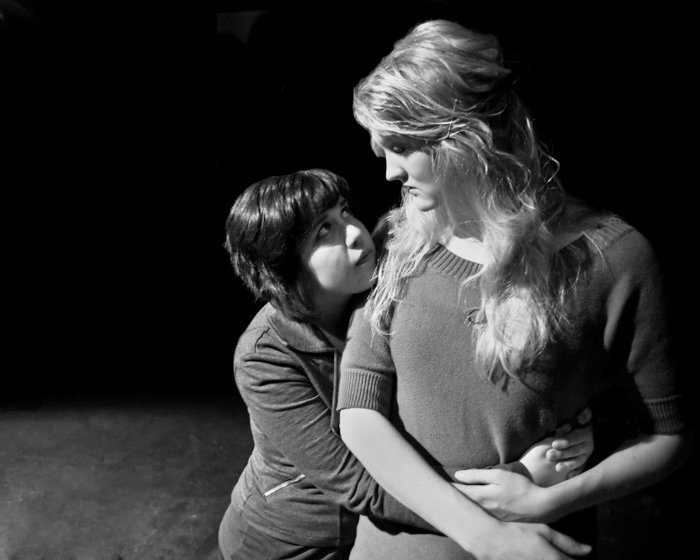
Erratica press shot, photo credit Benjamin Haile

Dave as the ghost of Christopher Marlowe in "Erratica"

How often do you work on your art–is it a full-time endeavor or something you work on in your spare time?
You assume I consider the time I spend on acting spare.  It’s not.  It’s a second job (or third or fourth, depending on how you count them).  It’s work I like, at least at the best of times, but it’s still work, not a hobby.  This is the fundamental assumption that a lot of what I will call, for want of a better way of putting it, normal people tend to make, that art is a hobby or something you do recreationally simply because it is often done for free.

Allow me to wank philosophical for a moment.

It’s something we assume about a lot of occupations.  A lot of people would say that my mother was unemployed for twenty-five years because being a full time parent is not a job.  Anyone who has been a full time parent, however, would likely disagree, if they gave it any thought.  I remember my mother recounting an exchange with a DA during jury selection in which he would not let go of the idea that she was unemployed.  She stressed with increasing irritation that she did in fact have a job and the sooner he understood that the more teeth he’d be able to hold on to.  I may be exaggerating that exchange slightly.

But ask yourself.  In what way is it distinct from a job?  Because it’s a position that involves no pay?  That would mean an internship is not a job, or that volunteer fire fighters are technically on vacation when they’re on call at the fire house because they are not getting paid.

This is more than a job.  It’s part of who I am, as cliche ridden as it may be to suggest it.  It is integral to what it means to be me and were it removed I would feel that I was no longer myself.

At any rate, I don’t call myself an artist.  The term is far too general.  Actor at least gives an indication of what I do.  I consider it a job, though it’s not how I pay the bills.  To do that, I work a desk.  It is boring.  Mostly I sit there and pray for the death that will not come.

How does art fit into your life, in general? Is it something you think about and talk about every day, or every week, or only in certain situations, etc.?
I think I’ve covered this for the most part. My friends are, by and large, theater people, so my personal and professional circles overlap a lot.  The artistic director of the theatre company I’m with presided at my wedding.  The reader/groomsman was an actor, and another groomsman was the first director I ever had.  And the beat goes on.  When I said it was part of who I am, I didn’t mean to be glib or self-aggrandizing.  The choices I’ve made and the people I’ve surrounded myself with are all part of that.

When you start on a piece, what kind of end result do you have in mind? Does it get performed or published, put in a permanent form or is it more temporary?
The idea behind theater is that it is alive.  The show will change slightly from night to night.  What one audience laughs at or is moved by will have no effect on another audience.  The show may be recorded, but staring at a screen is hardly the same thing as being in the theater watching the play happen live, as anyone who has done both will tell you.

There is the script.  That is, in some small way, permanent, but it is only one piece of the show.

What goals do you set in relation to your art, both short- and long-term? Is it something you hope to make money doing, or is it something you want to keep uncommercialized? Does the term “sell-out” hold meaning for you or do you see the art/commerce relationship as a necessary one?
The short term goal is always the same.  Finish this show and gear up for the next one.  Long term, it’d be brilliant to get paid to do this, enough so that it’s all I have to do.  I cannot describe how much I hate riding a desk.

The commodification of art.  That’s something we could spend a long time on.  You can tell yourself that money doesn’t matter, but to some extent, it does, whether you’re being paid for your work or not.  I would love to build glorious sets that immerse the audience in the play from the moment they enter, or costume actors in clothes specifically chosen from the whole history of fashion to communicate some intrinsic truth about them.  But ultimately, I haven’t got the budget.  So the actors wear what we can afford out of what we find, often some combination of their own clothes and second-hand items.  It’s the same all around.

To sell out, to me, means the money is more important than the art, and ultimately you can’t know someone to be a sell-out without knowing their mind.  There are plenty of big Hollywood actors who will tell you they do movies so they can come back and do theater without worrying about making ends meet.  I can respect that, even if I don’t much care for some of their work.  Does that mean they’re sell-outs?  No.  I don’t think so.  And while I’d like to say I’d never make an awful movie, the pragmatist in me knows we all have our price.  My wife and I have bills to pay, debts we owe.  If I could wipe those away by playing some part in making “Transformers 4: Just Like Transformers 2 But Somehow Even Worse,” I just might do that.  I’d keep doing theater, mind, because I need something that sates that creative impulse, and I might not watch the film once it came out.  But I’d do it.

I think fifteen year-old me would have a very different answer, but he’s not here, the lazy little shit.

What role does collaboration with others play in your art, if any?
It’s integral.  I can’t direct, do the lights and sound, produce, design costumes, and play all the characters.  I could do a one man show, I suppose, but I’d still need someone helping with publicity, a space to perform in.  Otherwise I’m just one of those crazy people on the street corner.  Unless I have a hat on the ground in front of me.  Then I’m an artist.  Or a panhandler.  It’s a fine line.
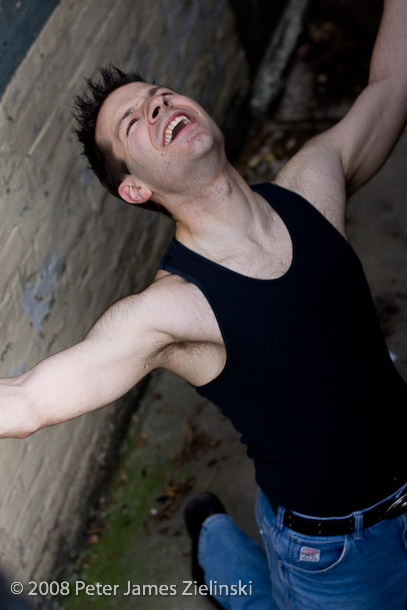
David Wilhelm

not panhandling

How conscious are you of your artistic influences? Who are your artistic influences?
To answer both questions in one go, I haven’t a fucking clue.  I can tell you what writers have moved me, what performers have surprised me.  In the end, everything that I am contributes in some way to the imagination that merges with the text to form the characters I play.

Since this is a travel blog, how does travel relate to or affect your art? (Themes in what you produce, road trips to perform your music, thoughts on what happens to your painting when you ship it across the country to a customer, etc.)
Money is the big issue here.  Travel isn’t cheap, and most places that need entertainers can find them nearby.  I’ll gladly travel anywhere to perform, so long as someone else is paying, because gods know I don’t have the coin.

I’ve traveled on my own, not as much as I’d like but more than I’ve any right to have managed.  Every part of it has helped to shape me in some way into the person I am now, so in that respect, it has had some effect.

And finally, a right-brain question: If your art was a map, what would it be a map of?
Big empty space with the words: Here be dragons.

If you’d like, share your website/Facebook page and any upcoming gigs/plans you’d like readers to know about.
www.actordavidwilhelm.com

Also, I am now co-host of the new game nerd podcast Loot the Room: http://loottheroom.libsyn.com

Photo 1 credit Benjamin Haile. Photo 2 credit Peter James Zielinski.

Aesthetically Speaking: Catherine Adel West

This week’s interview was conducted with Catherine West, a colleague of mine at work. We found out we actually grew up blocks from each other in Evergreen Park, and now years later we’re working as editors in a small office in downtown Chicago. Small world. Catherine’s blog makes me laugh every time I read it, and I’m looking forward to reading more as the inspiration strikes her. Thanks for sharing, Catherine!

What is your name and city of residence?
My name is Catherine Adel West and I live in Chicago, IL.

What medium do you work in?
I am a writer. Whether or not I am a legendary writer remains to be seen.

Catherine West

Catherine West, legendary writer

How often do you work on your art–is it a full-time endeavor or something you work on in your spare time?
I write in my spare time. Mostly I write after work or during breaks. It’s for the most part when inspiration hits me, which is more and more often these days.

How does art fit into your life, in general? Is it something you think about and talk about every day, or every week, or only in certain situations, etc.?
As I have to edit other people’s words, I think about my work and my words all the time, every time. It actually helps to know what techniques work in writing and which ones do not.

When you start on a piece, what kind of end result do you have in mind? Does it get performed or published, put in a permanent form or is it more temporary?
When I begin a story, it is very fluid. I never know where I’m going to end up which is most of the fun. My result varies with each story I create; I want to make you laugh; I want to make you cry. My overall goal is always the same and that’s to make the reader feel something powerful. I will publish my work on a blog. I am, however, experimenting with the idea of being more aggressive and entering short story competitions.

What goals do you set in relation to your art, both short- and long-term? Is it something you hope to make money doing, or is it something you want to keep uncommercialized? Does the term “sell-out” hold meaning for you or do you see the art/commerce relationship as a necessary one?
My ultimate dream or goal has always been two-fold. Become a successful writer both literary and screenwriting (maybe an Oscar or two in my future). To me, sell-out is not a dirty word as I have never been the “starving artist” type. We do have to make a living and we all, as artists, want to reach as many people as we can with our words, music, images, etc.

I think the lines that one is willing to cross determine the extent to whether they will be able to ultimately live with their decisions or not. I think in the end, I will be able to live with my decisions and do so happily.

What role does collaboration with others play in your art, if any?
Collaboration, if any, for me comes mostly in the editing process. I give my stories to a few trusted people and they give me their honest feedback. We will go back and forth about things that can be edited or changed. However, writing is mostly a very single and lonely process.

How conscious are you of your artistic influences? Who are your artistic influences?
I think anyone who performs music, paints, writes, or whatever is constantly trying to live up to an ideal person. With every note played, word written, or brush stroke comes a constant questioning of how would this person handle it or how can I put my own unique spin on my art form. I am no different.

 I read and re-read every line and compare myself. How I write, every word used has little bits of Zora Neale Hurston or Dean Koontz or Anne Rice or Chuck Palahniuk. I try to write to combine love of ethnicity and mystery and description and dark humor. I want my writing to be all of these things in a unique shell.

Since this is a travel blog, how does travel relate to or affect your art? (Themes in what you produce, road trips to perform your music, thoughts on what happens to your painting when you ship it across the country to a customer, etc.)
Travel mainly affects the way I describe a place in my writings. A lot of it I pull from different places I’ve visited. A hotel room in Paris; a casino in Vegas; the way the Pacific Ocean beats the sand in Santa Monica — all this helps me give a place or setting as much depth and feeling as the characters themselves.

And finally, a right-brain question: If your art was a map, what would it be a map of?
As much as I dislike the wilderness, I would actually compare my art to the forest. There is a lot of beauty, dense and raw, and it can be hard to get through, but once you hit that beautiful meadow, and the sun is shining off the picturesque lake, the trek was totally worth it!

If you’d like, share your website/Facebook page and any upcoming gigs/plans you’d like readers to know about.
I have a wonderful blog titled “Ghetto Yuppies.” It’s funny and crazy and a good read so I invite all people to check it out! http://catherineadelwest.blogspot.com/

Aesthetically Speaking: Natalie Hurdle

This week’s interview is with Natalie Hurdle, co-founder of Strange Bedfellows Theatre here in Chicago, a new company just putting down roots in the city. I’m excited to see what productions come next. Thanks for sharing, Natalie!

What is your name and city of residence?
My name is Natalie Hurdle and I live in Chicago.

What medium do you work in?
I work in the theatre–I am a co-founder and ensemble member of Strange Bedfellows Theatre, and I also work at Piven Theatre Workshop.

How often do you work on your art–is it a full-time endeavor or something you work on in your spare time?
That’s an interesting question to answer as a young artist–as Strange Bedfellows continues to grow, I hope that one day it can be my one and only job. In the meantime, I work in arts management at Piven to pay my bills and learn how to run my own theatre company. Even when I’m not actively in rehearsals or meetings, I feel I’m learning and preparing and garnering new resources for my work.

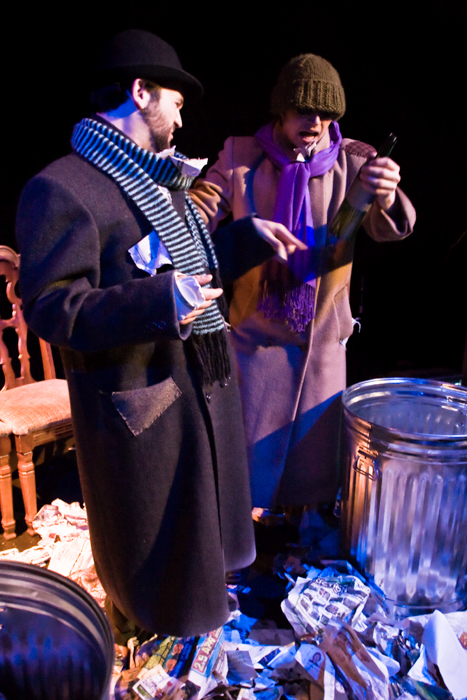
Fire Island by Strange Bedfellows

Natlie Hurdle and Jen Westervelt in Strange Bedfellows' "Fire Island"

How does art fit into your life, in general? Is it something you think about and talk about every day, or every week, or only in certain situations, etc.?
Art drives my life. It’s a constant thread in my heart and mind. Almost everything I experience ends up informing my work in one way or another. Every day, artists make the decision to keep creating–a decision that can require considerable compromises and sacrifices when it comes to personal relationships, financial security, and all the other messes in life.

On the other hand, I think to be a great artist, you need to have a life outside of art, otherwise you have nothing new to bring to what you create. Your art is richer and fuller when you step outside of your art bubble and splash around in the world and bump into other people. And there are definitely nights when I have a beer with a friend to talk about anything BUT theatre. We all need time to rejuvenate–making art can be exhausting.

When you start on a piece, what kind of end result do you have in mind? Does it get performed or published, put in a permanent form or is it more temporary?
Theatre isn’t theatre if it isn’t shared with an audience–the performers and sets and sound and lights are only half of the equation. The reaction of each different audience changes the show so incredibly. I love how I can see a performance of the same play with the same actors in the same place ten different times and the makeup of the audience alchemically alters the show. One of the things I love about theatre is how very temporary it is. That performance for that audience will never be repeated again, no matter how long the production runs. And you can’t capture the experience.

What goals do you set in relation to your art, both short- and long-term? Is it something you hope to make money doing, or is it something you want to keep uncommercialized? Does the term “sell-out” hold meaning for you or do you see the art/commerce relationship as a necessary one?
I would love to be bringing more money in as an artist so I can put more time and money back into my art. Art is valuable; I see no reason to refuse payment for making it. I don’t believe that I have a super commercial bent as a theatre artist, but finding ways to reach and engage a new audience is something I think theatre artists in particular should be thinking about–and creatively.

Fire Island by Strange Bedfellows

Brooks Applegate and Derrick Marshall in Strange Bedfellows' "Fire Island"

What role does collaboration with others play in your art, if any?
Strange Bedfellows is a very collaborative company. I think the work we do together is stronger and more interesting because it is made by dissimilar people with unique strengths and ideas and a common goal. Strange Bedfellows indeed.

How conscious are you of your artistic influences? Who are your artistic influences?
Very conscious. I read a lot; I see a lot of theatre; and when I feel stuck and uninspired, I go back to the artists who remind me of my passion. Anne Bogart, Paula Vogel, Sarah Ruhl, Mary Louise Parker, not to mention my great teachers–Joan Herrington, Mark Liermann, Jim Daniels, Elizabeth Terrel, and the list goes on.

Since this is a travel blog, how does travel relate to or affect your art? (Themes in what you produce, road trips to perform your music, thoughts on what happens to your painting when you ship it across the country to a customer, etc.)
When I was sixteen, I had the unreal experience of performing at the International Fringe Festival in Edinburgh, Scotland, the largest theatre festival in the world. That sealed the deal for me as an artist. I wanted to make theatre and engage with theatre and connect with other theatre artists and lovers of theatre for the rest of my life. Learning from artists of other backgrounds and cultures and examining the changing contexts in which theatre is made fascinates me. I would love to travel more to do all of that. For now, Chicago is our home base, and I imagine it will be for a long time. Who knows, though?

And finally, a right-brain question: If your art was a map, what would it be a map of?
A map of empathy. A map of magic.

If you are looking for any other information on Strange Bedfellows Theatre, check out our website.

Photos by Daniel Halden Fitzpatrick.

Aesthetically Speaking: Jeannie Miernik

This week’s artist interview was conducted with Jeannie, a writer living in mid-Michigan. Jeannie and I met at Kalamazoo College and studied abroad together in Rome junior year. Jeannie and her husband are raising a gorgeous baby daughter in Lansing, and she’s also writing a novel. I’m definitely impressed with her devotion to the craft, and her blog is a great source of writing tips and ruminations. Thanks for sharing, Jeannie!

What is your name and city of residence?
I’m Jeannie Miernik from Lansing, Michigan.

What medium do you work in?
I am writing a fantasy novel based on European folklore. The working title is Briars and Black Hellebore. On one level, it’s a retelling of fairy tales like many writers have done before, but on another level it’s a story about storytelling itself, about oral and literary traditions and the transmission of culture. It’s about the power of words and narratives to shape our realities. As I work on this novel, I am exploring what I call “metamyth,” the stories behind stories.

How often do you work on your art–is it a full-time endeavor or something you work on in your spare time?
Right now, I am a total guerilla writer. I have a six-month-old baby and two jobs, so I steal minutes here and there to write, only up to a few hours a week. It depends on how long my daughter naps!

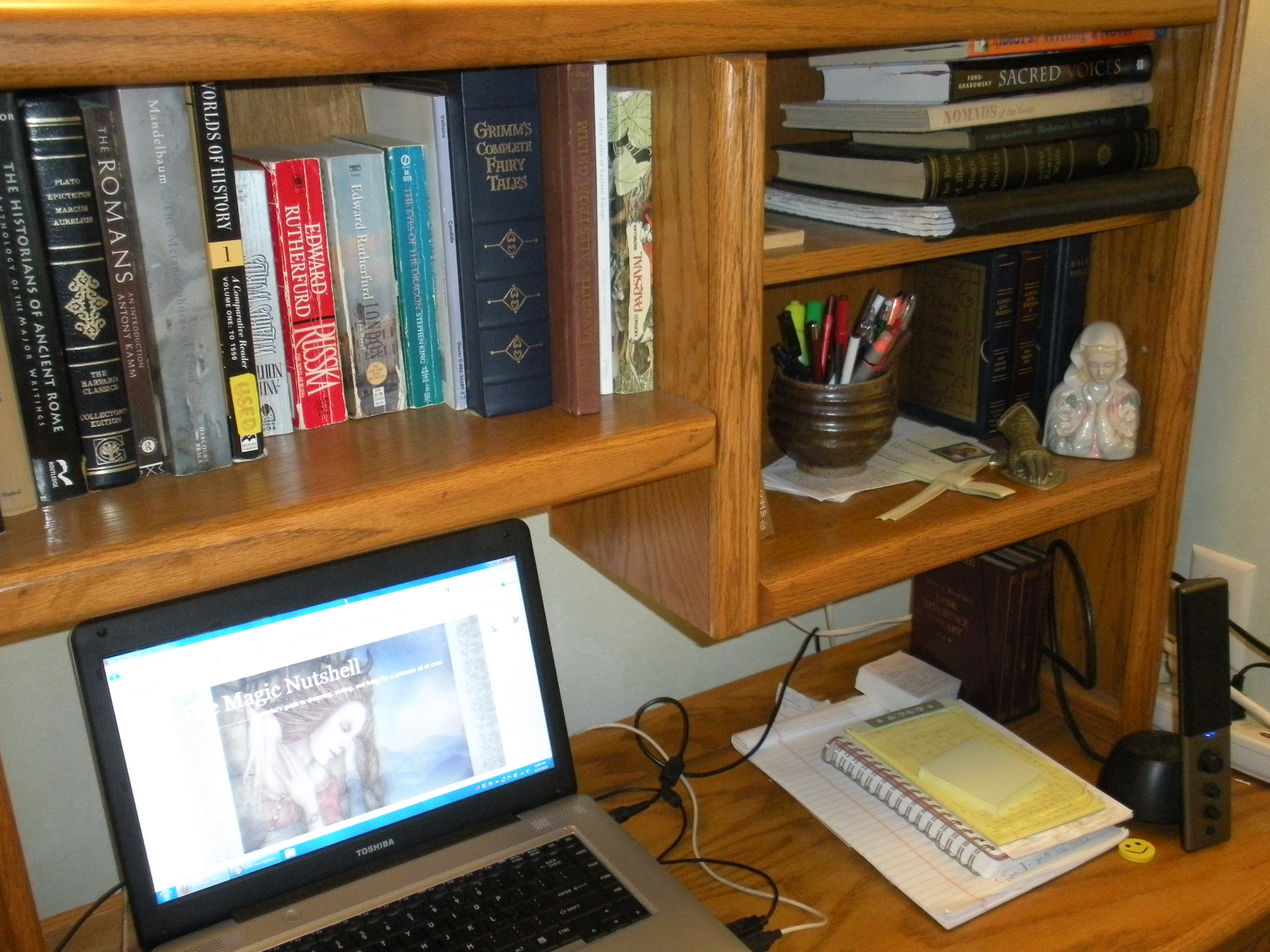
Jeannie's workspace

Jeannie's workspace

How does art fit into your life, in general? Is it something you think about and talk about every day, or every week, or only in certain situations, etc.?
Writing is solitary work, but I think about my plot, characters, and word choices every day—in the car, in the shower, during lulls at work, and even in dreams. Films, paintings, architecture, plays, nature, and all kinds of unlikely experiences give me ideas. Although I don’t have much time to sit down and write, I do read about European history and myth at every opportunity. I keep books and articles packed in my breast pump bag and my nightstand. I talk about concepts and interesting stories and history facts all the time with my family and friends. They will probably be bored with everything I’ve learned before I’ve finished my book!

When you start on a piece, what kind of end result do you have in mind? Does it get performed or published, put in a permanent form or is it more temporary?
I would like to see my book published one day. I hope to craft a novel of high enough quality and broad enough appeal to land a contract that could lead to an ongoing fiction writing career. I realize that such publishing deals are going the way of tenured professorships, but they still do exist, and that is my dream.

What goals do you set in relation to your art, both short- and long-term? Is it something you hope to make money doing, or is it something you want to keep uncommercialized? Does the term “sell-out” hold meaning for you or do you see the art/commerce relationship as a necessary one?
In the short term, while I’m caring for a baby, family is my top priority and takes most of my energy. So my goal for the next year or two is just to keep the writing momentum going, adding something to my manuscript every few days.

In the long term, I hope to reach many readers through publication of many novels. I hope to make enough money to support myself in continuing to write fiction—without having to maintain two “day jobs” in the meantime. It would be a great pleasure to reach a large readership who might enjoy my stories and interpret them in different ways.

Selling a work of art is not the same as selling out. I have always understood the term “selling out” to mean compromising a work’s integrity for a profit. But the difference between selling and selling out is complex and subjective. Not all changes or amendments to a work to prepare it for sale compromise its integrity. For example, an editor’s suggestions to fix errors within a manuscript to improve its quality for sale would likely improve the work from an artistic standpoint and not subvert its purpose. On the other hand, product placement within a novel that has nothing to do with the story would be a sell-out. But there is plenty of gray area between those obvious examples. I think it’s a distinction made in the gut of the artist in relation to each individual work.

The art/commerce relationship is not always necessary; many people express themselves creatively without selling their works. But the creation of any piece of art does take time and money, so if the artist cannot independently support her or his own work, it must be made possible through sales or grants or patronage, which are not entirely different arrangements. For me, selling my novel could give me the freedom to spend time writing more and better novels and improving my craft in a way that would be difficult or impossible if writing time were always forced into the periphery of my daily life.

What role does collaboration with others play in your art, if any?
The text of my novel itself I write completely on my own. But indirectly, many others have assisted me. My writing has benefited from a good critique partner who is encouraging, honest, and skilled at close reading and reviewing. Every time she says, “I don’t like this,” she points out a way to make the scene or chapter a hundred times better. Other help has been even more indirect, but no less important. My husband has been supportive in providing me some time and space to write, and I have learned a lot from networking online with authors and readers.

How conscious are you of your artistic influences? Who are your artistic influences?
I couldn’t possibly be conscious of all of them—in some way, I am influenced by every word I’ve ever heard or read—but I can name many that I intentionally draw upon.

A major influence of my current manuscript is Gregory Maguire, author of Wicked, Confessions of an Ugly Stepsister, and other creative retellings of fairy tales.

I try to read classic stories, old and new, in the hope that I can learn even a tiny bit from the literary masters. I like to read Shakespeare, the ultimate master of witty dialogue, and novelists like Vladimir Nabokov, Virginia Woolfe, Tolstoy, and Jane Austen.

I also admire J.K. Rowling for her world-building, her whimsical names and made-up words, and her fun and accessible storytelling.

My favorite modern storytellers, famous but still underrated, are American Indian authors Sherman Alexie and Louise Erdrich, who paint such vivid, inscrutable, and true faces of humanity. My own life experience is limited, and I feel that reading poignant stories of other people’s experiences, real or fictional, broadens my understanding of what it means to be human and helps me write better characters.

To keep my use of language fresh and interesting, I like to study prose and poetry in other languages as much as I can. Although I don’t read or understand Japanese, I enjoy the elegance of the haiku poetry form, and I like to read English translations of medieval Japanese love and Zen poetry. In Spanish, I have read some prose by Paolo Cuelho (translated from Portuguese) and Laura Esquivel and the poetry of Pablo Neruda. I love listening to Italian, French, and German opera and playing with different ways of translating the libretti into English to capture—or modify—meaning, tone, and lyrical rhythm in different ways. My husband and I practically worship the band Rammstein for Till Lindemann’s lyrics with their subversive and brilliant triple-entendres and wonderful turns of phrase. Some of the songs echo concepts and themes from medieval and ancient German folklore, which is perfect for my current project. Listening to Rammstein while writing has inspired a few of the scenes in my book.

With Briars and Black Hellebore in particular, I am drawing from extensive readings of Western European folklore, which is connected to the folk traditions and fairy tales of Eastern Europe and Southeast Asia and the Far East. As a child, I loved the Grimm brothers’ iterations of German fairy tales and also modern Disney movies based on fairy tales.

As an adult, I am having a great time tracing those storylines further and further back into pre-Christian epic poetry and cross-cultural traditions. I read Homer and Ovid in college, and just now I am delving into Beowulf and the Nibelungenlied, the great Germanic epic that splintered into many of the fairy tales recorded by the Grimm brothers. I am amazed at how downright entertaining and fascinating the Nibelungenlied is and how few Americans have even heard of it. I feel the same way about the story of Camaralzaman and Badoura in the Arabian Nights tales.

Old stories rooted in oral tradition have made me think deeply about the ways stories and cultural ideas evolve through time and across geo-political space, sometimes organically and sometimes intentionally by a single author. The stories within the Nibelungenlied and the Arabian Nights are influenced by true events and people, the stories of other cultures, bizarre misconceptions of other cultures, and editorial opinions and interpretations of the people who finally wrote them down. German fairy tales, often told by the lower classes and probably mostly by women, were edited, censored, and modified by the Grimm brothers in order to sell them in book form to a wealthy, male readership. (See “selling out,” above!) It is so exciting to plunge down the rabbit holes of revisionist history, cultural misappropriation, political and moral censorship, mistranslation, and divergent narratives following migrations and culture shifts.

I also have a fascination with sacred texts, Christian and otherwise. The “metamyth” of sacred texts is as interesting as the writings themselves. It is amazing how controversial and loaded the line between “myth” and “religion” is drawn in modern Western society, but the difference is impossible to define coherently or justify.


Since this is a travel blog, how does travel relate to or affect your art? (Themes in what you produce, road trips to perform your music, thoughts on what happens to your painting when you ship it across the country to a customer, etc.)

I love to create rich, purposeful settings for my stories. Traveling anywhere, to a nearby city or a distant country, to somewhere beautiful or ugly, for business or pleasure, stimulates my senses, layers and deepens my store of memories, and opens my mind and spirit to fresh insights and observations. Like a painter who builds up the “negative space” around the subject of a picture, I try to use setting to reflect and influence characters’ internal motivations, set moods, foreshadow, and become part of the action. As a novel reader, I like to be “taken away” on a journey outside myself, so I try to offer that experience in my own writing.


And finally, a right-brain question: If your art was a map, what would it be a map of?

It would be a map of Western culture. Ultimately, that is what I am exploring as I work on Briars and Black Hellebore.

If you’d like, share your website/Facebook page and any upcoming gigs/plans you’d like readers to know about.
http://magicnutshell.blogspot.com/

A Celebratory Thing

I read another write-up on M.I.A. and was struck by her final quote:

“I don’t know why it’s not a celebratory thing, the fact that I just know about a lot of fucking shit. That’s all. Yeah so I know how billionaires live in America, and I know how poor people live in Sri Lanka, and I know how soldiers are, and I know what it feels like for your dad to throw hand grenades out of your bedroom window, I just know that. I’m not going to be able to change any of those things, and ultimately I believe in creativity. You get out what you put in, and it’s not like I only put one thing in.”

You may remember a NYT Magazine article from earlier this year that had all sorts of negative things to say about M.I.A. One of those things was that she’s a sellout for marrying rich and living in LA, and that she can’t talk about her years of living poor in London and Sri Lanka anymore. Which, as she points out in this quote, is bullshit.

She’s had years of various experiences, and she’s perfectly entitled to talk about any and all of them, just as the rest of us are. Pretending you are still living an underprivileged life is very different from continuing to speak up about the conditions of that underprivileged life, and M.I.A. is doing the latter. She has strong (and controversial) political opinions and she’s using her fame and music as a forum for talking about those opinions and drawing attention to issues she believes are under-addressed in mainstream media and hip-hop.

She knows how music works, she knows how fame works, she knows how growing up in a civil war works, she knows how art school works, and she’s weaving all these parts of her past life into her current and future life. If we’re self-aware enough, we’re all doing the same thing with our own lives; sorting through which experiences and ideas are still useful to us, which aren’t, and which we still need to process in order to determine where they fit in our life story.

I can’t argue that M.I.A. is looking to make a buck, but I’m getting so sick of people railing against musicians and authors for that. We are all trying to make a buck, and generally those artists who make a lot of money use it to continue making art. Whether the art becomes good or bad isn’t related to the fact that they made money, but what they chose to do with it once they made it. A sellout uses money to shut down their creativity, whereas a financially successful artist uses money to fuel it.

So she isn’t selling out, she’s synthesizing her life experiences into her art and creativity. We should all be so lucky. As she says, it’s “a celebratory thing.”