New Centerstage Review Up

Last week I reviewed The Swordswomen of San Gimignano at New Rock Theater. The large setpieces were far too stilted, and one of the main leads, Serafina, wasn’t comfortable in the role. But there were many entertaining scenes, and some good performances. I mention the buffoons in the review, but Ruffaelo (Almir Limaj) and Roberto (Mike Ardashnikov) are also a good comedic pair, with an easy rapport. Here’s an excerpt of the review:

“Swordswomen” is a comedy in the classic sense, which means we have lovers who need some help getting together, cross-dressings and misunderstandings, and hapless henchmen providing more insightful commentary than the main characters.

You can read the rest of the review here.

Where’s the Game?

The other week I was on a shuttle bus headed back from a wedding reception to the hotel, and we passed a large white van pulled over on the side of the road. The cop car lights were flashing and as we zipped by, I saw the logo on the side of the van. It was a Salvation Army van! What was a Salvation Army van doing out and about at midnight, and in trouble with the law?

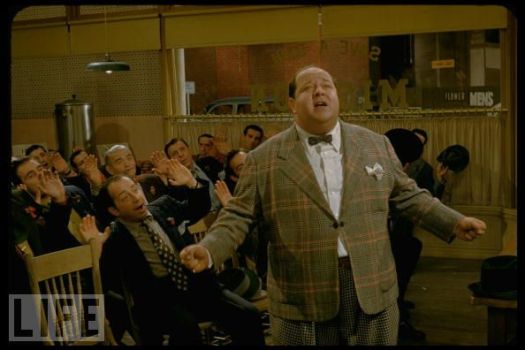
My bet is Nathan Detroit found a new place for the craps game.

Nicely Nicely in "Guys and Dolls"

Rockin' the boat went mobile

ACAM: Angkor Wat, Cambodia

Hello, dearest fellow travelers! We are now moving from Singapore to Cambodia in the ACAM Project. I’ve been reading A Short History of Cambodia: From Empire to Survival by John Tully, and so far I’m liking it as a very brief overview. One of the things that Tully emphasizes is that there are so few records of Cambodia before the 16th century. Unlike the ancient and well-documented civilizations of China and Japan to the north, the Khmer people live in the hot, wet land of southeast Asia, which doesn’t do so well for preservation of paper. So what we know of the history of Cambodia is largely taken from what visitors wrote about it over the years, and also a bit from stone inscriptions.

Angkor Wat photo by Trey Ratcliff

If it's this magnificent now, imagine how Angkor Wat looked in its day.

The ancestors of the Khmer people built the city of Angkor in the 9th century CE, and at its height it was the largest city in antiquity, with a population of 1 million. One million people in one place in the pre-industrial age! For comparison, London grew hugely in the 16th century and still only reached 225,000. So Angkor, today a giant ruin of temples and not much else, was, for several hundred years, the largest city in the world.

Tully is eager to emphasize that the massive building projects of Angkor were all based on a huge slave population. I got a bit uncomfortable with his descriptions of the “overweening egotism and peculiar religiosity” (p. 25) of the devarajas (god-kings) who ruled over their enslaved subjects and commissioned giant temples. I’m not uncomfortable with pointing out the barbarism of slavery, but there are several other places in the book where Tully draws comparisons between the Angkor people and other ancient peoples, which helps put their culture in context. I mean, when I read about tens of thousands of slaves dragging several tons’ worth of stone to a building location to construct an enormous temple made for the glory of a god-king, the first thing I thought of was the ancient Egyptians. Right? Pharaohs, gods incarnate, built pyramids as massive tombs for themselves, to be filled with materials to carry into the afterlife; and all at the considerable expense of slaves’ sweat and blood. But Tully never draws this comparison, which strikes me as odd.

Maybe the constructions weren’t similar enough for him? He says several times that the wats were an unprecedented religious construction; they were temples and mausoleums at the same time. So they weren’t like a church or mosque, which may have some tombs in it but serves the main purpose of being a place of worship for people; nor were they like pyramids or large tombs, which serve the main purpose of housing the deceased. They were places to worship the deity Vishnu or Shiva, but only through worshiping the god’s manifestation on earth, the god-king’s body. (Or at least this is what I got from re-reading the relevant chapter over and over; please correct me in the comments if I’m missing something.)

Angkor Wat photo by Philip Lock

splendid

Speaking of religion, the wats (yep, the Angkor Wat is the largest religious construction of what used to be this major city, and that’s how it got that name) were part of a strain of Hinduism practiced in Angkor, influenced by Mahayana Buddhism and Khmer folk beliefs (p. 39). Tully references historians who believe that the decline of these religions and the rise of Theravada Buddhism contributed greatly to the decline of the Angkor empire. The drive to build monuments glorifying one man, at the expense of thousands of men who literally lived to serve him, was a concept supported by Hindu and Mahayana Buddhist beliefs. Theravada Buddhism, on the other hand, emphasized living a simple life resigned to suffering. This resignation to suffering may have comforted the laborers, but the more democratic focus on achieving nirvana by living a good life rather than making great displays may have stirred up discontent among them as well and undermined the devaraja rule. (Please note that I am not familiar with the particulars of various strains of Buddhism, so I’m paraphrasing Tully here, who is talking about Buddhism as it was practiced 1000 years ago. These may not be the same as current iterations of the religion.)

Tully points to two other major factors in the decline of the Angkor empire: increased raids by neighboring Siam (today known as Thailand), and environmental destruction. The city (which was spread over a large swath of land) depended on a particular system of irrigation canals. Deforestation above the canals caused damage to the water and soil below, which destroyed many fish and introduced still water patches perfect for malarial mosquitoes to breed in.

So the people believe in a more equitable religion, one that denounces material things, right around the time armies are invading, and old farming and forestry practices are destroying the people’s habitat. Easy to see how these factors combined to kill and displace people, and transform the population of a mighty kingdom into a minor city and eventually a grand ruin.

Photos from here; photo 1 taken by Trey Ratcliff, photo 2 taken by Philip Lock.

Eat Your Vegetables

I love fruit. I do not love vegetables. Their texture is all wrong, it’s difficult to cook them just right so they’re not too hard or too limpid, and they taste far too much like earth and not nearly enough like something delicious. But being a grown woman of 28, I am aware that I need to eat more vegetables. I’m training myself to eat broccoli since it’s basically the best vegetable for you. How do I do this?

Mix the vegetables I do like in with broccoli, and stick them all next to mashed potatoes. Conceal and deceive!

rewards and punishments

For the record: it was not a fully successful experiment. Broccoli is still a tiny tree trying to sprout in my mouth. Perhaps repeated attempts will yield better results.

If not, there’s always the mashed potatoes.

It’s SO Hot Out…

How hot is it?

It’s so hot that the pigeons have given up. Rather than strut around their little poop-splattered kingdoms under the El tracks, or dive-bomb pedestrians in their petty turf wars, they’re lying down and calling it quits. I saw two pigeons today do this:

This is what defeat looks like.

Not even quite that. There was shade to be had, but it looked like they just couldn’t even make it that far, so they were sitting in direct sunlight, at noon, waiting for death. They each had the right wing out a little, as if it were sheltering something, but I saw nothing under the wing, just a patch of shade that did them no good. Poor little pigeons.

That’s right, it’s so hot out that even pigeons are inspiring sympathy.

Photo from here.

New Centerstage Review Up

Last week I saw Laer’s Last Prayer, which was not put on by a specific company but rather was the writing and directing project of one man, Stephen F. Murray. I find it difficult to review such personal projects (Like The Untangling at the Junction a few weeks ago), because any negative feedback seems particularly pointed since there’s one person bearing so much of the responsibility. Here’s an excerpt:

Stephen F. Murray’s “Laer’s Last Prayer” is a found poem made up of “King Lear,” “Twelfth Night,” biblical passages, and nursery rhymes. Laer (Elliott Fredland) reigns from a wheelchair, a senile old man tended to by his resentful son, Jack (Nick Lake), and his eager to please doctor, Kent (Brian Hurst).

You can read the rest of the review here.

I liked the idea of the play more than the actual execution. I tried to get at that a bit in the review by talking about the disconnect between absurdism and emotion. Any theater people out there want to tell me if that disconnect is ever bridged in Beckett-ish plays, or if the gap is purposeful?

In Praise of Sam Rockwell

I am slowly working my way through the Sam Rockwell catalog. Basically, I want to see anything he’s been in. Doesn’t matter if it was a bit part, because Rockwell’s genius is stealing scenes no matter the role. He’s easily one of the best character actors working today, and also, bonus, he is extremely attractive.

No foolin'

Apparently his mainstream breakthrough was as a vile criminal in The Green Mile, but I remember first seeing him in Charlie’s Angels, in which he plays a shaggy, soft-spoken geek who turns out (11-year spoiler alert) to be the ruthless villain. For a summer popcorn film directed by a man known only by his made-up last name, this actually showed Rockwell’s range nicely. He was easily the shy nerd kissing Drew Barrymore, and just as easily the pompadoured cad shooting her through a window and lighting up a cigarette.

Also, the dancing. He famously loves dancing, and shows off his fancy footwork at every opportunity. I’ve seen him shake it in Charlie’s Angels, Confessions of a Dangerous Mind, Hitchhiker’s Guide to the Galaxy, Moon, Iron Man 2, and The Winning Season. No, watch, he’s really good:

I don’t think I’ve seen him in a movie in which he wasn’t unhinged or just a little off. At some point in every film, his eyes go wild with desperation or dark with hopelessness. He often plays someone with a hidden side (Charlie’s Angels, Confessions of a Dangerous Mind), or a dangerous side (Snow Angels, The Green Mile), or both (Moon). He invests his characters with such emotion and commitment that I find myself marveling at the humanity he reveals in even his most despicable characters. I’ve read actor interviews about treating their villainous character as the hero of the story in order to find their motivations, but I didn’t really get what that meant til I saw several Rockwell movies close together. He’s never smarter than his sadsacks or kinder than his killers; instead, he knows his sadsack’s frustrations and his killer’s sick itch. He must be a novelist’s dream actor, since he so easily conveys the paragraphs of internal turmoil and meditation usually lost in translation from page to screen.

I’d love to see him on stage and see how his intensity plays out there. But until I get that chance, I’ll be looking out for him in whatever projects he chooses next. Coming soon, Cowboys & Aliens! I’ll be enjoying him, whether he’s looking like this:

Poor clone man, what is your identity now?

or this:

You still look a little lost. I will definitely help you find your way.

Photo 1 from here.
Photo 2 from here.
Photo 3 from here.

An Australian Tradition: Welcome to Country

Hello dearest fellow travelers! This week I saw a cool blog post that ties into my travels. Check out this post at Feministe, which explains the Australian Aboriginal tradition of the “welcome to country.” Here’s an excerpt from that post, explaining the concept:

The Welcome to Country and Acknowledgement of Country are protocols performed in Australia to (allegedly) indicate respect for Aboriginal history and culture, as well as to indicate respect for Aboriginal people who may be attending the event. A Welcome can be performed by a local Aboriginal elder, and represents the traditional owners of a place giving their blessing to an event and welcoming the guests onto their lands. A Welcome is one of the many services that local Aboriginal Lands Councils offer for a small fee, although Welcomes do not have to be performed by Lands Councils.

text for welcome to country in Australia

An example of a "Welcome to Country"

What a wonderful way to acknowledge the complex history of a conquered and colonized country. The tradition goes way back, when an Aboriginal group traveling to another group’s land would be formally welcomed by that group before any other business was attended to. In the last century, it also became a way for non-Indigenous people to show their respect when starting an event or ceremony.

As Hexy explains in the post and Australians write in the comments, sometimes the Welcome or Acknowledgment is done as a rote part of a ceremony, with no sincerity, which obviously misses the point of doing it. But the general idea of saying these words is still good, taking time out to specifically acknowledge and appreciate people who have endured horrifying attacks on their lives and culture. Here in the United States, if this were something we did, it would also be an important way to emphasize that it’s not like Native Americans disappeared, after white people killed them all in a tragic, romanticized West (which is a disturbingly popular view), since the Welcome explicitly welcomes Indigenous folks who may be present.

Of course Australia and the United States do not have the same history, and the indigenous peoples of both lands are very different, but there is a similarity in the way white colonizers treated them brutally, attempted to eradicate them, and now consider them an embarrassing aberration in the national history of white people’s dominance. Making even cursory attempts to acknowledge that bloody history is more than we do here, and it’s something I think would make us a better country. I am not aware of a Native American tradition of such a Welcome or Acknowledgment, and it’s not like you can just slot in one cultural tradition for another, so I don’t see this happening in the States any time soon.

But I’ll be sure to keep a sharp eye out when I’m in Australia to see which communities perform the Welcome/Acknowledgment at their events and ceremonies. I marvel at the wide world of the Internet–here’s a custom that didn’t show up in my ACAM research but is so fascinating!

Abandoned Cities, Tourist Hotspots

Well, I don’t know about hotspots, per se, but this Salon slideshow of “the world’s most beautiful wastelands” makes a compelling argument for why travelers and adventurers might enjoy scrambling over eroded walls and darting across dusty plazas. These places all used to mean a lot to the people who lived in them, and now they’re crumbling into nothingness. They served different functions but now just take up space. They’re a visual reminder of our transience, a melancholy ode to human achievement and fragility. Like stumbling across Atlantis on land.

photo from Salon.com

The splendor of days gone by in Detroit

Photo by Albert Duce, from http://www.salon.com/life/feature/2011/07/10/trazzler_slideshow_beautiful_wastelands/slideshow.html