
My autumnal table, Chicago, IL, November 19, 2011
My autumnal table, Chicago, IL, November 19, 2011
Yesterday, my friend Hannah and I joined in the Occupy Chicago march down Michigan Ave. after we left the office. We took over the northbound lane from Congress up to Randolph and then Randolph to the Thompson Center. (We were headed for Daley Plaza, but the Christkindlmarket was being set up.)

"People, Not Profits!"
There was lots of chanting — “We are the 99%!” “People, Not Profits, Occupy Chicago!” “ONE, we are the people, TWO, we are united, THREE, the occupation is. not. leaving!” — and also some cries of “join us, join us!” to onlookers.

Taking over Michigan Ave. was cool.
A helicopter followed our route, but I couldn’t tell if it was a police chopper anticipating a turn for the worse, or a news crew looking for an aerial view. The cops formed bicycle barricades to keep us from crossing to the southbound lane (although I must point out, which the newspapers do not, that there are several people in the Occupy group who wear reflective vests and direct the group to make sure we all stay pretty orderly, and that’s a service to our fellow citizens that goes unrecognized in the mainstream media).

Hey, that's your beloved capitalism for ya. Better hand over that cash!
We saw a lot of great signs, the most simple being “I can’t believe we still have to protest this crap.” There was a mix of people, a lot of young students, yes, but quite a few middle-aged and older folks as well; and it was a racially diverse group of righteously angry people. Hannah and I stayed for the first couple speeches at the General Assembly and then gave in to the cold and our growling stomachs and headed home.

Dig it.
I do love me a good protest march; there’s nothing quite like it for feeling part of something greater and more noble than your daily life, which is to say, the cause of making everyone’s daily lives better.
Images courtesy of Hannah.
Dearest fellow travelers, in case you missed my exhortation last year, let me repeat it: go see a panto. If you’re in Chicago, you’re in luck, because an Evanston theater company puts on a panto every Christmas season. Forget the tired old Goodman A Christmas Carol, or even any of the we’re-taking-the-piss-out-of-earnest-Christmas productions; Piccolo Theatre is where it’s at. But what is a panto? Here’s an excerpt from my theater review:
‘Pantomime’ is a bit of a misnomer; the British panto involves no miming. Indeed, it’s a raucous production involving cross-dressing, musical numbers, sly pop culture references, and rowdy audience participation. A fairytale or well-known story is reworked for maximum comedic effect, with adjustments made to fit in standard panto characters like the dame, the villain’s henchman, and the slightly clueless hero.
Read the rest here.
What fun! I’ve been to a couple in England on family vacations, and I still remember screaming out warnings to the hero, “He’s right behind you!” as the villain crept up for an attack. It is no less fun to do this as an adult, I promise you. So get thee to a panto!
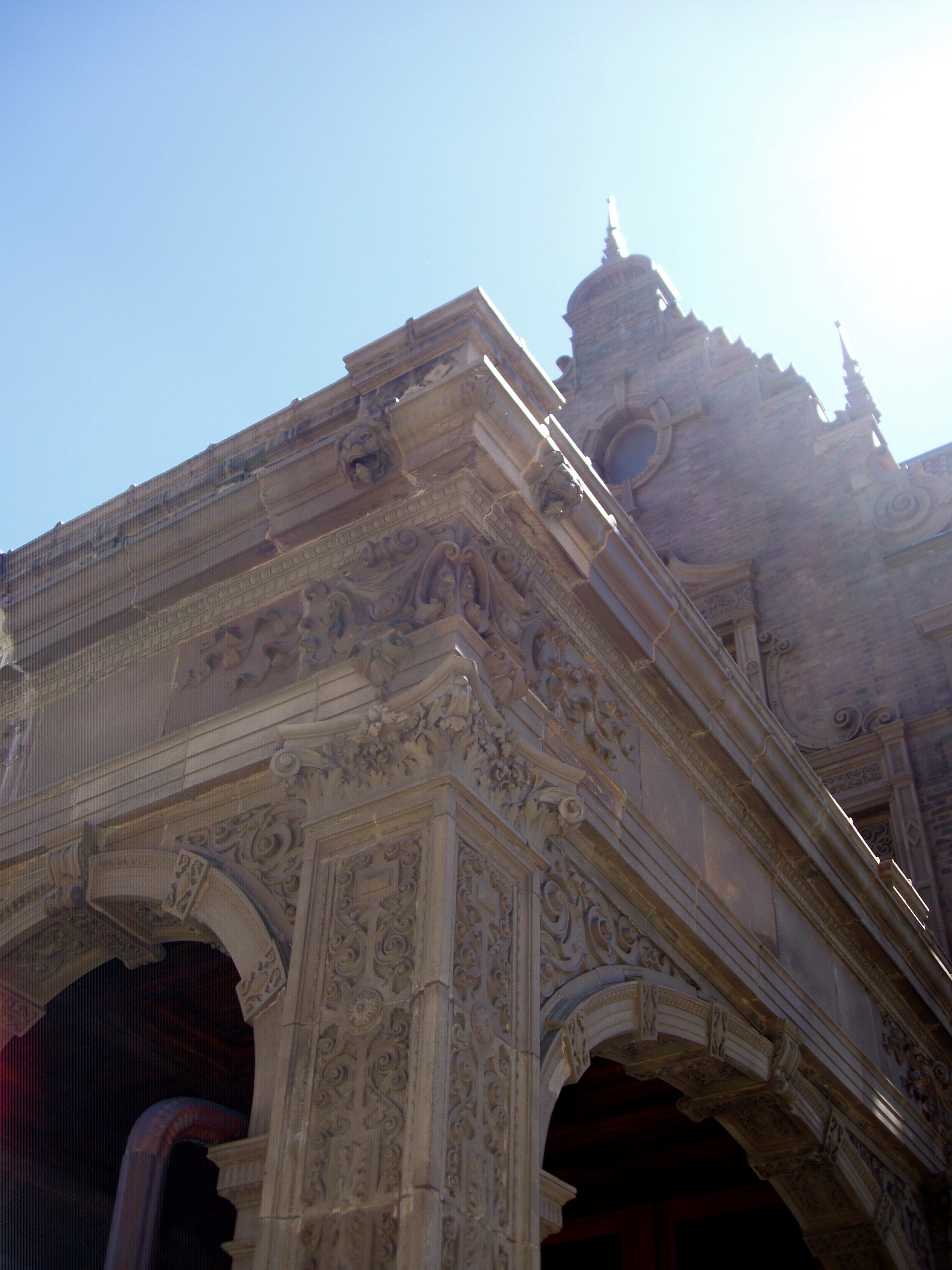
Pabst Mansion, Milwaukee, WI, June 18, 2010
This week’s artist is Kristin Walker. Kristin performs in burlesque shows around the city under the stage name as Trixie Sparx, combining her love of song, dance, and fantastic costumes. She has several shows coming up over the next couple months, so check ’em out. Thanks for sharing, Kristin!
What is your name and city of residence?
Kristin Walker, Chicago, IL
What medium do you work in?
Burlesque Theatre–stage name: Trixie Sparx

Trixie Sparx
How often do you work on your art–is it a full-time endeavor or something you work on in your spare time?
This is a part time endeavor–a little artistic something to feed my soul. While it does pay, it does not pay ALL of the bills… but it does provide enough to buy more sparkly things! I am a member of Vaudezilla Productions, a burlesque troupe (Shameless plug–voted Best Burlesque Troupe in Chicago by the Chicago Reader 2011). We have a group meeting and rehearse solo/group acts once a week and I perform anywhere from three to ten times a month- full blown shows and private gigs, alike.
How does art fit into your life, in general? Is it something you think about and talk about every day, or every week, or only in certain situations, etc.?
Being a part of this artistic community is exhilarating to say the least, and I am always thinking about how to improve my craft, come up with new and cleaver ideas for acts, or promoting my company and the art itself. There are many misconceptions that shadows this art form and deters many people from experiencing it–including many of my friends. Burlesque roots are in parody, which uses sensuality and ‘tease’ in each act while reveling what is underneath sparkly costumes. We burlesque performers are NOT strippers, though we do remove our clothing. It is the element of ‘tease’ which sets us apart from the ‘dead behind the eyes’ stripper types. The important thing to remember is that burlesque is about telling a story through music and movement–sometimes funny, sometimes sexy. While everyone knows the end result (the final reveal) it is the journey that the performer takes you on where the art truly lies.
When you start on a piece, what kind of end result do you have in mind? Does it get performed or published, put in a permanent form or is it more temporary?
When starting a new act, I either get really jazzed by a song I hear, or a concept / character that I think of which leads to a burning urge deep inside me that says: THIS MUST BE DONE! So, I start playing around. I find costume bits and pieces that will work with the concept and character, and through experimenting with dance and movement, I slowly build the choreography to a final product. The unique thing about live performance is that it is organic, and it changes every time you perform. The foundation of the piece is there, but it grows and evolves the more you do it. Moreover, I perform in many different spaces–from bar tops, to small stages, to large venues, to art galleries–and the dance must be modified to accommodate the space.

Dress envy!
What goals do you set in relation to your art, both short- and long-term? Is it something you hope to make money doing, or is it something you want to keep uncommercialized? Does the term “sell-out” hold meaning for you or do you see the art/commerce relationship as a necessary one?
As for goals–I would like to continue doing burlesque theatre for a very long time, as well as start to travel to festivals around the state, and do more private gigs. I am improving every week that goes by as a performer and it feeds my confidence and drive in my everyday life as well. The more I perform, the more I practice, the more I take classes, the more chances I have at making more money to feed the fuel that drives my craft. I never see myself ‘making it big’, or even surviving off of the income from my art, but the benefits it gives me creatively are worth so much more to me. No one in my business, in my humble opinion, has really ever ‘sold out.’ Promotion of burlesque can only lead to more acceptance and understanding of this theatrical art form and can benefit our pockets as well. Burlesque is still a rather underground movement that is surfacing on the social radar and any exposure or opportunity is greatly appreciated and used.
What role does collaboration with others play in your art, if any?
Collaboration happens all the time with burlesque theatre- quite often most shows are ‘Vaudeville-esque’ in nature, incorporating singers, magicians, acrobats, belly dancers, comedians, ect. I have done many ‘group acts’ some character driven and silly, others sensual, that have gone over smashingly. Currently, along with Vaudezilla Productions, I am working on collaborating with a local jazz ensemble for a live band show that will be held in November.
How conscious are you of your artistic influences? Who are your artistic influences?
As with any artist, I am susceptible and open to influence from everything from daily life, to music, still art, literature, culture, society, gender issues, politics and economics. Finding subtle ways to incorporate these themes into your art is a fun challenge. My artistic influences are my friends, whom for the most part, dabble in arts themselves. They impact me greatly and I strive to be a better artist myself so we can continue this ‘artistic dialog’ that inspires and encourages me. In addition, remarkable burlesque performers influence me–when you see it done right, it has a powerful effect on you.
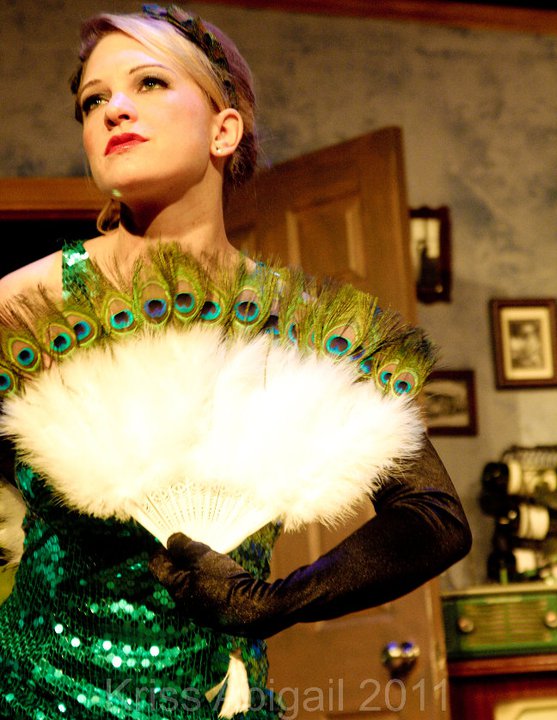
aaaand fan envy
Since this is a travel blog, how does travel relate to or affect your art? (Themes in what you produce, road trips to perform your music, thoughts on what happens to your painting when you ship it across the country to a customer, etc.)
Travel is a very deep passion of mine, and to combine that with the love of my art is the ultimate goal. I am ready and I want to take this act on the road! The best part of burlesque is that this is encouraged, and you can very easily. There are burlesque festivals all over the world, and I will be apply to a few festivals in 2012–some places I’ve never been, and really want to go such as Albuquerque, NM, Vancouver, Canada to name a few. I might also visit New Orleans and Colorado to support friends performing as well.
And finally, a right-brain question: If your art was a map, what would it be a map of?
Fantasia–with heaps of feathers, sparkles and sass.
If you’d like, share your website/Facebook page and any upcoming gigs/plans you’d like readers to know about.
Upcoming shows:
Nov. 23rd at the Holiday Club
Dec. 3rd 10:30pm at the 773 Theatre; Trim! A Christmas Craptacular
Dec. 9th at the Lincoln Tap Room
Jan 21st at the 773; The Guilty Pleasure show
Feb 18th at the 773; Live Band Burlesque show
Photo 1 credit Callie Lipkin. Photo 2 credit Oomphotography. Photo 3 credit Kriss Abigail.
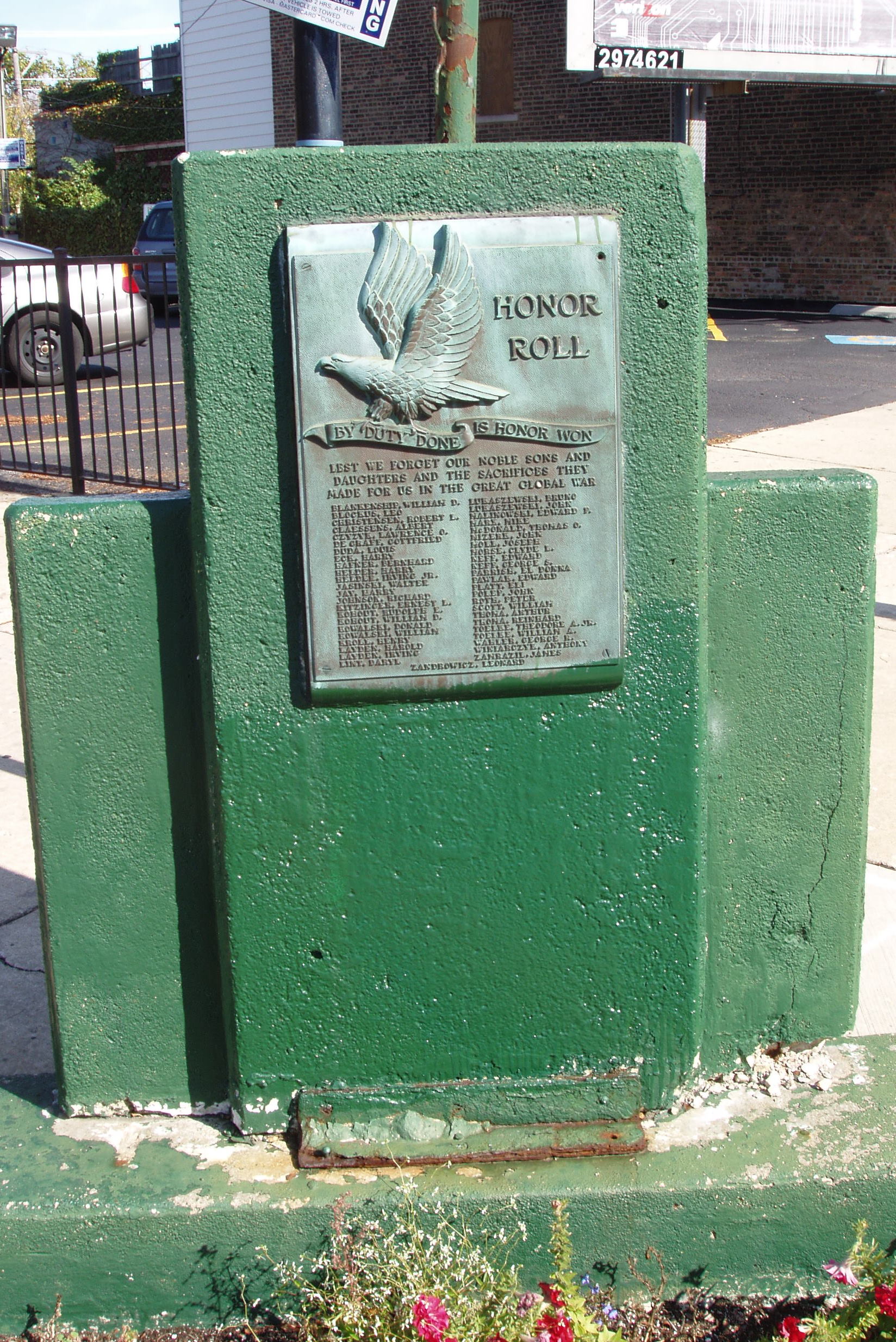
"Great Global War" memorial, Francisco and Fullerton, Chicago, IL
There are about a million “how much does it cost to travel around the world” pages out there on the World Wide Web, and I’m finding many of them really helpful in estimating how much I’m likely to spend per day while on my trip. Bloggers break down their costs by transportation, food, lodging, and miscellaneous (souvenirs, admission prices, etc.). This is what I’ve been concentrating on when figuring costs, but lately I’ve run across blogs that point out the non-daily costs essential to any RTW (round the world) trip–gear, insurance, immunizations, storage facilities. Let’s take a look at what some of these might cost me.
Travel Insurance
The most recommended travel insurance I’ve seen is World Nomads, which specializes in covering emergency evacuations, health costs, and even baggage loss. I considered not buying any, but the possibility of being stuck in a medical emergency halfway around the world without access to healthcare, or finding my trip interrupted for some reason and looking for compensation, I gotta go with coverage. I ran a basic search for one year starting in September 2012 and came up with a $900-$1200 quote.
Immunizations
Immunizations for a broad travel itinerary can run fairly high ($550 according to one estimate), but that can include things like meningitis, which I think I got covered in college (Mom?). Also, I’m hoping that my health insurance with my current job will cover some, so I’ll be taking advantage of that as the departure date grows closer. So this might cost me more like $200.
Storage Unit
A lot of RTW bloggers write about selling all their worldly possessions before heading out on the road, which makes sense if you can make money off your belongings. I don’t think I’d get much for my bed, bookshelves, and dining room table, but the cheapest Chicago storage unit I found that would actually fit that bed is $48 a month. Let’s say I’m gone for 15 months; that’s $720! So I’m still undecided on whether to go this route.
Visas
Apparently the way visas work is much the same way the rest of international relations work–you scratch my back, I’ll scratch yours. So the US lets citizens of some countries enter the States paying no or little visa money, and those countries return the favor for US citizens visiting them. Other countries don’t have such generous arrangements with us. For example, South Africa and New Zealand don’t require a visa, but China and Russia both cost upwards of $150. I added up the visa fees for all the countries I’m planning to visit, and I’m looking at $700.
Add those all up, and I’m looking at about $2800 before I even buy a plane ticket. Yikes! Next time I run the numbers I’ll be looking at gear and clothing, so check back for that.

Union Pier, MI, August 18, 2011
Please welcome back Rory Leahy to Stowaway. Rory last wrote for this space in a series of guest posts on road trips, which you no doubt remember with great fondness. Rory and I belong to a marvelous mutual admiration society, and I love seeing his writing performed onstage. I’m going to see the Old Tyme Variety Show tomorrow night; let me know if you’d like to join me. Thanks for sharing, Rory!
What is your name and city of residence?
Rory Leahy. I live in Chicago.
What medium do you work in?
I’m primarily a writer, also an actor and director. I write prose fiction and I write, direct and produce plays, sketch comedy and the like. Although my best work is probably done in the form of Facebook statuses.
How often do you work on your art–is it a full-time endeavor or something you work on in your spare time?
When I had a day job, I wrote on weekends. I was always too tired to do it after work so I would write on Saturday and Sunday morning/afternoons. Since I’ve been unemployed or as I prefer to think of it “Self employed,” I write every day, several hours a day if I am disciplined, less so when I am not. Plus I run my own theatre company–American Demigods–and producing stuff, which basically means coordinating, everything is extremely time consuming. When a show is going on it’s pretty close to a full time job. I have no idea how I handled it when I DID have a full time job. Probably because I did a lot of it at work I think.
How does art fit into your life, in general? Is it something you think about and talk about every day, or every week, or only in certain situations, etc.?
I think about it pretty constantly. Writing and acting are both about life, about people, about observation. You’ve got to pay attention to what’s around you because everything informs the art. Because I write comedy, definitely things that are funny are an influence on the work. I don’t put literally everything I experience that is funny, or everything that is serious, into a play or a story because obviously, not everything fits but I pay a lot of attention to how jokes work. To how emotions work, in daily life. Daydreaming about the Big Score after which I will be a wealthy literary superstar obviously consumes much of my waking life.

Just a simple suburban boy protecting the streets in "The Irrelevant Adventures of Jarvis McFadden"
When you start on a piece, what kind of end result do you have in mind? Does it get performed or published, put in a permanent form or is it more temporary?
Everything I write is intended to be performed or published. Whether it is or not is another matter, whether it should be or not is another matter, because not everything I write is any good and the stuff that isn’t gets to spend eternity in the mausoleum that is Microsoft Word. Most of what I write for the theatre these days gets produced by the American Demigods, which is to say, me and my friends. And self production is great of course. It’s awesome to write things and get to do them exactly how I want them. But I also get short plays produced here and there by other people and that’s very nice too. It’s great to see what other people do with my work when I have very little or no involvement. And you know, it’s validating because someone other than me thinks it’s good enough to do the work and expend the resources to put on. One of my goals for the near future is to have a full length play of mine produced by someone who is not me.
As for prose, I’ve spent less time on it than playwriting but I definitely have a passion and, I think, talent for fiction writing as well, but I only have a handful of short stories that I really like. I very much want to get them published but as anyone can tell you, that’s an elusive goal. Prose doesn’t offer the same kind of performance outlet that theatre does, although something I’ve started doing, really just recently, is getting to know the Chicago literary community and going to public readings. I get to read my work for other writers and listen to their work and everybody offers feedback and advice and that’s been a terrific experience.
What goals do you set in relation to your art, both short- and long-term? Is it something you hope to make money doing, or is it something you want to keep uncommercialized? Does the term “sell-out” hold meaning for you or do you see the art/commerce relationship as a necessary one?
Yes I absolutely want to make money doing it, indeed, make a living at it at some point, despite the overwhelming odds against that happening, especially as I age. I find inspiration in Rocky Balboa, a largely unsuccessful but persistent boxer who became Heavyweight Champion of the World at the unlikely age of 31, as seen in Sylvester Stallone’s acclaimed documentary series. But making a living at it in the ever further away “someday” is critical for me, because I’ve believed since childhood that it’s the only thing I CAN make a living at and I think my attempts at making a living in other ways have only demonstrated this thesis.
Artists have always had patrons. It’s nice when the state can fulfill that role, but in this country, especially in these days of economic austerity it’s a very limited role, so any successful artist gets underwritten by major corporations and you can rage against that if you want but it’s the reality and ultimately I’m okay with it, because that’s where the money is. There are two kinds of “selling out” as I understand the phrase. There’s selling out in a way that compromises your artistic vision, where you don’t get to do the work you want to do because the money wants you to do it differently. The other kind is when you lend your talents to the service of people or organizations that you consider to be unethical. Whatever it says about me as a person, I’m actually much more comfortable with the latter kind of selling out than the former. Ultimately my integrity as a writer means more to me than my integrity as a human being in some twisted way. Rod Serling said something really beautiful when he wanted the commercial sponsors to stay the hell out of his way creatively, I’m paraphrasing but it was something like “Gentlemen, we are all in the business of selling products, I know mine as well as you know yours and therefore I should have as much control over my production as you have over yours.” Something like that.
The other kind of selling out, when you’re compromising morally rather than aesthetically…one of my best friends is a sometime actress. A few years back she had agented representation and the potential to go really far with it. She was offered a national Walmart commercial. We all know Walmart is, even by the standards of American megacorporations, a particularly odious entity. She was offered ten thousand dollars to do the commercial. It would have been huge exposure. Most actors would kill for a national commercial. My friend agonized over it but ultimately decided not to do it. The killer thing for her was that she would have gotten union health insurance over it and the irony that she would be supporting an organization that does its damndest to prevent its employees from getting health insurance was just too much for her. I both admire the hell out of that decision and suspect I would have done the opposite. Temptation would have overwhelmed me. I’d have felt a lot of angst over it, and spent that ten grand in various ways to dull the pain.
But corporations are where the money is, if they wanted to pay me to write things I would be happy to take their money. I would actually love to write advertising copy or be a commercial voiceover artist if I had the chance. I’d love to endorse products I use. I would love to be paid to say “When I’m writing hilarious sketch comedy I enjoy the delicious, refreshing taste of Coca-Cola” because I do. This is of course, with the full knowledge that Coca-Cola benefits from death squads in Central America busting unions and stealing water supplies. So I enjoy the refreshing taste of Coca-Cola but not the death squad part. But you know, you’re not paying me to an express an opinion on death squads, you’re paying me to express an opinion on a soft drink.
Actually this interview probably ruins my chances of ever being paid to endorse Coke so thanks a lot, Stowaway.
Obviously there are moral limits. I guess a compartmentalization thing, I can make a mental distinction between what a corporation might be selling and the evil deeds they might do. I would never accept money to endorse actual immoral actions. Like I’ll never write a PSA saying “Please remember to report your Jewish acquaintances to the authorities.” There are some limits.
What role does collaboration with others play in your art, if any?
Collaboration is huge in theatre. More than huge. Theatre IS collaboration. I have strong vision and a strong desire to be in charge of the final product of what I write and produce. The words “power mad control freak” are not inapplicable, but I rely on lots and lots of people to do what I do. My consistent goal is to surround myself with the best people I can find, and I’m usually quite successful in that goal. To start with, actually I sometimes write with partners. In the past I wrote with my high school and college friend Marc Heiden, in the beginning of my early writing career, that partnership really helped me in setting the tone of my narrative voice and all that. These days I write most frequently with my actor friend Jordan Hoisington, who’s just a severe thunderstorm full of good ideas, we’ve written some killer sketches together and now we’re doing a two man show together. Then of course there’s my fledgling company, American Demigods which I think really attests to the magic of collaboration. I had the notion of having my own little vehicle for some time, probably right out of college. And I did put on one show under that banner, with help from some great people, most notably my college friend Tom Schorsch and generous patron Kurt Tuohy. But most of those folks didn’t want to continue doing it as a permanent thing so I was kind of left on my own and nothing in theatre, other than arguably a one man show, really comes of being on your own.
But my friends David Wilhelm and Samantha Raue really changed that when they agreed to be my board members in 2009 and we started to rev this thing up. I like to tell the story of how I met Dave, or rather became aware of Dave, he was two years younger than me and just started to get involved in my beloved undergrad theatre company, the Penny Dreadful Players, as I was leaving college. As the Springsteen song goes, “He was walkin’ in, I was walkin’ out” and I happened to see him in his acting debut, which was a ten minute play set in a coffeehouse. Then I saw him as one of the leads in Rosencrantz and Guildenstern Are Dead. I don’t think I actually met him after these occasions but I was so impressed by his presence and charisma that I told myself then and there “I’m gonna work with that guy someday.” And now we are working together on a continuous basis so dreams do come true, kids.
Wow I sure do seem to be a long winded interview subject. Because I work with all kinds of actors, writers, directors, tech folk. Directors are huge obviously, sometimes I direct my own work, sometimes I work with others, and collaboration’s not always pretty, because sometimes there are strongly differing viewpoints. Some folks really get it and some folks don’t, which is why I try very hard to work with people, both actors and directors, who do get it. I’d like to take the opportunity to sing the praises of the director I’m working with on my two person show right now, Katie Horwitz, who is very demanding in the best way. Jordan and I have spent the last couple of months riffing pretty hilariously on my couch and sometimes Katie’s just a stone, a really tough room. And that just makes me work so much harder, because you know when you get a laugh out of her, you earned it. And she says exactly what she thinks, which is so great. I have a really strong personality and some poor souls have found out that I will bulldoze right over them, sometimes to the benefit of my work and sometimes to its detriment, so if you’re gonna work with me, especially if you’re gonna direct me, you need to have a strong personality too.
Theatrical collaboration really makes me feel good about human nature. Because so many people are so helpful, so generous with their time, their labor, they’re getting something out of it too, but the biggest thing we all get out of it is a sense of shared accomplishment. It’s teamwork at its best.
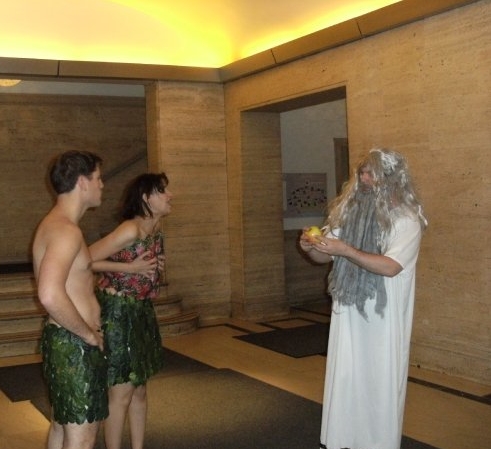
Rory plays god in "Dr. Strangegod or How I Learned to Stop Worrying and Love Blasphemy"
How conscious are you of your artistic influences? Who are your artistic influences?
Oh Heavens, always such a hard question, there are so many, as a writer, certainly Kurt Vonnegut, Douglas Adams, Neil Gaiman, Joss Whedon, Tom Stoppard, you know, all the great geeks but many, many others, anyone who’s literate in English has spent a lot of time with Shakespeare and that goes double for a theatre person. Joss Whedon may be the one I’m most self conscious of, because he’s, not so much an influence, because I think I encountered him at a time when I was already writing and starting to write really well, but he was just the apotheosis of everything I had always wanted to do and he was the first person I really saw doing it. By which I mean, he created great entertainment that basically sneered at the concept of “consistent tone” which is what I most want to do. He fully integrates drama and comedy and sees no particular reason to keep them in separate boxes, because life doesn’t do that so why should fiction?
Since this is a travel blog, how does travel relate to or affect your art? (Themes in what you produce, road trips to perform your music, thoughts on what happens to your painting when you ship it across the country to a customer, etc.)
For financial reasons, I’m not as well travelled as I’d like to be but I do love road trips. I love solo road trips especially, because while theatre is collaborative, writing is solitary. Place is tremendously important to my writing whether it comes across or not. I have a very geographically connected memory. Memories flood back when I’m in a certain place, like where I grew up or where I went to school. And the memories that flood back are less memories of concrete incidents than memories of sensations and emotions, and it’s the latter that really informs the work. I haven’t done a lot of travel to do theatre although that’s certainly a romantic notion. I did go to St. Louis about a year ago to participate in a 24 hour play festival and that was really sweet. It was great to discover an entirely new community of theatre artists, although many of them had ties to Chicago. I’ve also seen great theatre in other cities, the Minneapolis Fringe Festival was a great occasion a few years ago. It’s wonderful to think you can go pretty much anywhere and you will find practitioners of your art form, the same goes with art and music scenes around the country of course. It’s all one big, universal fraternity.
And finally, a right-brain question: If your art was a map, what would it be a map of?
I suspect, to a house where a really great party is going on but it’s a house in the suburbs and it’s terribly hard to find. And I’m basically a landmark navigator so it’s really imprecise. “It’s near a lake, or a river, definitely a body of water, I guess you’d call it a stream. Because there’s this gate over it? It’s at least six blocks past the McDonalds, no, the other McDonalds.” You’ll be a little late but you will get there. And you’ll see a lot of funny and interesting things along the way.
If you’d like, share your website/Facebook page and any upcoming gigs/plans you’d like readers to know about.
Right now I’m doing the American Demigods Magnificent Old Tyme Variety Show, which encompasses the aforementioned two person show as well as some other sketch stuff I’ve written and directed as well as live music and magic and burlesque dancing. That’s at Gorilla Tango Theater at 1919 N. Milwaukee every Wednesday night in November (except Thanksgiving week). Also I’m in the talking stages to write some burlesque shows for Gorilla Tango, one of which will be based on the films of Tim Burton. I’m also writing a novel based on my earlier play Lysistrata 3000. And 2012 will hopefully bring more great work by the American Demigods, mostly dependent on whether people give us money. Seriously. Give us some money. We’ll spend it well.
AmericanDemigods.com
American Demigods Facebook Page
Photo 1 credit Benjamin Haile. Photo 2 credit Gabriel Pastrana.

One of these things is not like the other
Guess which apple was picked over a year ago, and sat in a grocery store encased in wax that keeps the pesticides in; and guess which apples were picked mere weeks ago at an organic farm before being sold at a farmers’ market?
Supermarket chain fruit and veg is normal for me, but then sometimes I have delicious, expensive organic stuff and think anew that I need to make a real change in my buying habits.
 Stowaway Travel Writing & Editorial Services