
Sunset, Porthtowan, Cornwall, England
Sunset, Porthtowan, Cornwall, England
London, England; July 17, 2016

London, England; July 20, 2016

London, England; June 26, 2016
London, England; June 13, 2016
Once you’ve visited the Dulwich Picture Gallery, you definitely know two things: this was the first art gallery in Britain specifically created for the public, and the building was designed by Sir John Soane. These two facts are brought up in the guided tour, the building map, the website, and probably a few other places. But they’re rather remarkable facts, so I can see why the gallery emphasizes them.
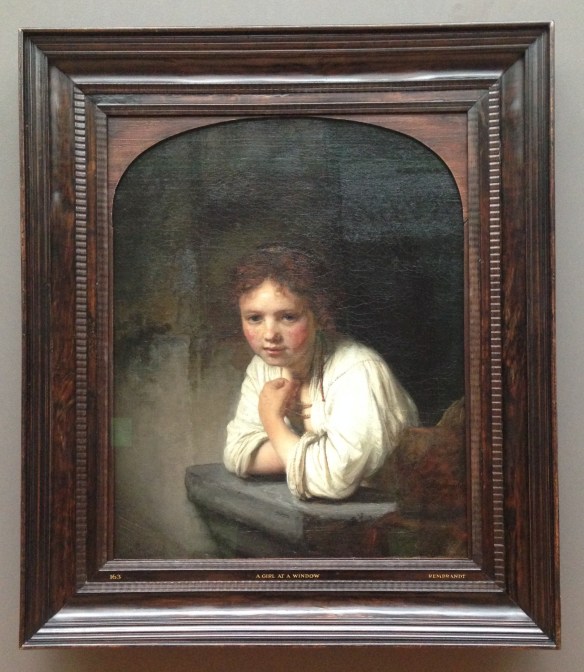
A Girl at a Window, Rembrandt
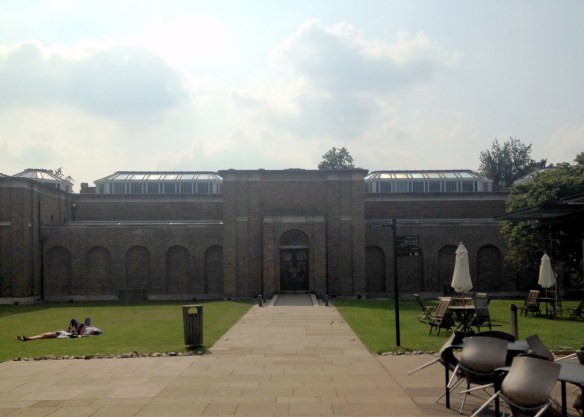
The entrance to Dulwich Picture Gallery
Soane was already Professor of Architecture at the Royal Academy when his friend’s will requested he design the gallery, so it was a big deal for him to spend his time on it (not only that, but he did it for no fee when it turned out there weren’t enough funds to cover his fee plus building costs). Soane was very interested in natural light and most of his buildings have some form of the domed canopy that we’re all familiar with from the iconic red telephone boxes (a trustee of the Sir John Soane Museum, Giles Gilbert Scott, designed the telephone boxes). He did something similar here, putting in massive skylights which light the pictures indirectly; this was a new approach and influenced future art gallery designs.
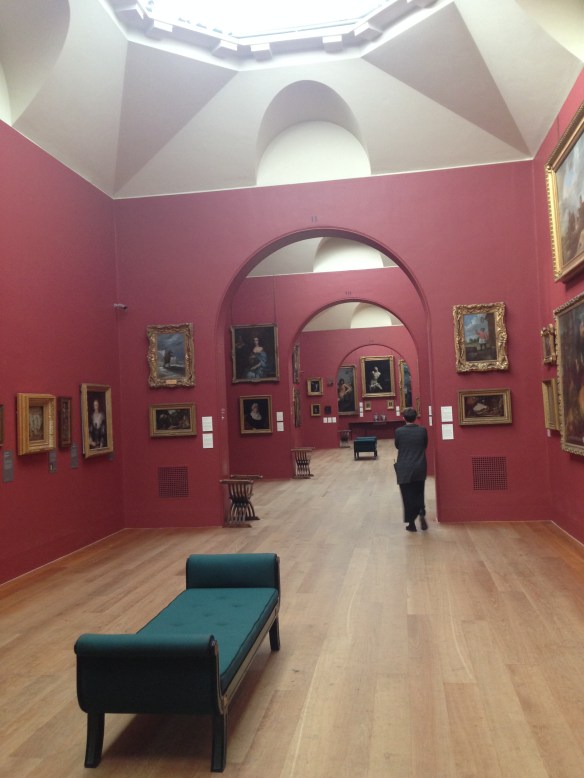
A well-lit series of interconnected rooms
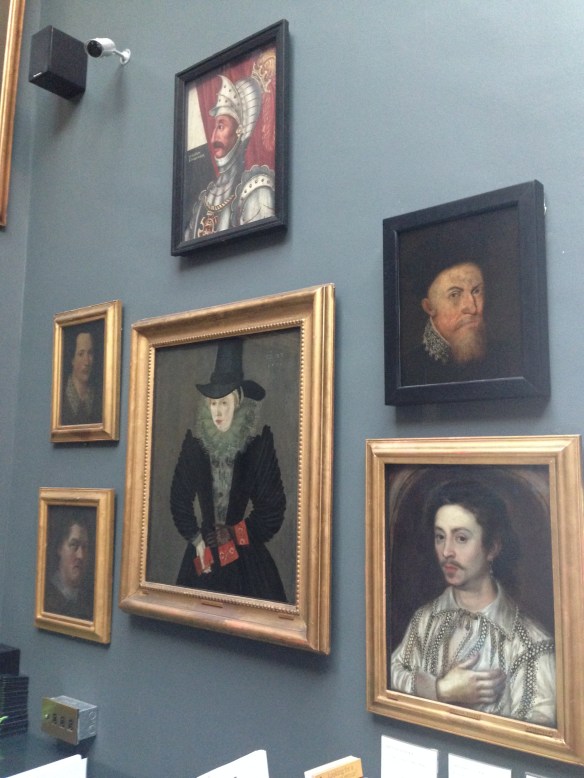
The original paintings of Dulwich College–a terrible William I, a lady, and four actors (the college was founded by actor Edward Alleyn)
The other point–that this was the first public gallery in Britain–is also remarkable. The gallery was opened in 1817, at a time when common people were only just starting to be seen as worth educating, let alone exposing to the finer things in life like art. I think the gallery’s openness must be because its founders, Noel Desenfans and Francis Bourgeois, were themselves not aristocrats. They hustled hard as art dealers (getting their start with the money Margaret Morris brought in when she married Desenfans), and they lived in comfortable nouveau riche style, inviting well-heeled friends to their home in Charlotte Street to view their personal collection. (Let’s just take a moment to appreciate how perfect that a middle-class man who worked as an art dealer was named Bourgeois–is there anything more bougie than that?) They clearly didn’t forget their roots, though, and I think it’s great that Bourgeois used his powerful connections (he was personal friends with Soane, he was wooed by Dulwich College to bequeath his collection to them) to create something for people with no connections to enjoy.

Miss Margaret Morris, later Mrs Desenfans, Reynolds

Head of an Old Man, Caracci

They’ve used period furniture to decorate the gallery
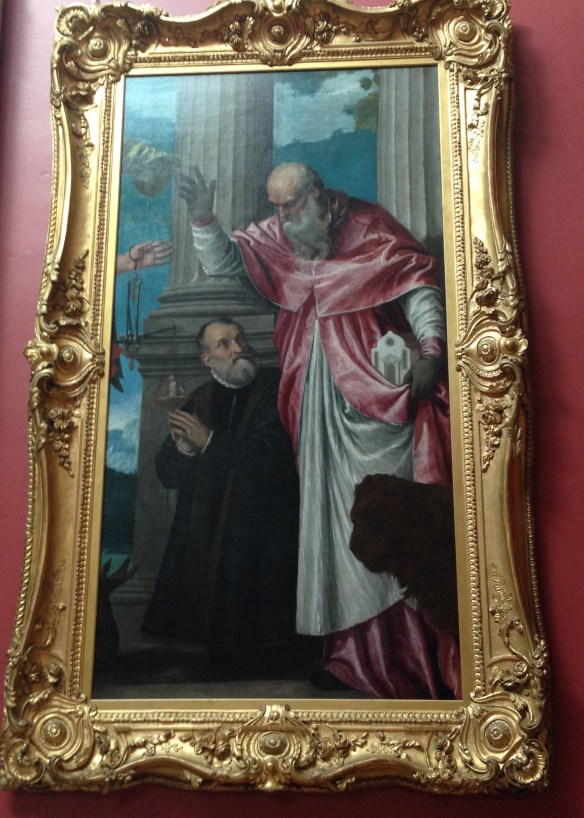
A cut-up piece of an altar piece by Veronese; other parts are in museums in California, Canada, and Scotland
Although perhaps this collection was destined for public viewing regardless. It was originally commissioned by Stanislaus Augustus, King of the Polish-Lithuanian Commonwealth, to form a national gallery of the old masters as part of his plans to encourage fine art in his country. Perhaps the public would have been invited to view that gallery? But his country kept getting partitioned by greedy nearby states, and five years after the commission, Stanislaus wasn’t ruler of anything anymore, which left Desenfans and Bourgeois with over 300 paintings to house.
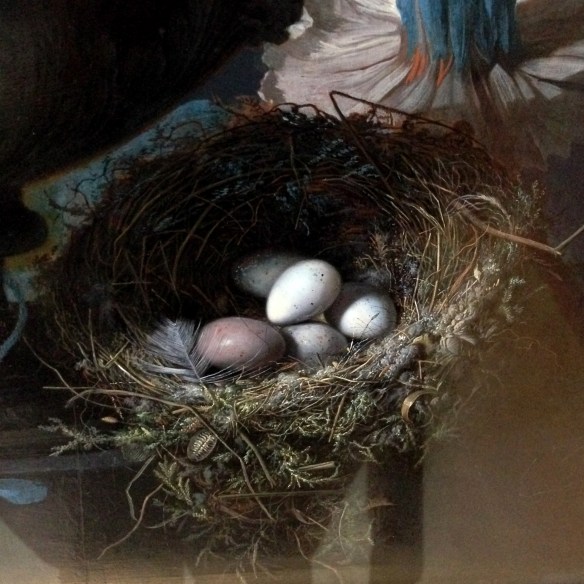
Detail of Vase with Flowers, Huysum
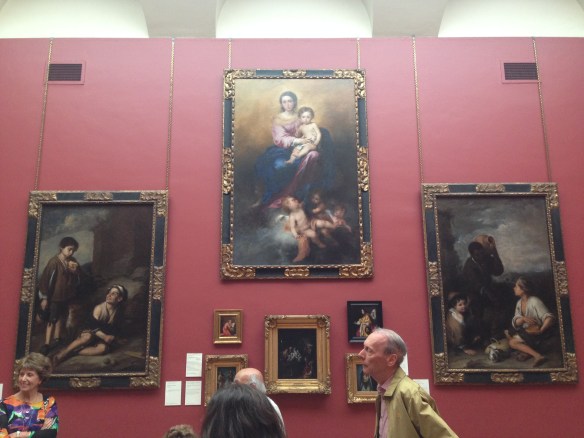
Three works by Murillo
This is one of the first times the faces of the Virgin & the baby Jesus are drawn from life studies rather than as iconic types

Saint Sebastian, Reni
Reni apparently claimed he could paint 100 different ways of people looking up, and indeed a lot of his pictures show a variation on that pose
The collection now numbers more than 600 paintings, and although the gallery doesn’t make any purchases, people try to make gifts pretty frequently. Because of limited storage space, the gallery has to be quite selective, only accepting pictures that fill a specific gap in the collection.
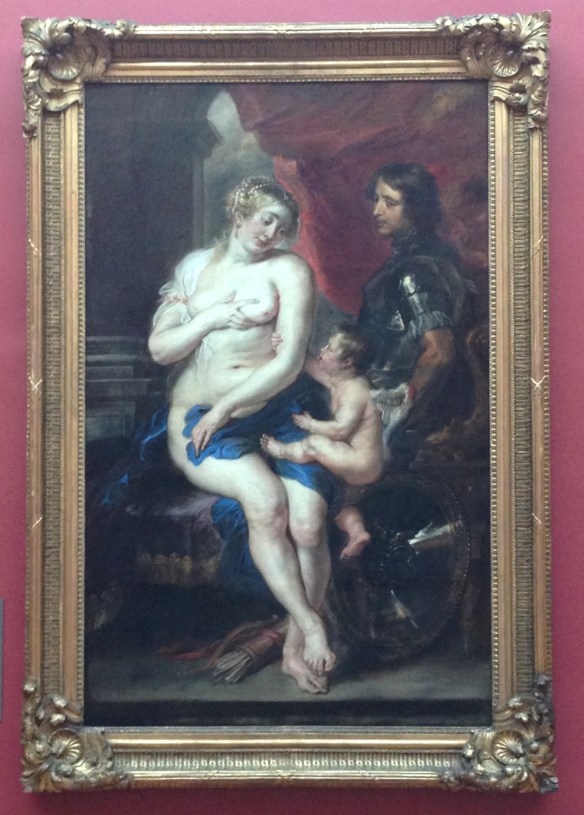
Venus, Mars and Cupid, Rubens
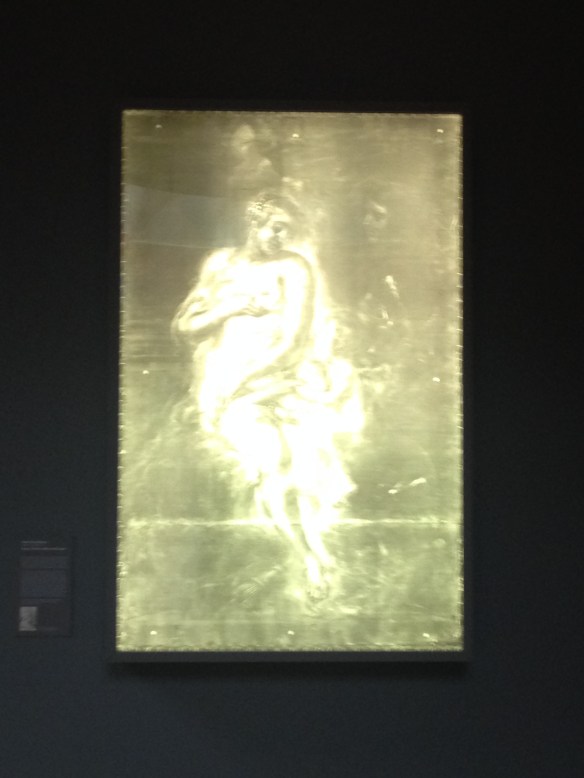
An x-ray of Rubens’ painting, which shows how he made changes like moving the left legs of both Venus and Cupid
The rooms are split up into different schools of painting, which more or less followed along national lines: British, Dutch, Flemish, French, Italian. Or as was explained to Queen Elizabeth II when she stood in the center of the gallery to re-open it after a major renovation in 2000: “To the left are the beer drinkers, ma’am, and to the right, the wine drinkers.” Meaning, of course, that the northern Europeans were to the left and the southern Europeans to the right. (Thanks to guide Hillary for this delightful anecdote.)

Paintings have been hung in a stacked style similar to the one used when the gallery first opened

Jacob III de Gheyn, Rembrandt
This painting has been stolen from the museum more than any other–four times!

Mrs Siddons as the Tragic Muse, Reynolds
This was Sarah Siddons’ favorite portrait of herself, because she felt it did the best job of highlighting her as a tragedian
After the tour was over and we started to disperse, I looked around at who was visiting on a Saturday. A lot of gray-haired folks, yes, but a few other people my age, a teenaged couple who held hands in front of a Rubens, and a couple young kids scampering about while their parents made their way around the Dutch room. Dulwich Picture Gallery might contain expensive works of art centuries years old, but it’s still filling its intended purpose of making that art available to the masses. Its founders would be proud.

Mrs Elizabeth Moody with her sons Samuel and Thomas, Gainsborough

The Nurture of Jupiter, Poussin
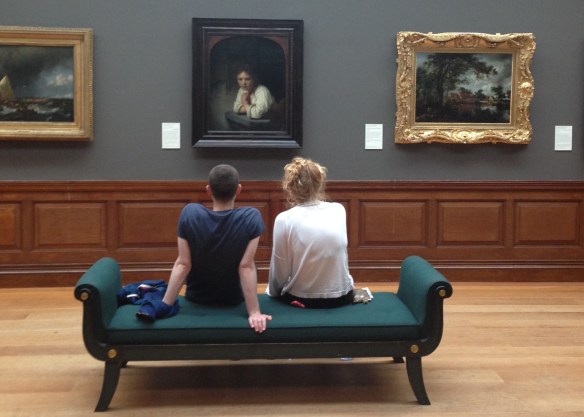
Teenagers enjoying the museum’s most famous painting

Myatts Field, London, England; May 14, 2016
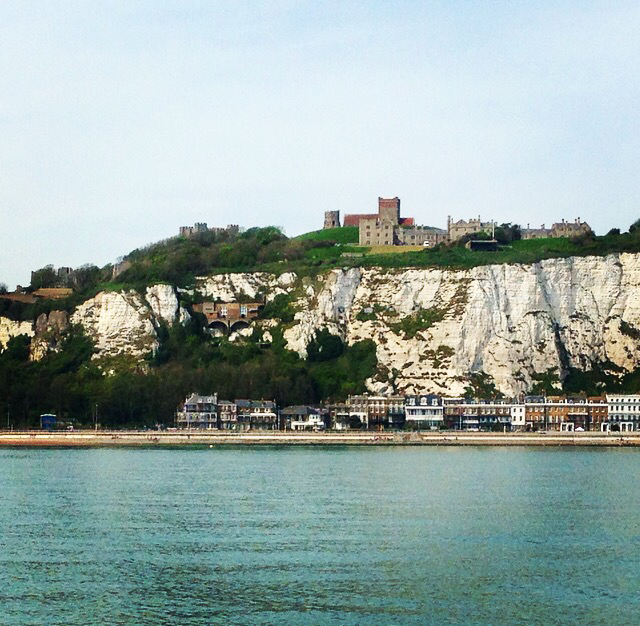
Dover Castle and those white cliffs, England; May 7, 2016
To commemorate 400 years of Shakespeare’s brilliance, the Globe Theatre set up a 2.5-mile walk along the south bank of the Thames the weekend of April 23-24, 2016, showing one 10-minute film for each of his 37 plays. The films combined new scenes shot just for this walk (set in places the plays were set like Hamlet in Denmark and Antony and Cleopatra in Egypt), scenes from silent movie adaptations (on loan from the British Film Institute), and scenes from Globe productions over the years.
I had a wonderful time walking the route over the course of two days, sometimes with friends and sometimes on my own. I mistimed my Sunday and got caught up in the mass of humanity that was cheering on the London Marathon across the river, so I just squeezed in all the plays that day and finished 15 minutes before the event ended and the screens went dark.
I certainly don’t know every play, and in fact upon talking it over with my friend Liz (who knows just about every single one and has seen most of them performed too), I realized that I know the tragedies and many of the comedies, but I only know the outlines of his histories and some of the problem plays. I suppose that just gives me more to explore.
I liked that the Globe filmed scenes where Shakespeare originally set them; I think this was particularly effective with Othello & Iago alone in a Cypriot fort, where Iago could pour his poison in Othello’s ear under the hot sun; Coriolanus driving around the streets of Rome at night, Taxi Driver-style; Juliet ending it all in the tomb named for her in Verona; Richard II handing over his crown in the austere Westminster Hall; Cordelia trying to bring Lear back from madness at the white cliffs of Dover; and Falstaff carousing and philosophizing in The George pub.
Here’s a sample of what I saw, in the order of the route as laid out by the Globe (you can see the route I followed here and the list of credits & play summaries here). I didn’t always get the famous lines on video, and my camera ran out of storage space before I could get video of each film so there are still photos for those plays. The only scene out of order is Hamlet–there’s a photo of that film in order, but the video is at the very end of my movie, because I think the brief lines there offer a nice coda. Enjoy!
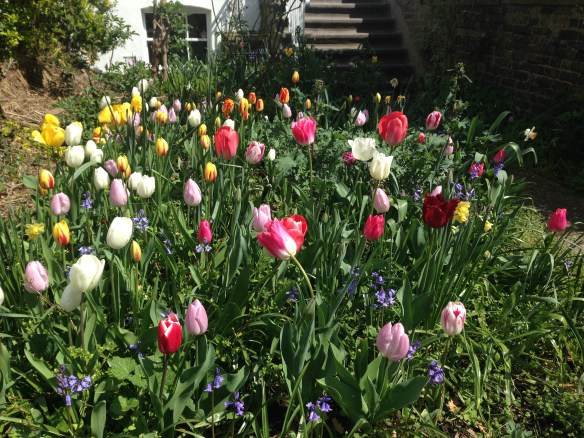
London, England; April 23, 2016
 Stowaway Travel Writing & Editorial Services