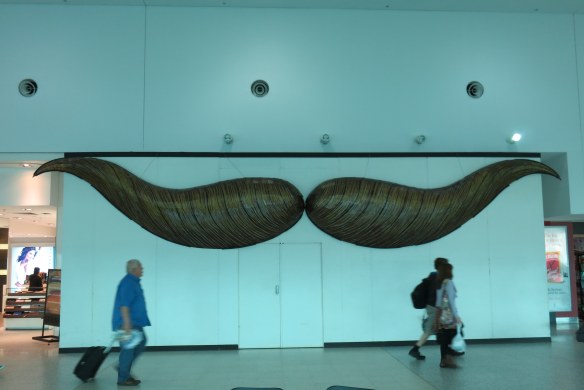
Would you like a fixie with that affectation?
How do you know you’re in the hipster capital of Australia? When you’re greeted at the airport by a giant handlebar mustache.
(Okay, so it was for Movember, but I had to make the joke.)

Would you like a fixie with that affectation?
How do you know you’re in the hipster capital of Australia? When you’re greeted at the airport by a giant handlebar mustache.
(Okay, so it was for Movember, but I had to make the joke.)
I researched this trip before I started it, but the more I travel, the more I realize I didn’t research nearly enough. I mean, I didn’t even know there was a rainforest in Australia, much less that it’s the oldest one in the world! The Daintree Rainforest is estimated to be 180 million years old, which puts it back at the time of dinosaurs. Plants grow here that were previously only found in fossilized form. And as a bonus, the main section of the rainforest visited by tourists is evocatively named Cape Tribulation.

Cape Tribulation, Daintree Rainforest
The phrase that all the promo materials repeat is “where the rainforest meets the reef,” because it’s the only place in the world where a rainforest comes right down to an ocean reef. It will not surprise you to learn that there is a large concentration of World Heritage Sites going on here.
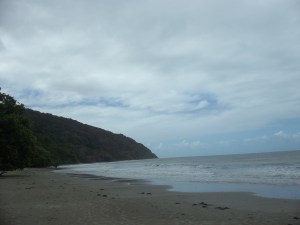
Long walks on the beach
I took a two-day trip to Cape Trib (remember, this is Australia, so you must shorten as many multi-syllabic words as possible) with Active Tropics Explorer. Our driver was a loquacious middle-aged man, who told us as much about his diving prowess as he did about the natural wonders we passed. That was only mildly annoying, but he crossed a line when he described what he wears while diving, and said he doesn’t wear the tight-fitting bodysuits because that makes him “look gay.” Way to live up to nasty stereotypes about bigoted outdoorsy Australians, dude.

Sugar cane is huge industry here. The companies built a railway just to transport the sugar cane–the gauge is too small for passenger or other freight trains. You’ll see tiny little tracks all over Queensland, made to carry sugar cane trains.
Aside from that, he was a pretty good guide. He clearly loves the area, and it’s always nice to be shown around by someone with such a passion for the place. We started out in Cairns, and he drove us north on the extremely windy Captain Cook Highway. We didn’t stop for any pictures on this picturesque drive, which was too bad, but we all got our cameras out at the second stop: a crocodile tour on the Daintree River.

Croc wrasslin’
We piled into a long, flat-bottomed boat, which puttered down the river slowly. Everyone scoured the banks for logs that might actually be reptiles, and the boat captain told us about saltwater crocodiles, which trickily live in both fresh and salt water, and which kill at least one person per year in Australia, so quickly that it’s hard to know what’s happening until you’re snapped up in their massive, powerful jaws. Crocodiles haven’t changed much since they lurked in primeval waters, and their dispassionate stare and long, deadly bodies give me the creeps. Probably just as well we didn’t see any.
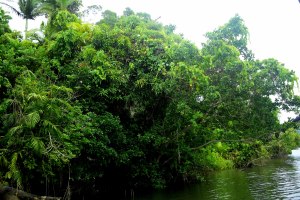
What’s lurking in those mangroves?
Instead, we heard fun facts about the many species of mangrove that line the river bank, and then crossed to the other side of the river, where our driver/guide was waiting for us. We went on even more winding and steep roads, and heard about the activists who protested the government bulldozing through the rainforest to build this road. The road was eventually built anyway, but the international attention the activists gained helped ensure that the rainforest–previously unprotected–was given the protection afforded by a World Heritage listing. See now, that is why you stage protests. They’re rarely the final say in a public debate, but they’re often the necessary catalyst to get those debates on the right track.
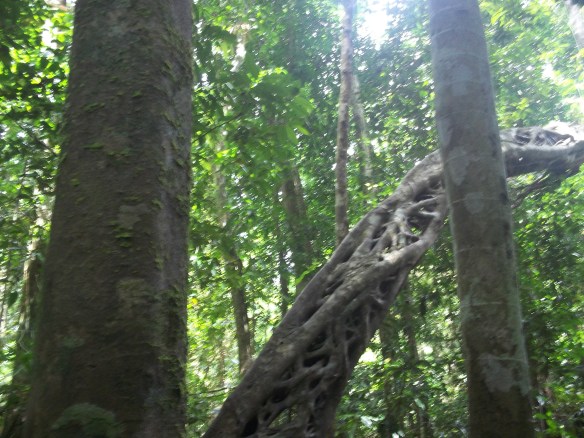
Intricate latticework on this tree
We stopped for a short walk on the Maardja Botanical boardwalk. We inspected basket ferns (which look like Mother Nature’s hanging baskets), cane vines (which are made into cane furniture), ferns with sharp spikes all along the edges of their leaves, and mud pits with trees poking their knobby-kneed roots in the air.

Walking the boardwalk
About halfway through the walk, our guide picked up an ant that was marching along the guardrail. As the ant squirmed in his fingers, our guide said, “Anyone got some tequila on them? Maybe some salt?” And then he licked the ant’s butt. “Lime!” he exclaimed. The green ant, which looks slightly irradiated, has an acidic taste to it that reminds some people of lime. Our guide found another ant and held it out to guys in the group, and one by one they all turned him down and walked away. He turned to me jokingly, but I am not one to turn down silly, harmless antics, so I said, “sure!”
And then I licked the ant’s butt. It did, indeed, taste a bit like lime. Not something I’d add to my margarita, but it was fun to do.

I don’t have any pictures of me tasting this ant, but trust me, it happened. (Blurry quality because these guys are small and fast.)
Cape Tribulation is so named because Captain Cook hit a reef on his way along the shore, then hit it again on his attempt to find deeper waters. That’s like hitting the concrete curb on your way into a parking stop, and hitting a car as you back out of it. If you look out at the ocean from the beach here, you won’t see any signs of a reef, so I suppose I can see how he made the mistake–the first time, anyway.
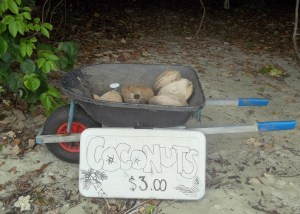
Our guide dropped us off at one of the hippest YHAs I’ve stayed in, and then we had an afternoon to do with as we pleased. Stinger season had just started–because why have crocodiles as the only danger when ocean swimming in Australia, when you could also have invisible jellyfish to take you down with one sting?–so I did not go in the water. Besides, it was a rainy day in the rainforest. I waited til it was mostly clear, then took a walk along the beach to a lookout on the cape. I passed coconuts in their hairy husks and a heron who tried to give me the slip with the most comical evasive maneuvers I’ve seen in a bird. I skirted mangroves and inspected pockets of tiny balls of sand, which look like someone made Dippin’ Dots out of sand. I still have no idea how they come to be.

The crop circles of the beach
On my walk to dinner, I passed a bird walking along the path and excitedly took a picture. Then I saw about 10 more of them in the next hour, and was informed that this is the brush or bush turkey, a very common Australian bird (which showed up in my Thanksgiving post). An uncommon bird found in these parts is the cassowary, which looks a bit like an emu with a bump on its head. I didn’t see one, but that’s not too unusual.

Cautionary art–the cassowary above, the speed bump below (turned into dead cassowary, should you go too fast)
The next day, after a leisurely breakfast, we piled back into the bus with a new driver/guide. She was the opposite of the first guy in so many ways–a hippie who spoke frequently and seriously about “the good vibrations of this special place” and the karmic complications of getting what you wish for (as illustrated by the story of a tourist who saw a croc and poked it with a stick to get a good action shot on his camera–and got his leg nearly bitten off).
We went to the Daintree Ice Cream Company, which grows all its non-dairy ingredients onsite. Each day they offer four flavors in one cup for $6, so we all bought a serving and ate our apricot, raspberry, macadamia nut, and wattleseed on the bus. (The apricot was delicious, the wattleseed a bit sharp but nice.) Afterward, we drove to Alexandra Range Lookout, so we could see the river flowing into the sea and some cockatoos squawking overhead.

View from Alexandra Lookout–weather was nice as I was leaving!
We drove out to Mossman Gorge for a short meeting with a representative of the local aboriginal group, the Kuku Yalanji. He talked about learning from his uncle about when to hunt, when to move to the seaside for a few months, and so forth, all based on traditions dating back thousands of years. He showed us some of the white body paint that you may have seen in photos of aboriginal people, and explained that for his people, this was used when meeting people from other groups (the word “tribes” is inaccurate in regards to groups of aboriginal people of Australia).

Artifacts used in the presentation
Next, we went to the Mossman River and walked along the path there. I liked this path a lot, because it was dotted with signs that didn’t just describe the natural sights around us, but also explained how human efforts to help the environment directly helped preserve those natural sights–like “your recycled milk bottles built this boardwalk,” etc.

Mossman Gorge
People gathered at a little rocky beach, and some brave souls got in the cold water. After a little dithering, I decided what was my Michigan upbringing for if not to prepare me for all types of swimming conditions, and I got in too. It was great! Fish swished by my ankles, the current carried me rapidly downstream, and for the first time all weekend, the sun shone.

This, as they say, is the life
The Daintree is the first example on my trip of the advantages of listening to tour company employees when they recommend sights. Sure, they’re selling you something, but sometimes that something is totally worth it. It may be the first example, but happily, it isn’t the last. More to come!

Maheno shipwreck, Fraser Island, Australia, October 17, 2012
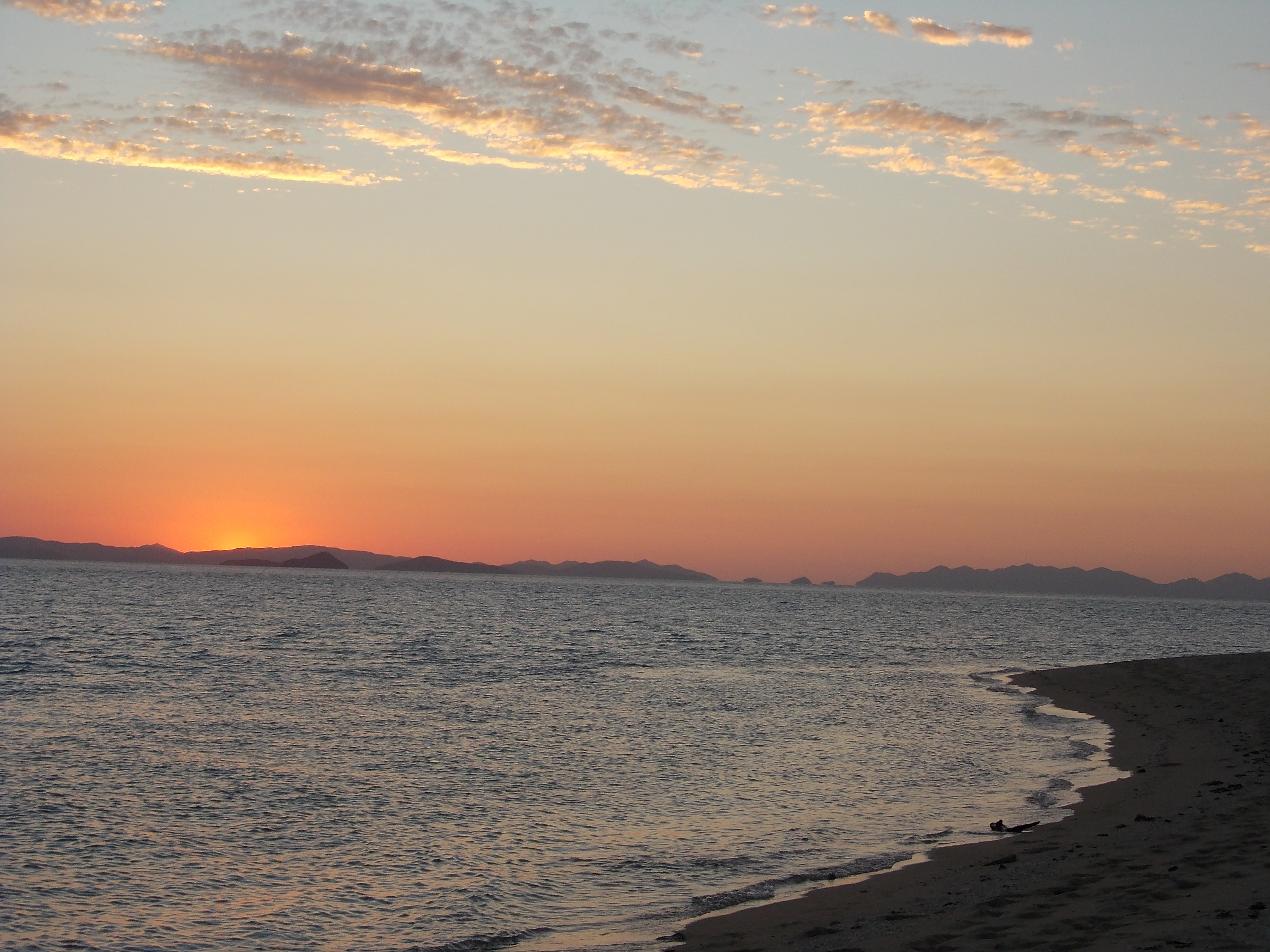
Sunset, Whitsundays, Australia
Being underwater isn’t just like being in another world–it’s like being in your own world. Sounds are muffled, movements are fluid and languid. Gestures are obscured by bubbles. Shadows are at once more menacing and more enticing. Other people might swim into view, but the space between you and them is heavier than on land, and it takes just a little longer to recognize them. Everything is more beautiful and mysterious underwater, and we can explore and interpret that world however we choose; we literally can’t hear what someone else might say about it, when we’re below the water line. No wonder the mermaid myth has remained popular through the centuries. It’s alluring to imagine ourselves belonging there.
Even being underwater with 70 other tourists didn’t detract from the magic of the morning for me. I took a boat named, hilariously, Passions of Paradise (doesn’t that sound like a C-list celebrity’s perfume line?). I’d felt ill for most of the two-hour boat ride from Cairns to Paradise Reef, but I felt better as soon as we stopped and looked out from the boat deck at the dark patches in the water that indicated coral. It was a little weird, looking around at open ocean with nothing but gently rolling waves out to the horizon, and then clownshoe-ing over to the edge of the boat in my flippers and slipping into the water and seeing just how much life there was under those gently rolling waves.
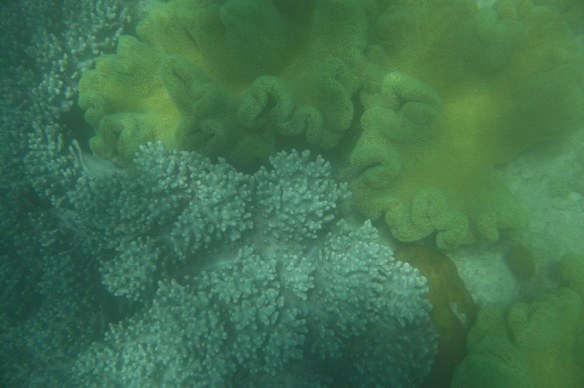
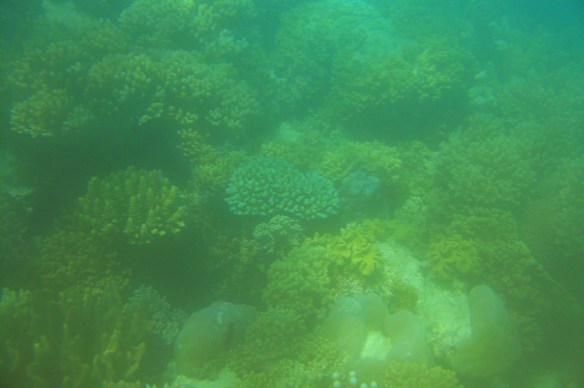
I wish I had been able to take pictures that showed how vibrant the colors were and how graceful the swaying coral was. Unfortunately, the camera I borrowed from Heather chose that morning to inexplicably fog up, and as a result all I have are some dark, dim photos. (I know, my camera luck has been amazing on this trip.) I’ll share a few anyway, but please see these to get a glimpse of what I saw down there.
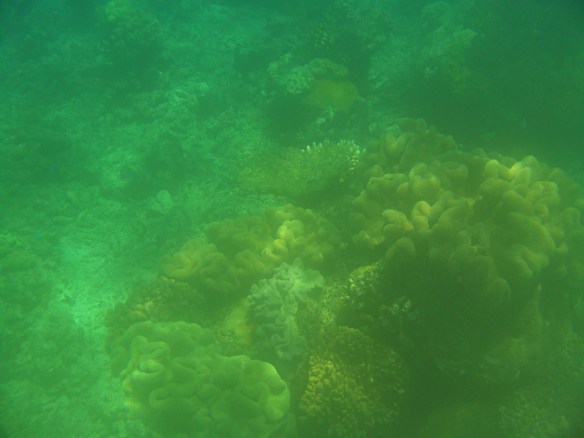
greened-out coral
People spread out as soon as we got in the water, so it was just me, and the coral, and the fish. I slowly waved my flippers up and down, and followed a fish from one patch of coral to another, then whipped my whole body around as a school of fish whirled past, and finally I just floated and watched the coral sway back and forth. There’s a philosophy to be found in the way the coral smoothly followed whichever direction the currents were flowing, but I will just note that this natural movement was beautiful to watch. Something caught in my peripheral vision, and I saw that my hand was emulating the coral, calmly swishing one way and then the other.
I saw a large school of fish gliding in the other direction, and I followed them to the edge of the reef. Since I know people will make Finding Nemo comparisons anyway, let me say that this was the part that most reminded me of that movie. When Nemo swims to the edge of the reef and they all peer over into the dark abyss beyond, and they’re all terrified. That’s what this was like. Remember that this is the open ocean, and what’s beyond that reef is thousands of meters of dangers known and unknown, in water that gets so dark it might as well be night. I hung out on the edge for a bit, drawn to that dark, silent place, but then I paddled back to the safety of the reef.
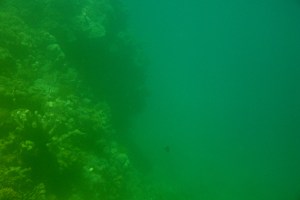
This sort of shows how sudden and steep the drop-off was.
I was one of the last ones out of the water, and then we went to Michaelmas Cay, which is a little strip of land used as a resting area for thousands of migrating birds each year. People chased sea turtles and walked on the beach. I floated on my back and watched the birds in sudden flight. Then I flipped over and watched some huge fish swim figure eights under the boat.

The birds of Michaelmas Cay

Sorry, random fellow snorkeler. I need to keep you in here to show how huge the fish was.
This time, I was the very last one out of the water, and they had to call out three times before I heard them. I had been watching a purple clamshell-shaped coral open and close its “mouth” as tiny yellow fish darted past. The coral and the fish were crystal clear, and everything else was indistinct. I eventually heard the crew’s calls, sounding like the teachers in Charlie Brown cartoons, and I surfaced.

One of the best days of my life
But the other thing about being underwater is that if you stay long enough, and you feel immersed enough in the beauty of it, then you can take a little of it with you when you leave. Now there will always be a part of my mind that can see the bright colors, the calm swaying, and the deep abyss.

Sunset, Sydney, Australia
When I told my mom I planned to go to Alice Springs as a starting point for my trip to Uluru, she recommended I read A Town Like Alice by Nevil Shute. It’s historical fiction set during and just after World War II, and the second half tells the story of a man and woman slowly building a life together in the harsh eastern Outback of Australia, and of their attempts to make the town as sweet a spot as Alice Springs.
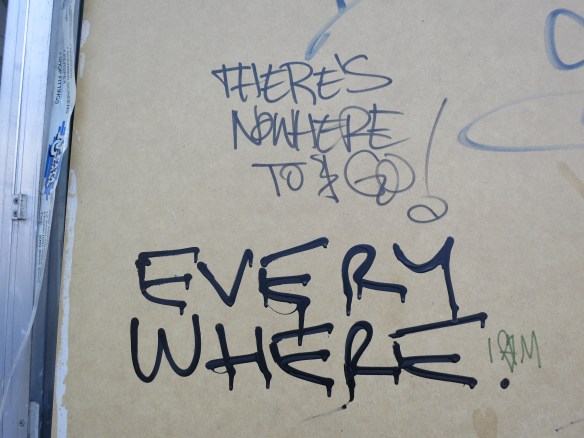
Graffiti in Alice Springs
In the book, Alice is an oasis of civilization and comfort in a desert that went on for days. Much was made of the ice cream parlor and hair salon and swimming pool–modern marvels in a land of stockmen and cattle. Nowadays, I don’t think anyone’s setting out to build a town like Alice. It’s seen more as a pit stop on the north-south highway than as an oasis.
To a person, everyone I met in Sydney who heard I was going up to Alice made a face and said something like, “well, watch yourself” or “that’s not a great place, don’t judge Australia by it.” They were referring to the high crime rate, specifically the often violent muggings of white people by gangs of aboriginal people. You don’t walk around by yourself, or even in a group of less than four, after dark.
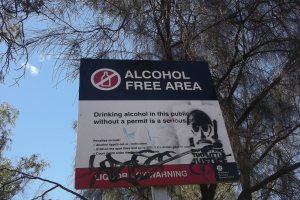
I’m not being glib when I say that I’m from Chicago, the most segregated city in the States, and I am all too familiar with the idea that there are entire neighborhoods you don’t go if you’re white, and entire neighborhoods you avoid if you’re black. But that’s in a city that’s spread out over several miles; Alice Springs is a small town with about a five-block square of downtown, and then surrounding residential areas. I didn’t expect to see the same sort of separation and mistrust there.
Of course, it isn’t the same. It’s an atmosphere specific to Australia, and to the history that produced it. The area has a complicated history of alcoholism among aboriginals, land grabs by white people, and resentment between the two groups. My understanding, when I was there, was that this had eased in the last twenty to thirty years. There was a sizable aboriginal community hall in the center of town, which banned liquor within its boundaries and encouraged pride in the accomplishments of the community. The town has a pretty big population of (mostly white) artists who come here from all over the world to create art in the desert, and their presence is differently felt than that of the businessmen and cattle ranchers. Still, all is not tranquility and goodwill here, and I did feel that somewhat as I walked around town.

Sunday morning market
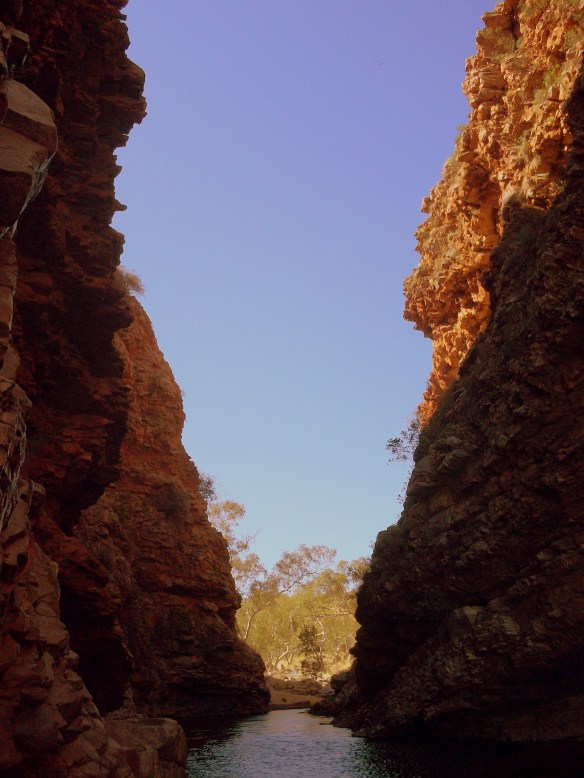
Simpsons Gap in the West Macs
I went to the market on Sunday morning, which was a fun mix of food stalls and crafts for sale. I walked along the dry riverbed for a bit on my way back to my wonderful Couchsurfing host’s home. I went on a short walk in the West MacDonnell Ranges. I had a good time during my short stay in town.
But I never did go out after dark in Alice.

Sunrise, Uluru, Australia
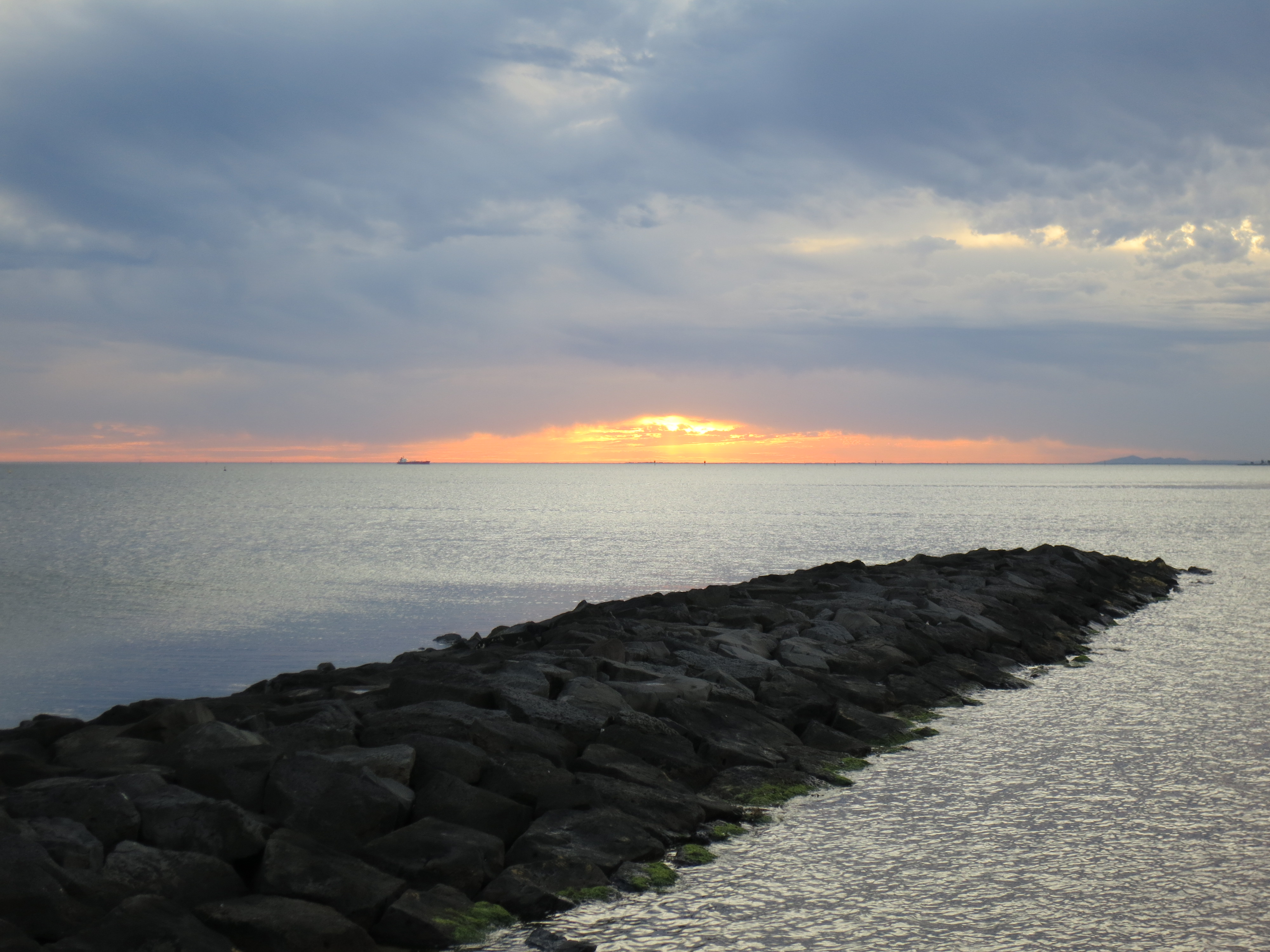
Sunset, Melbourne, Australia
I’ve talked about it on the funding page, I’ve referenced it in other posts, and I’ve put up a few photos of it already, but I haven’t actually told you what it was like to stand in front of Uluru. Break out the travel cliches, folks, because it was wonderful. It was breathtaking. It is now in my Top 5 Encounters with Rock Formations.
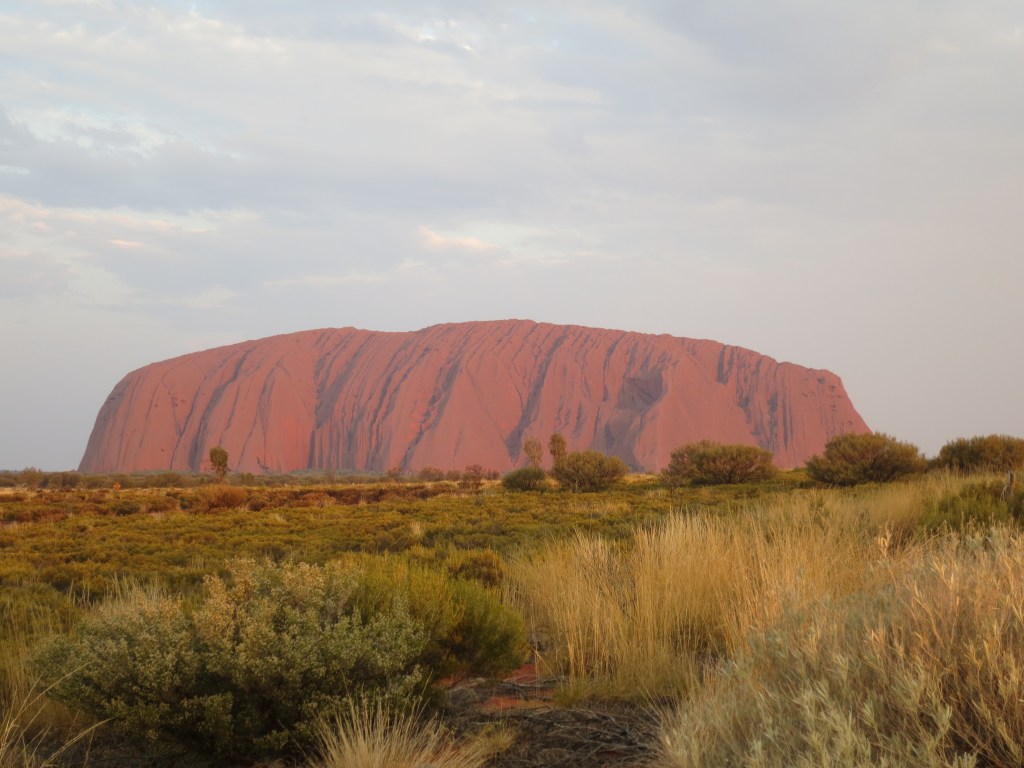
Uluru
Uluru (pronounced OOH-luh-roo or ooh-luh-ROO) is the local aboriginal name for the largest monolith in the world. It’s like an island in the middle of the desert, in that we see some of it above the ground, but most of the rock is under the earth’s surface, spreading for miles in all directions.
All the pictures show a massive rock rising above miles of flat desert land. I was surprised to find, on the five-hour drive from Alice Springs to the national park, that the whole area wasn’t flat. Much of the drive was spent gazing at the MacDonnell mountain ranges, and rolling hills of arid land covered in spiky spinifex.

Rather than drive myself or fly directly to the national park, I took a three-day, two-night tour from Alice Springs. I booked through Wayoutback Tours, but when no one else signed up for the same day, they unceremoniously switched me to an Adventure Tours group without advance notice. It worked out, but I was annoyed to discover that this tour switched the itinerary of the one I’d thought I was signing up for, so now Uluru would be last rather than first. I’d waited how many years to see it, and now I had to wait even longer?
One of our stops was at a camel farm. They also kept kangaroos and emus.
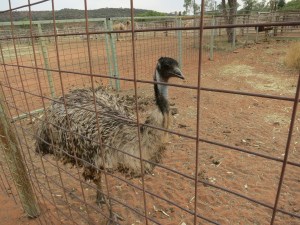

Baby camel!
Happily, there’s more to see out there, and my group of 16 saw a lot of it. First, we drove to Kings Canyon, which, being reddish and canyon-like, did remind me a bit of the Grand Canyon in Arizona. But here, you drive up to the bottom of the canyon, and most people walk up to the rim and then back down again. Considering the ascent is affectionately nicknamed “Heart Attack Hill,” I opted not to do that.

The river trail in Kings Canyon
Instead, I joined the woman in our group who had a broken ankle, and we went on the river walk. Sandi had had her crutches for several days at that point, so she was adept at navigating the uneven terrain. The walk took us through the riverbed, which had been dry almost as long as the last rainfall here, nearly five months previous. We picked our way through the loose rock, past other tourists who complimented Sandi on her toughness, until we reached the viewing platform. It was a beautiful view, and I liked the different perspective we got from down there.

Kings Canyon
That night we set up camp and cooked spag bog–spaghetti bolognese, but you have to shorten everything in Australia. We played a round of “I see the moon in the spoon,” which is one of those aggravating games with one simple rule that only one person knows at first and everyone else has to figure it out, and inevitably there’s someone who never does get it but the person teaching the game won’t spill the secret and it gets a bit uncomfortable as everyone else just wants to finish the damn thing already.
After our guide, Rachael, explained that we would likely see dingoes but not to worry, you can just tell them to shoo (!!!), we rolled out our swags and settled down for the night. They are very proud of their swags in the Northern Territory. They’re basically canvas sleeping bags, with a thin cushion sewed to the inside (and they’re referred to in “Waltzing Matilda”). You can put a sleeping bag inside it for warmth, then put your shoes just above your head, then pull up the edge of the swag to cover the shoes so the dingoes won’t steal them. Don’t leave anything out at night, or it will be gone in the morning. With visions of thieving dingoes darting through my head, and the eerie howling of real dingoes ringing in my ears, I fell asleep under the southern stars.

Night lights at camp
The next day, we broke camp early and headed to the national park that contains Uluru and Kata Tjuta (also known as The Olgas). Kata Tjuta was probably formed in the same kind of avalanche Uluru was, but the two formations look quite different. We went on a walk to the Valley of the Winds, which is as much statement of fact as it is poetic name. Luckily, none of us was blown off the trail, although it did look touch-and-go there for a bit.

Kata Tjuta from a distance

Valley of the Winds
That evening we joined the hundreds of other tourists at a designated sunset spot and got our first glimpse of Uluru. We didn’t get the stunning colors that the postcards show, because of cloud cover, but it still looked beautiful. And when we turned around, the backlit Kata Tjuta was a sight to see, too.

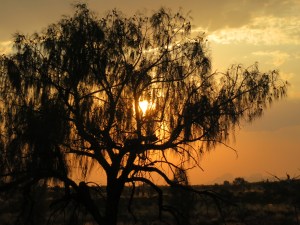
You can see the silhouette of Kata Tjuta to the right
On our final morning, we got up at 5am (maybe 4:30? some time humans are not meant to be conscious for, anyway) and drove to the same spot to see the sunrise. There’s a separate sunrise spot that all the other tour buses went to, but Rachael assured us that because of the cloud cover, this would be better, and we might get dramatic color lighting up the clouds around the rock. This didn’t end up happening, and we had a fairly dark sunrise. But still. Oh man.

The darkest hour is just before dawn
 Finally, we went to the visitors’ center, which was created by the local Anangu people and tells various stories associated with the rock. (Anangu is the name the Pitjantjatjara and Yankunytjatjara people have agreed on to refer to both groups, and together they are official caretakers of the area, in tandem with the Australian government.) I’d thought it was just one creation myth that made the place sacred, but actually there are many stories of gods and ancestors interacting on and around Uluru. Also, the Anangu people have lived in its nooks and crannies for thousands of years, so it’s a home as well as a sacred place. No wonder it’s an insult for visitors to climb it!
Thousands of people do climb Uluru every year, despite the outright pleas from the visitors’ center not to. The Australian government could ban the practice, of course, but a lot of tourism dollars come from the wealthy thrill-seekers who fly in, climb, see a sunset, and fly out again. So it remains legal, and there are guidelines on how to do it safely, and people keep tramping all over it. Three guesses how I feel about it.

The path–complete with chain to cling to–at the start of the climb
I overheard an exchange between a British guy and his new American girlfriend in my group. Him: “C’mon, climb it with me, it’ll be fun.” Her: “I know, I want to, I just feel bad, like we’re walking all over their culture.” Him: “I see where you’re coming from, but it’s just a massive rock.” British arrogance and American faux-cultural guilt in action.
Anyway, the climb was canceled for weather conditions, so no one climbed it the day I was there. Instead, our whole group followed Rachael on a short walk to various caves to see paintings and evidence of kitchen use. At the visitors’ center, we’d read about the plants found in the area, and the careful attention to seasons that allowed the Anangu to harvest food in such a punishing climate. Here, we got to see where they prepared that food for meals. We peered at the paintings–which were practice for showing directions while on the hunt–and in the kitchen we were allowed to run our fingers over the places in the rock used for grinding plants and putting together meals.

Cave paintings at Uluru
It was here, as I got close enough to this dreamed-about place to actually touch it and feel the ancient rock beneath my fingers, that my camera broke.
I was pretty calm about it, considering that it was hugely upsetting to me that my pricy camera had died and that it had done so on such a big day for photos. (For the record, no, I didn’t drop it or anything; it’s a known issue with the Canon S-100, in which the lens gets stuck on the open position and nothing but sending it back to the factory will fix it.)
After our cultural walk, the group split up so people could do the 10K walk around the base at their own pace. I hitched a ride with Rachael and Sandi to a little after the halfway point, then walked the rest of it on my own while they went to the gift shop.
A lot of the base walk isn’t allowed to be photographed, as it turns out. Areas that have special significance to the Anangu people are marked off with signs, and if a ranger catches you photographing there, the fines are steep. So okay, even if my camera hadn’t died a quick and treacherous death, I wouldn’t be able to capture about half my walk on film anyway. I gave myself over to the walk and enjoyed the first moments to myself I’d had in three days.

I ran into plenty of other tourists, but for long stretches it was just the natural surroundings and me. From far away, Uluru looks, well, monolithic, a large brown rock that changes color as the sun’s angle changes. But up close, it’s much more interesting. It’s an orangish-brown color, and it’s pockmarked all over with little holes caused by erosion and the occasional waterfall. The waterfalls leave long black streaks behind them, like they’re the lines and Uluru colored outside them.

You can see the black lines of the waterfalls
Uluru doesn’t go straight up (it’s much too old for that). Instead, it slopes and meanders up into the sky. Much of the rock looks like it’s shedding, or like someone’s chipping away at it with a paint scraper. I’m guessing that’s the forces of wind and rain at work.
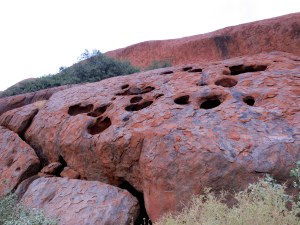
Despite the camera fiasco and walking around on two nights’ fitful sleep, I felt a deep calm walking next to Uluru. What a relief, that this place I’d had such high hopes for, easily met them. What an honor, to be walking on ground cared for by people whose ancestors first arrived here 40,000 years ago. What a joy, to gaze out at the landscape and understand what a beacon Uluru was.
As we piled into the van and began the drive back to Alice Springs, the clouds that had been gathering for days finally opened, and the five-month dry spell broke. We didn’t see a big thunderstorm or waterfalls running down the sides of Uluru, but we saw the orangish-brown rock darken, and the plants around the base shaking in the wind, and everyone stopped what they were doing and looked up at the sky in delight, and for just a moment, it was as it had ever been.
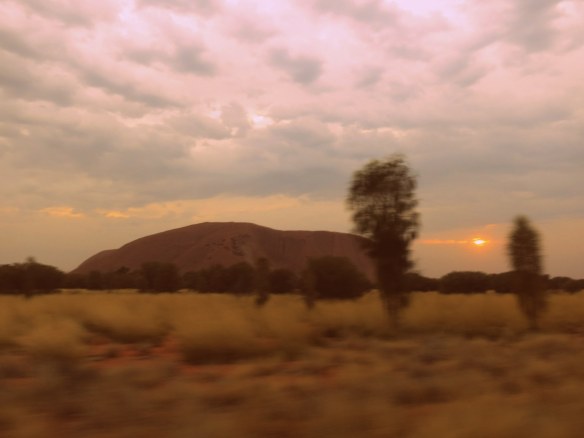
This is the only photo I used a filter on.
 Stowaway Travel Writing & Editorial Services