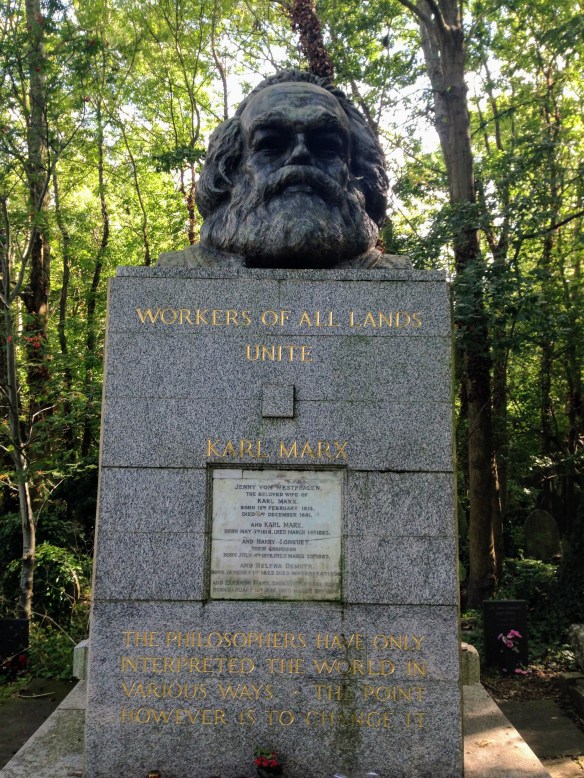
Highgate Cemetery, London, England; August 31, 2017
As McDonald’s workers strike for the first time in the UK, and workers fight for rights during the week of Labor Day in the US, seemed an appropriate time to post this
Highgate Cemetery, London, England; August 31, 2017
As McDonald’s workers strike for the first time in the UK, and workers fight for rights during the week of Labor Day in the US, seemed an appropriate time to post this
Check out the Advent Calendar for Social Justice here!
We have one month left before we’re in 2017, and although it’s tempting to just curl up into a ball until it’s over, we know that we need to prepare to live in a Trump world. (For the many people who see how this year has just pulled back the mask on what wasn’t all that well hidden to begin with – I hear you. I’m sorry it’s taking some of us so long to figure it out.) Okay, so let’s live in this world, let’s make it as good as we possibly can, and let’s do it together.

I used to be a weekly churchgoer, and the rhythms of the church year still echo in my life. The season leading up to Christmas is called Advent. Advent is a time of preparation, during which Christians prepare for the coming of the savior of the world. They prepare for the end of the world as we know it and the arrival of a better world we can barely imagine. This year, we are preparing for what certainly feels like the end of the world, and it’s hard to see anything beyond it. Trump is the opposite of a savior, no matter how he brands himself in his populist speeches. So this year we need to prepare ourselves to be our own saviors, to save ourselves from what we’ve allowed to happen. (I’m speaking mostly to my fellow straight white cis folks here – people of color and queer folk have been doing the heavy lifting since forever.)
This election seems to have served as a wake-up call for many of us. It’s not right that it took a loss that will devastate so many lives and alter the fabric of our democracy to serve as such, but here we are. So now what? is the question I see most frequently on Facebook, Twitter, in the news. There are a lot of good answers out there, from better thinkers than I. Read them, discuss them with friends and family, take action.
But for what it’s worth, here is my “what now?” response. Advent is a time of preparation, so let’s prepare. For each day of December, I’m going to take concrete action that makes me more prepared to resist the Trump presidency, or that offers some resistance now, or that contributes something good and kind to the world. Some of these actions can be done anywhere in the world, and some are US-specific.
I also think it’s important to do a mix of overtly political and more community-building or “good deeds” type things. Especially if you haven’t been politically active before, you may find this a little intimidating, but what we’ve seen from the way Trump’s campaign was run, and now after the election, is that white supremacy, misogyny, xenophobia, and homophobia play a prominent role in people’s political decisions and everyday lives. Coaching Little League builds community, yes, please keep doing that — but also see how you can assist your local Black Lives Matter chapter, to build community in that way as well. And artists — keep creating, always. Artists are vital.

Will you join me for this month? Especially for people who wouldn’t normally consider themselves political, or who don’t have much experience with activism, I tried to make this an accessible collection of things to do that will show how easy it is to fit these things into our busy lives, and how it’s not that scary to do.
If you have suggestions, please comment. Share this with anyone you like. The key is to take action, and to do it together. So call your mom, talk to your coworker, make a new friend, and go all in. As Angela Davis recently said, “How do we begin to recover from this shock? By experiencing and building and rebuilding and consolidating community. Community is the answer.”
Here is where I was going to put the calendar, but I can’t get it to embed. So please click through to the Advent Calendar for Social Justice. Be sure to click on each day to see notes and useful links with further info for each action item.
This calendar is intended as a helpful tool for people who want to do something, but aren’t sure where to start. I hope it will help you sample different ways of taking action, so that in the new year, you’ll be better prepared to really dig in to volunteering, donating, and organizing roles. I’d love your feedback. I consider it a live document and will adjust it as necessary.
Shout-out to Liz and Emmett for providing excellent advice and action items.

Resources for Educating Yourself and Taking Action:
Accomplices Not Allies
A List of Pro-Women, Pro-Immigrant, Pro-Earth, Anti-Bigotry Organizations That Need Your Support
Oh Crap! What Now? A Survival Guide
Opportunities for White People in the Fight for Racial Justice
“We’re His Problem Now” Calling Sheet
What Educators Can Do to Support Undocumented Students
What to Do Instead of Calling the Police
Organizations Fighting the Good Fight:
350
American Civil Liberties Union
Amnesty International
Black Lives Matter
Campaign Zero
Council on American-Islamic Relations
Emily’s List
National Center for Transgender Equality
National Coalition for the Homeless
National Disability Rights Network
National Women’s Law Center
Planned Parenthood
Showing Up for Racial Justice
Southern Poverty Law Center
Sylvia Rivera Law Project
The True Colors Fund
Welcoming Refugees
London, England; June 13, 2016
Happy New Year! Here’s to a year more just and kind than the last. May the fight against systemic injustice grow stronger, and may those who try to uphold those systems change their minds and their ways.
For 2015, I’ve got another list of New Year’s Celebrations to look forward to:
How about you? Any non-resolutions this year?

Comic from the ever-wonderful Dinosaur Comics by Ryan North.
The Hoa Lo Prison in Hanoi combined the single-minded propaganda of the War Remnants Museum and the strange echoes of death sites felt at the Cu Chi Tunnels, resulting in a bizarre experience. A friend and I went together, and we were two of only about thirty or forty visitors in the mid-afternoon heat, so often we were the only people walking through rooms that were once packed full of prisoners, our voices swallowed up by the thick concrete walls.

Before it was the Hanoi Hilton, it was the Maison Centrale of Hoa Lo Prison
American prisoners of war nicknamed this place the “Hanoi Hilton” in a bitter jab at the conditions they endured. The official Vietnamese line is that the POWs were treated very well, and learned to empathize with the people they had previously only known as “the enemy.” However, multiple POWs have reported inhumane conditions, including substandard housing, insufficient food, and physical torture.
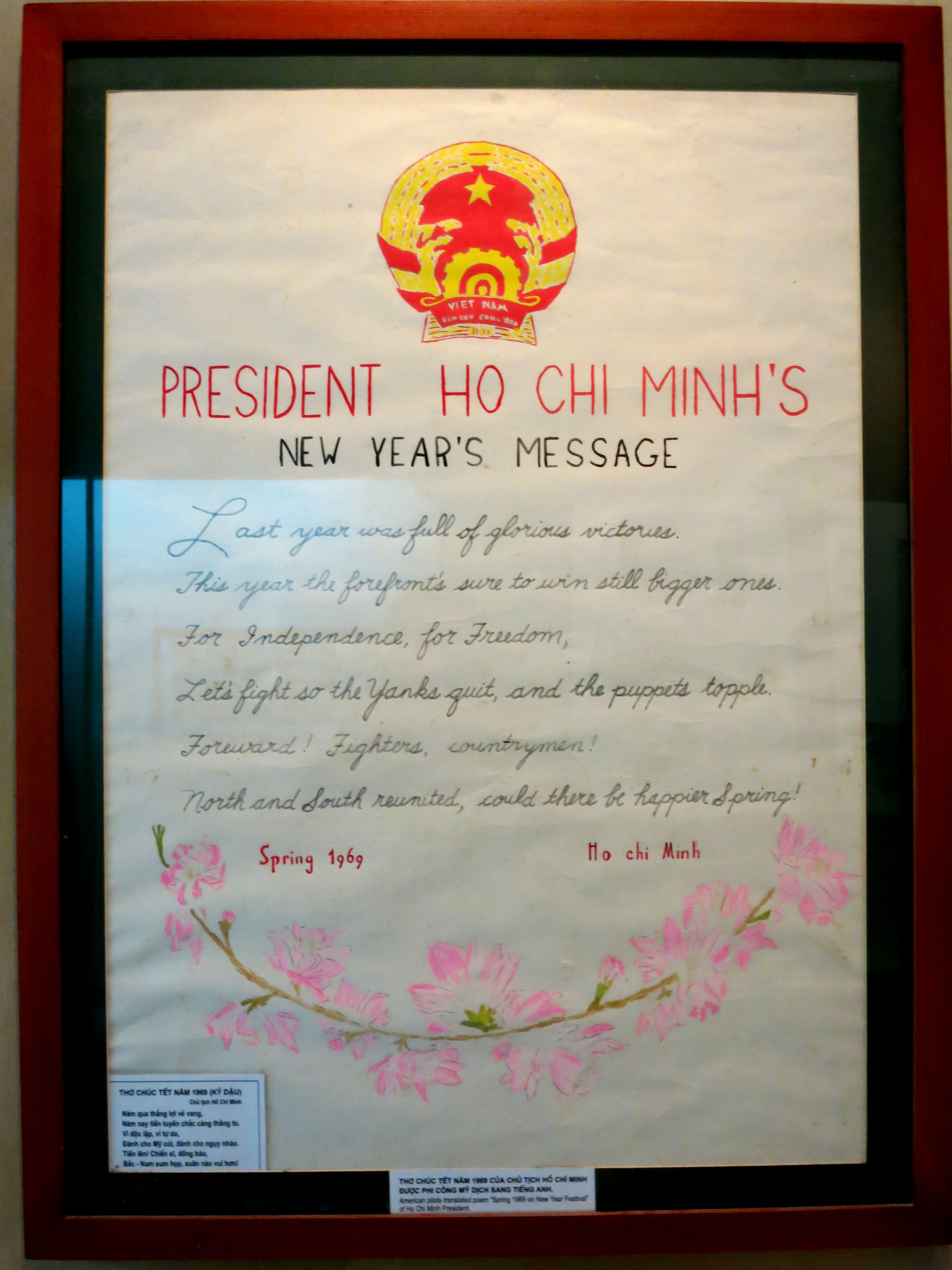
A 1969 New Year’s message from Ho Chi Minh, wishing to eject “The Yanks” and reunite North and South
But the first part of the museum doesn’t even mention Americans. The prison was built during French colonial times to house political prisoners, and the gatehouse that remains as the museum still has “Maison Centrale” arched over the doorway–the central house of the prison complex. Inside, there’s a mix of murals, glass cases filled with objects and scale models of the prison, and life-size sculptures of prisoners chained together and plotting revolution.

Before the 1880s, this part of the city sold stoves. This is part of the reason the prison is called “Hoa Lo”; it means “stove” and, supposedly, also “hell hole.”

Shackled statues
The Vietnamese who were imprisoned by the French endured terrible conditions; the exhibits emphasized how resilient the prisoners were, and how they did everything they could to resist their imperial jailers, including gathering under an old almond tree in the courtyard to discuss resistance measures. The guillotine used to execute prisoners was on display, as were the solitary confinement cells, the piece of sewer pipe that 100 prisoners escaped through, and the room that held many more female prisoners than could comfortably fit.

Part of the sewer used as a means of escape by Vietnamese prisoners

Several prominent Communist leaders were imprisoned here, when it was under French control

The guillotine was used as one method of execution
There were just a few small rooms devoted to the prison’s use in the ’60s and ’70s. These held artifacts like John McCain’s flight suit, a bed used by the prisoners, and a guitar and badminton net from all the leisure activities the POWs were supposedly allowed.

John McCain’s flight suit

Supposed evidence of benevolence
The two most striking things I saw in these small rooms were a video from the time of the war, and a document listing the regulations of the camp. That list started with:
American servicemen participating in the war of aggression by U.S. administration in Viet-Nam and caught in the act while perpetrating barbarous crimes against the Vietnamese land and people, should have been duly punished according to their criminal acts; but the Government and people of Viet-Nam, endowed with noble and humanitarian traditions, have given those captured American servicemen the opportunity to benefit a lenient and generous policy by affording them a normal life in the detention camps as practical conditions in Viet-Nam permit it and conforming to the situation in which the war is still on. [sic on everything]
The video was a marvel of propaganda. It alternated scenes of American POWs playing basketball and grinning at dinner with scenes of Vietnamese cowering from falling bombs and picking through the wreckage afterward. It was a genius video; who could watch it and not sympathize with the Vietnamese, who were so generous to the people who were daily trying to kill them? Of course the smiling the POWs did for the cameras was all done under duress, and it was sick to hold up these tortured men as examples of how beneficent their captors were. But just because the POW sequences were lies doesn’t mean the bomb and wreckage scenes were. It was a bloody, hateful war–as they all are.

Lots of propaganda photos, accompanied by text detailing the “typical” life of a POW here
My interest in the prison derived from my knowledge of the Vietnamese-American War, but once again, seeing the place in person showed me a side I wasn’t aware of–how significant the prison was to the Vietnamese as a place where they had been tortured and unjustly confined by French colonial forces. There wasn’t even a straight line drawn between the displays showing how badly the Vietnamese were treated, to displays showing how well the Americans were treated. That was a line you could draw, yes, but the way the museum was set up, it was more like it was a museum about the prison under the French, and the heroic Vietnamese prisoners who lived and died inside; and there were a few rooms about how the prison was later used.
It was fascinating, and sobering, and nothing like I’d expected.
No museum is a mere collection of facts. It’s not possible to display information completely objectively; there’s always a point of view taken, a lesson to impart, an agenda to push. This is true even for museums that aren’t at all political; for example, the Laura Ingalls Wilder Historic House & Museum promotes not just Wilder’s writing, but the idea that her values and way of living are worth emulating. Museums only exist because somebody thought the topic was worthy of further study and wider knowledge by the general public. Just by building a museum, you’re taking a position. But I have to say, I have never been to a more baldly biased museum than the War Remnants Museum in Ho Chi Minh City.

The War Remnants Museum in Ho Chi Minh City, Vietnam
Unlike a lot of museums, this one makes no bones about its purpose: it is there to tell the story of the Viet Cong during the Vietnamese-American War, and it is there as a corrective to the American narrative of the war. Every single poster and placard called it the American War of Aggression. Any time the war was called “the Vietnam War,” the phrase was placed in quotes. South Vietnam was called the “so-called Republic of Vietnam.”

Protests around the world
When the USSR or China were mentioned, the war was called a “struggle for national salvation,” to be more aligned with Communist vocabulary. One placard showed Australians protesting their government sending troops to aid the Americans, and the placard said they were protesting the agreement between the Australians and US to “force Australian youths to become field targets in the US battles in Vietnam.” The whole museum was a master course in semantics. (Which is not to say it was false–you can put a lot of gloss on a base of facts.)

Some veterans from the US have sent in their medals and fatigues to the museum, with notes of apology
It was also extremely difficult to visit, because the anger and loss on display was so raw and so recent. An entire room was devoted to photos of children suffering from painful and debilitating birth defects, which they got because their parents were exposed to the dioxin in Agent Orange. Did you know that this was only one of the toxins sprayed over forests and farmlands? The museum showed posters of the various “colors” of toxins used by the US. The posters looked a lot like our terrorist threat level posters today, only guess who was the threat?
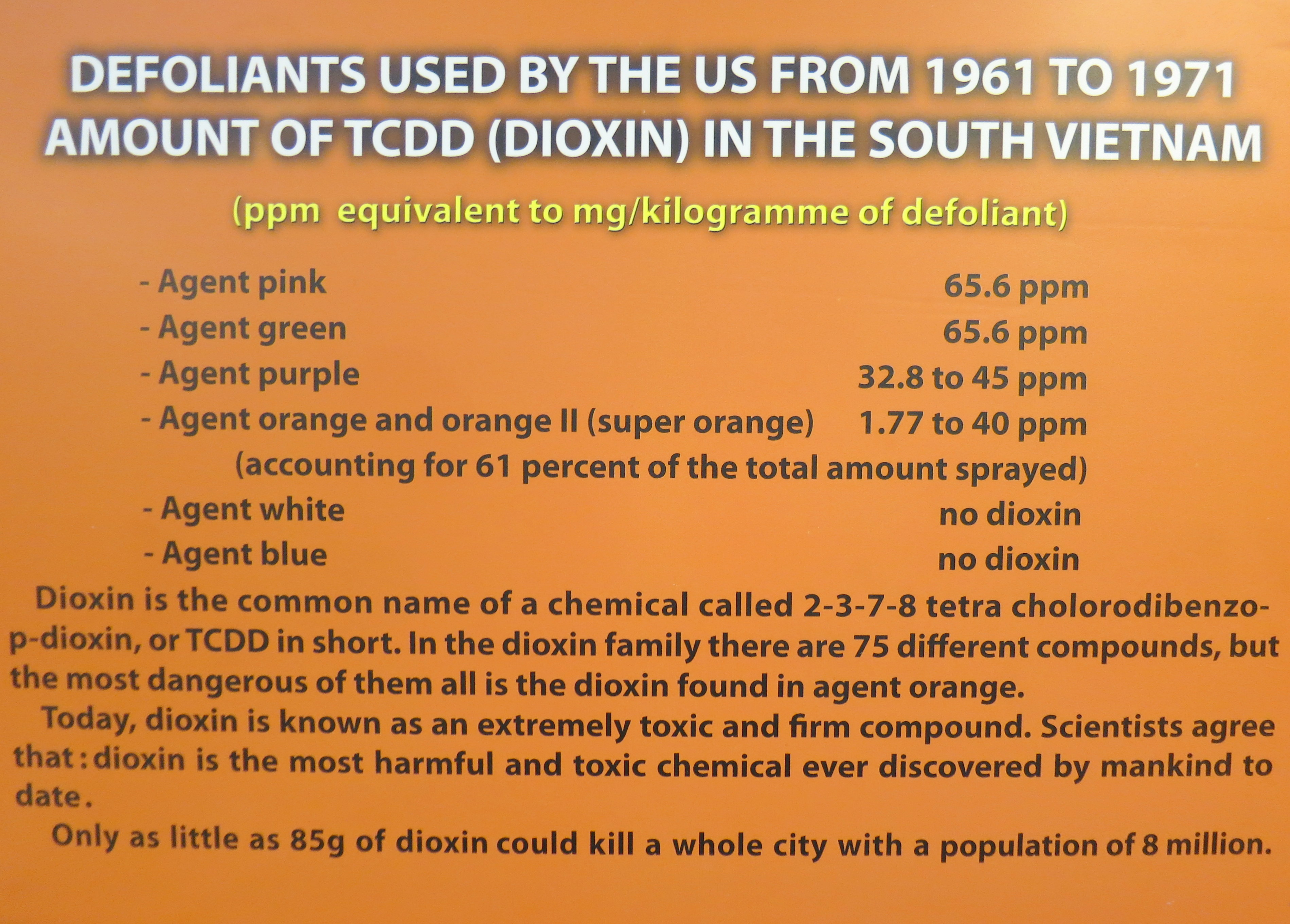
Yikes
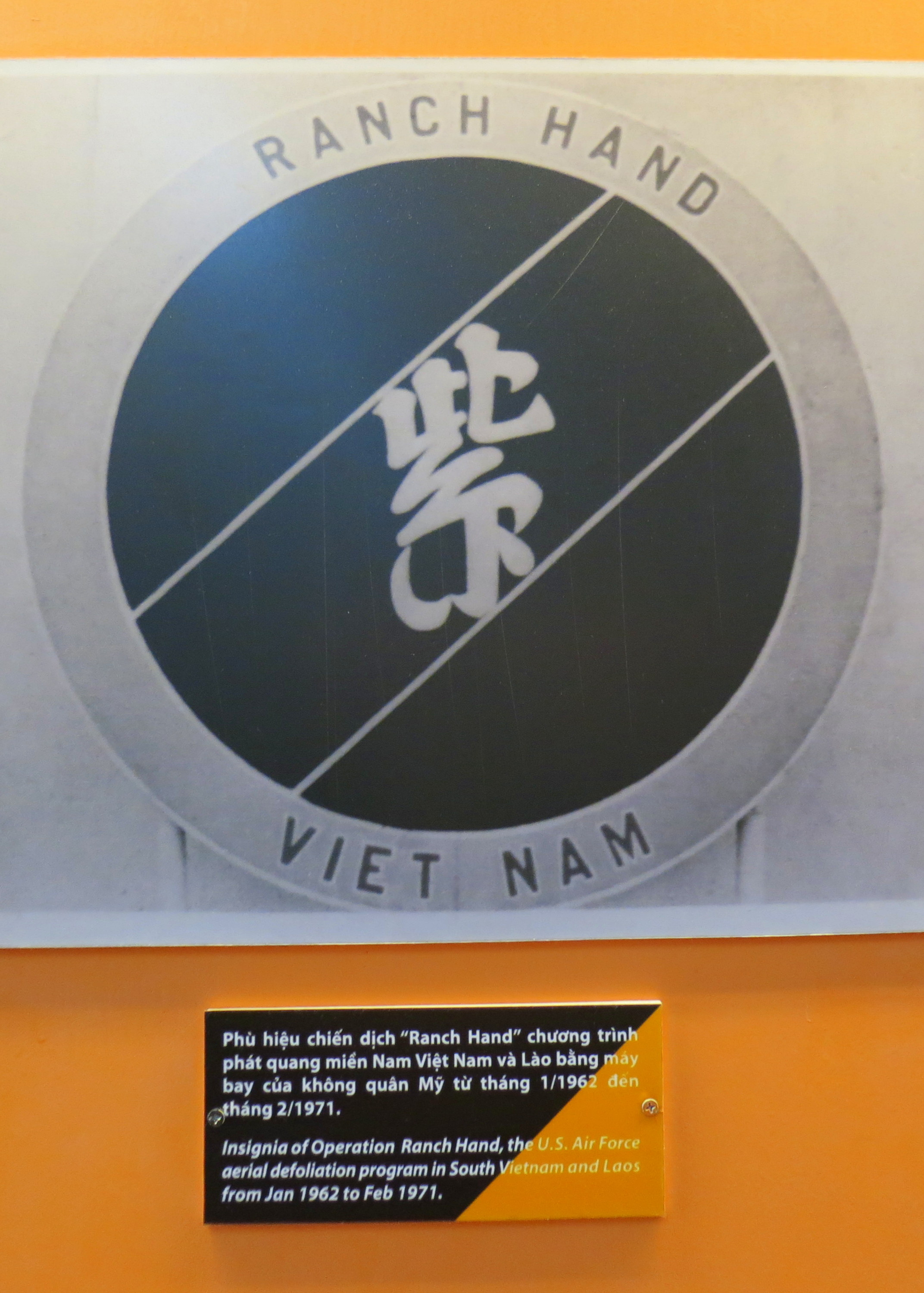
Ranch Hand: the name of the operation that sprayed various chemicals over the farmlands and forests of Vietnam from 1962 to 1971
Research since the 1960s has shown that even just one parent exposed to dioxin could affect the DNA of the child, resulting in spina bifida, diabetes, various cancers, twisted or missing limbs, developmental disabilities, and other defects and diseases. So it’s not just the people who survived the war who developed health problems, but their children did, too. (Of course, this has been a big issue in the States, too, as the military has slowly agreed to compensate some US veterans for the health problems they and their children suffer as a result of being exposed to Agent Orange. We hurt ourselves when we hurt others.)

A whole room of these images, difficult to see, harder to contemplate.
The Aggression War Crimes and Historical Truths sections, in addition to containing the Agent Orange room, included displays on the My Lai massacre, the founding of the National Front for Liberation (what we know as the Viet Cong), the bombings in Laos and Cambodia, and the airlift of Americans in Saigon in 1975.
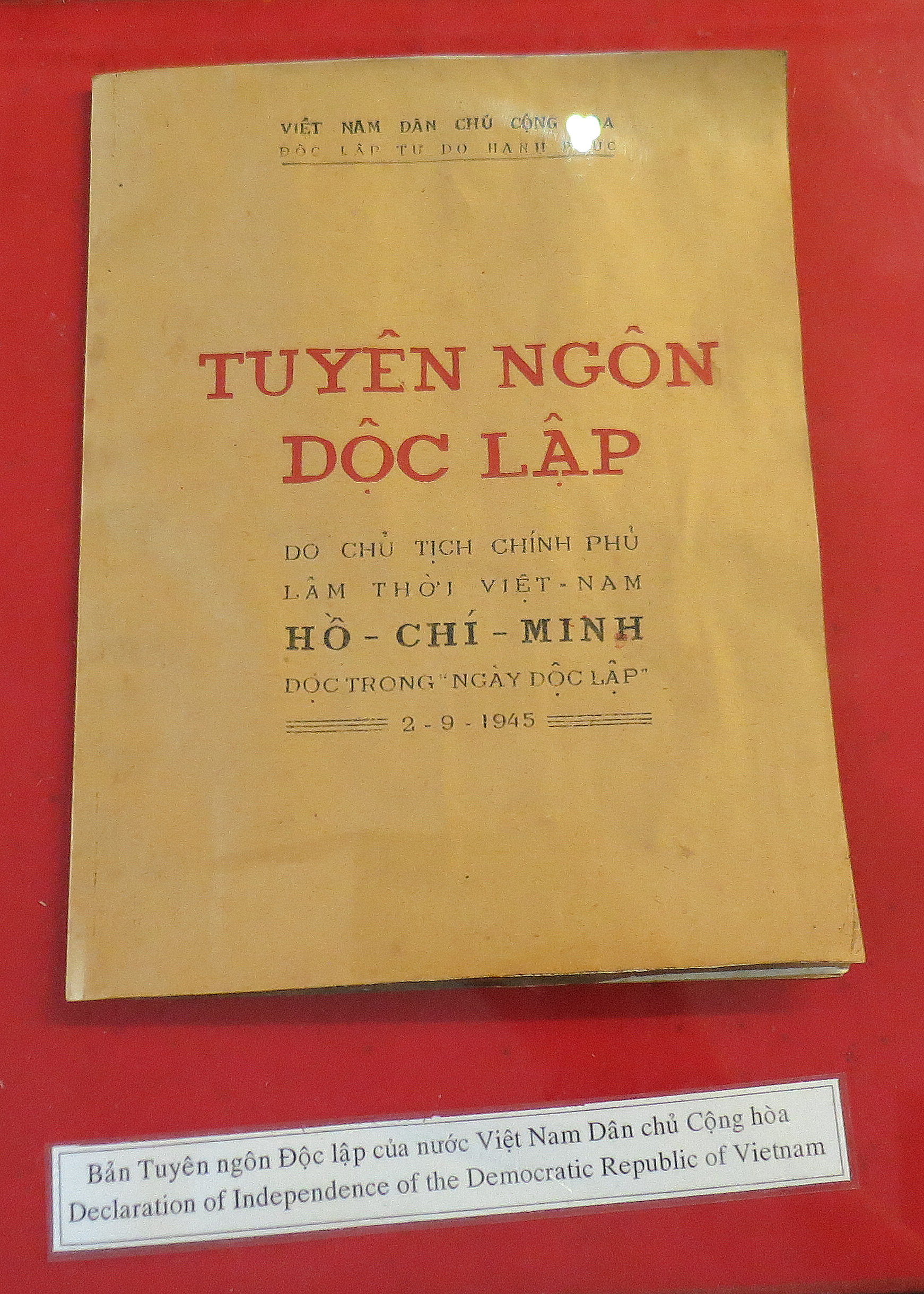
The Declaration of Independence of the Democratic Republic of Vietnam
There was a special display on photographers of the war, especially American and French photographers who trained their cameras on the atrocities the Vietnamese suffered at the hands of the American troops. A couple rooms held displays of shell fragments, different kinds of guns, and in a display on the total destruction of villages in Son My, pots and baskets to show what the lives of the villagers were like before the attack.
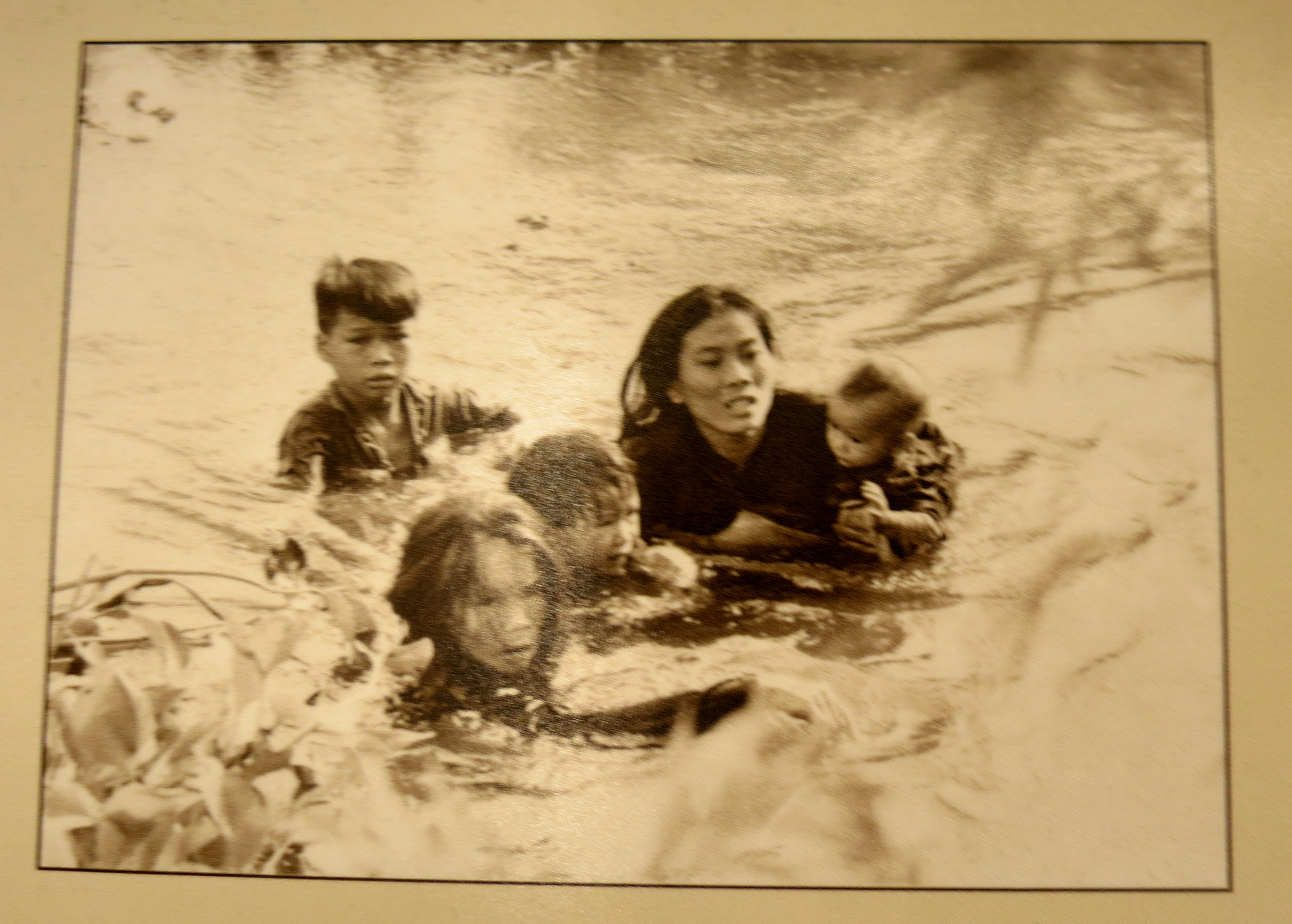
Part of the Photographers of the War exhibit


Pottery from the Son My massacre. We know it as the My Lai massacre, but that was just one of several villages in the area that was destroyed, and the Vietnamese call it the Son My massacre.
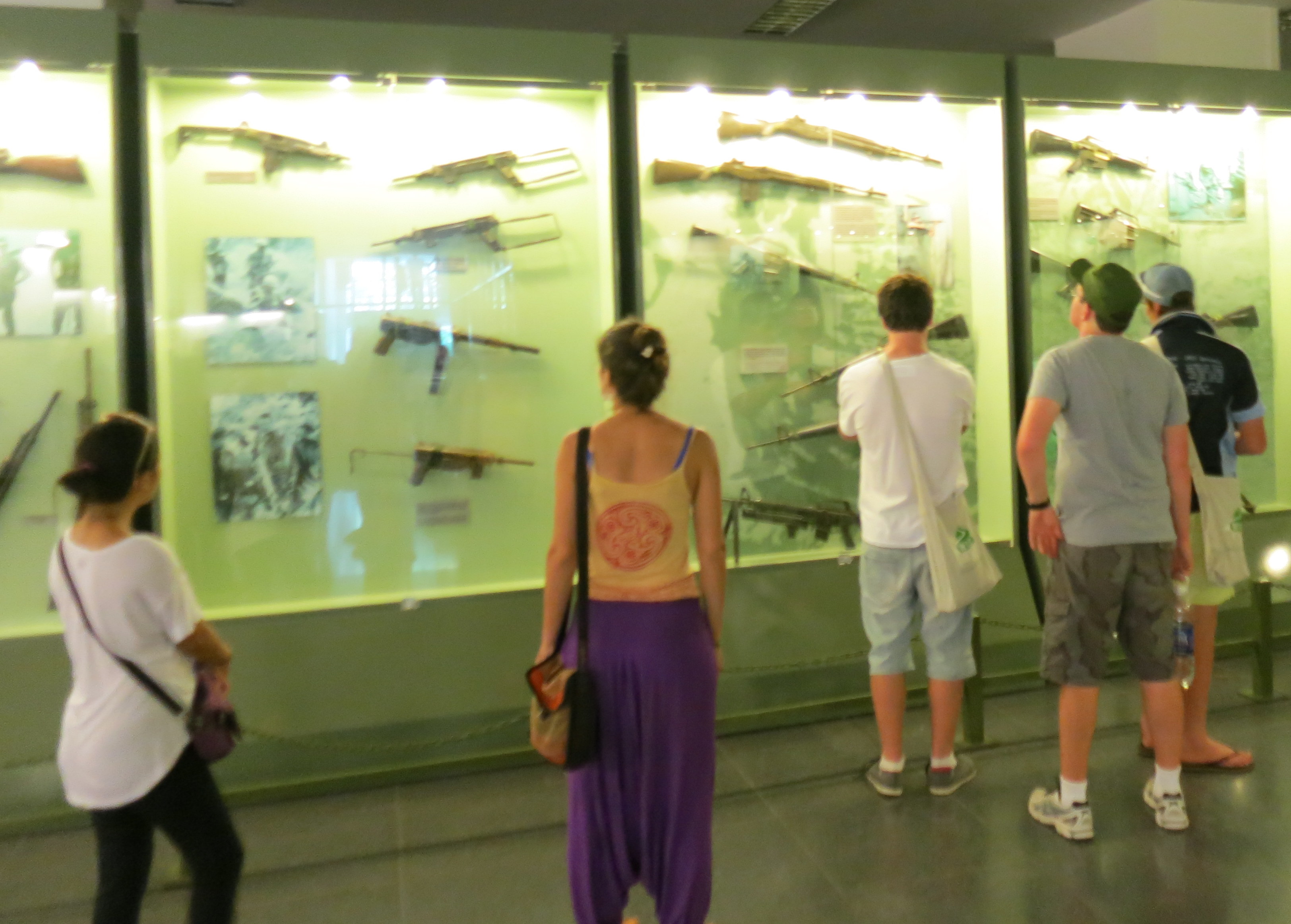
Visitors look at the guns on display
The first floor was split between two displays: one on the education the young Vietnamese received under the Viet Cong during the war, and one on the worldwide anti-war protests held during the ’60s and ’70s. The education display was dated, a magazine spread for people to read during the war. It showed children in obvious poses, smiles plastered on their faces as they shouted dedication to “Uncle Ho,” with captions like “Children tried to study well and work hard to make the contribution to the people’s movement defeating American aggressors.” I don’t mean to undermine the importance of the teachers during this time, though; they taught children in tunnels if they needed to, never sure of where or when the next bomb might go off.
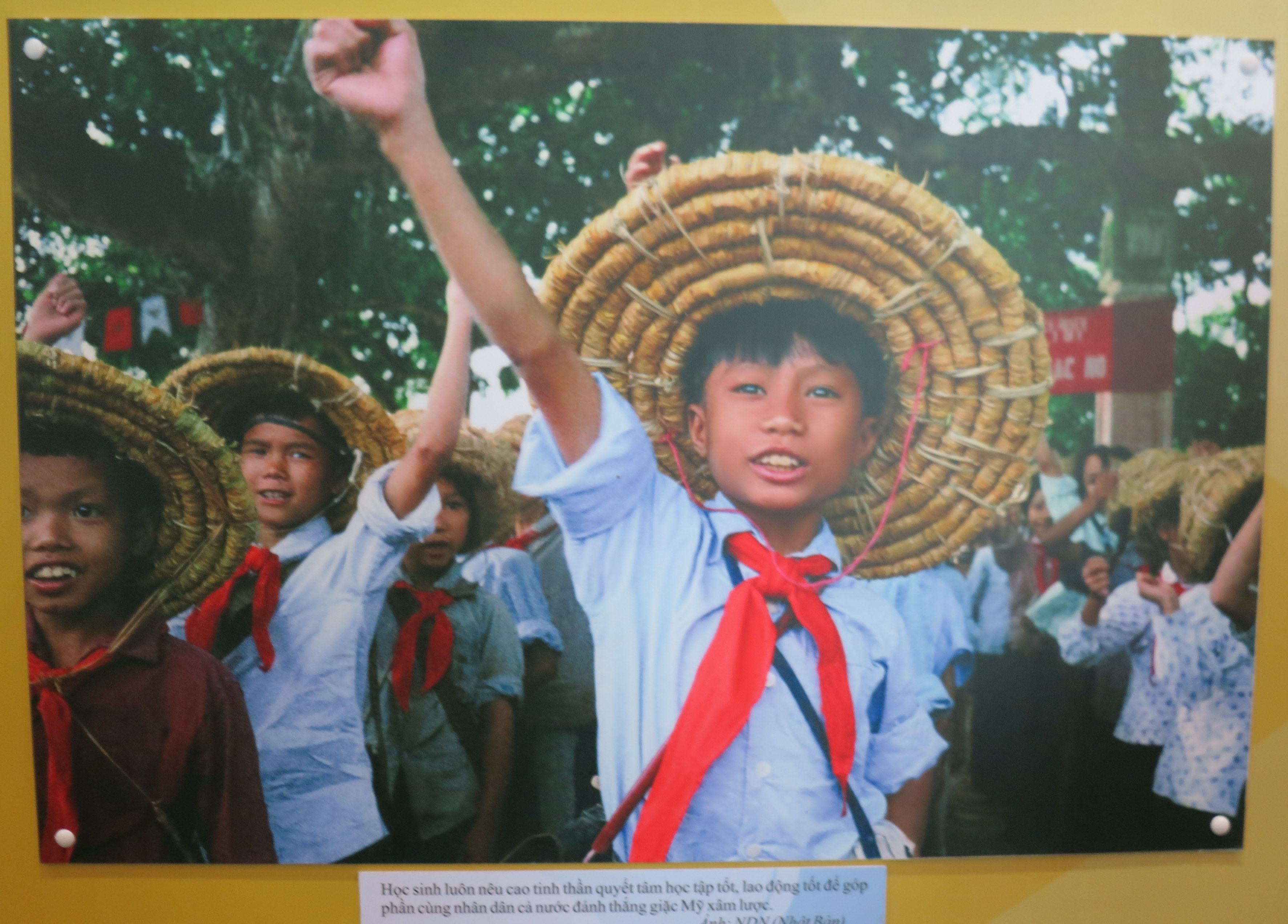
Part of the “Children During War” exhibit
The anti-war display was the opposite of dated; seeing the accumulation of anti-war and pro-Vietnam support from all those different countries, over many years, brought home how much this war meant to people around the world. People were not only concerned for the lives damaged and lost on both sides of the war, but also for what this kind of unofficial but all too real war meant for the world they lived in, and how it might affect their future. Seeing large posters declaring “Solidarity with Vietnam” in German, only 20 years after the end of World War II, was affecting. A man in Japan wore a sign saying “US Withdraw from Vietnam” during his commute, every day for 8 years. Several tribunals were convened on the “war crimes of the US” in Norway and Sweden. Thousands of people in South America, Africa, and Europe signed letters denouncing US intervention in Vietnam. Massive protests were held on every continent.

Before and after the war, from places around Vietnam
I’m so used to the American version of the story, even the anti-war story, that I was surprised by these global actions against the war. I’d let myself be insulated, seeing everything through a particular lens, and it was good to be reminded how narrow that view is. Especially in light of the anti-war protests in 2003–those didn’t come from nowhere, they have a lot of historical precedent.

Let there be peace
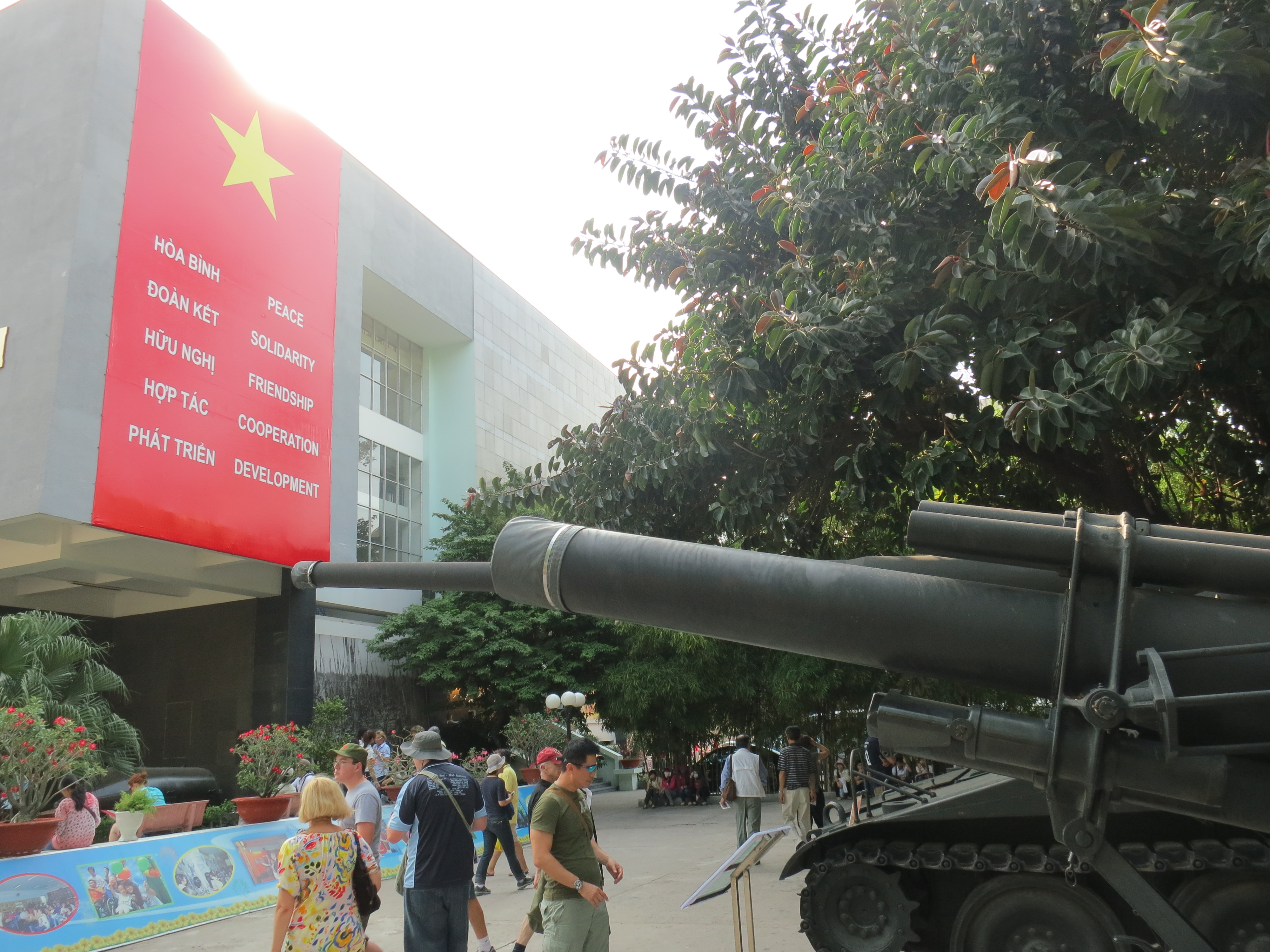
Outside the museum, captured American tanks, heavy artillery, and a bomber plane were on display in the sunshine. A group of children deformed by Agent Orange played musical instruments for a growing crowd of Vietnamese tourists. I stuck a flower in the gun of a tank, smiled and flashed a peace sign, consciously re-creating several historical photos of hope reaching out into violence. Behind me, the band struck up a folk song, and the gathered Vietnamese began to sing.
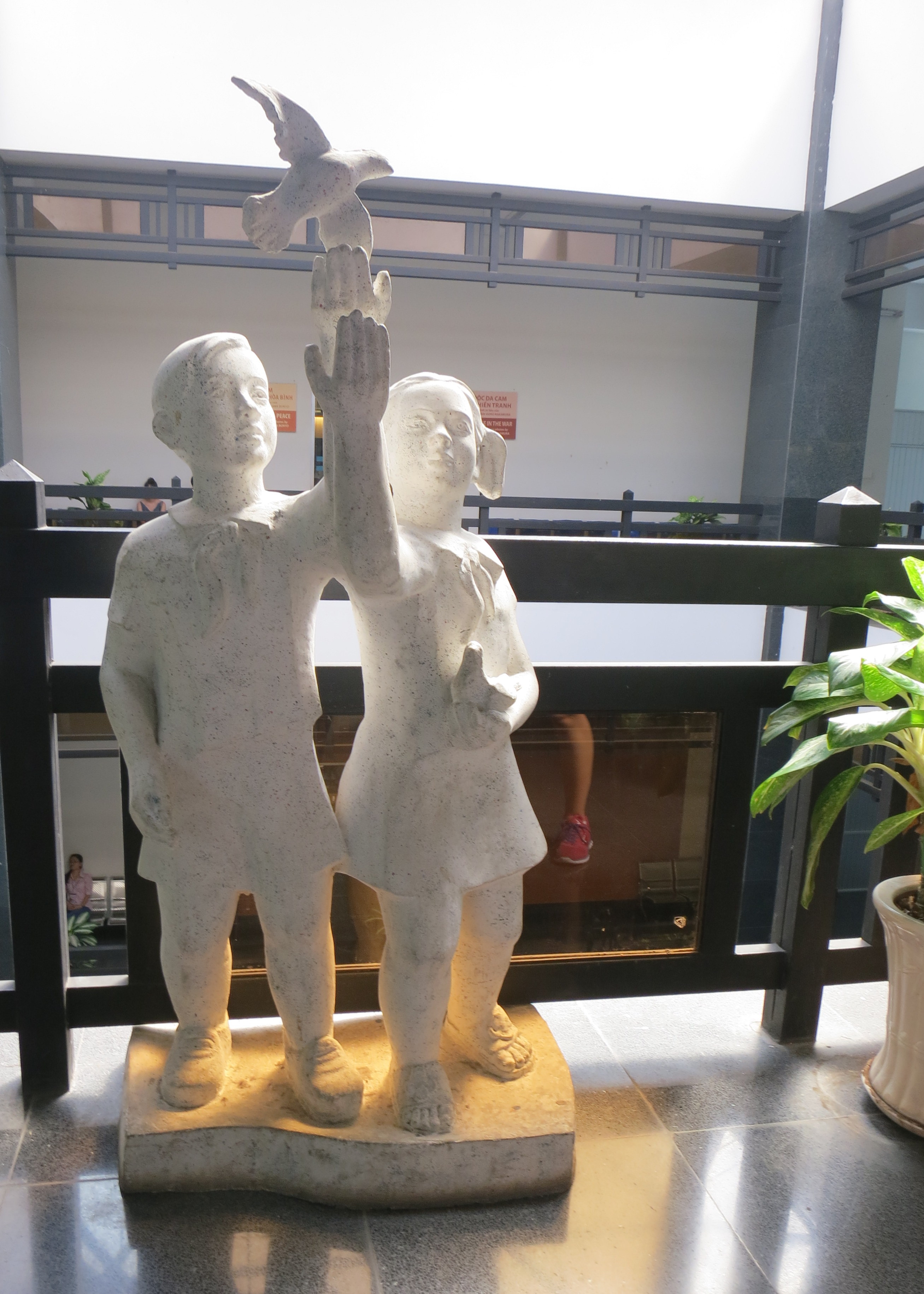
Outside the Peace Room
Happy Labor Day, fellow Americans! I hope you’re all enjoying barbecue with loved ones. For my friends outside the US who may not know, Labor Day is the American version of May Day; it used to hold a lot more power as a holiday recognizing workers’ rights, but now it’s generally seen as the the last party of the summer. Let’s take a moment to remember why we get to have the party.
Especially this year, when we’re remembering the March on Washington 50 years ago, I think it’s important to be grateful on Labor Day for the protections and opportunities we have, while we fight for the ones we’ve lost or haven’t gained yet. The nationwide attack on teachers–especially nasty in Chicago–in the guise of helping students. The “right-to-work” laws passed in 24 states (an amazing semantic victory for the right). The gender wage gap. Crippling student loan debt–and the recent doubling of interest rates on those debts. Blocked immigration reform. An unlivable minimum wage. Minimal support for new families, especially mothers in the workforce. Legal discrimination against LGBT folks. There’s a lot about employment in the US that needs fixing. (Click on those links to see groups that are taking action; you can join them.)
Obama’s speech this past Wednesday was pretty good, but the line that adapted MLK’s famous one is great: “The arc of the moral universe may bend towards justice, but it doesn’t bend on its own.” He then urges everyone to continue fighting the good fight, a point he makes in a lot of speeches but far too frequently contradicts in his actions as president. Still, he’s not wrong. The reason we have the workers’ rights we have is because people fought for them, and not just the union leaders and lobbyists paid to fight for them. People who were tired after a long day at work then went out and rallied in the streets, wrote to members of Congress, went on strike, made changes to local laws, talked to their friends and neighbors about what was going on, elected leaders who promised to fight the fight with them. You don’t have to come home from work tired and angry with workplace injustices and your lot in life. You can come home from work tired and happy with the work you do and the conditions you work in. You can come home from work fired up to make work a place you want to return to.
So raise a toast to the unions and workers of yesterday and make a pledge to join with the ones who are fighting for a better life today. Because Labor Day means a lot more than the last day of the season to wear white.
I’ve lived in Chicago for five years, and I’ve been to New York, LA, London, Sydney, Tokyo, and Paris. All have their own vibrant queer scenes, of course, but it was the subway in Toronto that actually showed how normalized the LGBT experience might be in that city. While waiting for a train I saw an ad for the personals:

And when I got off a couple stations later, I saw an ad for HIV medication, showing a gay couple discussing whether to use single tablet drugs to manage the virus:
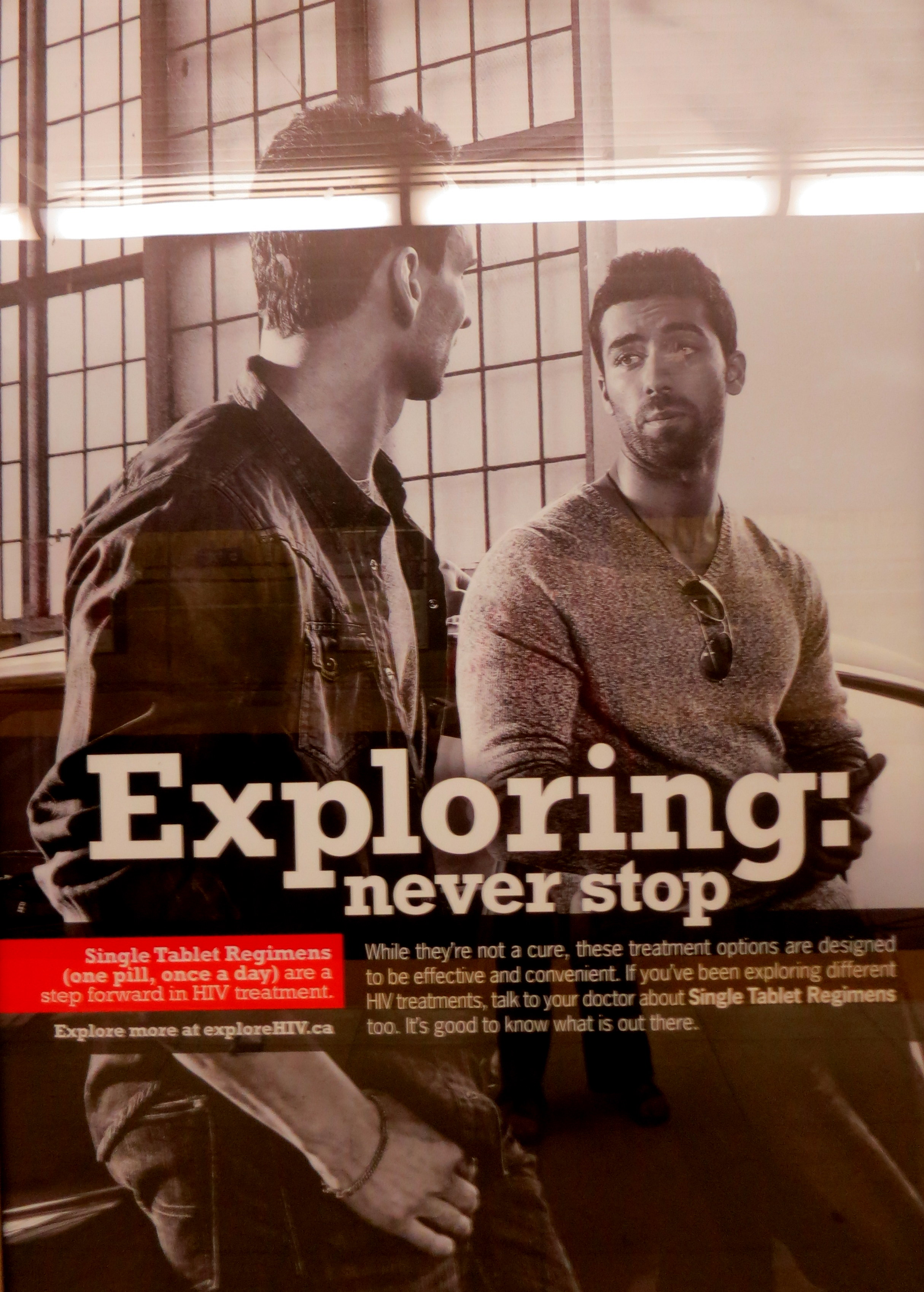
I don’t know what the daily life situation is like for LGBT folks in Toronto, but seeing those two ads made me think that at least the first hurdle of being seen, and being seen as normal humans at that, has been crossed. Other cities, take note.
Couchsurfing can make people nervous for various reasons, but questioning what it might do for your reputation or job security is not usually something that comes up. Janet at Journalist on the Run published a letter her friend received after hosting CSers at her flat in Korea. In it, her supervisor warns that her neighbors have filed a complaint about her because several strange men have been seen exiting her apartment over the past month.
Basically, her supervisor says, “I know you’re doing Couchsurfing, but you look like a slut, which is not the image we want for teachers in Korea, and you’re hired by the government of Korea, so you gotta change your ways or risk being fired.” Janet and the commenters discuss whether the supervisor should have supported the employee or whether the employee should have taken a cue from CS and adjusted to the new culture she finds herself in.
It’s a fine line between respecting cultural norms that are different from yours, and standing up for your own beliefs and way of life. This particular issue is made trickier because it involves her job. I guess for me, knowing that my job protection as an American in Korea is basically nil, I’d err on the side of caution and keeping my job. Then engage in conversation with other teachers and parents over the course of the year, with the goal of gently encouraging alternate points of view. Actually, if you’re a teacher in the States, your job security is pretty bad too, so that’s probably the tactic to take here as well.
Now, if it didn’t involve employment, I might act differently. Living in an apartment in Rome and my landlady disapproves of my nighttime visitors? Too bad, lady, I pay you each month and my bedroom is my business. Miming trying on a skirt at the night market in Chiang Mai and the merchant just laughs and says “too big! too big!”? Okay, that’s blunter than I’d hear at home, but you know your product better than I, so I’ll move on.
It can get a lot more serious, of course. A woman visiting Saudi Arabia? Cover your head. A lesbian couple visiting South Africa? Don’t hold hands. A Sikh man visiting rural Alabama? Bring a white friend. These aren’t matters of cultural misunderstanding so much as basic personal safety. How do we integrate respecting other cultures and respecting our own integrity? A question for the 21st century, and one that can only be answered by including the voices of people from the countries we visit as outsiders.
There’s a lot more to say on the topic, but I find myself posting later than expected today. Weigh in, dearest fellow travelers. What would you do if you were the teacher in question? What changes do you make in deference to cultural differences when you travels? What changes do you refuse to make?
July 13, 2013 has been a date I’ve looked forward to for months now, as the date I’d be back in East Lansing, seeing my family and friends. It was a great day for me, but as I learned from the paper the next day, it was a terrible day for justice in this country. George Zimmerman was acquitted of murdering Trayvon Martin, and the Stand Your Ground law of Florida is now firmly established as a law that does just the opposite of its supposed intention: it is now legal to intimidate and chase down an unarmed teenager, then shoot them dead after 911 tells you to back off–and you can do it all while claiming you’re the one being victimized. I heard someone say they weren’t surprised by the verdict, but I say you don’t have to be surprised to be outraged.
One of the major differences between the United States and other Western countries is that we are the only country that not only sees gun violence as a sad but inevitable part of normal life, but that fiercely defends those who want to keep it that way. Literally everyone I’ve met from another country can’t comprehend the American approach to guns. We actually have a hard time discussing the issue, even, because the idea that civilians can be so casually and heavily armed is utterly foreign to them.
A lot of people want to know if I feel safe traveling in cities around the world, and I tell them I lived in Chicago for five years, which has one of the highest gun homicide rates in the country. I’m no safer at home than I am abroad, and in many ways I’m less safe, in the most mundane of locations: movie theaters, elementary schools, even the fat ladies store I shop at–all of them have been fatal sites of gun violence. Someone had easy access to a deadly weapon, and they used that weapon in a public place, injuring, killing, and terrorizing people trying to live their daily lives. This happens far too often here. I am happy to be back in the States for many reasons, but I’m certainly not feeling safe here.
And I’m not black, or poor, or in an abusive relationship, or any of the other factors that make it far more likely that you’re going to be attacked by someone with a gun. It’s a scary thought for me, but it’s a terrifying reality for millions of people across the country. The racism evident in the shooting, the arrest, the trial, and the verdict is abhorrent, and an integral part of the problem of gun violence in the US. How is this a situation we’ve come to accept as a nation? How is this a country we want to live in? Surely we all want better, safer lives. Sign the petitions, call your representatives, and don’t let up until the gun lobby is defeated and we have strong gun laws in place. It’s the least we can do in memory of Trayvon and the others killed by armed Americans, and the least we can do for our own future.
 Stowaway Travel Writing & Editorial Services