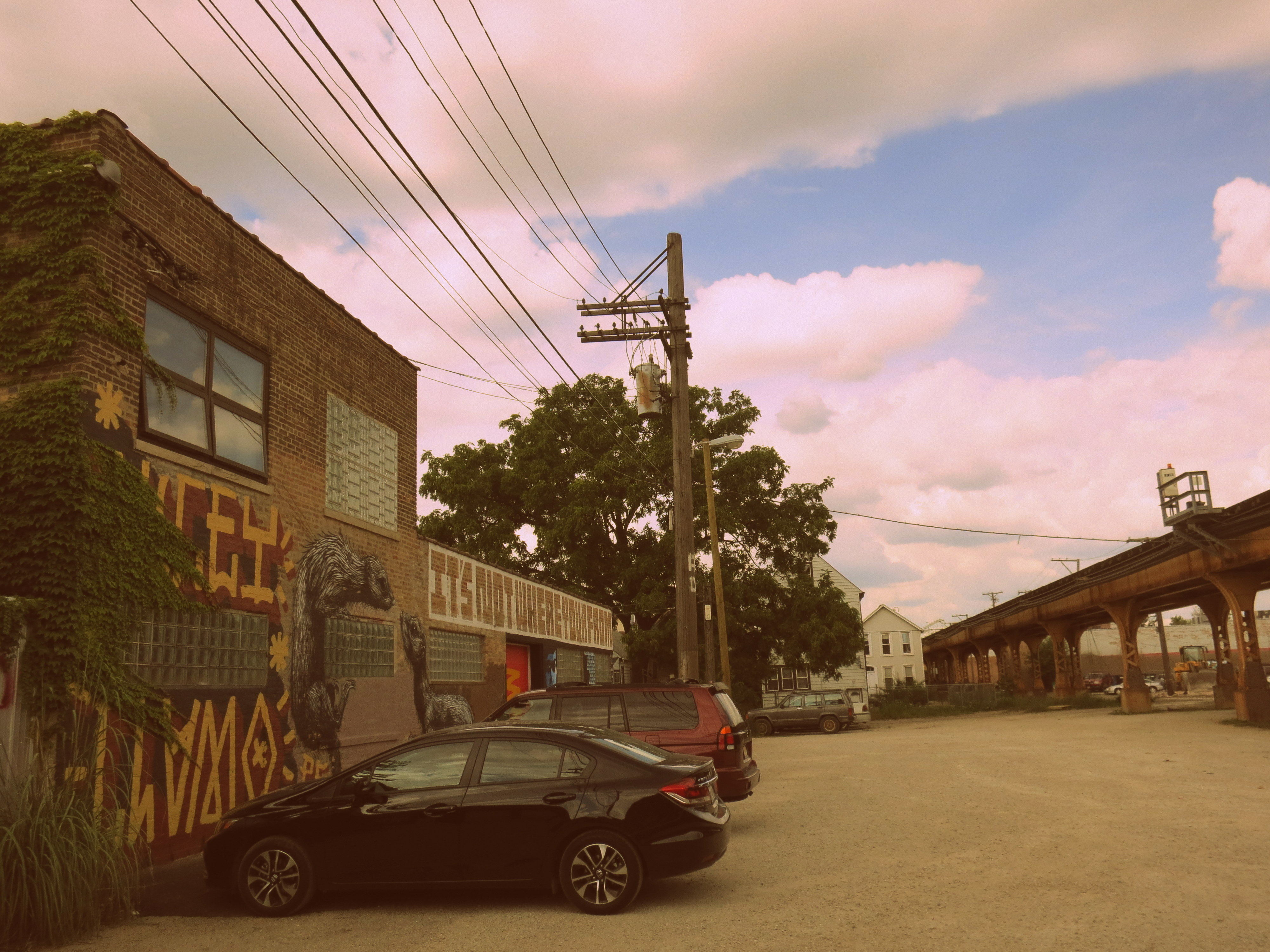
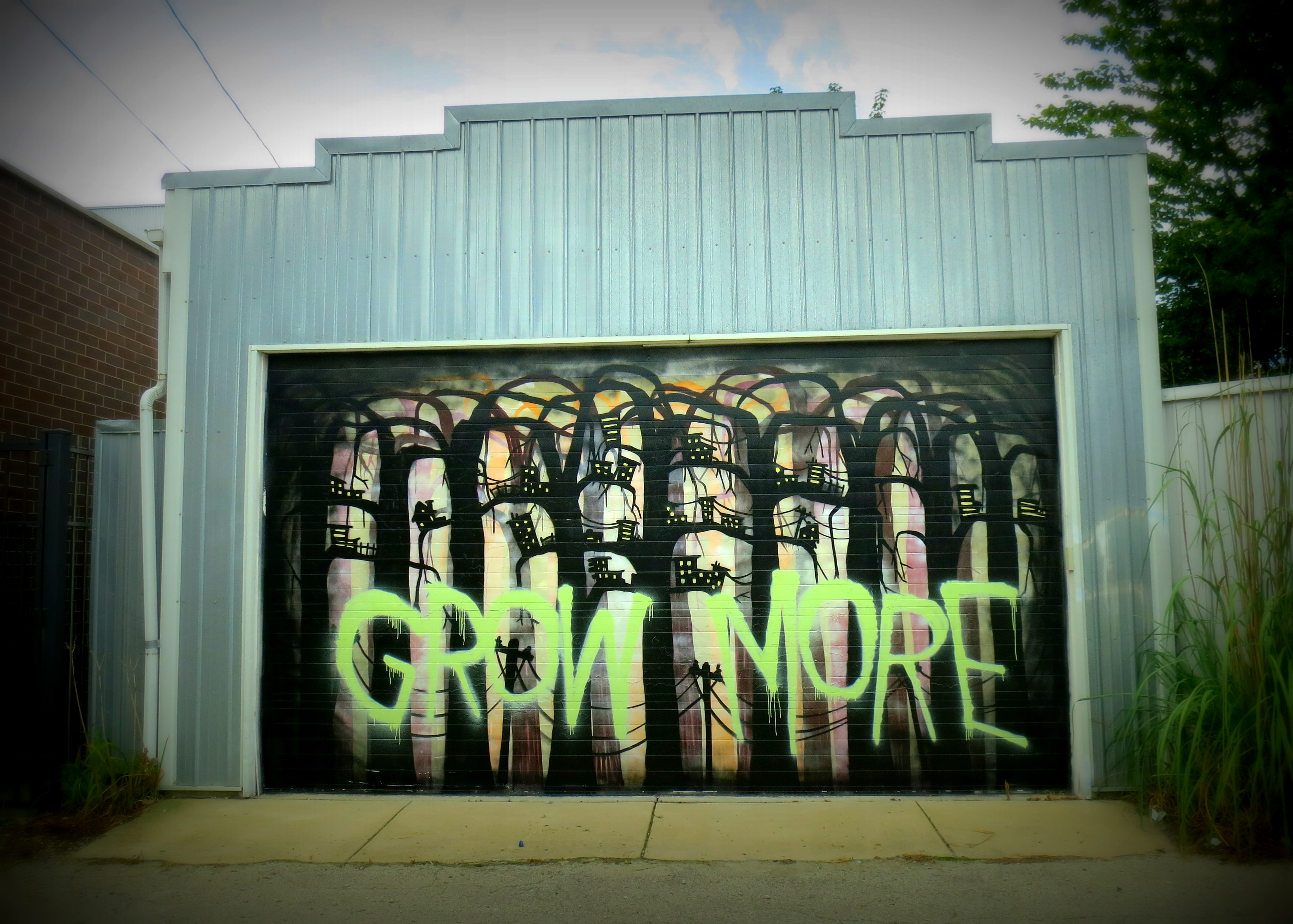
I went to Chicago this weekend, visiting friends and family I hadn’t seen for a year. I had a wonderful time catching up over delicious meals and drinks, especially as the weather gradually warmed up to proper August temperatures. I didn’t have much time on my own, but Thursday afternoon I went back to my old neighborhood, and I finally took some pictures of an art studio I’d seen from the el but never found on the ground before. Here are some shots of the great paintings I found there.
Category Archives: Hometown Tourist
Hometown Tourist: Graceland Cemetery
Any time I ride the Red Line north of Belmont, I do two things: I whine internally about how far I am from my side of town, and I admire the long stretch of green cemetery that glides past the window in Uptown. In late June, I finally stopped riding by it and stopped in for a visit.
Graceland Cemetery was built before the Civil War, back when it was well outside city limits. Apparently it was a new thing at the time, started by Queen Victoria, to make graveyards less jumbled plots of sadness and more spacious parks for picnicking and dignified visits with the deceased. When I went, it was absolutely empty. Granted, this was during one of those weeklong stretches of 100-degree weather we’ve had this summer, so it wasn’t exactly an ideal time for a stroll.
Still, Sessily and I had a nice time walking down the meandering paths and looking at the various monuments and gravestones. I always thought predominantly Christian graveyards would have a bunch of stone crosses and marble angels, but this one is full of self-important movers and shakers of Chicago, so it’s populated with grandiose tombs and a lot of obelisks.
And now, many pictures. Enjoy!
Where it is: 4001 N Clark St., at Irving Park Rd. (there’s only one entrance)
When to go: 8am-4:30pm daily (office is open 9-4 M-F, 10-3 Sat, closed Sun); some tours operate on weekends during the warmer months
What to see: The office just inside the gates has a map and guidebook for sale, but you can also take a couple free pamphlets that show the basic lay of the land and point out some of the more famous monuments in the cemetery.
Cost: Free
Hometown Tourist: Chicago Cultural Center
What’s that saying about the hidden gem of a city? I’ve found Chicago’s, and when I say “gem” I mean “it looks like a beautiful jewelbox on the inside.” The Chicago Cultural Center is a neoclassical building running the length of a city block on Michigan Avenue. Even though it’s across the street from Millennium Park, I’d never heard of it before a few of my friends went on a tour and urged me to visit. What an odd and lovely building it is.

Chicago Cultural Center
You start out at the Randolph Street entrance and the tour works its way up and across the building until you’re at the Washington Street entrance. We had a wonderful guide, a lifelong Chicagoan who used to come to the Reading Room back when the building was still the city library. She knew everything there was to know, and editorialized subtly enough that you could miss it if you were so inclined, or hear her little digs at Daley’s 1989 plan to turn the building into a mall and such.
Apparently, after the Great Fire of 1871, Queen Victoria helpfully sent over thousands of book to replenish the city’s library–except Chicago had never had a library to replenish. So a library board was formed, and after fighting over the land with the city and then with Civil War veterans who wanted that land for a museum, they finally agreed to share for awhile, and went over budget to finish building it in twice the allotted time. Chicago!
Even when it was finished, it was an unusual thing. You can only go from one part of the building to another on the first and fourth floors, one side of the building has a fifth floor and one doesn’t, and the second floor isn’t even the same height all the way across the building. You’d never know this from looking at the building’s facade, and I’m still not clear on why it ended up this way, but it’s quite an adventure walking around inside. A guide definitely came in handy.
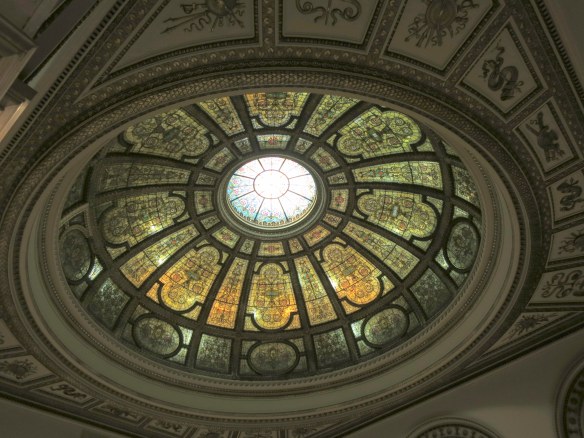
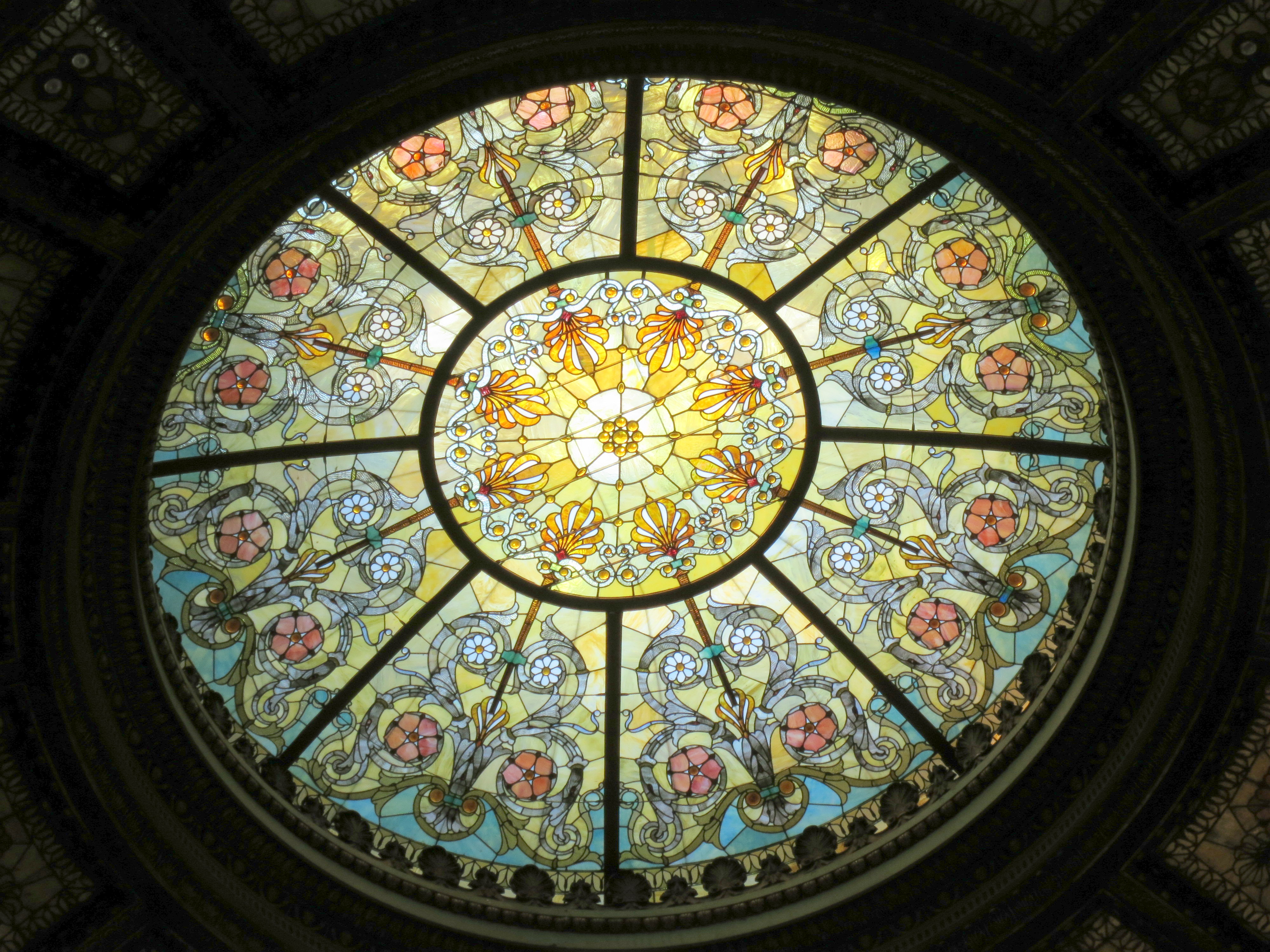
The dome in the Grand Army of the Republic Hall — they covered it up to protect it form the weather and it muted the colors.
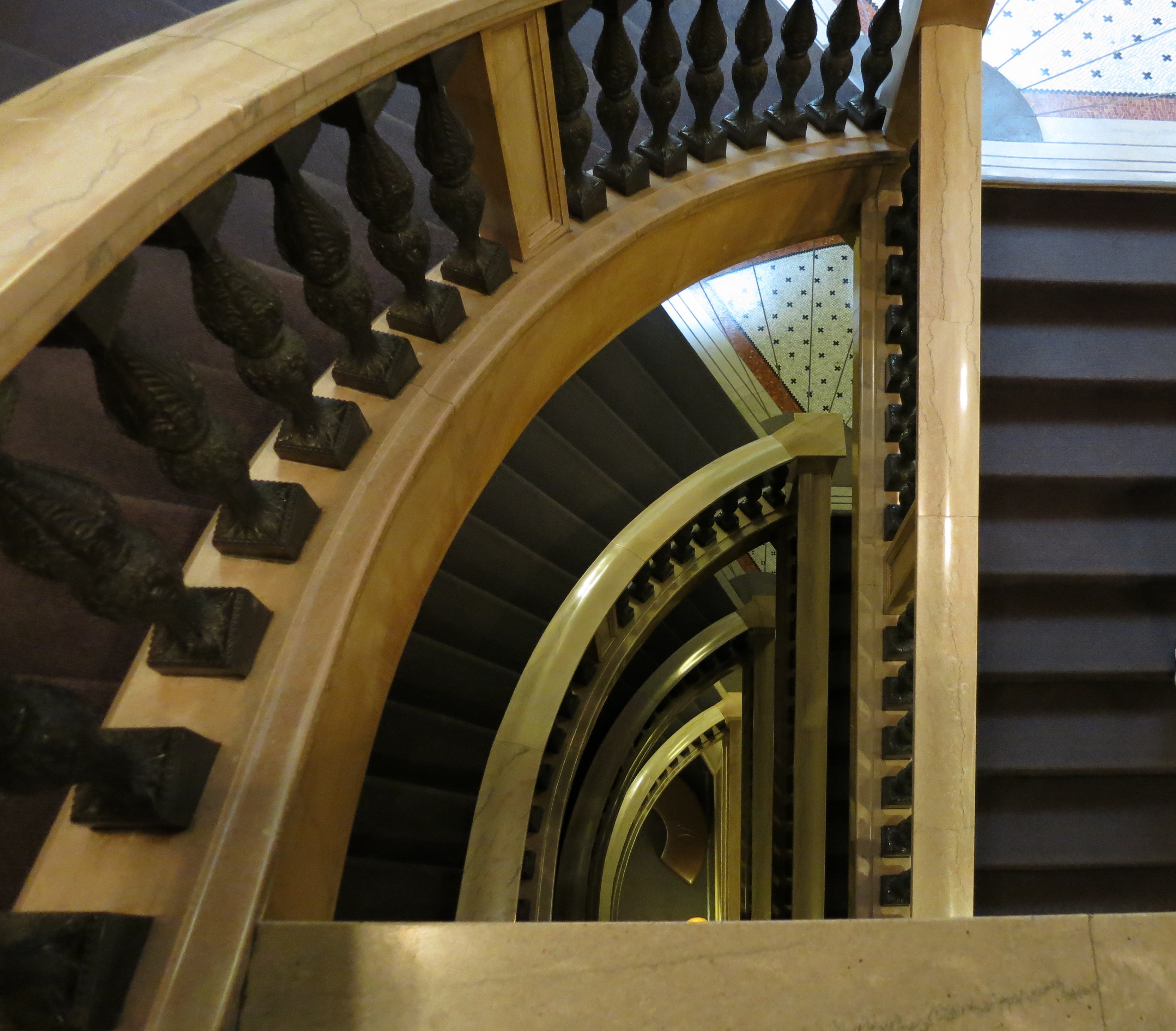
The Randolph entrance is all delayed gratification: through hand-carved mahogany doors, under a recessed ceiling pained white and gold, through a lobby full of people escaping the heat under more recessed ceiling, and finally to the two-sided staircase. Everything is made of marble, one of many safeguards against fire. Marble walls, marble staircase, inlaid tile on the ceiling… I don’t think I would have noticed if our guide hadn’t pointed it out, but much of the building didn’t have any painted surface at all, because there was no plaster to paint over. Everything was just solid. And it looked great; I can see why emperors and rich folks are so fond of using it.
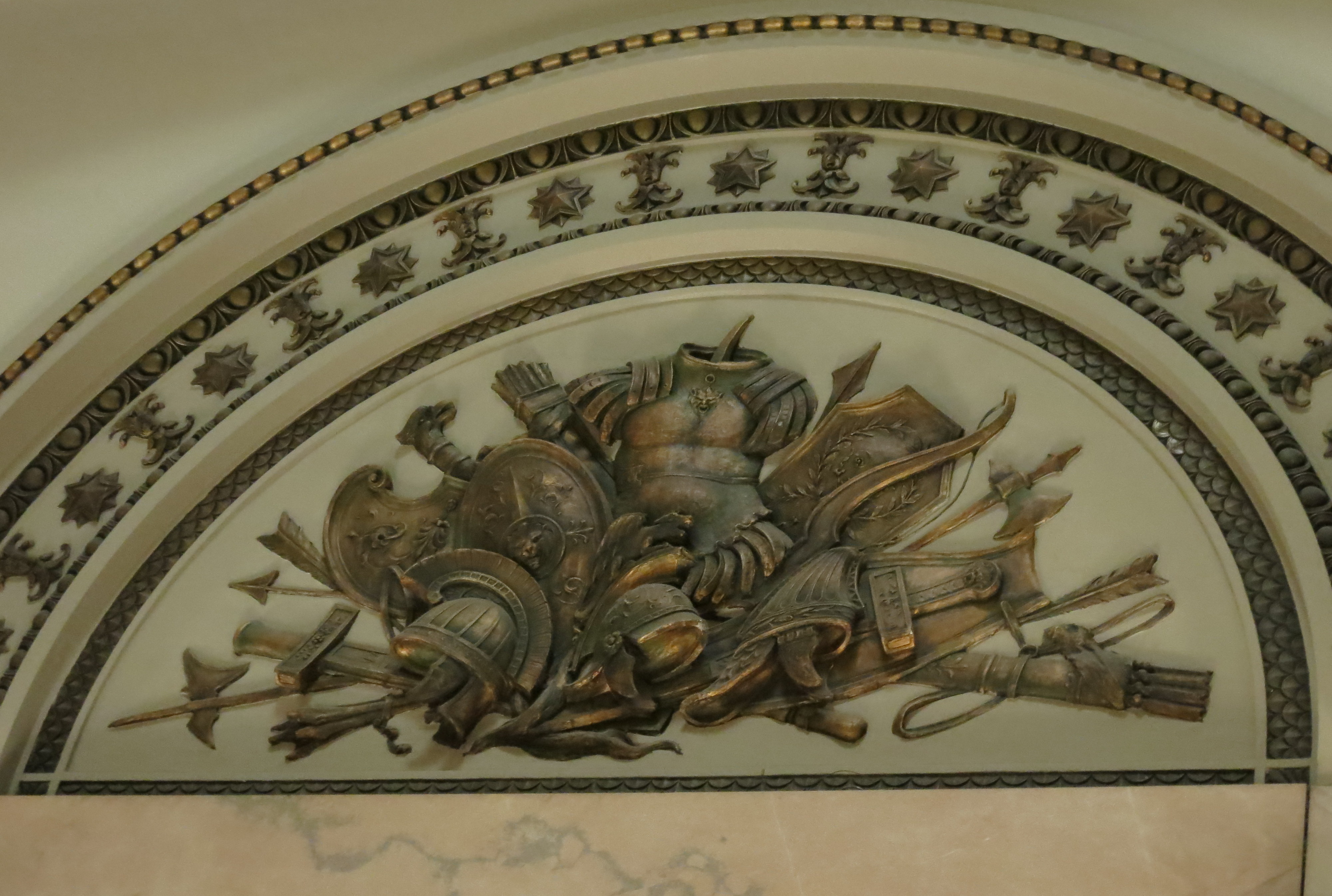
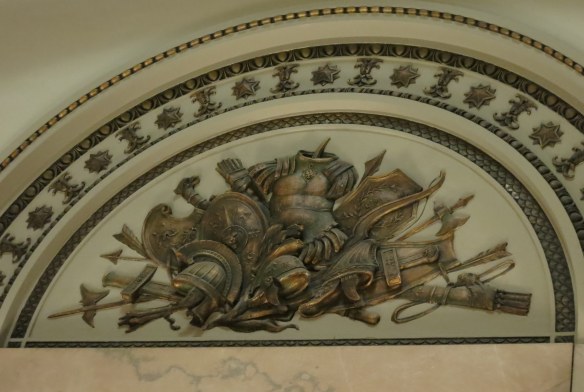
We looked at what was once the museum of the Grand Army of the Republic (those Civil War veterans from earlier). The view from that room is amazing, and they do $50 civil service weddings there every Saturday, in 15-minute increments. The walls under the dome of the GAR are decorated with brass bas-reliefs of piles of weapons. Just piles of them, haphazardly thrown together over archways. Very strange.
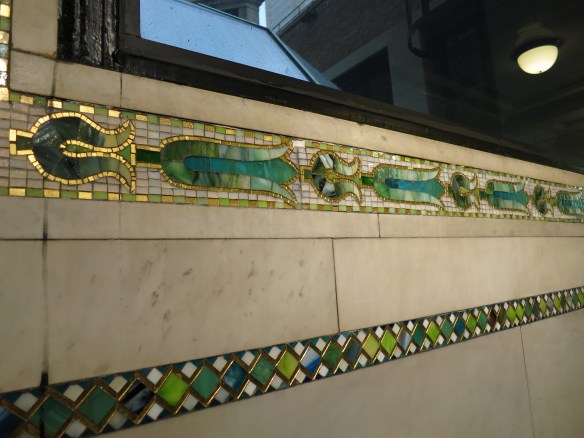
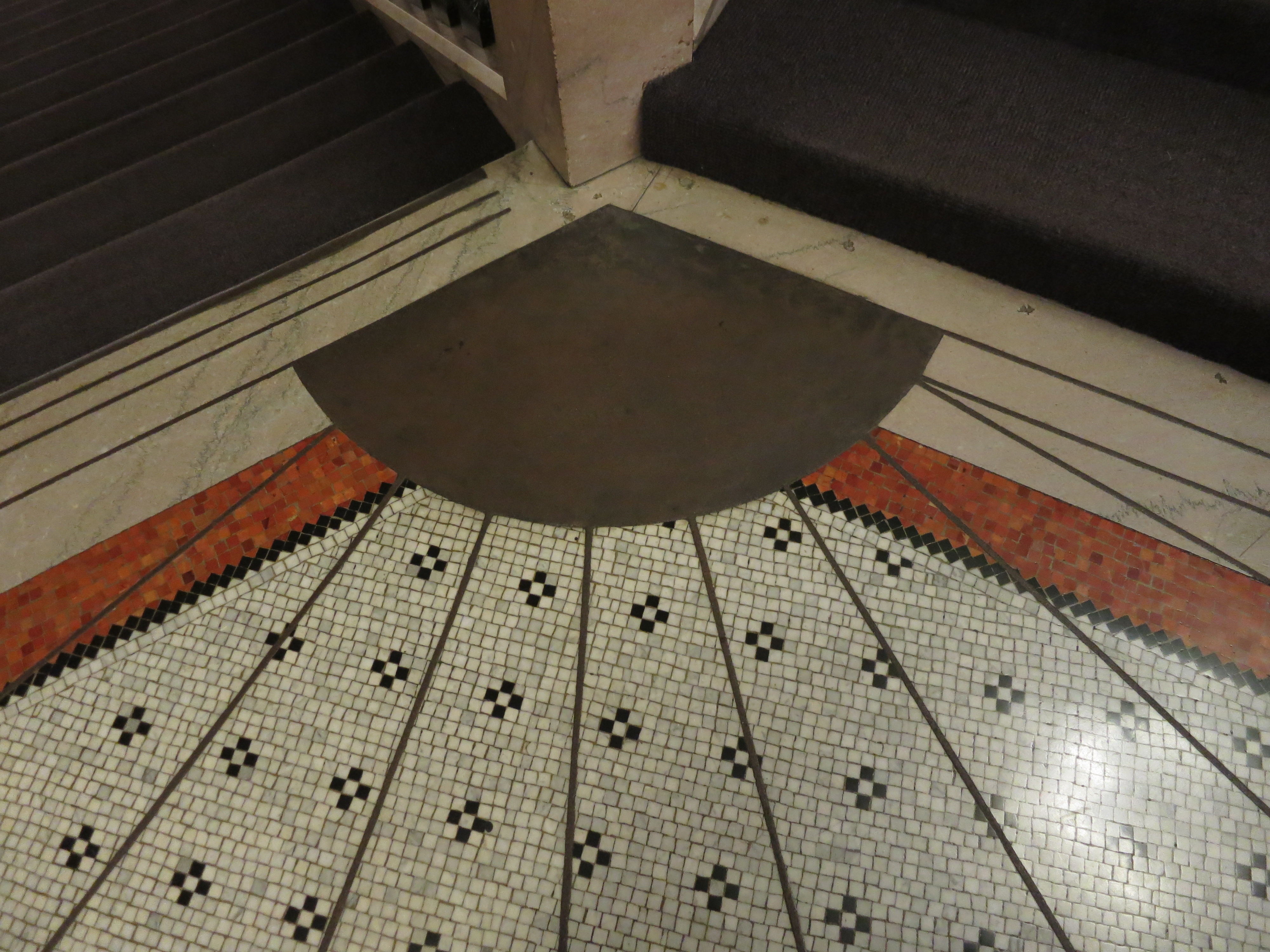
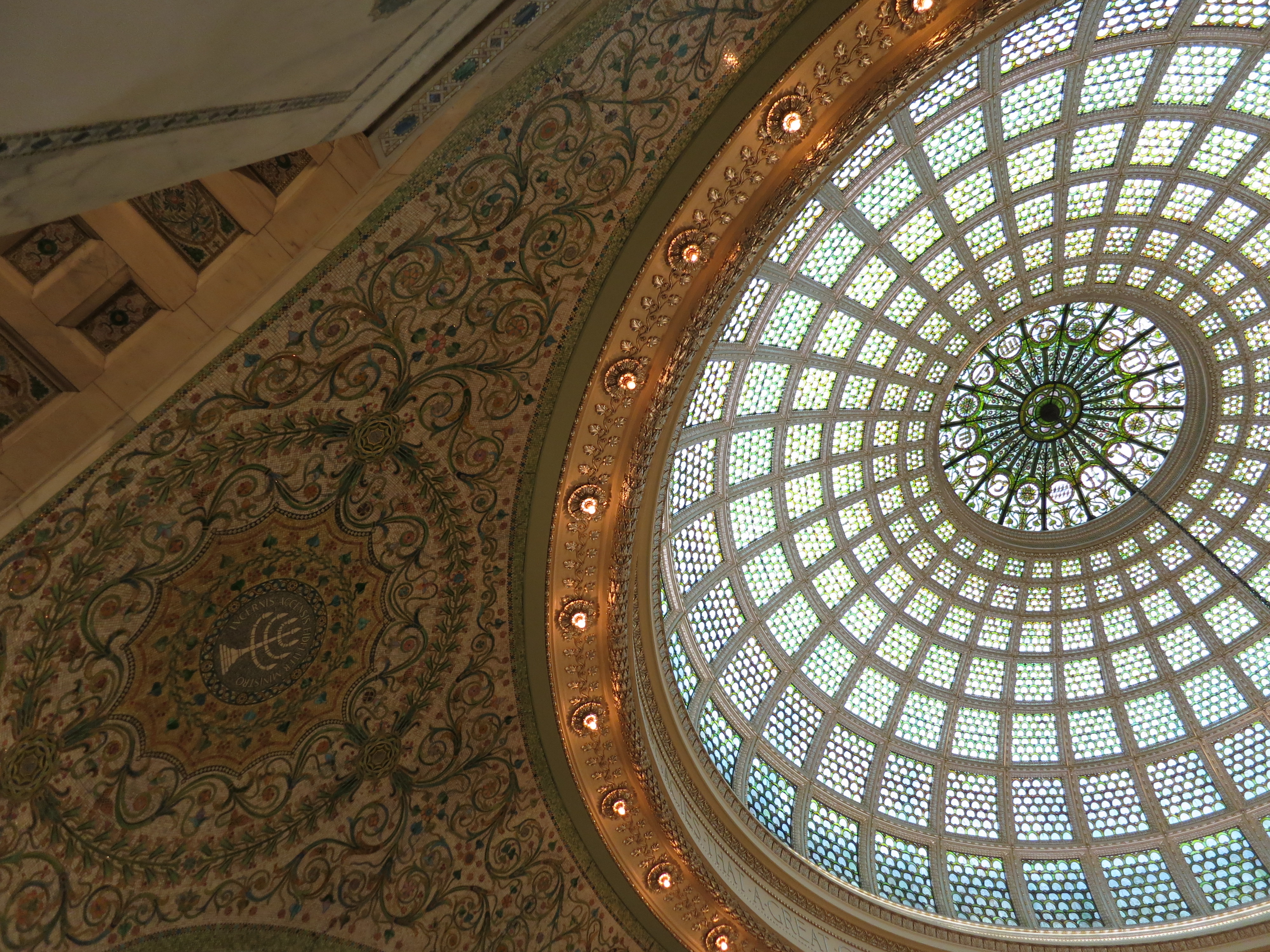
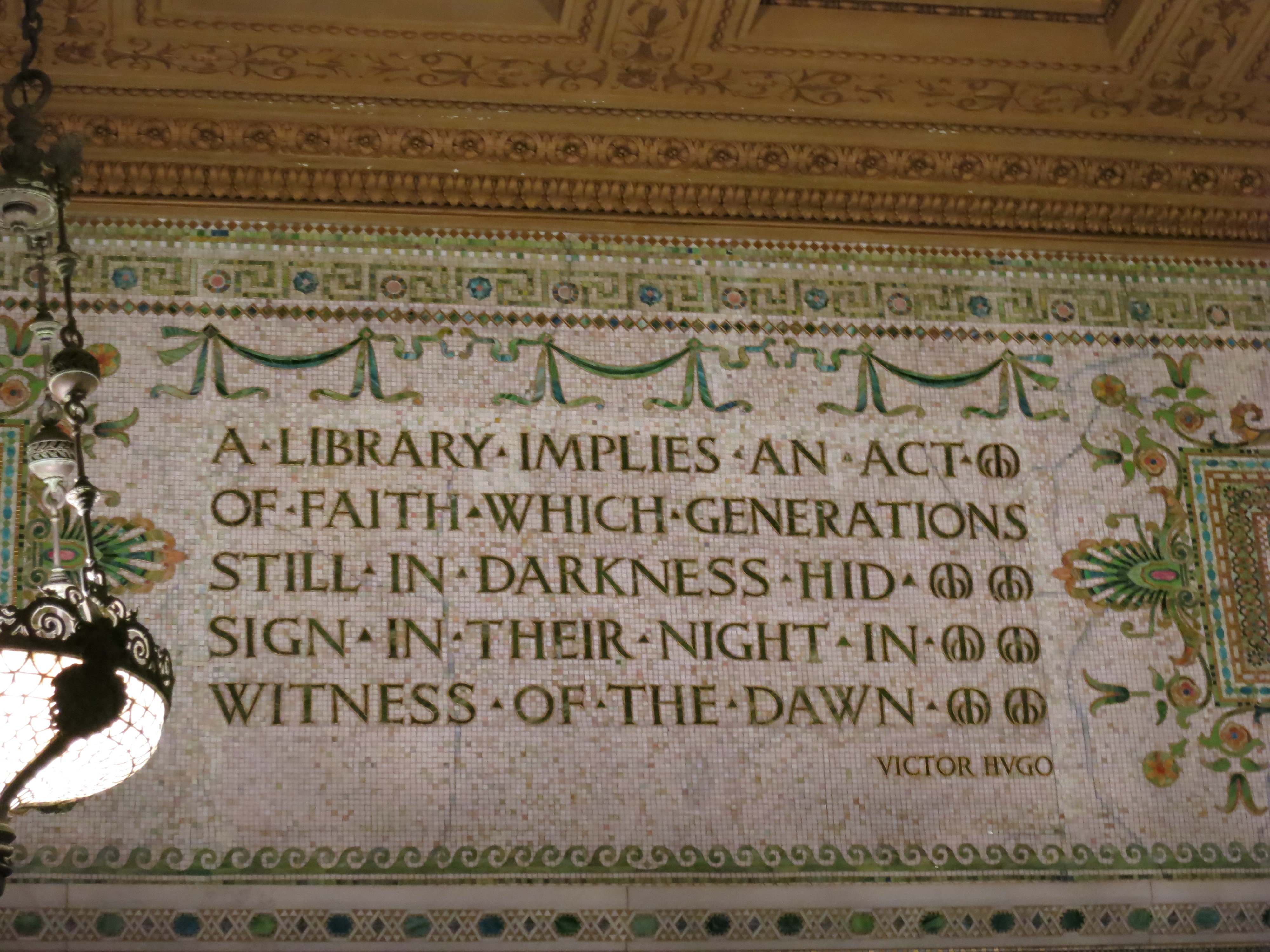
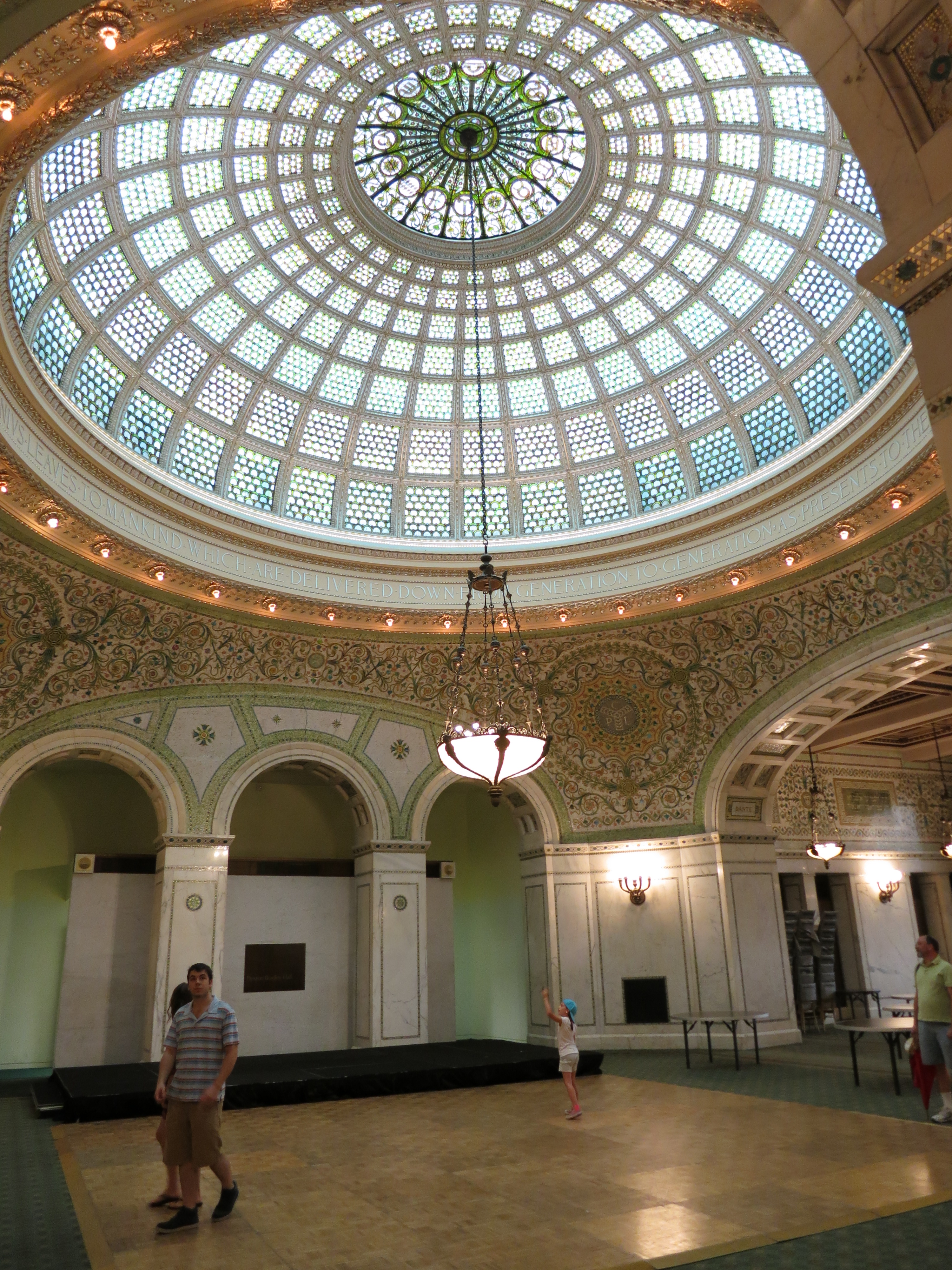
The other side of the building carries on the marble theme, but here it’s white marble from Italy, inlaid with brightly colored glass and gold leaf that glistens in the light, brightening up the whole area. There’s more inlaid tile here, too, in intricate patterns naming famous authors and spelling out quotes about literature in various languages. If you were to enter the building from this side, you’d be immediately struck with the size and beauty of the staircase leading up to the hall with the Tiffany dome. But I’m glad we came in from the side; we made a progression from impressive site to impressive site (we had to skip a couple rooms because they’re switching out the exhibitions, but those are meant to be lovely too), and then we walked down a rather dull and small corridor, rounded the corner, and voila! Stunning.
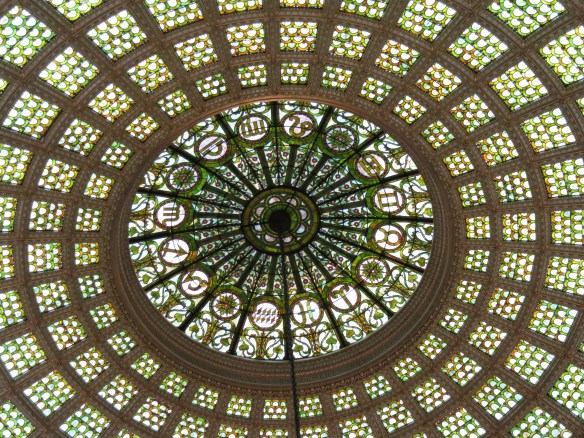
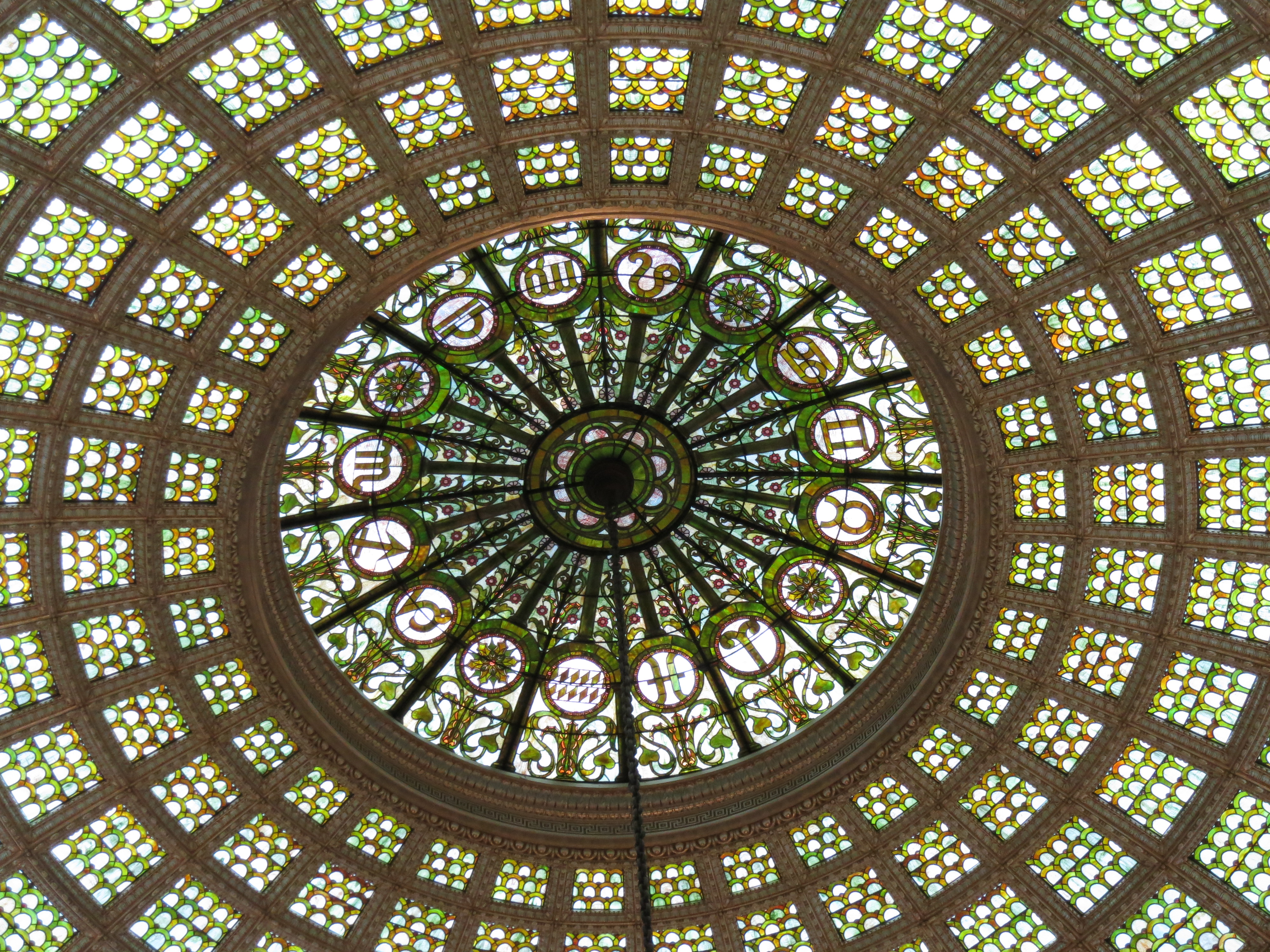
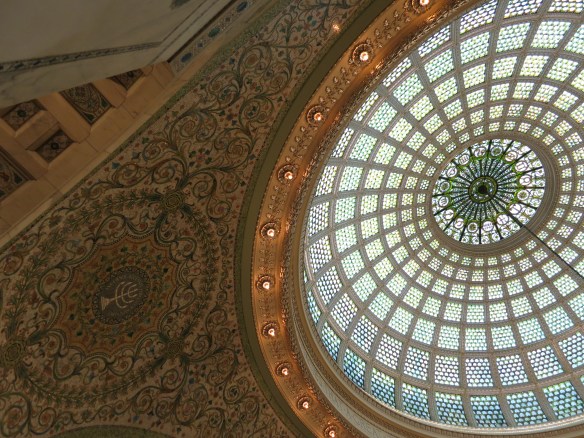
Preston Bradley Hall contains the largest Tiffany dome in the world, and the largest display of intricate inlaid tile in the country, outside of a church in St. Louis.
I found the Cultural Center to be a lovely surprise, and a place I wish I’d visited years ago. Get going!
Where it is: The official address is 78 E. Washington St., but if you go for the tour, you’ll enter on Randolph.
When to go: The free tours are Wednesdays, Fridays and Saturdays at 1:15 pm. They last about an hour and a half, and that time flies by.
What to see: The tour points out all the architectural features, but of course this is an active cultural center, so you can come here for concerts, art exhibitions, and lectures. You can visit the art studio and gallery for mentally and physically disabled artists on the first floor, and buy some of their artwork. You can use one of the lobby areas to relax, eat a lunch, use the wireless. You can duck into the Visitor Center and get some official info on touring Chicago. You can convince some rich friends to hold their reception in Preston Bradley Hall so you can dance under that Tiffany dome.
Cost: For the most part, free!
Image 1. All other images mine.
Hometown Tourist: Humboldt Park
Hometown Tourist is a series that hears that chipper tip, “be a tourist in your hometown!” and says, “Okay!” When friends come to visit, I like to show them a combination of standard tourist spots and the neighborhood places they’d never know to look for. Why not write about all those places? If you have suggestions on Chicago places you’d like to see covered for Hometown Tourist, add it in the comments.
I might never have started this blog were it not for Humboldt Park. Humboldt is bordered by North Ave, California, Kedzie, and Division, a vast expanse of green on the west side of Chicago. When I lived on California, I would walk the seven-tenths of a mile down the street and find a spot next to the lake to sit and read. In 2009, I’d been thinking of starting a blog (nothing like joining a trend a year or two late). On a few sunny September afternoons, feeling stifled and uncreative in my apartment, I walked down to Humboldt Park, sprawled out on the grass, and wrote. Surrounded by families barbequing and teenagers biking and old men fishing, I scrawled some ideas in a notebook and decided they would be enough to go on.
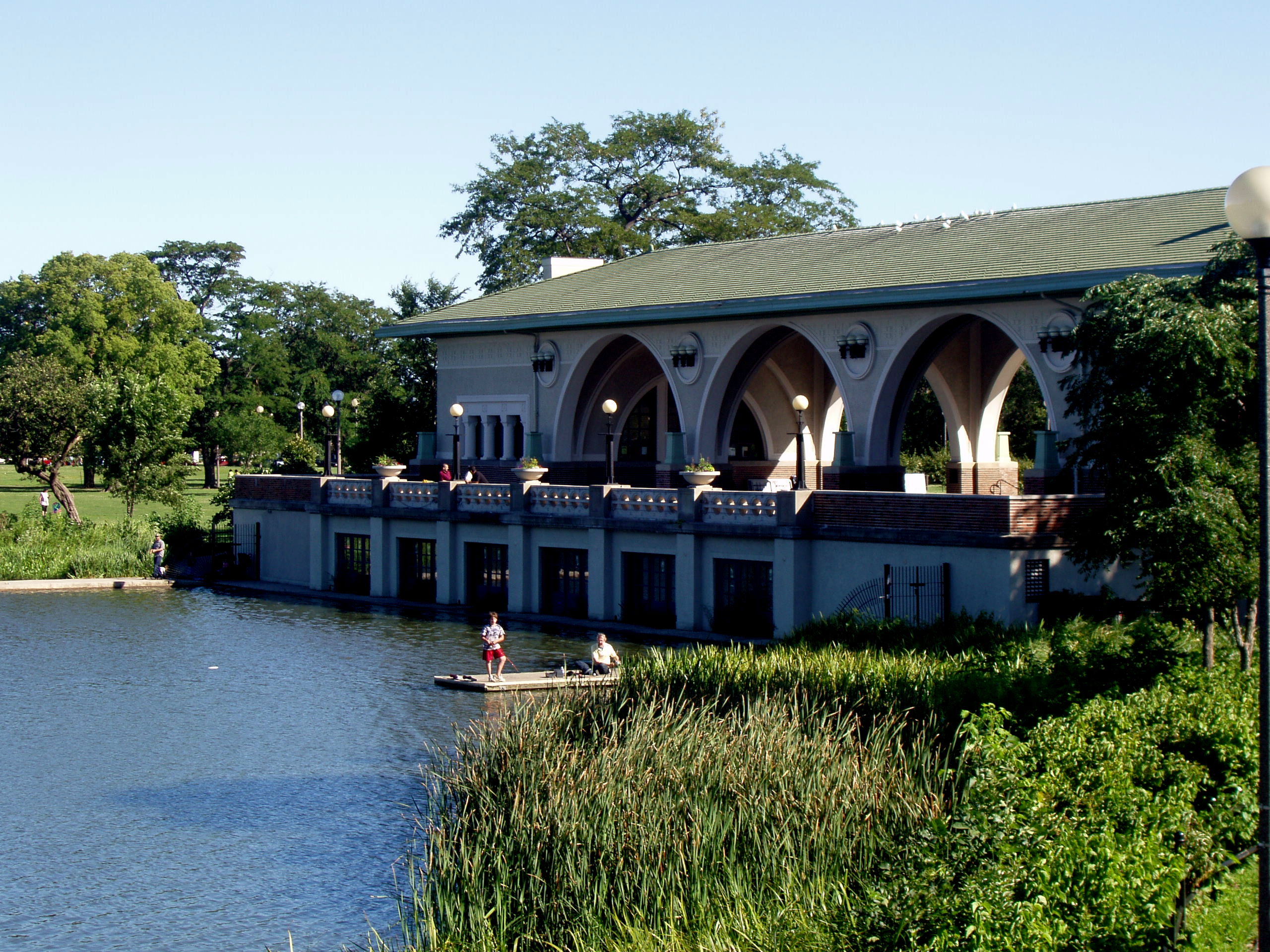
The manmade lake is stocked with fish, and the patient and hopeful find many places around the perimeter to set up their poles and see what they can catch. The boat house is basically a big pavilion covered by graceful arches, and I mostly look at it from afar, although it can give a nice view of the lake when you’re standing on it. Also, there are barebones bathrooms in there, which is useful.
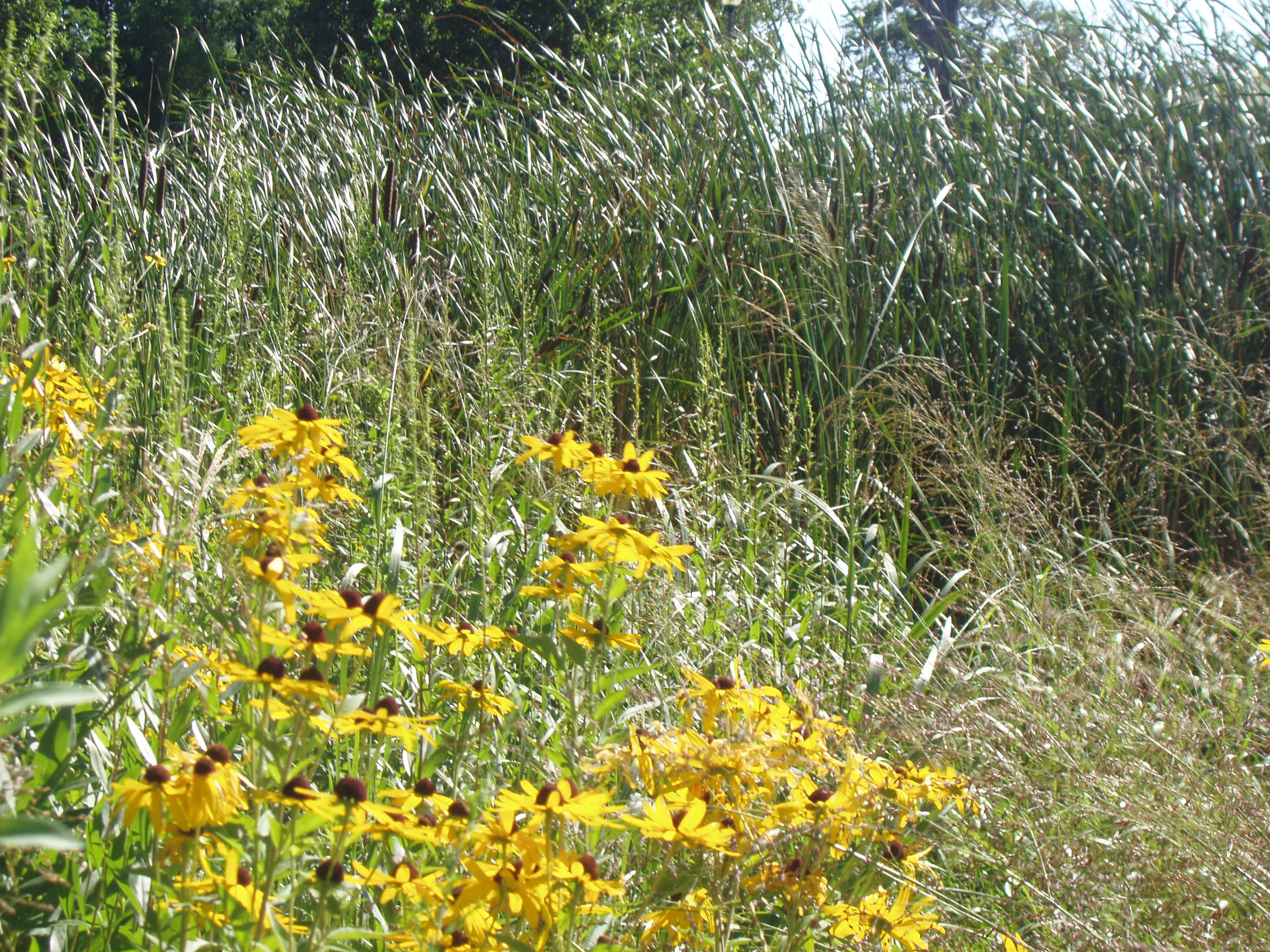
The park was designed by Jens Jensen, who designed various other parks in Chicago and throughout the Midwest. One of Jensen’s main principles was using native plants in landscape design, rather than importing exotic plants. He believed that a space was most beautiful when it used the materials at hand, and looking at the prairie design of Humboldt, it’s easy to agree. I also think of my friend Matthew, who works for a parks department in Michigan and spends a large part of his time removing invasive plants and educating homeowners about the dangers of invasives and the benefits of natives. Looks like Jensen may have been ahead of his time on this one!
The park is so large that a road runs through it so cars aren’t inconvenienced. All the pictures here are ones I took in the eastern side of the park, but the western side has great stuff too: a fancy fieldhouse, a small lagoon with a sand beach (the only such beach in the city that’s not on Lake Michigan), and a little river flanked by benches sheltered by plants in just such a way as to make them perfect makeout spots. A bike path meanders through the whole park, baseball fields host games all summer, and the playground is almost always covered in children squealing with delight.
Humboldt Park is the name of the surrounding neighborhood as well as the green space, and it’s a predominantly Puerto Rican neighborhood. Giant, metal Puerto Rican flags straddle two of the streets, and almost every other storefront is a restaurant with delicious foods. The city of Chicago hasn’t really caught up to the street food craze sweeping the nation, but there are several food huts and carts at the park with tasty jibaritos and alcapurrias for sale. In June of each year, the streets host an official parade and also an unofficial parade of jubilant, flag-waving people in slow-moving cars for the Fiestas Puertorriquenas. People sit out on their porches and grill food, bomba and salsa music blasts from stereos, and everyone’s in a great mood. All this is concentrated in the park, where a large carnival is set up and live music plays. It’s a good time, and a total change to the usually peaceful park.
In short, if you’re anywhere west of Western and north of the Eisenhower, stop by! It’s a lovely place to spend an afternoon.
Where it is: In the square created by North Ave, California Ave, Kedzie Ave, and Division Street
When to go: Whenever! Obviously, it’s not as active in the winter, although the scenery is just as beautiful as it is in the summer, if different.
What to see: The lake and boat house, the gardens tucked away in the shade, a baseball game at one of the diamonds, the shallow swimming lake on those hot summer days
Cost: Free
Hometown Tourist: The Lyric Opera
Hometown Tourist is a series that hears that chipper tip, “be a tourist in your hometown!” and says, “Okay!” When friends come to visit, I like to show them a combination of standard tourist spots and the neighborhood places they’d never know to look for. Why not write about all those places? If you have suggestions on Chicago places you’d like to see covered for Hometown Tourist, add it in the comments.
For the inaugural Hometown Tourist post, I thought I’d start classy: the Lyric Opera. “Ugh, Lisa,” I hear you all groan. “How boring! And overpriced!” But dearest fellow travelers, let me assure you that it is not boring! And it doesn’t have to be too expensive! I’ve seen three operas at the Lyric over the past five years, and I’ve never spent more than $75 on a ticket. That’s no pocket change, sure, but it’s maybe twice what you’d pay for a show at The Riv, and no one will be spilling beer on you or elbowing past for a better view of the stage here.

The Civic Opera House in Chicago
As to the boring part: I was raised on a lot of different kinds of music, but opera wasn’t one of them, so it’s not like I have an ear for it. But the tunes are stirring and the singing is powerful stuff. When I saw Aida on Tuesday, there were a few moments during Hui He’s solos that actually caused me to catch my breath, they were so lovely. The stories are never too hard to follow, so even when they’re told in Italian or German, they’re easy enough to follow. The emotions expressed onstage would be overblown if they were spoken in a play, but they take on more gravity in song form, and it becomes clear that the only way to truly express love or heartbreak is to devote an aria to it.
Right, so: opera can be riveting stuff, and it can be enjoyed without breaking the bank. Where do you go to see opera? In Chicago, there are a few companies that put on shows, but the biggest, most established one is the Lyric Opera. They have their own building on the Chicago River, and it is beautiful. It was built in 1929, and when they renovated it from 1993 to 1996, they kept the Art Deco style. This means that not only are you classing it up by going to the opera, you are classing it up flapper-style. What more could you ask for?
The theater seats almost 3,600 people, and when my friend Hannah and I were there on Tuesday, it looked to be just about sold out. On a Tuesday night! That’s a lot of music and theater lovers in Chicago, which warms my artsy heart.

That's a lot of aria appreciators
Where is it: Civic Opera House, 20 North Wacker Drive, on the northwest corner of Madison and Wacker
When to go: Weekday shows are cheaper, straight up. If you have a job that isn’t 9-5, they even have matinees, which are much cheaper. The season runs October through April, and show runs overlap.
What to see: Whatever your heart desires! If you wait past opening night, you can read reviews and see if something sounds particularly good. For example, Show Boat is getting raves this year. The only downside to this strategy is that tickets will be few and far between by the time the show run starts.
Cost: Tickets range from $35 to $200. Full-time students can get $20 tickets to some shows.
Some practical tips:
- Unless you are an opera buff, you probably aren’t familiar with the various shows. (I definitely am not.) Do a little research beforehand; I always thought of opera as solos alternating with big choral numbers, so I was disappointed that Tristan und Isolde never had more than six people on stage at once. I listened to clips of operas before buying tickets this season, and found that Aida had a lot of choruses, so I went with that one. (And it did not disappoint. There were easily over 100 people on stage at one point on Tuesday, including dancers who really livened things up during the instrumental portions of the show.)
- They are obsessive about starting on time here, so do not be late! The ushers will shut you out until intermission if you are late, so give yourself enough time to float elegantly up the stairs to your seat.
- Speaking of seating, unless you’re shelling out, you’re probably going to be in either the First or the Upper Balcony. Try to get a seat closer to the front of the balcony, because it can get pretty claustrophobic at the back, with the balcony above crowding in on you and the rows of people in front of you partially obstructing your view of the stage. In fact, the Upper Balcony is less claustrophobic, so if you are looking at seats in the back of the Upper Balcony versus seats in the back of the First Balcony, I’d recommend going against instinct and choosing the Upper Balcony seats. You’ll get a clearer view and save money, too!
Oh look, I made a 30-second video of Tuesday’s trip to the opera.