Aesthetically Speaking: Lizzie McAdam

Please welcome Lizzie McAdam to the Stowaway team of travelers. Lizzie did a lot of theater in high school and college, has taught in the NYC public school system, and is currently getting a master’s in drama therapy at NYU. She’s a lovely and talented person, and here she shares with us a bit about what it’s like to combine an artistic format with a therapeutic goal. Thanks for sharing, Lizzie!

What is your name and city of residence?
My name is Lizzie McAdam, and I currently live in Brooklyn.

What medium do you work in?
I am currently working towards a Master’s degree in Drama Therapy at New York University. I am training as a therapist that uses theater-based techniques as part of the therapeutic process.

How often do you work on your art–is it a full-time endeavor or something you work on in your spare time?
I am engaged in the program full time. In terms of making art, I am currently working on a theater piece with some of my fellow classmates entitled Race as Performance. This project is a theater performance, but is also part of an arts-based research project that explores the question, “Is race playable?” This project arose out of our experiences engaging in dialogues around race that felt unplayable, stuck, or even harmful. We wanted to create a piece that would encourage dialogue and playability around the (sometimes scary!) topic of race.

How does art fit into your life, in general? Is it something you think about and talk about every day, or every week, or only in certain situations, etc.?
I think about theater and art all of the time! My work as a therapist involves working in metaphor and thinking about aesthetics. I also try to get out and see as many concerts and shows as my budget will allow.

When you start on a piece, what kind of end result do you have in mind? Does it get performed or published, put in a permanent form or is it more temporary?
This specific research project came out of our general desire to engage in a dialogue about race that allowed people to be safe while also taking risks. The performance was an end-product designed to engage audiences in this dialogue, but the rehearsal process–wherein we told our own stories around race–was essential to exploring the playability of race for ourselves. As we often say in drama therapy, we can’t ask our audiences to go to a place we haven’t been ourselves.

What goals do you set in relation to your art, both short- and long-term? Is it something you hope to make money doing, or is it something you want to keep uncommercialized? Does the term “sell-out” hold meaning for you or do you see the art/commerce relationship as a necessary one?
We have no financial goals for this project–admission is free. Instead, our research process is focused on the experience of the audience and whether or not they are able to play with race–in short, we seek the answer to our research question, “is race playable?” I think the answer for all of us is that we want it to be, and it’s important that we engage with the audience in a talk back after the performance in order to further the dialogue. I think it’s probably not surprising that a group of therapists-in-training are interested in the process and experience of the audience!

What role does collaboration with others play in your art, if any?
Without collaboration this piece would not have been possible.

How conscious are you of your artistic influences? Who are your artistic influences?
We have many artistic influences in the drama therapy world, but I have to say that our director, Nisha Sajnani, has been an incredible role model for us all as burgeoning therapists and arts-based researchers. Nisha is the President-Elect for the National Association for Drama Therapy, and currently works as the director of the Drama Therapy, Community Health and Prevention program at the Post Traumatic Stress Center in New Haven, CT. In addition to her extensive background in trauma work, she writes extensively about social justice and advocacy issues and is, in short, an inspiration.

For those people interested in learning more about drama therapy and arts-based research, I am including a list of references for further reading! šŸ™‚

Since this is a travel blog, how does travel relate to or affect your art? (Themes in what you produce, road trips to perform your music, thoughts on what happens to your painting when you ship it across the country to a customer, etc.)
We hope to take this current project to various conferences, schools, and lectures as an educational piece that encourages discussion around the topic of race. We hope to reach both the drama therapy community, as well as the wider community of anyone working in the helping professions or who is interested in dialoguing about race. We may also write about the research process for this piece to contribute to the larger field of arts-based research.

And finally, a right-brain question: If your art was a map, what would it be a map of?
I think it would be more like a web that connects people to one another. So a map of human relationships, I guess!

If you’d like, share your website/Facebook page and any upcoming gigs/plans you’d like readers to know about.
Here is the info on the performance:

New York University
Steinhardt School of Culture, Education, and Human Development
Department of Music and Performing Arts Professions
Drama Therapy Program Presents:

Mama Always Said, ā€˜Don’t Play with Fire’
Race as Performance
With Ashley Kleinman, Lizzie McAdam, Amber Smith, Dana Trottier and Britton Williams
Directed by Nisha Sajnani

An arts-based research performance exploring the question: Is race playable?

WHEN: Friday, January 27th, 8:00pm

WHERE: Black Box Theatre, Pless Hall, 82 Washington Square East, New York, NY

TICKETS: Admission is free, but you must reserve your tickets. To reserve your tickets, please call the NYU drama therapy office atĀ (212) 998-5402.

This performance is a part of the Drama Therapy Program series, ā€œā€¦as Performance,ā€ made possible by a grant from The Billy Rose Foundation.

Continue reading

Aesthetically Speaking: C.S.E. Cooney

Today’s Aesthetically Speaking interviewee is a published author and writer of many things, from novels to poems, plays to blog posts. I especially appreciate the honesty of how tough it is to find good readers of your writing, who you can trust and whose advice you can take. Thanks for sharing, C.S.E.!

What is your name and city of residence?
C.S.E. Cooney, almost-formerly-of-Chicago. Soon to be “Somewhere, Rhode Island.” I’m moving in a few weeks, east.Ā 

What medium do you work in?
Words! Stories, novels, poetry, plays, reviews, blogs, whatever!

Jack o the Hills book cover CSE Cooney

Jack o' the Hills

How often do you work on your art–is it a full-time endeavor or something you work on in your spare time?
It’s like a second job that wants to be my first job. Nights and weekends sort of thing. These days, writing is not so much an escape from the day-job, as it is that the day-job (and everything else) serves the writing.Ā 

How does art fit into your life, in general? Is it something you think about and talk about every day, or every week, or only in certain situations, etc.?
It’s the sort of thing that creeps into almost every conversation. The sort of thing where you’re babbling at someone about whatever book you’re reading, story you’re writing, writing convention you’ve just gone to, this new writer you’re corresponding with, this play of yours that you’ve just seen produced, and thinking, “Is this all I ever talk about? Am I more boring than any bore that ever lived? Talk about something else. Talk about that Wampug you just saw on YouTube…”Ā 

(http://www.youtube.com/watch?v=ey2L_ExKWuI)

But there’s this: whatever else I talk about — movies, science, that creep on the train, the etymology of the word “yawn” — there’s a voice in the back of my head that says, “Remember this. Use it in a story.”

When you start on a piece, what kind of end result do you have in mind? Does it get performed or published, put in a permanent form or is it more temporary?
I write short stories with the idea of submitting them as soon as possible. They have to accumulate a number of both drafts and rejection slips before they’re either trunked for good or finally accepted somewhere.Ā 

Sometimes an idea starts out a poem, morphs into a play, and then it turns out it’d make a better story. I rarely know this starting out. Some ideas require many structures before its ultimate shape is refined.

Plays I either write for fun, or competitions, or festivals. I usually write them only if someone out there’s interested in something from me specifically. But there have been a few cases of me waking up in the morning and saying, “I’m gonna write a play today.” No one wants them necessarily, but at least I had fun pulling them out of the ether for their own sakes and no one else’s.

Poetry is usually a visceral reaction I have to something. Either that, or I stumbled onto a moment I want frozen in all its glorious hyperbole. Those times I’m feeling something strongly I may never feel again, something effervescent in its novelty, I’ll try and capture to examine more closely later. And also to show it off… My wild menagerie of past experiences.

With novels, I don’t know — I’ve not had one published yet. With the one I’m working on now, a fantasy called Shadowstalkers, the end in sight is, “Finish the danged thing, go on a Great Agent Quest, and then from there we’ll see.” I’m fewer than 100 pages away from writing The End on this present draft.

What goals do you set in relation to your art, both short- and long-term? Is it something you hope to make money doing, or is it something you want to keep uncommercialized? Does the term “sell-out” hold meaning for you or do you see the art/commerce relationship as a necessary one?
I certainly want to make money with my writing. The times I already have are kind of addictive. The trick is getting the production and quality up to a level where my earnings from the writing are at least as consistent at whatever day-job I’m working in order to eat and pay rent while writing. I may never get there. It’s a goal, anyway.

I hate the term “sell-out.” What does that even mean? Producing something you hate for loads of cash? If that’s what a “sell-out” does, then I couldn’t do it.Ā Just judging from past day jobs: if I’m in a position I consider toxic, I quit — for my own health’s sake, which I value. I want to wake up and like myself. It’d be great to wake up, like myself, and make money too. I don’t mind compromise or flexibility. I often don’t even know my own boundaries until I come smack up against them. I try to keep an open mind until confronted with an ethical crisis, and make my decision then.

Also, just because I create something, recognize that it’s well-constructed, and even publish it — that doesn’t mean it’s good art. Ā I have failed at making the kind of art I want to make — failed spectacularly. Sometimes it’s not possible to recognize that something is a splattering huge mess when you’re right in the middle of it, looking out. Someone might come along and point out this huge, raw flaw you’d never intended, never in a million years, and you wish you could take it all back and put it down somewhere in the dark, but it’s out in the world now. You suck it up. Learn something about yourself and the world you live in. What it makes you. What you make of it.You just learn from it, try not to do it again, and hopefully do something better with the next project.

Every story I write seems to require something utterly different from me than the last. Ā I have to learn a whole new skill set with each thing I write. It’s completely fascinating, but I hardly ever feel like I know what I’m doing.Ā I’m trying to become more conscious of my process, without stymying the process. That gets tricky. But it’s never boring.

The Big Bah-Ha by C.S.E. Cooney book cover

The Big Bah-Ha

What role does collaboration with others play in your art, if any?
Well, you can’t have theatre without collaboration. That’s a given. So, with a play — collaboration’s built in. Actors might give a script a read, directors will piece it apart, everybody’s input informs the next draft. The script often morphs during the rehearsal process. So far, that’s been my experience. My experience is pretty limited.Ā 

But stories, at least in the initial stages, are more personal. For myself, I have a handful of friends, who are all writers or editors at varying levels of their career — from award-winning, published novelists to people like me who’ve only just traded their apprenticeship for journeyman’s rank — and I often send them early drafts of things for their critique.

There’s much trial and error involved in this. Trust must be built up over time. Few people come through the crucible of this process, but those who do I value highly.Ā I have to be careful to whom I send a story, because a certain kind of criticism too early, or given tactlessly, can ruin my enthusiasm for months. Some friends I can take a pummeling from and bounce up grinning. Some friends, even at their gentlest, slay my desire to create. It’s not their fault, or mine. It’s simply a matter of personalities.

After a draft is done, of course, and a story is submitted, it takes a small army of slush readers, associate editors, editors, designers, and artists to put together a magazine. Without them, I’m just a writer with a few thousand words in a Microsoft Document.

How conscious are you of your artistic influences? Who are your artistic influences?
Pretty conscious, I’d say. Stephen Sondheim, Caryl Churchill, Shakespeare, Ogden Nash, Dorothy Dunnett, Gene Wolfe (probably him above all, as he’s been my mentor since I was 18 years old), Robin McKinley, Patricia McKillip, Victor Hugo, Flaubert, the BrontĆ«s, Jane Austen, Lois McMaster Bujold, Neil Gaiman, Stephanie Shaw, Alexandre Dumas, Lloyd Alexander, Tolkien and Lewis, Diana Wynne Jones, Georgette Heyer, Frances Hodgson Burnett, Elizabeth Peters, Ursula K. LeGuin, Octavia E. Butler, Shirley Jackson, James Enge, Pablo Neruda, Peter S. Beagle, Stephen King… Can you tell I’m mainly a Fantasy writer?Ā 

Since this is a travel blog, how does travel relate to or affect your art? (Themes in what you produce, road trips to perform your music, thoughts on what happens to your painting when you ship it across the country to a customer, etc.)
Much of the traveling I’ve done in the last nine years has been to writing conventions. That’s where you meet folks in your field. That’s where you meet your influences, hear them read out loud and answer interview questions and shake their hands. It’s where they become human. And suddenly you think, “If they can do it, I can do it.”Ā 

Road trips — especially with other writer friends — to these sorts of things are where character, plot and story are all born.

There’s something about movement, the freedom of the road, really late nights in highway darkness, that get all the good weird stuff of the soul stirred up. There’s also a great deal of history moving outside your window. The good, the bad, the pretty and the ugly all buried in that landscape with the bones. Horizons you’ve never seen. Roads you’ve never traveled. Music on your friend’s iPod you’d never listen to on your own. Really vulgar jokes. Weird roadside pranks. All of it full of story.

There’s a reason there’s a whole genre of novels called “picaresque.”

And finally, a right-brain question: If your art was a map, what would it be a map of?
You know those ragged, half-scorched parts of ancient maps that say “Here Be Monsters”? Everything beyond that.Ā 

If you’d like, share your website/Facebook page and any upcoming gigs/plans you’d like readers to know about.
I keep a blog at csecooney.livejournal.com. On my profile page is everything I’ve done writing-wise and where to find it.Ā 

If you want to buy my book “Jack o’ the Hills,” being two stories in one of a very twisted fairy tale, check out Papaveria Press.

Aesthetically Speaking: Kristin Walker

This week’s artist is Kristin Walker. Kristin performs in burlesque shows around the city under the stage name as Trixie Sparx, combining her love of song, dance, and fantastic costumes. She has several shows coming up over the next couple months, so check ’em out. Thanks for sharing, Kristin!

What is your name and city of residence?
Kristin Walker, Chicago, IL

What medium do you work in?
Burlesque Theatre–stage name: Trixie Sparx

Trixie Sparx photo by Callie Lipkin

Trixie Sparx

How often do you work on your art–is it a full-time endeavor or something you work on in your spare time?
This is a part time endeavor–a little artisticĀ something to feed my soul. While it does pay, itĀ does not pay ALL of the bills… but it does provide enough to buy more sparkly things!Ā  I am a member of Vaudezilla Productions, a burlesque troupe (Shameless plug–voted Best Burlesque Troupe in Chicago by the Chicago Reader 2011).Ā  We have a group meeting and rehearse solo/group acts once a week and I perform anywhere from three to ten times a month- full blown shows and private gigs, alike.

How does art fit into your life, in general? Is it something you think about and talk about every day, or every week, or only in certain situations, etc.?
Being a part of this artistic community is exhilarating to say the least, and I am always thinking about how to improve my craft, come up with new and cleaver ideas for acts, or promoting my company and the art itself.Ā  There are many misconceptions that shadows this art form and deters many people from experiencing it–including many of my friends.Ā  Burlesque roots are in parody, which uses sensuality and ‘tease’ in each act while reveling what is underneath sparkly costumes.Ā  We burlesque performers are NOT strippers, though we do remove our clothing.Ā Ā It is the element of ‘tease’ which sets us apart from the ‘dead behind the eyes’ stripper types.Ā The important thing to remember is that burlesque is about telling a story through music and movement–sometimes funny, sometimes sexy.Ā  While everyone knows the end result (the final reveal) it is the journey that the performer takes you on where the art truly lies.

When you start on a piece, what kind of end result do you have in mind? Does it get performed or published, put in a permanent form or is it more temporary?
When starting a new act, I either get really jazzed by a song I hear, or a concept / character thatĀ I think ofĀ which leadsĀ to aĀ burning urge deep inside me that says: THIS MUST BE DONE!Ā  So, I start playing around.Ā  I find costume bits and pieces that will work with the concept and character, and through experimenting with dance and movement, I slowly build the choreography to a final product.Ā  The unique thing about live performance is that it is organic, and it changes every time you perform.Ā  The foundation of the piece is there, but it grows and evolves the more you do it.Ā  Moreover, I perform in many different spaces–from bar tops, to small stages, to large venues, to art galleries–and the dance must be modified to accommodate the space.

Trixie Sparx photo by Oomphotography

Dress envy!

What goals do you set in relation to your art, both short- and long-term? Is it something you hope to make money doing, or is it something you want to keep uncommercialized? Does the term “sell-out” hold meaning for you or do you see the art/commerce relationship as a necessary one?
As for goals–I would like to continue doing burlesque theatre for a very long time, as well as start to travel to festivals around the state, and do more private gigs.Ā  I am improving every week that goes by as a performer and it feeds my confidence and drive in my everyday life as well. The more I perform, the more I practice, the more I take classes, the more chances I have at making more money to feed the fuel that drives myĀ craft. I never see myself ‘making it big’, or even surviving off of the income from my art, but the benefits it gives me creatively are worth so much more to me. Ā No one in my business,Ā in my humble opinion,Ā has really ever ‘sold out.’Ā  Promotion of burlesque can only lead to more acceptance and understanding of this theatrical art form and can benefit our pockets as well. Burlesque is still a rather underground movement that is surfacing onĀ the social radarĀ and any exposure or opportunity is greatly appreciated and used.

What role does collaboration with others play in your art, if any?
Collaboration happens all the time with burlesque theatre- quite often most shows are ‘Vaudeville-esque’ in nature, incorporating singers, magicians, acrobats, belly dancers, comedians, ect.Ā  I have done many ‘group acts’ some character driven and silly, others sensual,Ā that have gone over smashingly.Ā  Currently, along with Vaudezilla Productions, IĀ am working on collaborating with a local jazz ensemble for a live band show that will be held in November.

How conscious are you of your artistic influences? Who are your artistic influences?
As with any artist, I am susceptible and open to influence from everything from daily life, to music, still art, literature, culture, society, gender issues, politics and economics.Ā  Finding subtle ways to incorporate these themes into your art is aĀ fun challenge.Ā  My artistic influences are my friends, whom for the most part, dabble in arts themselves.Ā  They impact me greatly and I strive to be a better artist myself so we can continue this ‘artistic dialog’ that inspires and encourages me.Ā  In addition, remarkable burlesque performers influence me–when you see it done right, it has a powerful effect on you.

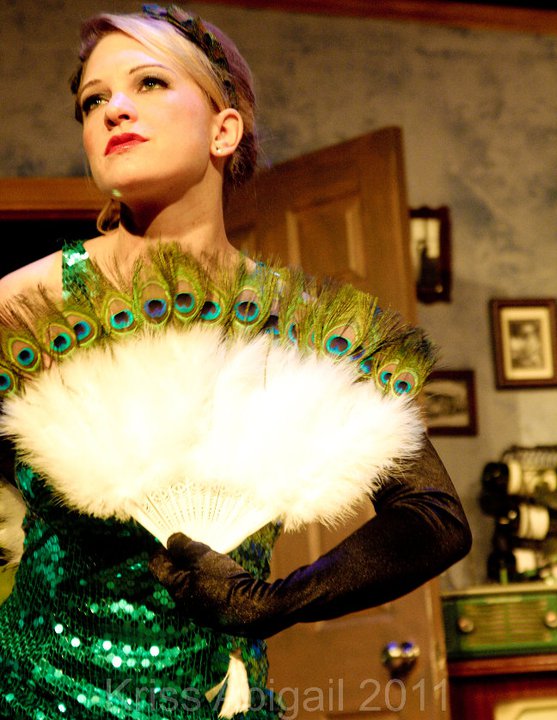
Trixie Sparx photo by Kriss Abigail

aaaand fan envy

Since this is a travel blog, how does travel relate to or affect your art? (Themes in what you produce, road trips to perform your music, thoughts on what happens to your painting when you ship it across the country to a customer, etc.)
Travel is a very deep passion of mine, and to combine that with the love of my art is the ultimate goal.Ā  I am ready and I want to take this act on the road!Ā Ā The best part of burlesque is that this is encouraged, andĀ you can very easily.Ā  There are burlesque festivals all over the world, and I will be apply to a few festivals in 2012–some places I’ve never been, and really want to go such asĀ Albuquerque, NM, Vancouver, Canada to name a few.Ā  I might also visit New Orleans and Colorado to support friends performing as well.

And finally, a right-brain question: If your art was a map, what would it be a map of?
Fantasia–with heaps of feathers, sparkles and sass.

If you’d like, share your website/Facebook page and any upcoming gigs/plans you’d like readers to know about.
Upcoming shows:
Nov. 23rd at the Holiday Club
Dec. 3rd 10:30pm at the 773 Theatre; Trim!Ā  A Christmas Craptacular
Dec. 9th at the Lincoln Tap Room
Jan 21st at the 773; The Guilty Pleasure show
Feb 18th at the 773; Live Band Burlesque show

For more information, please visit: www.vaudezilla.com

Photo 1 credit Callie Lipkin. Photo 2 credit Oomphotography. Photo 3 credit Kriss Abigail.


Aesthetically Speaking: Rory Leahy

Please welcome back Rory Leahy to Stowaway. Rory last wrote for this space in a series of guest posts on road trips, which you no doubt remember with great fondness. Rory and I belong to a marvelous mutual admiration society, and I love seeing his writing performed onstage. I’m going to see the Old Tyme Variety Show tomorrow night; let me know if you’d like to join me. Thanks for sharing, Rory!

What is your name and city of residence?
Rory Leahy. I live in Chicago.

WhatĀ mediumĀ do you work in?
I’m primarily a writer, also an actor and director. I write prose fiction and I write, direct and produce plays, sketch comedy and the like. Although my best work is probably done in the form of Facebook statuses.

How often do you work on your art–is it a full-time endeavor or something you work on in your spare time?
When I had a day job, I wrote on weekends. I was always too tired to do it after work so I would write on Saturday and Sunday morning/afternoons. Since I’ve been unemployed or as I prefer to think of it ā€œSelf employed,ā€ I write every day, several hours a day if I am disciplined, less so when I am not. Plus I run my own theatre company–American Demigods–and producing stuff, which basically means coordinating, everything is extremely time consuming. When a show is going on it’s pretty close to a full time job. I have no idea how I handled it when I DID have a full time job. Probably because I did a lot of it at work I think.

How does art fit into your life, in general? Is it something you think about and talk about every day, or every week, or only in certain situations, etc.?
I think about it pretty constantly. Writing and acting are both about life, about people, about observation. You’ve got to pay attention to what’s around you because everything informs the art. Because I write comedy, definitely things that are funny are an influence on the work. I don’t put literally everything I experience that is funny, or everything that is serious, into a play or a story because obviously, not everything fits but I pay a lot of attention to how jokes work. To how emotions work, in daily life. Daydreaming about the Big Score after which I will be a wealthy literary superstar obviously consumes much of my waking life.

Just a simple suburban boy protecting the streets in "The Irrelevant Adventures of Jarvis McFadden"

When you start on a piece, what kind of end result do you have in mind? Does it get performed or published, put in a permanent form or is it more temporary?
Everything I write is intended to be performed or published. Whether it is or not is another matter, whether it should be or not is another matter, because not everything I write is any good and the stuff that isn’t gets to spend eternity in the mausoleum that is Microsoft Word. Most of what I write for the theatre these days gets produced by the American Demigods, which is to say, me and my friends. And self production is great of course. It’s awesome to write things and get to do them exactly how I want them. But I also get short plays produced here and there by other people and that’s very nice too. It’s great to see what other people do with my work when I have very little or no involvement. And you know, it’s validating because someone other than me thinks it’s good enough to do the work and expend the resources to put on. One of my goals for the near future is to have a full length play of mine produced by someone who is not me.

As for prose, I’ve spent less time on it than playwriting but I definitely have a passion and, I think, talent for fiction writing as well, but I only have a handful of short stories that I really like. I very much want to get them published but as anyone can tell you, that’s an elusive goal. Prose doesn’t offer the same kind of performance outlet that theatre does, although something I’ve started doing, really just recently, is getting to know the Chicago literary community and going to public readings. I get to read my work for other writers and listen to their work and everybody offers feedback and advice and that’s been a terrific experience.

What goals do you set in relation to your art, both short- and long-term? Is it something you hope to make money doing, or is it something you want to keep uncommercialized? Does the term “sell-out” hold meaning for you or do you see the art/commerce relationship as a necessary one?
Yes I absolutely want to make money doing it, indeed, make a living at it at some point, despite the overwhelming odds against that happening, especially as I age. I find inspiration in Rocky Balboa, a largely unsuccessful but persistent boxer who became Heavyweight Champion of the World at the unlikely age of 31, as seen in Sylvester Stallone’s acclaimed documentary series. But making a living at it in the ever further away ā€œsomedayā€ is critical for me, because I’ve believed since childhood that it’s the only thing I CAN make a living at and I think my attempts at making a living in other ways have only demonstrated this thesis.

Artists have always had patrons. It’s nice when the state can fulfill that role, but in this country, especially in these days of economic austerity it’s a very limited role, so any successful artist gets underwritten by major corporations and you can rage against that if you want but it’s the reality and ultimately I’m okay with it, because that’s where the money is. There are two kinds of ā€œselling outā€ as I understand the phrase. There’s selling out in a way that compromises your artistic vision, where you don’t get to do the work you want to do because the money wants you to do it differently. The other kind is when you lend your talents to the service of people or organizations that you consider to be unethical. Whatever it says about me as a person, I’m actually much more comfortable with the latter kind of selling out than the former. Ultimately my integrity as a writer means more to me than my integrity as a human being in some twisted way. Rod Serling said something really beautiful when he wanted the commercial sponsors to stay the hell out of his way creatively, I’m paraphrasing but it was something like ā€œGentlemen, we are all in the business of selling products, I know mine as well as you know yours and therefore I should have as much control over my production as you have over yours.ā€ Something like that.

The other kind of selling out, when you’re compromising morally rather than aesthetically…one of my best friends is a sometime actress. A few years back she had agented representation and the potential to go really far with it. She was offered a national Walmart commercial. We all know Walmart is, even by the standards of American megacorporations, a particularly odious entity. She was offered ten thousand dollars to do the commercial. It would have been huge exposure. Most actors would kill for a national commercial. My friend agonized over it but ultimately decided not to do it. The killer thing for her was that she would have gotten union health insurance over it and the irony that she would be supporting an organization that does its damndest to prevent its employees from getting health insurance was just too much for her. I both admire the hell out of that decision and suspect I would have done the opposite. Temptation would have overwhelmed me. I’d have felt a lot of angst over it, and spent that ten grand in various ways to dull the pain.

But corporations are where the money is, if they wanted to pay me to write things I would be happy to take their money. I would actually love to write advertising copy or be a commercial voiceover artist if I had the chance. I’d love to endorse products I use. I would love to be paid to say ā€œWhen I’m writing hilarious sketch comedy I enjoy the delicious, refreshing taste of Coca-Colaā€ because I do. This is of course, with the full knowledge that Coca-Cola benefits from death squads in Central America busting unions and stealing water supplies. So I enjoy the refreshing taste of Coca-Cola but not the death squad part. But you know, you’re not paying me to an express an opinion on death squads, you’re paying me to express an opinion on a soft drink.

Actually this interview probably ruins my chances of ever being paid to endorse Coke so thanks a lot, Stowaway.

Obviously there are moral limits. I guess a compartmentalization thing, I can make a mental distinction between what a corporation might be selling and the evil deeds they might do. I would never accept money to endorse actual immoral actions. Like I’ll never write a PSA saying ā€œPlease remember to report your Jewish acquaintances to the authorities.ā€ There are some limits.

What role does collaboration with others play in your art, if any?
Collaboration is huge in theatre. More than huge. Theatre IS collaboration. I have strong vision and a strong desire to be in charge of the final product of what I write and produce. The words ā€œpower mad control freakā€ are not inapplicable, but I rely on lots and lots of people to do what I do. My consistent goal is to surround myself with the best people I can find, and I’m usually quite successful in that goal. To start with, actually I sometimes write with partners. In the past I wrote with my high school and college friend Marc Heiden, in the beginning of my early writing career, that partnership really helped me in setting the tone of my narrative voice and all that. These days I write most frequently with my actor friend Jordan Hoisington, who’s just a severe thunderstorm full of good ideas, we’ve written some killer sketches together and now we’re doing a two man show together. Then of course there’s my fledgling company, American Demigods which I think really attests to the magic of collaboration. I had the notion of having my own little vehicle for some time, probably right out of college. And I did put on one show under that banner, with help from some great people, most notably my college friend Tom Schorsch and generous patron Kurt Tuohy. But most of those folks didn’t want to continue doing it as a permanent thing so I was kind of left on my own and nothing in theatre, other than arguably a one man show, really comes of being on your own.

But my friends David Wilhelm and Samantha Raue really changed that when they agreed to be my board members in 2009 and we started to rev this thing up. I like to tell the story of how I met Dave, or rather became aware of Dave, he was two years younger than me and just started to get involved in my beloved undergrad theatre company, the Penny Dreadful Players, as I was leaving college. As the Springsteen song goes, ā€œHe was walkin’ in, I was walkin’ outā€ and I happened to see him in his acting debut, which was a ten minute play set in a coffeehouse. Then I saw him as one of the leads in Rosencrantz and Guildenstern Are Dead. I don’t think I actually met him after these occasions but I was so impressed by his presence and charisma that I told myself then and there ā€œI’m gonna work with that guy someday.ā€ And now we are working together on a continuous basis so dreams do come true, kids.

Wow I sure do seem to be a long winded interview subject. Because I work with all kinds of actors, writers, directors, tech folk. Directors are huge obviously, sometimes I direct my own work, sometimes I work with others, and collaboration’s not always pretty, because sometimes there are strongly differing viewpoints. Some folks really get it and some folks don’t, which is why I try very hard to work with people, both actors and directors, who do get it. I’d like to take the opportunity to sing the praises of the director I’m working with on my two person show right now, Katie Horwitz, who is very demanding in the best way. Jordan and I have spent the last couple of months riffing pretty hilariously on my couch and sometimes Katie’s just a stone, a really tough room. And that just makes me work so much harder, because you know when you get a laugh out of her, you earned it. And she says exactly what she thinks, which is so great. I have a really strong personality and some poor souls have found out that I will bulldoze right over them, sometimes to the benefit of my work and sometimes to its detriment, so if you’re gonna work with me, especially if you’re gonna direct me, you need to have a strong personality too.

Theatrical collaboration really makes me feel good about human nature. Because so many people are so helpful, so generous with their time, their labor, they’re getting something out of it too, but the biggest thing we all get out of it is a sense of shared accomplishment. It’s teamwork at its best.

Rory plays god in "Dr. Strangegod or How I Learned to Stop Worrying and Love Blasphemy"

How conscious are you of your artistic influences? Who are your artistic influences?
Oh Heavens, always such a hard question, there are so many, as a writer, certainly Kurt Vonnegut, Douglas Adams, Neil Gaiman, Joss Whedon, Tom Stoppard, you know, all the great geeks but many, many others, anyone who’s literate in English has spent a lot of time with Shakespeare and that goes double for a theatre person. Joss Whedon may be the one I’m most self conscious of, because he’s, not so much an influence, because I think I encountered him at a time when I was already writing and starting to write really well, but he was just the apotheosis of everything I had always wanted to do and he was the first person I really saw doing it. By which I mean, he created great entertainment that basically sneered at the concept of ā€œconsistent toneā€ which is what I most want to do. He fully integrates drama and comedy and sees no particular reason to keep them in separate boxes, because life doesn’t do that so why should fiction?

Since this is a travel blog, how does travel relate to or affect your art? (Themes in what you produce, road trips to perform your music, thoughts on what happens to your painting when you ship it across the country to a customer, etc.)
For financial reasons, I’m not as well travelled as I’d like to be but I do love road trips. I love solo road trips especially, because while theatre is collaborative, writing is solitary. Place is tremendously important to my writing whether it comes across or not. I have a very geographically connected memory. Memories flood back when I’m in a certain place, like where I grew up or where I went to school. And the memories that flood back are less memories of concrete incidents than memories of sensations and emotions, and it’s the latter that really informs the work. I haven’t done a lot of travel to do theatre although that’s certainly a romantic notion. I did go to St. Louis about a year ago to participate in a 24 hour play festival and that was really sweet. It was great to discover an entirely new community of theatre artists, although many of them had ties to Chicago. I’ve also seen great theatre in other cities, the Minneapolis Fringe Festival was a great occasion a few years ago. It’s wonderful to think you can go pretty much anywhere and you will find practitioners of your art form, the same goes with art and music scenes around the country of course. It’s all one big, universal fraternity.

And finally, a right-brain question: If your art was a map, what would it be a map of?
I suspect, to a house where a really great party is going on but it’s a house in the suburbs and it’s terribly hard to find. And I’m basically a landmark navigator so it’s really imprecise. ā€œIt’s near a lake, or a river, definitely a body of water, I guess you’d call it a stream. Because there’s this gate over it? It’s at least six blocks past the McDonalds, no, the other McDonalds.ā€ You’ll be a little late but you will get there. And you’ll see a lot of funny and interesting things along the way.

If you’d like, share your website/Facebook page and any upcoming gigs/plans you’d like readers to know about.
Right now I’m doing the American Demigods Magnificent Old Tyme Variety Show, which encompasses the aforementioned two person show as well as some other sketch stuff I’ve written and directed as well as live music and magic and burlesque dancing. That’s at Gorilla Tango Theater at 1919 N. Milwaukee every Wednesday night in November (except Thanksgiving week). Also I’m in the talking stages to write some burlesque shows for Gorilla Tango, one of which will be based on the films of Tim Burton. I’m also writing a novel based on my earlier play Lysistrata 3000. And 2012 will hopefully bring more great work by the American Demigods, mostly dependent on whether people give us money. Seriously. Give us some money. We’ll spend it well.

AmericanDemigods.com
American Demigods Facebook Page

Photo 1 credit Benjamin Haile. Photo 2 credit Gabriel Pastrana.

Aesthetically Speaking: David Wilhelm

This week’s interviewee is Chicago actor David Wilhelm. I’ve seen Dave kill on stage many a time, most recently as the dancing, singing, advice-giving ghost of Christopher Marlowe in “Erratica.” (It was as awesome as it sounds.) Starting TOMORROW, Wednesday the 2nd, he’s appearing in a four-week run of the American Demigods Old Tyme Variety Show at Gorilla Tango Theatre, which is sure to be a good time, so check it out. Thanks for sharing, Dave!

What is your name and city of residence?
David Wilhelm
Chicago, IL

What medium do you work in?
Theatre mostly, but I also write, and I’m working on getting into voiceover.

Erratica press shot, photo credit Benjamin Haile

Dave as the ghost of Christopher Marlowe in "Erratica"

How often do you work on your art–is it a full-time endeavor or something you work on in your spare time?
You assume I consider the time I spend on acting spare.Ā  It’s not.Ā  It’s a second job (or third or fourth, depending on how you count them).Ā  It’s work I like, at least at the best of times, but it’s still work, not a hobby.Ā  This is the fundamental assumption that a lot of what I will call, for want of a better way of putting it, normal people tend to make, that art is a hobby or something you do recreationally simply because it is often done for free.

Allow me to wank philosophical for a moment.

It’s something we assume about a lot of occupations.Ā  A lot of people would say that my mother was unemployed for twenty-five years because being a full time parent is not a job.Ā  Anyone who has been a full time parent, however, would likely disagree, if they gave it any thought.Ā  I remember my mother recounting an exchange with a DA during jury selection in which he would not let go of the idea that she was unemployed.Ā  She stressed with increasing irritation that she did in fact have a job and the sooner he understood that the more teeth he’d be able to hold on to.Ā  I may be exaggerating that exchange slightly.

But ask yourself.Ā  In what way is it distinct from a job?Ā  Because it’s a position that involves no pay?Ā  That would mean an internship is not a job, or that volunteer fire fighters are technically on vacation when they’re on call at the fire house because they are not getting paid.

This is more than a job.Ā  It’s part of who I am, as cliche ridden as it may be to suggest it.Ā  It is integral to what it means to be me and were it removed I would feel that I was no longer myself.

At any rate, I don’t call myself an artist.Ā  The term is far too general.Ā  Actor at least gives an indication of what I do.Ā  I consider it a job, though it’s not how I pay the bills.Ā  To do that, I work a desk.Ā  It is boring.Ā  Mostly I sit there and pray for the death that will not come.

How does art fit into your life, in general? Is it something you think about and talk about every day, or every week, or only in certain situations, etc.?
I think I’ve covered this for the most part. My friends are, by and large, theater people, so my personal and professional circles overlap a lot.Ā  The artistic director of the theatre company I’m with presided at my wedding.Ā  The reader/groomsman was an actor, and another groomsman was the first director I ever had.Ā  And the beat goes on.Ā  When I said it was part of who I am, I didn’t mean to be glib or self-aggrandizing.Ā  The choices I’ve made and the people I’ve surrounded myself with are all part of that.

When you start on a piece, what kind of end result do you have in mind? Does it get performed or published, put in a permanent form or is it more temporary?
The idea behind theater is that it is alive.Ā  The show will change slightly from night to night.Ā  What one audience laughs at or is moved by will have no effect on another audience.Ā  The show may be recorded, but staring at a screen is hardly the same thing as being in the theater watching the play happen live, as anyone who has done both will tell you.

There is the script.Ā  That is, in some small way, permanent, but it is only one piece of the show.

What goals do you set in relation to your art, both short- and long-term? Is it something you hope to make money doing, or is it something you want to keep uncommercialized? Does the term “sell-out” hold meaning for you or do you see the art/commerce relationship as a necessary one?
The short term goal is always the same.Ā  Finish this show and gear up for the next one.Ā  Long term, it’d be brilliant to get paid to do this, enough so that it’s all I have to do.Ā  I cannot describe how much I hate riding a desk.

The commodification of art.Ā  That’s something we could spend a long time on.Ā  You can tell yourself that money doesn’t matter, but to some extent, it does, whether you’re being paid for your work or not.Ā  I would love to build glorious sets that immerse the audience in the play from the moment they enter, or costume actors in clothes specifically chosen from the whole history of fashion to communicate some intrinsic truth about them.Ā  But ultimately, I haven’t got the budget.Ā  So the actors wear what we can afford out of what we find, often some combination of their own clothes and second-hand items.Ā  It’s the same all around.

To sell out, to me, means the money is more important than the art, and ultimately you can’t know someone to be a sell-out without knowing their mind.Ā  There are plenty of big Hollywood actors who will tell you they do movies so they can come back and do theater without worrying about making ends meet.Ā  I can respect that, even if I don’t much care for some of their work.Ā  Does that mean they’re sell-outs?Ā  No.Ā  I don’t think so.Ā  And while I’d like to say I’d never make an awful movie, the pragmatist in me knows we all have our price.Ā  My wife and I have bills to pay, debts we owe.Ā  If I could wipe those away by playing some part in making “Transformers 4: Just Like Transformers 2 But Somehow Even Worse,” I just might do that.Ā  I’d keep doing theater, mind, because I need something that sates that creative impulse, and I might not watch the film once it came out.Ā  But I’d do it.

I think fifteen year-old me would have a very different answer, but he’s not here, the lazy little shit.

What role does collaboration with others play in your art, if any?
It’s integral.Ā  I can’t direct, do the lights and sound, produce, design costumes, and play all the characters.Ā  I could do a one man show, I suppose, but I’d still need someone helping with publicity, a space to perform in.Ā  Otherwise I’m just one of those crazy people on the street corner.Ā  Unless I have a hat on the ground in front of me.Ā  Then I’m an artist.Ā  Or a panhandler.Ā  It’s a fine line.

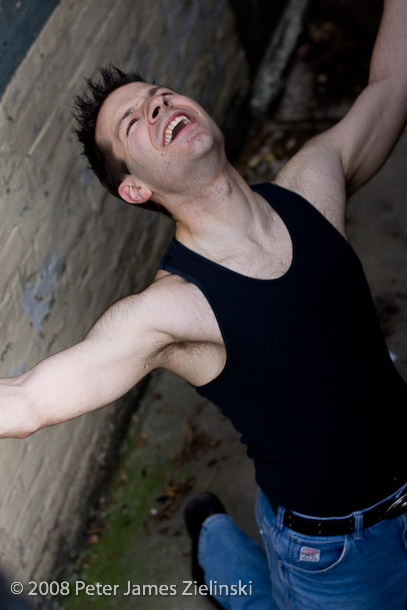
David Wilhelm

not panhandling

How conscious are you of your artistic influences? Who are your artistic influences?
To answer both questions in one go, I haven’t a fucking clue.Ā  I can tell you what writers have moved me, what performers have surprised me.Ā  In the end, everything that I am contributes in some way to the imagination that merges with the text to form the characters I play.

Since this is a travel blog, how does travel relate to or affect your art? (Themes in what you produce, road trips to perform your music, thoughts on what happens to your painting when you ship it across the country to a customer, etc.)
Money is the big issue here.Ā  Travel isn’t cheap, and most places that need entertainers can find them nearby.Ā  I’ll gladly travel anywhere to perform, so long as someone else is paying, because gods know I don’t have the coin.

I’ve traveled on my own, not as much as I’d like but more than I’ve any right to have managed.Ā  Every part of it has helped to shape me in some way into the person I am now, so in that respect, it has had some effect.

And finally, a right-brain question: If your art was a map, what would it be a map of?
Big empty space with the words: Here be dragons.

If you’d like, share your website/Facebook page and any upcoming gigs/plans you’d like readers to know about.
www.actordavidwilhelm.com

Also, I am now co-host of the new game nerd podcast Loot the Room: http://loottheroom.libsyn.com

Photo 1 credit Benjamin Haile. Photo 2 credit Peter James Zielinski.

Aesthetically Speaking: Paige Draper

Please welcome Paige Draper to the Aesthetically Speaking series of artist interviews. I know Paige from wayback, when she was singing in something like four choirs and dancing her way through the halls of our high school. Looks like she’s kept that joy of movement in her new home of Philly. Thanks for sharing, Paige!

What is your name and city of residence?
Paige Draper,Ā Philadelphia

What medium do you work in?
Irish step dance

How often do you work on your art–is it a full-time endeavor or something
you work on in your spare time?

About twice a week–I teach and take lessons myself.

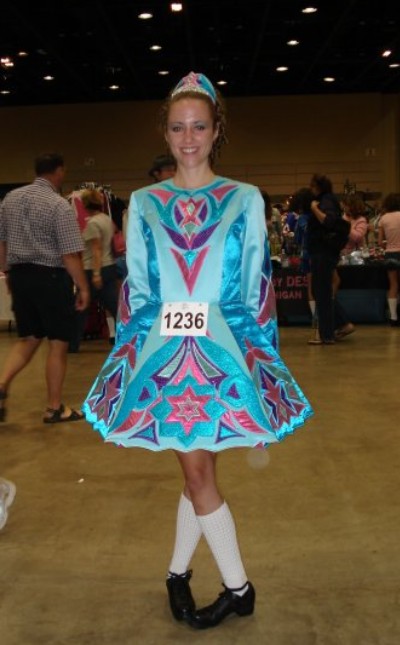
Paige Draper

all gussied up for a competition

How does art fit into your life, in general? Is it something you think about
and talk about every day, or every week, or only in certain situations,
etc.?

Irish dance has always been a huge part of my life and I certainly think about it every day. I would like to be involved in more, but the economy makes it difficult at this point.

When you start on a piece, what kind of end result do you have in mind? Does
it get performed or published, put in a permanent form or is it more
temporary?

Usually if the dance is to be performed I’m mostly concerned about the nature and attention-span of the audience. The material needs to also accommodate the performance space and floor. Since Irish dance is performed in hard and soft shoes, whether or not we use hard shoes depends on whether it’s a hard floor or carpet. In terms of the audience, if they want traditional Irish dance we try to use traditional dances and if it’s more of a flashy show we use music and choreography from Broadway shows such as “Riverdance” and “Lord of the Dance.”

What goals do you set in relation to your art, both short- and long-term? Is
it something you hope to make money doing, or is it something you want to
keep uncommercialized? Does the term “sell-out” hold meaning for you or do
you see the art/commerce relationship as a necessary one?

Teaching Irish dance allowed me to afford graduate school and move to Philly, but now it’s more of a therapeutic part of my life. I someday will get my teaching certificate and hopefully make money as a teacher, but I’m focusing more on my role as a performer and competitor as of now. I’m not the biggest fan of the way Irish dance has been introduced in this country because it is a national symbol of Irish history and culture. “Riverdance” and especially “Lord of the Dance” represent Irish dance in a flashy, Broadway manner.

What role does collaboration with others play in your art, if any?
Concerning traditional Irish dance, we provide jobs and roles for Irish musicians, costume designers, and artists. If Irish dance were not as popular as it is in the US, these individuals may not have as many work opportunities.

How conscious are you of your artistic influences? Who are your artistic
influences?

I know that some children have expressed Irish dance as positive role in their social lives and has given them confidence as a performer and individual. I don’t have very many artistic influences, however expanding my knowledge of the history and importance of the dance has given me a powerful sense of my heritage and culture. I’d like to think that my ancestors smile upon my work to preserve and represent such a significant cultural symbol.

Since this is a travel blog, how does travel relate to or affect your art?
(Themes in what you produce, road trips to perform your music, thoughts on
what happens to your painting when you ship it across the country to a
customer, etc.)

Myself and many others travel great distances to perform and compete in Irish dance, in fact, so much to the point that it costs money and sacrifice.

And finally, a right-brain question: If your art was a map, what would it be
a map of?

I’d like to think my art is a map of Ireland and its history. The dances represent cultural traditions and historical events that have occurred in the past. It is a wonderful way to teach people about such things through movement and music.

Photo from Paige’s personal collection.

Aesthetically Speaking: Em Findley

I’ve written about the singing and songwriting talents of Emily before, but here’s some more. Clearly I’m a big fan, and anyone who has heard Em sing has heard one of the strongest voices out there. It’s Em’s birthday week, so send well wishes in the comments, won’t you? Thanks for sharing, Em!

What is your name and city of residence?
Emily Findley, Brooklyn, NY


What medium do you work in?

Music


How often do you work on your art–is it a full-time endeavor or something you work on in your spare time?

Most definitely part-time/spare time. When the mood strikes me, MAYBE once a week?


How does art fit into your life, in general? Is it something you think about and talk about every day, or every week, or only in certain situations, etc.?

Music is what I know at my core, what I think I am best at, and what I would like to spend my time “doing.” Rather than going everywhere and doing everything, I am quite content to be sitting (or moving!) and listening to melodies and harmonies that inspire me.


When you start on a piece, what kind of end result do you have in mind? Does it get performed or published, put in a permanent form or is it more temporary?

All of the above! Sometimes it’s just one chord progression with a tune or sometimes it’s an entire song. Sometimes I sing it just for myself or sometimes I get up on stage.


What goals do you set in relation to your art, both short- and long-term? Is it something you hope to make money doing, or is it something you want to keep uncommercialized? Does the term “sell-out” hold meaning for you or do you see the art/commerce relationship as a necessary one?

If I could be the next American Idol without the glitter, I would be! Just kidding. If I could be a “known” singer/songwriter, that would be amazing. Or maybe, if I could just open for the bands that I love, THAT would be a dream. If I could actually make money from singing, well, wouldn’t that be fly!


What role does collaboration with others play in your art, if any?

I’ve spent a long time looking for “the one” person to sing with. When Lizzie and I sing together, I feel like I have found that person. I also love it when I get up in front of a room full of people and everyone sings along. I also welcome edits and collaboration on what I’ve written, which is what a lot of my family members (ahem, Lisa) have given me.


How conscious are you of your artistic influences? Who are your artistic influences?

I tend to write from someone else’s bravery. When I hear what someone else has done, I know that I can do it, too. Indigo Girls, Girlyman, Motown, girl groups, tight harmonies, my family members.


Since this is a travel blog, how does travel relate to or affect your art? (Themes in what you produce, road trips to perform your music, thoughts on what happens to your painting when you ship it across the country to a customer, etc.)

Music can go wherever you go. I hope that my music follows me. Or rather than following me, I hope that I make the conscious effort to bring it with me, to perform in new places or just to experience my music in different places because that brings me a new experience of what I have created.


And finally, a right-brain question: If your art was a map, what would it be a map of?

The heart.

Just kidding! Well, not really. But maybe bicycle and paths?

If you’d like, share your website/Facebook page and any upcoming gigs/plans you’d like readers to know about.
Music has, unfortunately, been a low priority for me for far too long. For me, it has felt like a lot of other life things have gotten in the way. But in my center I know that it’s always the biggest part of me so even though I’m not writing or performing, I know that, and that makes me feel ok.

Aesthetically Speaking: Ellie Maybe

Today I’d like to introduce you to a bona fide rock goddess, Ellie Maybe. Ellie writes songs for and performs in about 5,000 different bands, and is awesome in all of them. She has a show coming up this week, Thursday, October 13, so be sure to check her out at LiveWire. Thanks for sharing, Ellie!

What is your name and city of residence?
Ellie Maybe – Chicago, IL

What medium do you work in?Ā 
Music

Ellie Maybe photo by Audrey Leon

rock goddess

How often do you work on your art–is it a full-time endeavor or something you work on in your spare time?
I haven’t had a real job in three or four years. Ā I’m gradually (read: barely) approaching the point where I’m actually making the majority of my income off of live music, which, while I am hanging by a thread and paying rent late every month, is pretty exciting. Ā That said, I’m still looking for a part-time bartending gig so if you know of anything…… heh.

How does art fit into your life, in general? Is it something you think about and talk about every day, or every week, or only in certain situations, etc.?
Music is the basis and motivation for everything I do. Ā I am a musician. Ā Even odd jobs I work are based around music (music marketing, graphic design for artists, roadie gigs, et cetera). Ā Every day I’m booking shows or rehearsing or promoting gigs or trying to start new bands and projects. Ā It’s not something I could really go a day without — listening to music in the car while running errands makes me want to go home and pick up an instrument. Ā My phone’s memo app is filled with song ideas, random lyrics, names of tribute bands I haven’t created yet. Ā It’s a constant thing for me… there’s not a second of the day where I’m not (at least in some capacity) thinking about, creating or promoting music.

When you start on a piece, what kind of end result do you have in mind? Does it get performed or published, put in a permanent form or is it more temporary?
Music is intangible and the “end result” is inarguably emotional — what the listener experiences and, in cases of live performance, what the artist experiences while playing. Personally, I often envision reactions from an audience (or occasionally the person I’m writing for/about) while writing a tune… how will this make them feel? Ā How will this lyric come across? Ā Will my exboyfriend know I wrote this song about his best friend? Hahaha…

What goals do you set in relation to your art, both short- and long-term? Is it something you hope to make money doing, or is it something you want to keep uncommercialized? Does the term “sell-out” hold meaning for you or do you see the art/commerce relationship as a necessary one?
This is a topic on which I’m very vocal. Ā I don’t believe that “selling out” is even a concept. Artists create to share their work with the world, and those with the proper talent and drive should be compensated to do so. Ā Sure, there are certain companies I’d prefer not to sell my music to, but if McDonald’s wants to use one of my tunes in a commercial and it means I don’t have to *work* at a McDonald’s to make a living, I’m gonna do it. Ā I am a musician by preference, but above all else, by trade. Ā I consider this a job. Ā I love it and I would play music if I couldn’t make a dime at it (and have), but I want to make a living doing this, and turning down opportunities simply because of an outdated stigma of “selling out” just seems silly to me.

I was once asked by a professor at an audition whether I would rather have a half-assed album that I was ashamed of go platinum and make millions, or an independent release I was incredibly proud of that only sold ten copies. Ā I told him that I’d take the former any day, and use the proceeds to fund the marketing of the latter.

“Selling out” is what you make of it. Ā Money makes our society move, and it’s important in this industry to have backing… It’s futile to attempt to preserve your artistic integrity by allowing less people to hear the music you create.

What role does collaboration with others play in your art, if any?Ā 
Music in and of itself is a collaborative medium. Ā The writing end can be a little more personal…Ā For the longest time, I refused to collaborate. Ā Songs just kind of fell out of me. I’d get an idea, sit down to write, and it was done. Ā I don’t like to edit. Ā However, about six years ago I met a guy who was an amazing guitarist and fairly accomplished songwriter. Ā We ended up working together on a lot of things. Ā We were involved in a romantic relationship as well, so there was a comfort level there… I still refused to write with others until 2008, when I participated in Steel Bridge SongFest’s weeklong Construction Zone songwriting workshop. Ā I ended up working with dozens of people I’d never met before (including freaking Jane Wiedlin of the Go-Go’s!!) and came home ten times the musician I was simply for the experience of interacting with these folks. Ā I’ve since been able to cowrite with bands, producers, et cetera and I’ve become a much stronger writer for it.

The creation of music is a very personal experience, but I’ve learned that the challenge of pouring your heart out into a song with another writer can actually be quite therapeutic — and often times the piece comes out stronger than it could have with only one perspective.

Ellie Maybe photo by Allison King

collaboration in action

How conscious are you of your artistic influences? Who are your artistic influences?
While I have very defined favourites who I would usually list as influences (Tom Waits, Foreigner, KISS… yes, seriously), there are very few instances in which I really push my style to emulate them. Ā Actually, as far as musical influences go, I take a *lot* from rap music. Ā Syncopation and literary devices fascinate me, and there is a heavy emphasis on that in hip hop. Ā There’s nothing quite as cool as getting that perfect lyric — the one that not only expresses the sentiment clearly, but makes you think, “How has no one already said this?” Ā Rappers have a flare for this — it’s what they do.

Since this is a travel blog, how does travel relate to or affect your art? (Themes in what you produce, road trips to perform your music, thoughts on what happens to your painting when you ship it across the country to a customer, etc.)
Travel is one of the reasons I am a musician. Ā My goal in life is to pack my dog and my guitar into an RV and tour the country. Ā I’m currently writing a new solo record so that I can make this dream a reality — my freaking Twitter tagline is “I want to go everywhere and meet everyone.” Ā And it’s true. Ā I haven’t been many places (outside of the Midwest I could probably list them on one hand) and I’m thrilled by the concept of discovering new dive bars in small towns across the country, seeing baseball games in different parks, and making new friends who will give me a reason to come back and visit. Ā One of these days I’m hitting the road and I’m not getting out of the damn truck for at least a year.

And finally, a right-brain question: If your art was a map, what would it be a map of?
The El. Ā Seriously. Ā I still think west is up on a compass because of the damn Elevated maps. Ā The CTA ruined me. Ā Maybe I should take a navigator with me in that RV…. ha!

If you’d like, share your website/Facebook page and any upcoming gigs/plans you’d like readers to know about.
Thursday, October 13 @ 10:00PM
LiveWire (3394 N Milwaukee Ave in Chicago)
The Sonnets (my band) with Black Market Parts & Tiny Riots (from Madison)

www.emaybe.net (me)
www.the-sonnets.com
(my band)
www.slutter.net (my all-lady KISS tribute)
www.twitter.com/ellie_maybe

Ellie Maybe photo by John Schulze

Slutter, all-lady KISS tribute band. YES.

Aesthetically Speaking: Branden Johnson

Please welcome Branden Johsnon to Aesthetically Speaking. He’s a renaissance man of the arts, playing music and writing many things. I’ve seen These Guys These Guys perform, and they do a great live show of moody, Peter-Gabriel-era-Genesis-type instrumental music. They have a show on Friday, October 14 so check them out. Thanks for sharing, Branden!

What is your name and city of residence?
Branden Johnson – Resident of Oak Forest, IL, a suburb of Chicago

What medium do you work in?
I’m primarily a writer and a musician. It really does fall about 50/50. I write novels and short stories, as well as screenplays (specifically for a web series called Kole’s Law), and I play piano and guitar in post-rock band These Guys These Guys.

How often do you work on your art–is it a full-time endeavor or something you work on in your spare time?
As much as I would love to be creative full-time, I’m a wage slave like most everyone else. My passion for working on my art comes and goes in waves. When I’m not working on music to prepare for a gig, I’m writing alone at my desk or collaborating on a screenplay.

How does art fit into your life, in general? Is it something you think about and talk about every day, or every week, or only in certain situations, etc.?
My creative work is incredibly important to me. Sometimes I forget that. Those are the times I find myself the most down. When I remember the joy I get from creating, it’s like getting a second wind in a big race, and I can’t wait to get off work so I can get home and create some more.

Branden Johnson

on keys

When you start on a piece, what kind of end result do you have in mind? Does it get performed or published, put in a permanent form or is it more temporary?
It varies, really. I’ve had a few short stories published in some journals, which felt great at the time. And when the band plays a gig, we get the satisfaction of interacting with the crowd, which is immediate feedback.

What goals do you set in relation to your art, both short- and long-term? Is it something you hope to make money doing, or is it something you want to keep uncommercialized? Does the term “sell-out” hold meaning for you or do you see the art/commerce relationship as a necessary one?
The term “sell-out” to me is far from a bad word. It really depends on the artist’s intention. If my goal is to write a novel and get it published, then certainly I’d like it to sell. If it’s not selling, why did I work to get it published? But if I create an intensely personal piece, I may only want to share it with some close friends or family. In the long term, I want to create for a living. And I’m at a place where the term “create” has a bit of flexibility. If my band scored a big recording contract — great! If a novel I write is published — awesome! If one of my web series is discovered and appreciated by a Hollywood big-wig — terrific! I so enjoy the various projects I’m involved in that any one of them could become a career for me and I would be perfectly happy.

What role does collaboration with others play in your art, if any?
Our collaboration in the band is incredibly important. We write together. We make all our decisions together. If a compromise has to be reached, we reach it. My solo writing, of course, is primarily just me — but even then, writers’ groups (like online group Zoetrope.com) have provided me with valuable feedback that has helped me grow as a writer.

How conscious are you of your artistic influences? Who are your artistic influences?
I’ve been influenced by a number of writers. One of the major writers would be Neil Gaiman. I never read his comics, but his novels, and particularly his short fiction, have really spoken to me. Musically, I grew up listening to video game scores (being then, as now, a huge nerd), and have taken a great deal of inspiration from Japanese composers such as Yasunori Mitsuda and Nobuo Uematsu.

Branden Johnson

the glasses mean "writer"

Since this is a travel blog, how does travel relate to or affect your art? (Themes in what you produce, road trips to perform your music, thoughts on what happens to your painting when you ship it across the country to a customer, etc.)
I don’t want to only write what I know. I want to learn more, grow more. Staying put doesn’t do much to help with that. My experiences in other places have helped me extend my perspective, which can only benefit my writing. As far as my music goes, well… We haven’t really toured yet. But that could happen soon!

And finally, a right-brain question: If your art was a map, what would it be a map of?
It would be a map of the Midwest as drawn by a maniacal 4th grader.

If you’d like, share your website/Facebook page and any upcoming gigs/plans you’d like readers to know about.
Twitter: @brandenjohnson
Facebook: www.facebook.com/brandenjohnson
These Guys These Guys: www.theseguystheseguys.com
TGTG on Facebook: www.facebook.com/theseguystheseguys

Kole’s Law: www.koleslawshow.com
Kole’s Law on Facebook: www.facebook.com/koleslawshow

Upcoming Show Details:
El Mamey
Friday, October 14
2645 W. North Ave, Chicago, IL
21+/8:00pm/$7
With: Mountains For Clouds & I Know Everything

Photo 1 credit Keith Kosmal. Photo 2 credit Jenny Schuler.

Aesthetically Speaking: Catherine Adel West

This week’s interview was conducted with Catherine West, a colleague of mine at work. We found out we actually grew up blocks from each other in Evergreen Park, and now years later we’re working as editors in a small office in downtown Chicago. Small world. Catherine’s blog makes me laugh every time I read it, and I’m looking forward to reading more as the inspiration strikes her. Thanks for sharing, Catherine!

What is your name and city of residence?
My name is Catherine Adel West and I live in Chicago, IL.

What medium do you work in?
I am a writer. Whether or not I am a legendary writer remains to be seen.

Catherine West

Catherine West, legendary writer

How often do you work on your art–is it a full-time endeavor or something you work on in your spare time?
I write in my spare time. Mostly I write after work or during breaks. It’s for the most part when inspiration hits me, which is more and more often these days.

How does art fit into your life, in general? Is it something you think about and talk about every day, or every week, or only in certain situations, etc.?
As I have to edit other people’s words, I think about my work and my words all the time, every time. It actually helps to know what techniques work in writing and which ones do not.

When you start on a piece, what kind of end result do you have in mind? Does it get performed or published, put in a permanent form or is it more temporary?
When I begin a story, it is very fluid. I never know where I’m going to end up which is most of the fun. My result varies with each story I create; I want to make you laugh; I want to make you cry. My overall goal is always the same and that’s to make the reader feel something powerful. I will publish my work on a blog. I am, however, experimenting with the idea of being more aggressive and entering short story competitions.

What goals do you set in relation to your art, both short- and long-term? Is it something you hope to make money doing, or is it something you want to keep uncommercialized? Does the term “sell-out” hold meaning for you or do you see the art/commerce relationship as a necessary one?
My ultimate dream or goal has always been two-fold. Become a successful writer both literary and screenwriting (maybe an Oscar or two in my future). To me, sell-out is not a dirty word as I have never been the “starving artist” type. We do have to make a living and we all, as artists, want to reach as many people as we can with our words, music, images, etc.

I think the lines that one is willing to cross determine the extent to whether they will be able to ultimately live with their decisions or not. I think in the end, I will be able to live with my decisions and do so happily.

What role does collaboration with others play in your art, if any?
Collaboration, if any, for me comes mostly in the editing process. I give my stories to a few trusted people and they give me their honest feedback. We will go back and forth about things that can be edited or changed. However, writing is mostly a very single and lonely process.

How conscious are you of your artistic influences? Who are your artistic influences?
I think anyone who performs music, paints, writes, or whatever is constantly trying to live up to an ideal person. With every note played, word written, or brush stroke comes a constant questioning of how would this person handle it or how can I put my own unique spin on my art form. I am no different.

Ā I read and re-read every line and compare myself. How I write, every word used has little bits of Zora Neale Hurston or Dean Koontz or Anne Rice or Chuck Palahniuk. I try to write to combine love of ethnicity and mystery and description and dark humor. I want my writing to be all of these things in a unique shell.

Since this is a travel blog, how does travel relate to or affect your art? (Themes in what you produce, road trips to perform your music, thoughts on what happens to your painting when you ship it across the country to a customer, etc.)
Travel mainly affects the way I describe a place in my writings. A lot of it I pull from different places I’ve visited. A hotel room in Paris; a casino in Vegas; the way the Pacific Ocean beats the sand in Santa Monica — all this helps me give a place or setting as much depth and feeling as the characters themselves.

And finally, a right-brain question: If your art was a map, what would it be a map of?
As much as I dislike the wilderness, I would actually compare my art to the forest. There is a lot of beauty, dense and raw, and it can be hard to get through, but once you hit that beautiful meadow, and the sun is shining off the picturesque lake, the trek was totally worth it!

If you’d like, share your website/Facebook page and any upcoming gigs/plans you’d like readers to know about.
I have a wonderful blog titled “Ghetto Yuppies.” It’s funny and crazy and a good read so I invite all people to check it out! http://catherineadelwest.blogspot.com/