
Chiang Mai, Thailand; February 18, 2013
Chiang Mai, Thailand; February 18, 2013
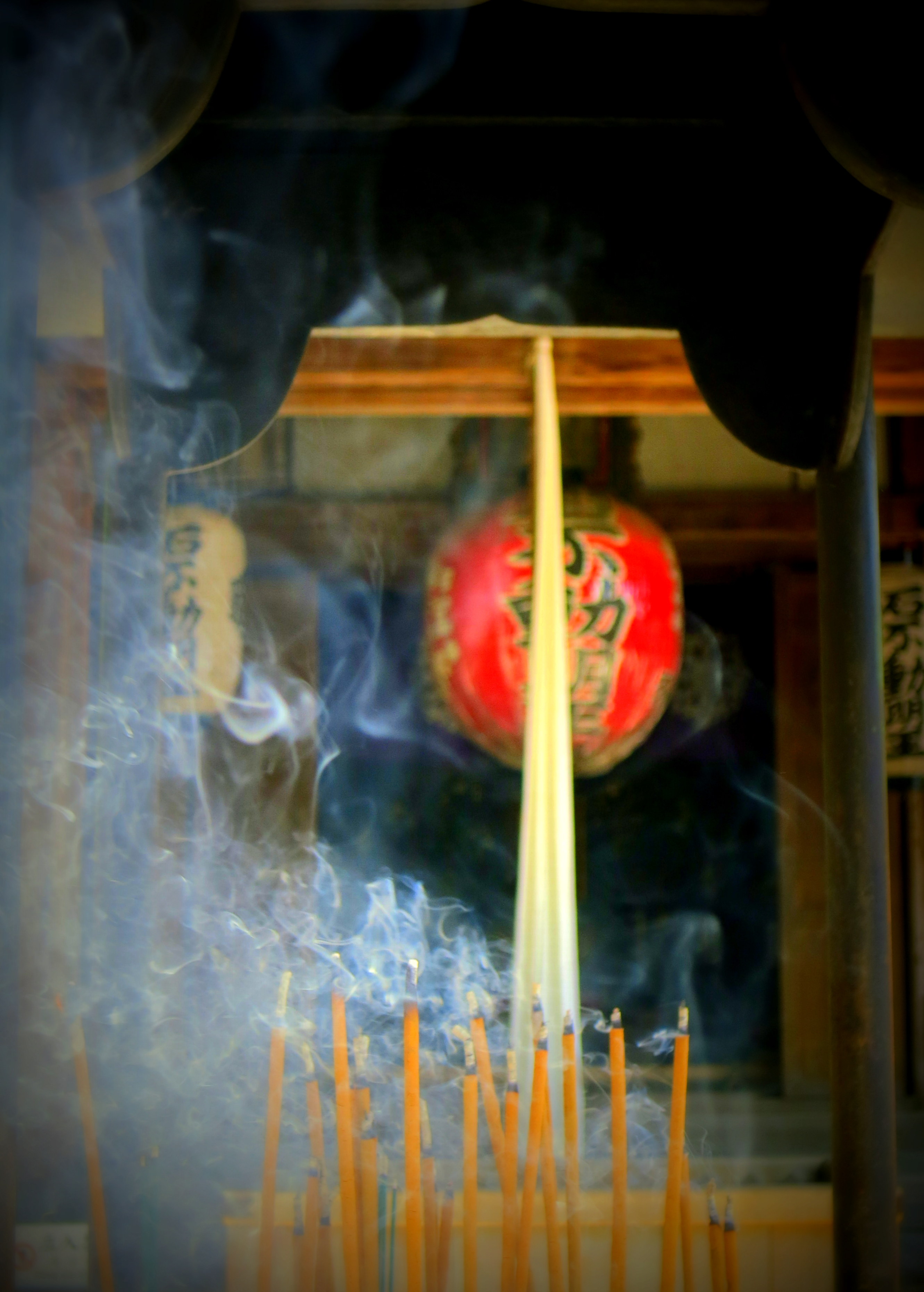
There are more temples in Kyoto than days on a Japan Railpass, but I did manage to see the Golden Palace, the Silver Palace, Ryoan-ji, and Kiyomizu Temple over the course of a couple days. I can see why people rhapsodize about them.
Kyoto temple
Ginkaku-ji (officially Jisho-ji) was built in the 15th century, and is probably nicknamed the Silver Palace as it came after construction of the gold-leafed Golden Palace. Possibly it was even going to be covered in silver foil, but that never happened, and it remains a painted wooden sculpture.

Ginkaku-ji

The Silver Palace, a wooden structure whose proper name is Temple of Shining Mercy

The approach to the temple was direct, but felt like a giant maze because of the huge hedges
The grounds were extensive (I feel like a character in an Austen novel every time I say that, but it’s true). The gardens I visited in Japan were all meticulously laid out, and little arrows pointed the exact path you should follow, both to avoid congestion and to appreciate the gardens according to the aesthetic plan of the designers. The gardens at Ginkaku-ji were flowering beautifully, and the large raked rock garden (it is a Zen temple) was a perfect complement to the leafy trees.

Lovely gardens

Seriously lovely

Another view from the hill walk
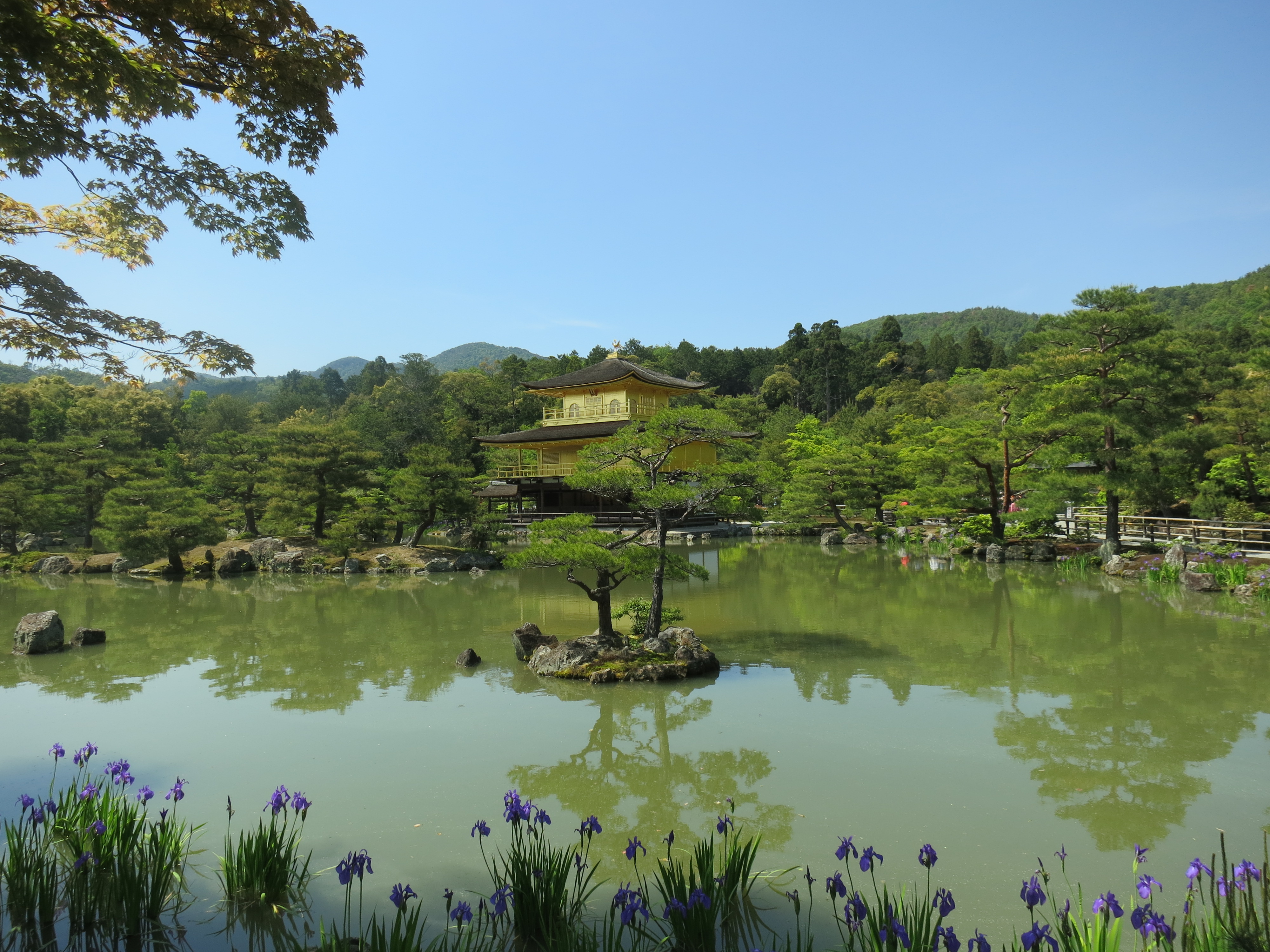
Kinkaku-ji, the Golden Palace, was super crowded–it’s one of the most popular destinations in the country, for domestic and foreign tourists alike. There’s a little spot set aside for photos of the gilded palace across the pond. Trying to elbow in for a photo in front of the fence was a bit of work. A Japanese teenager tried to take a photo with me–with me as the tourist attraction. I declined. Was that so different from taking a photo of the women in line with me at the kabuki theater? I like to think it was, since I chatted with the women in line before asking for a photo, but I’m not sure.
Golden Palace

May was a great time to visit, with everything in bloom
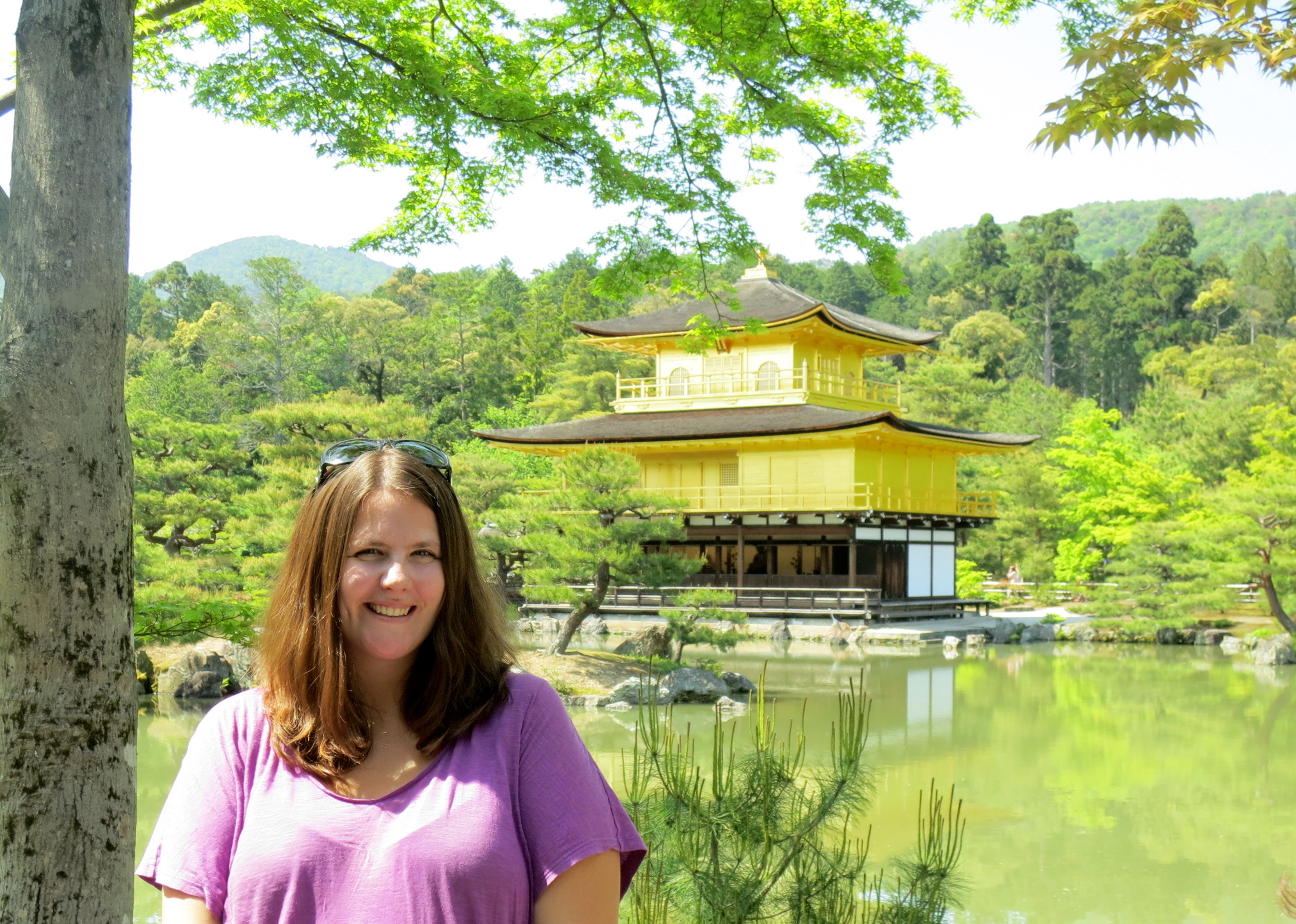
Finding space to get this shot was an exercise in patience
The palace a large house on stilts. It was originally the villa of a wealthy man; another man bought it later and then asked that it be turned into a Zen temple upon his death. So he got to enjoy the lavish place for himself and then piously give it over to religion–nice one! The original structure was burned down by a disturbed novice monk in 1950, and it has since been rebuilt. The hill walk here was far less impressive than that of the Silver Palace. I’m glad about that, actually, since I take it to mean that I’m getting a little better at distinguishing among the Japanese gardens I’ve seen, and determining which are more pleasing.

I love the temple gates

In the gardens of Ryoan-ji

A view of the rock garden of Ryoan-ji
Ryoan-ji is part of the World Heritage listing of Kyoto, and it’s famous for its Zen rock garden, which has kept the same arrangement since the 15th century. The grounds are huge, and they include a large pond with ducks (which are apparently rare here), and a little fox shrine on a tiny island on the pond. Up the hill was the building. Everyone had to remove their shoes before entering, which is actually the first time I’d encountered that in a religious temple in Japan. (I removed them at every temple in Thailand.)

Teenagers in traditional dress, taking a selfie

A miniature of the rock garden, so you can see the layout

The rooms behind the rock garden were empty except for these beautifully painted screens
The rock garden is enclosed in a large stone fence. There are 15 rocks, set in carefully raked gravel/gray sand. I couldn’t get a good angle to see the whole garden at once, which is apparently intentional; you’re meant to sit and reflect on the portion you can see, and take meaning from that. You’re also only able to see 14 of the 15 rocks from any one point on the viewing pavilion, because you can “see” the final rock when you reach enlightenment. It would have been peaceful to sit there and reflect, but there were a lot of people and they all talked loudly, so that didn’t happen.

Kiyomizu-dera
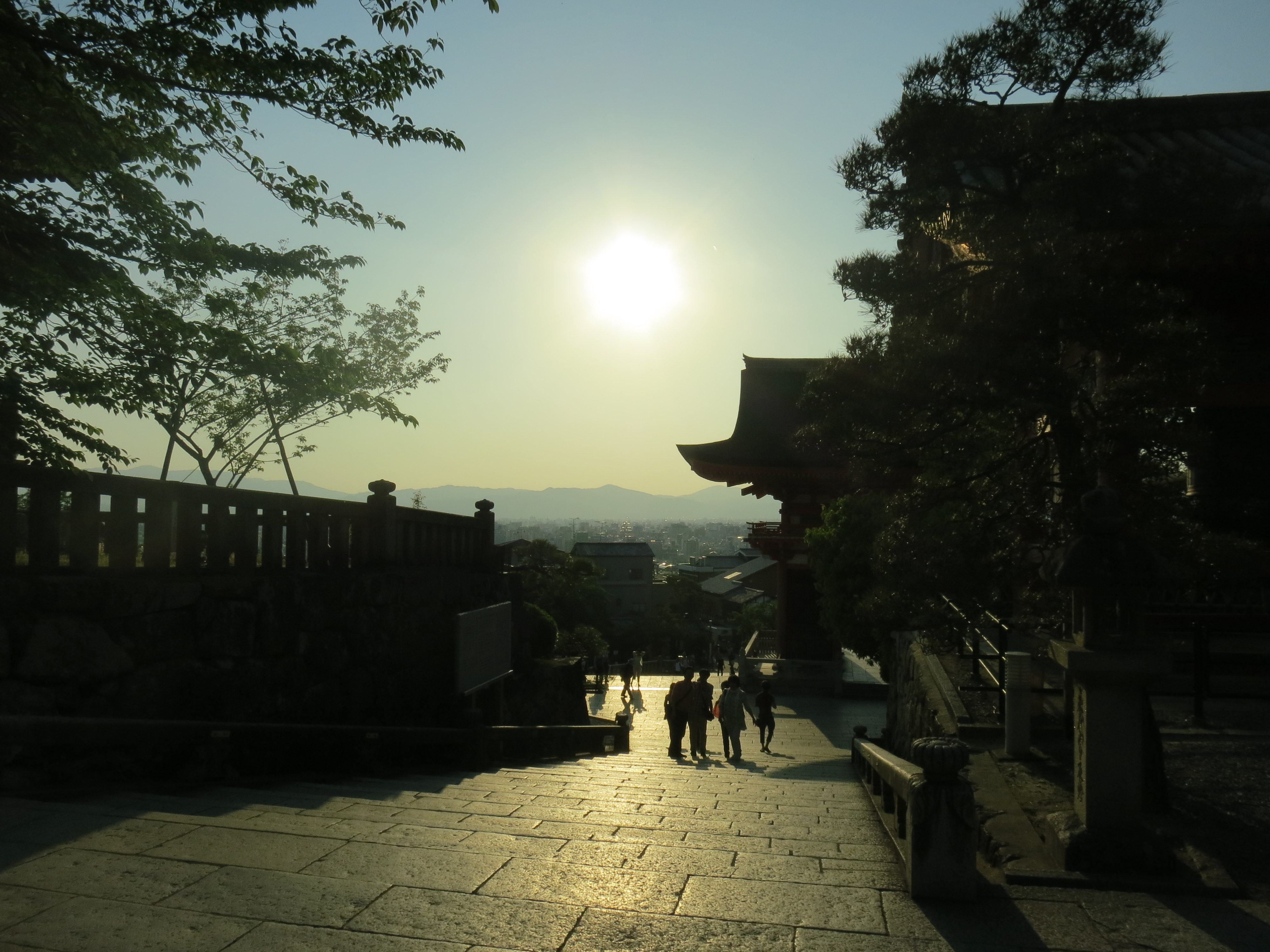
One last temple before sundown

Detail on one of the structures at Kiyomizu

Picture perfect
Getting to Kiyomizu Temple was more of a journey than I’d expected. I took a bus, walked up an endless hill, which finally turned into old Edo period buildings, and eventually I reached the shrine. It was a large complex, set around the edge of the hill, so for the first part you stood on the patio and looked across the ravine to a pagoda. (“Jump off the ledge at Kiyomizu” is a Japanese idiom similar to “take the plunge”–if you could jump 13 meters from the pavilion to a spot below, you’d get your wish. Not everyone survived this plunge.)

A peek at the pagoda
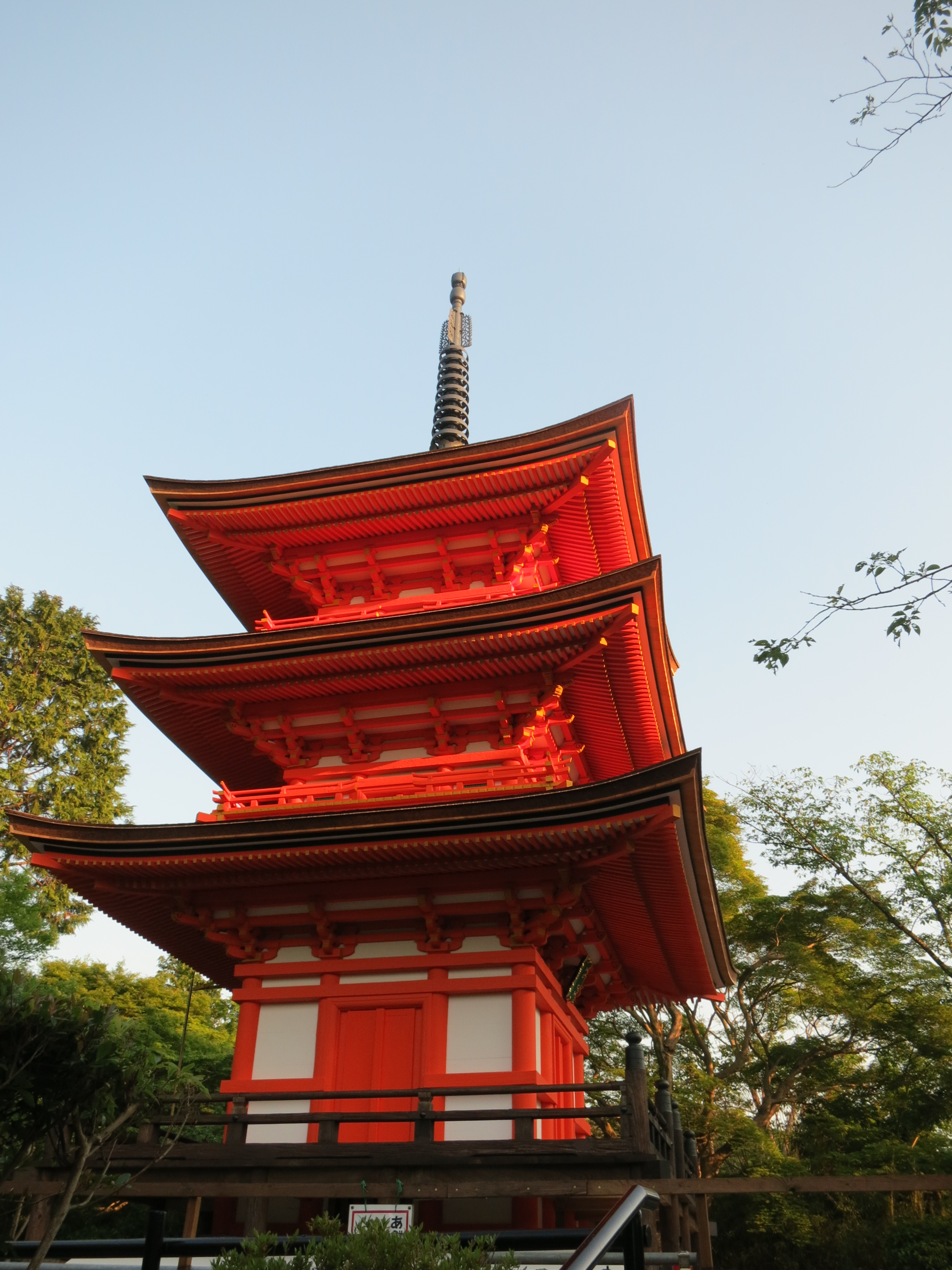
Up close
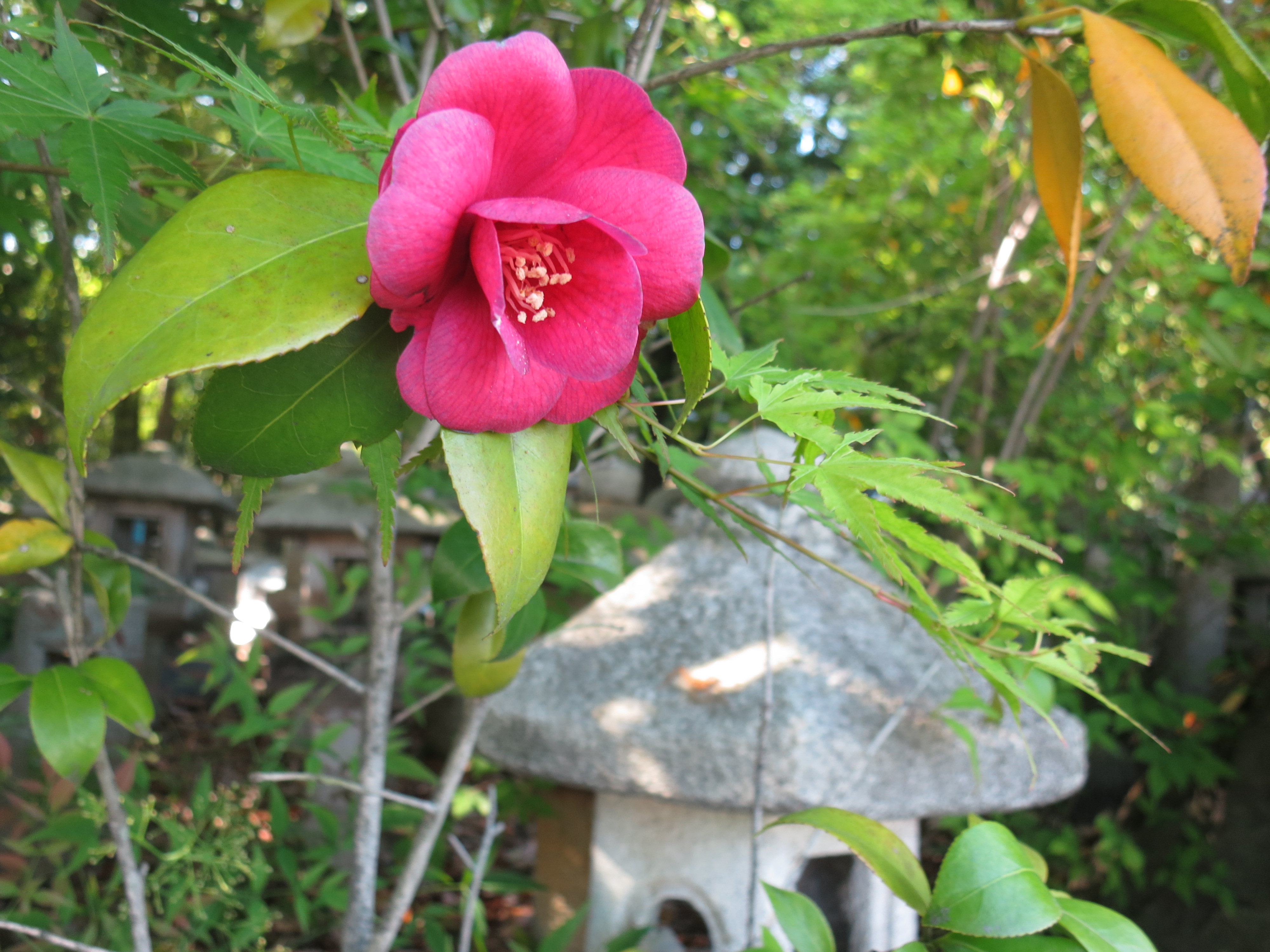
I saw what looked to be overflow on stock of religious sculptures on my walk through town
Then I walked along the rim of the valley to that pagoda and looked back at the buildings there, with the city off to the side and the sun starting to set. It was all picturesque, as just about everything in Japan was. Because I was there at closing, I didn’t get to to see the waterfall for which the temple is named, so, next time.

Goodbye, Kiyomizu Temple and Kyoto
Pre Rup

Pre Rup

Banteay Srei
This temple is called the “lady temple” because it’s shorter than the other temples, lady-sized. No one seems to be sure why it was built on such a small scale. It’s built of red sandstone, rather than the mix of sandstone, laterite, and brick used in some of the other temples. It’s also covered in beautiful decorative carvings, and because the buildings are only a little taller than eye level, it’s easy to admire the art.
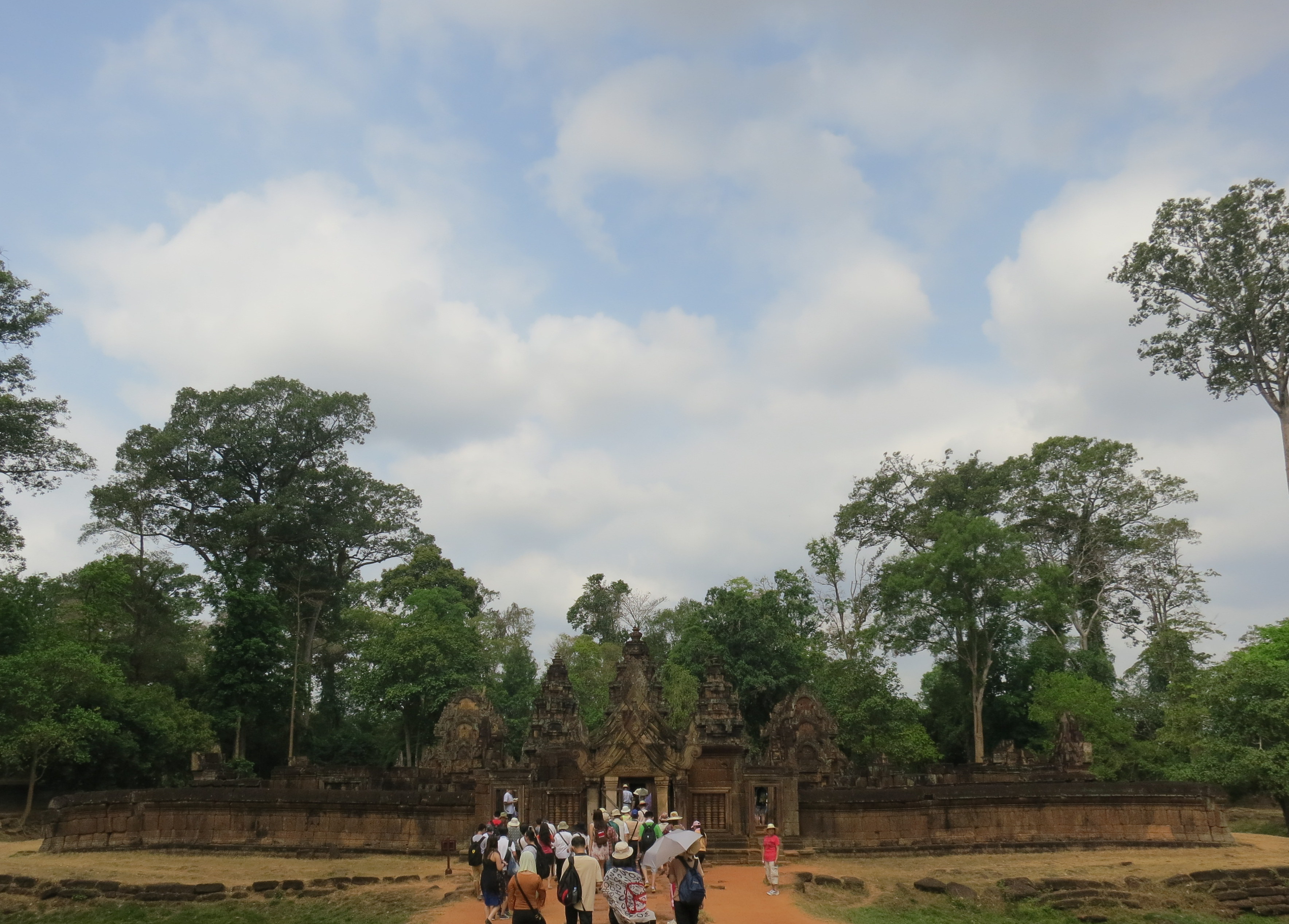
On the approach, you can see how the temple is so much smaller than the other temples.

Banteay Srei

Most of the statues in the park are copies because the originals kept losing their heads to vandals.
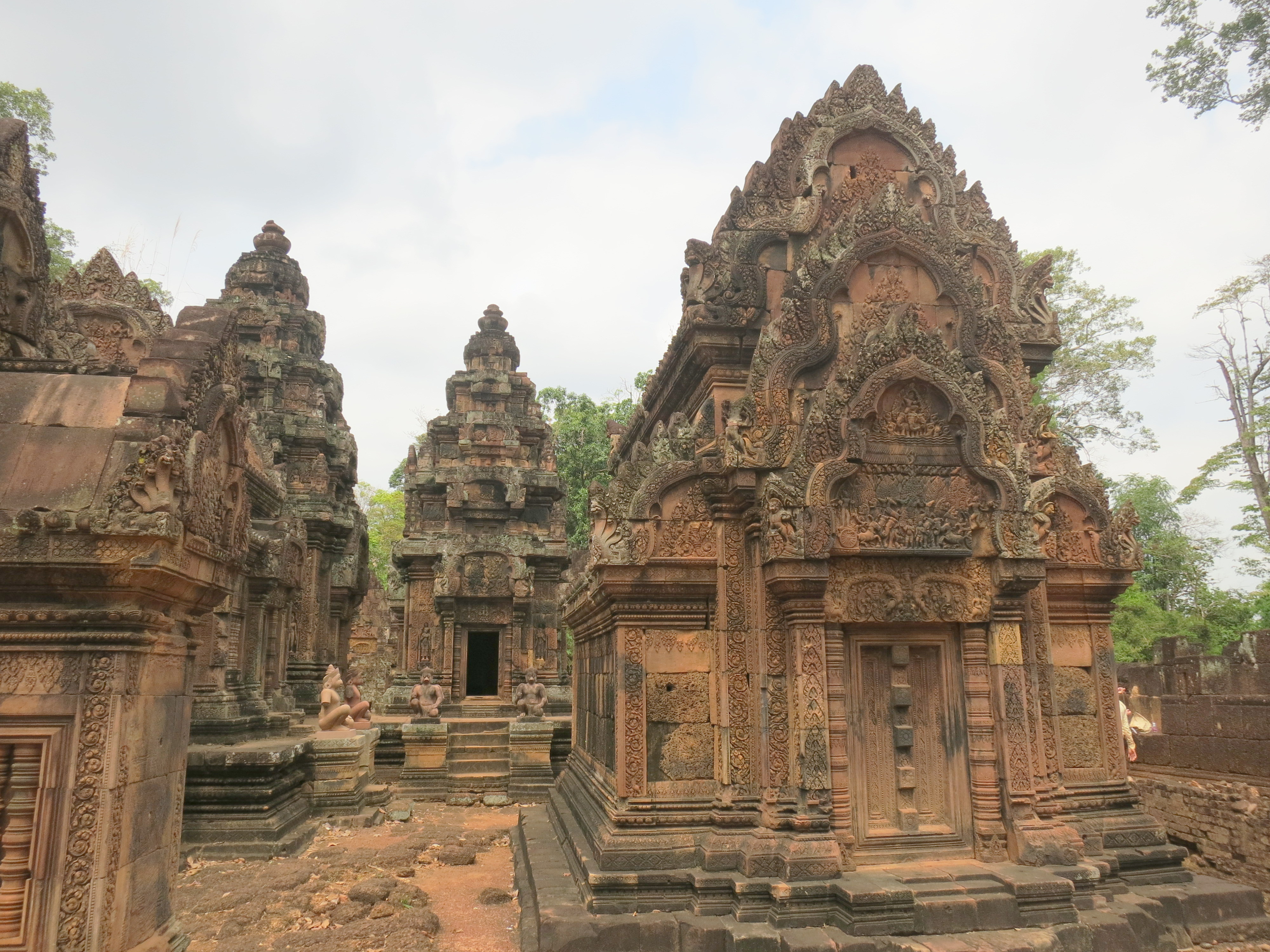

Gorgeous detail in Banteay Srei
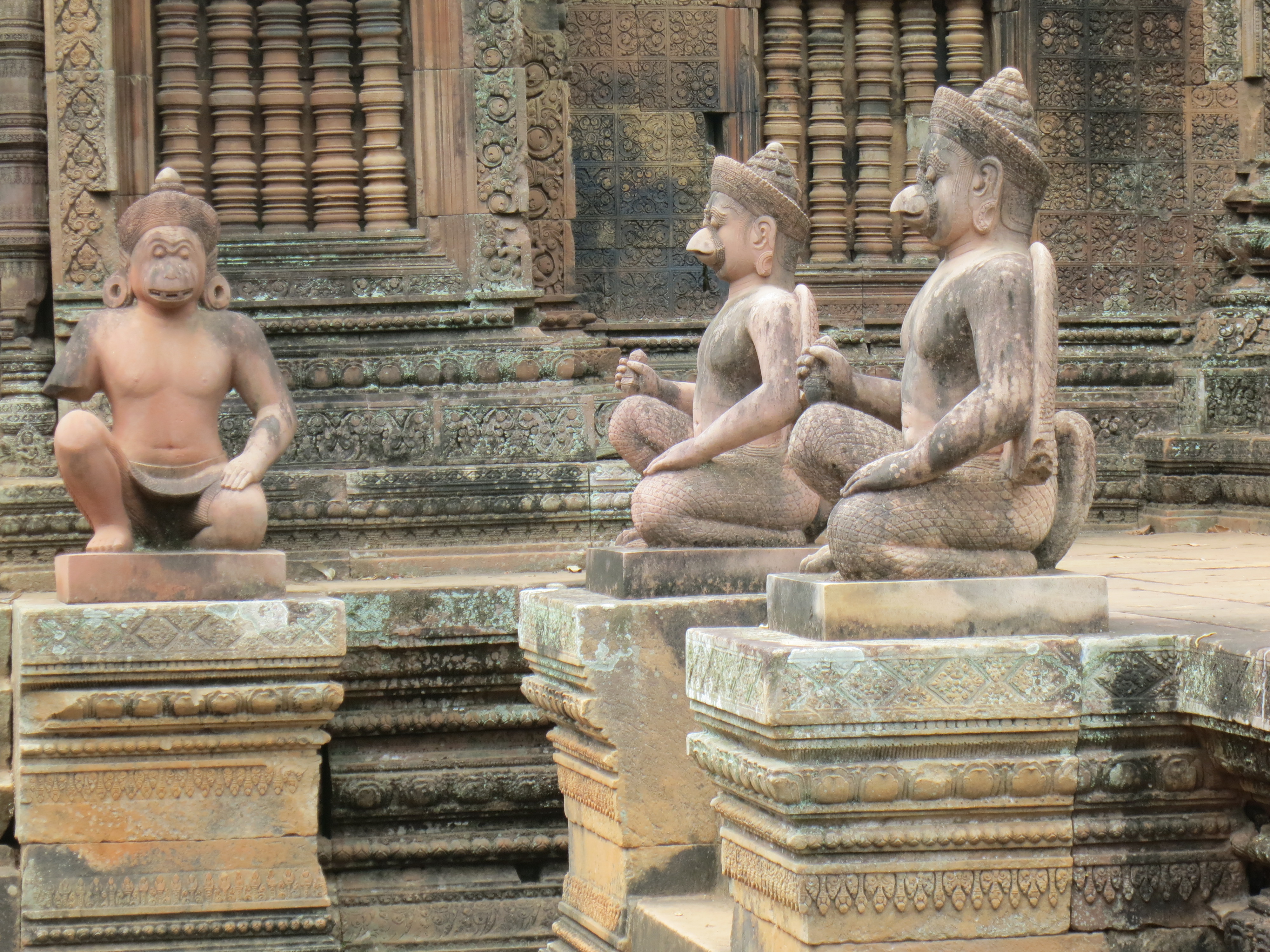
Also monkeys
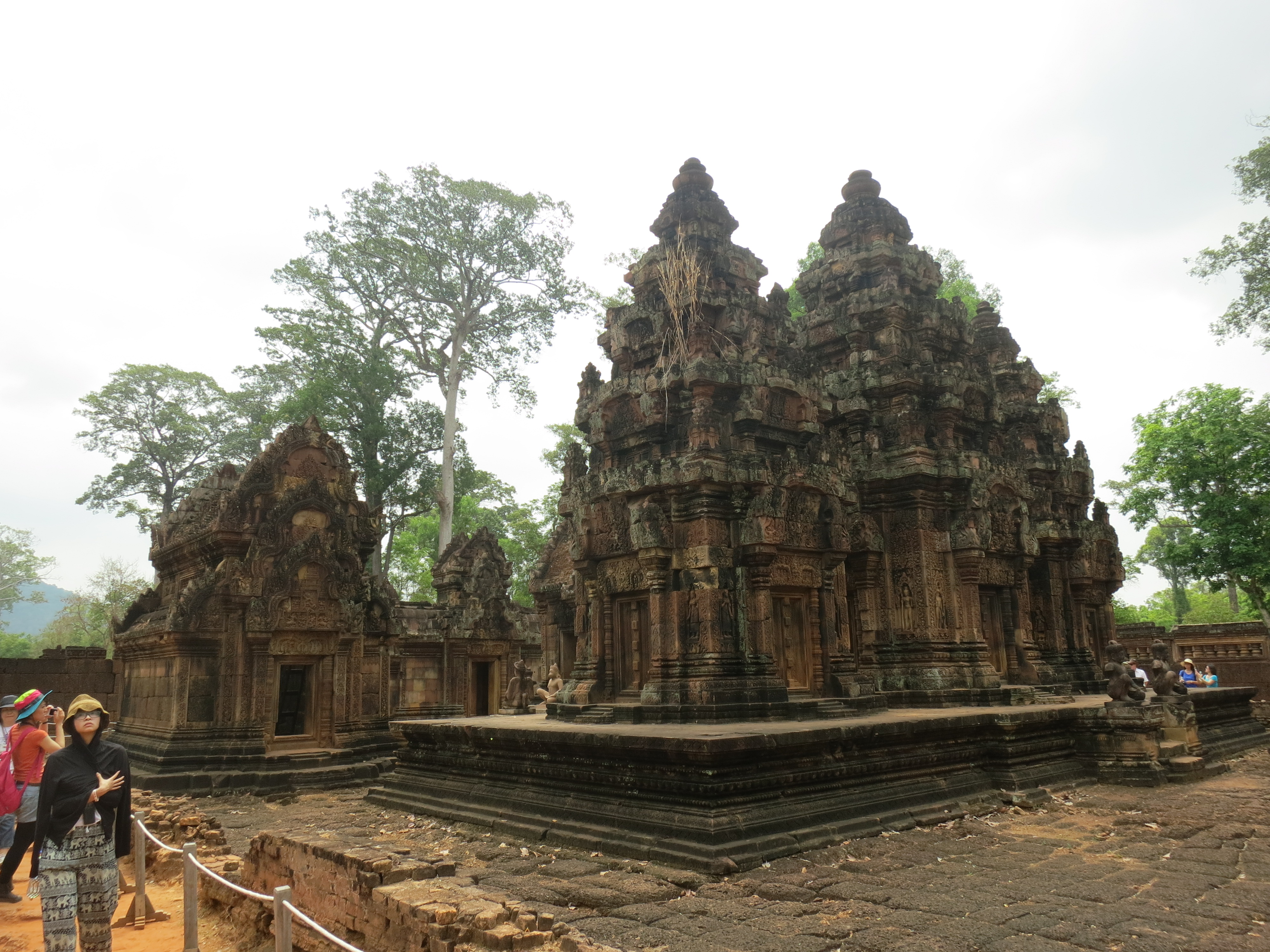
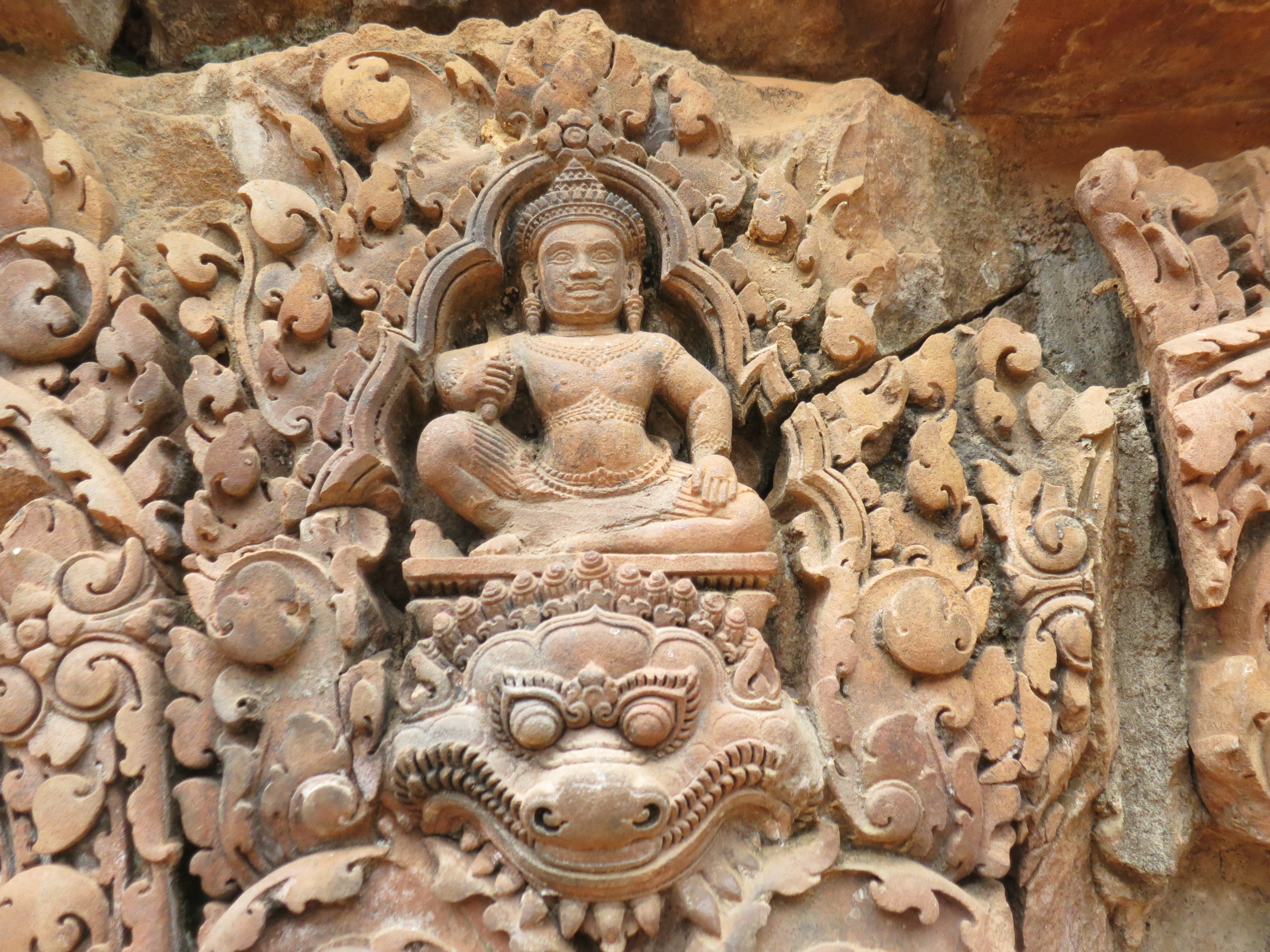
Such cool detail
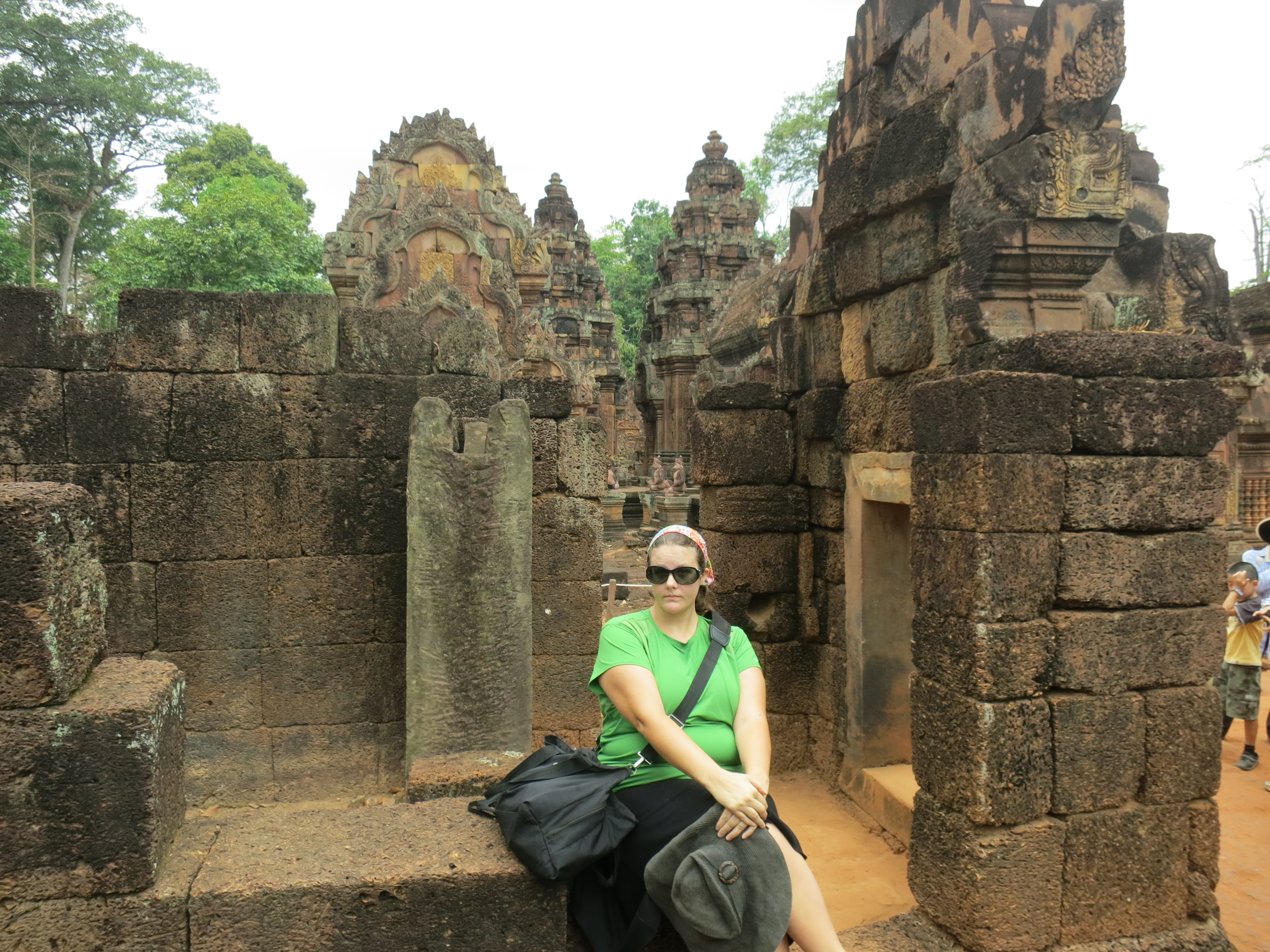
Being demure in the lady temple

Banteay Samré
More than other temples I visited, Banteay Samré seemed like it was missing water. Everything was raised off the ground–the outer walls, the inner libraries, the inner temple–and since it was all closer together than Angkor Wat or similar, I got the feeling that there should have been water filling in all the empty spots. Like a floating temple. This was just what I wanted, though, and probably isn’t at all what it would have looked like in the 12th century.

Banteay Samre
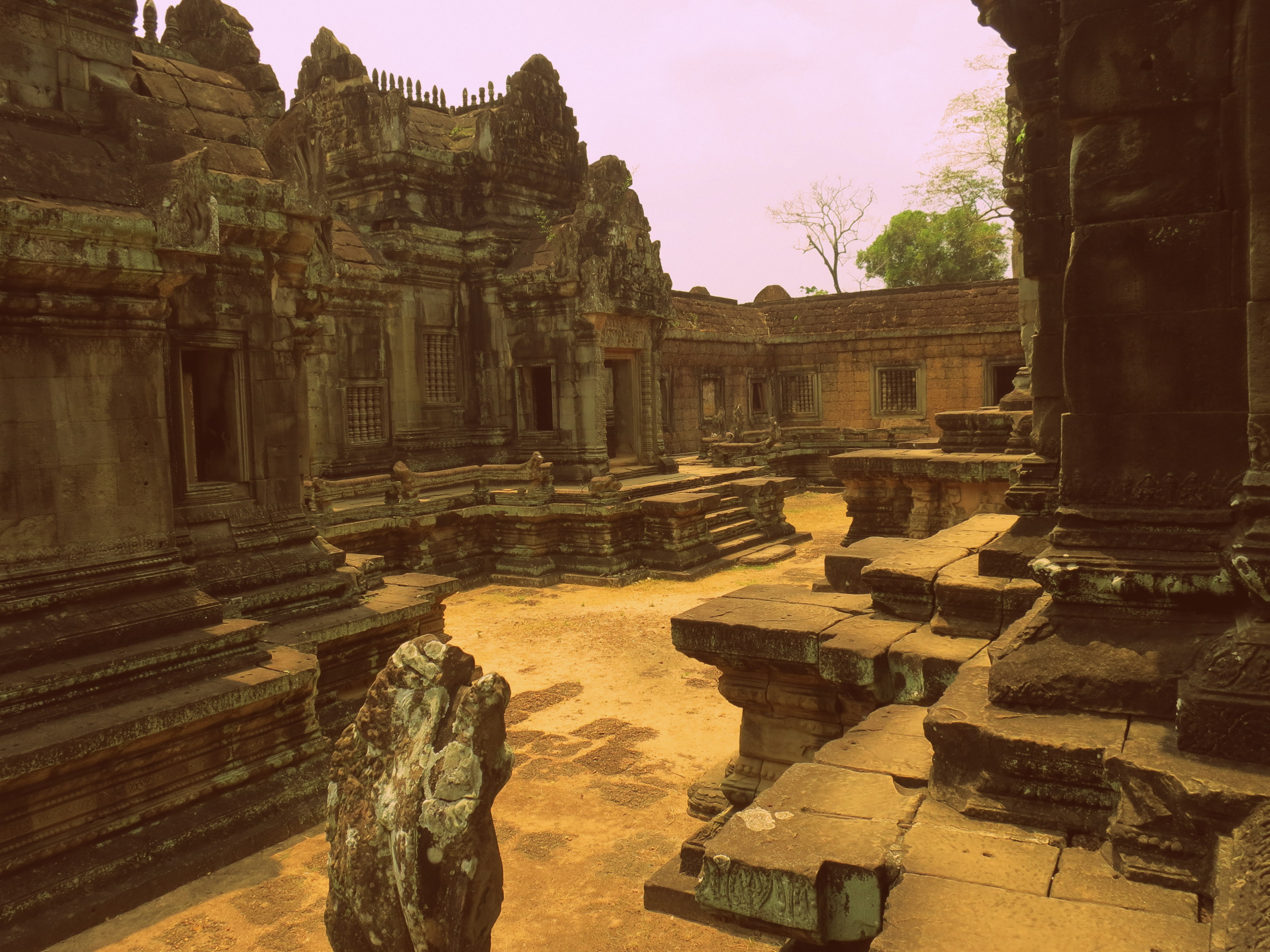
Can’t you just see water filling in all those spaces?
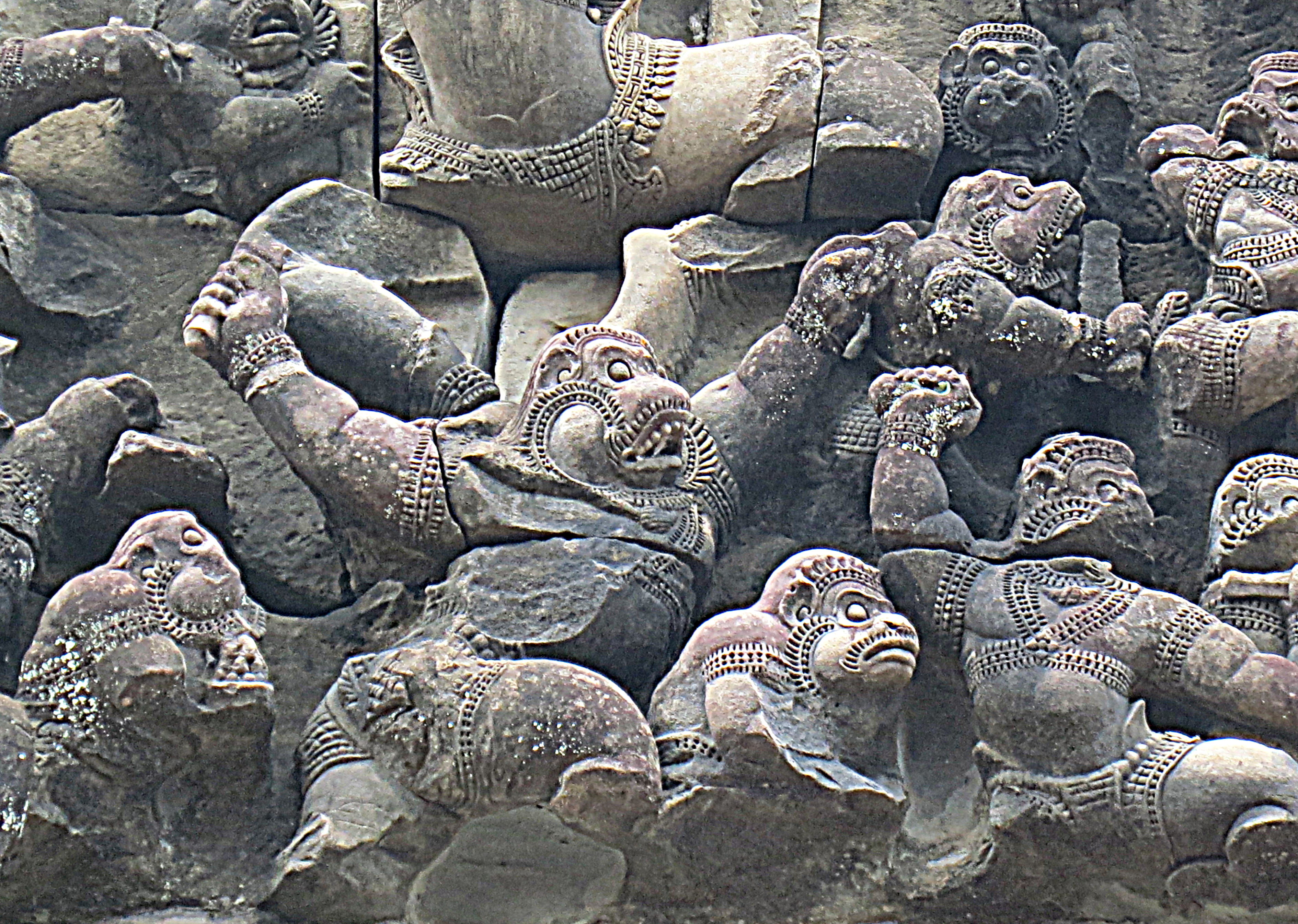
That detail again

East Mebon

East Mebon

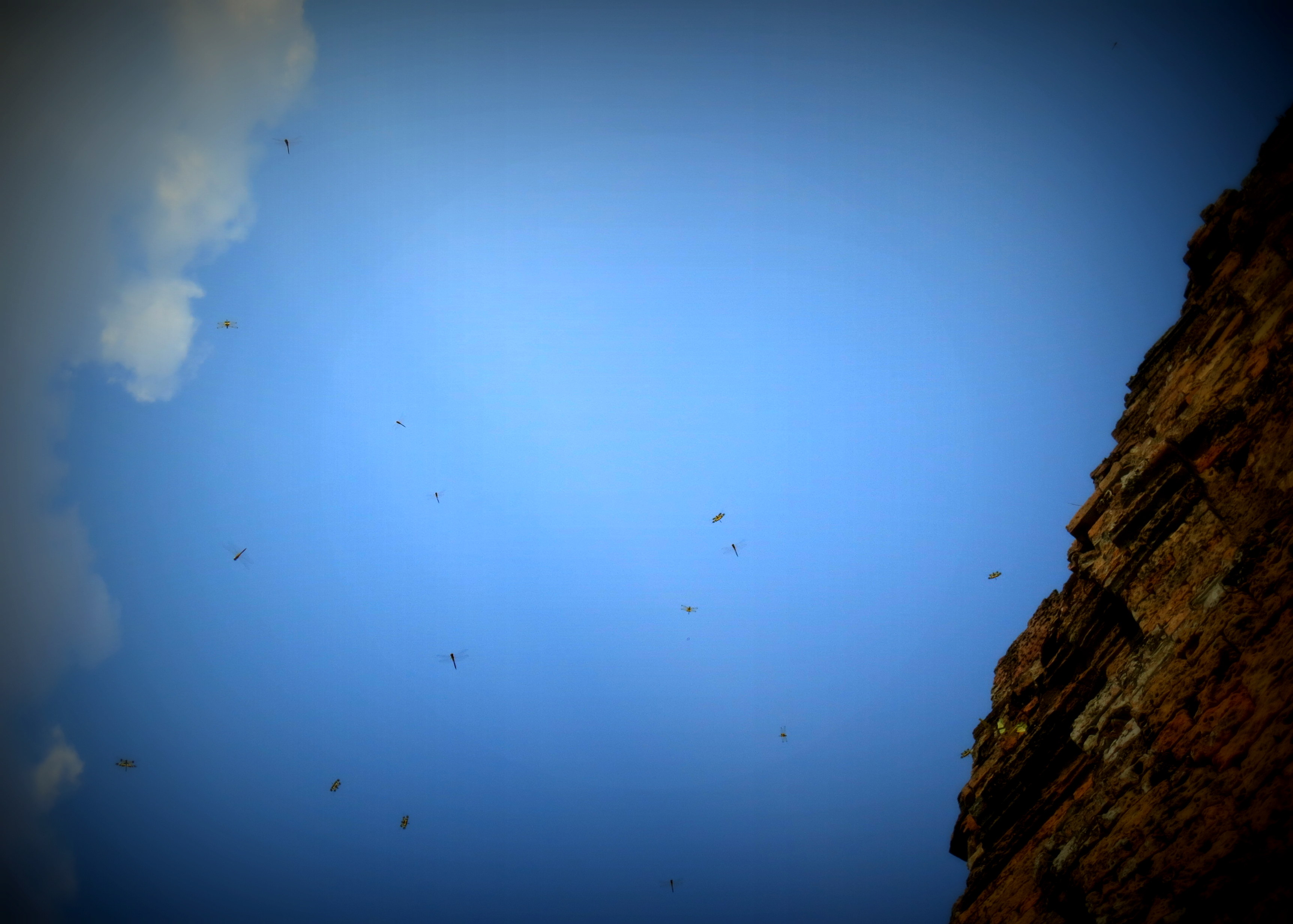
Dragonflies everywhere
Ta Som

Ta Som
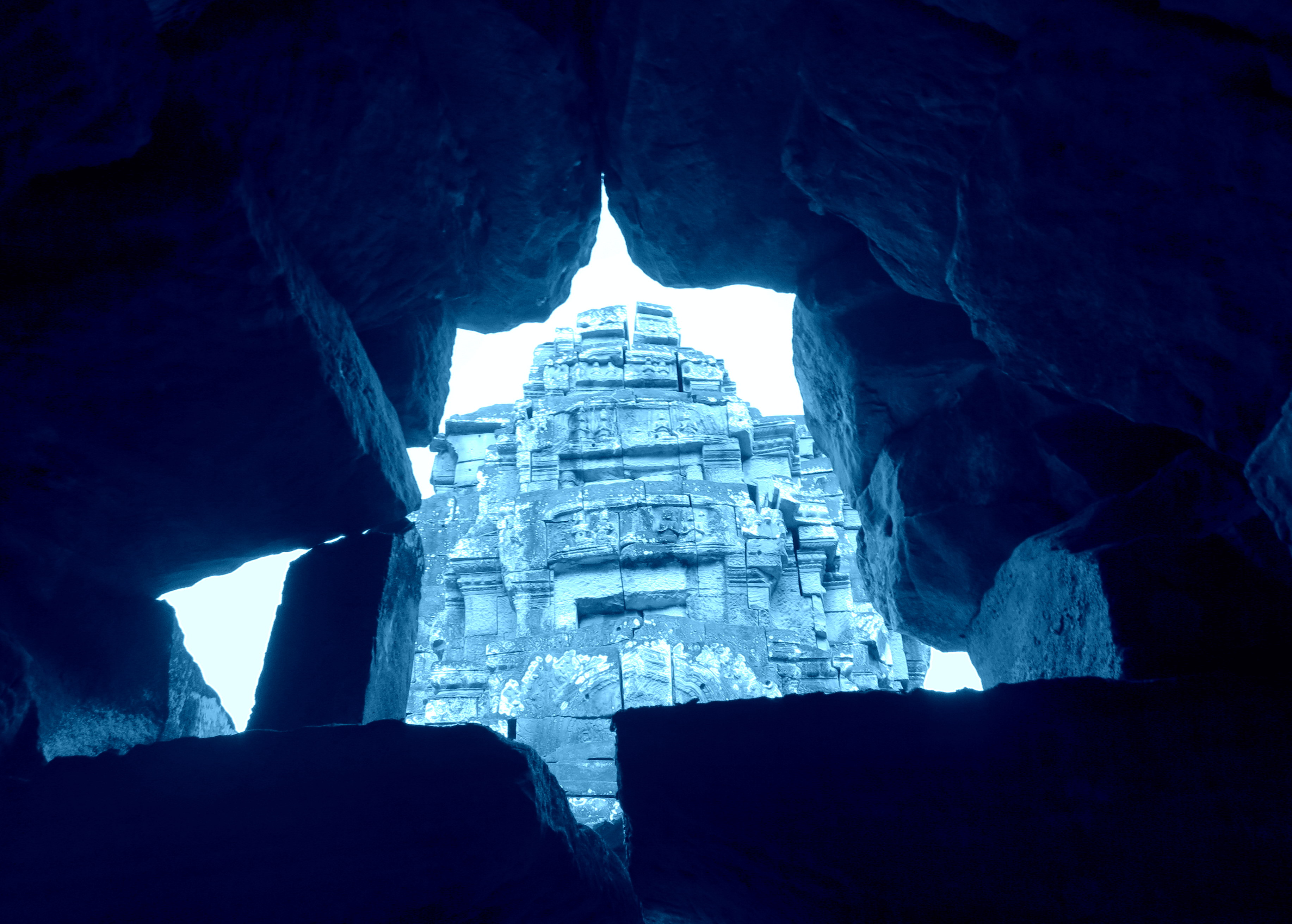
Neak Pean
A royal lake, and a long walk through some pretty marshy areas to get to it. Tiny temples at the lake.

The long path to Neak Pean
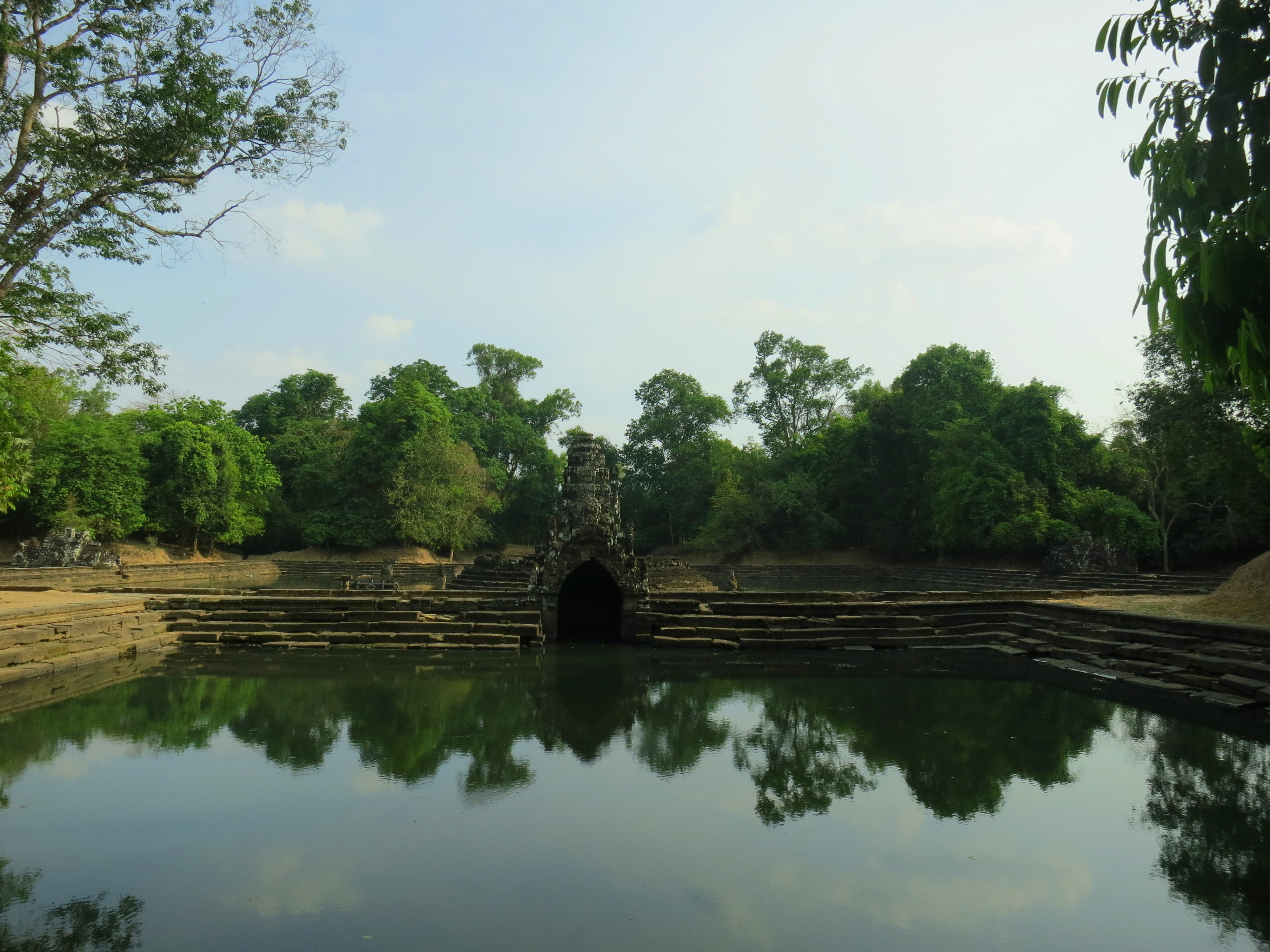
Love the symmetry of these lakes
Preah Khan
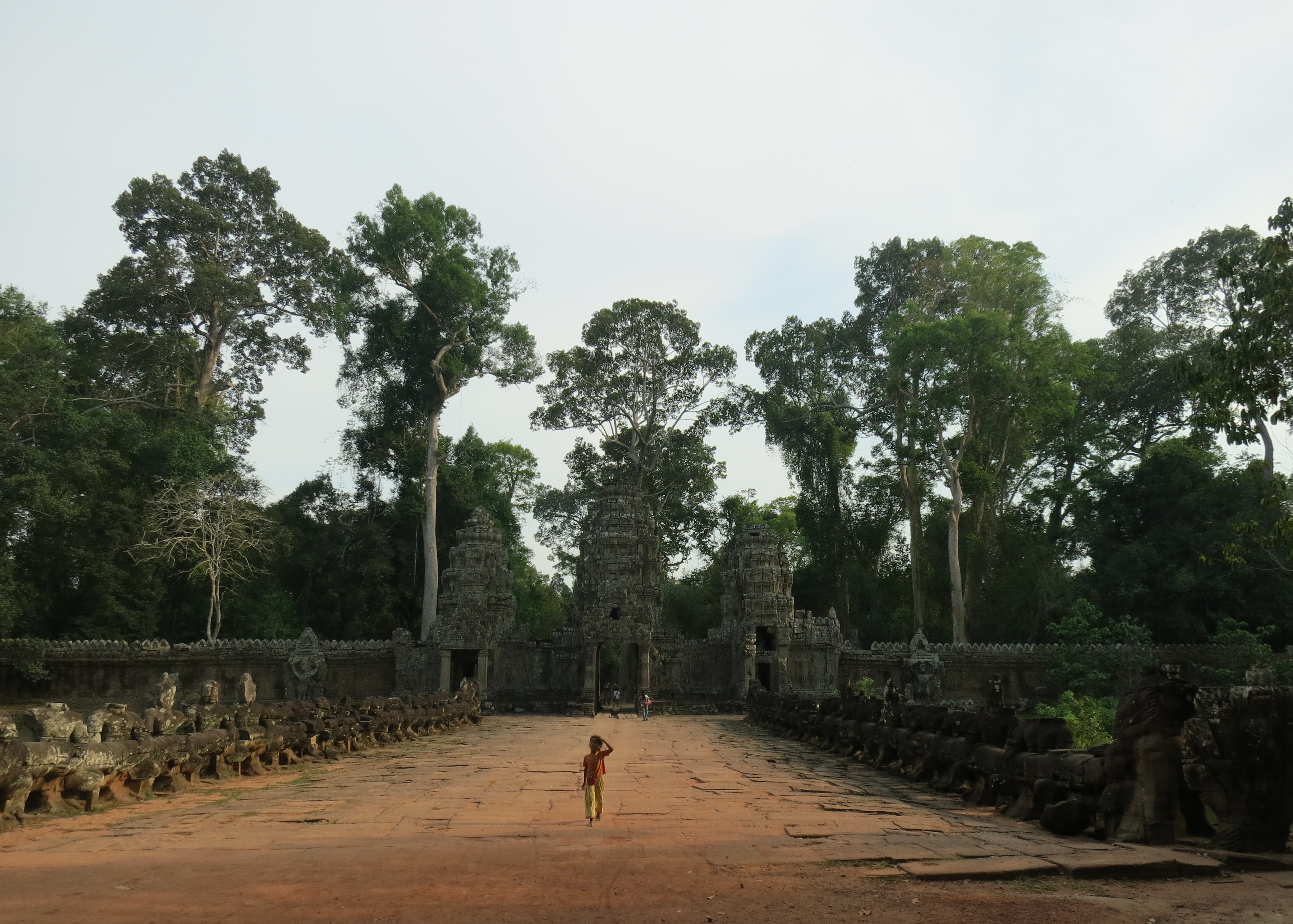
Preah Khan


The hall of dancers at Preah Khan

The library at Preah Khan


Looks like it’s Angkor Week here at Stowaway! The temples were so amazing that I took at least 1,000 photos, so I suppose it’s not too surprising that I’m using four days to show them off. Enjoy!

Ta Keo
The most interesting part of Ta Keo was the fact that it was undergoing renovations when I was there, so all the workings of the structure were laid out, labeled, and slowly put back together. Different nations sponsor renovations on different parts of the park at Angkor; Japan, the US, Australia, and India are among the countries that have contributed to restoring the temples to some of their former glory. Part of Ta Keo was covered in scaffolding, and the peace of the morning was broken by the sound of a large crane moving stones into place, a modern update to the never completed temple of the 11th century.

Every stone is labeled for the giant jigsaw that is renovation

When the glass breaks, they know the stones have shifted, and they can adjust their renovations accordingly

The stairs, which I actually climbed more like a ladder because they were so steep
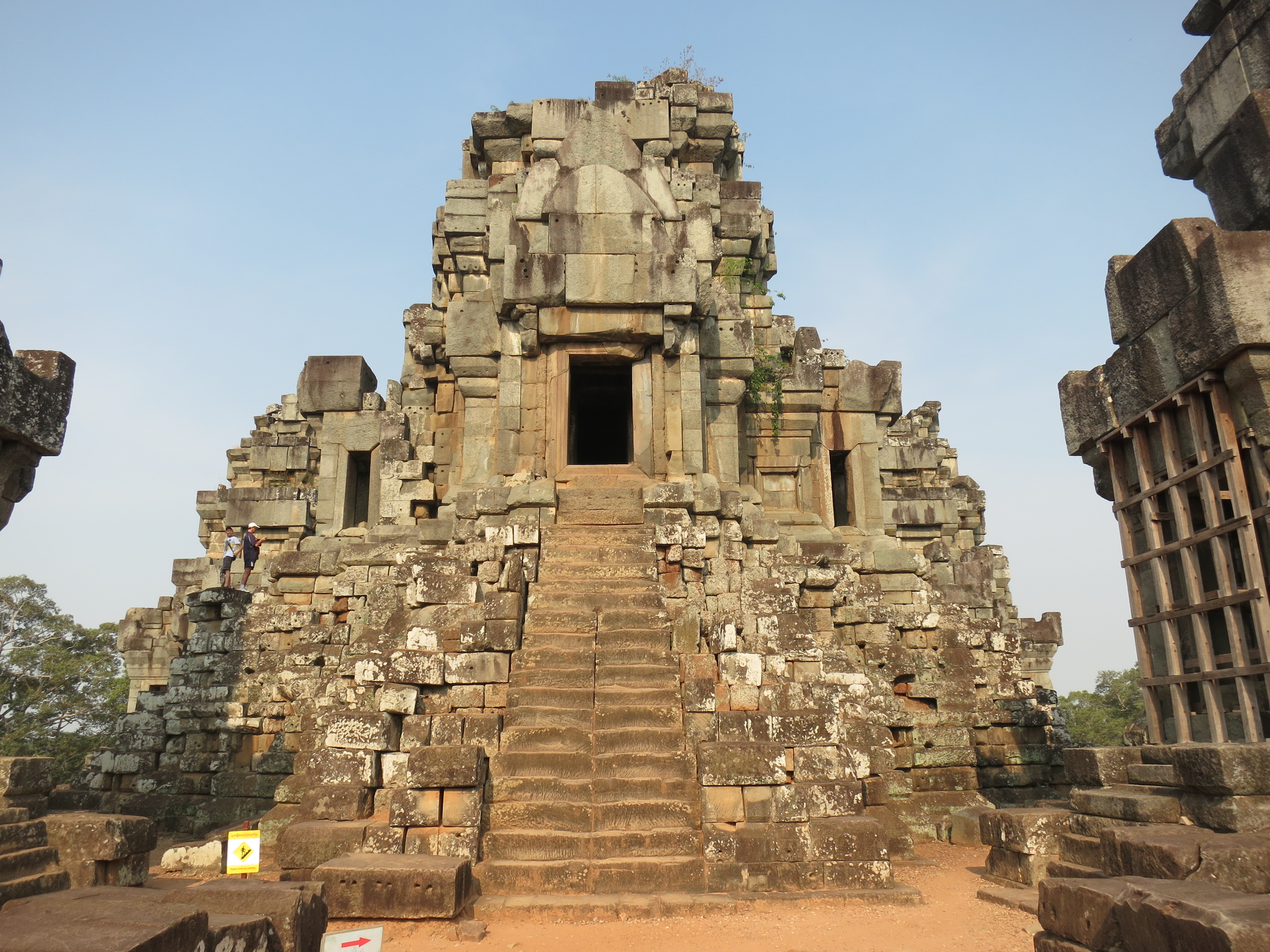
A little higgledy-piggledy
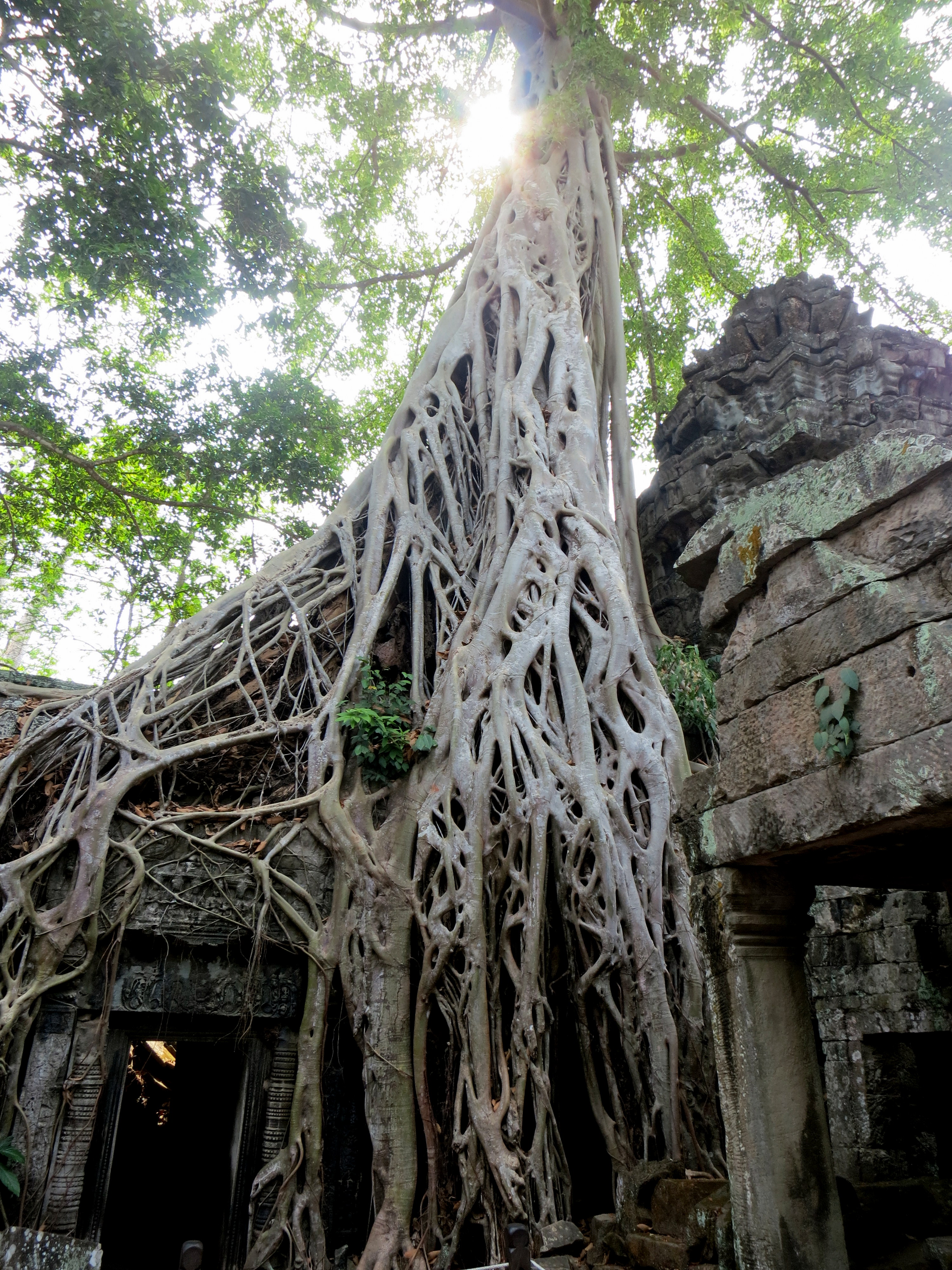
Ta Prohm brings to mind Indiana Jones movies, but it’s actually the site of filming for several scenes from Lara Croft: Tomb Raider, so all the touts and drivers I encountered called it the Tomb Raider temple. The French Ecole Francaise d’Extreme-Orient, which decided what to do with the Angkor temples when France had control of Cambodia, decided to leave Ta Prohm as it was, to show how most of Angkor looked when Westerners stumbled upon it in the 19th century. So the jungle has crept over the bridge and wriggled through the walls, and the result is a beautiful blend of nature and architecture.
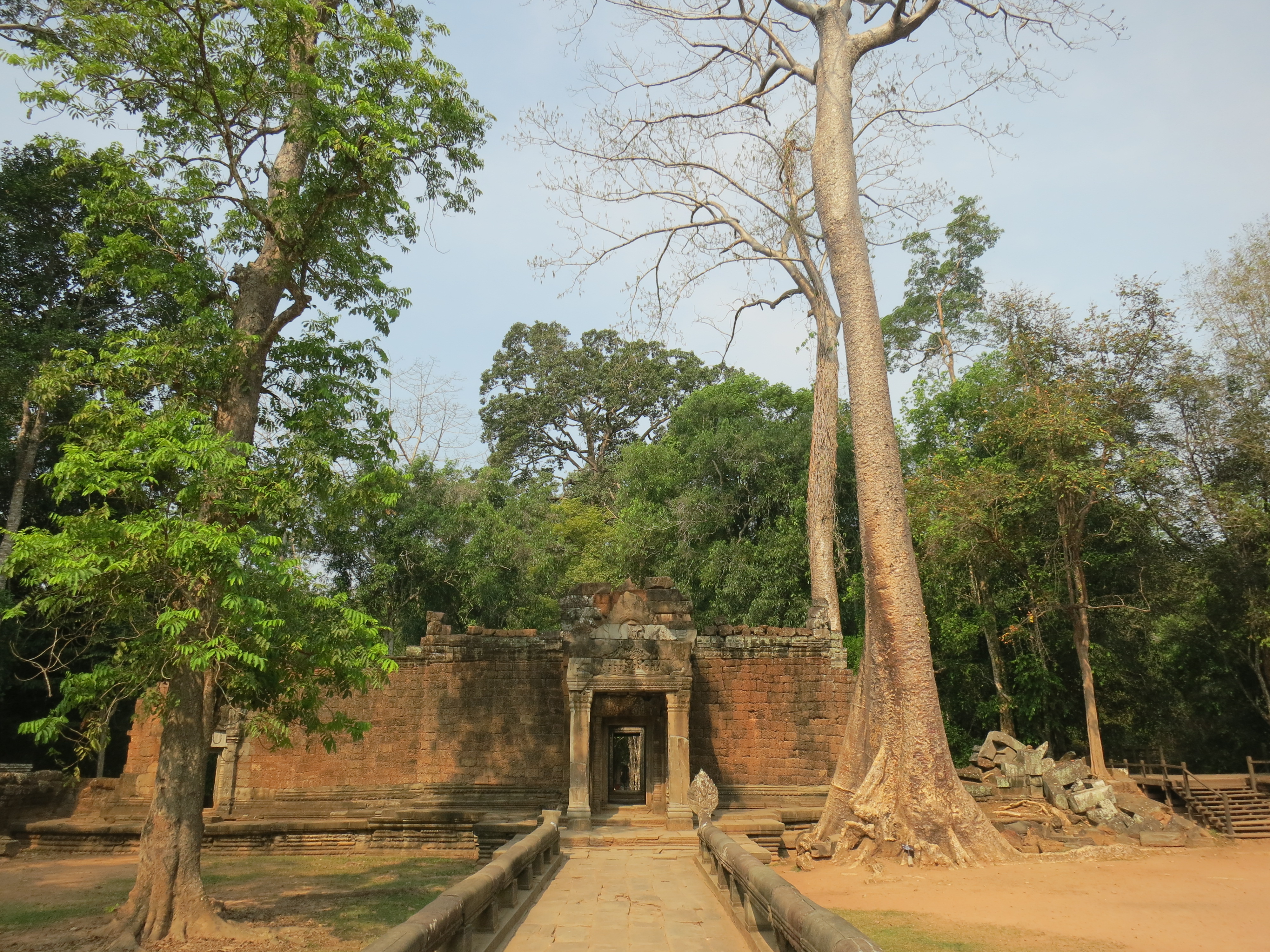
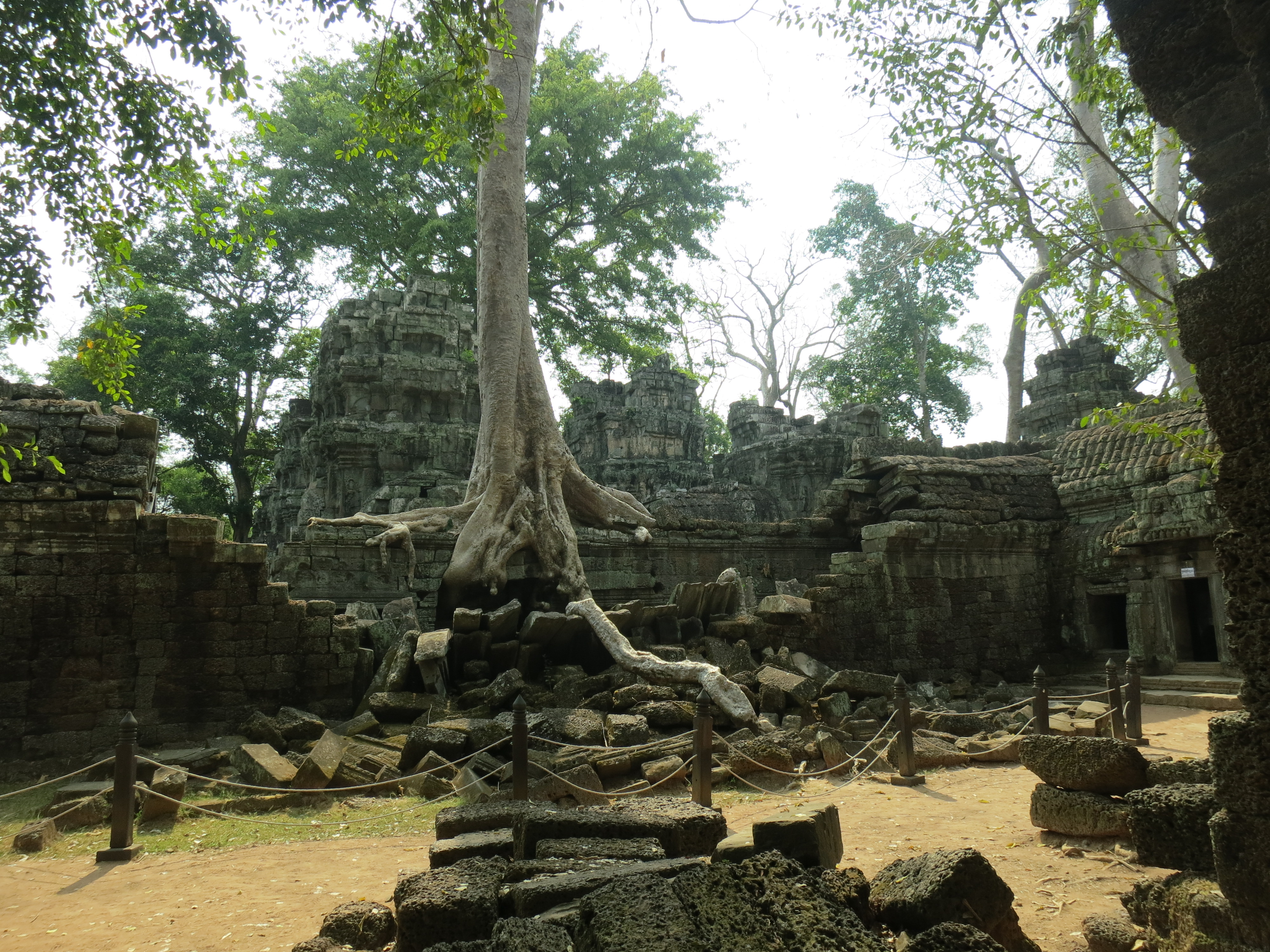
Ta Prohm


They do a lot of work to make sure that the places open to visitors are structurally sound, while leaving the “classical ruins” look in place

A sense of scale


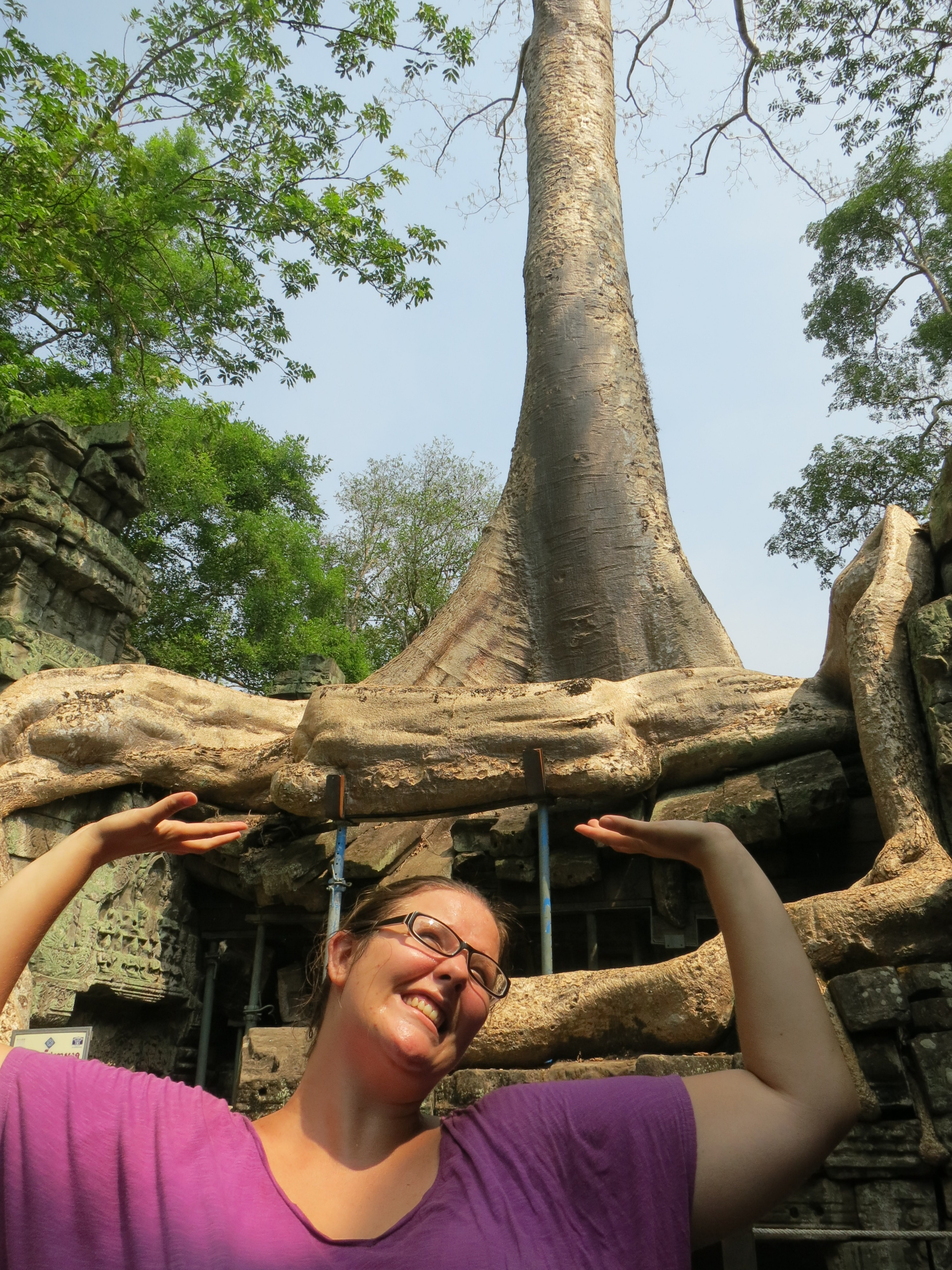
Superwoman
If I visit Angkor again, I’ll go to Sra Srang during sunrise; going during the middle of the day revealed that it was a large man-made lake (or baray, to use the term from my guidebook) that may or may not have once had a temple in the middle of it, but currently has nothing else. It was apparently a bathing pool for just about anyone to use (despite its current name meaning “royal baths”), which is a nice touch for an ancient kingdom.

Sra Srang
On my last day in the park, I walked up the hill to Phnom Bakheng to see the sunset from there. As I mentioned in a post last week, I almost didn’t get to go in at all. I’m still annoyed that there are no signs or warnings at the base of the hill, and that you walk all the way to the top, and then stand in line, before someone says, “You can’t go in because you’re not dressed right.” Apparently, the scarf around my shoulders wasn’t enough. I wasn’t about to give up, so I looked around for someone who, in this heat, was wearing a shoulder-covering shirt and a shirt over that. I found someone! I turned to a woman waiting with her tour group, and asked if I could borrow the thin raincoat she was wearing. We had to overcome some language barriers for her to realize I wanted to borrow, not steal, her coat, and then she smiled and handed it over. The Clothing Police waved me in, and I ascended the stairs of the temple.

The path to the top of the hill
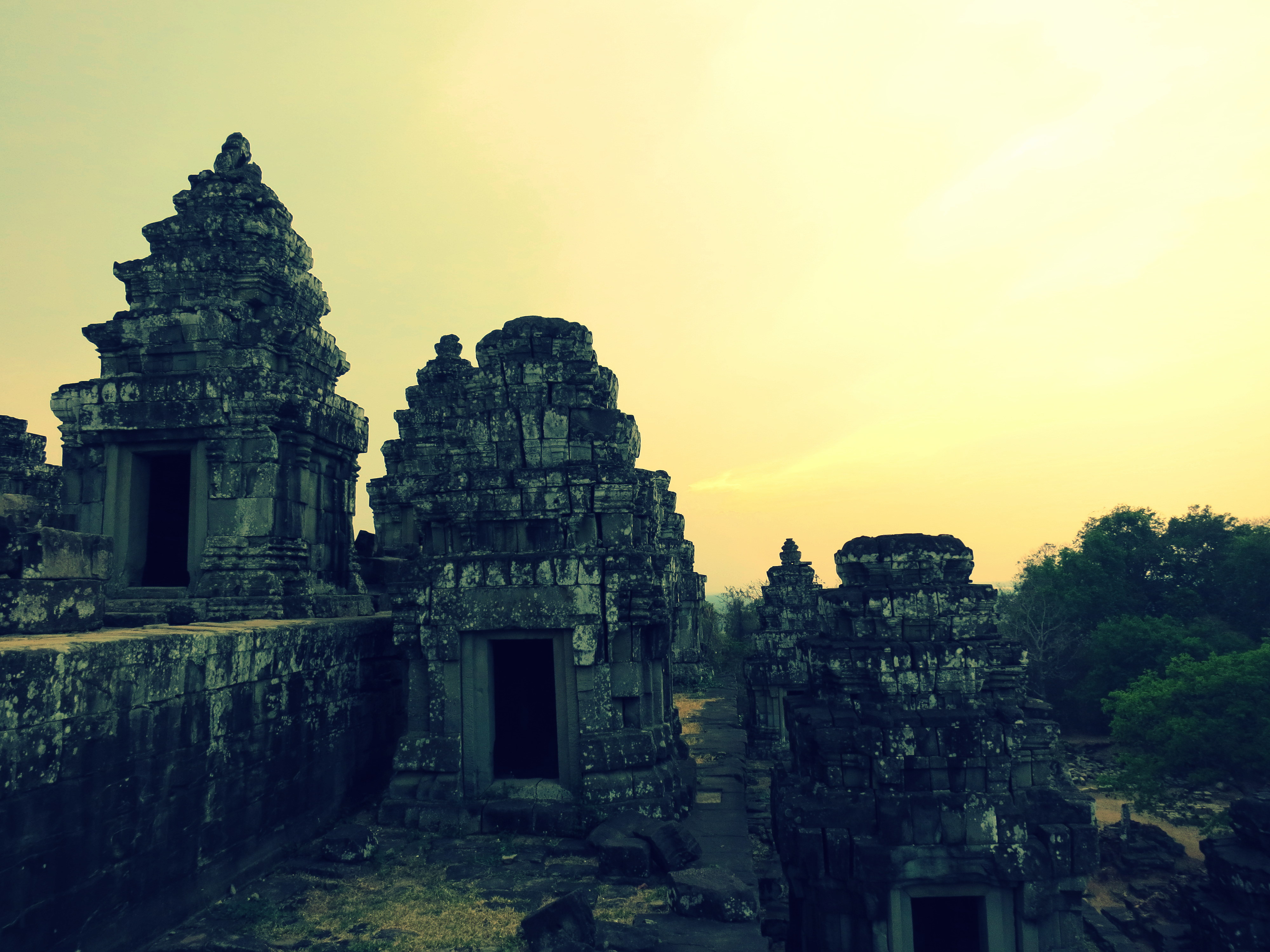
The view was lovely–forests and barays and temples as far as the eye could see, in all directions. The sunset wasn’t very dramatic, as there was too much haze, but it was cool to look down at Angkor Wat from this height. I also liked the walk up and down the hill, when I got a glimpse of the small Baksei Chamkrong in the distance.

Baksei Chamkrong
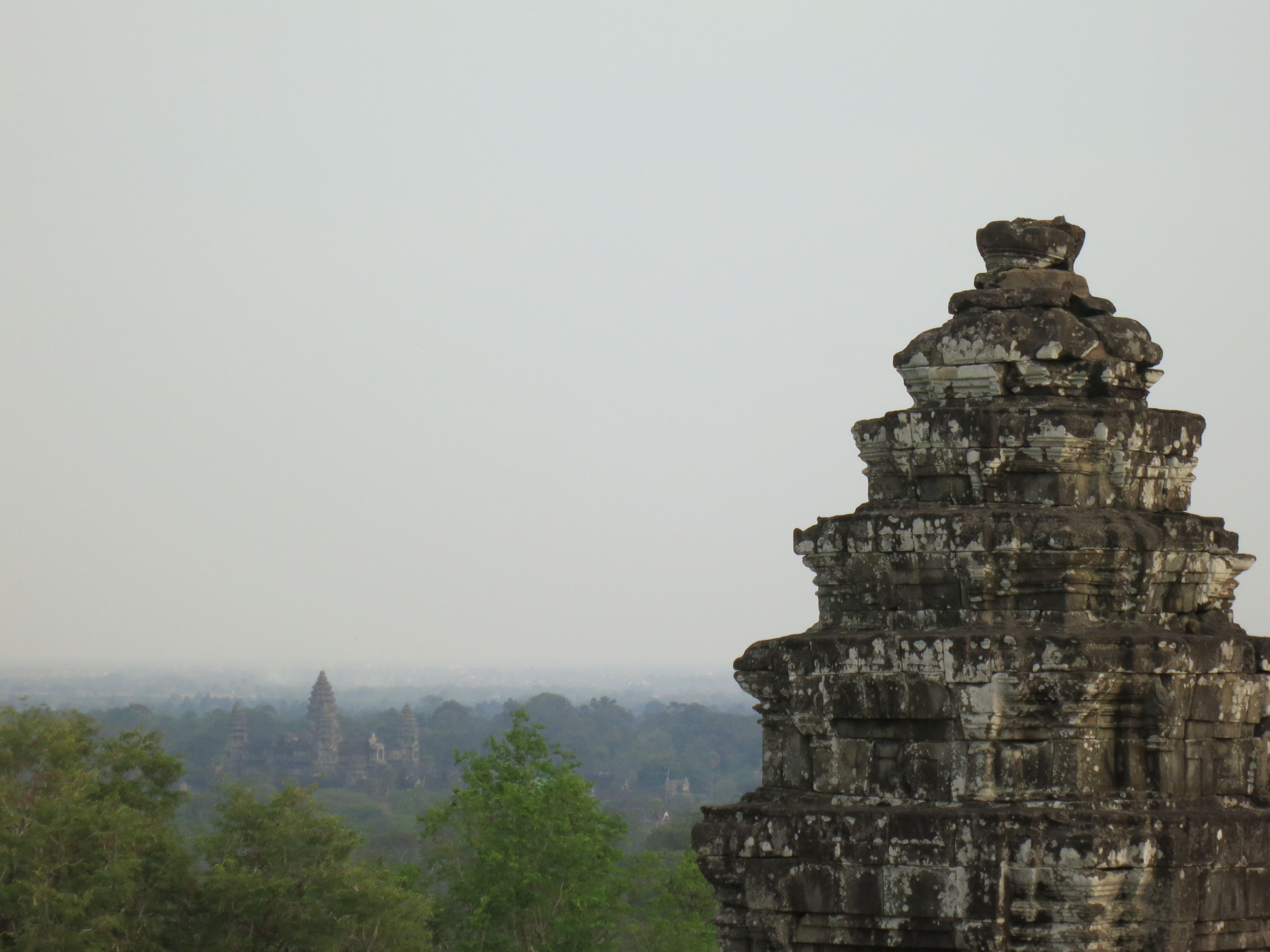
From Phnom Bakheng

View of Angkor Wat from Phnom Bakheng
I went to Angkor, World Heritage site and location of dozens of ancient temples renowned for their architecture, carvings, and historical importance, in March of this year. I read up a little on what to expect before I went, but was still tripped up by a few things I discovered on the ground. Here’s my advice for how to visit the temples with minimum fuss and maximum enjoyment. Share your own tips in the comments!

Angkor Wat at sunrise
DO:
Buy the 7-day pass for $60, if you have a flexible schedule and at least four days in the area. I bought the 3-day pass for $40, intending to use every day in full, but then I stepped outside and almost fainted from the humid heat (we’re talking over 100 degrees Fahrenheit every day). If I’d had the 7-day pass I could have done half-days in the mornings and escaped to air conditioning in the afternoons, but as it was I had to push on through the heat. I still didn’t fit in everything I wanted to see, so I had to buy a 1-day pass for $20 for my last trip out there. If I’d spent that $60 upfront, I’d have had more time in the park for the same amount of money.

Bring at least a liter of water to drink and plan to buy at least another liter while at the park. It is 40*C/104*F on a regular basis here.
Bring a bandana or handkerchief. You’ll use it as a sweat rag during the amazingly humid days, and also as a face mask during your tuk-tuk rides on the often dusty roads.
Bring snacks, and a full lunch if you can swing it. Unlike in town, no one’s pulling a food cart all over the parks, and there are just a few places where restaurants are set up. I got hungry climbing up and down the many stairs of the temples, and was glad of the fruit and granola I had in my bag. Of course, your driver will know of the perfect little place to take you when it’s lunchtime, and they all seemed more or less the same to me, so why not say yes and let him have his commission?
Plot your trip ahead of time. If you’re just going for a day and you want to catch sunrise and sunset at Angkor Wat and maybe see the Tomb Raider temple, then you’re fine and your tuk-tuk driver will have no trouble getting you to each place with plenty of time. However, if you have more time and want to explore the temples in more depth, work out with your driver ahead of time exactly where you want to go and in what order, and generally at about what time. My driver thought I would take less time than I did at each temple I went to, so he was surprised I couldn’t do his normal itinerary in one day, but I know I take a long time seeing sights, so I wasn’t surprised. I should have communicated better with my driver about timing, though, so that we both knew what to expect.
Bring a proper cardigan or long-sleeved shirt when going to Angkor Wat and Phnom Bakheng. I had a scarf to cover my shoulders as a sign of respect, which was fine at other temples, but at Angkor Wat and Bakheng I was turned away. I was told I needed to have a proper shirt–because a scarf is too easy to take off? I’m not sure what the reasoning was, but the guards were absolutely strict on this, despite there being no warnings about such rules at the ticket office or anywhere else, and as a result I never got to climb to the very top of Angkor Wat (yep, I planned to do it on my last day there, oops).
Plan more than one sunrise at Angkor Wat, if your schedule and sleepyhead ways can swing it. I only made it to one, and it was gorgeous, but I was torn between staying by the pond with the hundreds of other visitors to see the full sunrise, and scooting into the temple after a few minutes to explore while it was mostly still empty. I ended up doing the latter, and I do not regret that at all, but it would have been nice to have gone another time and just relaxed for sunrise.

DON’T:
Lose your pass. That ticket just cost you at least $20, and they won’t replace it. At nearly every temple I entered, I needed to show my pass before I could climb the steps of the actual temple, so don’t think you only need it at the entrance, either. They take your photo and put it on the pass when you buy the ticket, so there’s no mistaking whose ticket is whose.
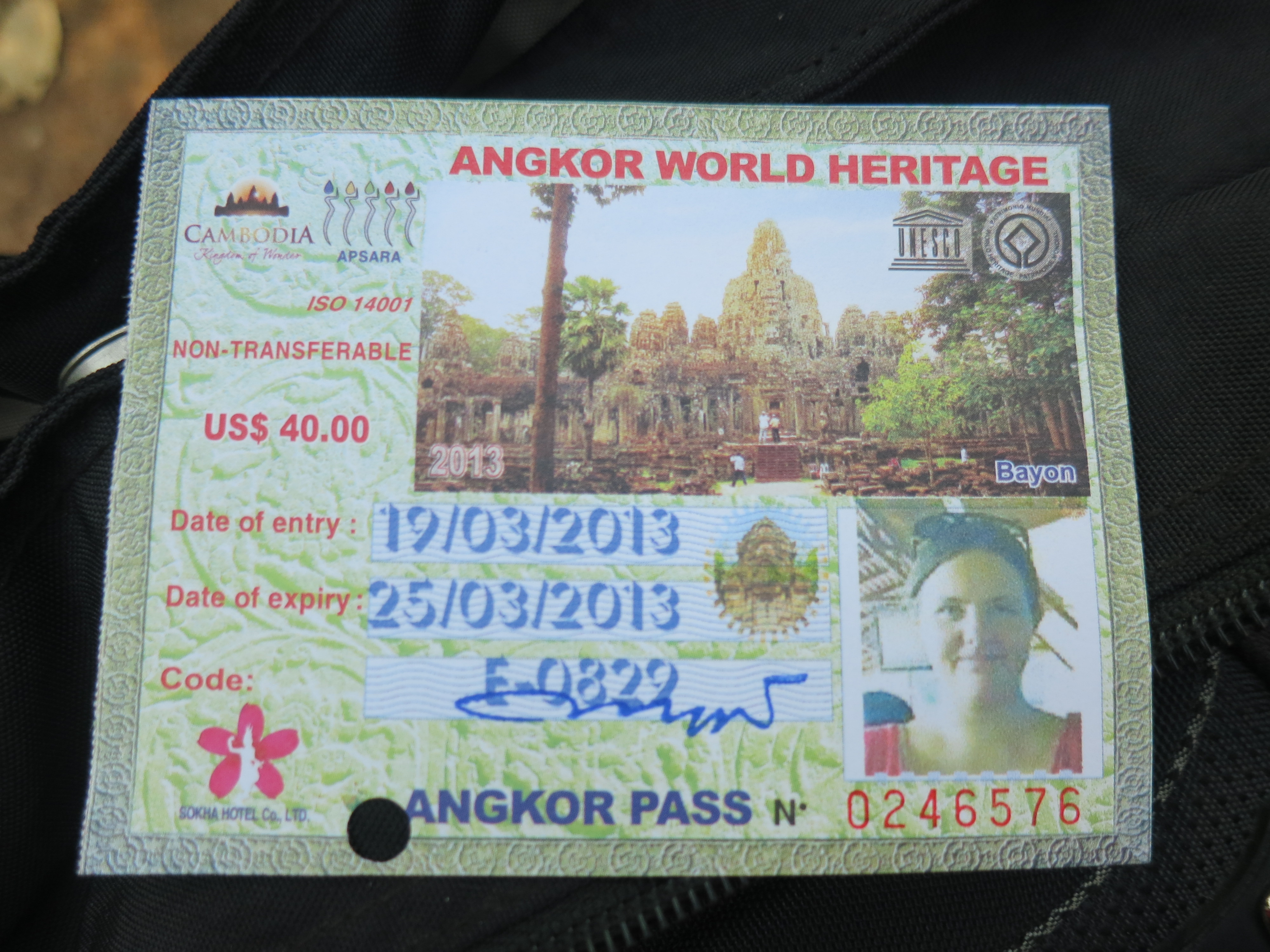
Pay attention to guidebooks that say you need a special ticket to get non-consecutive passes. That may have been true in past years, but not anymore. If you buy a 3-day pass, you can use it on any three days in a week, and you can use a 7-day pass any seven days in a month.
Forget to bring or buy a guidebook. There are no helpful placards here, no clear markers next to exhibits of note. You can hire a guide for the day, and I overheard some great guides sharing in-depth information, but I also heard some impenetrable accents and bare-bones introductions to the sites, so the quality of the guides varies and it can get pricey to hire one if you’re on your own. I bought Ancient Angkor by Michael Freeman and Claude Jacques, and it proved pretty useful. There’s a lot of history up front and then the sections on specific temples focus more on the architecture. It was last updated in 2003 and there have been improvements to the park since then, so some of the info on what is accessible is outdated. I got the book for $8 at a bookstore in town, and then six different touts tried to sell me the same one for $1 at the park itself. You can go that route, but realize it’s probably an illegal copy so the publisher isn’t getting paid, and of course the tout sees maybe a few pennies of that money.
Stress about getting from Siem Reap to the park. Your guesthouse/hostel/hotel will have tuk-tuk drivers they can call, guaranteed. The only thing you’ll need to do is negotiate price, which you can prepare for by looking online to see what other people have paid in the past. If you’re fancy, you can take an air-conditioned car, but tuk-tuks are much more affordable and perfectly comfortable (see above about a face mask, though). Hopping on the back of a motorcycle is even cheaper, but if you’re fat they might not let you, even if you’ve done this before and you know it’ll be fine. You can also bicycle there, if bicycling in 90% humidity at 100 degree temperatures appeals to you. Pretty decent roads, not sure where you’d lock it up, scary drivers to share the road with, but you do get to set your own pace and schedule.
Try to go against the grain on the prescribed routes in the temples. There are no markers telling you what you’re looking at, as I mentioned, but there are plenty of signs telling you which way to walk once you’re in the temple. These are set up to manage the flow of the crowds, and are really helpful. You can always dart off to the side and come back or take a seat if you need a breather, but try not to turn around and head the opposite way everyone else is going. You’re gumming up the works. Of course, some temples don’t have a prescribed path, so you can hop about all you like there.

UNESCO put Luang Prabang on its World Heritage Sites list because it’s a town with a well-preserved mix of Laotian and French colonial architecture. After the jumble of rowhouses and tiny shops of Chiang Mai, it is striking to see the long, broad buildings of Luang Prabang, painted a colonial yellow and set at a dignified distance from the brightly decorated Buddhist temples.

Colonial architecture

Colonial yellow
Dignified, stately, slow-moving: these are the words I kept coming up with as I wandered the streets of Luang Prabang. A little in keeping with that stately feeling (and certainly in keeping with its colonial history), there were a lot of fences and walls; more space is cordoned off in this small town than I saw walled away in all of Thailand.

Every evening, vendors set up outside those walls for the night market. In Thailand, the markets are set up on card tables, but in Laos, the goods are laid out on tarps and blankets on the ground. If you want to inspect the goods at a particular booth, you have to squat down, or use one of the tiny plastic stools the vendor whips out for you. I would gingerly lower myself onto these unstable pieces of plastic and smile genially as all the women selling quilts and table runners laughed. Just about every stall has a woman holding a baby, and some stalls are staffed by men or teenagers. I saw one little boy playing on an iPad while his parents sold handicrafts–it’s a shrinking world, indeed!
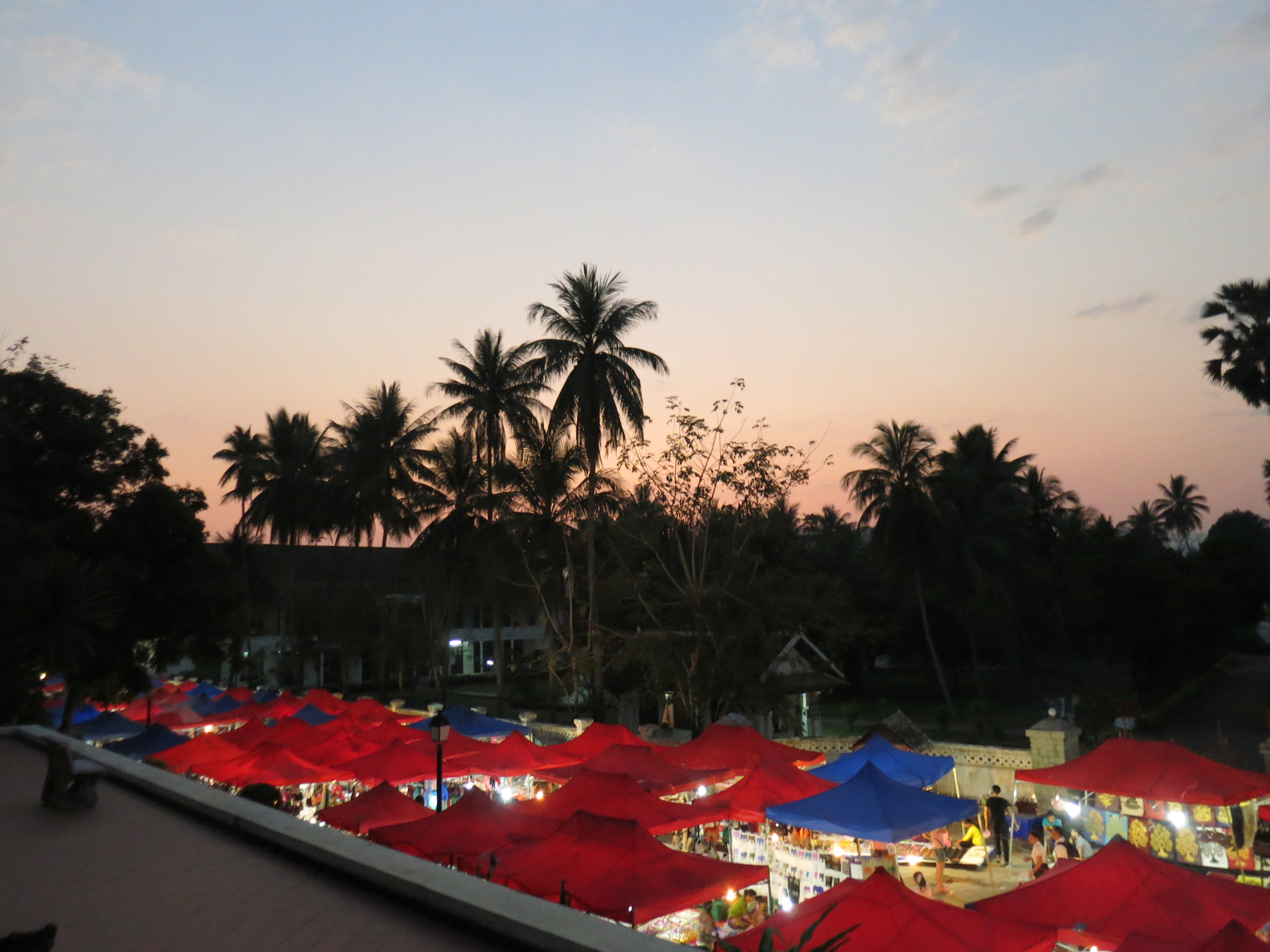
The tents of the night market

Bombs to bracelets
I picked out wedding presents and souvenirs from various stalls, but my favorite spot was the bombs-to-bracelets stall. The US waged a secret bombing campaign on Cambodia and Laos in the late ’60s and early ’70s, as part of its campaign against the Communist bogeyman. The villagers of Ban Napia in eastern Laos took the aluminum from the thousands of bombs dropped on their homes and, in their words, turned it from “something that kills into something that feeds,” producing spoons. They later added bracelets and charms to their collection, and the number of bombs dropped can be guessed at by the fact that they’re still making jewelry today, nearly 40 years after the bombs stopped falling. I chose to support the artisans, although there is some controversy in doing so, because villagers have to collect scrap metal to make them, and there are a lot of accidents and sometimes deaths with the UXOs (unexploded ordnances). As with so many potential purchases, it’s complicated.

Meat on a stick–a lot of it
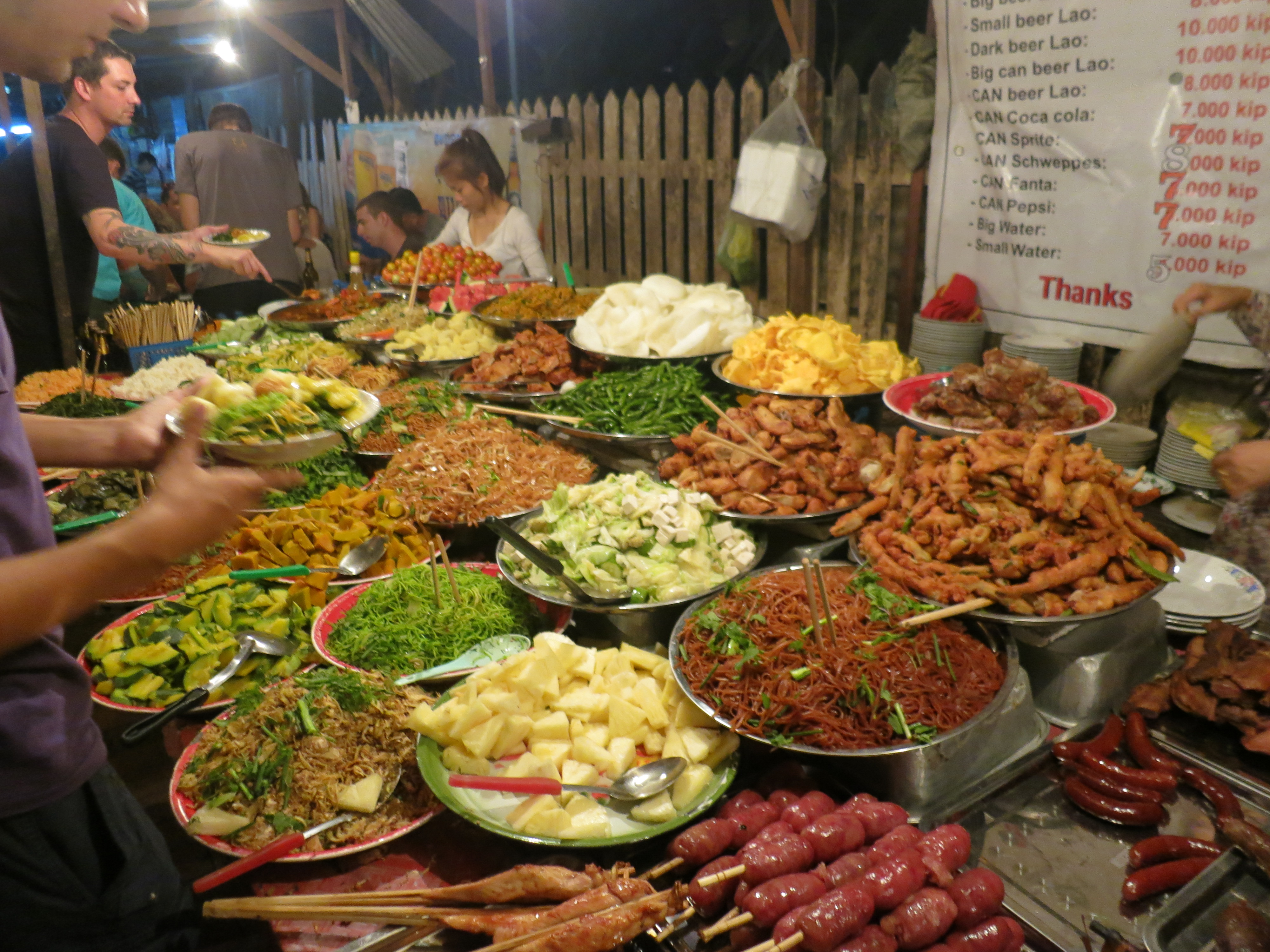
The much-lauded buffet (I never tried it)
Of course, there’s food. One woman sliced watermelon with a machete while another flipped sweet potatoes on a small woodfire grill. A narrow alley of food vendors included pork and fish on sticks, dumplings, grilled sticky rice, and two giant all-you-can-eat buffets. I had really good veggie and pork dumplings, and a non-spicy lemongrass sausage (a specialty of the area).
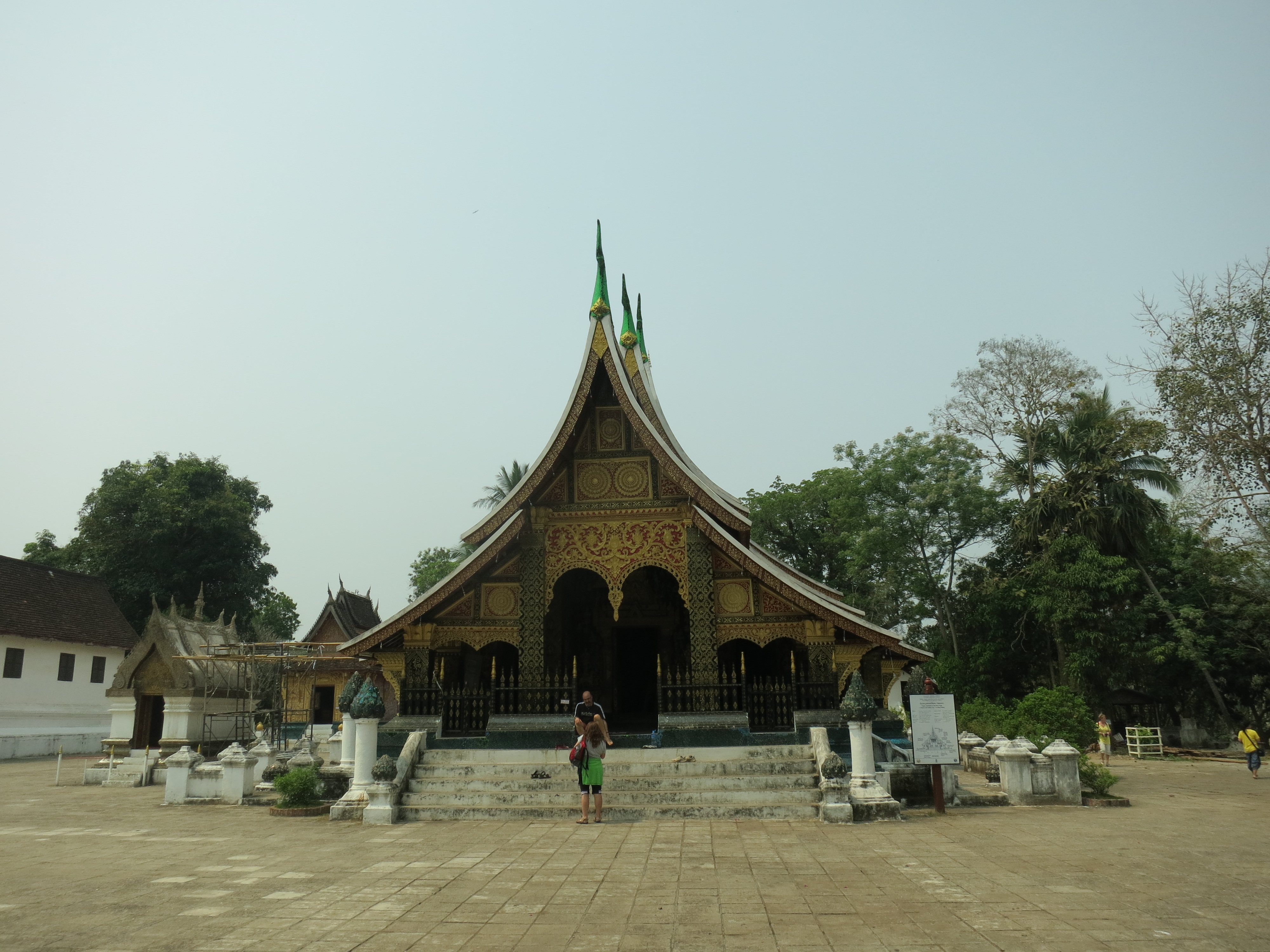
Wat Xieng Thong
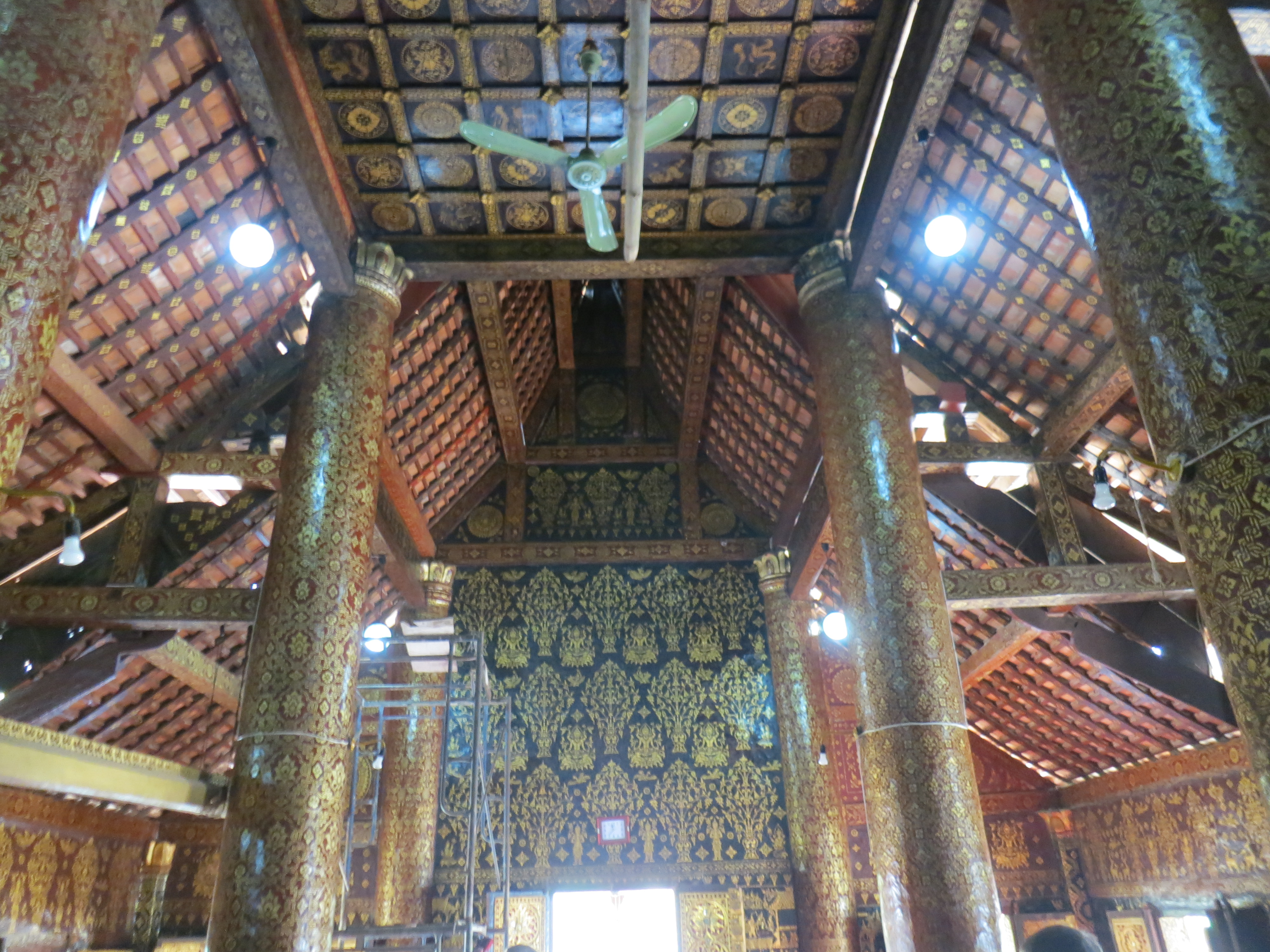
Gold painting everywhere
Luang Prabang has dozens of Buddhist temples, and a high concentration of monks and novices (those under age 25 are called novices). The temples, or wats, are painted in elaborate, intricate scenes, sometimes both inside and outside. The grounds are spare, with just a little greenery carefully confined to a few areas, and the rest tiled courtyards between buildings. Monks and novices move around on the edges, running errands, doing homework (many boys enter the monastery to get a good education), making adjustments in the temples.

Seriously impressive

Probably the most famous wat in Luang Prabang is Wat Xieng Thong, sometimes called The Temple of the Golden City. Since Luang Prabang is on the World Heritage list, there’s a lot of upkeep work going on at various temples, funded by various countries–and this temple is no exception. The US Embassy is supporting efforts to reinforce the structural elements of the temple, and scaffolding was set up around the buddha when I visited.

Unfinished renovations


The main building was painted a maroon color inside, and then gold leaf designs were painted on top of that, on every available surface–ceiling, columns, walls. Inside, a long wooden pipe sat along one wall, and at the end of it sat a small buddha in a glass box. During a water-based festival, water blessed by monks travels through the wooden pipe and washes the buddha. My favorite part of this temple was a separate building, which housed a giant dragon boat. The back wall was red, covered in intricate, colorful mosaic scenes and accented with sparkly glitter. There was no way to get a decent picture to show just how big and full of life it was, but I tried. Exteriors of some other buildings were dotted with similar mosaics.

View from Mount Phousi

Buddhas in various positions
Mount Phousi rises above the center of town, and a small temple sits atop it, with various buddha statues and shrines scattered below it, so each step of the climb to the top takes you past a holy site. At the top, if you can balance yourself between the edge and the dozens of fellow tourists, you can see a beautiful sunset over the Mekong. On the walk up, off to the side is the Imprint of the Buddha’s Foot; it’s a large, vaguely foot-shaped indentation in the rock that someone decided was a holy sign. (In that way, it reminds me of the Virgin Mary water spot under the bridge on Fullerton in Chicago.)

Indentation of the Buddha’s Foot
The foot is just past a pavilion with a view of the Nam Khan River to the east, and on this pavilion stood a young novice. His name was Tip, and he was doing homework. He clearly stations himself here most nights in hopes of practicing English, because he was eager to ask and answer questions with me. He was 17, he’d been a novice for many years, his wat was across the river, America sounded interesting… I didn’t have time to ask for a photo or chat with him further, because a couple teenage Laotian boys entered the pavilion, and Buddhist monks aren’t supposed to be alone with women. I didn’t want him getting in trouble, so I said goodbye and he said, “I hope you have many happinesses in your travels in Laos.”

I’ve reconnected with old friends and met a lot of wonderful people on this trip, and it’s all been great. But there’s nothing like seeing a familiar face, and that’s what had me most excited about going to Chiang Mai. I met up with my Chicago friend Hannah and we spent just under a week exploring the northern Thai city together. We’d never traveled together before, and I was a little worried, because Hannah’s laid back, and I’m… less so. But that turned out to be a great combination, and we focused on finding tasty food and seeing one or two interesting sights each day.
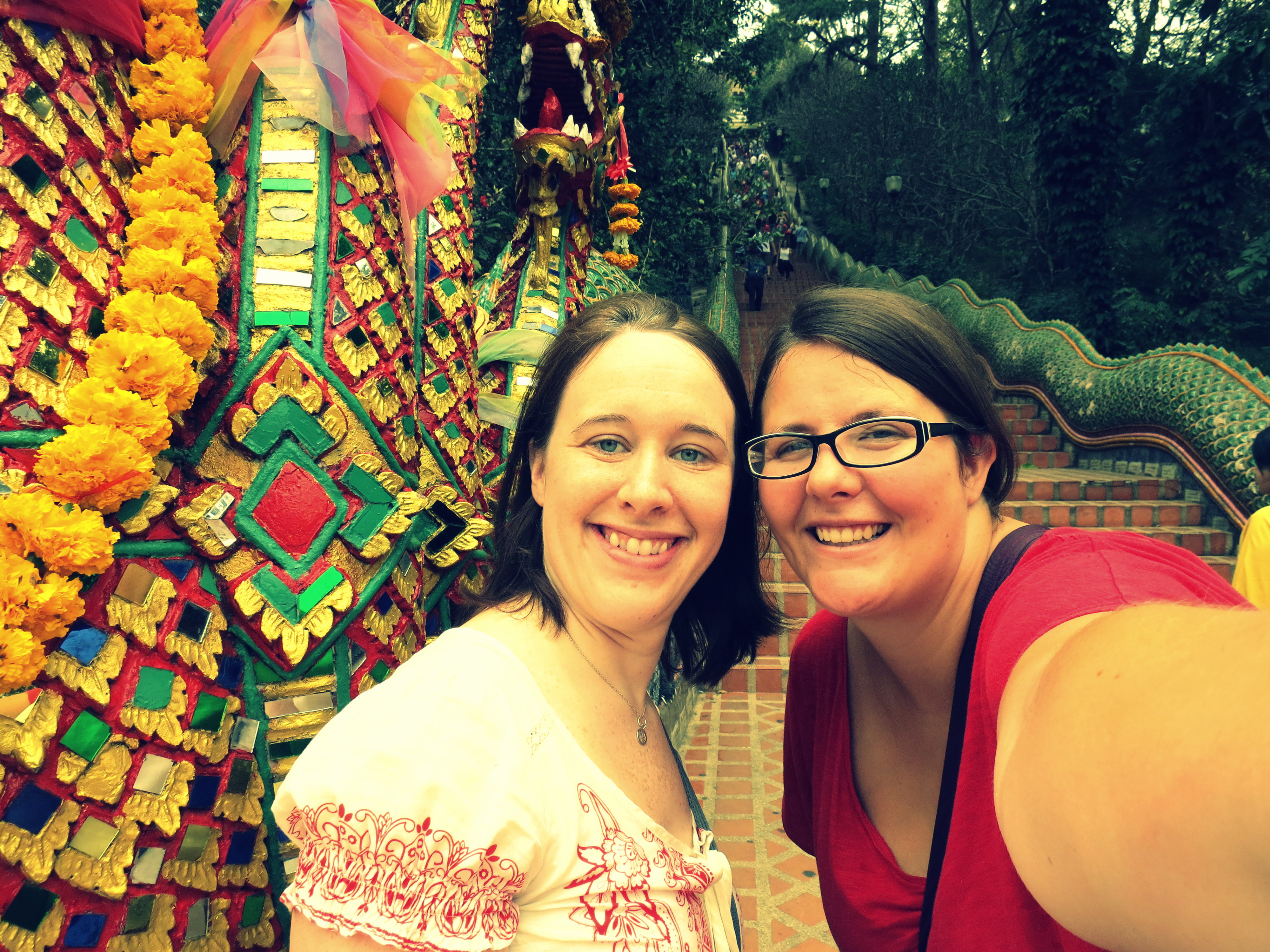
Hannah and me at the bottom of the stairs to Doi Suthep
We stayed in Eurana Hotel, a step up from the guesthouses and hostels I’d used so far. It had a pool and was next door to Sumphet Market, in the tourist-flooded northeast corner of the old city. We mostly stuck to this part of town, and if we’d had more than five days I’m sure we would’ve explored more, but there was plenty to see just in that area. Our first two days we lazed in the pool area, poked around in Sumphet, and bought tons of souvenirs at the Saturday and Sunday night markets.
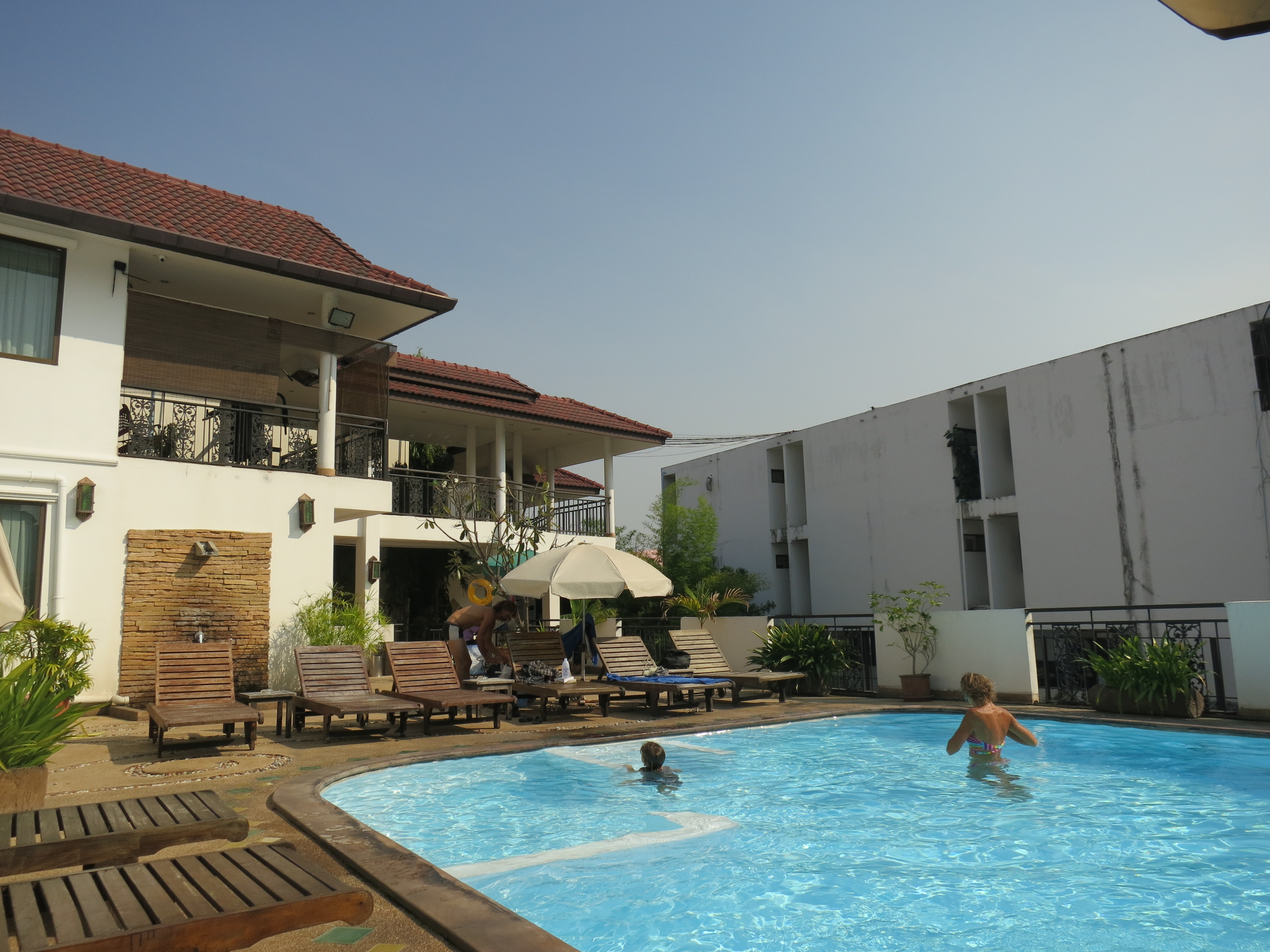
Poolside
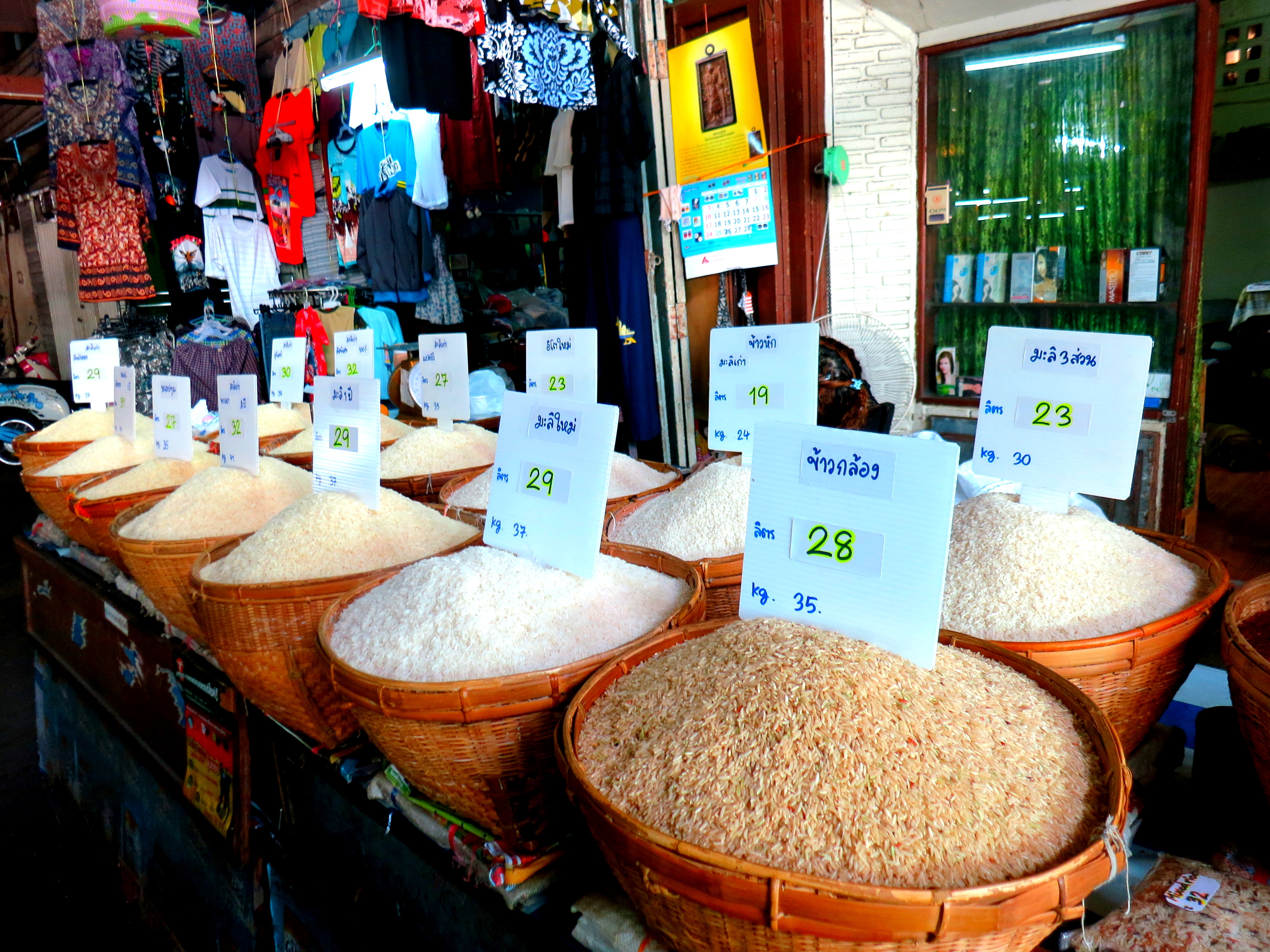
Our chef at the cooking school talked about the different kinds of rice used in Thai cooking.

Sumphet Market, Chiang Mai, Thailand
Around 3pm the streets are cordoned off and vendors set up card tables, some with awnings and backdrops, and displayed their wares: coin purses, t-shirts, jade statues, lamps, bedding, hippie pants, chopsticks, wood carvings, scarves, paintings, silver jewelry, pillow cases, and on and on. The food stalls usually clustered in their own areas. We ate a lot of delicious things (wonderfully described in Hannah’s guest post).
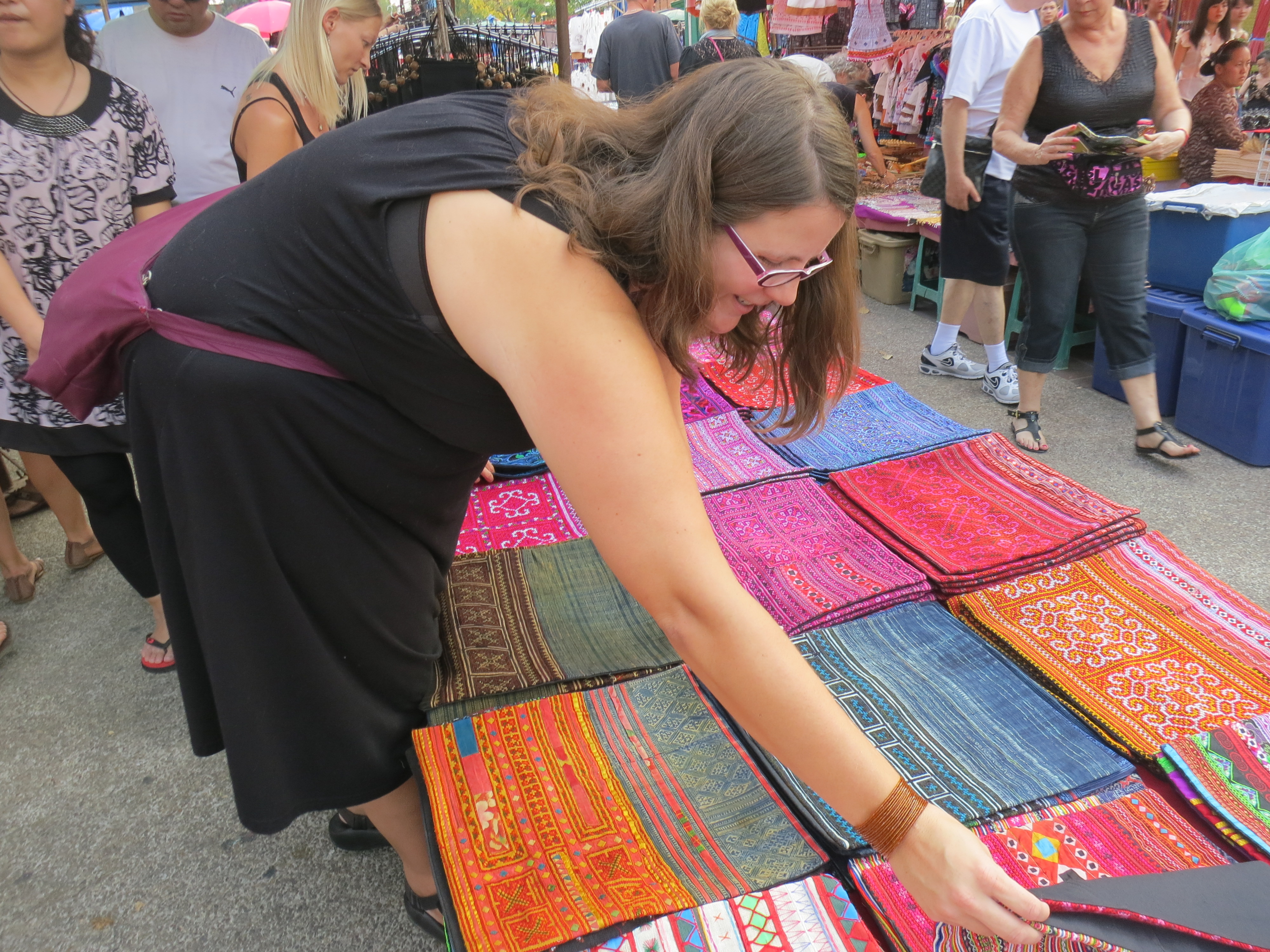
I can get into shopping if I’m buying gifts–or books & music, of course
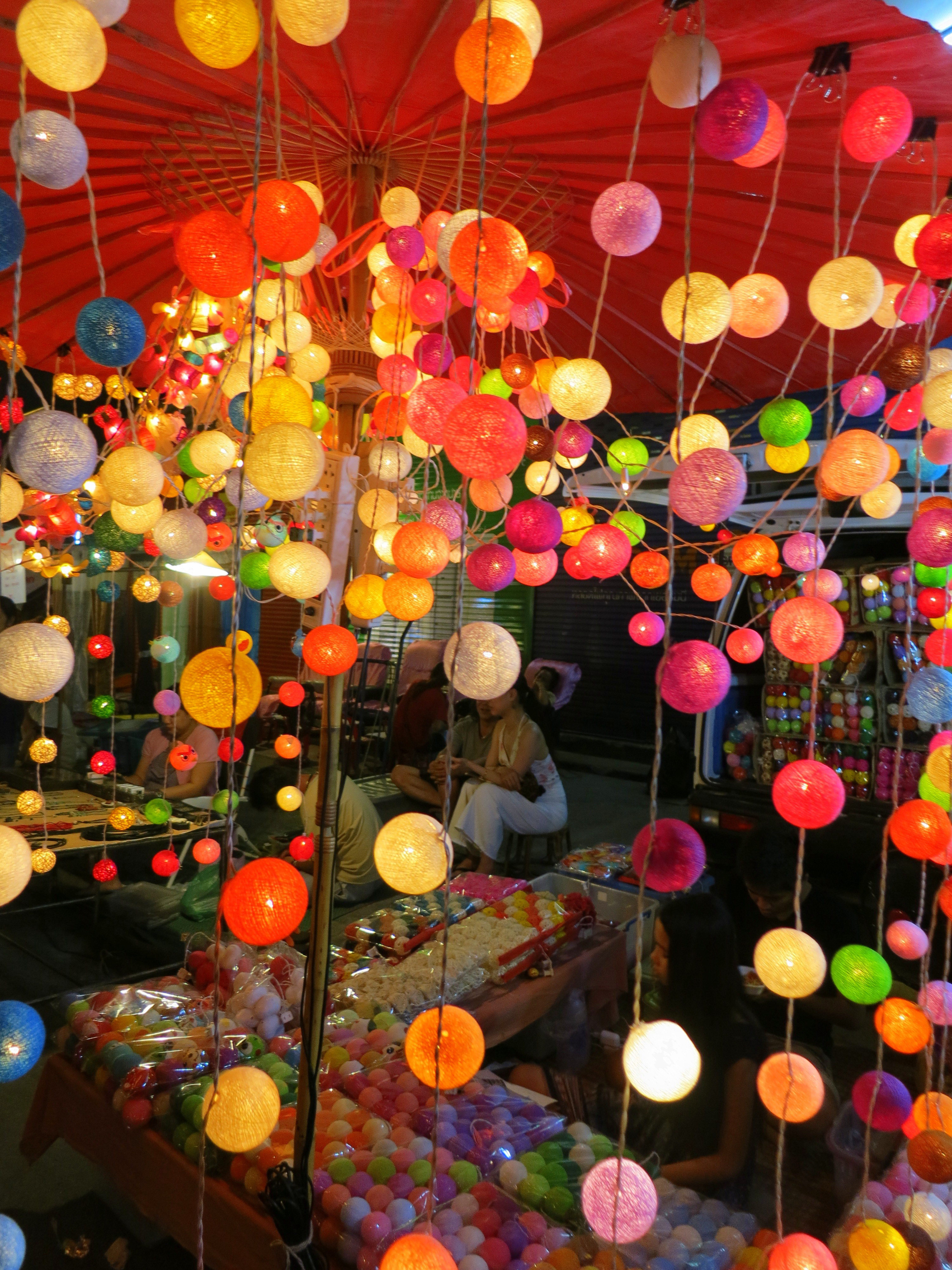
At the market
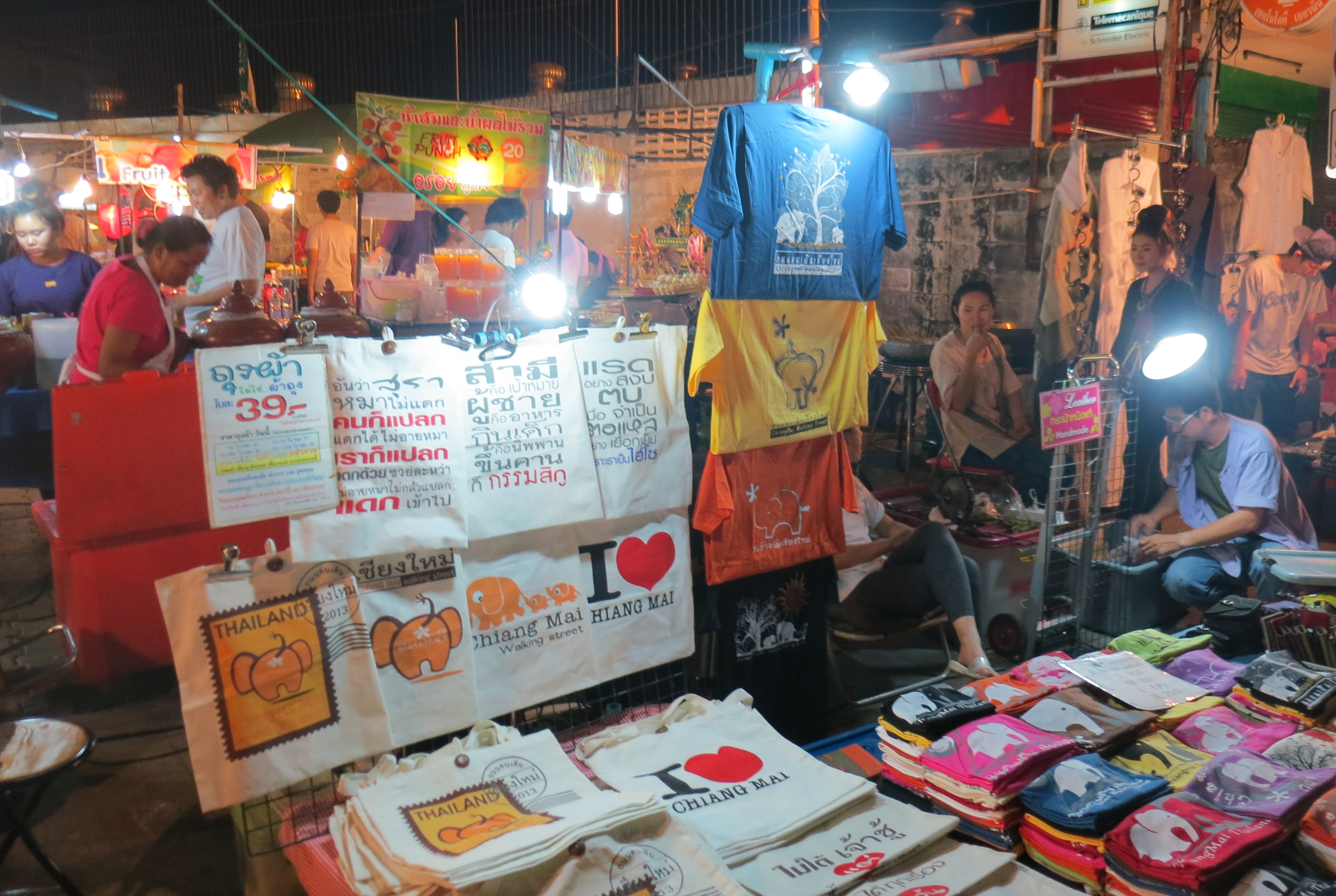
The Sunday market was located on Rajdamnoen Road, starting at the eastern gate (Tha Pae Gate) and carrying on down the road for what seems like miles when you’re shouldering your way through the massive crowds. Several temples line this street, and the food stalls set up on the temple grounds, so you can munch on your mango and sticky rice next to the crenellated head of a dragon, which we found really cool. We watched a man make sugar cane juice–he took giant stalks of sugar cane, peeled off fibers, fed them into a clattering pressing machine, and caught the juice that was squeezed out.

Doi Suthep, Chiang Mai
Wat Doi Suthep is located atop a mountain 15 kilometers outside of town. Legend says that King Nu Naone sent a white elephant out into the jungle, bearing a religious relic. The elephant climbed Doi Suthep, trumpeted three times, and died, which the king took as a sign. He ordered construction of a Buddhist temple in 1383, and this beautiful set of buildings was made. Apparently there’s a tram you can take to the top if you want to avoid the 309 steps, but I didn’t see the tram and anyway the steps weren’t so bad.

Blessings from a monk
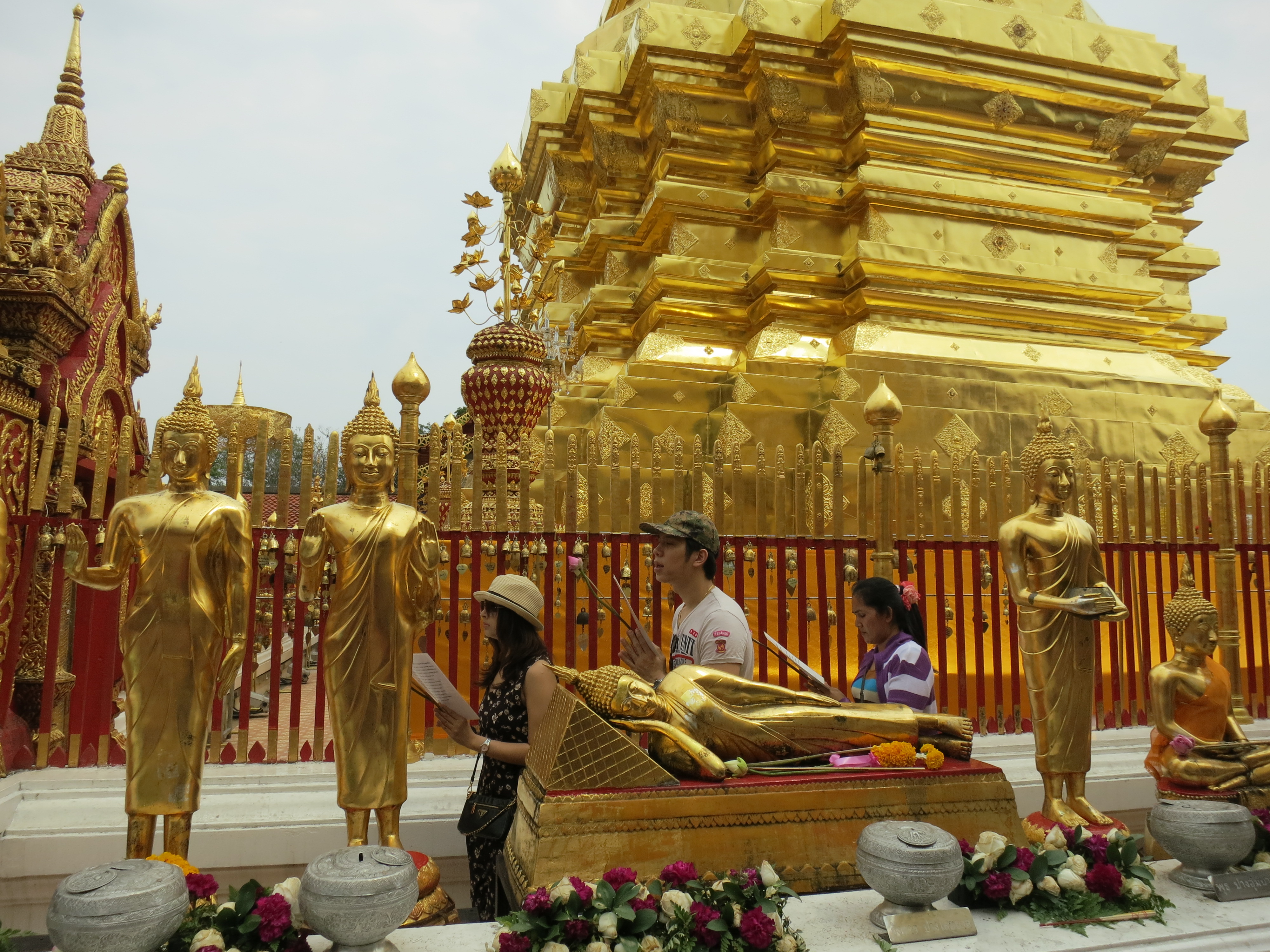
Walking around the stupa (or chedi) and chanting prayers
Hannah and I paid the small entrance fee (“Foreigner Buy The Ticket Now” said the sign at the top of the stairs), removed our shoes, and went inside. We marveled at the gold leaf on everything, the little hearts people had donated money to write their names on, the small jade buddha, the bank of small file drawers labeled with the different causes you could fund with your donations, the flowers and incense sticks adorning various altars. We sat in the main shrine, our feet tucked behind us, as a monk chanted over us and splashed holy water on us. He said, “for good luck, for good luck” at the end and smiled at us, and we smiled back and thanked him. At the main stupa in the center of the complex, we picked up a pamphlet of prayers and walked around the stupa three times, reading the prayers out loud.
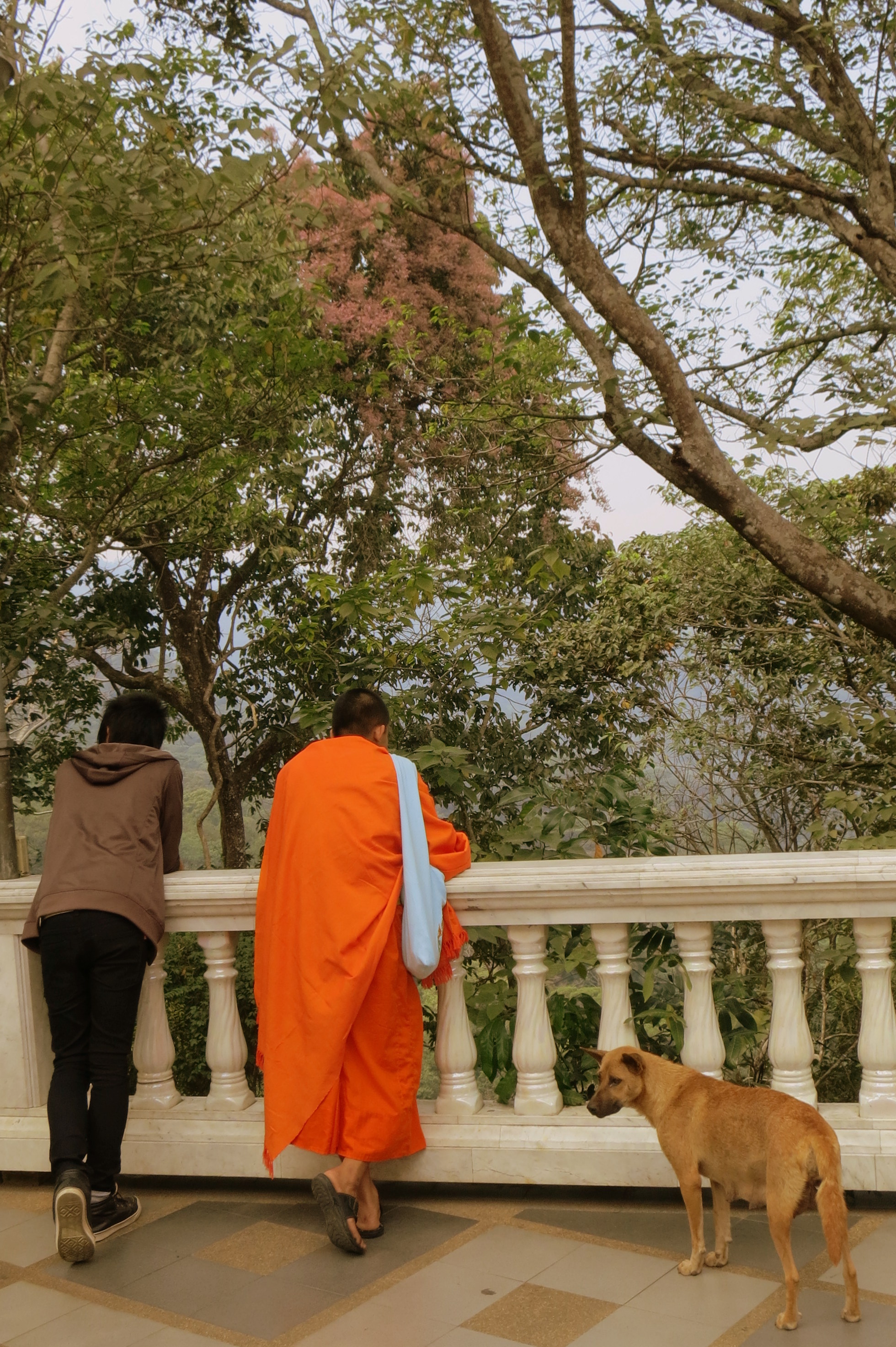
A teenage novice and his friend have a chat
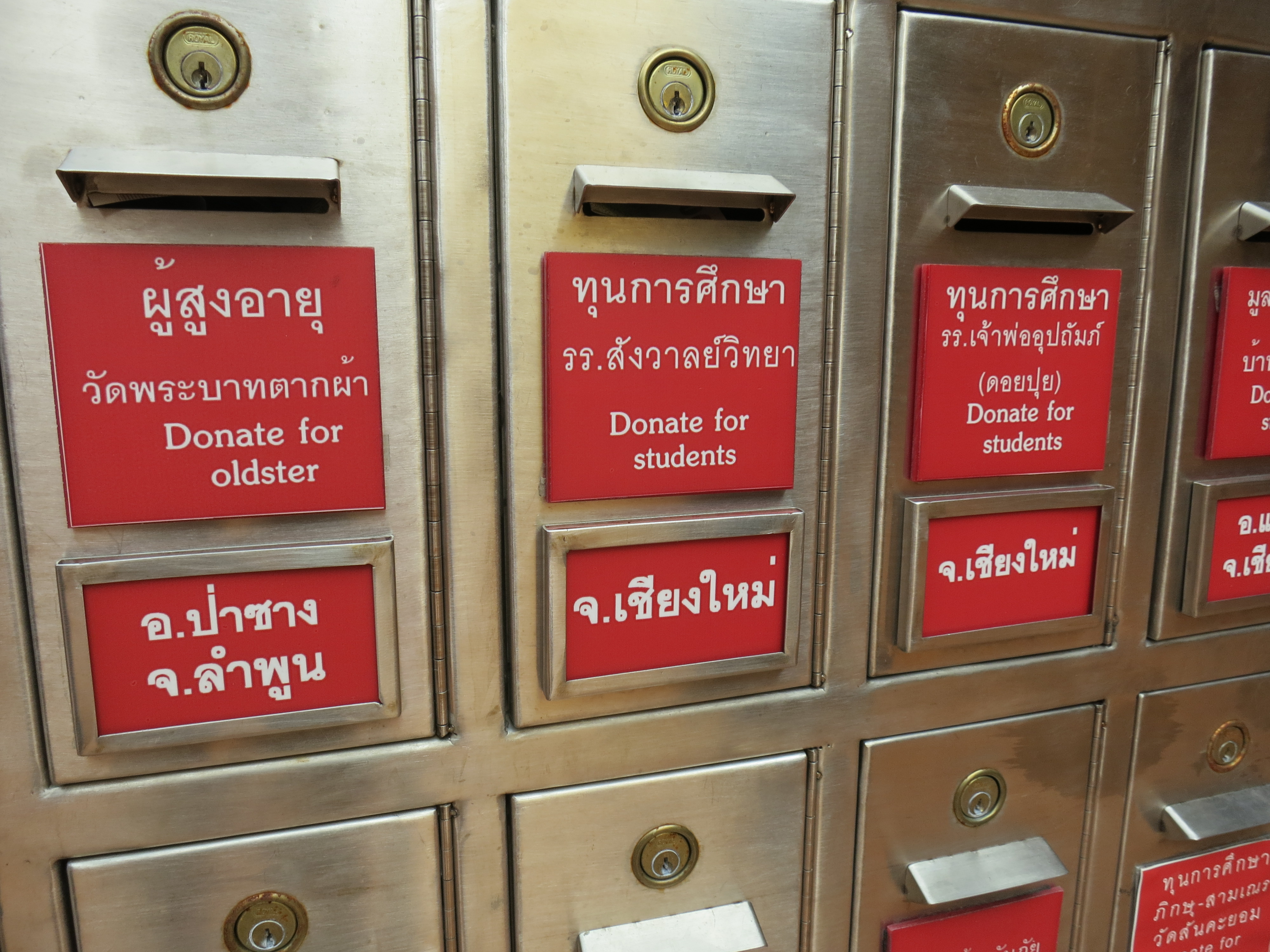
Choose your cause
We walked around the outer courtyard and watched people ring the bells along one of the walls. We checked out the view of Chiang Mai below, but it was a hazy day and we couldn’t see much. We watched three puppies eagerly play around the ankles of their favorite monk, a young man more properly called a novice (you’re a novice until age 25). A statue of the legendary white elephant stands to the left of the entrance, standing guard over her temple.
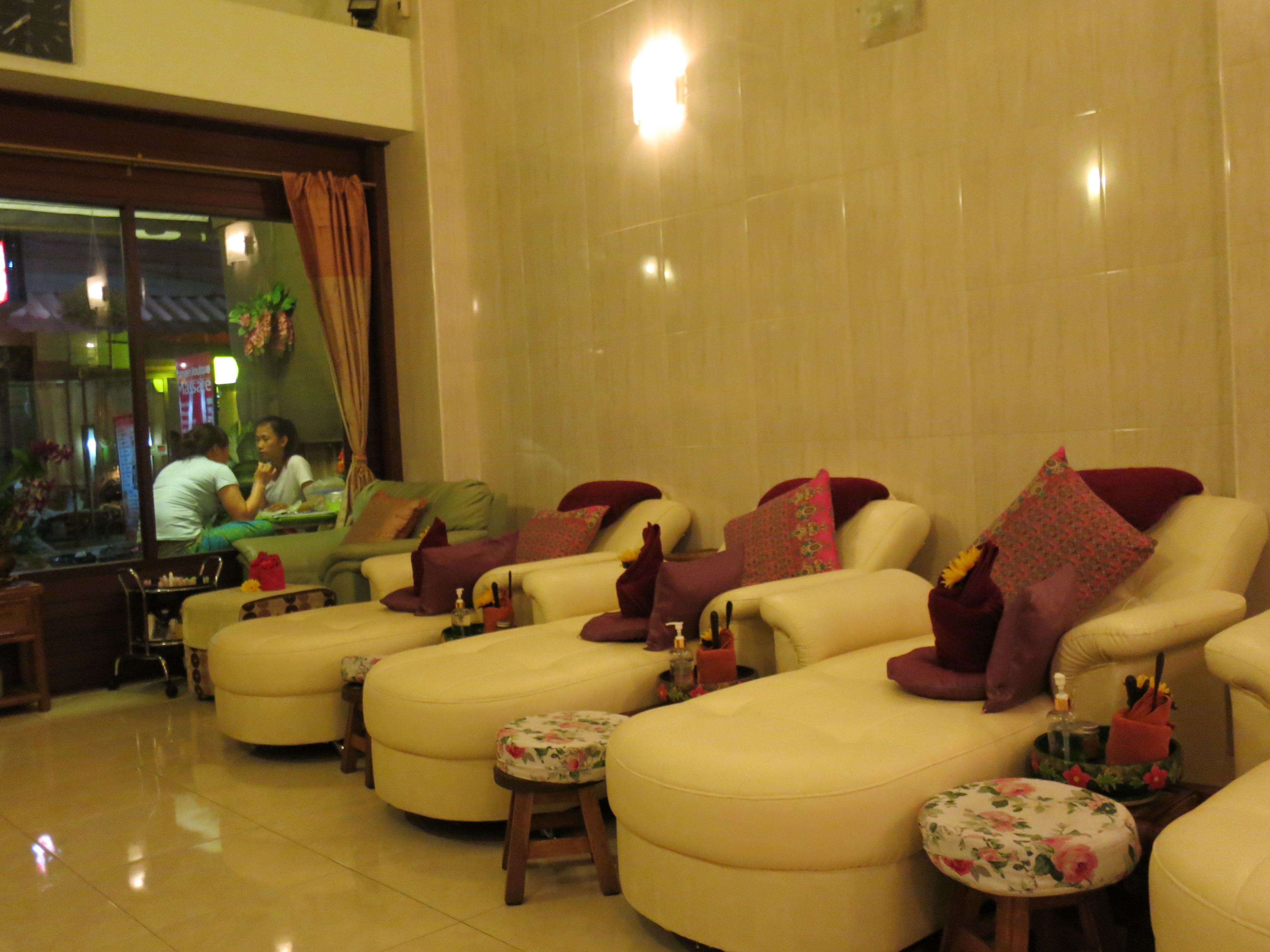
Sweet set-ups at the spa
Thailand is well-known to western tourists as a place to go for cheap spa treatments. I hadn’t done much of this kind of pampering before, but I did learn to appreciate a pedicure while there. Hannah and I also went to Lila Thai Massage, which is a small chain of spa shops that employs formerly incarcerated women. My massage there wasn’t as peaceful as it might have been, since the masseuses all chatted among themselves as they went to work on six of us in one long room, but for $6 you can’t complain too much. We tried a different place later in the week, where Hannah had her first Thai massage and I got a pretty pedicure.
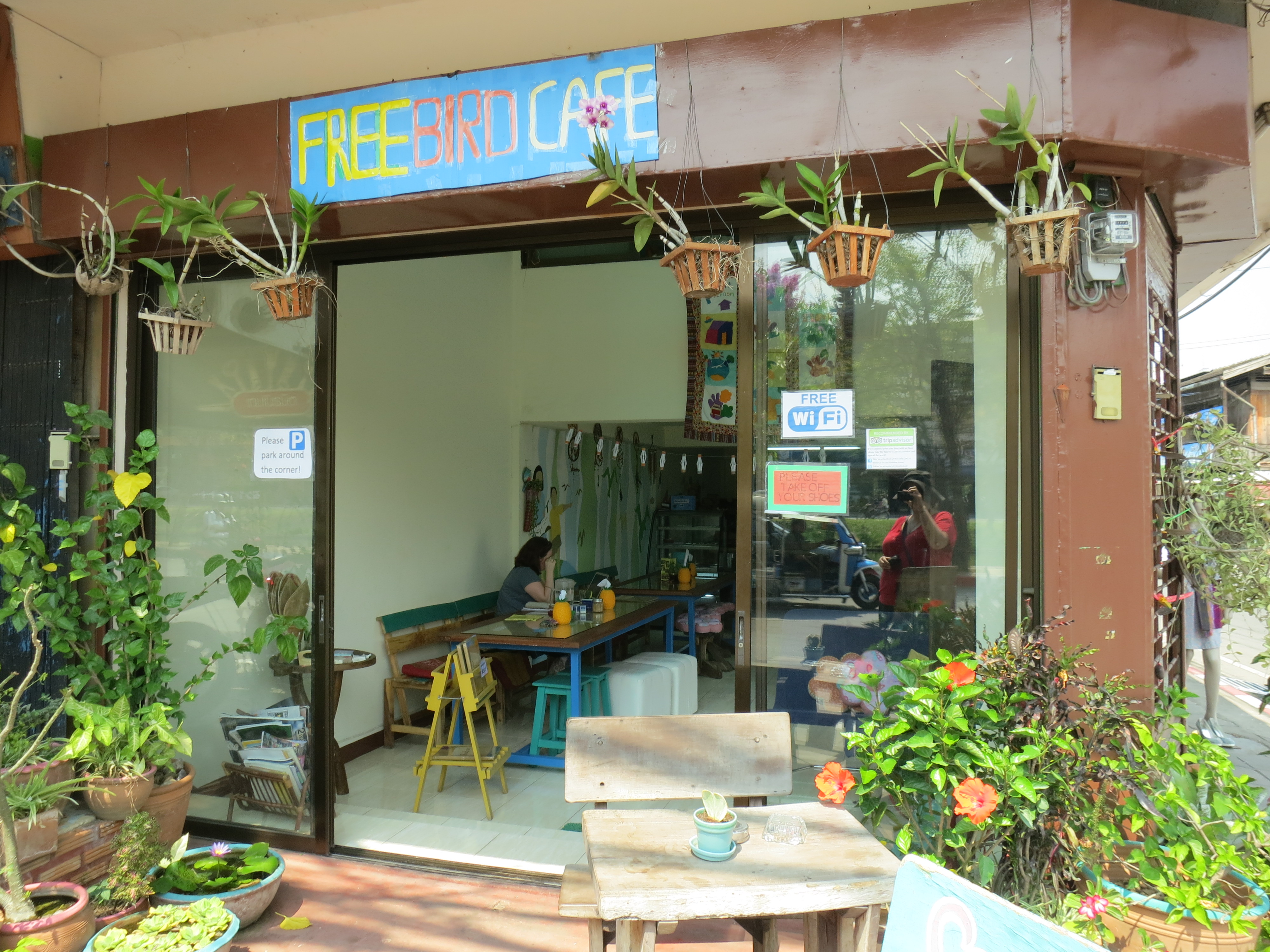
Free Bird Cafe is a lovely little place

Lots of vegetarian paraphernalia at Taste of Heaven
We went to a couple restaurants that cooked for a cause. Taste from Heaven donates its proceeds to the Elephant Nature Park, and it papers its walls in photos of animals and posters beseeching people to become vegetarians. Free Bird Cafe is part of Thai Freedom House, which provides education to Shan refugees from Burma. The restaurant also houses a small thrift store. We ate the Shan specialties recommended on the menu, and they were delicious.

Hannah makes the curry paste

I made a coconut soup and tasty penang curry
We went to a four-hour cooking class with Asia Scenic Cooking School. I’m glad we did it, especially because Hannah enjoyed it so much, but we did seem to spend an awfully small amount of time actually cooking. Perhaps the full day course involved more time at the stove. Still, it was fun to learn about the different spices used in Thai cooking, and to experience first-hand how labor intensive grinding curry powder is. Also, we made delicious food and got a cookbook so we can try these on our own back at home. The book even includes some substitutes you can make if you don’t have access to the necessary herbs and spices.

Muay thai boxing
We went to see muay thai boxing, which is one of the few sporting events I’ve actually made it to on this trip. We both sort of knew what to expect, but we were still surprised by the violence of the kicks to the ribs and knees to the groin, especially as we couldn’t see so much as a mouth guard on any of the participants. We sat on one side of the ring with a bunch of other dazed Westerners, and followed the lead of the Thai people to our right, who clearly knew what was going on and had money riding on the outcome.

Silk worm cocoons

So many choices!
On our last day together, we went out to Shinawatra Silk Showroom. We watched a woman pull the impossibly thin threads of silk out of worms, and another woman work a foot-powered loom to weave colored threads into long skeins of colorful silk. We then entered the showroom and spent a really long time picking out silk for ourselves and presents for others. We held each other’s hands and breathed deeply as our purchases were rung up and our credit cards run through, but we made it relatively unscathed.
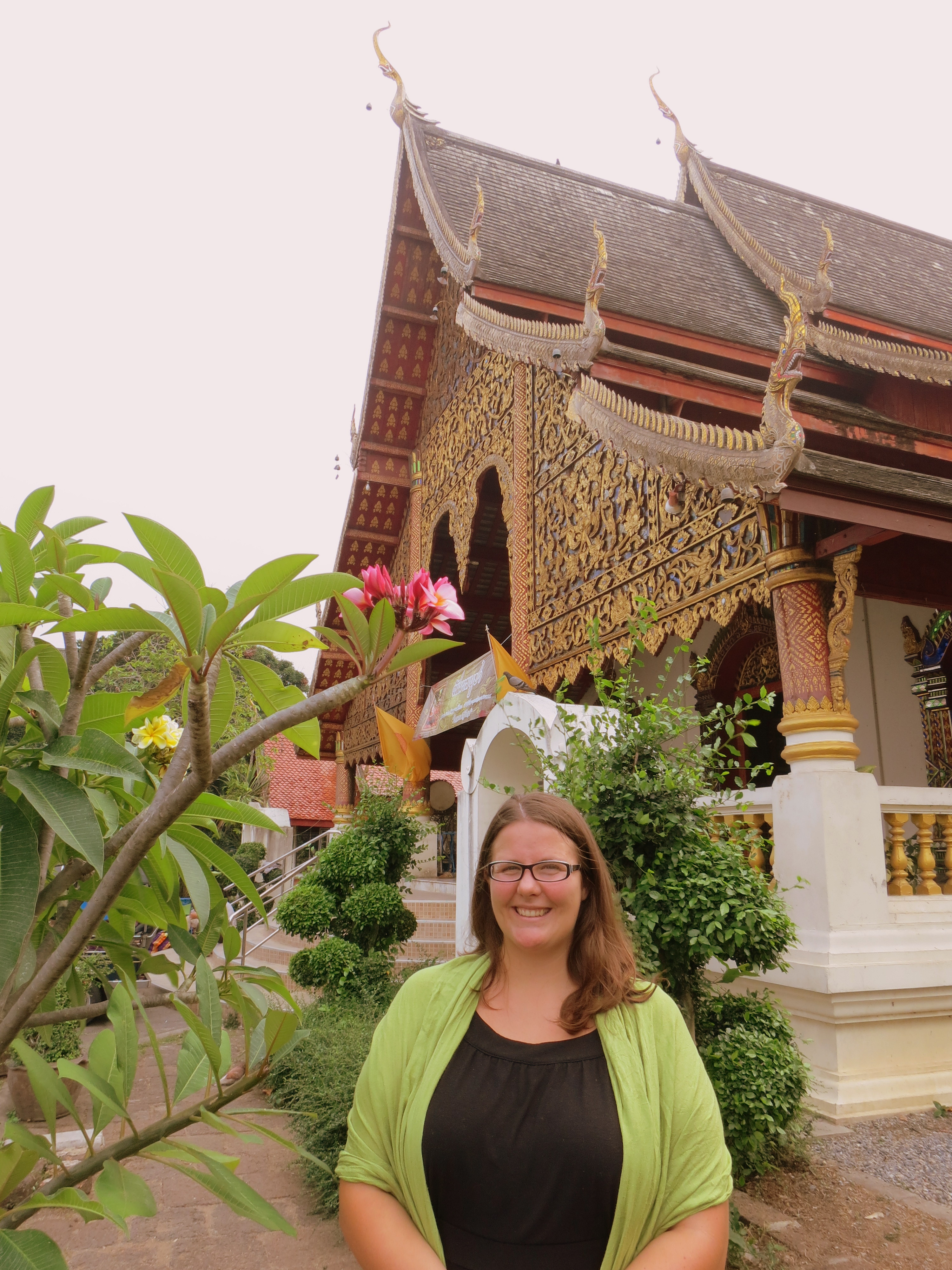
At one of the many temples in Chiang Mai

Thai cover band–they tore through rock hits for a good hour
Hannah and I visited other temples in town–including one with a stupa supported by giant stone elephants–and had fun getting lost in the alleyways. We went out to a few bars and heard some fun cover bands while enjoying Tiger beers. We caught up on each other’s lives and enjoyed the luxury of vacation time.
I had a great time in Chiang Mai, finding the right mix between relaxing and sightseeing, and I’m so glad I got to explore the town with Hannah.
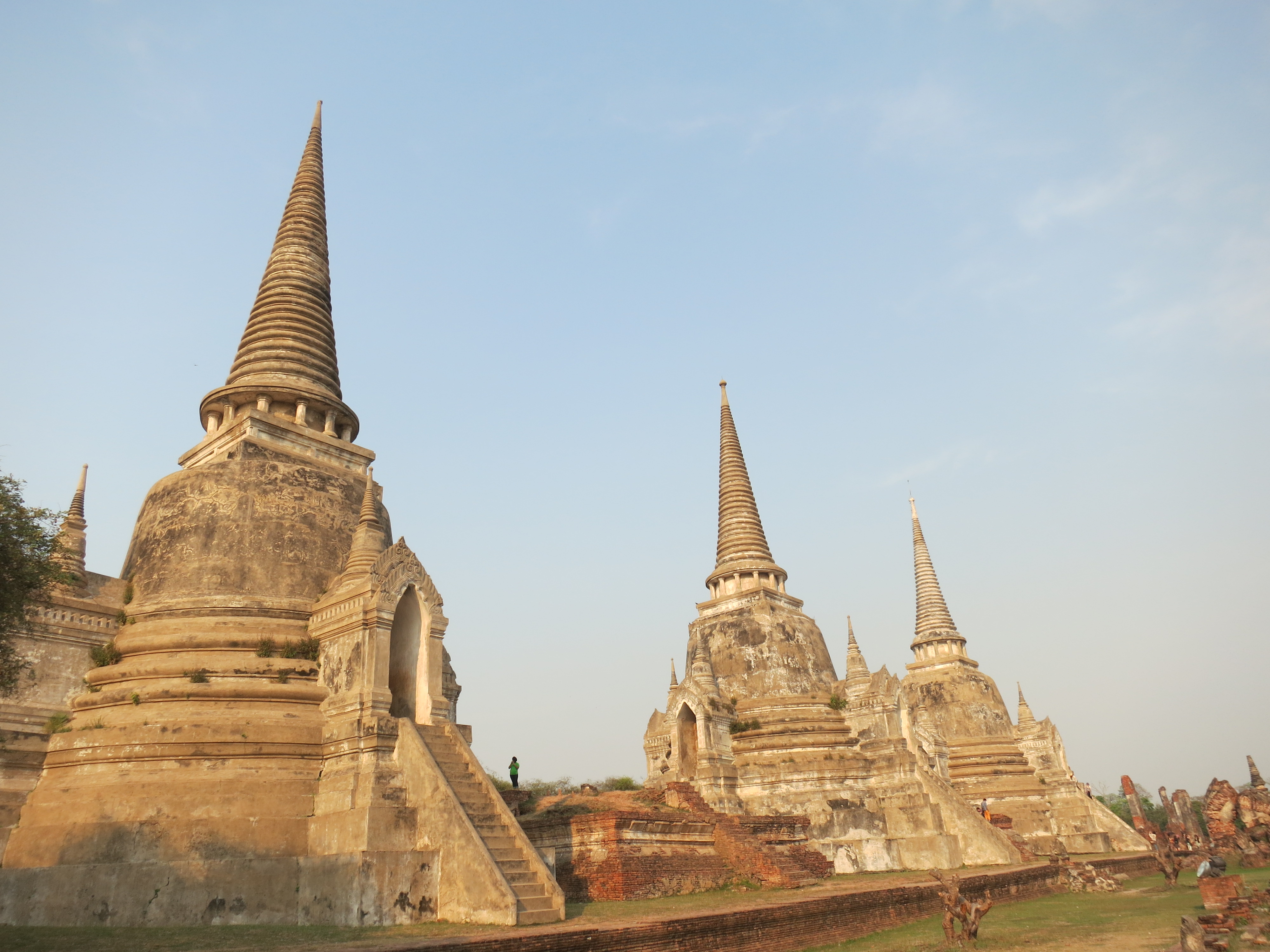
I like to pretend that my short time in Ayutthaya, ancient capital of the kingdom of Siam, was spent in the manner of a ruler from that era: whisked from magnificent stupa to impressive monument in my personal chariot, all doors open to me. In reality, of course, I bounced along in the back of a tuk-tuk and paid the same entrance fees as everyone else, but when the afternoon sun is beating down and you only have a few hours in a place when you’d planned to have two days, you have to inject a little romance where you can.

Astonishing what one color against stone can do (no filter)
Ayutthaya is a World Heritage site, and as such it’s better maintained than many tourist sites in Thailand. All the guidebooks suggest renting bikes to get from one site to another, which sounds nice in theory, but in practice it still means dodging terrifying traffic and sucking in mouthfuls of exhaust. Some friends did bike to different temples, and they said those were the problems exactly, plus it’s super hot, of course. So all in all, I’m glad I paid $20 for a driver to take me door-to-door for three hours.

Tiny me in there for a sense of scale

Mini buddhas at Wat Phra Chedi Chaimongkhon
The city of Ayutthaya was founded in the 14th century, and at its peak at around 1700 CE it had 1 million inhabitants, which made it one of the largest cities in the world. In 1767 the Burmese invaded, burning the city to the ground and committing blasphemous acts like cutting the heads off the stone buddhas in the temples. The kingdom would be fought over and rebuilt over the next few years, but the capital was never re-founded on the same site, and it’s remained in ruins to this day.

One of the many headless buddhas

Wat Phra Mahathat
Some of the temples seemed to be out of use, while others contained buddha statues, yellow or saffron cloth coverings, and other signs that they were still active places of worship.
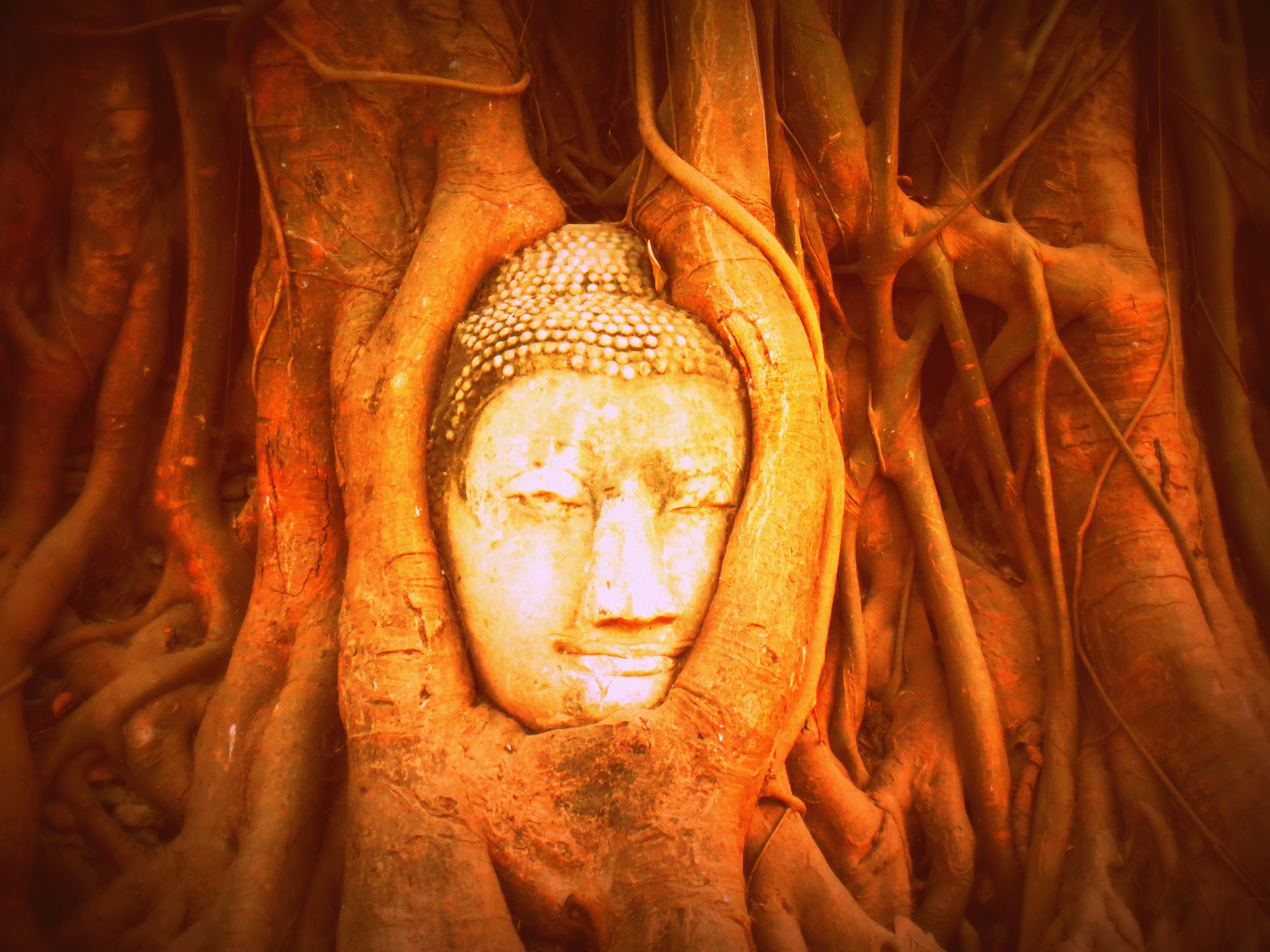
I think he looks downright cozy
Guards stationed themselves by the head in the tree of Wat Phra Mahathat to make sure people took respectful photographs. It’s considered disrespectful to put your head above that of a buddha or monk, so any time you’re in a temple you have to watch yourself. Since this particular head somehow got wrapped up in the roots of this tree, it’s even lower than statues usually are, and you have to kneel on the ground to make sure you’re not breaking any taboos.
Mortal Kombat?
I visited Wat Phra Sri Sanphet, which a fellow American told me was the site of some scenes from Mortal Kombat–look familiar, anyone?

Reclining buddha of Phra Budhasalyart
The reclining buddha of Phra Budhasalyart, according to legend, got in that position because a giant was boasting about how big he was, and how therefore he didn’t need to pay proper respect to the buddha. The buddha made himself bigger than the giant and just laid out on his side, like, hey, what’s up, we can play this game if you really want to. (I presume the giant was humbled, though accounts don’t say.)

Wat Phu Khao Thong
The last stop of the day, Wat Phu Khao Thong, was one of the nicest simply because the sun was going down and the site was deserted. Once my driver dropped me off at the bridge that served as the entrance, it was just me and a determined evening jogger as the sun descended and the temple folded itself in shadow. It was a peaceful end to a busy afternoon of temple-hopping, and kudos to my driver for arranging it that way.
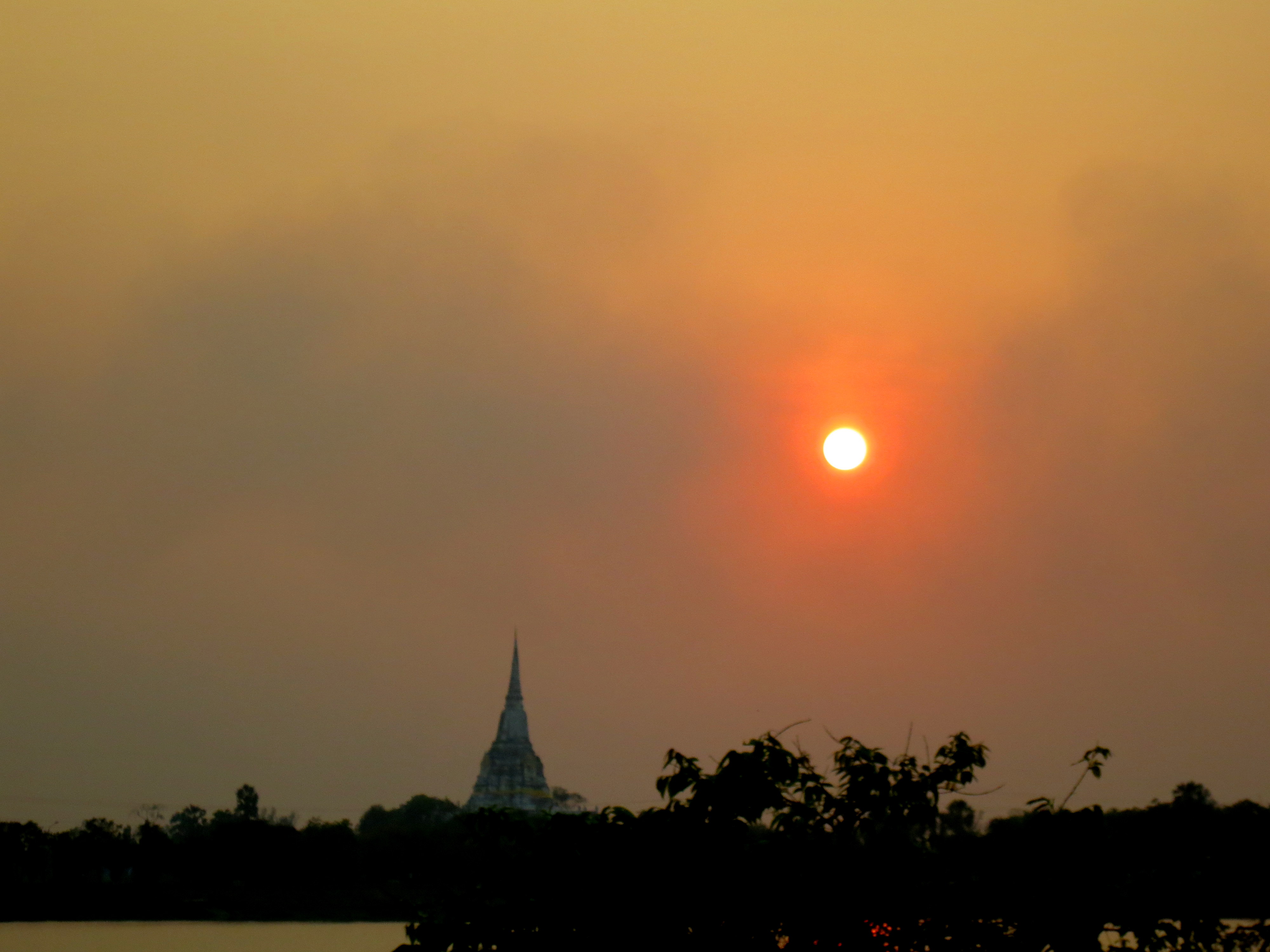
A peaceful good night
Every town has something worth seeing. Any trip that lasts more than three months is necessarily going to include downtime; you won’t see highlights every day, and every few weeks, entire days are taken up with the minutiae of travel: laundry, planning onward travel, etc. But even the stopover towns have a monument or natural feature or a really good diner, and if I have more than a night in a place, I try to check it out. So even though my time in Phuket Town was mostly spent recovering from jet lag and visiting hospitals (shingles lingers for an impossibly long time), I did spend an afternoon admiring the buildings at the center of town.

Old Town in Phuket
The free “Treasure Map” of town explains the origins of the town’s Sino-European architecture: Phuket is perfectly placed for ocean commerce, and it was a big trade center where Indian, Malay, Arab, European, and Chinese merchants gathered–and some settled down. Chinese tin miners were especially influential, building the colorful two-story shop-houses that I also saw lots of in Singapore. A few downtown streets have recently been renovated, and apparently one in particular, Soi Rommani, is a popular filming location. Phuket is so heavily strung with electric wires that it’s a wonder they don’t fall to the ground, so it was nice to walk along the renovated streets, where the cables have been buried.

Soi Rommani
It took a little backtracking and poking my head into the wrong alleyways, but eventually I found the Shrine of the Serene Light, a Chinese Taoist temple. The courtyard was full of bamboo scaffolding, long wooden boards, and bags of building materials. A man crouched near a sculpture to the side and carefully applied a new coat of paint. No one else was in there, so I covered my bare shoulders with a hat and a bandana in a hasty stab at proper dress, and went inside.
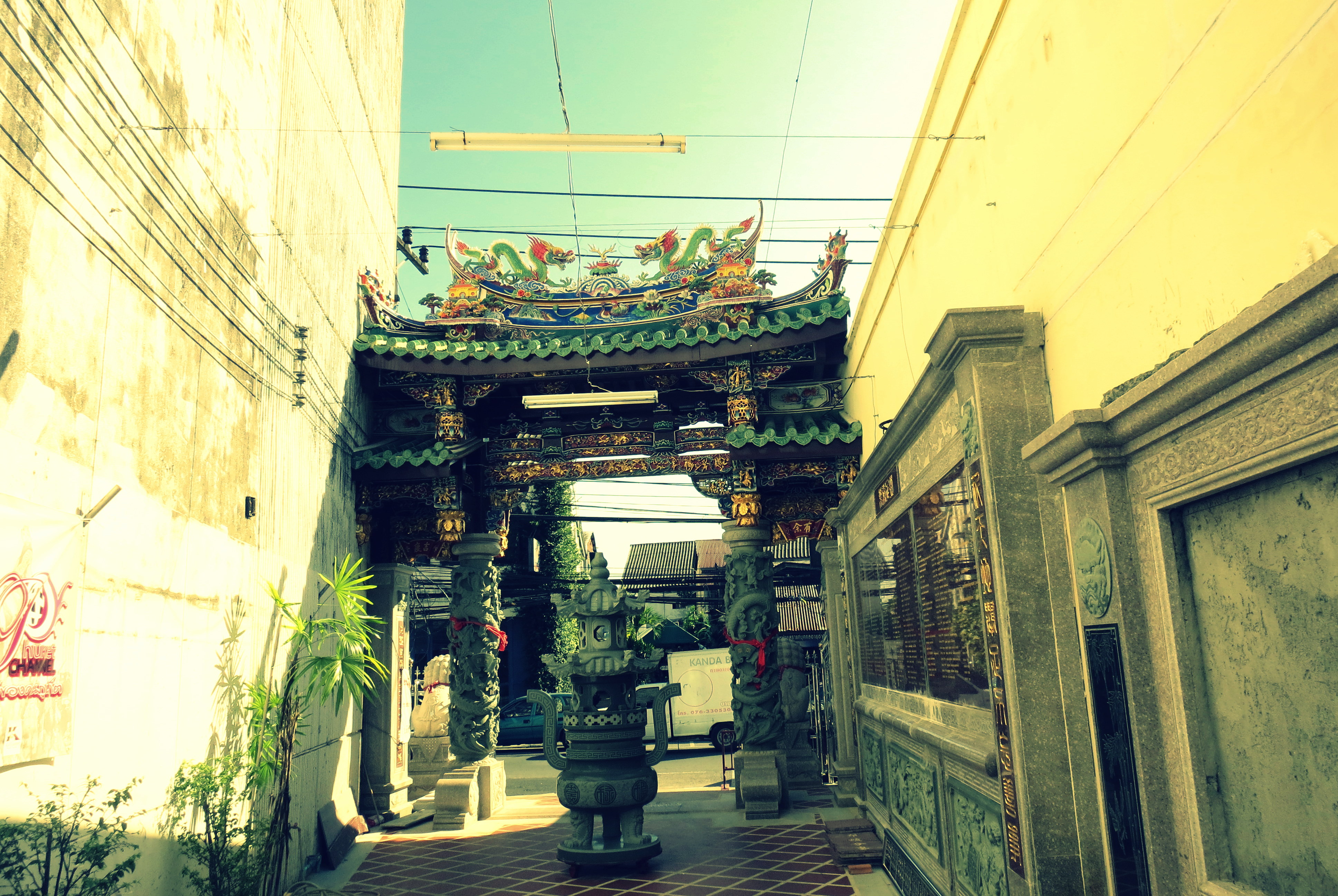
After passing under an elaborate gate, you walk down a long alleyway overshadowed by construction before you get to this second gate for the Shrine of the Serene Light
I had already passed under two gates to get to the shrine, and now I took off my shoes at the pavilion immediately in front of the shrine. I ogled the fruit laid out in offering, and stepped over the threshold into the dark temple. Drawers of paper-slip fortunes lined the right-hand wall, and a wisp of smoke rose from the tall candles in the center of the room. A boombox in the corner played what I assume was a religious song, and I walked to the back of the small room to look at the different altars; one had a bronze bas-relief on the wall, one housed a statue under a carved wooden canopy, and one was so cluttered with flowers, fruits, and candies that it was hard to see the honored figure behind.

Shrine of the Serene Light

I had only been in Thailand for a few days, but already I was used to being honked at while walking down the street, and hearing drivers shout out “Taxi! Motobike!” in a bid for my business. So I wasn’t surprised, while walking back to my hostel from the hospital one hot afternoon, to hear a “Taxi! Madam! Taxi!” and to see a songthaew driver lean out his window and gesture to me frantically. I smiled and said, “No, thank you,” and carried on.
But he was not done. He followed me for several meters, and after I thought I’d finally shook him, I heard a pattering behind me and looked up to see that he had got out of his car and actually chased me down on foot. Had this been nighttime instead of broad daylight, I would have been frightened.

Songthaew means “two benches.” They’re somewhere between bus and taxi on the scale of public/private transit.
He held a map out and said, “10 baht, 10 baht, I take you anywhere you want to go, 10 baht, we go here first.” 10 baht is about 30 cents and cheaper than any songthaew ever costs, so it was clear to me that this was one of the Souvenir Shop Scams I’d read about. You get in an absurdly low-priced vehicle, the driver takes you to at least one souvenir shop, more if he can, and he gets a cut of whatever you spend. It was very hot, the hostel was quite far down the road, I wanted to know what these mysterious souvenir shops look like, and I thought, hey, I’m not really getting scammed if I know about it up front, right?
I got in the songthaew and when he pulled in to the souvenir shop I obediently went inside. Immediately, a woman in a long traditional dress greeted me, and she shadowed me for my entire time in there. It was a vast room, like one of those abandoned shops in the mall that occasionally gets rented out to a book discounter or a Halloween outfit, and it was almost entirely filled with jewelry cases. Two women peered into the cases and seemed intent on buying at least one piece each from the smiling saleswoman behind the counter. The huge room was empty except for us.
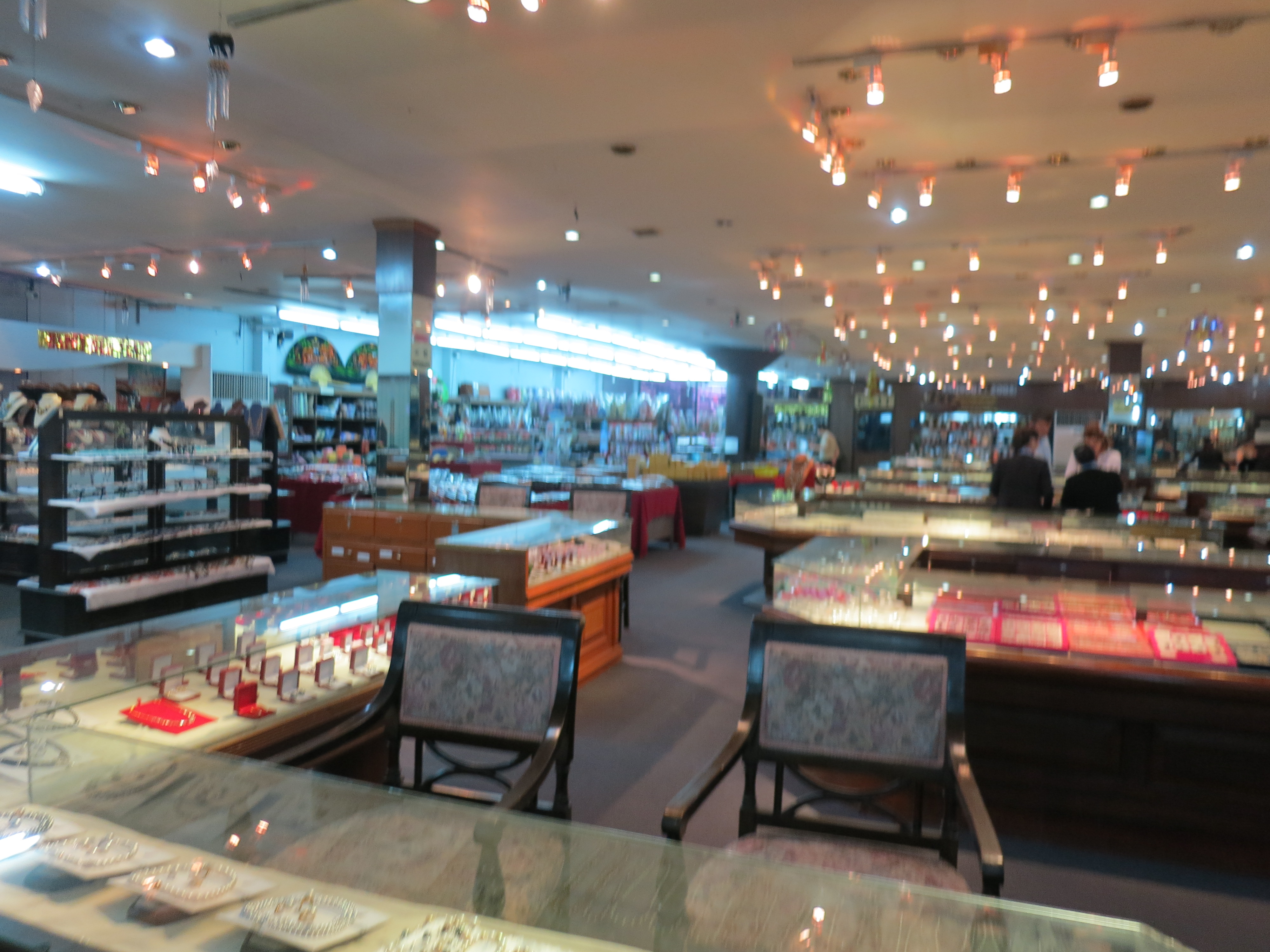
Acres of jewelry cases
My guide tried to steer me to the jewelry, but I looked around the walls, at the t-shirts, scarves, and trinkets. I took a blurry photo before my guide could stop me and point to the many “No Photo” signs posted around the room. Then I bought two postcards, to my guide’s evident disgust, and went back to the songthaew. He wanted to take me to the mall next, but I’d experimented with the scam long enough and asked to go straight back to the hostel.
I was only in Phuket for a few days, but I managed to see the old buildings and the new scams, which is not bad for a stopover town.

Chinese medicine shop
 Stowaway Travel Writing & Editorial Services