
When I told my mom I planned to go to Alice Springs as a starting point for my trip to Uluru, she recommended I read A Town Like Alice by Nevil Shute. It’s historical fiction set during and just after World War II, and the second half tells the story of a man and woman slowly building a life together in the harsh eastern Outback of Australia, and of their attempts to make the town as sweet a spot as Alice Springs.
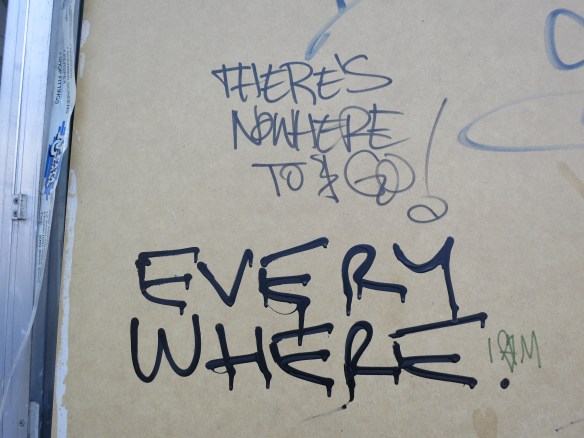
Graffiti in Alice Springs
In the book, Alice is an oasis of civilization and comfort in a desert that went on for days. Much was made of the ice cream parlor and hair salon and swimming pool–modern marvels in a land of stockmen and cattle. Nowadays, I don’t think anyone’s setting out to build a town like Alice. It’s seen more as a pit stop on the north-south highway than as an oasis.
To a person, everyone I met in Sydney who heard I was going up to Alice made a face and said something like, “well, watch yourself” or “that’s not a great place, don’t judge Australia by it.” They were referring to the high crime rate, specifically the often violent muggings of white people by gangs of aboriginal people. You don’t walk around by yourself, or even in a group of less than four, after dark.
I’m not being glib when I say that I’m from Chicago, the most segregated city in the States, and I am all too familiar with the idea that there are entire neighborhoods you don’t go if you’re white, and entire neighborhoods you avoid if you’re black. But that’s in a city that’s spread out over several miles; Alice Springs is a small town with about a five-block square of downtown, and then surrounding residential areas. I didn’t expect to see the same sort of separation and mistrust there.
Of course, it isn’t the same. It’s an atmosphere specific to Australia, and to the history that produced it. The area has a complicated history of alcoholism among aboriginals, land grabs by white people, and resentment between the two groups. My understanding, when I was there, was that this had eased in the last twenty to thirty years. There was a sizable aboriginal community hall in the center of town, which banned liquor within its boundaries and encouraged pride in the accomplishments of the community. The town has a pretty big population of (mostly white) artists who come here from all over the world to create art in the desert, and their presence is differently felt than that of the businessmen and cattle ranchers. Still, all is not tranquility and goodwill here, and I did feel that somewhat as I walked around town.

Sunday morning market
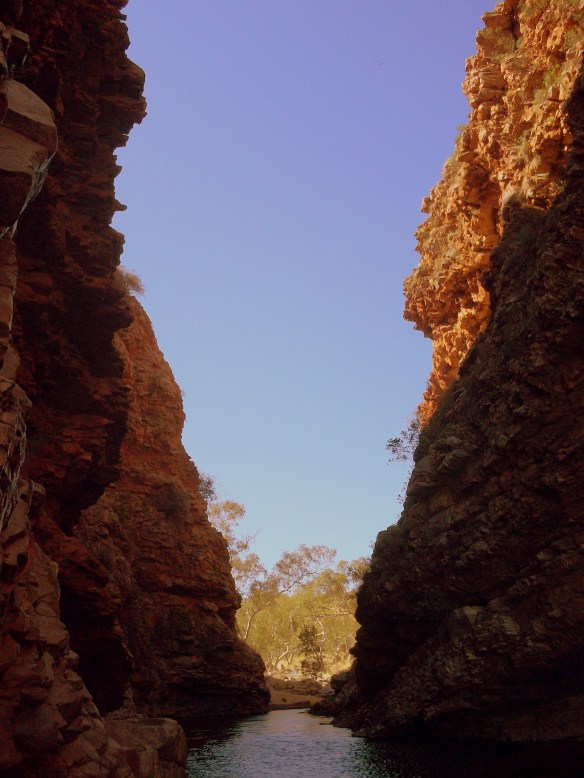
Simpsons Gap in the West Macs
I went to the market on Sunday morning, which was a fun mix of food stalls and crafts for sale. I walked along the dry riverbed for a bit on my way back to my wonderful Couchsurfing host’s home. I went on a short walk in the West MacDonnell Ranges. I had a good time during my short stay in town.
But I never did go out after dark in Alice.

 Stowaway Travel Writing & Editorial Services