Me Too

Me too.

Have you been catcalled walking down the street? Called “sweetheart” at work? Had to plaster a smile on your face while clients hit on you because “you’re in a customer-facing role”? Forced yourself to laugh along with the taxi driver because it’s dark out and he knows your address? Walked the last few blocks home with your keys out, grateful your mom taught you this but wishing she’d never had to?

Me too.

Have you said “I have nothing to wear” not because ladies are ditzes who buy too many clothes, but because you’ve still not found that magical outfit that will protect you from the leers and comments and gropings of strange and familiar men in the workplace, the subway, the bar? Have you worn what you wanted to anyway, and tried to not think “you knew what you were getting when you put this on” when the leers and comments and gropings appeared?

Me too.

Have you tried to turn the times you’ve been sexually harassed into comic stories – you have to laugh or you’ll cry? Have you kept the incidents that are too serious to be turned into a funny story to yourself?

Me too.

Did you at one time believe them when they said you were too fat or too ugly or too something for anyone to want to assault you? Did you feel somehow doubly betrayed when they assaulted you anyway?

Me too.

When you were assaulted, did you immediately remind yourself that others have it much worse, and that comparably what you experienced is not so bad? Did you not tell anyone for some time? Did you find it hard to name it to yourself?

Me too.

Have you noticed that I haven’t even used the word “men” once yet? Did you not notice because there’s no need to name the thing that is always there, the menacing presence that hovers on the periphery of your daily movements, and all too often forces itself into the center of your life?

Me too.

Are you deeply distressed that “a menacing presence” is a valid way of thinking about men, since statistically speaking they are the ones who harass, beat, rape, abuse, murder? Do you wish there were some failproof way to know if any man you meet is going to be one of those ones? Do you have many wonderful men in your life? Do you wish you had more?

Me too.

Are you wondering why more of the men in your life aren’t speaking up today? Wondering why you don’t see them taking concrete steps to intervene when they see sexual harassment, to call their friends out when they say something sexist, to take a friend aside and ask if they realize that what they’re doing is hugely harmful? Wondering why men aren’t proactively suggesting rigorous (not checkboxes-style) sexual harassment training at work? Why they’d still rather make a joke than a real change in their behavior?

Me too.

Are you reading this and feeling unseen and unknown, because you are a man or non-binary person who has experienced sexual harassment and assault? Or because a woman is the one who assaulted you? Or because your experience includes additional layers of abuse involving race, religion, ability, sexual orientation, gender identity, class?

I see you. I believe you.

Are you angry that even though we’ve said it over and over again, we’re being asked to say it again? Are you furious that it is on the survivors and victims to say something, that the harassers and abusers and rapists can continue on with their day unaffected – which is always true for them anyway? Are you livid that the norm is for their lives to be wholly unaffected by what they have done to you, while you’ll carry it with you for forever?

Me too.

Are you heartbroken by the sheer number of people who are posting today – and from such a wide swathe of your life? Have you seen your former teachers post, the priest of your childhood church, parents of your friends, community elders, not to mention what seems like every single one of your peers? Are you holding them all in your heart, including those who don’t use social media or chose not to post but definitely have experienced sexual harassment and assault?

Me too.

Are you holding a bit of hope that maybe this time, more HR departments will fire the harasser instead of retaliating against the whistleblower, more colleges will expel the rapist instead of punishing the victim, more people will say “we’re on her side” instead of “I see both sides and I’m sure he’s sorry,” more men will do the hard work of holding each other accountable instead of looking away and feeling guilty? That maybe more people who have felt alone now feel less so?

Me too.


Three Pro Tips on Writing

#1: Author Joanna Russ died on April 29th. She wrote science fiction and literary criticism, and I have The Female Man waiting in my Goodreads queue. Another one of her books had the best book cover:

It's sad and funny 'cause it's true

#2: Zadie Smith has shared the shortest, most to to the point, list of ten rules for writers at the Guardian:

1 When still a child, make sure you read a lot of books. Spend more time doing this than anything else.

2 When an adult, try to read your own work as a stranger would read it, or even better, as an enemy would.

3 Don’t romanticise your “vocation”. You can either write good sentences or you can’t. There is no “writer’s lifestyle”. All that matters is what you leave on the page.

So far I have #1 down! Excellent. (Read the rest here.)

#3: The Rejectionist has a delightful (as usual) post on using female characters’ deaths as plot devices:

Racking up the (hot, slutty, dismembered) Lady Character body count to prove just how Depraved your serial killer is: NOT APPROPRIATE

The Lady Character randomly kills herself/is murdered solely to add Dramatic Interest to a Conflict between two Gentlemen Characters (aka the “Christopher Nolan”): NOT APPROPRIATE

I love that she named that last one. (Read the rest here.)

The Good, The Bad, and The Silly

The Good

Elizabeth Goodyear outlived all her family and friends, but in the last seven years she made more, a host of twentysomethings who read to her and brought her chocolates. Hurrah for the human spirit and community! (Via.)

Renee Martin talks about the many ways in which this photo of a young Muslim woman in New York is beautiful.

Here is a helpful way to think about tax brackets, which really matters when we talk about tax breaks and who is affected.

The Bad

Senator DeMint of South Carolina outright says what a lot of people seem to believe (judging by their voting records): Gay people and unmarried women living in sin shouldn’t be teachers. Think of the children, etc. Dear lord.

Sady Doyle breaks down a loathsome editorial. I like her point about “I might be a jerk but” being an opener to a despicable comment that you can’t argue with, because hey, he already admitted he’s a jerk; no need to rub it in! It’s kind of like how “no offense, but” always precedes something really offensive.

Greg Sargent explains to the White House why all their moaning about the left’s “whining” is not only unhelpful but inaccurate besides.

US Border Patrol agents are charged with rape and assault of undocumented immigrants. I like poster Cara’s question: “How can we expect Border Patrol agents to reasonably respect the human rights of undocumented (or even suspected undocumented) immigrants when the denial of their humanity is the name of the game?”

For anyone who thinks we can always trust law enforcement to pursue justice, read this article about how BIA agents lied, saying they’d caught a serial rapist when they knew they hadn’t. It’s not just your department budget or reputation that suffers when you don’t genuinely close a case, it’s the women who  men continue to rape.

The Silly

My favorite part of this photo is that it is the same pose teenage girls use at the beach. Check out the whole slideshow of the European Beard And Moustache Championship.

Another slideshow — this one of some delightful gender-bending.

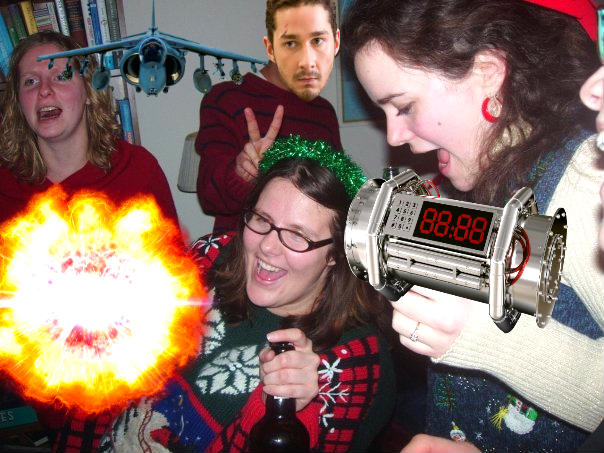
How do you improve that slightly blurry vacation shot of you and your friends at the bar? Stick in an explosion and some fire with the Bayifier (playing on the explosiosity of Michael Bay films)! My Christmas party just got even better:


me and friends singing Christmas carols with explosions and fighter jets

Wishing you a Very Michael Bay Xmas


Book Report: Australia, Part 2

Oh my goodness, an actual post about travel! What’s more, it’s a post about the A Country a Month challenge, which at this point should be named the Country Maybe Every Six Months, Seriously It’s Been Years Since College and I’m Out of Practice on All This Nonfiction Reading challenge.

But now — Australia! Last time, I mentioned the national narrative. Now, most of my historical information is coming from Macintyre’s Concise History, so whatever basic narrative arc he’s giving the country is going to influence how I see it. Also I’m thinking of the various ideas, stereotypes, jokes, random facts, and anecdotes about Australia I’ve heard and read over the years. And maybe I’m not reading enough or thinking critically enough, but my original understanding of the Australian story remains much the same: the white narrative is one of hardships overcome, an unforgiving land tamed, and a hardy people always down for a drink or a trek or both. To be clear, this is not how all Australians actually are, but it is the carefully cultivated national story and image.

There’s a lot to admire in that story — pursuing your dreams, making your own way, and doing it with a cheerfulness and willingness that makes the whole endeavor worthwhile. There’s also a whole lot that needs reexamining or outright condemnation. The narrative doesn’t just forget women and non-whites, it forcibly keeps them out of the history of their own country. The fragile ecosystem of this huge, dry continent has been almost entirely destroyed, and obtaining water is a real concern in an increasing number of communities. Not only did whites steal the land of the people who lived here for 40,000 years before Cook showed up, but they also stole thousands of children in an attempt to steal and destroy Aboriginal culture entirely — The Stolen Generations (for which the federal government has expressed regret, but not apologized). Those same friendly blokes willing to share a pint or five with you at the bar are also pretty likely to go home and hurt their partners — an IVAWS survey in 2003 found that 57% of women surveyed had been physically and/or sexually assaulted in their lifetimes, and 34% of those incidents were in the home (this survey also underreported the experiences of indigenous and non-English speaking women, who statistically experience a higher percentage of assaults than white women).

One of the things I was most surprised to learn about was the White Australia movement. Almost all of the early colonizers were whites, both the convicts and shortly thereafter, the gentry and entrepreneurs who bought up huge tracts of land for sheep grazing and mining (including gold). Clearly, the Aborigines were not white, and many of them did fight for their land or take a small plot to work when shut off into reservations, but from the beginning, they were not granted the rights of citizenship that Britain extended to whites. Other workers were also shut out of not just the national story, but the practical benefits of equal rights and freedom as well, especially the Chinese miners. When times got hard, as they always do, the whites blamed the non-whites, as  they always do (the world over).  Main publications like the Bulletin and eventually official government policy touted the importance of keeping Australia white and safe from foreign invaders. This was devastating on so many fronts — white women were explicitly referred to as breeders of the correct race, non-white women were forcibly sterilized to keep from reproducing, non-white men were denied jobs, and it’s not like this policy actually created more jobs for white men or made it easier to live on the Australian frontier. The White Australia policy had a huge impact on immigration, severely limiting or even outright denying the attempts of non-whites to enter the country. You can imagine how well this played with the Asian Pacific nations that surround the island country. It wasn’t until after World War II that restrictions were eased so the labor pool could be increased, and it wasn’t until freaking 1966 that the policy was mostly dismantled, and 1973 when immigration laws were changed in a meaningful way. No Statue of Liberty here; this was a country founded as a prison, and the bars keep people out as well as in.*

White Australia still holds sway in Australian politics, although of course it goes by different names — the One Nation party, mandatory detention, and an English language and “Australian values” citizenship test. As Kristin mentioned in a comment several months ago, a lot of people want to move to a rich, industrialized nation like Australia, but when they get there, they find seriously racist policies and everyday behaviors. It looks like the conservative Liberal/National parties held power for 11 damaging years, until the 2007 elections. Now the Labor party is in power, although I’m not sure what effect this has had on legislation relating to progressive issues concerning race, gender, class, etc.

White Australia policy today comic

White Australia policy today

One last thing that surprised me about Australia’s history — and pleasantly, too. The labor unions fought bitter, violent battles for years with the business owners, pastoral companies, and mining firms. According to Macintyre, the latter half of the 19th century was really rough, and the unions made some advances only to lose them a short time later. However, in 1907 the Australian Settlement was reached, which established a living wage for working men. It was specifically designed for men supporting families, which of course left out women, who weren’t guaranteed such a decent amount. I’m not sure if it left out non-white men as well, although it wouldn’t surprise me. The basic wage was guaranteed to every working man in the country, and was raised as necessary to keep up with inflation. At first, I was surprised at the long history of wage guarantees in Australia (the earliest minimum wage was introduced in 1824 in Victoria), since it’s a country so proud of hard work and individualism. But this law, combined with the efforts by the Labor Party pre-WWII to create jobs for every man in the country, fits in that picture of hard work and individualism. If you could be pretty sure of getting a job, and certain of a decent wage once you got it, you could work hard at it and really earn that wage. It wasn’t hand-outs, it was earned, was the thinking. Again, things have changed in the last 50 years, but there’s still a decent minimum wage in Australia and an expectation of available jobs. (I don’t know how this expectation squares with immigration, more women in the workplace, etc.)

There’s so much more to learn about Australia, of course, but the point of the A Country a Month challenge is to get a general idea of the country itself, both its history and its current events. I’ve tried to do that in this post, and there may be future posts on Australia. I’m especially interested in learning more about dreamwalking and how Australia’s past intersects with the current trend of Australians abroad.

Finally, please don’t think that all I want to do is find the flaws in a country. Far from it! I learned a lot about Australia that makes me even more excited to go there — the countryside, the cultural aspects, etc. But as I’ve mentioned before, I don’t believe neutralized/neutered travel writing does anyone any favors. I don’t intend this post as pointing fingers and laying blame, or an un-self-aware criticism, but please advise me if it reads like that. I’m still figuring out how to write about other cultures, places, and people without Otherizing them to oblivion or choking on my own sanctimony, but I hope this is a start.

Apologies for the imperfect coherence of this long post, but thanks for reading, and as always, please leave comments and help me keep the conversation going.

*I am perfectly aware that US immigration policies have generally been much more severely restrictive than Lady Liberty would have us remember, and of course we currently have some fucked-up approaches to the whole issue, with Arizona leading the way.