Every totalitarian regime has an apparatus for maintaining control: trusted government officials and spies, torture facilities to get information from those the spies turn in, secret prisons to stash uncooperatives away. Every totalitarian regime finds that the paranoia this system engenders results in the very same officials and spies who turned people in being themselves brought in on charges of sedition. If your government is run on fear, that fear is going to turn against the government and the people who work in it.

S-21
Pol Pot’s Khmer Rouge regime was no different. Pol Pot and his top advisers, including Comrade Duch, set up prisons throughout the country. I visited S-21, a high school that was converted to Security Prison 21, now called Tuol Sleng, which apparently means “Hill of the Poisonous Trees” or “Strychnine Hill.” Unlike the killing fields at Choeung Ek, S-21 wasn’t torn down during the liberation. Instead, it looks like the prison was left exactly as it was when the prisoners were freed. The bed frames sat at an angle in the center of the floor, the doors creaked on the hinges of the wooden barracks built in classrooms. The floors were dirty and the walls covered in grime and what was probably dried blood. It’s like the prisoners who were here only just left. History as recent as yesterday. Ghosts in every room.


One of the prison rooms
S-21 is a complex of buildings. Most of them were open to the public but unlabeled, and only a few had placards explaining what went on in there. One building had thin metal frame beds, small lockboxes used as chamber pots, and shackles along the wall. Another building had cells made of wood on one floor and cells of brick on another. They were tiny, barely big enough for me to stand in, and I don’t think I could stretch out my legs if I sat on the floor. The cells were built as the regime brought in more and more prisoners, accusing more and more people of crimes against the state. They needed room to put them.

Wooden cells

Bricked-up cells
Some rooms were emptied of artifacts and filled with fading posters explaining who the leaders of the Khmer Rouge were and what the status of their trials was as of 2011. So far, Comrade Duch is one of the only ones to be convicted of war crimes. The posters included snippets of communication between the top Khmer Rouge officials and their families; these letters were filled with rants against capitalists and those who opposed the regime.
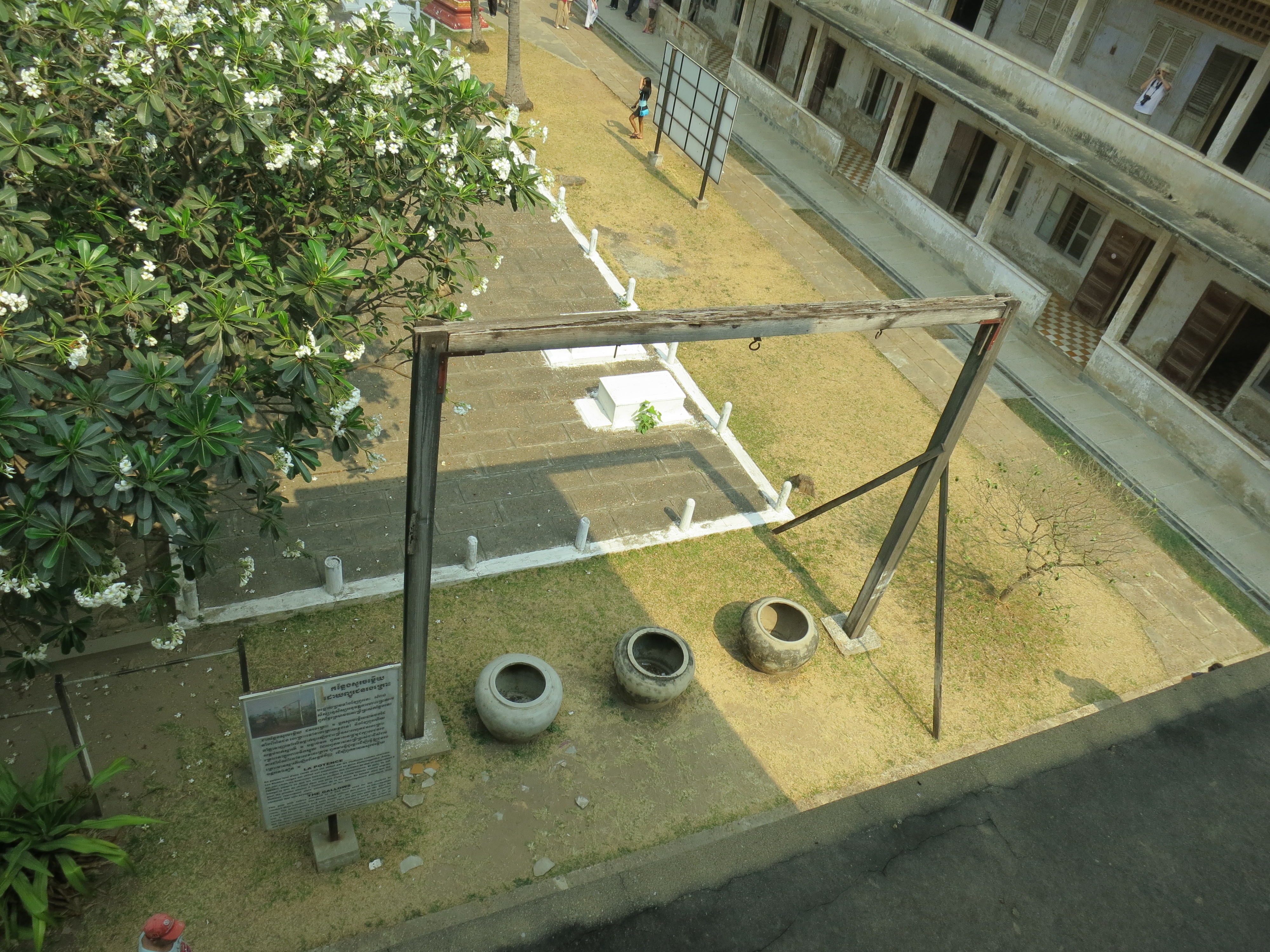
The gallows

An artist’s map of the country after the regime
One floor showed photos of victims and of guards, and copies of statements they signed when confessing crimes–seeing as how some of the guards became victims as the paranoia of the state increased. One binder included confessions by foreign nationals who happened to be in the country at the wrong time. A popular crime to confess to was working for the American CIA.

A written confession and English translation
One floor was dedicated to peace; it had photos of a place that was the site of the only land battle in Japan in WWII, and also a room of drawings by kids calling for peace. All in a building with barbed wire strung in front of the balconies so prisoners couldn’t attempt suicide by jumping. In the courtyard, plumeria trees bloomed.

Barbed wire to prevent suicide jumpers
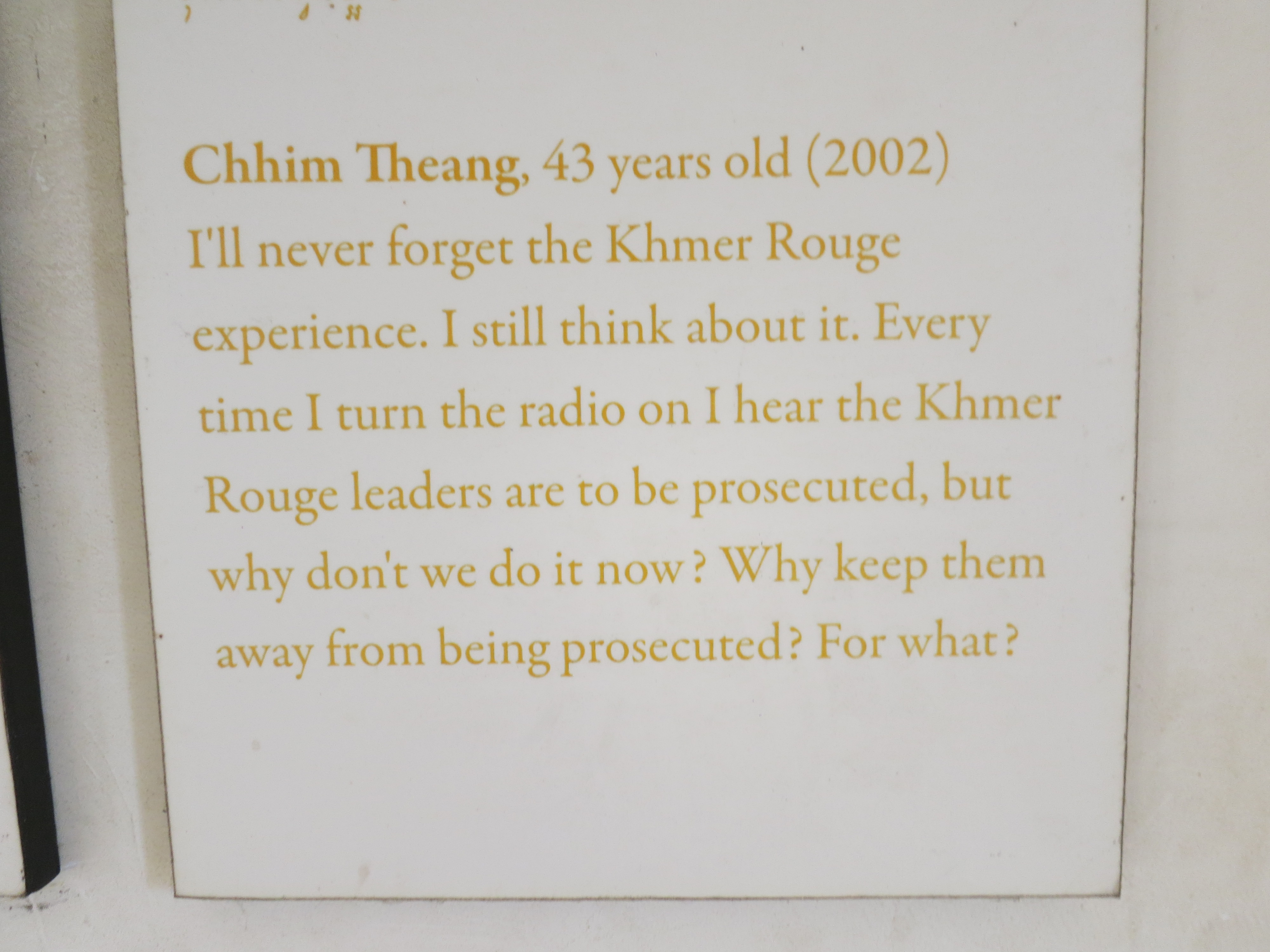
Part of an art project that asked former workers at S-21 about their memories of the place
There were signs posted outside some of the rooms with a person smiling/laughing and a line through it, but I can’t imagine who would go through these rooms and have any desire to smile. Outside, a poorly translated sign proclaimed the rules of the place, which included “While getting lashes or electrification you must not cry at all” and “Don’t make pretext about Kampuchea Krom in order to hide your secret or traitor.” Duch said the Vietnamese who set up the museum at Tuol Sleng invented these rules, but others claim they were real.

Security regulations at S-21

Graves of prisoners
In one disconcertingly bright room, past a row of rusted foot shackles used to immobilize prisoners, down a long corridor of bricked-up cells barely large enough to fit in sideways, behind the barbed wire fence, I saw a graffitied message a tourist had left at some point. It was a hard message to read in that horrible place, one that seemed nearly impossible under the weight of this very recent, very terrible history. But it was vital to see, and to keep close when returning to the recovering city outside: Give us hope.

 Stowaway Travel Writing & Editorial Services