Year in Review: What I Read and What I Hope to Read

Books! I want to read them all the time, I always have at least one on the go, and yet despite all that and my two months of unemployment at the end of the year, I still barely made it to 52 books read in 2016. I suppose the rest of life holds a lot of distractions. Anyway, I read several excellent books last year, several good ones, and a few duds. I made a concerted effort to read mostly books by women.

Let’s break it down.

Books read: 52

Books by women: 46

YA fiction: 12

Non-fiction: 8

Adult fiction: 32

Series read or completed: 3

Books read because I wanted to evoke a certain time and mood while I was in a certain place: 2 (The Paris Wife and A Moveable Feast)

My favorite fiction titles: The Interestings, A God in Ruins, How to Be Both, My Brilliant Friend, All Our Pretty Songs, The Girl with All the Gifts, Texts From Jane Eyre

My least favorite fiction titles: The Quick, Burial Rites, The Heart Goes Last, My Life Before Me, Innocent

My favorite non-fiction titles: H is for Hawk, Notorious RBG

Non-fiction titles that surprised me by being disappointing, given how much I like the authors’ other work: Bad Feminist, Scandals of Hollywood

Hard copies read: 5

E-books owned: 3

So… e-books borrowed from the library: 44!

Books written before 1900: 1

Books written 1900-2000: 13

Books written 2000-2010: 1

Books written after 2010: 37

And with an eye to the future…

For 2017, I’m hoping to read:

  • 60 books
  • at least half by authors of color
  • at least half written before 2000
  • at least a third from cultures other than the US/UK

How about you? Any books coming out this year that you can’t wait to read, or authors who you’re hoping will do a Beyonce-like surprise release?

I keep track of the books I read on Goodreads, and I also write mini-reviews of nearly every book I read on there. If you’re on Goodreads, or if you’re looking for a way to keep track of what you read/what you want to read/what your friends recommend you read, feel free to add/follow me on there. There’s a link and a list of what I’m currently reading to the left on this blog’s main page, or down at the very bottom if you’re reading on a mobile.

The Bookshelf Challenge

At the beginning of 2012 I realized I had quite a few novels on my bookshelf that I hadn’t ever read. This seemed silly, to own books that just sat there without being enjoyed. So I endeavored to read through as many of them as I could before leaving on my trip in September 2012. I have about 45 unread, and I’m hoping to read 20 or even 25 by Labor Day.

Here’s what I’ve read so far:

Kindred — Octavia E. Butler
American Salvage — Bonnie Jo Campbell
The Love Wife — Gish Jen
O Pioneers! — Willa Cather
Father Brown Stories — G.K. Chesterton
A Tramp Abroad — Mark Twain
I Know Why the Caged Bird Sings — Maya Angelou
Dangerous Laughter — Steven Millhauser
Go Tell It on the Mountain — James Baldwin
The Sound and the Fury — William Faulkner
The Glass Castle — Jeannette Walls
All the Pretty Horses — Cormac McCarthy
Pilgrim at Tinker Creek — Annie Dillard
A Field Guide to Getting Lost — Rebecca Solnit

UPDATED AUGUST 4:

Okay, so I read 14 books off that shelf and a few from the library or borrowed from friends. Not my goal, but not bad. I’m packing all my books away this weekend, so that’s the end of the Bookshelf Challenge for 2012. I might revisit it when I move back to the States — whenever and wherever that might be!

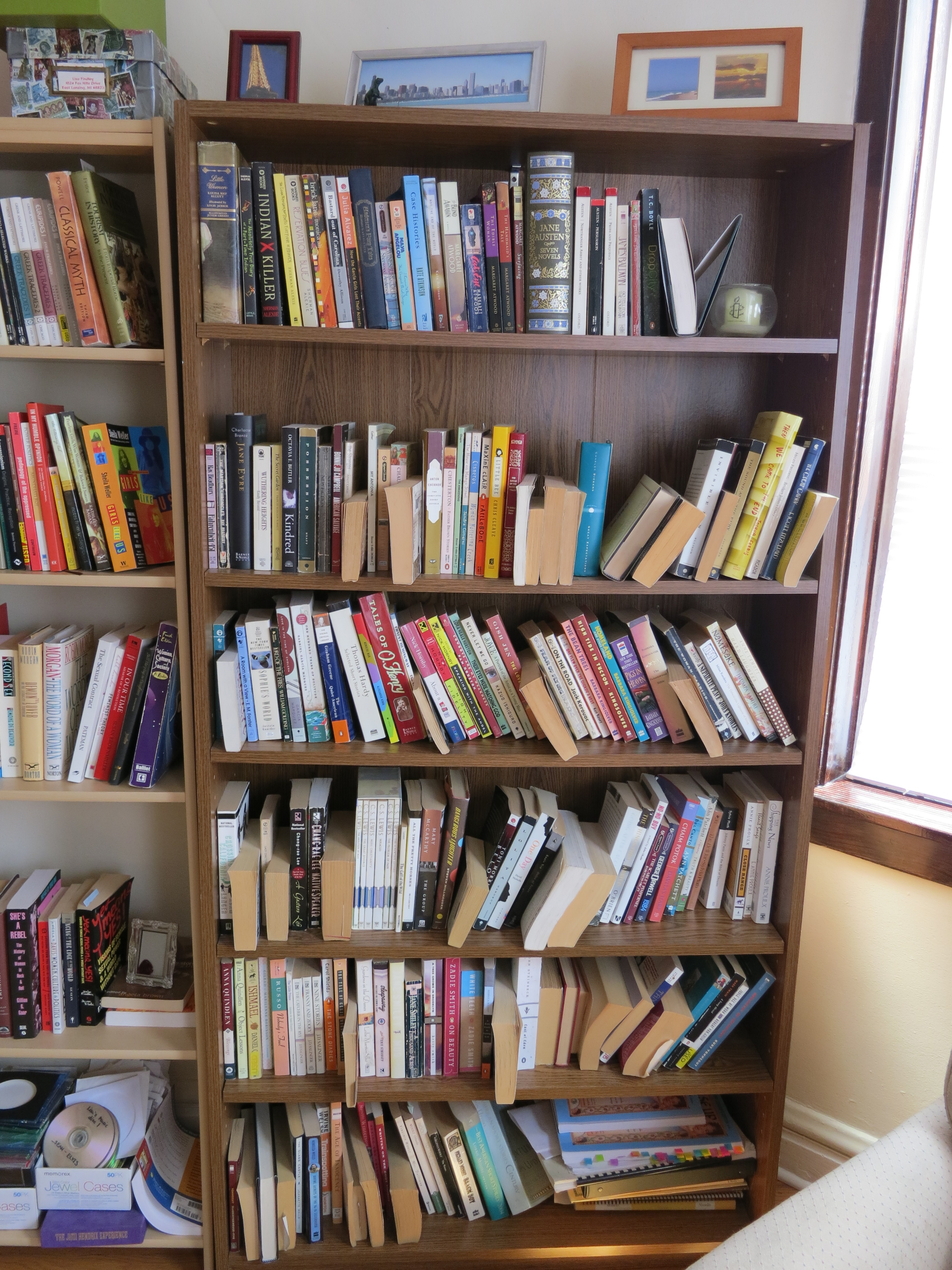
Here’s a photo of the shelf post-challenge (the books on their sides are the unread ones).

Stowaway Featured on International Business Times Site!

I hope you enjoyed yesterday’s post, dearest fellow travelers. If you haven’t had a chance to read it yet, you can check it out at the International Business Times website! That’s right, yesterday’s post, “How Reading Disturbing YA Books Made Me a Better Person,” was selected to be featured on the Books section of the prestigious IBT website here: http://www.ibtimes.com/articles/163335/20110615/disturbing-ya-books-meghan-cox-gurdon-sherman-alexie.htm. They’re building up a neat little corner of discussion on books over there, so be sure to take a look around.

Tell all your friends and link them here so we can keep the momentum going on making Stowaway a regular destination for people interested in reading and talking about travel, literature, and social justice. As ever, thanks for reading.

Readers vs. Writers?

This post is a month late and maybe a dollar short, but I think it’s worth talking about anyway. Last month, Laura Miller, co-founder of Salon, wrote a piece that basically stated NaNoWriMo is not only worthless, but damaging to books and the literary community. Many bloggers took umbrage with this, notably Campatron, who said that NaNoWriMo is vital to keeping creativity alive in this country. At the risk of sounding controversial, I’m going to say that they’re both a bit right and a bit wrong. (And possibly a little bit country and/or rock and roll, although that rumor is unconfirmed.)

Readers vs. Writers?

Miller’s main points are: NaNoWriMo participants would write regardless of whether they devoted a month to meeting daily writing quotas. The material they produce in this time period is crap. They submit that crap for publication, and we don’t need to publish more crap. Too many writers don’t read. Readers are underappreciated and not enough people read. People should read more.

Campatron’s main points are: NaNoWriMo participants wouldn’t write regardless, because the world doesn’t value creativity enough. There aren’t too many books already in the world. Not everyone who participates tries to publish. All the writers she knows read, and in fact the NaNoWriMo organization puts together book drives and young writer programs. Miller’s piece is part of the problem in a country that doesn’t support creativity among kids and adults alike.

Seems to me that both authors are looking at the whole thing with too narrow a focus. Laura Miller’s looking at it from the book publishing side of things, and Campatron’s looking at it from the unpublished writer’s side of things, so they both miss realities the other sees all too clearly.

Miller’s right in that there aren’t as many readers as there used to be — just look at this National Endowment for the Arts report on declining reading rates among young people especially. Maybe Campatron is privileged to be surrounded with writing AND reading friends, but I know writers who don’t make the time to read, despite the wise adage that in order to be a good writer, you need to be a good reader. People aren’t reading a diverse array of books, is one of the main problems. The past fifteen years has seen the rise of the mega-blockbuster, which makes some people very, very rich, and keeps more oddball or esoteric efforts on the edges with no money from the publishing houses to support even a small print run on them. Everyone’s reading Dan Brown, and all the money Random House pumps into publicity and print runs on his latest novel means there’s that much less available for a debut novel or poetry chapbook. Publishing houses and readers play the blame game with each other, but the fact is that publishing houses are taking fewer and fewer risks in publishing unknown authors and unusual literature, and readers are buying fewer and fewer books that aren’t on the bestselling shelves. Hardworking indie publishers are doing their best to combat this, and I commend them for their efforts, but it is too bad that major publishing houses are so convinced that their industry is dying that they’re all scrambling to hoard a piece of the pie they’re familiar with instead of, I dunno, baking a whole new pie.

Miller’s point that writers need readers sounds simplistic, but it’s true and I agree it’s a point that doesn’t get as much attention as it ought. As my adviser in college once told me, reading is a creative act just as important as writing. We don’t need readers only for book sales; we need them to share interpretations and inspirations and disagreements with other readers, and to talk about what those books mean to their lives. We need readers to share in the imagination of the writers. I totally agree with Miller’s fear of the decline of reading and the attendant decline in quality writing. Reading gives writers ideas for new ways to say what they want to say, and enriches their own imagination. A well-read author is an author I want to read.

But Campatron is right when she says that discouraging writers from participating in something like NaNoWriMo is a disgraceful thing for someone involved in literature to be saying. Miller’s focused on the idea that all these writers are submitting their first drafts for publication, and no doubt some do. There are always going to be some people who are convinced their every word is a perfect pearl and they deserve publication and a seat next to Dan Brown and Stephenie Meyer at the Hot Shit Writers’ Table. But there are more writers out there with a realistic view of things, who don’t print out hundreds of pages on November 30 and cram it all into envelopes bound for the overworked editors of Little, Brown. These writers participate in NaNoEdMo in March, devoting their time to revising and editing those novels they pumped out the previous November. These writers are on writers’ forums online, and perhaps in writing groups in their hometowns. These writers are serious about the act of writing, and when the NaNoWriMo website admits that writers will write a lot of crap during November, those serious writers know that doesn’t mean they should just be done with it. They know there are many more steps to publication. Or alternately, as Campatron points out, they don’t even aim for publication but write just for the joy of writing, and why would you ever be against someone doing something that brings them joy like that? Miller says, “there’s not much glory in finally writing that novel if it turns out there’s no one left to read it,” which is true if your ultimate goal is to have people read your work. But if you write only for yourself, then fine, keep your novel in your home and enjoy it yourself. It’s not hurting anyone and why would Miller have a problem with that?

Campatron is 100% wrong when she says, “the world DOES need bad books. Without the bad books there would be no good books because you need to start somewhere goddammit.” The world needs bad DRAFTS of books, but there is no need to have dreck published and sent out into the world to be consumed and tossed aside. Writers need to start somewhere, sure, but that somewhere should be in something like a NaNoWriMo session or a writing group, not in a published book. How many authors admit they spent years on their first novel, only to realize they needed to get it out of their system so they could write their second, much better novel? (Many, is the answer.) Not every published book has to be perfect, but it has to be more than the first effort, because books are too precious to waste. And that is something that both Campatron and Miller seem to agree on, if nothing else.

What I Do When I Read

I am now in the middle of a couple good books, and I’m realizing that the editor’s voice in the back of my mind can never be fully turned off. I find bad word choices jarring, I cringe at stilted dialogue, and I just about pass out when I find a spelling error. As a former lowly worker in the publishing industry, I know how little editors are paid and appreciated, but every time I wince while reading a new novel, I want to call up the editor in charge and offer my services gratis.

Of course, some of this impulse to edit on the go comes from being a voracious reader, and I know many bookish non-editor types who confess to the same reading habits. I was an English major in college, trained to read closely and carefully, looking for broad themes, detailed characterization, and turns of phrase. I was also a Women’s Studies minor, which means that I read everything closely and carefully in an entirely different manner — not looking for the artistic merit of the work, but rather for the politics at play in the writing, the subject matter, what is omitted and what is left in. The former kind of reading is often best suited for fiction and poetry, but a feminist lens can be trained on fiction and nonfiction alike. As I referenced in my post and comments a couple weeks ago, I love reading any kind of media critically. I feel much more involved in whatever I’m reading/viewing/consuming.

I’m currently tearing through Suzanne Collins’ The Hunger Games, the first in a popular YA series of novels about a post-American-apocalypse society that requires 24 kids a year to fight to the death in the wilderness, on camera. It’s like Death Race 2000, but with teenagers and no speedy cars. It’s an engrossing read, as you might imagine, and the main character, Katniss, is easy to like and also easy to sympathize with as she makes rash decisions, hurts people who care for her, and generally behaves like a teenager, albeit one faced with the horrifying task of hunting and killing her peers before they kill her.

Nifty cover design on The Hunger Games

When I’m reading this book, I am first and foremost looking to have fun, to immerse myself in a strange-but-scarily-not-so-strange world, and eagerly anticipate what happens next. I’m reading for tight plotting, characters who change in interesting ways, and, uh, brutal deaths. I’m two-thirds of the way through, and so far I’m not disappointed, but I did have to put the book down and huff about “these editors today” when I read a line about a noise that PROCEEDED a certain action. No, it did not. It quite possibly CAME BEFORE, in a PRE kind of way, like maybe it PRECEDED that action. I never took a single Latin class, but I’ve read enough to understand the basics of prefixes and suffixes, and how they fit into words we use on a pretty regular basis. An editor should be a reader first, and the other necessary skills follow. If you’ve read enough, and paid enough attention to the words themselves as you’re reading (and not just the story), and you don’t have a problem with spelling in general (I know that’s a real thing) or another learning disability, you will start to notice that things like “The gong proceeded the announcer arriving” are ridiculous, and you will open your red pen with a flourish as you go to work. Ahem. Anyway. Get off my lawn.

The other book I’m reading is A Concise History of Australia by Stuart Macintyre. (I know, right? Finally! Get on that ACAM project, already, Lisa!) I am only 10 pages in, and it is already leagues better than A Traveller’s History of Australia by John Chambers. Both books start off with some discussion of the Aborigines’ arrival in Australia and way of life there for thousands of years before Cook showed up in 1770. But Chambers’ book starts with Cook, fills in the Aborigines for a couple of pages, writes them off basically as uncivilized savages, and then gets back to the white people. Macintyre, on the other hand, starts with Cook, describes that popular history timeline, then introduces the Aboriginal arrival as the more accurate starting point, and delves into what this means for history and the national Australian story.

I’m ditching Chambers for Macintyre, no question. His whole worldview is more comprehensive and more complex than Chambers’, and that is the kind of worldview I’m looking for when learning about new places. Every record of history will have its own perspective, prejudices, and problems, but I’m going to seek out those histories that at least acknowledge that fact and engage with the challenges in recording history — what you leave in, what you leave out, whose point of view you use (let’s be clear that third person does not equal objectivity; everyone has a specific point of view), what conclusions you draw, etc.

Which I suppose brings me back to the two kinds of reading I do — the literary and the analytical. The truth is that good analytical thinking is applicable to any kind of writing, and literary analysis can be applied to even dry nonfiction (does the writer return to her themes? does she use clear, concise language — or, if she’s experimenting with a different form, does she use that form to good effect?).

A good reader uses different tools for reading different types of writing, but the basics are the same. In my case, being a good reader (of this Macintyre book but also of the Collins book) means reading not just for style and content, but also for context, intent, and implications. Learning about new countries is useless if that knowledge is based on faulty logic, privileged premises, and shortsighted analysis. When readers insist on seeing books that go beyond this limited, damaging writing to writing that engages in complex, challenging concepts and discussions, we’ll see more of such writing. The writing will improve, the discussions centered around that writing will improve, and eventually the social and political mindset will improve. Yes, art is that powerful.

I once told my English professor that I wished I were a better writer. “All I’m good at,” I told him morosely, “is reading.” He looked right at me and said, “Actually, I think being a good reader is just as important as being a good writer.” I’m beginning to see what he meant.

I ❤ Reading