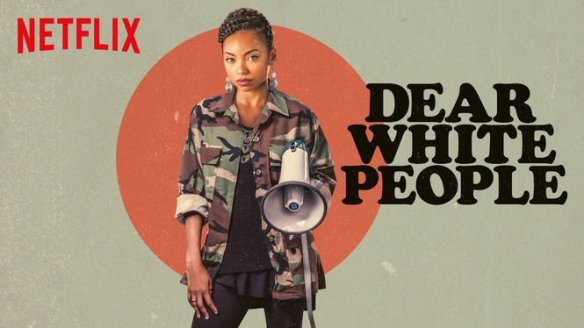
Black History Month: Dear White People

TV recommendations seem to be as popular a part of small talk as the weather and traffic patterns. People tend to recommend hour-long dramas, but what I want are 20- or 30-minute comedies, something funny, smart, and thoughtful. The Netflix series Dear White People, based on the movie of the same name, is all those things. If we’re talking and we’ve covered how rainy it’s been and how crowded the Tube is, expect me to bring up this show.

dearwhitepeople

Continue reading

#BlackLivesMatter and #ICantBreathe: Resources for a Post-Ferguson America

Watching the murderers of Mike Brown and Eric Garner walk away unpunished in any way has been infuriating and heartbreaking. These two cases (and there are more cases coming to light every day, such as that of Tamir Rice) highlight the extreme racism and injustice at the root of American law and culture. Following people on Twitter and reading blog posts and articles linked from Facebook has helped me learn more and direct my energies and monies to movements that are responding on the ground (since I’m in London and can’t be there in person to march).

From blacklivesmatter.com

I’ve compiled some pieces here for Learning and Taking Action. This is mostly for my fellow white people, since a lot of this is explanatory in a way that people of color don’t need to hear because they’re living it. There are a range of pieces, from beginner to advanced stage anti-racism, so don’t be scared if you’re new to listening and talking about race in an informed way. Certainly I’m not any kind of expert, but a lot of the writers here are, so please take a look. I can especially recommend Ta-Nehisi Coates, Melissa Harris-Perry, Jay Smooth, Janet Mock, and Latoya Peterson as people to follow, read, and learn from.

Let’s not look away. Let’s look this straight in the face and tell it where to go.

Please go to the comments to share any other links you’ve found helpful.

From blacklivesmatter.tumblr.com

LEARN

If you’re only going to read one link from this post, read this one by the excellent Luvvie. It’s smart and comprehensive but succinct, and she uses funny GIFs.

White and not really understanding why people are so upset about Ferguson and Eric Garner? It’s probably because you’re mostly talking to other white people–that’s the norm in the US, as this article explains. Time to broaden what you read and who you talk to.

Here’s an even more accessible article on how acknowledging white privilege and working against racism doesn’t mean you have to hate white people, just the terrible racist system that white people put into place and now perpetuate.

The devastating new rules for being black in the United States. My friends have a baby not yet two months old, and knowing he’ll learn these rules makes me furious.

Eric Garner’s widow, Esaw, is not accepting the apology of her husband’s killer. She’s furious, she’s grieving, and she’s not letting Pantaleo make himself feel better by getting her to forgive him.

Bevin’s great collection of resources and reflections over at Queer Fat Femme highlighted this article, which reveals that #BlackLivesMatter is a specific movement founded by queer black women. It’s good to be aware of the origins of this widely-used hashtag.

Ta-Nehisi Coates continues to be one of the foremost writers on a lot of things, but especially race. Here he talks about Obama’s reaction to Ferguson, and what the system is set up to do and not do.

One piece of laminated plastic means this Vassar College professor experiences humiliating, dangerous situations rather than life-threatening situations –and he’s never allowed to forget it.

Don’t repeat the ignorant ‘but what about black-on-black crime?’ question. Coates has you covered.

The last words of some black and brown people murdered in the United States, in artwork.

We like to think that the non-indictments in the Eric Garner and Michael Brown case (and the acquittal of George Zimmerman in the murder of Trayvon Martin) are evidence of flaws in the American justice system, but this straightforward piece argues that they’re just links in the chain of a justice system doing what it’s designed to do–oppress people of color for the benefit of white people in this country.

From blacklivesmatter.blogspot.co.uk

ACT

Steps to take as a white person if the Ferguson case is just shaking you awake to the trenchant racism alive and well in the United States. Self-educate and get involved! (I especially like the intro, in which the author Janee Woods wonders why so few reactions to the case appeared on her Facebook wall–something I wondered about when looking at my wall, too.)

You want facts to convince you of the unfairness of what happened? You want convincing that protests are worthwhile? Check out this post on how to talk about Ferguson and the aftermath.

Support people taking anti-racist action in the aftermath of Ferguson by making a gift to various organizations. ‘Tis the season, right?

Do you interact with kids as a teacher, parent, guardian, relative, friend? Here’s a great resource on how to talk with them about what’s been going on.

If you already consider yourself an active ally, take a look at this piece that challenges us to be accomplices rather than allies.

Don’t contribute to #CrimingWhileWhite–keep the focus on #AliveWhileBlack.

Visit Ferguson Action and Ferguson Response for actions you can join in on.

AND SOME HOPE

Look, redirect your money for militarizing police forces to these trainings instead, and eliminate police killings of citizens in under a decade! It truly is a culture we can change, not a given we must resign ourselves to.

Don’t Shoot rally at Howard University (From http://www.cbc.ca)

Arizona’s Racism Hurts Little Girl in Maryland

And this is just one public moment of heartbreak that shows why 1) states shouldn’t get to make their own laws on a national issue like immigration and 2) anyone making laws on immigration had better make sure those laws are humane, just, and carefully considered.

http://thelede.blogs.nytimes.com/2010/05/19/worried-girl-asks-michelle-obama-if-her-mother-will-be-deported/

Arizona’s New Era of Racism: The Ethics of Traveling to Repressive Places

The state of Arizona recently passed SB 1070, which is a terrifying piece of legislation that mandates racial profiling, rewards paranoia and hate, and puts Arizona back at least 50 years. This is no exaggeration. Take a look at that NYT article — this law REQUIRES police officers to demand identification papers from anyone they suspect might be in the country illegally; it makes it a misdemeanor to not carry immigration papers; and it lets any citizen sue local law enforcement if they think this law isn’t being enforced. First we have Driving While Black; now we have Living While Brown.

This is the only law of its kind in the United States, but don’t think that doesn’t mean other states aren’t running to catch up. And don’t think for a second it isn’t racist. Check out Rachel Maddow’s short but effective rundown of the authors of the bill — longstanding members of groups whose explicit purpose is to make sure America’s majority is white. Who are most of the undocumented immigrants in Arizona? Latinos. So a law aimed at cracking down on illegal immigration is aimed at cracking down on Latinos. And how do you determine which Latinos are US citizens, legal immigrants, tourists, etc. and which are crossing the border from Mexico without official approval? No really, how do you tell? Even Governor Jan Brewer, who signed the bill into law, couldn’t answer that question. “I do not know what an illegal immigrant looks like,” she said when asked. But the police are supposed to know and make arrests based on that unknowable qualification? Is this like porn — I know it when I see it? Nope, pretty sure it’s like mandatory racial profiling — all brown people are immediately suspect.

handmade sign at the May Day rally

no child should know what a SWAT truck looks like

My dad is always concerned that I consider the other side of the matter before taking a stand, which is good advice. So okay, people who support this bill are concerned about what, exactly? Sharing increasingly scarce resources with people who weren’t born here? Talk to your representatives about spreading the wealth a little more evenly. Losing your job to someone who braved brutal conditions, rape and murder on the trip from Mexico to the States? Even fairly conservative groups will agree that many undocumented immigrants do the work you don’t want to do, and in some cases their presence even raises wages. The increasing rate of crime in your state? Take a look at those who say they’re protecting the American way and then talk to me about rising crime rates. But mostly the support for this bill comes from many white Arizonans’ discomfort at the many brown faces they encounter on a daily basis. I hate to break it to you, but you weren’t exactly here first, and you were never really the majority.

I think the reasoning that most kindhearted but ignorant Americans hold is that it’s already illegal for these people to be here, so what’s the big deal if they get caught? Well, a whole lot of people who have every legal right to be here are going to be caught up in this giant net that’s been cast, simply based on the way they look. What if they run a red light, as anyone is liable to do, and they forgot their immigration papers at home? White Arizonans would be ticketed for running the red light and sent on their way. Latino Arizonans will be ticketed, handcuffed, and brought to the police station for holding and questioning while they’re run through the system to see if they’re allowed to be here. Everyday lives will be dramatically circumscribed, as every action is weighed against the possible consequences from a hostile law enforcement body. And that’s just legal immigrants and citizens.

Undocumented immigrants (“illegal immigrants” confers illegality on a person’s very being and thus dehumanizes them, and anyway is less accurate than “undocumented immigrants,” so I won’t use it) face grave consequences for simply being out on the street when a police officer happens along and decides to take a closer look at them. The category of “undocumented immigrants” encompasses a whole host of people, including people who were brought here by their parents when they were young and know no other home than the States, people who are escaping brutal regimes and couldn’t gain refugee status but are still terrified to return to their homeland, and women who are escaping the more commonplace but equally terrifying regimes of their brutal partners. “Undocumented immigrants” does not equal “job-stealing criminals.” It equals “people.” It equals “you or me in a different situation, in a different stroke of luck or fate.” The consequences for undocumented immigrants under this law is families being ripped apart, wretched treatment in detainment facilities, forced deportation, and uncertain and dangerous futures. That’s the big deal if they get caught.

This law is not “misguided,” as President Obama has called it. It is hateful and wrong.

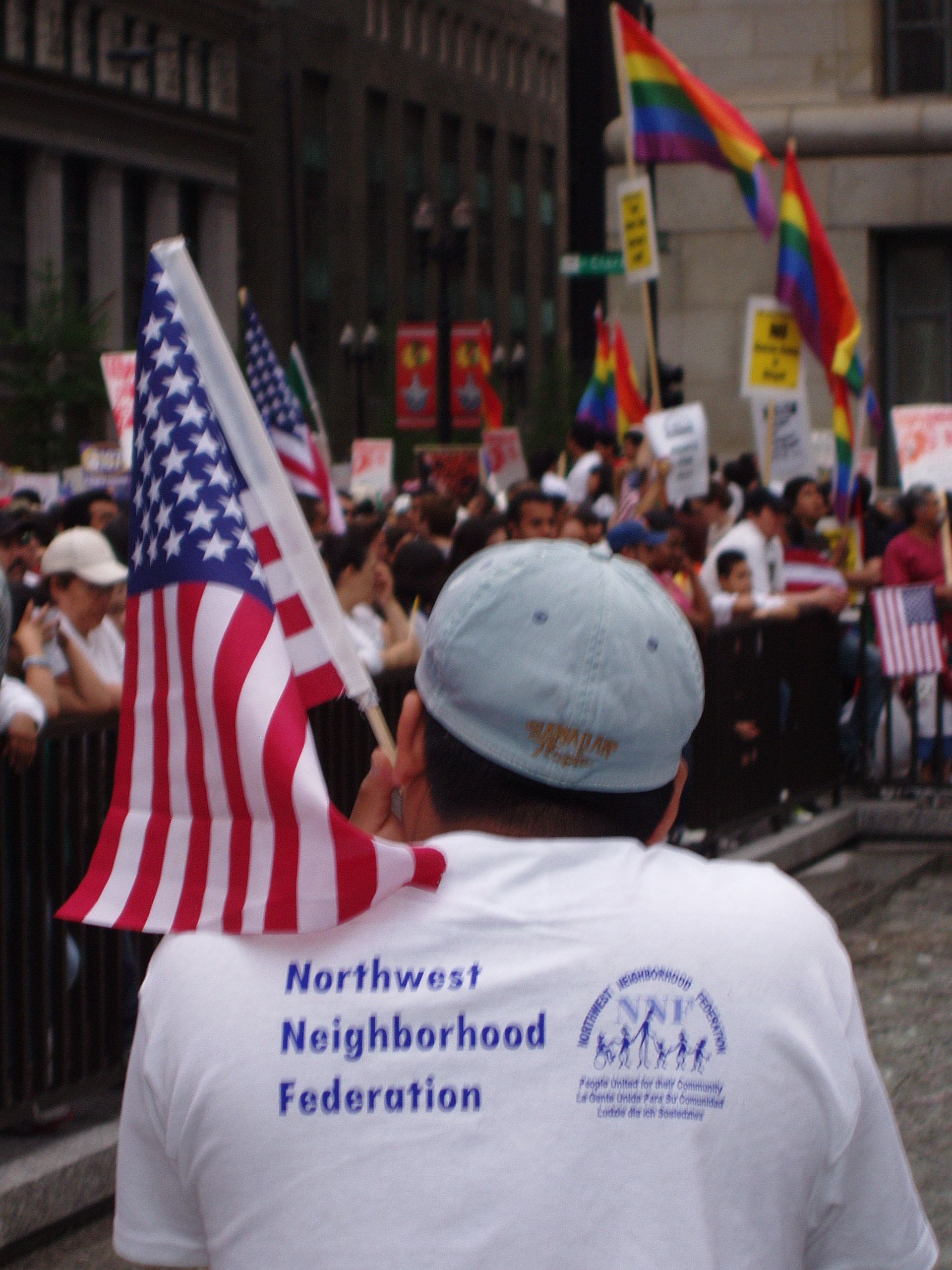
May Day Rally at Daley Plaza 2010

May Day Workers' Rights and Immigration Reform Rally at Daley Plaza 2010

So what do we do about it? This roundup at Feministe has some suggestions. The May Day rally I attended in Daley Plaza certainly united people in a loud, strong voice against it. Even some law enforcement officials are outright refusing to obey the law. Write to your Congressperson and Senators; encourage them to work on strong immigration reform legislation in this next congressional session. Write to President Obama and tell him “okay job on health care, we’ll see if Wall Street reform works, now let’s get to immigration reform.”

And since this is a travel blog, as my friend Pam suggested, let’s consider the travel implications. It might seem a small thing, but I do believe every stand we take matters. Representative Grijalva has called for a convention boycott of his own state in protest of the law, and the city of San Francisco has already voiced its support. I’m just one traveler, but I can keep my money away from Arizona and its repressive ways. This isn’t even the only racist law they’ve instated recently — ethnic studies courses are now banned as treasonous, and the state Department of Education is removing teachers who speak with too thick a Spanish accent (even though a study shows that accented teachers might be better for their students). This is a state intent on enforcing a very narrow definition of “normal” and “acceptable,” and it is a state that needs to be stopped. Whatever we can do to turn back this tide of racism, xenophobia, and hatred, we must do. Of course, there are many people in Arizona and out of state who have worked tirelessly for years for human rights in Arizona, and there was a big push from a lot of groups prior to the signing of this law to stop it before it got to the governor’s desk. Unfortunately, their calls for reason and basic decency went unanswered in this case, but that doesn’t mean that’s the only answer they’ll ever get. Americans are scared, and scared people often do stupid things. We must help people see that fear is not the right way to live, or the right way to vote.

And that’s where travel boycotts come in. Pam asked me to consider the ethics of traveling to repressive places, and what I’ve come up with is this: There are varying degrees of repression in every single human-occupied place on this planet, so of course I can’t avoid them all, nor would it be right to do so. But I can refuse to support local economies with my money and my high praise if I find their laws reprehensible. This is a work in progress kind of rule, but I think it comes down to agency and power (as so much does). The residents of Burma, for example, have agency, as every human being does, but they have very little real power, because the ruling junta has it all. The brutal laws of Burma are terrible, but I might still visit there to aid locals (if they wanted me — not all foreigners are welcome, since Americans especially can cause more trouble than they’re worth there). A boycott of Burma might hurt the residents more than the state, and the residents haven’t yet been able to oust their repressive government in favor of another.

The residents of Arizona, on the other hand, have agency AND power. They have the power to nominate and elect legislators who will pass just laws and protect the interests of ALL residents, documented and undocumented alike. Instead, an unfortunate majority of Arizonans has elected cowards, racists, and calculating fearmongers to lead them, and so we get laws like SB 1070. I will not visit a state that elects such people. I will not give money to citizens who support such legislation. This is rough for the many, many Arizonans who work so tirelessly for equality and justice, but I think it is an important statement to make against those who work for the degradation of fellow humans. Arizonans have the power to change their government, their laws, and their way of life, and so I will hold them responsible for doing just that. I have a very good friend in Tucson, but I don’t think I can visit her until her fellow residents have worked out some of their problems. People are rightfully quoting the “First they came for…” poem, but as Problem Chylde says in a brilliant and impassioned post, “We no longer wait for them to come. First we fight.”

What do you think? What is the ethical approach to visiting repressive states? What is the right response as a traveler to unjust laws and fear-filled populations?

May Day Rally 2010

Rallying for change and hope

P.S. I know I’ve used the word “racist” a lot in this post, and I know that makes a lot of people uncomfortable. Generally I agree with Jay Smooth when he says that you need to address the action rather than the sentiment behind it, but sometimes you have to call a racist a fucking racist.

Book Report: Australia, Part 2

Oh my goodness, an actual post about travel! What’s more, it’s a post about the A Country a Month challenge, which at this point should be named the Country Maybe Every Six Months, Seriously It’s Been Years Since College and I’m Out of Practice on All This Nonfiction Reading challenge.

But now — Australia! Last time, I mentioned the national narrative. Now, most of my historical information is coming from Macintyre’s Concise History, so whatever basic narrative arc he’s giving the country is going to influence how I see it. Also I’m thinking of the various ideas, stereotypes, jokes, random facts, and anecdotes about Australia I’ve heard and read over the years. And maybe I’m not reading enough or thinking critically enough, but my original understanding of the Australian story remains much the same: the white narrative is one of hardships overcome, an unforgiving land tamed, and a hardy people always down for a drink or a trek or both. To be clear, this is not how all Australians actually are, but it is the carefully cultivated national story and image.

There’s a lot to admire in that story — pursuing your dreams, making your own way, and doing it with a cheerfulness and willingness that makes the whole endeavor worthwhile. There’s also a whole lot that needs reexamining or outright condemnation. The narrative doesn’t just forget women and non-whites, it forcibly keeps them out of the history of their own country. The fragile ecosystem of this huge, dry continent has been almost entirely destroyed, and obtaining water is a real concern in an increasing number of communities. Not only did whites steal the land of the people who lived here for 40,000 years before Cook showed up, but they also stole thousands of children in an attempt to steal and destroy Aboriginal culture entirely — The Stolen Generations (for which the federal government has expressed regret, but not apologized). Those same friendly blokes willing to share a pint or five with you at the bar are also pretty likely to go home and hurt their partners — an IVAWS survey in 2003 found that 57% of women surveyed had been physically and/or sexually assaulted in their lifetimes, and 34% of those incidents were in the home (this survey also underreported the experiences of indigenous and non-English speaking women, who statistically experience a higher percentage of assaults than white women).

One of the things I was most surprised to learn about was the White Australia movement. Almost all of the early colonizers were whites, both the convicts and shortly thereafter, the gentry and entrepreneurs who bought up huge tracts of land for sheep grazing and mining (including gold). Clearly, the Aborigines were not white, and many of them did fight for their land or take a small plot to work when shut off into reservations, but from the beginning, they were not granted the rights of citizenship that Britain extended to whites. Other workers were also shut out of not just the national story, but the practical benefits of equal rights and freedom as well, especially the Chinese miners. When times got hard, as they always do, the whites blamed the non-whites, as  they always do (the world over).  Main publications like the Bulletin and eventually official government policy touted the importance of keeping Australia white and safe from foreign invaders. This was devastating on so many fronts — white women were explicitly referred to as breeders of the correct race, non-white women were forcibly sterilized to keep from reproducing, non-white men were denied jobs, and it’s not like this policy actually created more jobs for white men or made it easier to live on the Australian frontier. The White Australia policy had a huge impact on immigration, severely limiting or even outright denying the attempts of non-whites to enter the country. You can imagine how well this played with the Asian Pacific nations that surround the island country. It wasn’t until after World War II that restrictions were eased so the labor pool could be increased, and it wasn’t until freaking 1966 that the policy was mostly dismantled, and 1973 when immigration laws were changed in a meaningful way. No Statue of Liberty here; this was a country founded as a prison, and the bars keep people out as well as in.*

White Australia still holds sway in Australian politics, although of course it goes by different names — the One Nation party, mandatory detention, and an English language and “Australian values” citizenship test. As Kristin mentioned in a comment several months ago, a lot of people want to move to a rich, industrialized nation like Australia, but when they get there, they find seriously racist policies and everyday behaviors. It looks like the conservative Liberal/National parties held power for 11 damaging years, until the 2007 elections. Now the Labor party is in power, although I’m not sure what effect this has had on legislation relating to progressive issues concerning race, gender, class, etc.

White Australia policy today comic

White Australia policy today

One last thing that surprised me about Australia’s history — and pleasantly, too. The labor unions fought bitter, violent battles for years with the business owners, pastoral companies, and mining firms. According to Macintyre, the latter half of the 19th century was really rough, and the unions made some advances only to lose them a short time later. However, in 1907 the Australian Settlement was reached, which established a living wage for working men. It was specifically designed for men supporting families, which of course left out women, who weren’t guaranteed such a decent amount. I’m not sure if it left out non-white men as well, although it wouldn’t surprise me. The basic wage was guaranteed to every working man in the country, and was raised as necessary to keep up with inflation. At first, I was surprised at the long history of wage guarantees in Australia (the earliest minimum wage was introduced in 1824 in Victoria), since it’s a country so proud of hard work and individualism. But this law, combined with the efforts by the Labor Party pre-WWII to create jobs for every man in the country, fits in that picture of hard work and individualism. If you could be pretty sure of getting a job, and certain of a decent wage once you got it, you could work hard at it and really earn that wage. It wasn’t hand-outs, it was earned, was the thinking. Again, things have changed in the last 50 years, but there’s still a decent minimum wage in Australia and an expectation of available jobs. (I don’t know how this expectation squares with immigration, more women in the workplace, etc.)

There’s so much more to learn about Australia, of course, but the point of the A Country a Month challenge is to get a general idea of the country itself, both its history and its current events. I’ve tried to do that in this post, and there may be future posts on Australia. I’m especially interested in learning more about dreamwalking and how Australia’s past intersects with the current trend of Australians abroad.

Finally, please don’t think that all I want to do is find the flaws in a country. Far from it! I learned a lot about Australia that makes me even more excited to go there — the countryside, the cultural aspects, etc. But as I’ve mentioned before, I don’t believe neutralized/neutered travel writing does anyone any favors. I don’t intend this post as pointing fingers and laying blame, or an un-self-aware criticism, but please advise me if it reads like that. I’m still figuring out how to write about other cultures, places, and people without Otherizing them to oblivion or choking on my own sanctimony, but I hope this is a start.

Apologies for the imperfect coherence of this long post, but thanks for reading, and as always, please leave comments and help me keep the conversation going.

*I am perfectly aware that US immigration policies have generally been much more severely restrictive than Lady Liberty would have us remember, and of course we currently have some fucked-up approaches to the whole issue, with Arizona leading the way.