It’s Always Deer Season in New Zealand

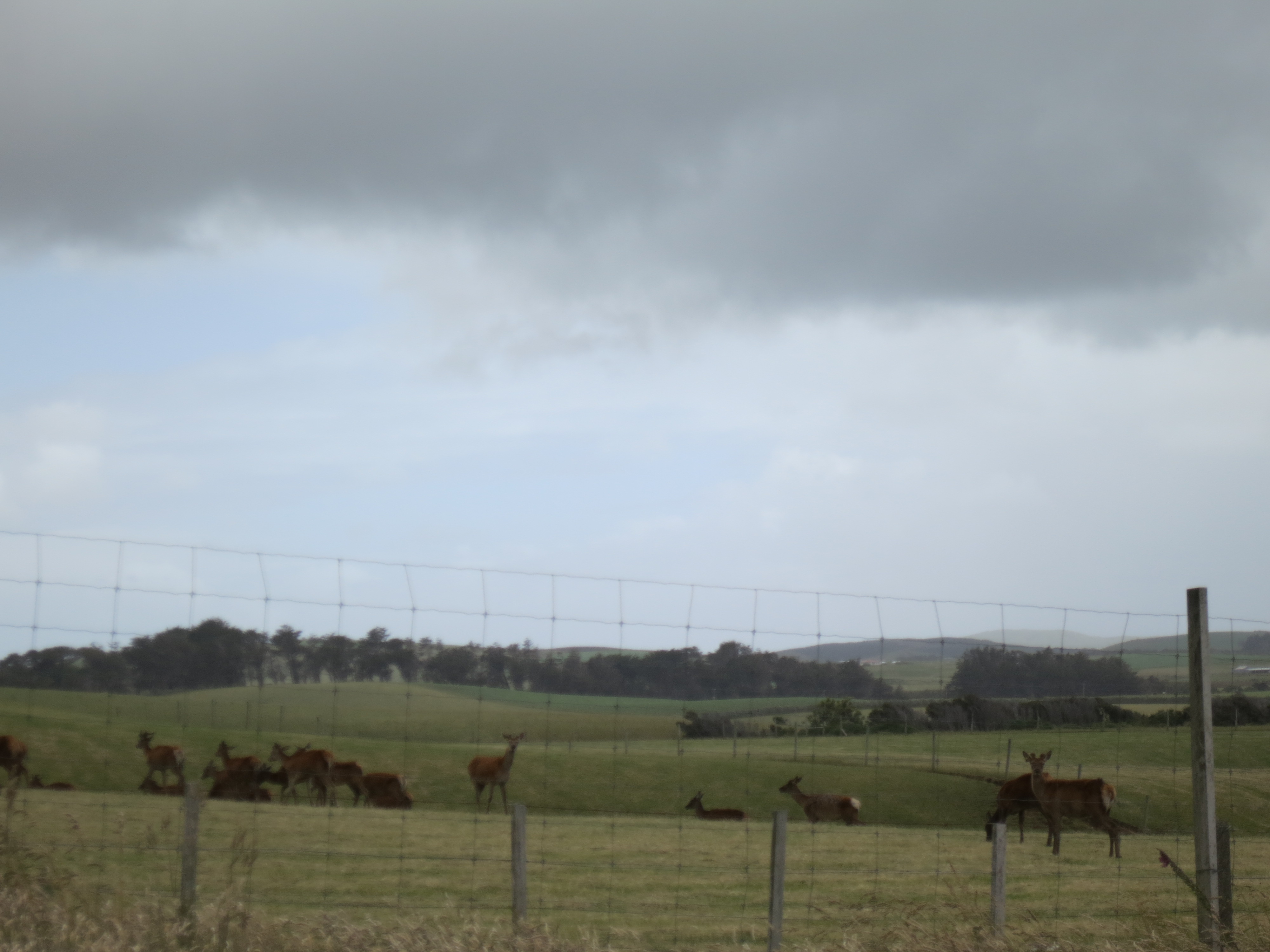
One of the most surprising sights to me in New Zealand wasn’t the fiords or the beaches or the hobbits—it was the deer farms. In Michigan, deer are wild, a bit too numerous for the health of the plant life, and hunted every year. Here, they graze in paddocks next to cows and sheep, they’re sometimes cross-bred with elk, and they’re used commercially for their meat and velvety antlers.

They're not totally domesticated--they were all super aware of me, and they moved to the back of the field as I approached the fence with my camera, whereas cows and sheep just chew their cud at you.

They’re not totally domesticated–they were all super aware of me, and they moved to the back of the field as I approached the fence with my camera, whereas cows and sheep just chew their cud at you.

Turns out, it wasn’t always this way. Like just about everything else in this country, some idiot Europeans introduced the species, and they got out of control (see: rabbits, stoats, ferrets, possums). Red-tailed deer were imported to the forests in the mid-1800s for pleasure hunting, but they ate and trampled all the plants. By the 1920s, the government agreed that they were a pest, and they built a series of tracks and huts throughout the country to encourage hunters to stay out for weeks at a time and kill as many deer as they could. So some of the extensive walking trails in New Zealand are the result of government trying to fix a problem they should never have allowed in the first place. Sometimes good things come from bad things.

Rainy shot of grazing deer

Rainy shot of grazing deer

By the 1960s, the price of venison skyrocketed, and helicopter pilots got involved. They originally dropped people in the forests to collect the carcasses left by other hunters, but with the price of venison so high, too many people got involved, and pilots started shooting at each other. So the new goal became to capture the deer alive and establish deer farms. At first, they dropped men down from helicopters onto the backs of running deer, and their goal was to wrestle the deer to the ground and tie it up (they called this “bulldogging”). Whoa! But then they started using tranquilizer darts and net guns, and this was more effective.

There are still wild deer up in them thar hills, but for the most part, deer are now a farm animal in New Zealand. Rather than a rare sighting on the side of the road at dusk, grazing deer are part of the landscape here.

Blurry shot from the bus

Blurry shot from the bus

My Milford Sound tour guide piqued my interest in the deer of NZ, and I used this site to get my facts straight.

‘Tis the Season in Auckland

I haven’t actually heard anyone use the phrase “tis the season” here in New Zealand, but that doesn’t mean the country isn’t ready for the Christmas season. Queen Street, the main drag in Auckland, is strung with glittery decorations, shops ring out with pop versions of carols, and one of the department stores has its windows set up with a story of a sheep having adventures with Santa. The first Saturday of the month, the city kicked off the season with a tree lighting and street party, and I went to see what it was like.

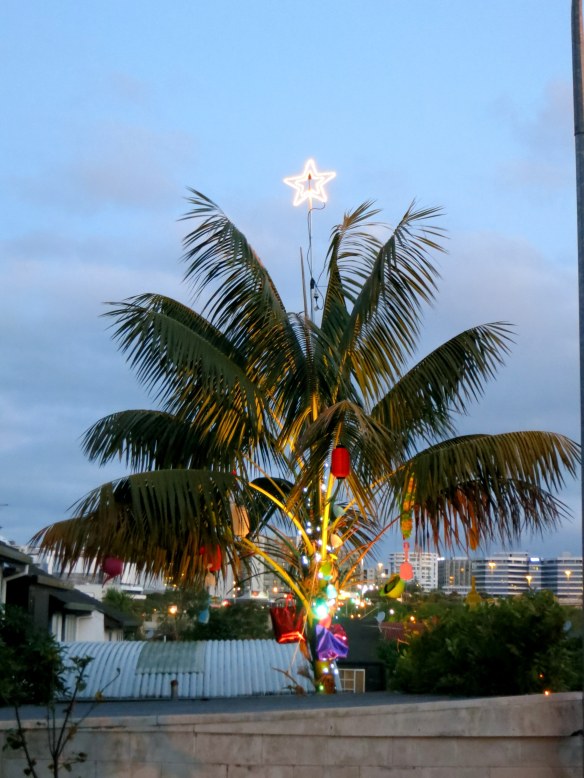
Decked-out palm on Franklin Street in Auckland

Decked-out palm on Franklin Street in Auckland

Franklin Street is a road in the Freemans Bay neighborhood of Auckland that dresses up for Christmas. In the States, we’re used to most neighborhoods decorating their houses in lights for the month of December, but that’s less common here, so the fact that most of Franklin Street does it is notable. The first weekend of December, they throw themselves a street party, and this year it got more notice in the paper and people from all over the city joined in.

Street party

Street party

Region-specific decorations

Region-specific decorations

I walked down the street (a giant hill, as most streets in Auckland seem to be), and watched as neighbors mingled on one another’s lawns, drinking glasses of wine and chatting. Families strolled by, the kids oohing and ahhing at the different set-ups. At one point, I stopped to listen to a women’s choir sing a carol, and then joined in for a couple verses of “O Come All Ye Faithful.”

choir + children = Christmas

choir + children = Christmas

I can't get over the tropical Christmas thing

I can’t get over the tropical Christmas thing

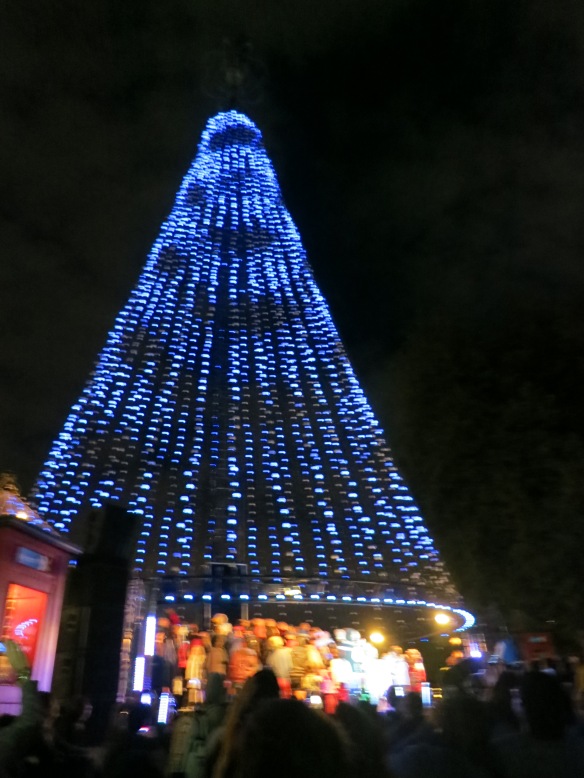
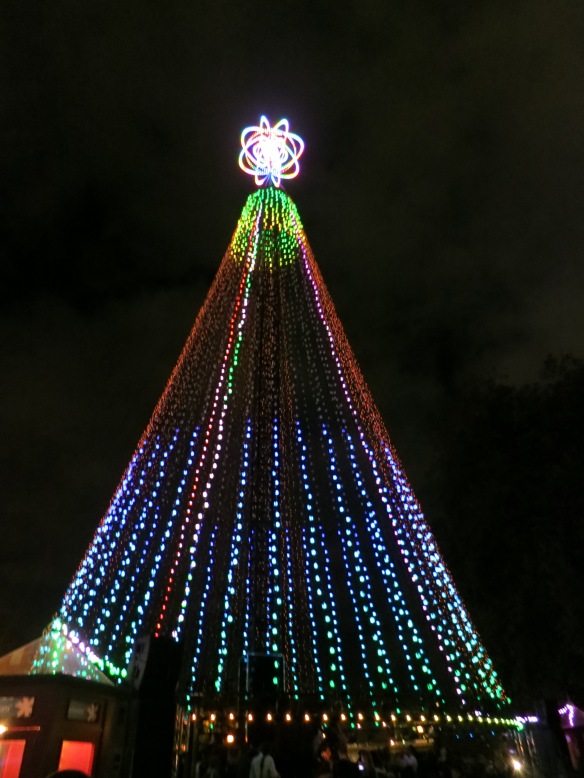
By the time I reached Victoria Park, I was in a festive mood. I joined a group of people I’d met at a CouchSurfing event earlier in the week, and we settled in to watch the tree lighting ceremony. When I say “tree,” I don’t mean anything that you’d find in a forest. Strings of lights come together in the form of a giant pine, and the Telecom sponsors put on a little show to turn the lights on. It was strange to be at an event that was so clearly corporate sponsored, but I guess it does separate church and state more than the city-sponsored tree lighting ceremonies in the States.

IMG_3255

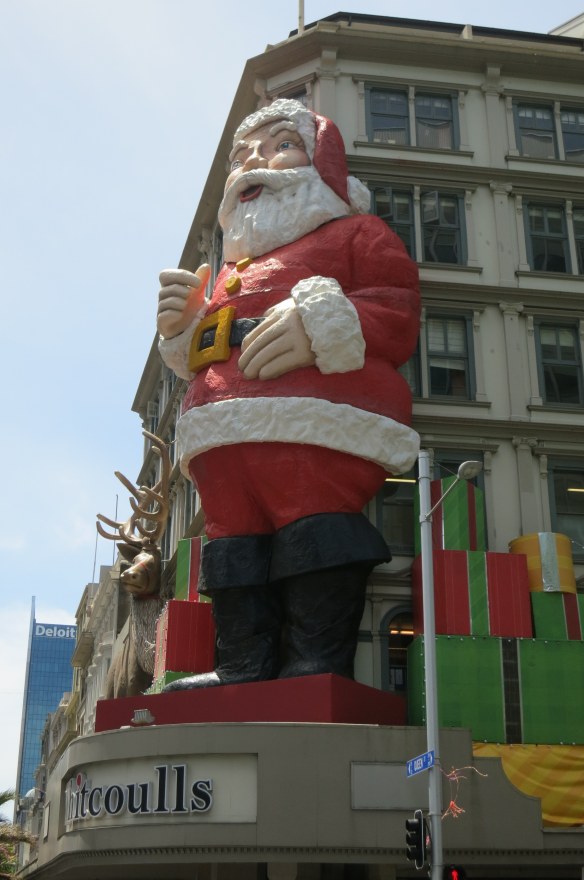
Titanium performed their hit song ‘Come on Home.’ Oh, you don’t know Titanium? They’re only Auckland’s biggest boy band! It was great fun watching the tweens in the crowd go crazy for them, even during their insipid version of “Rockin’ Around the Christmas Tree.” While they performed, little kids ran into the old English-style phone booths stationed around the tree, which were labeled “Santa Line,” and called Santa personally, presumably to relay some very specific instructions.

Direct to the North Pole

Direct to the North Pole

Then the emcee stepped up on stage, bizarrely clad entirely in Raiders paraphernalia. He informed the crowd that even though this was the fifth year of the Telecom tree, they still hadn’t figured out how to turn the lights on. Kids yelled out practical suggestions like “hit the button” and “try the lever,” but no, no, those wouldn’t do. We’d have to call Santa on the Santa Line and see if he could help. When the emcee informed him that one of the suggestions to turn the tree on had been “get more kids,” Santa said, “well, that could take some time”—naughty Santa! He then informed us that this particular tree operated only on the laughter of children, and just our luck, he’d been practicing some jokes. So he told us some terrible jokes and the audience groaned, and finally the emcee cut him off rather unceremoniously and suggested we all just say “ho ho ho.” It took a few tries, of course, because we had to build suspense, but eventually a bunch of kids piled up on stage, directly under the tree, and shouted “ho ho ho” into it, and it lit right up.

Maybe a whole crowd of kids will make it work

Maybe a whole crowd of kids will make it work

Good job, kids

Good job, kids

I hadn’t been to anything so cheesy or family focused in a long while, and I enjoyed it immensely. The kids in the crowd were adorable, and the whole affair was charmingly ramshackle, despite this being a major city. I’m used to the crushing crowds of wintry Chicago during December, and it was refreshing to see this little city’s relaxed approach to the holiday season.

Hurrah for cheesy holiday outings

Hurrah for cheesy holiday outings

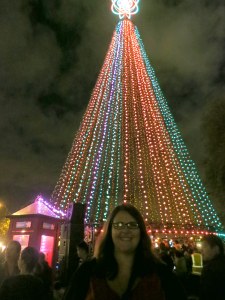
A rainbow of Christmas cheer

A rainbow of Christmas cheer

History is Not Inevitable — and That Matters for Today

History is not inevitable. Perhaps this is something they go over with history majors (although I will say I never encountered the idea in the several history courses I took in college), but for me and I think for the general populace, it’s an unusual idea. After all, events unfolded the way they did and now we are here, so how could it have been otherwise? It’s like a kind of Q.E.D. — it happened, therefore it is proven; it happened, therefore it must have been meant to happen. I know that this shows up in several religious schools of thought, like determinism in Christianity, and also in general ideas about fate. But it’s a poor approach to history.

This way of thinking sees history as static, and usually consisting of political, military, and economic events rather than a synthesis of these with social, religious, artistic, and scientific events and movements. But history is a living, breathing thing that we are creating right now. If we view ourselves as not only part of the history we know but also the part of the history future generations will learn about, it becomes easier to see past historical events as not inevitable or fated, but part of a series of individual and communal decisions made in constantly shifting circumstances. That’s not to say that I can quite wrap my linear-focused brain around the Australian Aboriginal concept of Dreamtime (in which you are here now but also in the past and the future, all at once) or the physics concept of nonlinear time. All that fluid space and time is nifty but makes me dizzy. But I can grasp the interlocking moments, motivations, and actions that make up our history, as opposed to the clear-cut line from Cause A to Effect B.

Understanding history as more complex than a straight series of inevitable events is crucial to understanding the ways we interact now — legally, socially, personally. For example, the colonization of New Zealand by the British is often seen as something that was bound to happen. The British had more efficient killing machines and more of them, they had thousands more people to populate the land, and they had the backing of an entire empire. But even if colonization were inevitable, the way it happened was drastically different from, say, the colonization of Australia. The British imported convicts to Australia and swept aside the Aborigines as if they were only a small obstacle to populating a continent, rather than the original inhabitants of that continent. In New Zealand, however, they found the Maori not only ready to fight for their land (as many Australian Aborigines were), but organized in a way the British could better understand, with recognizable leaders and specific land boundaries. So the British decided the Maori were more advanced than the Aborigines, and much more likely to respond well to being “civilized.”

Because the British saw the Maori as more civilized and basically more human than the Aborigines, they gave the Maori more consideration when taking their land, and that different historical approach has repercussions today. Unlike Australia, which was declared terra nullius (“empty land”) despite the very obvious presence of Aborigines, the British negotiated for land sales with the Maori of New Zealand. The Treaty of Waitangi was signed by the Pakeha Lieutenant-Governor and most Maori chiefs on February 6, 1840. The document was written in English and immediately translated so the Maori could know what they were signing, but the translation has some key differences from the English version. Notably, the treaty states that New Zealand is part of the British Crown, and only the Crown has the right to purchase land from Maori – or at least, one version states that. Another states that the Crown does not have this right of pre-emption. All versions were introduced with Lieutenant-Governor William Hobson stating, “We are one people.” As Philippa Mein Smith says in A Concise History of New Zealand,

Did ‘one people’ mean all the same, including one law, which in British thought meant civilising and assimilating Maori? Or did it endorse the idea of a new community of Maori and Pakeha, two ethnic groups henceforth defined in relation to each other? (p. 47)

Did the treaty mean Maori chiefs were giving up their sovereignty, or did it mean they were ruling alongside the British monarch and Pakeha governor?

These questions reverberated through the next century and a half, as first the Pakeha poured into New Zealand and bought up Maori land at ridiculously cheap prices (after the Crown bought them at even cheaper prices; an insulting way to get around that provision of the treaty) and later Maori asserted their land rights and citizenship rights. The Waitangi Tribunal in the latter half of the twentieth century resulted not only in recognition of Maori as an official language of the nation and the recognition of the importance of environmental considerations in indigenous rights, but in actual money settlements for breach of treaty (p. 231-236). Central to the arguments for money settlements and land renegotiations in the 1980s and 1990s were questions of not just what had taken place in 1840 but what kind of future both Pakeha and Maori were envisioning when they signed that treaty.

I find it fascinating that the New Zealand national government actually had a public discourse about what its intentions had been 150 years previous, and what effect those intentions and actions had on its citizens subsequently. The government recognized a breach of treaty and redressed that breach to the descendants of the wrong party. It’s all very proper Western legal action, but it’s also a bold step in acknowledging history as a living thing with no inevitable outcome and no fixed endpoint. Just because New Zealand is now a part of the British Commonwealth and overwhelmingly run by people of European descent doesn’t mean that that’s how it has to stay. Maori have regained some fishing and land rights, and they have also gained seats in parliament due to proportional representation measures, so they have more of a voice in the shaping of history going forward and not just looking back. Asians, instead of being legally shut out of the country and considered a threat to New Zealanders, are now being welcomed and encouraged to settle in New Zealand.

Certainly New Zealand has its share of bigots and racist policies, but I do find it heartening that a country that had a strong “White New Zealand” movement for decades (much like the “White Australia” movement that has unfortunately not died out as quickly it should) has made conscious efforts to not erase that history but to repudiate it and build a better one. Of course, it took the tireless efforts of thousands of ordinary citizens, activists, and politicians to bring about these changes, and I find that even more encouraging. The more people recognize history as living and evolving, the more we can build a just and peaceful history for ourselves and those who come after us.
Use It or Lose It

I’m about a third of the way through Philippa Mein Smith’s A Concise History of New Zealand, and I’m starting to get the hang of some of the words she’s using. Mein Smith carefully uses Maori words for Maori objects and concepts throughout the book. She includes a glossary in the back, but once she’s explained it once in the actual text, that’s it, you have to remember what it means or constantly flip back to see what she’s talking about. This shouldn’t be hard, of course; many books introduce unfamiliar English terms and don’t re-explain them later, and I’m pretty easily able to file that new vocabulary word away in my brain and apply it to the reading at hand. But non-English phrases always stump me. My brain takes extra time to process them, even after a clear definition, so that I really am constantly flipping back to the glossary to see what she’s talking about. I find it frustrating to have to do this, but it is actually getting less frequent. I can remember now that “waka” means “large, ocean-going canoe” and “Pakeha” is the word for “white people of European descent” in the Maori language. I know that the more I think of these words themselves instead of their translations, the more I’m actually understanding the text and the culture it’s describing.

Language is hugely important in understanding anything about ourselves or others (and to some, it’s the only thing that matters at all, depending on how committed to language as sole meaning you are, but that’s a discussion for philosophers and English majors). To use the language of the people you’re learning about is to get a better sense of the nuances of words and the layers of meaning in each phrase. For example, as Mein Smith points out, the Maori weren’t Maori until the Pakeha arrived. It took the arrival of a whole new set of people to necessitate the construction of identity in opposition to (that doesn’t mean conflict with) the newcomers. So we get Maori and Pakeha, and Pakeha is different from Europeans. “Pakeha” implies intrusion, late arrival, strange new customs. “Europeans” implies Old World, civilization, explorers. “Europeans” may be the appropriate word in certain portions of histories, or in histories that don’t involve the Maori at all. But for Maori-Pakeha relations, “Pakeha” is the appropriate word to use. This repositions us, the American readers and travelers, from an outsider’s perspective so that we’re in New Zealand, with the Maori. This isn’t to say we suddenly become insiders and get to talk about the Maori as our brothers and sisters — that is just appropriation. But it does mean we get closer to understanding this point of view, this way of seeing and discussing the world, and that is a key part of travel.

I’m pretty bad at learning languages, but I’ve always wanted to be fluent in more than one. I want to be able to communicate with people in their language, to get their jokes and idioms, to see the world without translation. I don’t see myself becoming fluent in anything any time soon (although I do keep trying French), but I can learn a few words of the language everywhere I go. Saying “please” and “thank you” can seem like the lazy American’s concession to culture, but it doesn’t have to be. It can be a very real way to show respect for those you can’t understand, and a simple attempt to show appreciation for the communication you are having — be it through a translator, with gestures and pantomimes, or with their own knowledge of English.

Whether in a book or in a real life conversation, if you can use a word from the relevant language and use it with a good understanding of its many meanings and not just a word-for-word translation, chances are you’ll gain a better understanding of the culture that uses that language. Use it enough times til you’re comfortable with it, and then there’s no need to get lost in translation.

Film Club: Whale Rider

Dearest fellow travelers, come with me to the beautiful coastline of New Zealand, where we’ll cover some Film Club and some A Country a Month at the same time. Whale Rider is a 2002 film directed by Niki Caro, from a screenplay by Caro and Witi Ihimaera (who authored the book it’s based off of). Several people recommended this film to me, telling me how much I would enjoy the story of a young girl overcoming a thousand years of patriarchal rule to become the next leader of her tribe. This was an accurate prediction on your part. Whale Rider is a lovely movie.

Whale Rider movie poster

Whale Rider movie poster

Paikea is named after the legendary Maori figure who rode on the back of a whale from the homeland of Hawaiki to reach Aotearoa (the islands of New Zealand). Pai is a delightful 11-year-old who adores her crotchety old grandfather, Koro, the chief of the tribe. Yes, there is some of that well-worn gruff old man with a soft spot for a precocious young child — a tiresome cliché that flattens out both characters in many films — but it’s kept from getting too sentimental because Koro really does resent Pai for being a girl instead of a boy and thus unable to assume leadership of the tribe. Throughout the movie, he has many opportunities to relent and acknowledge her as his heir, but he refuses right up until the end. He does love Pai but says several cruel things about her and actively keeps her from learning the rites of chieftainship. She loves Koro but consistently disobeys his orders to keep her place as a girl. It’s more painful to watch a film like this, because the characters are acting more like real people than characters in other movies, and real people can be pretty awful to each other, but that’s what makes it so great, and also what makes the eventual reconciliation much more meaningful.

Another thing I liked about the movie is the film’s and Pai’s refusal to make her a saint or ideal. Koro is searching for a prophet to lead his people out of the troubled times they find themselves in (encroaching crime and drug use). Pai knows she is the next leader of the tribe, but she also knows she is no prophet. She is a gifted, sensitive girl, with a strong link to her ancestors and the natural world that her community lives in, but she is not superhuman. She doesn’t want to be a savior; she wants her whole community to come together and bring themselves out of the bad times and into a brighter future. How rarely do films, books, or even real life leaders express this wish? We are so accustomed to looking for saviors (and that’s not even counting religious figures) who will make everything right that we miss countless opportunities to fix our own problems and improve our own communities. Pai knows that the only way to be a strong group is to work as a group, and we see a beautiful illustration of that communal effort at the end of the film, when she leads a giant waka (Maori canoe) full of her neighbors into the sea as part of a celebratory ceremony. We need leaders who know how to bring out the best in us, not saviors who bring the best to us.

And yes, that happens to be my political philosophy. Heroes and saviors make great action figures and film stars, but they rarely make great history without a strong community to build on their vision. Whale Rider shows that truly humble people can also be compelling on the screen, and the numerous regular people in our lives working for a better world show how compelling they are in making history.