Border Crossings I’ve Made by Land

I’ve made three border crossings by land on this trip. Actually, when I got to Europe I made several bus and train crossings, but they were all seamless, and all but one were in EU countries, so I don’t really count them. The ones that stand out are Thailand to Laos, Cambodia to Vietnam, and Canada to the United States. Guess which one was the most aggravating?

I got 3/4 of the way through this top form before messing up, and I had to start all over again. Genius.

I got 3/4 of the way through this top form before messing up, and I had to start all over again. Genius.

I’m used to either shuffling through the EU, where they glance at your passport, grunt, and move on; or flying into a new country and standing in a long line at border control, to have an official scan my passport through some criminal system, take my fingerprints, sometimes even snap a photo. The land crossings I made on this trip fell somewhere in-between these types.

Thailand to Laos

Crossing from the town of Chiang Khong, Thailand to Huay Xai, Laos was pretty simple. I walked up to the small hut near the bottom of the hill, filled out the card that border control had stapled to my passport when I entered the country, and turned it in to the guard, who literally did not look up from the pile of papers he was stamping. He just stamped my card and waved me away. At the bottom of the hill I bought a ticket to cross the river, waited until there were enough people for a full ride, then climbed in the skinniest boat I’d ever been on.

A tiny boat on a huge river

A tiny boat on a huge river

I suppose that technically this was a water border crossing instead of a land one, but whatever, the main thing is I hardly breathed as that tiny boat skimmed across the Mekong River. Once on the other side, I filled out a long form and helped a Japanese guy fill his out; he had a little English, but not enough to navigate the customs questions on his own. An Israeli chipped in when I had trouble explaining a concept, and then we all went up to the window to get our visas. Most Westerners owe $35 (except for Canadians, who owe $42—what did Canada ever do to Laos?). I had crisp tens and twenties, as I had read enough to know that beat-up bills might be rejected, and then you’re screwed, because they want payment in US dollars, and where are you going to find an ATM with US dollars on the western border of Laos? I had read it was good to have exact change, but not necessary. Well, for me anyway, they wanted exact change. I had two flimsy dollar bills and was wondering whether to insist they take three tens and give me five back, or just tell them to keep the five, when the Israeli next to me in line said he could help out. He gave me $3 with a smile. I peeked in the office and saw three officials standing around and two creating visas, which seems a standard ratio of layabouts to workers for government offices worldwide. Eventually, I received my visa, shiny and pink, and I was officially allowed to stay in Laos for 30 days.

Cambodia to Vietnam

My bus from Phnom Penh was mostly full of Cambodians and Vietnamese, which I think explains why some aspects of the border crossing that are infamous on internet boards were absent in my experience. No one charged me an extra dollar or three for a “health exam,” for example, and I didn’t get taken to a fake border control office. Unlike in Laos, the bus didn’t drop me off a kilometer or two from the actual border, forcing me to hire a tuk-tuk to get to my actual destination.
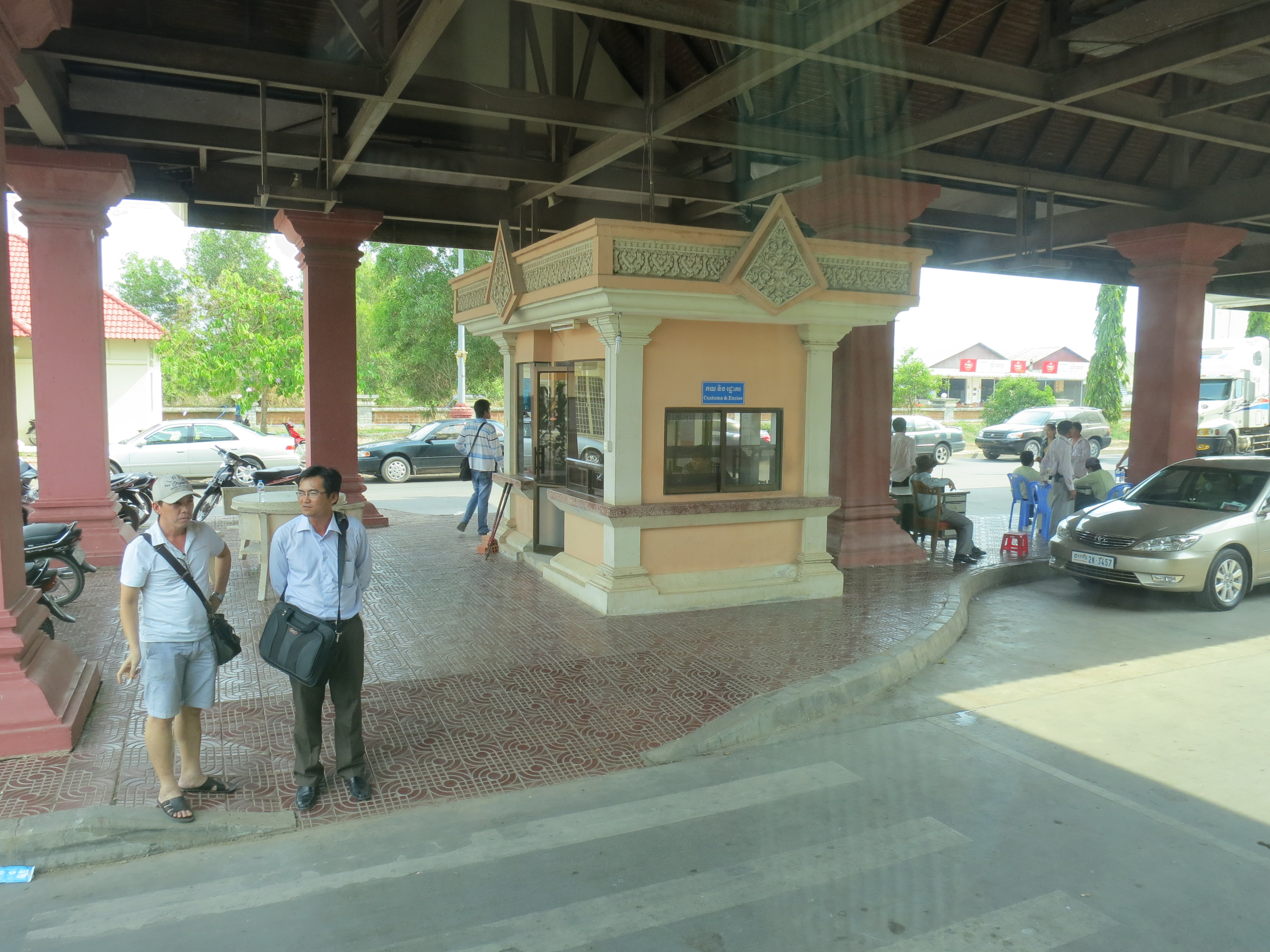
Guard station at Cambodia to Vietnam border crossing

Guard station at Cambodia to Vietnam border crossing

Instead, our bus pulled up to the Vietnamese border control office (we never did anything to say goodbye to Cambodia), and we were waved off and told to bring everything with us, including our bags from the hold below. We stood in a clump in the mercifully cool border control building and watched our driver hand over a stack of our passports to an official, who then stamped each one without a glance or a scan anywhere. The driver then called out people whose passports were ready. I grabbed my passport, walked past an empty “health exam” window, and put my bags on an x-ray belt. I picked up my bags on the other end, showed my passport with its stamp on my visa to a guard slouching in a folding chair, and walked to the bus, which had been moved to the other side of the border. Voila!

Crossing from Cambodia to Vietnam was pretty painless. Officials didn’t hassle me or anyone on my bus, and security was light. The bus was carrying goods for some small businesses, and they must have checked those while we were inside, because when I put my bag back on the bus, everything was back in there, customs approved and ready to go.

Canada to the United States of America

Here’s where it got annoying. Trying to get from friendly neighbor Canada to my home country was way harder than it should have been. They are strict! And by “they” I mean the US Border Office. The bus I was on breezed through Windsor, Ontario and took the tunnel under the Detroit River. When we popped up on the other side, the bus pulled over at the super clean border patrol office. We unloaded our gear and stood in line. Probably it would have been fine if it hadn’t been for one officer.

Passport control on the Thailand side of the Mekong River

Passport control on the Thailand side of the Mekong River

This guy was a total tool, almost stereotypically power tripping. He targeted me and two other people, all of whom had backpacks instead of rolling suitcases. I showed him my US passport and he waved me ahead, but the woman from New Zealand and her boyfriend from South Africa, these needed special attention. He demanded to see their visas; the Kiwi said she had the waiver that she’d filled out online. Nope, doesn’t count, he made her fill it all out again on paper. Isn’t the online form supposed to save us from wasting time like this? He grilled the South African on just why he wanted to visit America anyway—what were his intentions? He didn’t plan to stay, did he? Worse was when it was the Kiwi’s turn. She explained that they were couchsurfing in Chicago, and that they’d been traveling for nine months. Why would you want to travel for that long, and what is this “couchsurfing” you speak of, etc., etc., and all in a smarmy tone. He leered at her as he talked, and when we got back on the bus she said it felt like he was hititng on her. While making her feel small and trying to find a way to keep her out of the country. Ugh.

Even I got a bit of a hard time from the officer checking my passport. Where was I living? How long had I been gone? Why had I gone to so many countries? I just want to go home, yeesh! Then I sat in the row of hard chairs with the rest of the people from the bus (about 15 of us) while we waited for any one of the four free officers to turn on the x-ray machine and run our bags through them.

The South African and the Kiwi were camping for much of their trip, so there were pots, a tent, and a large carving knife in the guy’s bag. The officer pointed out the knife to a civilian standing next to him at the x-ray machine and said, “Huh, wonder what’s up with the knife” and waved him on. So that seemed like a secure process. Not that it had been any more secure at the Vietnamese border, but they weren’t pretending it was, and the US officers were definitely treating us like we were all smuggling in kilos of drugs and AK-47s, while not really checking to make sure we weren’t; but they still did their best to make us all—including the American citizens—feel super unwelcome.

The Good, The Bad, and The Silly

The Good:

The Feds turn up the heat on Sheriff Joe Arpaio. As article author Seth Freed Wessler points out, Arpaio has been exercising much of the power of terror and deportation based on a federal rule, so it’s a bit hypocritical of the government to just now push the issue. But at least they are actively going after the man who prides himself on making life hell for thousands of people on a daily basis.

Judge Walker’s decision on Prop 8 might not even be allowed to be appealed, since Schwarzenegger and other California government officials aren’t interested in appealing. It’s possible that this case won’t go to the US Supreme Court, which is maybe bad news in that a nationwide decision wouldn’t be made, but maybe good news in that the conservative slant of the court might make a terrible nationwide decision. If appeals aren’t allowed, then gay marriage is legal in California and those who don’t like it don’t have much recourse.

The Bad:

Obama and his Press Secretary think those of us who have high expectations for the administration are whiners and should STFU already. Look, I know a lot of good things have happened in the last year and a half and that is genuinely exciting, but I also know a lot of things haven’t been done or even attempted (Obama could stay DADT with an executive order while waiting for Congress and the DOD to dick around on long-term policy, for example). I know that some Bush-era legacies remain or are even being strengthened (like the extension of powers of the executive branch, which Obama as candidate promised to overturn, or selling off my right to my body in order to pass health insurance reform). Sure, you have to play politics in Washington, but that doesn’t mean you have to play games with people’s rights. What’s the phrase? Don’t piss on my leg and tell me it’s raining.

This is what happens when you make it a matter of national policy to consider immigrants an expendable nuisance rather than human beings: people use that as a cover to treat people as expendable on their own time.

The Silly:

Britain prepares for the Olympics with some real gems of advice on intercultural understanding. My favorites: “Do not be alarmed if South Africans announce that they were held up by robots.” and “When meeting Mexicans it is best not to discuss poverty, illegal aliens, earthquakes or their 1845-6 war with America.” (Via.)

Gay Sex and the City. ‘Nuff said. (Via.) (Okay actually not enough said, please note that this is an explicitly political project and I don’t mean to take away from that by placing it in The Silly; it’s a fun project, though, so here it goes.)

Leave your own links in the comments!

The Good, The Bad, and The Silly

Hello dearest fellow travelers. Here’s something new! I thought I’d start a feature that rounds up some of the best and worst of the political/cultural news I run across each week, so you can get even further inside my brain without getting too Malkovich about it. And since usually the good and bad news is still news and therefore always kind of a downer, how about a silly element on the end of it? Something lighthearted, cheerful, adorable, or otherwise Unserious. If you’re already reading blogs with a political or cultural slant, probably you’re running into similar features, and maybe you won’t find much new here. But maybe you will, and then you will feel enlightened. Also, you can put links to other interesting articles in the comments and this blog will become a veritable font of information.

So here we go — the inaugural The Good, The Bad, and The Silly!

The Good

“Papers, Please” portion of AZ law SB1070 put on hold by federal judge — it’s a start

Erin Andrews urges Congress to pass a stricter anti-stalking law, one that would include high-tech types of stalking and emotional threats

The Bad

As is so often the case, human rights are traded for money — prisons are set to profit big time off SB1070

As the Kalamazoo area reels from an oil spill, Democrats decide a majority in both houses and the White House, plus an oil spill disaster in the Gulf that has the country fuming, isn’t enough to actually push through tough energy reform (Via)

Also, check out this site and be sure to place it over your city. It’s truly disturbing. http://www.ifitwasmyhome.com/

The Silly

A mother makes fantastical dreamscapes starring her baby (Via)

What have you run across?

Arizona’s New Era of Racism: The Ethics of Traveling to Repressive Places

The state of Arizona recently passed SB 1070, which is a terrifying piece of legislation that mandates racial profiling, rewards paranoia and hate, and puts Arizona back at least 50 years. This is no exaggeration. Take a look at that NYT article — this law REQUIRES police officers to demand identification papers from anyone they suspect might be in the country illegally; it makes it a misdemeanor to not carry immigration papers; and it lets any citizen sue local law enforcement if they think this law isn’t being enforced. First we have Driving While Black; now we have Living While Brown.

This is the only law of its kind in the United States, but don’t think that doesn’t mean other states aren’t running to catch up. And don’t think for a second it isn’t racist. Check out Rachel Maddow’s short but effective rundown of the authors of the bill — longstanding members of groups whose explicit purpose is to make sure America’s majority is white. Who are most of the undocumented immigrants in Arizona? Latinos. So a law aimed at cracking down on illegal immigration is aimed at cracking down on Latinos. And how do you determine which Latinos are US citizens, legal immigrants, tourists, etc. and which are crossing the border from Mexico without official approval? No really, how do you tell? Even Governor Jan Brewer, who signed the bill into law, couldn’t answer that question. “I do not know what an illegal immigrant looks like,” she said when asked. But the police are supposed to know and make arrests based on that unknowable qualification? Is this like porn — I know it when I see it? Nope, pretty sure it’s like mandatory racial profiling — all brown people are immediately suspect.

handmade sign at the May Day rally

no child should know what a SWAT truck looks like

My dad is always concerned that I consider the other side of the matter before taking a stand, which is good advice. So okay, people who support this bill are concerned about what, exactly? Sharing increasingly scarce resources with people who weren’t born here? Talk to your representatives about spreading the wealth a little more evenly. Losing your job to someone who braved brutal conditions, rape and murder on the trip from Mexico to the States? Even fairly conservative groups will agree that many undocumented immigrants do the work you don’t want to do, and in some cases their presence even raises wages. The increasing rate of crime in your state? Take a look at those who say they’re protecting the American way and then talk to me about rising crime rates. But mostly the support for this bill comes from many white Arizonans’ discomfort at the many brown faces they encounter on a daily basis. I hate to break it to you, but you weren’t exactly here first, and you were never really the majority.

I think the reasoning that most kindhearted but ignorant Americans hold is that it’s already illegal for these people to be here, so what’s the big deal if they get caught? Well, a whole lot of people who have every legal right to be here are going to be caught up in this giant net that’s been cast, simply based on the way they look. What if they run a red light, as anyone is liable to do, and they forgot their immigration papers at home? White Arizonans would be ticketed for running the red light and sent on their way. Latino Arizonans will be ticketed, handcuffed, and brought to the police station for holding and questioning while they’re run through the system to see if they’re allowed to be here. Everyday lives will be dramatically circumscribed, as every action is weighed against the possible consequences from a hostile law enforcement body. And that’s just legal immigrants and citizens.

Undocumented immigrants (“illegal immigrants” confers illegality on a person’s very being and thus dehumanizes them, and anyway is less accurate than “undocumented immigrants,” so I won’t use it) face grave consequences for simply being out on the street when a police officer happens along and decides to take a closer look at them. The category of “undocumented immigrants” encompasses a whole host of people, including people who were brought here by their parents when they were young and know no other home than the States, people who are escaping brutal regimes and couldn’t gain refugee status but are still terrified to return to their homeland, and women who are escaping the more commonplace but equally terrifying regimes of their brutal partners. “Undocumented immigrants” does not equal “job-stealing criminals.” It equals “people.” It equals “you or me in a different situation, in a different stroke of luck or fate.” The consequences for undocumented immigrants under this law is families being ripped apart, wretched treatment in detainment facilities, forced deportation, and uncertain and dangerous futures. That’s the big deal if they get caught.

This law is not “misguided,” as President Obama has called it. It is hateful and wrong.

May Day Rally at Daley Plaza 2010

May Day Workers' Rights and Immigration Reform Rally at Daley Plaza 2010

So what do we do about it? This roundup at Feministe has some suggestions. The May Day rally I attended in Daley Plaza certainly united people in a loud, strong voice against it. Even some law enforcement officials are outright refusing to obey the law. Write to your Congressperson and Senators; encourage them to work on strong immigration reform legislation in this next congressional session. Write to President Obama and tell him “okay job on health care, we’ll see if Wall Street reform works, now let’s get to immigration reform.”

And since this is a travel blog, as my friend Pam suggested, let’s consider the travel implications. It might seem a small thing, but I do believe every stand we take matters. Representative Grijalva has called for a convention boycott of his own state in protest of the law, and the city of San Francisco has already voiced its support. I’m just one traveler, but I can keep my money away from Arizona and its repressive ways. This isn’t even the only racist law they’ve instated recently — ethnic studies courses are now banned as treasonous, and the state Department of Education is removing teachers who speak with too thick a Spanish accent (even though a study shows that accented teachers might be better for their students). This is a state intent on enforcing a very narrow definition of “normal” and “acceptable,” and it is a state that needs to be stopped. Whatever we can do to turn back this tide of racism, xenophobia, and hatred, we must do. Of course, there are many people in Arizona and out of state who have worked tirelessly for years for human rights in Arizona, and there was a big push from a lot of groups prior to the signing of this law to stop it before it got to the governor’s desk. Unfortunately, their calls for reason and basic decency went unanswered in this case, but that doesn’t mean that’s the only answer they’ll ever get. Americans are scared, and scared people often do stupid things. We must help people see that fear is not the right way to live, or the right way to vote.

And that’s where travel boycotts come in. Pam asked me to consider the ethics of traveling to repressive places, and what I’ve come up with is this: There are varying degrees of repression in every single human-occupied place on this planet, so of course I can’t avoid them all, nor would it be right to do so. But I can refuse to support local economies with my money and my high praise if I find their laws reprehensible. This is a work in progress kind of rule, but I think it comes down to agency and power (as so much does). The residents of Burma, for example, have agency, as every human being does, but they have very little real power, because the ruling junta has it all. The brutal laws of Burma are terrible, but I might still visit there to aid locals (if they wanted me — not all foreigners are welcome, since Americans especially can cause more trouble than they’re worth there). A boycott of Burma might hurt the residents more than the state, and the residents haven’t yet been able to oust their repressive government in favor of another.

The residents of Arizona, on the other hand, have agency AND power. They have the power to nominate and elect legislators who will pass just laws and protect the interests of ALL residents, documented and undocumented alike. Instead, an unfortunate majority of Arizonans has elected cowards, racists, and calculating fearmongers to lead them, and so we get laws like SB 1070. I will not visit a state that elects such people. I will not give money to citizens who support such legislation. This is rough for the many, many Arizonans who work so tirelessly for equality and justice, but I think it is an important statement to make against those who work for the degradation of fellow humans. Arizonans have the power to change their government, their laws, and their way of life, and so I will hold them responsible for doing just that. I have a very good friend in Tucson, but I don’t think I can visit her until her fellow residents have worked out some of their problems. People are rightfully quoting the “First they came for…” poem, but as Problem Chylde says in a brilliant and impassioned post, “We no longer wait for them to come. First we fight.”

What do you think? What is the ethical approach to visiting repressive states? What is the right response as a traveler to unjust laws and fear-filled populations?

May Day Rally 2010

Rallying for change and hope

P.S. I know I’ve used the word “racist” a lot in this post, and I know that makes a lot of people uncomfortable. Generally I agree with Jay Smooth when he says that you need to address the action rather than the sentiment behind it, but sometimes you have to call a racist a fucking racist.